
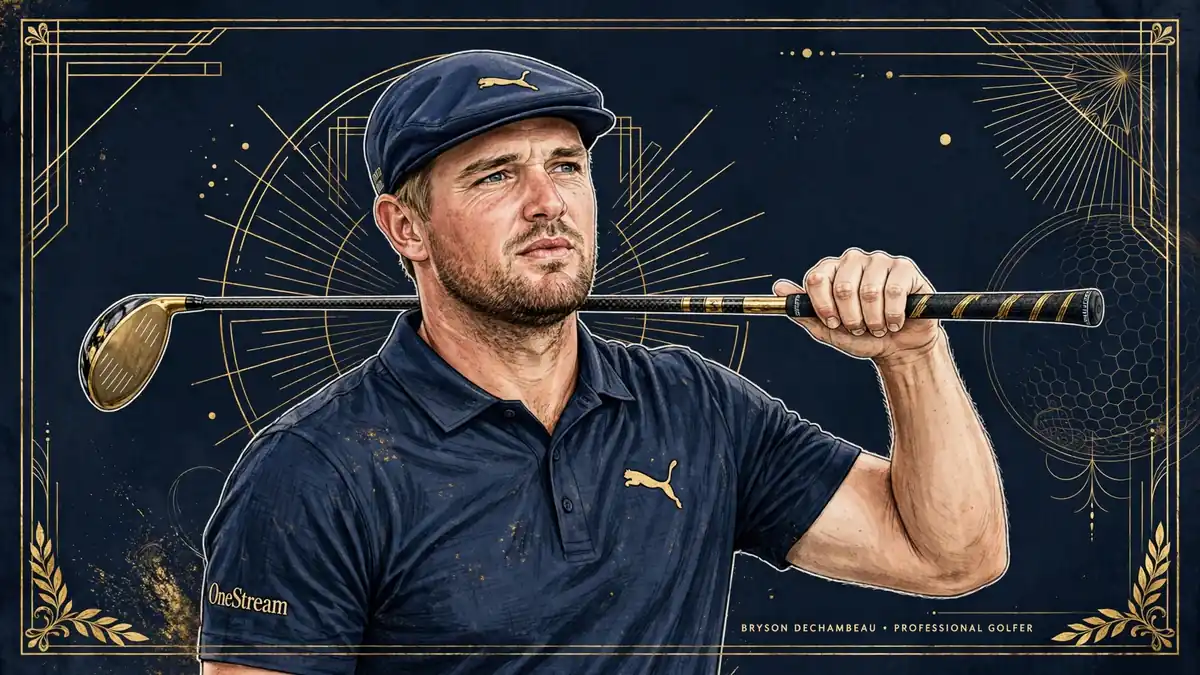
Bryson DeChambeau‘s net worth is estimated at $55 million to $75 million as of November 2026. The two-time U.S. Open champion built that fortune on a reported nine-figure LIV Golf signing deal, more than $90 million in career on-course prize money across tours, and a second career as one of golf’s biggest YouTube creators — and his 2026 season ended with his LIV contract in limbo after the league filed for bankruptcy.
Bryson DeChambeau: Quick Facts
| Estimated net worth | $60 million (range: $55 million to $75 million) |
|---|---|
| Profession | Professional golfer, LIV Golf captain of Crushers GC |
| Nationality | American |
| Born | September 16, 1993 (age 33) |
| Height | 6 ft 1 in (1.85 m) |
| Primary income sources | LIV Golf contract and prize money, major-championship winnings, endorsements, YouTube and content |
| Active years | 2016–present (professional) |
| Last reviewed | November 2026 |
- Early Life and Background
- Education
- Career Journey
- Rise to Fame
- Main Sources of Income
- Salary and Earnings
- Businesses and Investments
- Brand Deals and Sponsorships
- Houses, Cars and Other Assets
- Awards and Achievements
- Net Worth Growth Over the Years
- Social Media Presence
- Personal Life
- Sources & Reporting
- Frequently Asked Questions
Early Life and Background
Bryson James Aldrich DeChambeau was born on September 16, 1993, in Modesto, California, to Jon and Jan DeChambeau, and grew up in Clovis, in California’s Central Valley. He picked up golf at age seven, and by his teens he was already studying the swing with an intensity that set him apart from other junior players. In 2010, at 16, he won the California State Junior Championship, an early sign that his analytical bent was producing results, not theories alone.
At Clovis East High School, DeChambeau’s golf instructor, Mike Schy, introduced him at 15 to Homer Kelley’s physics-based instruction book The Golfing Machine. That book shaped everything that followed. DeChambeau began working toward a single-plane swing — one repeating motion regardless of the club in hand — and ran into a practical problem: standard iron sets change length from club to club, forcing the posture to change with each one. His answer was to make every iron and wedge the same length, cutting out a variable most golfers accept without question. Coaches and rivals called it eccentric. DeChambeau treated it as an engineering problem with a correct answer.
The family background matters to the money story too. DeChambeau did not arrive on tour with family wealth behind him; his father worked in golf-course-related jobs and his mother in education circles in the Fresno area, and the early years of his career were funded the usual way — junior events, college golf, and then sponsor support after he turned professional. The fortune came later, and it came fast.
Education
After graduating from Clovis East in 2012, DeChambeau accepted a scholarship to Southern Methodist University (SMU) in Dallas, Texas, where he majored in physics. The choice of major was not a backup plan — it was the point. His coursework gave him the vocabulary of launch angles, spin rates, and force vectors that he applied directly to his swing, his equipment, and later his training. Teammates at SMU remember a player who charted everything and trusted numbers over feel.
His amateur peak came in 2015, and it was historic. Within weeks of each other that summer, DeChambeau won the NCAA Division I individual championship for SMU and then the U.S. Amateur at Olympia Fields in Illinois, becoming only the fifth player to capture both titles in the same year, after Jack Nicklaus, Phil Mickelson, Tiger Woods, and Ryan Moore. The double made him the most talked-about amateur in American golf and set up a professional debut watched far more closely than most. He left SMU before completing his degree, turning professional in April 2016 after playing the Masters as an amateur.
Career Journey
DeChambeau signed a multi-year equipment and apparel deal with Cobra-Puma Golf within days of turning professional in April 2016, and his pro debut told the story of his early career: a tie for fourth at the RBC Heritage in South Carolina, worth nearly $259,000, announced a player who did not need a learning curve. His first PGA Tour victory arrived at the John Deere Classic in 2017, and he finished that season as one of the tour’s rising names rather than a curiosity.
The 2018 season was his PGA Tour breakthrough in full. He won four times — the Memorial Tournament, the Northern Trust, the Dell Technologies Championship, and the Shriners Hospitals for Children Open — and reached the top of the FedEx Cup standings conversation. By the end of that run, the single-length irons and jumbo grips that had drawn smirks were being copied in pro shops, and equipment companies were paying attention to a player who treated club design as research.
Late in 2019, DeChambeau began the physical transformation that defined his next chapter. He added roughly 40 pounds through the end of 2020, chasing swing speed and driving distance with the same systematic approach he applied to his clubs. In 2020 he became the longest driver on the PGA Tour, and the experiment paid off at the highest level within months. His PGA Tour career totals nine victories, according to tour records summarized by golf outlets in 2026, with career PGA Tour prize money of about $29–30 million before he left for LIV Golf.
Rise to Fame
DeChambeau’s first major title, at the 2020 U.S. Open at Winged Foot, is the round that silenced most of the scepticism. He won by six strokes and finished as the only player under par for the week, overpowering a course set up to punish exactly that style of play, and collected a $2.25 million winner’s check. The victory proved that distance plus discipline could beat a U.S. Open setup, and it made him a genuine star rather than a talking point.
His second U.S. Open, at Pinehurst No. 2 in June 2024, was a different kind of famous. DeChambeau held off Rory McIlroy by a single stroke, sealing the win with a bunker shot on the 72nd hole that became one of the most replayed shots of the decade. The winner’s check was $4.3 million, a record for the championship at the time, and the win landed two years into his LIV Golf career — proof, for his supporters, that leaving the PGA Tour had not dulled his major-championship game. Between the two U.S. Opens he had also become captain of Crushers GC, LIV Golf’s team franchise, which won the league’s team championship in 2023.
The other engine of his fame arrived off the course. DeChambeau built one of golf’s largest YouTube channels during the LIV years, with a “Break 50” series, course-record attempts, and backyard challenges filmed at his Texas home. By 2026 he had about 2.6 million subscribers (some outlets counted 2.89 million by September 2026), and his channel had become a negotiating asset in its own right — a direct line to fans that no tour controlled. In January 2026, speaking to Front Office Sports, he said he believed he could stay competitive in the four majors on YouTube golf alone, a claim that would have sounded absurd from any other player and sounded like a business plan from him.
Main Sources of Income
DeChambeau’s wealth rests on four pillars, and their relative weight has shifted sharply since 2022. First, the LIV Golf signing package: a reported $125 million deal struck in June 2022, running about four and a half years through the 2026 season, with much of it paid up front. DeChambeau himself has said the $125 million figure is “a little low,” without giving a precise number, and other reports have put the package at $120 million or around £100 million — the range reflects private terms and currency conversion, not disagreement that the deal was nine figures.
Second, tournament prize money. His LIV on-course earnings alone total roughly $64 million in prize money for 2022–2026 on one tally, and about $68.7 million when team winnings ($12.7 million) and season bonuses ($10.2 million) are added, according to October 2026 reporting that broke down his five LIV seasons. Add roughly $29–30 million from the PGA Tour and about $14 million from majors (with some overlap between those tallies, since major prize money is counted in tour records), and his career on-course haul sits above $90 million before any signing money.
Third, endorsements and commercial deals, worth about $10 million in 2026 according to Forbes’ off-course estimate — a sharp rise from the roughly $1–3 million a year that outlets reported for his sponsorship income in earlier years, reflecting the Reebok team deal and his expanded media profile. Fourth, content and business ventures: YouTube advertising, his content company Regecy, equipment work with LA Golf and Avoda Golf, and investments in real estate and a multi-sport complex project. Each pillar is examined in detail below.

Salary and Earnings
Golfers do not draw a salary in the conventional sense, so DeChambeau’s “salary” is best read as his contracted LIV payments plus prize money. The clearest public window into the contract payments came in October 2026, after LIV Golf’s bankruptcy filing forced disclosures: leaked payslip documents published by GiveMeSport, citing Financial Times golf correspondent Sujeet Indap, showed DeChambeau received $9,087,865.89 over the preceding year in quarterly PPA (player participation agreement) payments plus expense reimbursements. Jon Rahm’s equivalent figure was $20,335,069.29. The documents may not capture bonuses or prize money, so the payslip is a floor for his LIV income, not a total.
Forbes’ 2026 accounting is the most useful single-year snapshot. In its June 2026 list of the world’s highest-paid golfers, Forbes put DeChambeau’s 2026 earnings at $52 million — $42 million on-course and $10 million off-course — ranking him eighth among golfers and 47th among athletes worldwide. That $52 million is annual earnings, not net worth, and much of the confusion in rival articles comes from treating the two as interchangeable. A golfer can earn $52 million in a year and still hold a net worth far below his lifetime gross, once taxes, agent and caddie shares, travel costs, and reinvestment are subtracted — and DeChambeau, by his own account, reinvested aggressively.
Year by year, his LIV prize money alone shows the scale: about $4.1 million in his partial 2022 season, $16.9 million in 2023, $8.3 million in 2024, $20.3 million in 2025, and $14.5 million in 2026, per the Yardbarker season-by-season tally — $64.1 million in total before team money and bonuses. The 2026 season itself was his strongest LIV campaign on the course: $15.2 million in individual prize money plus a $3 million bonus for finishing second to Jon Rahm in the individual standings, including back-to-back individual wins in Singapore and South Korea worth $4 million each early in the season. His 2025 LIV season had also produced a win at LIV Golf Korea and a Ryder Cup appearance for the United States at Bethpage Black that September.
For comparison, the same Yardbarker analysis put Rory McIlroy’s earnings since DeChambeau left the PGA Tour at $72 million including FedEx Cup bonuses, and Scottie Scheffler’s five-year PGA Tour prize total at $112.5 million — a reminder that DeChambeau’s LIV prize money alone did not out-earn the PGA Tour’s top stars, and that the signing package, not the weekly purses, is what changed his balance sheet.
Businesses and Investments
DeChambeau’s most revealing statement about his money came when he described himself as “broke” — then immediately explained that the money had already moved. In interviews, he said his wealth was invested in his charitable foundation, real estate, a multi-sport complex project, his family, and his content company Regecy, adding: “I’m again broke.” The remark, widely quoted in 2024–2025, is best read as a liquidity statement, not a wealth statement: cash converted into property, projects, and businesses does not show up as a bank balance, but it remains wealth.
The Bryson DeChambeau Foundation is his main charitable vehicle, supporting junior golf and youth programmes, and it appears regularly in his public appearances and fundraising content. Regecy, his content operation, produces the YouTube channel and related media — the business behind the “Break 50” series and the backyard challenges that turned his home into a studio. On the equipment side, after his Cobra-Puma deal ended in 2022, he worked with Avoda Golf on 3D-printed irons and with LA Golf on shafts and a driver built to his specifications, keeping a hand in the club-design research that made his name. These ventures are private companies with no published revenues, so this article credits them as income and asset contributors without inventing figures for them.
His real-estate activity is documented in the assets section below. What is not documented is any large public stock portfolio, venture fund, or franchise ownership of the kind some athletes publicize. DeChambeau’s investments, as far as public records show, are concentrated in property, his own content business, and equipment projects — a narrower, more hands-on portfolio than the diversified holdings often attributed to golfers in round-up articles. That concentration is one reason a range, rather than a single number, fits his net worth: the value of a custom Texas home and a private content company is genuinely uncertain until either is sold.
Brand Deals and Sponsorships
DeChambeau’s endorsement history divides cleanly at the LIV move. The Cobra-Puma Golf deal that began at his professional debut in 2016 ran until 2022, when the two sides parted as he joined LIV. Bridgestone Golf, his ball sponsor, ended in 2023. Those exits cost him the steady equipment income that had anchored his PGA Tour years, and for a period his endorsement portfolio looked thinner than his prize money suggested.
The rebuild came through team and lifestyle deals rather than a single equipment giant. In December 2024, Reebok signed DeChambeau and Crushers GC to an apparel deal, part of the brand’s return to performance sport under Authentic Brands Group, which had acquired Reebok for $2.4 billion in 2021. He has also been linked in reporting to Rolex, NetJets, Qualcomm, and Google as partners, alongside his equipment work with Avoda Golf and LA Golf. Forbes’ $10 million off-course figure for 2026 suggests the current portfolio is far more valuable than the $1 million-a-year endorsement estimates that circulated in 2024 — the difference is consistent with a Reebok team deal plus YouTube-driven commercial work being counted differently across outlets.
Two cautions apply to rival articles on this topic. First, several still list Cobra and Puma as current sponsors, four years after that deal ended — check the date on any endorsement list before trusting it. Second, no outlet has published the value of the Reebok deal or his other current contracts, so any article giving a precise annual sponsorship figure beyond Forbes’ $10 million off-course estimate is guessing. This article reports the Forbes figure and names the partners that reporting supports, without inventing contract values.

Houses, Cars and Other Assets
DeChambeau lives in Grapevine, Texas, in the Dallas–Fort Worth area, in a custom home he began building in 2020 on land bought in 2019 (the land was listed at $850,000; the sale price was not made public). The house, which he has described as a long, patient build rather than a stock spec home, first appeared on his social channels in late 2024, when he filmed himself trying to hit a hole-in-one over the roof onto a backyard green — a challenge that took 16 days and ended on shot 14 of the final day, according to local coverage by WFAA. The yard includes a 60-yard practice hole with a landing zone reachable from the roof, and in September 2026 it hosted “Bryson’s Backyard Games,” a ten-player YouTube tournament.
Before Grapevine, he owned a Dallas home in Melshire Estates, bought in 2018, with five bedrooms, five and a half bathrooms, and more than 5,300 square feet, including a golf simulator and pool table. He listed it at $3.2 million in April 2024 and sold it in July 2024 for just over $2.8 million, according to Realtor.com’s reporting of the records (Texas is a nondisclosure state, so the final price is reported rather than recorded in full). The Grapevine property’s value is where reporting diverges wildly: Realtor.com has described it as a $10 million custom mansion, while a 2026 county appraisal figure of about $18.9 million has circulated in property round-ups. An appraisal is not a sale price, and no sale record for the Grapevine home has been published — so this article treats its value as unconfirmed, somewhere in the multi-million-dollar range, and does not add any single property figure to the net worth estimate as though it were cash.
On cars, public reporting is thin, and this article will not fill the gap with invention. DeChambeau has not publicized a car collection the way some golfers have, and no verified inventory of his vehicles exists in credible reporting. His most valuable documented assets remain the Grapevine property, his content business, his equipment interests, and the remaining value of his LIV arrangements — plus, until the bankruptcy proceedings resolve, whatever LIV still owes him. EssentiallySports reported in October 2026 that LIV owed him around $5.8 million stemming from the third quarter of 2026 alone, a claim that sits inside the bankruptcy process and may or may not be paid in full.
Awards and Achievements
DeChambeau’s record, as summarized by tour and major-championship reporting in 2026, includes two major championships (U.S. Open 2020, 2024), nine PGA Tour victories, five LIV Golf individual victories, and one DP World Tour victory, for 15 worldwide wins. His amateur double in 2015 — the NCAA individual title and the U.S. Amateur in the same year — remains one of the rarest feats in American amateur golf. He captained Crushers GC to LIV Golf’s team championship in 2023 and represented the United States at the 2025 Ryder Cup at Bethpage Black.
His 2020 U.S. Open win earned him the title of the tour’s longest driver that season and a place in the debate about distance in modern golf that still runs today. His 2024 Pinehurst victory, sealed by that final-hole bunker shot, is already part of U.S. Open lore. He has also been named among Forbes’ highest-paid golfers for 2026 (eighth) and highest-paid athletes overall (47th), a commercial ranking rather than a playing honour, but a useful marker of how far his earning power has travelled since the 2016 RBC Heritage debut.
Net Worth Growth Over the Years
The table below tracks the documented milestones behind the estimate, not a year-by-year bank balance — no such record exists for a private individual, and articles that print one are inventing precision.
| Period | Milestone | Effect on wealth |
|---|---|---|
| 2016–2017 | Turns professional; Cobra-Puma deal; first PGA Tour win | First seven-figure earnings; sponsorship base established |
| 2018 | Four PGA Tour wins in one season | Prize money and endorsement value jump sharply |
| 2020 | First U.S. Open title, $2.25 million winner’s check | Major-winner commercial value; longest driver on tour |
| 2022 | Joins LIV Golf on a reported $125 million package | Single largest wealth event of his career; much paid up front |
| 2023 | Crushers GC team title; LIV prize money builds | Team winnings add to individual purses |
| 2024 | Second U.S. Open title, $4.3 million; Dallas home sold | Record major payday; property capital released |
| 2025 | Forbes net worth estimate about $44 million; Ryder Cup | Conservative baseline before the 2026 season |
| 2026 | Forbes earnings $52 million; LIV bankruptcy; contract rejected | Estimate range $55–75 million; future LIV income uncertain |
Why the range, and why it sits above Forbes’ 2025 net worth figure? Because the 2026 season added roughly $18 million in LIV prize money and bonuses, plus $10 million off-course, to a player who had already banked a nine-figure signing package — while taxes, reinvestment, and the unresolved bankruptcy claim pull in the other direction. Aggregators quoting $80–90 million appear to add the full $125 million signing package to lifetime prize money without subtracting anything at all, which is not how net worth works. Aggregators quoting $44–55 million appear to lean on Forbes’ older net worth figure or its 2026 earnings number alone. The honest position sits between those poles, and it will move again once his 2027 playing home — LIV 2.0, the PGA Tour, or neither — is settled.
Social Media Presence
DeChambeau’s social following is a business asset, not a vanity metric. His YouTube channel carried about 2.6 million subscribers and 268 videos as of mid-2026 reporting, with some outlets counting 2.89 million by September 2026; his TikTok following passed one million during the 2024 hole-in-one challenge run. The channel’s formats — “Break 50” rounds with celebrity guests, course-record attempts, and backyard challenges — regularly draw seven-figure view counts, and his most recent videos at the time of the September 2026 count were passing 1.5 million views within a week.
What does that pay? Estimates vary as widely as the net worth figures. GOLF reported monthly advertising revenue of $66,000 to $143,000, which annualizes to roughly $800,000 to $1.7 million. MyGolfSpy’s Connor Lindeman told Forbes that DeChambeau could have earned around $700,000 from YouTube in 2025. Other outlets have suggested $800,000 to $2 million a year from ad revenue alone, before sponsorships embedded in videos. The spread reflects different counting methods — ad revenue only, versus ad plus integrated brand deals — and this article reports the range rather than picking a favourite. What is not in doubt is the strategic value: in January 2026 he told Front Office Sports he would happily grow the channel threefold and dub content into other languages if tour golf contracted, and LIV’s own former chief executive Greg Norman has publicly credited LIV with giving DeChambeau the intellectual-property freedom to build the channel.
Personal Life
DeChambeau keeps his private life considerably more guarded than his golf swing. He has not announced a marriage, and he rarely discusses relationships in interviews, preferring to keep the focus on golf, his foundation work, and his content. He remains based in Texas, where he has lived since his SMU years, and his parents have appeared in coverage of his career without becoming public figures themselves.
His public persona has softened markedly since the LIV move. The “Scientist” of the late 2010s — known for protracted pre-shot routines, slow-play criticism, and public disagreements with other players — became, by 2024, one of the most popular players with general audiences, largely through the YouTube channel and his visible enjoyment of the Pinehurst victory celebrations. That shift matters commercially: a player fans like is a player sponsors pay for, and the change in public warmth tracks closely with the rise in his off-course earnings from the low single millions to Forbes’ $10 million for 2026.
Sources & Reporting
Forbes — 2026 highest-paid golfers list (June 2026): $52 million in 2026 earnings, $42 million on-course and $10 million off-course; earlier net worth estimate of about $44 million (2025). Used for the earnings anchor and the off-course figure.
ESPN (via October 2026 reporting) — DeChambeau remains committed to LIV 2.0 and is working behind the scenes on its return, without a formal signature as of late October 2026. Used for his post-bankruptcy status.
GOLF — YouTube advertising revenue estimate of $66,000–$143,000 per month. Used for the content-income range.
Realtor.com — Dallas home listed at $3.2 million in April 2024 and sold in July 2024 for just over $2.8 million; Grapevine home described as a $10 million custom mansion; construction began in 2020. Used for the property record.
Front Office Sports — January 2026 interview: DeChambeau open to majors-and-YouTube golf, 2.6 million YouTube subscribers, exemption into majors through at least 2028. Used for social and future-plans reporting.
Sportskeeda — Reebok deal with DeChambeau and Crushers GC (December 2024); Cobra-Puma deal ended 2022; Avoda Golf association. Used for the endorsement timeline.
Spotrac (via 2025 summaries) — career earnings breakdown of roughly $30 million PGA Tour, $42 million LIV, $14 million majors, with overlap noted. Used for the career prize-money cross-check.
USGA championship records and U.S. Open reporting — 2020 Winged Foot ($2.25 million) and 2024 Pinehurst ($4.3 million) winner’s checks; 2015 U.S. Amateur title. Used for major-championship facts.
PGA Tour records (via tour summaries) — nine PGA Tour victories, 2018 four-win season, 2020 longest driver. Used for the career record.
LIV Golf — Crushers GC captaincy and team championship (2023); 2026 season results including Singapore and South Korea wins. Used for team and season facts.
GiveMeSport (October 2026) — leaked LIV payslip documents showing $9,087,865.89 paid to DeChambeau over the preceding year, via Financial Times reporting. Used for the contract-payment floor. Court and bankruptcy reporting (September–October 2026) — LIV’s Chapter 11 filing on September 8, 2026, Saudi Public Investment Fund funding withdrawal after more than $5 billion invested, and rejection of player contracts including DeChambeau’s. Used for the bankruptcy section. Reporting window for this article: June 2025 – October 2026, with the estimate dated November 2026.
Frequently Asked Questions
What is Bryson DeChambeau’s net worth in 2026?
Bryson DeChambeau’s net worth is estimated at $55 million to $75 million as of November 2026. Published figures disagree — Forbes put it near $44 million in 2025, while other outlets quote $55 million or $60 million for 2026 — so a range is the honest figure. His 2026 earnings alone were $52 million according to Forbes, but annual earnings are not the same as net worth.
How much did LIV Golf pay Bryson DeChambeau?
DeChambeau reportedly signed a LIV Golf deal worth about $125 million in June 2022, running four and a half years through the 2026 season, with much of it paid up front. He has said the $125 million figure is “a little low.” Separate from the signing package, he earned roughly $64 million in LIV prize money from 2022 to 2026, or about $68.7 million including team winnings and season bonuses.
How much does Bryson DeChambeau earn per year?
Forbes estimated his 2026 earnings at $52 million — $42 million from on-course results and $10 million from off-course income including endorsements and content. Leaked LIV payslip documents from October 2026 showed $9,087,865.89 in contract payments over the preceding year, but that figure excludes prize money and bonuses, so it is a floor rather than a total.
How much prize money has Bryson DeChambeau won in his career?
His career on-course prize money exceeds $90 million across tours: roughly $29–30 million on the PGA Tour, about $64 million in LIV Golf prize money, and about $14 million from major championships, with some overlap between those tallies. His biggest single checks were $4.3 million for the 2024 U.S. Open and $2.25 million for the 2020 U.S. Open.
How much does Bryson DeChambeau make from YouTube?
Estimates range from about $700,000 a year (MyGolfSpy via Forbes, for 2025) to roughly $800,000–$2 million a year from advertising alone, with GOLF reporting $66,000–$143,000 per month in ad revenue. Integrated brand deals in videos would push the total higher. He had about 2.6 million subscribers as of mid-2026.
What brands sponsor Bryson DeChambeau?
His current partners include Reebok (which signed him and Crushers GC in December 2024), Rolex, NetJets, Qualcomm, and Google, alongside equipment work with Avoda Golf and LA Golf. His earlier Cobra-Puma deal ended in 2022 and his Bridgestone deal ended in 2023, so older lists naming those brands as current are out of date.
Where does Bryson DeChambeau live?
He lives in Grapevine, Texas, in the Dallas–Fort Worth area, in a custom home he began building in 2020. He previously owned a Dallas home in Melshire Estates, which he listed at $3.2 million in April 2024 and sold in July 2024 for just over $2.8 million.
Is Bryson DeChambeau still with LIV Golf after the bankruptcy?
His LIV contract was rejected in the league’s Chapter 11 bankruptcy proceedings in October 2026, leaving him free to negotiate for 2027. Reporting in late October 2026 said he remained committed to a relaunched LIV 2.0 and was working behind the scenes on it, but had not formally signed, with some reports suggesting an equity stake could be part of a new deal.
Final Thoughts
Bryson DeChambeau’s fortune is a product of two bets that both paid off: a physics-first approach to golf that produced two U.S. Open titles, and a nine-figure jump to LIV Golf at exactly the moment the sport’s money was being rewritten. The $125 million signing package changed his life; the $52 million he earned in 2026 alone shows he did not stop earning after it. The honest estimate — $55 million to $75 million — sits below the lifetime gross that aggregators love to add up, because taxes, reinvestment, and a Texas home and content business that have never been sold all sit between gross earnings and net worth.
The next chapter will decide whether that range rises or stalls. If LIV 2.0 launches with DeChambeau as a stakeholder-captain, or if he returns to the PGA Tour with his YouTube audience intact, the earning power is undiminished. If neither materializes, he still holds two major titles, a $52 million earning year on the record, and a media business most athletes would envy. Either way, the “Scientist” label that once marked him as an outsider now describes one of the shrewdest commercial careers in modern golf.
Published on November 2, 2026. Last reviewed November 2026. Found an error? See our corrections policy.