
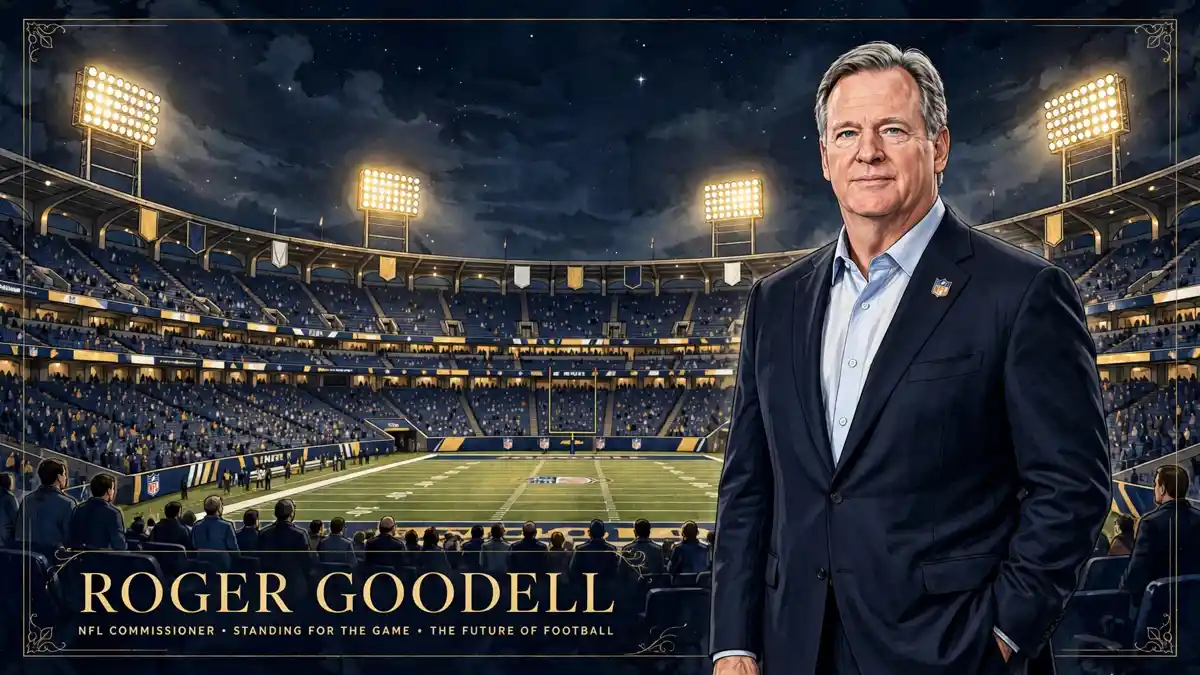
Roger Goodell‘s net worth is estimated at $250 million to $300 million as of November 2026. The top of that range is the current Celebrity Net Worth figure, updated after the NFL handed its commissioner a fifth contract extension in September 2026. Goodell has now run the league for two decades, his pay has climbed from about $6 million in his first full year to roughly $65 million a year in recent seasons, and his career earnings from the NFL alone are estimated at about $751.7 million. If pay holds near recent levels through his new deal, which runs to March 31, 2031, his cumulative NFL earnings should approach $1 billion — a total no commissioner in American sports has ever reached without owning a team.
Roger Goodell: Quick Facts
| Estimated net worth | $300 million (range: $250 million to $300 million) |
|---|---|
| Profession | Commissioner of the National Football League (NFL) |
| Nationality | American |
| Born | February 19, 1959 (age 67) |
| Height | Not publicly listed by the NFL |
| Primary income sources | NFL commissioner salary and performance bonuses |
| Active years | 1982–present (commissioner since September 2006) |
| Last reviewed | November 2026 |
- Early Life and Background
- Education
- Career Journey
- Rise to Fame
- Main Sources of Income
- Salary and Earnings
- Businesses and Investments
- Brand Deals and Sponsorships
- Houses, Cars and Other Assets
- Awards and Achievements
- Net Worth Growth Over the Years
- Social Media Presence
- Personal Life
- Sources & Reporting
- Frequently Asked Questions
- Final Thoughts
Early Life and Background
Roger Stokoe Goodell was born on February 19, 1959, in Jamestown, New York, about an hour south of Buffalo. He was the third of five sons of Charles Ellsworth Goodell and Jean Goodell. Politics ran through the household. His father served in the U.S. House of Representatives from 1959 to 1968, then was appointed by Governor Nelson Rockefeller to fill the Senate seat left vacant by the assassination of Robert F. Kennedy, serving from 1968 to 1971. Charles Goodell, a Republican who spoke out against the Vietnam War, lost his seat in the 1970 election and died in 1987 at 60, almost two decades before his son reached the job he had dreamed about since boyhood.
The family moved to Bronxville, New York, in 1971, when Roger was 12. Bronxville is a wealthy Westchester County suburb just north of New York City, and it shaped his adult life as much as his childhood: he still lives in the New York City area, and he has served on the board of Lawrence Hospital in Bronxville. At Bronxville High School he captained the football, basketball, and baseball teams — a three-sport athlete who never played at a level that pointed toward a professional career, yet organized his whole working life around the sport anyway.
Two details from his youth explain the commissioner he became. The first is the letter he wrote his father on graduating from college, thanking him and adding that the only thing he wanted in life, apart from becoming NFL commissioner, was to make his father proud. The second is what happened next: told he was wasting his time, he wrote to the league office and to all 28 NFL teams asking for a job. One of those letters landed him a three-month administrative internship in Commissioner Pete Rozelle’s office in 1982. His early duties were unglamorous — copying and clipping newspaper articles for the public relations department — and they taught him the league from the mailroom end of the building up.
Education
Goodell graduated magna cum laude from Washington & Jefferson College in Washington, Pennsylvania, in 1981 with a degree in economics, and he received the school’s Walter Hudson Baker Prize for excellence in economics. Washington & Jefferson is a small liberal-arts college, not a football factory, and Goodell did not play college football there. That fact answers one of the most searched questions about him: no, Roger Goodell never played in the NFL, and he did not play football in college either. His route to the top of the sport ran through economics, public relations, and league administration, not through a playing career.
The economics degree mattered more than it looks on a résumé. Goodell’s tenure is defined by money negotiations — media rights, labor deals, franchise sales, stadium financing — and his early training gave him the language of those rooms. He has stayed close to the college since, and Washington & Jefferson has repeatedly told the story of his graduation letter to his father as the founding document of his ambition.
Career Journey
Goodell’s NFL career is a single-employer story spanning more than four decades, with one brief detour. After the 1982 internship under Pete Rozelle, he spent 1983 as an intern with the New York Jets, then returned to the league office in 1984 as an assistant in the public relations department. In 1987 he became assistant to Lamar Hunt, president of the American Football Conference and the Kansas City Chiefs founder whose name now sits on the AFC championship trophy. From 1990 onward he worked closely with Commissioner Paul Tagliabue across football and business operations, moving through a series of senior executive roles that put him in charge of, at different times, football operations, officiating, media properties, marketing, and stadium development.
In December 2001 Tagliabue named him the NFL’s executive vice president and chief operating officer. As COO, Goodell oversaw football operations and officiating and supervised league business functions. He helped guide the creation of the league’s instant-replay system and played a lead role in building the NFL Network, which launched in 2003. By the time Tagliabue retired, Goodell was the insider candidate with the deepest knowledge of how the league actually worked — and the owners’ search committee, headed by Pittsburgh Steelers owner Dan Rooney, still put him through a real contest.
Goodell was one of five finalists, alongside Gregg Levy, the league’s outside counsel, Frederick Nance, Robert Reynolds, and Mayo Shattuck III. He won on the fifth ballot and was then approved unanimously by acclamation. He was chosen on August 8, 2006, and took office on September 1, 2006, days before the season opened. He was 47, and he became the eighth commissioner in league history — some counts call him the sixth man to hold the job, because the title changed hands through acting commissioners and an earlier era of league presidents, but the NFL’s own count lists him eighth among its chief executives.
Rise to Fame
Goodell did not become famous as a player or a television personality. He became famous as the face of the league’s biggest decisions, and the famous parts of his tenure are a mix of commercial triumph and public argument. The commercial side is hard to dispute. League revenue was about $6 billion to $6.5 billion when he took over in 2006, according to Forbes and Celebrity Net Worth, and it passed $20 billion a year during his tenure, reaching roughly $23 billion in the fiscal year ending in March 2025. Average franchise values rose more than sevenfold in the same period, to roughly $7.1 billion per Forbes’ most recent rankings.
The deals behind those numbers carry his fingerprints. In 2011 he steered the league through a lockout that ended with a new collective bargaining agreement. In 2020 he closed a 10-year CBA with the NFL Players Association. In 2021 he closed media-rights agreements with CBS, NBC, Fox, ESPN, and Amazon worth more than $110 billion — the bundle that underwrote the modern NFL economy and, through the bonus structure of his own pay, a large share of his personal fortune. Close to 90% of his compensation in the 2019–2021 period was bonus money tied to milestones including that media bundle and the 2020 CBA, according to reporting on the disclosures.
The argumentative side is just as much a part of his public profile. He built a reputation for personal-conduct discipline, handing down suspensions that players, teams, and fans fought in public and sometimes in court. The Deflategate case involving Tom Brady and the New England Patriots ran for more than a year and reached federal court. The league’s handling of domestic-violence cases, above all the Ray Rice case in 2014, drew sustained criticism and forced changes to the personal-conduct policy. The concussion litigation and the league’s long reckoning with brain injuries shadowed his early years in charge. None of that slowed his contract renewals. Owners kept paying him more, because the revenue line kept rising — and that tension, between public criticism and private reward, is the central fact of his career.
His tenure also carried the league into new territory: the NFL Network and NFL RedZone, Thursday night football, games in London and then Germany and Brazil, a streaming-first Thursday package on Amazon, and franchise moves to Los Angeles and Las Vegas. The 2023 sale of the Washington Commanders for $6.05 billion set a league record at the time, the Denver Broncos had sold for $4.65 billion in 2022, and in 2026 the Seattle Seahawks sold for a record $9.612 billion. Each sale raised the value of every other owner’s asset, and each one strengthened the case owners made for keeping Goodell.
Main Sources of Income
Goodell has one income source that matters: the NFL. He holds no team equity, runs no known side business, and has no endorsement portfolio. That single-source structure is what makes his wealth unusual. Most people with a $300 million net worth built it from ownership, investments, or several businesses. Goodell built his from salary and bonuses paid by one employer over 20 years — which is why sports-business writers keep returning to the same question: is he the only person ever to earn close to $1 billion from a single company without owning any of it?
The structure of his pay explains both the size and the shape of the fortune. His base salary is a small slice. The bulk arrives as performance bonuses set by the NFL’s Compensation Committee, a group of owners chaired by New England Patriots owner Robert Kraft and including, in the 2026 negotiation, John Mara of the Giants, Shad Khan of the Jaguars, Jimmy Haslam of the Browns, Michael Bidwill of the Cardinals, and Greg Penner of the Broncos. The committee works with an independent compensation consultant and outside counsel, shows the finished deal to all 32 owners, and puts it to a vote. Under the September 2026 extension, more than 95% of Goodell’s total compensation is tied to his performance and the league’s performance against set metrics, at the committee’s discretion — the most performance-weighted deal of his career.
His wife Jane Skinner had her own television career — two decades on air, including co-hosting Fox News’ Happening Now with Jon Scott — but she left Fox News in 2011, and her earnings are a footnote beside his. Goodell has no reported book deal, speaking-fee business, or product line. When outlets list his income sources, the honest list is one line long: NFL commissioner pay, with bonuses doing the heavy lifting.

Salary and Earnings
Goodell’s pay history splits into two eras: the years the NFL filed public tax returns, and everything after. For much of his early tenure the league office operated as a tax-exempt trade association, which required financial filings that revealed his compensation. Those filings show he earned a combined $212.5 million during his first 10 years as commissioner, from 2006 through 2015. His first full year, 2007, paid about $6 million. By 2015, the last fully disclosed year before the league gave up its tax-exempt status, Sportscasting’s review of the filings put his pay at $31.7 million.
When the NFL voluntarily surrendered the league office’s tax-exempt status in 2015, the annual disclosures stopped. The major exception came from the New York Times, which reported that Goodell earned $63.9 million in each of two consecutive league fiscal years, 2019–20 and 2020–21 — about $128 million across the two years, with close to 90% of it bonus money tied to the new CBA and the media-rights bundle. That $63.9 million figure became the benchmark every later estimate is measured against, and it is the last hard number in the public record.
For the years since, estimates converge on a narrow band. Celebrity Net Worth puts his recent annual compensation at about $64 million to $65 million, listing $65 million for each of 2023, 2024, and 2025. Pro Football Network’s 2025 profile used a similar band and estimated his career total at about $500 million at the time of writing, with a path past $700 million by the end of the contract then running to March 2027. Celebrity Net Worth’s updated accounting, published after the September 2026 extension, puts his salary and bonuses from 2007 through 2025 at about $751.7 million. The gap between those totals is a dating difference, not a dispute: the later figure counts two more seasons at roughly $65 million a year.
The September 2026 extension changed the frame again. Its financial terms were not disclosed — the NFL announced the duration, through the 2030 season, and the performance structure, but no salary number. External estimates still cluster near $64 million a year, but that is an extrapolation from the old deal, not a confirmed term of the new one. This article treats it as such. Sports-business reporter Kurt Badenhausen, formerly of Forbes, laid out the arithmetic on X after the announcement: $212.5 million in the first 10 years, $64 million a year for 2019 and 2020 per the New York Times, and if compensation then ran at roughly $55 million a year, career earnings reach about $1 billion by March 2031. Huddle Up’s analysis reached the same destination by a slightly different route, assuming $60 million a year since 2020. Both are projections, and both depend on bonuses actually paying out — which, under a deal that is more than 95% performance-linked, is the whole point.
One more pay detail belongs in any honest account. During the 2017 extension talks, ESPN reported that Goodell’s demands included lifetime use of a private jet and lifetime health insurance for his family, alongside compensation of roughly $50 million a year. The 2017 deal itself was reported as worth up to $200 million over five years. The jet and insurance demands became a symbol in the press of how far commissioner pay had traveled from the $6 million starting point — and of how personally the owners’ relationship with their commissioner had become.
Goodell has received five extensions since 2006: in 2009, 2012, 2017, 2023, and 2026. The October 2023 extension, his fourth, ran through March 2027; ESPN’s Adam Schefter described it at the time as likely the most lucrative deal ever given to a commissioner in any sport, though its terms were never confirmed publicly. Owners discussed a fifth extension at the May 2025 spring meetings in Minnesota and tabled it — then approved it in September 2026. At the end of the new deal Goodell will be nearly 72 and will have served 24 years as commissioner, more than double the tenure of his predecessor Paul Tagliabue’s 17 years in the chair.
Businesses and Investments
Goodell is not a businessman in the ownership sense. He has no reported equity stake in a team — NFL rules bar league employees from owning team stock — and no public portfolio of startups, restaurants, or media ventures. His business life is the league’s business life: media rights, sponsorships, stadium deals, and the NFL’s own ventures, including the NFL Network, which he helped create, and the league’s charitable arm, NFL Charities, of which he is president.
That absence is itself a finding, and it separates him from the owners he works for. Jerry Jones, Robert Kraft, and Shad Khan built fortunes in oil, paper, and auto parts before buying teams; Goodell built his entirely inside the building he joined as an intern. His investments, if any, are private — no filings, interviews, or property records reviewed for this article disclose a stock portfolio, a fund stake, or a business holding in his name. Readers should treat any site that lists specific Goodell businesses or stock holdings as guessing. The documented wealth story is pay, saved and invested privately, over 20 years at the top of a $23 billion-a-year league.
The closest thing to a business legacy is the league’s own growth under his watch: the $110 billion-plus media bundle, the international games program, the league’s gambling partnerships after the 2018 Supreme Court decision opened sports betting, and the steady rise in franchise values that turned owners into multi-billionaires several times over. Goodell does not own a slice of that growth. He was paid a commission on it, in effect, through bonuses — and the bonuses were large enough to make him richer than almost every player who ever took the field.
Brand Deals and Sponsorships
Goodell has no endorsement deals. He does not appear in commercials, sign shoe contracts, or lend his name to products. The sponsorship money in his story belongs to the league, not to him personally: the NFL’s deals with broadcasters, beer and soft-drink sponsors, sportsbooks, and technology partners flow into league revenue, which flows into franchise values and, indirectly, into the bonus metrics that set his pay.
That distinction matters because search results sometimes blur it. Articles that credit Goodell with “brand deals” are usually describing league partnerships he negotiated — the Amazon Thursday night package, the YouTube Sunday Ticket deal, the league’s official sportsbook partners — not personal income. The honest version is more interesting anyway: a man with no endorsements, no equity, and no side business out-earned every athlete in his league on salary alone, and his pay now sits more than three times higher than the next-best-paid commissioner in American sports.
Peer comparison makes the gap concrete. MLB commissioner Rob Manfred earned a reported $17.5 million a year as of 2023. NBA commissioner Adam Silver earned about $10 million a year. NHL commissioner Gary Bettman’s last publicly disclosed salary was $9.5 million, from 2013–14 filings. Sportscasting calculated that Goodell earns 3.65 times more per year than the second-highest-paid commissioner on that list. Against players, the gap is narrower but still startling: his roughly $65 million annual compensation tops the yearly cash earnings of most NFL quarterbacks, and his estimated $751.7 million career total sits beside Tom Brady’s career earnings as a player — a comparison several outlets made explicitly when the September 2026 extension was announced.

Houses, Cars and Other Assets
Goodell’s home life is reported in broad strokes, and this article keeps the strokes broad where the record is thin. He and his wife Jane live in the New York City area, and Bronxville — the suburb he grew up in after 1971 — is the reported base. House & Whips reported a $4.8 million Bronxville mansion as his primary residence and a vacation home in Maine, where the family has long spent summers. Those figures come from a single secondary outlet, not from a property record reviewed for this article, so they are reported here as reported figures, not verified purchases. No reliable outlet has published a confirmed Goodell property record with a purchase price and date, and no car collection has been documented anywhere credible.
The Maine connection is the best-attested part of his property story, though in a different sense: Goodell has spent time in Maine for years, and his family ties there are part of his public biography rather than a real-estate listing. The 2017 contract reporting — lifetime use of a private jet, lifetime family health insurance — is the closest his asset story comes to a headline perk, and even that was a negotiation demand reported by ESPN, not a confirmed term published by the league.
What can be said with confidence is what he does not flaunt. There are no Instagram tours of a garage, no yacht profiles, no watch-collection features. Goodell’s public image is a suit at a podium, a handshake at a draft, a statement after a disciplinary decision. The wealth is real — $300 million does not hide — but its visible form is a suburban New York life and a job that has lasted 24 years, not a celebrity asset portfolio. That restraint is consistent with a man whose fortune comes from an employer’s bonus plan rather than from a brand built on display.
Awards and Achievements
Goodell’s honors are institutional rather than competitive. In 2013 the National Football Foundation and College Hall of Fame named the NFL and Goodell recipients of its Gold Medal, the foundation’s highest honor, recognizing what its announcement called his influence on the sport. The Sports Broadcasting Hall of Fame inducted him for his role in building the league’s broadcast business, including the creation of the NFL Network. Washington & Jefferson College, his alma mater, has honored him repeatedly, and he received the school’s Baker Prize as a student in 1981.
The achievement list that matters more is the commercial record: five contract extensions; league revenue roughly quadrupling from about $6 billion to about $23 billion; a $110 billion-plus media-rights bundle; a 10-year labor deal in 2020; franchise values rising from an average of roughly $600 million per team transaction in the decade before his appointment to a $9.612 billion record sale in 2026. His critics measure him by discipline decisions and the concussion era. His employers measure him by those numbers. Both scorecards are in this article because both are true, and the pay story only makes sense with both in view.
Net Worth Growth Over the Years
No audited year-by-year net worth series exists for Goodell, because his pay was private for most of his tenure and his spending and investments are private entirely. What exists is a trail of published estimates and disclosed pay figures, and the table below keeps those two things separate. The left column is what was reported or disclosed; the right column is what it means for the fortune.
| Year | Reported figure | What it shows |
|---|---|---|
| 2006–2007 | About $6 million first full year; $6.5 million starting compensation reported | Commissioner pay starts near the top of sports management, not near the top of sports pay generally |
| 2006–2015 | $212.5 million combined, per NFL tax-exempt filings | The disclosed decade — the only fully documented stretch |
| 2015 | $31.7 million, per filings reviewed by Sportscasting | Pay had quintupled in nine years; then disclosure stopped |
| 2019–2021 | $63.9 million a year, per the New York Times | Bonuses tied to the CBA and media bundle double his pay in one step |
| 2022 | Net worth estimated at $200 million (Celebrity Net Worth, via NBC Sports Boston) | The stale figure still quoted by older profiles |
| 2025 | Net worth estimated at $250 million (Celebrity Net Worth, via Pro Football Network) | The pre-extension estimate |
| 2026 | Net worth estimated at $300 million; career earnings about $751.7 million (Celebrity Net Worth, post-extension) | The current anchor figure for this article |
| 2031 (projected) | Career earnings approaching $1 billion if pay holds near $50–60 million a year | Badenhausen’s projection, not a guarantee — bonuses must pay out |
Read the table as a story about disclosure as much as about money. The years with hard numbers are the years the NFL filed tax returns or a newspaper obtained the figures. The years with estimates are the years after 2015, when the league stopped publishing. That is why the range in this article — $250 million to $300 million — is wider than a single number would suggest, and why the $300 million anchor is dated to September 2026 rather than presented as timeless. Older profiles quoting $200 million are not wrong about their own time; they are out of date. Profiles quoting $250 million are one revision behind. The September 2026 update is the newest published estimate, and it is the one this article leads with.
Social Media Presence
Goodell has no personal social-media brand in the athlete sense. He does not run a public Instagram feed of his daily life, sell products to followers, or post training clips. His public presence runs through the NFL’s channels — the league’s accounts, its press releases, and the set-piece events he fronts, above all the NFL Draft, where his name is announced, and booed, by fans in the arena each year. That draft-night ritual, repeated annually since 2006, is the most visible recurring image of his tenure: a commissioner greeting each first-round pick on stage while the crowd makes its feelings known.
For net worth purposes, social media contributes nothing measurable to his income. No sponsorship in his name runs through a personal account, and no follower count converts into a fee. His influence travels through the league’s broadcast and digital rights, which are worth billions, rather than through a personal audience. Readers looking for a verified personal Goodell account should be skeptical of impostor profiles; the NFL’s official accounts are the reliable channel for his public statements.
Personal Life
Goodell married Jane Skinner in October 1997. Skinner, born February 12, 1967, in Chicago, is the daughter of Sam Skinner, who served as White House chief of staff under President George H. W. Bush and earlier as Secretary of Transportation. She earned bachelor’s and master’s degrees from Northwestern University and worked in television for about 20 years, rising from small-market stations to Fox News, where she co-hosted Happening Now with Jon Scott. She left Fox News in 2011. The couple have twin daughters, born in 2001.
His family story carries one more thread worth noting. His father Charles died in 1987, before Roger became commissioner, and Goodell has said he believes his father would be smiling at what followed. His brother Tim has worked for Hess Corporation, and his cousin Andy Goodell has served in the New York State Assembly. The Goodell name, in other words, stayed in public life through more than one branch of the family — politics for his father, sports administration for Roger.
Outside the league, Goodell serves on the boards of Big Brothers Big Sisters of New York City and Lawrence Hospital in Bronxville, and he is president of NFL Charities, the league’s charitable foundation. He has also been involved with GENYOUth, the youth-wellness nonprofit the league supports. Those roles fit the same pattern as his property story: local, institutional, and low-profile, a long way from the celebrity charity galas that fill other net worth profiles. His charitable footprint is real but quiet, and this article does not inflate it into a dollar figure it cannot source.
Sources & Reporting
Celebrity Net Worth — current $300 million net worth estimate, $64–65 million recent annual compensation, $751.7 million career earnings 2007–2025, $212.5 million first-10-years filing total, and the September 2026 extension terms. Reporting window: updated September 2026.
The New York Times — $63.9 million pay in each of the 2019–20 and 2020–21 fiscal years, with about 90% bonus money, as reported in coverage of the disclosures.
ESPN — 2023 extension described as likely the most lucrative commissioner deal in sports history; 2017 negotiation reporting on lifetime jet and insurance demands; September 2026 extension coverage via the Kraft memo.
Pro Football Network — 2025 profile carrying the then-current $250 million estimate, the $500 million career-earnings estimate at that date, and the $700 million path to March 2027.
Forbes — league revenue of about $6.5 billion in 2006 and franchise-value rankings putting the average team near $7.1 billion.
Britannica Money — biography: born February 19, 1959, in Jamestown, New York; father Charles Goodell’s House and Senate service; Washington & Jefferson graduation in 1981.
NFL — league announcements and commissioner biography material, including the 1982 internship, the 2001 COO appointment, and the September 2026 extension through the 2030 season.
Huddle Up (Substack) — September 2026 analysis of the Compensation Committee, the $1 billion career-earnings projection, and the 2017 jet and insurance reporting.
Sportscasting — commissioner salary comparison ($17.5 million Manfred, $10 million Silver, $9.5 million Bettman) and the $31.7 million 2015 filing figure.
Frequently Asked Questions
What is Roger Goodell’s net worth in 2026?
Roger Goodell’s net worth is estimated at $300 million as of November 2026, according to Celebrity Net Worth’s post-extension update. Older estimates of $250 million (2025) and $200 million (2022) are still quoted by some profiles, so this article gives the range as $250 million to $300 million, with $300 million as the current anchor.
How much does Roger Goodell make a year?
His recent annual compensation is estimated at about $64 million to $65 million, including salary and bonuses. The last hard disclosed figure was $63.9 million in each of the 2019–20 and 2020–21 fiscal years, reported by the New York Times. The NFL has not disclosed the salary terms of his September 2026 extension.
What is Roger Goodell’s new contract?
In September 2026 the NFL announced Goodell’s fifth contract extension, covering the 2027 through 2030 seasons and expiring on March 31, 2031. More than 95% of his compensation under the deal is tied to his performance and the league’s performance, according to a memo from Compensation Committee chairman Robert Kraft.
How much has Roger Goodell earned in his career?
About $751.7 million in salary and bonuses from 2007 through 2025, according to Celebrity Net Worth’s updated accounting. His first 10 years as commissioner paid a combined $212.5 million, per the NFL’s old tax-exempt filings. If pay holds near recent levels, his career total should approach $1 billion by March 2031.
How did Roger Goodell become NFL commissioner?
He joined the NFL as an administrative intern in 1982 after writing to the league office and all 28 teams, worked his way up through public relations and football operations, became chief operating officer in December 2001, and was chosen to succeed Paul Tagliabue on August 8, 2006, winning on the fifth ballot. He took office on September 1, 2006.
Who is Roger Goodell’s wife?
Jane Skinner, a former Fox News anchor who co-hosted Happening Now with Jon Scott. They married in October 1997 and have twin daughters, born in 2001. Her father, Sam Skinner, served as White House chief of staff under President George H. W. Bush.
How old is Roger Goodell?
He was born on February 19, 1959, in Jamestown, New York, making him 67 in November 2026. He will be nearly 72 when his current contract expires on March 31, 2031, after 24 years as commissioner.
Is Roger Goodell the highest-paid commissioner in sports?
Yes, by a wide margin. His roughly $65 million a year compares with a reported $17.5 million for MLB commissioner Rob Manfred, about $10 million for NBA commissioner Adam Silver, and $9.5 million in the last public filing for NHL commissioner Gary Bettman. Sportscasting calculated that Goodell earns 3.65 times more than the second-highest-paid commissioner.
Final Thoughts
Roger Goodell’s fortune is the cleanest money story in sports: one employer, one job, 24 years, and a bonus plan tied to the league getting richer. He started as an intern clipping newspaper articles in 1982 and will finish, if the current deal runs its course, as the first commissioner whose career earnings approach $1 billion without owning a team. The $300 million net worth figure is an estimate, and the $250 million to $300 million range is the honest way to print it while his recent pay stays undisclosed. What is not in doubt is the direction: every extension has paid more than the last, every revenue record has strengthened his hand, and the owners who set his pay have voted five times to keep him. The next number to watch is not a salary announcement — the league no longer makes those — but the bonus payouts at the end of this deal, when the $1 billion projection either lands or falls short.
Published on November 2, 2026. Last reviewed November 2026. Found an error? See our corrections policy.