
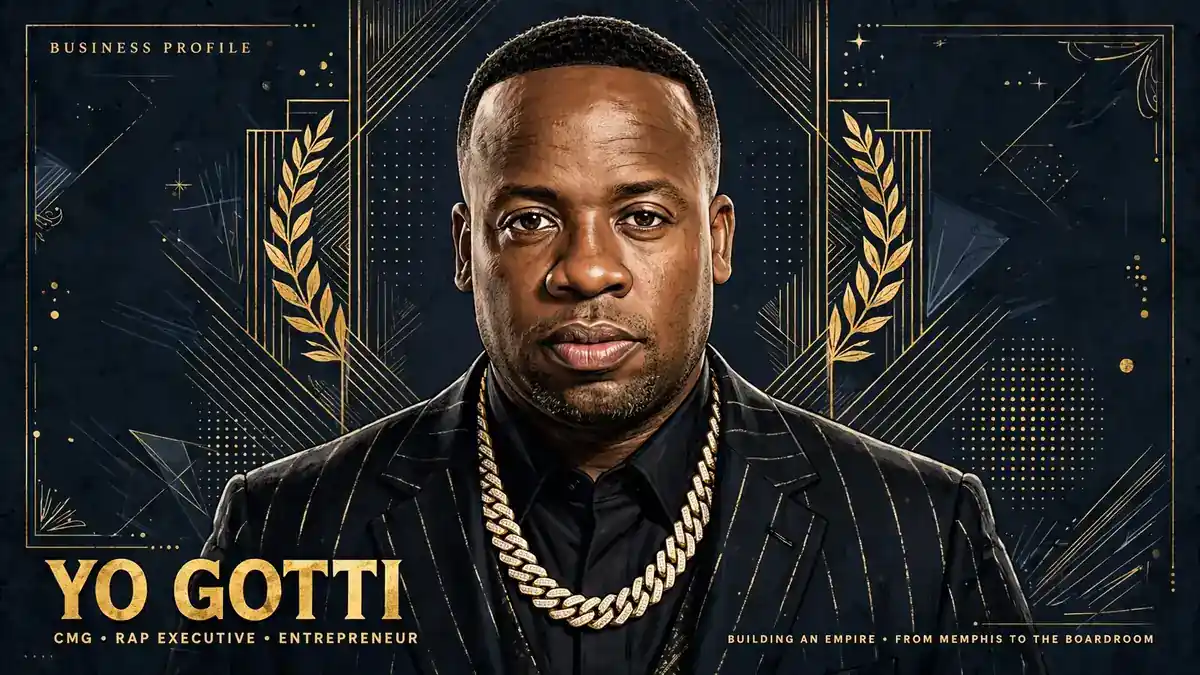
Yo Gotti‘s net worth is estimated at $100 million as of November 2026. That figure comes from Forbes, which put his fortune at around $100 million in a February 2024 cover profile, and Celebrity Net Worth agrees with the same $100 million estimate. The number is not the whole story: other 2026 trackers print far lower figures, down to $16 million, and this article explains exactly where that gap comes from instead of pretending it does not exist.
Yo Gotti: Quick Facts
| Estimated net worth | $100 million (published range: $16 million–$100 million) |
|---|---|
| Profession | Rapper, songwriter, record executive, entrepreneur |
| Nationality | American |
| Born | May 19, 1981 (age 45) |
| Height | 5 ft 7 in (1.70 m, as most commonly reported) |
| Primary income sources | Collective Music Group (CMG) label ownership, recorded music and publishing, touring, D.C. United minority stake, Prive restaurant, real estate |
| Active years | 1996–present |
| Last reviewed | November 2026 |
- Early Life and Background
- Education
- Career Journey
- Rise to Fame
- Main Sources of Income
- Salary and Earnings
- Businesses and Investments
- Brand Deals and Sponsorships
- Houses, Cars and Other Assets
- Awards and Achievements
- Net Worth Growth Over the Years
- Peer Comparison
- Social Media Presence
- Personal Life
- Sources & Reporting
- Frequently Asked Questions
- Final Thoughts
Early Life and Background
Mario Sentell Giden Mims was born on May 19, 1981, in Memphis, Tennessee, and grew up in the Ridgecrest Apartments in Frayser, in the north of the city. Forbes describes him as the middle of three children, raised in a part of Memphis where money was short and the streets set the daily terms. That background is not decoration in his business story; it explains why his first investments were houses bought with cash in the same city, why his label signs Memphis artists first, and why his restaurant sits in Memphis rather than in Los Angeles or Atlanta.
He started rapping at around 14, performing as Lil Yo and working with DJ Sound and his crew, according to his biographical record. The early work was local, physical and slow: mixtapes, neighborhood shows and a reputation built block by block rather than through a television contest or a viral clip. By the time he released his debut album, Youngsta’s on a Come Up, in 1996, he had already spent years learning the two skills that later made him rich — how to record on a tight budget and how to sell a record without waiting for a major label to do it for him.
The Frayser years also left him with a financial education gap he has talked about openly since. In a 2024 interview on the Earn Your Leisure podcast, reported by AfroTech, he said he bought 10 to 15 houses with cash early in his career and went four or five years without paying property tax on them, simply because nobody had told him the bill existed. A letter threatening seizure forced him to a tax lawyer and an accountant. That episode, embarrassing as he presents it, is the hinge of his later career: the artist who did not know about property tax became the executive who tells his own signees to hire a certified public accountant before they spend anything.
His mother, Geraldine Mims, remains a visible part of the story. She runs the Memphis soul-food restaurant Prive, the family business attached to his name, and her presence in the operation is one reason the restaurant reads as a Memphis institution rather than a celebrity licensing deal. Gotti’s older brother, Anthony Mims, has also been linked to the CMG operation, with some label histories naming a relative, Brandon Mims, as the label’s president — a reminder that CMG, for all its Interscope scale, is still run as a family-adjacent Memphis company.
Education
Yo Gotti has no college degree on his record, and Forbes notes plainly that he never finished college. That fact matters for the net worth story in two directions. It meant he entered the music business without the credential or the network a university supplies, and it meant his real business education happened inside record deals, including the ones that went wrong. His first major-label years — RCA, then Epic — taught him what a bad rollout and a bad contract cost, and the lesson stuck: he left the major system to build his own label rather than signing another artist deal on someone else’s terms.
In December 2023, at 42, he went back to school on his own terms, enrolling in classes at UCLA’s Anderson School of Management with a focus on corporate valuation, as he told Forbes. The timing is telling. He enrolled months before the Forbes profile valued him at $100 million, and the subject he picked — corporate valuation — is the exact skill a label owner needs when the question stops being “how many records did we sell?” and becomes “what is this company worth?” It is also a direct answer to the property-tax episode: the man who once missed a tax bill was now studying how companies are valued, in a classroom, in his forties.
He has also put money into schools back home. In August 2019 he funded new uniforms for Shelby County Schools students, starting at Grandview Middle School and Frayser-area schools, according to local reporting of the donation. It fits the same pattern as the restaurant and the label: Memphis first, and the spending tied to places he actually came from rather than to national charity galas.
Career Journey
Gotti’s recording career falls into three clear phases, and the money follows the same breaks. The first phase, 1996 to 2006, was independent: five albums released without a major-label machine behind them — Youngsta’s on a Come Up (1996), From Da Dope Game 2 Da Rap Game (2000), Self-Explanatory (2001), Life (2003) and Back 2 Da Basics (2006). None of them made him nationally famous. All of them taught him to own his masters, his mixtape series and his audience, and that ownership habit is the single most valuable habit in his financial life.
The second phase began when he signed with J Records in 2009. The major-label albums that followed — Live from the Kitchen (2012), which debuted at No. 12 on the Billboard 200, and I Am (2013), which carried the single “Act Right” with Jeezy and YG — gave him national chart positions and radio reach he had never had. But the major system also frustrated him. Celebrity Net Worth records that he was disappointed with the rollout and sales of Live from the Kitchen and eventually left RCA. The experience confirmed what the independent years had suggested: the artist made the money, and the label kept too much of it.
So he built the label himself. He founded Collective Music Group in 2012, originally under the name Cocaine Muzik Group, as an outlet for his own music and a platform for Memphis artists. The name change to Collective Music Group came, by his own account to Forbes, after advice from Curtis “50 Cent” Jackson, who told him the old name would scare corporate partners. That one piece of advice is worth real money: a label called Cocaine Muzik Group does not sign an Interscope partnership or a D.C. United ownership deal. A label called Collective Music Group does.
The third phase, from 2016 onward, is the executive phase. The Art of Hustle (2016) gave him his commercial peak as a performer, I Still Am (2017) consolidated it, Untrapped (2020) kept him in the Billboard 200 top 10, and CM10: Free Game (2022) closed his run of solo studio albums to date. Since then his public output has been dominated by CMG compilations — Gangsta Art (2022) and Gangsta Art 2 (2023) — and by other artists’ records. The shift is deliberate and it is the core of the net worth story: a performing artist earns when he works, while a label owner earns when anyone on his roster works.
Rise to Fame
Gotti’s national breakthrough did not arrive with an album. It arrived with a single. “Down in the DM,” released in 2015 ahead of The Art of Hustle, peaked at No. 13 on the Billboard Hot 100 and earned a double-platinum certification from the Recording Industry Association of America (RIAA). The song’s direct-message premise travelled far beyond rap radio, and the Nicki Minaj remix pushed it further. For an artist who had been releasing records for 20 years, it was a late breakthrough, and late breakthroughs pay differently from early ones: Gotti arrived at fame already owning a label, so the weight of the hit flowed to his company instead of to a major label’s balance sheet.
The follow-up sealed it. “Rake It Up,” featuring Nicki Minaj and produced by Mike WiLL Made-It, was released in 2017, peaked at No. 8 on the Billboard Hot 100 — still his highest-charting single — and earned a triple-platinum RIAA certification. It appeared on I Still Am, which debuted at No. 6 on the Billboard 200 and earned a gold certification. Two songs, released two years apart, did what 20 years of mixtapes and independent albums had not: they made Yo Gotti a national name with a catalog that keeps paying. Streaming revenue from a triple-platinum and a double-platinum single does not stop when the chart run ends; it compounds, year after year, through playlists, radio and sync.
The chart peaks also changed his price as a live act and as a collaborator. Guest verses, festival slots and features with artists such as Megan Thee Stallion, Lil Uzi Vert, Rick Ross and Estelle on Untrapped kept him visible through the streaming era, and his 2016 management deal with Roc Nation — reported at the time of The Art of Hustle — put Jay-Z’s operation behind his career just as his commercial peak arrived. The Roc Nation link matters beyond prestige: Jay-Z is the mentor Gotti credits in the Forbes profile with showing him that an artist from a housing project could build a company, buy property and run a business empire rather than simply collecting checks.
By 2021 the fame had converted into institutional power. Billboard put CMG on its cover in 2022 as “the hardest-working label in hip-hop,” and the Interscope partnership announced in June 2021 gave the label major-label distribution while Gotti kept control. Fame, in Gotti’s case, was never the end product. It was the raw material he fed into a label, and the label is what turned a two-hit peak into a nine-figure valuation.
Main Sources of Income
CMG is the largest source, and it is not close. As founder and chief executive, Gotti owns the label that releases music by Moneybagg Yo, GloRilla, 42 Dugg, EST Gee, Mozzy, Blac Youngsta and BlocBoy JB, among others. Every stream, sale, sync placement and touring cycle from that roster generates label revenue, and a share of that revenue flows to the owner. That is why his fortune kept growing in years when he released little of his own music: the label’s artists were working even when he was not in the studio. Billboard’s 2021 reporting on the Interscope deal describes CMG as a 14-year-old label at that point with a roster that had already produced a Billboard 200 No. 1 in Moneybagg Yo’s A Gangsta’s Pain, which spent two weeks at the top, and a No. 8 debut for 42 Dugg’s Free Dem Boyz.
His own catalog is the second source. Eleven studio albums and more than 20 mixtapes, in the count used by several 2026 trackers, produce recorded-music royalties, publishing income from songs he co-wrote, and streaming revenue that renews every month. The two anchor assets are “Rake It Up” (triple platinum) and “Down in the DM” (double platinum), but the long tail matters too: older albums such as I Am and The Art of Hustle still stream, and the Cocaine Muzik mixtape series still circulates. Catalog income is the least glamorous line in a rapper’s accounts and the most reliable one.
Touring and live performance form the third source. Gotti has toured as a headliner and as a festival act for two decades, and his fees rose sharply after 2016. No reliable public record states his current per-show fee, and this article does not invent one: trackers that print a $50,000-to-$100,000 range for headline rap bookings are describing the market, not a confirmed Gotti contract. What is documented is that live income, for an artist with two platinum singles and a 20-year catalog, is a multi-million-dollar annual line in good years, and that it stopped being his main line the moment CMG’s roster started producing its own tours.
Sports ownership, restaurants and real estate make up the rest. His D.C. United stake, bought in 2021, is a long-hold asset whose value rises with the club’s valuation rather than with ticket sales in any single season. Prive, the Memphis restaurant his mother runs, is a smaller, steadier business. Real estate — the early cash-bought Memphis houses, the Westlake Village mansion bought in 2021, and other holdings — contributes both rental-style income and appreciation. None of these lines alone explains $100 million. Together, with a label at the center, they do.
Salary and Earnings
There is no published annual salary for Yo Gotti, and readers should distrust any article that prints one as fact. He is not an employee. He is an owner, and owners take distributions, advances, royalties and sale proceeds rather than a paycheck. The closest thing to a hard earnings figure in his own words comes from Untrapped, where, as The Richest reported, he rapped about making $20 million through investments and paying $8 million in taxes. Treat that as a lyric, not a filing: it tells you the scale he was operating at around 2020, and it tells you his tax bill alone was larger than most rappers’ entire net worth estimates, but it is not an audited income statement.
The Interscope deal gives a better sense of scale. In a 2021 interview with XXL, Gotti described the CMG–Interscope partnership as an eight-figure deal, saying plainly that the label was not doing business under eight figures. Eight figures means at least $10 million, and his phrasing suggested the number sat well above the floor. The deal’s value to him is not a single check: it is distribution, marketing muscle and advances for a roster that already included Moneybagg Yo, 42 Dugg and EST Gee, with GloRilla joining in July 2022 after “FNF (Let’s Go)” broke. A label partnership of that size, on top of a catalog and a touring history, is what separates a $16 million tracker estimate from a $100 million Forbes estimate. The lower number looks like a performer’s income. The higher number prices a company.
That distinction is the key to the whole article, and it is worth stating plainly. Trackers such as Net Worth Spot, which put him at $16 million in an October 2026 update, and several smaller sites printing $15 million to $25 million, appear to model a recording artist: album sales, streaming royalties, touring and endorsements. Forbes and Celebrity Net Worth, at $100 million, price an executive: the same artist income plus the equity value of CMG, plus a sports-team stake, plus a restaurant, plus property. Neither side publishes its full model, so neither can be checked line by line. But the Forbes figure rests on a named reporter, Jabari Young, sitting with Gotti in his home and reporting the label, the team stake and the restaurant as the components — while the low figures come from formula-driven tracker pages that do not mention CMG’s valuation at all. That is why this article anchors at $100 million and reports the $16 million–$100 million spread rather than splitting the difference into a meaningless middle number.
One more earnings line deserves a note because it is often misreported. In 2019, Gotti joined a group of investors — including Sylvia Rhone, Swae Lee and Pitbull, as reported by Andscape — that invested $40 million into the esports organization FaZe Clan. That $40 million was the group’s total, not Gotti’s personal check, and articles that credit him with the full amount overstate his outlay. The same care applies to D.C. United: the club was valued at roughly $730 million when he bought in, but his slice was around 1% — the group of four new owners together held under 10%, according to the Sports Business Journal — so his stake was worth roughly $7 million at entry, not $730 million. Getting those two numbers right is the difference between a real portfolio and a fantasy one.
Businesses and Investments
Collective Music Group is the business, and its history explains the valuation. Founded in 2012, it signed Moneybagg Yo in 2016, BlocBoy JB and Blac Youngsta from Memphis, then expanded geographically: 42 Dugg from Detroit, EST Gee from Louisville in January 2021, Mozzy from California, and GloRilla in July 2022. The Interscope Geffen A&M partnership, announced June 3, 2021, gave CMG major-label distribution while Gotti stayed in charge of artist development. Billboard reported the deal as an eight-figure partnership and later crowned CMG the hardest-working label in hip-hop. The label’s compilation albums, Gangsta Art (2022) and Gangsta Art 2 (2023), turned the roster itself into a product, with GloRilla, Moneybagg Yo and Fivio Foreign appearing alongside Gotti.
The roster is also a risk concentration, and an honest profile says so. CMG’s value depends on a handful of artists staying productive, staying out of serious legal trouble, and staying with the label. 42 Dugg’s legal problems and the general churn of rap careers are not footnotes to the valuation; they are the valuation’s main risk. Gotti’s answer to that risk has been volume — signing across cities and sounds, from GloRilla’s Memphis breakout to EST Gee’s Louisville street rap — so that no single artist’s fortunes decide the company’s year. It is the same diversification logic as his property portfolio, applied to people.
D.C. United is his most public non-music investment. In September 2021 he joined the club’s ownership group alongside Joe Mamo, Jake Silverstein and Adam Gerry, expanding the group to 12 people, as the Sports Business Journal reported. The Washington Post’s reporting, summarized by AfroTech, put the group’s projected stake at about 6%, with Mamo holding 2% to 3% and Gotti, Gerry and Silverstein splitting about 3% — roughly 1% each. Yahoo Sports later described his stake as slightly more than 1% of a club valued at $730 million. Forbes put the club’s valuation at $775 million in 2024, up 11% from 2023, with revenue estimated at $85 million and operating income at $10 million. On those numbers, a stake of just over 1% is worth roughly $8 million — a meaningful asset, and a long way from the headline valuation of the club itself.
Why a soccer team? Gotti told Andscape the investment came through his admiration for co-chairmen Jason Levien and Steve Kaplan and what they had done in Memphis with the Grizzlies, and through his own history of big shows in the Washington–Baltimore corridor. The logic is relationship-driven, and it matches his other deals: he invests with people he already knows, in assets he can visit, rather than chasing anonymous stock tips. The FaZe Clan group investment in 2019 followed the same pattern — a group of entertainment figures backing an organization they understood as a media company, not a bet on a single game.
Prive, the Memphis restaurant, completes the non-music trio. Reports differ on the exact ownership paperwork — Andscape says his mother is the restaurant’s owner, while Forbes lists the restaurant among Gotti’s holdings — and the honest reading is that it is a family business with his capital and his mother’s day-to-day operation. Either way, a single Memphis restaurant does not move a $100 million estimate by itself. Its value to the story is different: it keeps his brand anchored in Memphis, gives the family a cash business outside music, and shows up in every Forbes-style profile as proof that the empire amounts to more than a label on paper.
Brand Deals and Sponsorships
Gotti’s endorsement record is thinner than many rappers’ — and that is a choice that shows up in the numbers. His longest-running brand relationship is with Puma, for which he has been a brand ambassador since 2017, according to Andscape. The deal puts him in the same endorsement lane as athletes and lifestyle figures rather than in one-off sneaker drops, and a multi-year ambassador contract pays differently from a single campaign: steady, contracted income rather than a spike.
Other brand links reported over the years include D’USSE Cognac partnerships and Roc Nation’s management and brand apparatus after his 2016 management deal. What he has not done, notably, is build a personal product empire of the kind some peers chase — no widely distributed liquor brand of his own, no fashion label with national retail distribution, no headphones or cannabis line carrying his name at scale. Some low-quality tracker pages credit him with a “CMG Apparel” fashion line and with tech-startup windfalls; no named reporting in the sources reviewed supports a fashion line of that size, and this article does not repeat those claims as fact. The gap between his endorsement income and, say, a sneaker mogul’s is real, and it is one reason the tracker estimates stay low: they price the artist, and the artist’s brand deals are modest next to his label equity.
The endorsement that matters most may be the one that pays nothing directly: the Roc Nation management relationship and the Jay-Z mentorship. Roc Nation’s chief executive Desiree Perez is someone Gotti names as a call he makes for advice, and Jay-Z praised his business sense to Forbes, saying it was evident in every move he made. A mentor relationship does not appear on a balance sheet, but it opens rooms — the D.C. United ownership group, the Interscope negotiation, the UCLA classroom — that a solo artist cannot open alone. Readers pricing Gotti’s career should count access as an asset, even when it carries no invoice.

Houses, Cars and Other Assets
The best-documented property in Gotti’s portfolio is the Westlake Village mansion he bought in May 2021 for $7.6 million, about $100,000 above its asking price, according to The Real Deal citing Dirt. The Tuscan-style house, built in 1999 for former Westwood One executive Bruce Kanter, measures about 10,000 square feet on three gated acres, with six bedrooms, eight bathrooms, an infinity pool and a golf-course setting in the North Ranch Country Club area. Forbes described the same house, loosely, as a 10,000-square-foot Tuscan-style mansion just north of Malibu — a description that points to the same property, since Westlake Village sits northwest of Los Angeles rather than in Malibu itself.
In December 2022, about 18 months after buying it, he listed the house — known as Villa Forza — for $8.6 million, exactly $1 million above his purchase price, as The Kitchn reported. Whether it sold, and at what price, is not confirmed in the sources reviewed for this article, and readers should not assume the $1 million paper gain was banked. The listing itself is the useful fact: it shows a buy-and-list pattern consistent with his early Memphis house buying, only at California scale — acquire, hold briefly, test the market above cost.
The Memphis houses are the older, more instructive portfolio. Buying 10 to 15 houses with cash, as he told Earn Your Leisure, is a classic cash-flow strategy in a low-price market: no mortgage, rental income or resale upside, and full exposure to the tax bill he did not know existed. Memphis prices make the strategy possible in a way coastal markets do not, and the episode explains why his later property moves look more professional — lawyers, accountants and listed prices rather than cash deals and crossed fingers. No public record in the sources reviewed gives a current count or total value for his Memphis holdings, so this article does not print one.
Cars and watches fill out the visible-wealth picture, with the usual caution about owner claims. His collection is widely reported to include Lamborghinis and Rolls-Royces, and Forbes reported his own claim that his watch collection is worth about $10 million, including pieces by Patek Philippe, Rolex and Vacheron Constantin. That $10 million is his claim, not an appraisal, and it should be read as such — but even discounted heavily, a serious watch collection plus a luxury car fleet is a seven-figure asset line that most net worth trackers leave out entirely. It is another small reason the Forbes number sits above the tracker numbers: the trackers count songs, while Forbes counts the garage and the safe as well.
One asset class he does not appear to hold at scale is the one fans most often ask about: his own liquor or fashion brand. There is no verified record of a Gotti-owned spirits label or a national clothing line contributing material revenue. The honest portfolio is narrower and stronger for it: a label, a catalog, a sports stake, a restaurant, property, cars and watches. Everything else in the rumor mill — tech-startup jackpots, crypto windfalls — appears in tracker pages without a named source, and this article leaves those claims out rather than dressing them up as reporting.
Awards and Achievements
Yo Gotti’s trophy record is modest next to his business record, and the contrast is the point. His 2013 album I Am earned a BET Hip Hop Awards nomination for Album of the Year, according to Celebrity Net Worth — recognition from the genre’s own awards, but not a win, and not a Grammy. He has no Grammy win on his record, and no major televised award win is documented in the sources reviewed. For an artist whose fortune is estimated at $100 million, that absence is unusual, and it underlines where his achievement actually sits: in chart positions, certifications and company-building rather than in statuettes.
The chart achievements are concrete. “Rake It Up” reached No. 8 on the Billboard Hot 100 and went triple platinum. “Down in the DM” reached No. 13 and went double platinum. The Art of Hustle reached No. 4 on the Billboard 200. I Still Am debuted at No. 6 and went gold. Untrapped debuted in the Billboard 200 top 10. Those five lines, taken together, are a commercial record most rappers would trade awards for, because each one converts directly into royalties, touring fees and catalog value.
The executive achievements outrank the performing ones. Signing Moneybagg Yo in 2016 and developing him to a Billboard 200 No. 1 album. Signing GloRilla in July 2022, weeks after “FNF (Let’s Go)” entered the Hot 100, and watching her become one of rap’s biggest new stars. Closing an eight-figure Interscope partnership in 2021. Earning a Billboard cover in 2022 as the hardest-working label in hip-hop. Joining a Major League Soccer ownership group in 2021. Enrolling at UCLA Anderson in 2023 to study corporate valuation. Each of those is a verifiable milestone, and together they describe a second career — executive — that has already out-earned the first.
There is also a civic line in the record. The 2019 school-uniform donation in Shelby County, the financial-literacy advice he now gives CMG artists, and the Memphis restaurant all point to a local legacy that will outlast any chart run. It is not the kind of achievement that moves a net worth estimate, but it is the kind that explains why Memphis treats him as an institution rather than as a visiting celebrity.
Net Worth Growth Over the Years
Year-by-year net worth tables for private individuals are mostly fiction, and this article will not print one as if it were a bank statement. What follows is an anchor-point timeline: the years where a named source, a documented deal or a chart event gives a real reason to move the number, and the honest limits of each point.
| Period | What changed | Estimate / status |
|---|---|---|
| 1996–2006 | Independent albums and mixtapes; local Memphis income, no major-label scale | Low single-digit millions at most; no reliable published estimate |
| 2009–2013 | J Records signing; Live from the Kitchen (No. 12) and I Am bring national chart income | Rising, but still a performer’s income, not an executive’s fortune |
| 2015–2017 | “Down in the DM” (No. 13, double platinum) and “Rake It Up” (No. 8, triple platinum); Roc Nation management in 2016 | Catalog and touring income step up sharply; mid-eight-figure territory becomes plausible |
| 2021 | Interscope partnership (eight figures, per Gotti); D.C. United stake at a $730 million club valuation; Westlake Village purchase at $7.6 million | Label equity enters the valuation; estimates begin to diverge by tens of millions |
| February 2024 | Forbes cover profile values him at around $100 million, citing CMG, D.C. United and Prive | ~$100 million (Forbes anchor) |
| 2026 | No new solo studio album since CM10: Free Game (2022); CMG roster continues; low trackers print $16 million–$25 million | $100 million anchored; published range $16 million–$100 million |
The shape of the curve matters more than any single year’s number. For 20 years the line rises slowly, tracking a working rapper’s income. In 2016 it bends upward with the two platinum singles. In 2021 it bends again, this time because the asset changed: he stopped being only the product and became the company. The 2024 Forbes figure is the first estimate that prices the company, and that is why it jumps so far above the tracker figures that came before it. Whether the true number today sits at $100 million depends on what CMG itself is worth — a private company whose valuation no outsider can audit — and on whether the Westlake listing, the D.C. United stake and the watch collection are counted at full value. A reader who trusts only documented cash flow will land lower. A reader who trusts Forbes’ reporting on the label will land at $100 million. This article lands at $100 million, with the range stated wherever the headline figure appears.
Peer Comparison
Comparison is where most net worth articles cheat, by lining up figures from different years and different methods as if they were measured the same way. The table below keeps the method visible: every figure is a named outlet’s estimate, and the gaps between the rows say as much about the method as about the artist.
| Artist | Estimated net worth | Main wealth driver | Label ownership |
|---|---|---|---|
| Yo Gotti | $100 million (Forbes, 2024) | CMG label equity, catalog, D.C. United, Prive, property | Yes — founder, CMG |
| Moneybagg Yo | $6 million (Celebrity Net Worth) | Recorded music, touring; CMG artist | No — signed to CMG |
| GloRilla | $2 million–$5 million (reported range, 2025–2026) | Recorded music, touring, endorsements; CMG artist | No — signed to CMG |
The comparison that matters is the first two rows. Moneybagg Yo is one of the most commercially successful artists on CMG — a Billboard 200 No. 1 album, platinum singles, six-figure show fees at his peak — and his net worth is estimated at $6 million. Gotti’s is estimated at $100 million. The difference is not talent or fame. It is ownership. The artist keeps a share of his own records. The label owner keeps a share of everyone’s records, plus the company itself. That single structural fact explains the entire gap between Gotti and his own roster, and it is the most important lesson in this article for anyone trying to understand music money.
The wider peer set tells the same story from the other side. Rappers who stayed artists — even very successful ones — tend to land in the single-digit or low-double-digit millions on tracker estimates. Rappers who became label owners, sports investors or brand owners land higher, because their wealth is equity, not income. Gotti sits in the second group now, alongside the mentor he credits, Jay-Z, whose Roc Nation model he has studied since 2016. He is not in Jay-Z’s financial league — no honest article would suggest that — but he is playing the same game: own the company, own the catalog, own a piece of a team, and let the assets work while the artist rests.
Social Media Presence
Gotti’s social media presence is executive as much as artistic. His Instagram and X accounts mix new-music announcements, CMG signings and roster celebrations with Memphis community posts and the occasional luxury snapshot — cars, watches, the Westlake house — that doubles as brand maintenance. The CMG announcements are the financially meaningful posts: a signing announcement on his account is a press release, a talent signal to the industry and a marketing launch for the artist, all in one image. When he welcomed GloRilla to CMG in July 2022, the jet photo and the announcement travelled further than a label press release ever would.
He does not publish follower counts as a business metric, and this article does not print unverified follower numbers that change weekly and differ by source. What can be said is that his accounts are large enough to move a record — “FNF (Let’s Go)” and the CMG compilation rollouts both used his channels as a primary launchpad — and that his most viral moments in recent years have been relationship and business news rather than music: the January 2023 confirmation of his relationship with Angela Simmons, and the recurring business headlines around CMG and D.C. United. For a label owner, that is the right mix. The artist’s account sells the artist. The owner’s account sells the company.
YouTube remains his catalog’s home, with the official videos for “Down in the DM” and “Rake It Up” acting as permanent, monetized assets. A triple-platinum single’s video does not retire when the song leaves the chart; it keeps earning advertising revenue and driving streaming discovery for years. That long-tail video income is another line the low tracker estimates tend to underweight, because it looks like nothing — an old video sitting on a channel — while quietly paying every month.
Personal Life
Gotti keeps his private life guarded, and the published record reflects that guardedness: counts of his children disagree across sources, with older profiles commonly citing three children and some later profiles counting six, and no single figure is confirmed by Gotti himself in the sources reviewed. This article therefore does not print a firm number. What is documented is that he has children from previous relationships, that he keeps them largely out of the spotlight, and that his family — his mother at Prive, his brother around CMG — is woven into his businesses rather than kept separate from them.
His most public relationship began, in song, long before it began in life. He referenced Angela Simmons, daughter of Run-DMC’s Rev Run, in his music for years before the two confirmed their relationship on social media in January 2023. The relationship became one of hip-hop’s most discussed pairings, and breakup rumors have circulated repeatedly since early 2024, intensifying around his birthday in May 2025. No official statement from either party confirming a split was found in the sources reviewed, and some reports note the couple may simply be keeping a lower profile. Readers should treat the split as unconfirmed rumor, not fact — a useful discipline in a niche where rumor is routinely printed as biography.
His height is another small example of the same problem. Most listings give 5 ft 7 in (1.70 m), but published figures range from 5 ft 5 in to 5 ft 9 in. This article uses the most commonly reported figure and notes the spread, rather than presenting a disputed measurement as settled. The same caution applies to his marital history: older profiles describe a marriage to Lakeisha Mims, with divorce reported later, but the details are private and inconsistently reported, so this article does not build a timeline out of them.
What is not in dispute is his Memphis identity. He still centers the city in his business, his philanthropy and his roster, two decades after leaving its independent scene for the national charts. The school-uniform donation, the Prive restaurant, the Memphis-first signings at CMG and the property-tax story he tells on podcasts all point the same way: the fortune left Memphis in the sense that it now includes a California mansion and a Washington soccer team, but the decision-making never left Frayser.
Sources & Reporting
Forbes — February 23, 2024 cover profile by Jabari Young: the $100 million estimate, the CMG/D.C. United/Prive components, the UCLA Anderson enrollment (December 2023, corporate valuation), the 50 Cent name-change advice, the Jay-Z mentorship, and the $10 million watch-collection claim. The anchor source for the headline figure.
Celebrity Net Worth — Yo Gotti profile: agreement with the $100 million figure, the album-by-album career record (Live from the Kitchen No. 12, The Art of Hustle No. 4, I Still Am gold, Untrapped top 10), the BET Hip Hop Awards Album of the Year nomination for I Am, and the RCA departure.
Billboard — 2021–2022 CMG coverage: the Interscope partnership, the eight-figure scale of the deal, Moneybagg Yo’s A Gangsta’s Pain (No. 1, two weeks) and 42 Dugg’s Free Dem Boyz (No. 8), the GloRilla signing, and the 2022 “hardest-working label in hip-hop” cover.
XXL — 2021 Yo Gotti interview on the Interscope deal: Gotti’s own description of the partnership as an eight-figure deal, the Roc Nation management deal in 2016, and his “next Cash Money” ambition for CMG.
Andscape — 2021 D.C. United profile: the ~1% stake context, the Levien/Kaplan relationship, the Puma ambassadorship since 2017, the 2019 FaZe Clan group investment of $40 million, and Prive being run by his mother.
Sports Business Journal — September 27, 2021: the four new D.C. United owners, the group expanding to 12, and the four newcomers’ combined stake under 10%.
AfroTech — D.C. United valuation reporting (Forbes $775 million in 2024, up 11% from 2023; $85 million revenue, $10 million operating income) and the June 2024 Earn Your Leisure property-tax story (10–15 cash-bought houses, the seizure letter, the tax lawyer and CPA).
The Real Deal — June 2021: the Westlake Village purchase at $7.6 million, $100,000 above asking, 10,000 square feet, three acres, six bedrooms, eight bathrooms.
The Kitchn — December 2022: the Villa Forza listing at $8.6 million, $1 million above the 2021 purchase price, with the sale outcome unconfirmed in sources reviewed.
HotNewHipHop — February 2024 Forbes coverage and the 2021 Westlake reporting: corroboration of the $100 million figure and the mansion purchase details.
Low-end trackers (for the published range, not the anchor): Net Worth Spot (October 2026 update, $16 million), NetWorth202 ($18 million) and similar tracker pages ($15 million–$25 million). These are cited only to document the spread; their models do not appear to price CMG equity, which is why this article does not adopt them.
Reporting window: deals and chart data 1996–2024, with tracker updates checked in November 2026. Figures are estimates from public reporting, not audited statements.
Frequently Asked Questions
What is Yo Gotti’s net worth in 2026?
Yo Gotti’s net worth is estimated at $100 million as of November 2026, anchored by Forbes’ February 2024 profile and agreed by Celebrity Net Worth. Published estimates range from $16 million to $100 million; the gap comes from whether the estimate prices his CMG label equity or only his income as a performer.
Why do some sites say Yo Gotti is worth only $16 million?
Low trackers such as Net Worth Spot ($16 million in October 2026) appear to model a recording artist’s income — sales, streaming, touring and endorsements — without pricing the value of Collective Music Group, his D.C. United stake, his restaurant or his property. Forbes priced the whole portfolio, including the label, and reached $100 million.
How does Yo Gotti make most of his money?
Through Collective Music Group, the label he founded in 2012. CMG’s roster — Moneybagg Yo, GloRilla, 42 Dugg, EST Gee, Mozzy, Blac Youngsta and others — generates label revenue from streams, sales and touring, and Gotti owns the company. His own catalog, touring, D.C. United stake, Prive restaurant and real estate add to it.
What is Yo Gotti’s real name and how old is he?
His real name is Mario Sentell Giden Mims. He was born on May 19, 1981, in Memphis, Tennessee, which makes him 45 years old as of November 2026.
How big is Yo Gotti’s stake in D.C. United?
He bought in during September 2021 as part of a four-person group of new owners whose combined stake was under 10% of the club. Reports put his personal slice at slightly more than 1% of a club then valued at about $730 million — roughly $7 million at entry, and roughly $8 million at Forbes’ 2024 valuation of $775 million.
Does Yo Gotti own the Prive restaurant?
Prive is a Memphis soul-food restaurant tied to his family: Forbes lists it among his holdings, while Andscape reports that his mother, Geraldine Mims, runs it. The fair description is a family business backed by his capital and run day to day by his mother.
Is Yo Gotti still making music?
His most recent solo studio album is CM10: Free Game (2022). Since then his public output has centered on CMG — the Gangsta Art compilations (2022 and 2023) and his roster’s records — reflecting his shift from performer to full-time label executive.
Who is Yo Gotti’s partner?
He confirmed a relationship with Angela Simmons, daughter of Run-DMC’s Rev Run, on social media in January 2023, years after referencing her in his songs. Breakup rumors have circulated since 2024, but no official split statement from either party was found in the sources reviewed.
Final Thoughts
Yo Gotti’s fortune is a case study in the difference between earning money and owning the thing that earns money. For 20 years he was a working rapper with a growing catalog and, eventually, two platinum singles. That career alone would have made him comfortable. What made him wealthy — by the Forbes measure, $100 million wealthy — was the decision to stop renting his career from major labels and to own the label instead. CMG turned his fame into a company, his signings into assets, and his Interscope deal into eight-figure negotiating weight.
The honest caveat stays attached to the headline number. Nobody outside CMG’s accounts knows what the label is truly worth, and the $16 million trackers are a standing reminder that a fortune built on private equity is always partly a judgment call. But the judgment with the best reporting behind it — a Forbes reporter in the room, a named roster, a documented sports stake and a documented restaurant — is $100 million, and the low figures do not survive contact with those facts. They price the rapper. Forbes priced the owner. In 2026, Yo Gotti is the owner.
His next chapter, if the UCLA classes are any guide, is about valuation itself: learning, in a classroom at 42, how to price the empire he built by instinct at 20. The property-tax letter taught him the cost of not knowing. The label taught him the value of owning. The combination — a Memphis founder who now studies corporate valuation — is why the $100 million figure, for all its uncertainty, is the most defensible number in this article.
Published on November 5, 2026. Last reviewed November 2026. Found an error? See our corrections policy.