
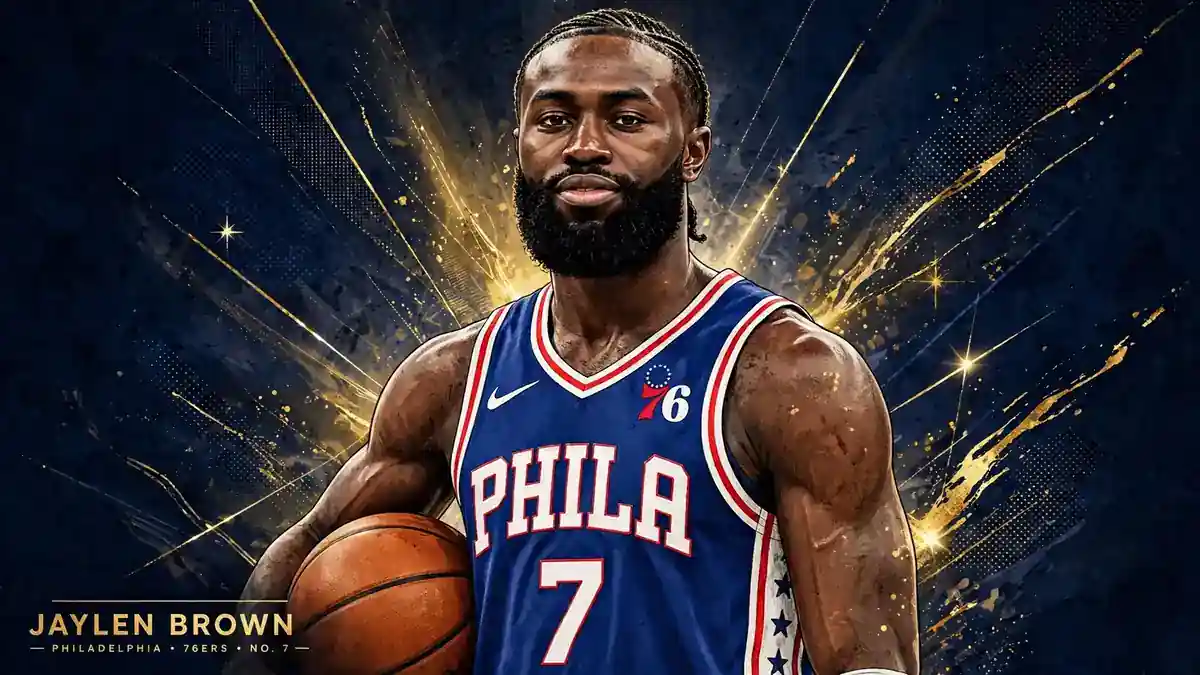
Jaylen Brown‘s net worth is estimated at $80 million as of November 2026. The figure sits inside a range of $80 million to $100 million, and it rests on three pillars: a supermax contract that was the richest in NBA history when it was signed, a career year in 2025-26 that made him the best player on a 56-win team, and a self-funded sneaker brand he built after turning down more than $50 million in endorsement money.
Brown’s money story changed shape twice in four months. First came the career season — 28.7 points per game, a fifth All-Star selection and a sixth-place finish in MVP voting while carrying Boston through Jayson Tatum’s Achilles injury. Then came the shock of the summer: on July 6, 2026, the Celtics traded the 2024 Finals MVP to the Philadelphia 76ers for Paul George and four draft picks, ending a ten-year run in Boston. The supermax contract travelled with him, so the trade changed his jersey, not his paycheque.
Jaylen Brown: Quick Facts
| Estimated net worth | $80 million (range: $80 million – $100 million) |
|---|---|
| Profession | Professional basketball player, shooting guard / small forward |
| Nationality | American |
| Born | October 24, 1996 (age 30) |
| Height | 6 ft 6 in (1.98 m) |
| Primary income sources | NBA salary, endorsements, 741 Performance brand, 7uice, investments |
| Active years | 2016–present |
| Last reviewed | November 2026 |
- Early Life and Background
- Education
- Career Journey
- Rise to Fame
- Main Sources of Income
- Salary and Earnings
- Businesses and Investments
- Brand Deals and Sponsorships
- Houses, Cars and Other Assets
- Awards and Achievements
- Net Worth Growth Over the Years
- Social Media Presence
- Personal Life
- Sources & Reporting
- Frequently Asked Questions
- Final Thoughts
Early Life and Background
Jaylen Marselles Brown was born on October 24, 1996, in Marietta, Georgia, a suburb northwest of Atlanta. His mother, Mechalle Brown, is an educator and professor. His father, Marselles Brown, was a professional boxer who later served on the Hawaii State Boxing Commission. Brown grew up with his younger brother, Quenton, in a household where sport and schoolwork were treated as equal obligations — and where dinner-table conversation could run from boxing footwork to philosophy.
Brown attended Joseph Wheeler High School in Marietta, where he played basketball and football before choosing basketball full time. As a senior he averaged 28 points and 12 rebounds a game and led Wheeler to a 30-3 record and the Georgia High School Association Class 6A state championship. Recruiters ranked him among the best players in the 2015 class, and the offers arrived from every blue-blood programme in the country. He picked the one nobody expected.
Two details from those years still shape how Brown handles money. The first is that his mother moved the family to Massachusetts once his NBA career took off and now lives in the Wellesley home he bought in 2020, with his nephew — the house functions as a family base, not a bachelor pad. The second is that Brown arrived in the league already thinking about ownership rather than paycheques. He has said repeatedly that he studies history, philosophy and chess, and that he wants to understand the systems that move money before he trusts anyone else to move his.
Education
On May 1, 2015, Brown committed to the University of California, Berkeley, turning down Kentucky and Kansas in the process. The choice raised eyebrows: Cal was not a basketball factory, and Brown was a projected top-five draft pick. He has since said he chose Berkeley for the education and the culture, and his one season there backs that up — during his first semester he took a master’s-level class in Berkeley’s Cultural Studies of Sport in Education programme, an unusual load for a freshman athlete with NBA ambitions.
On the court, Brown averaged 14.6 points, 5.4 rebounds and 2.0 assists in 27.6 minutes per game across 34 games for the Golden Bears in 2015-16. He was named Pac-12 Freshman of the Year and earned first-team All-Pac-12 honours. After one season he declared for the 2016 NBA draft. The education did not stop there: Brown later partnered with MIT to run Bridge, a programme connecting Boston public-school students with science and technology opportunities, and he has kept up a public habit of reading and language study — he has spoken about learning Spanish and about meditation as part of his daily routine.
Career Journey
The Boston Celtics selected Brown with the third overall pick in the 2016 NBA draft, behind Ben Simmons and Brandon Ingram. He signed his rookie contract on July 27, 2016 — a four-year deal worth about $21.4 million — and made his NBA debut on October 26, 2016, against the Brooklyn Nets. The early years were uneven. Brown came off the bench, shot inconsistently, and heard his name in trade rumours almost from the start. He answered by adding something every summer: a handle, a jumper, a post game.
The first real money decision of his career came in October 2019, when he signed a four-year, $106.3 million extension rather than testing restricted free agency. It was a bet on security over upside, and it paid off — by the time that deal expired, his value had roughly tripled. He made his first All-Star team in 2021, reached the NBA Finals in 2022 (losing to Golden State), and then watched the Celtics fall short again in the 2023 Eastern Conference Finals. The near-misses set up the summer of 2023, when Boston made him the richest player in league history.
The 2023-24 season delivered the payoff. Brown won Eastern Conference Finals MVP, then NBA Finals MVP as Boston beat Dallas in five games for the franchise’s 18th championship, averaging 20.8 points, 5.4 rebounds and 5.0 assists in the Finals — and, in the eyes of voters, outplaying Jayson Tatum on the biggest stage. He finished sixth in MVP voting two seasons later, after the best year of his life.
That best year, 2025-26, is the hinge of Brown’s career. With Tatum missing most of the season while recovering from a ruptured Achilles tendon, Brown became Boston’s No. 1 option and averaged a career-high 28.7 points, 6.9 rebounds and 5.1 assists in 71 games. The Celtics went 56-26, far better than expected, and Brown earned his fifth All-Star selection. But Boston lost in the first round of the playoffs, and the front office — staring at a roster built around two supermax deals and a punishing luxury-tax bill — decided to rebuild around Tatum. On July 1, 2026, ESPN’s Shams Charania reported the trade; it became official on July 6. Brown denied demanding a trade, and his representative called claims that he had presented Boston with a list of demands “10000% a lie,” telling ESPN that after Boston informed him he would be dealt, his only request was input on his destination. He debuted for Philadelphia in the preseason against the New York Knicks, joining Tyrese Maxey, Joel Embiid and rookie VJ Edgecombe on a 76ers team that also signed LeBron James that summer.
Rise to Fame
Brown’s rise did not follow the usual star arc. He was never the anointed one — Tatum was drafted a year later and quickly became the face of the franchise — and for years the conversation around Brown was whether Boston should trade him for a “true” second star. The 2023 supermax changed the terms of that conversation: a team does not hand the richest contract in NBA history to a player it plans to move. The 2024 championship settled it. Finals MVP is the one award that cannot be argued with, and Brown won it while guarding Luka Doncic on one end and running Boston’s offence on the other.
The 2025-26 season added the last missing piece — proof he could carry a team as the first option. Before that year his career high was 26.6 points per game; he jumped to 28.7 while also setting career marks in rebounds and assists. That is the season that turned a very good two-way wing into a franchise cornerstone in the eyes of the rest of the league, and it is the season that made Philadelphia willing to give up Paul George plus four draft picks for a player on a $60-million-a-year deal. ESPN’s reporting after the trade noted the scepticism in some front offices — Boston had a better net rating with Brown off the floor than on it in each of the past four seasons — but it also noted that no team in the league doubted his talent, only the price of it.
Off the court, fame arrived on Brown’s own terms. He never signed a shoe deal after his Adidas contract expired in 2021, and in 2024 he launched his own brand instead. The decision cost him guaranteed money and bought him something rarer in the NBA: a business he owns outright, in a league where most stars rent their image to a sponsor.
Main Sources of Income
Brown’s wealth comes from four streams, and the balance between them is shifting. NBA salary is still the foundation — about $232.6 million banked through the 2025-26 season, with roughly $183 million still to come over the final three years of his supermax deal. Endorsements are the second stream, and they look unusual for a player of his stature: because he turned down the big shoe money, his deals are concentrated in eyewear, beverages, audio and fashion rather than footwear. His own brands are the third stream — 741 Performance and 7uice — and they are the ones with the most upside, since he owns the equity rather than collecting a fee. Investments and board roles, including a position with the wearable-tech company Hapbee, make up the fourth.
That mix explains why Brown’s net worth is lower than his career earnings might suggest. A player who has banked $232.6 million in salary does not keep $232.6 million. Federal and Massachusetts taxes, agent fees, and the cost of funding his own brand out of pocket all take large bites — one widely shared analysis by Andrew Petcash, reported by Sportskeeda, calculated that Brown would keep roughly $24.5 million of a roughly $60 million paycheque once taxes, state taxes and basketball-related costs were counted. The number is an estimate, not a filing, but it shows the shape of the problem: a supermax salary is a gross figure, and the net figure is far smaller. Brown’s answer has been to convert salary into ownership, where the tax treatment and the long-term upside are both better.
| Income stream | What it pays | Notes |
|---|---|---|
| NBA salary | About $232.6M earned through 2025-26; ~$183M remaining | Supermax deal runs through 2028-29 |
| Endorsements | Estimated low seven figures per year | Oakley, Pepsi, Beats by Dre, David Yurman, VKTRY Gear |
| 741 Performance | Low seven figures in sales in first two years | Self-funded; Brown owns the brand outright |
| 7uice / other ventures | Not publicly disclosed | Streetwear brand founded in 2019 |
| Investments / board roles | Not publicly disclosed | Includes Hapbee; equity rather than fees |
Salary and Earnings
Brown’s contract history is a clean staircase, and each step roughly tripled the last. The rookie deal (2016-2020) paid about $21.4 million over four years. The 2019 extension paid $106.3 million over four years. The 2023 supermax was announced as a five-year, $304 million deal — the richest in NBA history when it was signed — but that number came with an asterisk that most coverage skipped over, and it is the single most misunderstood figure in Brown’s financial story.
The asterisk is the salary cap. Maximum NBA contracts are set as a percentage of the cap, so the $304 million figure was a projection based on where the cap was expected to go. The actual schedule came in lower. Celebrity Net Worth, working from the real cap figures, puts the deal at approximately $285.4 million over five seasons: about $49.2 million in 2024-25, $53.1 million in 2025-26, $57.1 million in 2026-27, about $61 million in 2027-28 and about $65 million in the final season. Basketball-Reference’s salary records match that shape, listing $53,142,264 for 2025-26. The deal is fully guaranteed, carries a trade kicker, and has no player option — which is why Philadelphia inherited the whole obligation when it traded for him, and why Brown’s income is locked in regardless of how the 76ers seasons go.
| Contract | Years | Value |
|---|---|---|
| Rookie scale deal, Boston Celtics | 2016–2020 | About $21.4 million |
| Extension, Boston Celtics | 2020–2024 | $106.3 million |
| Supermax extension, Boston (now Philadelphia) | 2024–2029 | $304 million reported; about $285.4 million actual schedule |
Season by season, the supermax pays $49.2 million (2024-25), $53.1 million (2025-26), $57.1 million (2026-27), about $61 million (2027-28) and about $65 million (2028-29). Through the end of the 2025-26 season Brown had earned approximately $232.6 million in NBA salary alone, per Basketball-Reference, and the deal still owes him about $183 million over its final three seasons. He becomes an unrestricted free agent in the summer of 2029, at 32, with one more large contract realistically available to him.
Here is the part of the story most net-worth pages leave out: the gap between the headline salary and the money that actually lands. Petcash’s breakdown, reported by Sportskeeda, estimated Brown would keep about $24.5 million of a roughly $60 million annual paycheque after federal tax, Massachusetts state tax, agent fees and other basketball-related costs — a $36.3 million haircut. That is why his net worth, at $80 million, is a fraction of his career earnings. It is also why the trade mattered financially in a way that has nothing to do with basketball: Pennsylvania’s state tax treatment differs from Massachusetts’, and players on deals this size notice the difference. No filing has been published showing Brown’s exact tax position, so treat the $24.5 million as an informed estimate, not a fact — but the direction is certain. Supermax money is gross money.
How does Brown’s deal compare with the other max contracts in the league? The table below uses reported contract values, not net worths, because contract values are public and net worths are not.
| Player | Reported contract | Team (2026-27) |
|---|---|---|
| Jaylen Brown | 5 years, $304M reported ($285.4M actual) | Philadelphia 76ers |
| Jayson Tatum | 5 years, $314M (signed 2024) | Boston Celtics |
| Paul George | 4 years, $212M (signed 2024) | Boston Celtics |
| Joel Embiid | 3-year, $193M extension (signed 2024) | Philadelphia 76ers |
Tatum’s deal, signed a year after Brown’s, passed it — which is exactly how the “richest contract ever” title works in the NBA. It lasts about twelve months.
Businesses and Investments
The most interesting part of Brown’s money story is the part he chose over money. In 2024, months after winning the Finals, he launched 741 Performance, an independent performance apparel and sneaker brand, anchored by the Rover — a $200 sneaker silhouette he designed himself. To do it, he turned down more than $50 million in traditional endorsement offers, according to Adweek and NBC Sports Boston, and funded the venture himself so he would keep full ownership and creative control. In doing so he joined a small group of players who have launched their own sneaker brands — Patrick Ewing, Stephon Marbury and Shaquille O’Neal are the usual comparisons — and he did it at 27, at the peak of his earning power, when the safe choice was to take the cheque.
The early numbers are modest, and Brown has not hidden that. Adweek reported that 741 sold 16,000 pairs of shoes in its first two years and grossed low seven figures in sales, according to a company spokesperson. For context, the same piece noted that Hoka took eight years and On eleven years to pass $500 million in sales, per industry analyst Matt Powell. The company started in October 2024 with four full-time staff and has since grown to eight, including Que Gaskins, a former Reebok and NBA Players Association executive who joined as chief executive roughly a year in. Brown wears his own shoes in NBA games — the most valuable advertising the brand gets, and it costs him nothing.
The name 741 comes from Brown’s personal number theory — spiritual awakening, hard work and new beginnings, as he has described it — and the brand sits alongside 7uice, the premium streetwear label he started in 2019. 7uice is often mistaken for athlete merchandise; it is positioned as a fashion line, with limited capsule drops and collaborations, and it gives Brown a second lane that does not depend on basketball at all. The two brands together are the clearest sign of his strategy: he would rather own the factory than rent the billboard, as one profile of his business thinking put it.
Beyond the brands, Brown’s portfolio is built around access and education rather than flash. He founded the 7uice Foundation shortly after joining the Celtics, teaching entrepreneurship and financial literacy to underserved young people in Boston and Atlanta. With MIT he launched Bridge, which for five years has connected Boston public-school students with science and technology opportunities. Through Boston XChange (BXC) he announced an initiative aimed at generating $5 billion in generational wealth for communities of colour — framed not as charity but as capitalisation: access to funding, programming, mentorship and facilities. He also holds an executive innovation role and a board seat at Hapbee, a wearable wellness technology company built around frequency-based mood and recovery products. None of these ventures has a published valuation attached to Brown’s stake, so none of them is counted in the $80 million estimate — they are upside, not present value.
One earlier business move is worth recording because it shows how Brown weighs control against cash. In 2022 he became the first NBA player to sign with Donda Sports, the agency started by Kanye West, positioning himself as the face of a forthcoming Yeezy basketball line. The partnership ended the same year after West’s public controversies. Brown walked away quickly and without a public fight — a pattern he repeated when he left Adidas in 2021 without signing anywhere else. He has shown, twice, that he will give up a paycheque to keep control of his name.
Brand Deals and Sponsorships
Brown’s endorsement history reads backwards from most NBA stars. He started with the standard deal — a rookie contract with Adidas after being drafted third overall in 2016 — and then spent the next five years moving away from standard deals. The Adidas relationship ran until the contract expired in 2021. He then had a short-lived deal with the Chinese brand PEAK, during which he was spotted wearing rival brands with their logos covered, and the Donda Sports chapter in 2022. Then nothing: three years without a shoe sponsor, by choice, while he built 741.
The first traditional endorsement he did sign, in February 2025, tells you what he was waiting for. Oakley signed Brown to a multi-year partnership that he described as the first major endorsement deal of his career — his words, reported by Sustain Health Magazine — because it was the first one that matched his own mission around self-expression, style and community. The deal makes Oakley his exclusive eyewear sponsor and folds in limited-edition product lines developed with his 741 brand, plus youth empowerment work through the 7uice Foundation and support for the EssilorLuxottica OneSight Foundation’s vision-care outreach.
Alongside Oakley, his current commercial partners include Pepsi and Beats by Dre, both long-standing relationships, plus Nutrafol and the luxury jeweller David Yurman. In October 2026, days before his first 76ers game, he announced a partnership with VKTRY Gear, the sports performance brand known for aerospace-grade carbon fibre insoles; Brown said he had tried the insoles himself after seeing them online and that the science behind them was what drew him in. Booking Agent Info lists 21 brands across his career, but the honest way to read that number is that most of them were short appearances and event work — the durable, paying relationships are the handful named here, and the footwear money that usually dominates an NBA star’s endorsement income is money Brown deliberately left on the table.
That refusal is the single most important fact in this section. Kicks on SI reported that he declined a $50 million offer from Nike to keep his creative autonomy; Adweek put the total value of the offers he turned down at more than $50 million. Either way, the number is larger than most players earn from endorsements in a career, and Brown gave it up before he had sold a single pair of his own shoes. If 741 grows into a real brand, the decision will look like the best financial move of his life. If it stays small, it will have cost him tens of millions. Both outcomes are still open, and the $80 million net worth estimate does not assume either one.

Houses, Cars and Other Assets
Brown’s property footprint is smaller and more deliberate than most players on his salary. The centrepiece is the Wellesley, Massachusetts, estate he bought in July 2020 for $7.8 million, shortly after signing his $106.3 million extension. The modern New England farmhouse, designed by McAlpine and built over roughly three years from two adjacent parcels, covers about 10,000 square feet on 1.53 acres in the Dana Hall area, with seven bedrooms, eight-plus bathrooms, a 33-foot kitchen, a covered patio with an oversized fireplace, an in-ground hot tub and a private tennis court. Multiple outlets now value it at around $10.2 million — a paper gain of about $2.4 million in six years. The property is reported to be held in his mother Mechalle’s name, and she lives there with Brown’s nephew.
The house made unwanted news in December 2024, when it was targeted in an attempted break-in while family members were at home. Nobody was harmed and nothing was reported stolen, and the incident was part of a wider wave of break-ins targeting professional athletes’ homes that season. Brown spoke about it briefly on local television, saying the week had given him perspective and that he was grateful the situation did not escalate, particularly for his mother’s safety. We are not publishing the street address.
Brown also owns a penthouse in Boston’s Fort Point neighbourhood, at 49 Melcher Street, in the Seaport district — a base close to TD Garden during his Celtics years. With the July 2026 trade to Philadelphia, both Massachusetts properties are now question marks: no public source has confirmed whether he still uses Wellesley as his primary residence, and any talk of a sale is speculation until Brown or a public record says otherwise. A Philadelphia base has not been publicly reported yet.
On cars, the reporting is thinner and should be read with that in mind. Housing Market News, which tracks celebrity property and car collections, puts his collection at about $5 million and lists a Lamborghini Urus, a Ferrari, a Rolls-Royce Phantom, an Audi Q5, a Porsche Macan and a Range Rover Evoque. No single outlet has verified that list against registrations, so treat it as reported rather than confirmed. What is confirmed is the negative: unlike many players at his income level, Brown has no publicly known yacht or private jet, and his spending pattern — property, family, and funding his own company — points to someone parking money in assets he controls rather than in depreciating toys.
Awards and Achievements
Brown’s trophy case is short on volume and heavy on weight. The 2024 championship and Finals MVP sit at the top, and everything else reads as the record of a player who kept getting better rather than one who peaked early.
| Honour | Year(s) |
|---|---|
| NBA champion | 2024 |
| NBA Finals MVP | 2024 |
| Eastern Conference Finals MVP | 2024 |
| NBA All-Star | 2021, 2023, 2024, 2025, 2026 (5 selections) |
| All-NBA Second Team | 2023 |
| NBA All-Rookie Second Team | 2017 |
| Pac-12 Freshman of the Year | 2016 |
| First-team All-Pac-12 | 2016 |
Two achievements do not come with trophies but matter to the money story. In 2019 Brown was elected a vice-president of the National Basketball Players Association, giving him a seat in the room where the collective bargaining agreement — the document that sets the salary cap his supermax is tied to — gets negotiated. And his 2025-26 season, the 28.7-point career year with a sixth-place MVP finish, is the performance that justified the trade price Philadelphia paid: a player in his prime, under contract for three more seasons, coming off the best basketball of his life.
Net Worth Growth Over the Years
Brown’s wealth has grown in steps that track his contracts, not in a smooth line. The rookie deal made him a millionaire; the 2019 extension made him wealthy; the supermax made him rich — and the taxes on the supermax are the reason the net-worth line lags so far behind the earnings line. The table below is our estimate, built from the contract schedule, the reported endorsement income and the public reporting on his business ventures. It is labelled as estimated because no outlet has access to Brown’s private accounts.
| Year | Estimated net worth | What moved it |
|---|---|---|
| 2017 | $3 million | Rookie deal begins; first NBA salary banked |
| 2019 | $12 million | Four-year, $106.3M extension signed |
| 2021 | $25 million | First All-Star selection; extension money flowing |
| 2023 | $45 million | Supermax signed — richest deal in NBA history |
| 2024 | $60 million | NBA title, Finals MVP; 741 Performance launches |
| 2025 | $70 million | Supermax year two; Oakley deal signed |
| 2026 | $80 million | Career year (28.7 ppg); trade to Philadelphia |
The honest version of this table is that the 2023-2026 jumps are smaller than the salary jumps, because that is when the tax bill on a $50-million-plus salary arrives in full. A player earning $53.1 million in a season does not add $53.1 million to his net worth; after taxes, agent fees and living costs, the annual addition is closer to half that, before endorsements and business income are counted. That is also why the range matters: outlets that count more of the contract’s future value, like Kemifilani’s $80-120 million, are not wrong so much as they are measuring a different thing — the value of the remaining contract rather than the wealth already banked. Our $80 million anchor measures what is banked, and the $80-100 million range allows for the endorsement and business income that public reporting cannot see.
Looking forward, the arithmetic is simple. Brown is owed about $183 million over the next three seasons. Even after the heavy tax drag, that should roughly double his net worth by 2029 if he stays healthy — before a single dollar from 741 is counted. The open question is not whether he gets richer; it is whether 741 turns his wealth from salary wealth into equity wealth, which is the difference between a retired player with a large bank account and a retired player with a company.
Social Media Presence
Brown’s social media presence is smaller than his salary would suggest, and he uses it differently from most stars. His Instagram handle is @fchwpo — the letters stand for “Faith, Consistency, Hard Work Pays Off” — and public trackers last put his following above 2.5 million. His X account uses the same handle, @FCHWPO, and he also runs a YouTube channel under his own name. The accounts mix game highlights with 741 product launches, foundation work and the occasional chess or book post, which is to say they read like the feed of someone who treats social media as a distribution channel for his businesses rather than as a second career.
That restraint is a commercial choice as much as a personal one. A player with Brown’s profile could earn significant sponsored-post income — public estimates for an Instagram post from an account his size run from a few hundred dollars at the low end to around $5,000 at the high end, per SpeakRJ’s influence tracking — but he has not built his income around it. The one place his following clearly pays is 741: the brand’s launches go out through his accounts first, and the 16,000 pairs sold in its first two years were sold largely to people who found the brand through him. In that sense his social media is not an income stream; it is the marketing department of the company he owns.
Personal Life
Brown is not married and has no children that have been publicly confirmed. He has kept his romantic life mostly private, which is itself unusual for a player of his profile. He was publicly linked with WNBA player Kysre Gondrezick — the two attended the 2024 ESPY Awards together — and reports in late 2024 and early 2025 fuelled speculation about a possible split, but neither has publicly confirmed a break-up, so the current status is unconfirmed. Older rumours linking him to Kendall Jenner have never been confirmed by either party and should be treated as gossip, not fact.
Family is the centre of Brown’s off-court life. His mother Mechalle, an educator, lives in the Wellesley home he bought, and his brother Quenton is involved in his foundation work. His father Marselles, the former professional boxer, has spoken publicly about the discipline he tried to pass on, and Brown has credited both parents with the intellectual curiosity that shows up in his interviews — the chess, the philosophy, the master’s-level class at Berkeley, the interest in learning Spanish.
Brown’s private interests feed directly into his public work. Meditation and reading are daily habits he has discussed in interviews. The 7uice Foundation and the MIT Bridge programme are extensions of his own education story — a player who chose Berkeley over Kentucky and now builds pathways for students from Boston public schools into science and technology. And the Boston XChange initiative, with its $5 billion generational-wealth goal, is the most ambitious version of the same idea: Brown’s wealth project is about more than his own money — it is about who else gets access to capital.
Sources & Reporting
Celebrity Net Worth — the $80 million net worth figure; the $304 million reported supermax value against the $285.4 million actual schedule; the July 6, 2026 trade to Philadelphia; career earnings of about $232.6 million through 2025-26. Reporting window: updated September 2026.
Basketball-Reference — career salary totals ($232,591,618 through 2025-26) and the $53,142,264 salary for the 2025-26 season; season-by-season statistics including the 28.7 points per game career year. Accessed November 2026.
ESPN — reporting on the July 2026 trade (Paul George plus two first-round and two second-round picks), the Celtics’ 56-26 season with Tatum injured, and front-office reaction to the deal. Reporting window: July–November 2026.
Adweek — the 741 Performance deep dive: more than $50 million in endorsement offers turned down, 16,000 pairs sold and low seven figures grossed in the first two years, eight full-time staff, and the 7uice Foundation and MIT Bridge background. Reporting window: 2026.
EssentiallySports — the $80 million net worth estimate, the $53,142,264 salary for 2025-26 and the five-year supermax terms. Published February 2026.
Heavy — full trade details (reported July 1, official July 6, 2026) and the return package of Paul George, the 2028 and 2031 first-round picks and the 2028 and 2030 second-round picks. Reporting window: 2026.
TalkBasket — Brown’s denial that he demanded a trade, his representative’s “10000% a lie” response to the Scalabrine claims, and his early 76ers averages (20.6 points, 6.6 rebounds, 4.2 assists through five games). Published October 29, 2026.
MansionsRadar — the Wellesley home: $7.8 million purchase in 2020, about 10,000 square feet on 1.53 acres, seven bedrooms, and a 2026 value of about $10.2 million. Reporting window: October 2026.
Sportskeeda — the supermax breakdown ($52.3M/$56.6M/$60.7M projections at signing) and Andrew Petcash’s take-home analysis (about $24.5 million kept from a roughly $60 million paycheque). Reporting window: 2023–2026.
Athlon Sports — the VKTRY Gear partnership announced before Brown’s first 76ers game, the 7uice brand background and the Oakley and David Yurman deals. Published October 2026.
Biographical facts (birth date and place, Wheeler High School, Cal Berkeley season averages, draft position, All-Star selections, Finals MVP) are consistent across Basketball-Reference, Sportskeeda and the outlets above. Where sources disagreed — the $304 million reported contract value against the $285.4 million actual schedule, and the $80 million consensus net worth against higher $80–120 million estimates — we published the range and named who says what. No figure in this article rests on a single weak source.
Frequently Asked Questions
What is Jaylen Brown’s net worth in 2026?
Jaylen Brown’s net worth is estimated at $80 million as of November 2026, inside a range of $80 million to $100 million. Celebrity Net Worth, EssentiallySports and SurpriseSports all put the figure at $80 million. The money comes overwhelmingly from his NBA salary — about $232.6 million earned through the 2025-26 season — plus endorsements and his 741 Performance brand.
How much does Jaylen Brown make per year?
Brown earned $53,142,264 in the 2025-26 season, per Basketball-Reference. His salary rises to about $57.1 million in 2026-27, about $61 million in 2027-28 and about $65 million in the final season of his supermax deal in 2028-29. He is owed roughly $183 million over those final three seasons.
What is Jaylen Brown’s contract?
Brown signed a five-year supermax extension with the Boston Celtics in July 2023. It was reported at the time as worth up to $304 million, the richest contract in NBA history, but because maximum contracts are tied to the salary cap the actual schedule is about $285.4 million. The deal is fully guaranteed, has no player option, and runs through the 2028-29 season. It transferred to the Philadelphia 76ers when he was traded in July 2026.
What team does Jaylen Brown play for now?
Jaylen Brown plays for the Philadelphia 76ers. Boston traded him on July 6, 2026, receiving Paul George, first-round picks in 2028 and 2031, and second-round picks in 2028 and 2030. The move ended Brown’s ten-year run with the Celtics, who drafted him third overall in 2016. He made his 76ers debut in the 2026 preseason against the New York Knicks.
How much has Jaylen Brown earned in his NBA career?
Through the end of the 2025-26 season, Brown had earned approximately $232.6 million in NBA salary alone, according to Basketball-Reference. That covers his four-year rookie deal (about $21.4 million), his four-year $106.3 million extension, and the first two years of his supermax deal. About $183 million remains on the contract.
What is 741 Performance?
741 Performance is the independent sneaker and apparel brand Brown launched in 2024, anchored by the Rover, a $200 sneaker he designed himself. He turned down more than $50 million in endorsement offers from major shoe companies to fund the brand himself and keep full ownership. In its first two years the brand sold 16,000 pairs of shoes and grossed low seven figures in sales, according to Adweek.
Where does Jaylen Brown live?
Brown has owned a home in Wellesley, Massachusetts, since 2020, when he bought the seven-bedroom estate for $7.8 million. It is now valued at around $10.2 million. He also owns a penthouse in Boston’s Fort Point neighbourhood. Since his July 2026 trade to Philadelphia, no public source has confirmed whether Wellesley is still his primary residence.
Is Jaylen Brown married?
No, Jaylen Brown is not married, and he has no children that have been publicly confirmed. He was publicly linked with WNBA player Kysre Gondrezick, with whom he attended the 2024 ESPY Awards, but reports of a possible split have never been confirmed by either of them. He keeps his romantic life largely private.
Final Thoughts
Jaylen Brown’s $80 million net worth is the honest number for a player whose earnings and whose wealth have never quite matched — and that mismatch is the story. He has banked about $232.6 million in salary, signed the richest contract in NBA history, and still walks away with a fraction of it after taxes, because that is what a supermax salary looks like after the government and the agent take their share. The trade to Philadelphia did not change his pay, only his address, and the $183 million still owed to him means the net-worth line will keep climbing whether or not he ever wins another title.
The more interesting question is the one Brown has been answering since 2024, when he turned down $50 million to build his own shoe brand: is he a basketball player who invests, or a businessman who plays basketball? 741 Performance has sold 16,000 pairs and grossed low seven figures — a real business, not a vanity project, but not yet a fortune-maker. If it scales, the $80 million estimate will look conservative within a few years. If it does not, Brown will still retire very rich on salary alone. Either way, the player who chose Berkeley over Kentucky, who took a master’s-level class as a freshman, and who walked away from Adidas, Nike money and Donda Sports rather than give up control of his name, has made the same bet every time: that ownership is worth more than a paycheque. So far, the paycheques have kept coming anyway.
Published on November 6, 2026. Last reviewed November 2026. Found an error? See our corrections policy.