
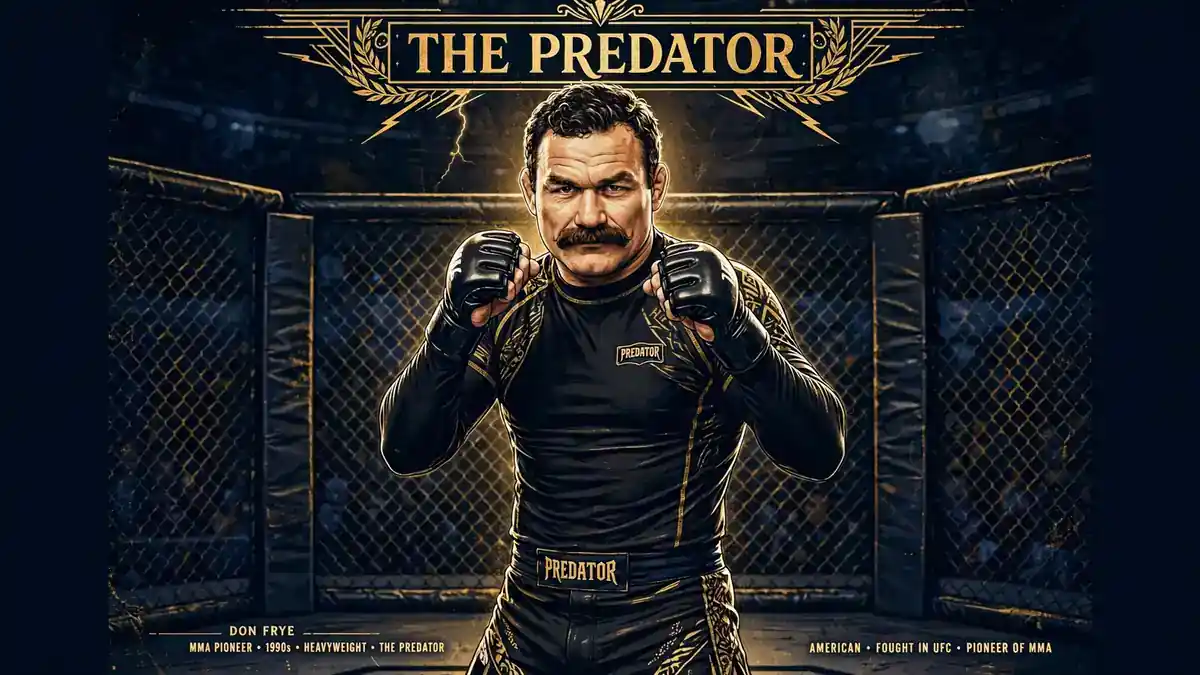
Don Frye‘s net worth is estimated at $2 million to $3 million as of November 2026. The man they called “The Predator” built it the hard way: two UFC tournament titles in 1996, four years as one of Japan’s biggest foreign wrestling stars, a second fighting life in PRIDE that produced the most famous brawl in MMA history, and then a Hollywood run that put him in a Godzilla film and a Michael Mann crime epic. He never earned the eight-figure paydays of the modern UFC era — he fought before those paydays existed — and serious health problems in 2016 and again in late 2025 have eaten into whatever he kept.
Don Frye: Quick Facts
| Estimated net worth | ~$2 million (range: $2 million to $3 million) |
|---|---|
| Profession | Retired mixed martial artist, professional wrestler, actor |
| Nationality | American |
| Born | November 23, 1965 (age 60) |
| Height | 6 ft 1 in (1.85 m) |
| Primary income sources | MMA fight purses (UFC, PRIDE, K-1), New Japan Pro-Wrestling contracts, acting roles, Japanese commercials, YouTube |
| Active years | 1989–1990 (boxing); 1996–2011 (MMA); 1997–2021 (pro wrestling, sporadic) |
| Last reviewed | November 2026 |
- Early Life and Background
- Education
- Career Journey
- Rise to Fame
- Main Sources of Income
- Salary and Earnings
- Businesses and Investments
- Brand Deals and Sponsorships
- Houses, Cars and Other Assets
- Awards and Achievements
- Net Worth Growth Over the Years
- Social Media Presence
- Personal Life
- Sources & Reporting
- Frequently Asked Questions
Early Life and Background
Donald Frye was born on November 23, 1965, in Sierra Vista, Arizona, to a family of Irish and Scottish descent. His childhood was unsettled: his father served in the Air Force, so the family moved often, and Frye has spoken openly about being molested on three separate occasions as a child — trauma he believes fed the anger problems and drinking that started when he was still in grade school. It is a dark thread in his story, and one he has refused to hide from interviewers.
Sports gave him the first structure his life had. He played Little League baseball, boxed, and took up judo as a boy, but wrestling — the sport that would define him — was an acquired taste. He first tried it at Buena High School in Sierra Vista and disliked it on first contact. He stuck with it anyway, and by his senior years he was good enough to wrestle in college. He fought one amateur boxing match in eighth grade, knocking his opponent down before getting his own nose broken, and quit the sport at his mother’s insistence.
The small-town Arizona backdrop matters to the money story. Frye was never a product of a big-city gym system or a wealthy family. He came out of Sierra Vista, a military town near the Mexican border, and every dollar he later earned in fighting came from a sport that, in 1996, barely paid anyone. The firefighter’s salary he lived on before the UFC — a working-class wage in Bisbee, Arizona — is the baseline against which his whole fortune should be measured.
Education
Frye enrolled at Arizona State University in 1984, where he wrestled under assistant coach Dan Severn — the same Dan Severn who would later become a UFC pioneer himself and, briefly, Frye’s cornerman and mentor. A shoulder injury interrupted his college career after he crashed an ATV while intoxicated, costing him a full year. He came back in 1987 and won both the freestyle and Greco-Roman events at an Olympic qualifier, but lost at the 1988 Olympic national trials and missed the Seoul Games.
A year later he transferred to Oklahoma State University–Stillwater, one of the strongest wrestling programs in the country. His teammates there included Randy Couture, another future UFC Hall of Famer. Frye also earned a second dan black belt in judo, a credential that separated him from the pure wrestlers and pure strikers of early MMA: he could throw, he could grapple, and he could punch. That three-way skill set was rare in 1996, and it is the main reason he won tournaments while one-dimensional fighters went home early.
No record shows Frye completing a degree, and his education story ends where his fighting education begins. The wrestling rooms at Arizona State and Oklahoma State were his real training ground, and the contacts he made there — Severn first among them — pulled him into the UFC.
Career Journey
Frye’s professional life falls into four acts, and each one paid differently. Act one was boxing: after college he trained for a year and a half, debuted on August 28, 1989, in Phoenix with a first-round knockout of Luis Mora, and fought eight times in fourteen months. The record was poor — two wins, five losses, one draw — and his last bout, a technical-knockout loss to David Kilgour at the Reseda Country Club on December 11, 1990, ended it. He boxed under the name J.R. Frye in several bouts after a contractual dispute forced a name change. Boxing paid him almost nothing; he retired and became an emergency medical technician and a firefighter in Bisbee, Arizona, and worked a stint in a psychiatric ward that ended after he broke a patient’s arm restraining him.
Act two was the UFC, and it arrived by accident. In 1995 Frye helped train Dan Severn for Ultimate Ultimate 1995 in Denver, traveling with Severn’s entourage. The UFC’s matchmakers saw a big, mustached wrestler who could box, and signed him. He debuted at UFC 8 in Bayamón, Puerto Rico, on February 16, 1996, and won the eight-man openweight tournament in a single night: an eight-second knockout of 410-pound Thomas Ramirez in the quarter-final — a UFC record for fastest knockout at the time — then a technical knockout of Sam Adkins and a submission of Gary Goodridge in the final. Three fights, one night, one tournament title.
He beat Amaury Bitetti at UFC 9 in May 1996, then reached the final of UFC 10 that July, losing for the first time to Mark Coleman, the decorated wrestler who invented the ground-and-pound style Frye himself used. In December 1996 he won the Ultimate Ultimate 1996 tournament — the UFC’s champion-of-champions event — beating Goodridge again, submitting Mark Hall in 20 seconds, and choking out Tank Abbott in the final. In ten months he had gone 9–1 in the UFC with two tournament titles. Then, at 31, he retired from MMA.
Act three was Japan. The money in Japanese pro wrestling in the late 1990s dwarfed early UFC pay, and Frye followed it. Trained by Brad Rheingans and Curt Hennig, he debuted for New Japan Pro-Wrestling in August 1997, beating Kazuyuki Fujita, and within a year he was one of the company’s top foreign heels. On April 4, 1998, he won the tournament to face founder Antonio Inoki in Inoki’s retirement match — losing the match itself, but sharing a ring with a national icon in front of a huge Tokyo Dome crowd. He joined Masahiro Chono’s Team 2000 stable in 1999, feuded with Scott Norton over the unofficial title of top foreign wrestler, challenged for the IWGP Heavyweight Championship three times (against Keiji Mutoh in 1999, Kensuke Sasaki in 2000, and Fujita in 2001), and won the G1 World Climax tournament in September 2001.
Act four was the PRIDE return. In September 2001, five years after leaving MMA, Frye signed a multi-fight deal with PRIDE Fighting Championships and walked into the Osaka ring at Pride 16 waving an American flag in a shirt that read “terrorists suck” — two weeks after the September 11 attacks. He beat Gilbert Yvel by disqualification after Yvel repeatedly gouged his eyes, then beat Ken Shamrock in a split decision at Pride 19 in February 2002 in a fight that wrecked both men’s ankles and left Frye dependent on painkillers for years. Four months later came the Takayama fight. The rest of his career — K-1 and Hero’s from 2004 to 2006, a final PRIDE appearance in 2007, coaching the Tucson Scorpions in the International Fight League, and sporadic fights until a knockout loss to Ruben Villareal in December 2011 at age 46 — was a long, uneven wind-down. His final MMA record: 20 wins, 9 losses, 1 draw, 1 no contest across 31 fights.
Rise to Fame
Frye became famous twice, in two countries, for two different things. In America, the 1996 UFC run made him one of the first fighters fans could name. The sport was still a pay-per-view curiosity in 1996, banned from cable in many markets, and its stars were not rich — but Frye’s mustache, his brawling style, and the eight-second knockout gave him a look and a highlight that stuck. He was one of only two fighters of that era skilled in both stand-up and ground fighting, the other being Marco Ruas, and the UFC’s own record books still note him as one of only two men — Severn is the other — to win both a UFC tournament and an Ultimate Ultimate tournament.
In Japan, the fame was bigger and it paid better. As a New Japan heavyweight he was a featured foreign star for four years, and his PRIDE return turned him into a folk hero: the muscular American patriot who fought through a ruined ankle against Shamrock and then stood toe-to-toe with Yoshihiro Takayama in the most violent six minutes the sport had ever seen. The June 23, 2002, fight at Pride 21 in Saitama — the two men grabbing each other’s heads and trading undefended punches like a hockey fight, Frye landing roughly 60 punches in 30 seconds at one stretch, referee Yuji Shimada in tears — was named the Wrestling Observer Newsletter’s Fight of the Year for 2002 and topped Fox Sports Net’s “Best Damn 50 Beatdowns” list. Frye himself has said he should have retired after that fight: “He stole my soul. I was never the same after that fight.”
The third wave of fame came from film. Director Ryuhei Kitamura wrote the role of Captain Douglas Gordon in Godzilla: Final Wars (2004) specifically for Frye after watching his fights, and Frye’s scene-stealing turn in the 50th-anniversary Godzilla film made him a cult figure with a fan base that had never watched a fight. Appearances in Miami Vice (2006), Big Stan (2007), and Michael Mann’s Public Enemies (2009) kept him on screen through the decade. In 2016, the UFC closed the circle by inducting him into its Hall of Fame, Pioneer Wing.
Main Sources of Income
Frye’s money came from four streams, and their order changed across his career. In 1996 it was UFC purses and tournament prizes. From 1997 to 2001 it was New Japan Pro-Wrestling — contracted pay, merchandise, and appearance fees as a featured foreign heavyweight. From 2001 to 2007 it was PRIDE and K-1 fight purses, plus Japanese television commercials. From 2004 onward it was acting fees, and in recent years a YouTube channel that, by January 2026, had about 80,000 subscribers and 27.2 million views.
The wrestling years were almost certainly the best-paid stretch of his life. Japanese pro wrestling in the late 1990s paid its top foreign stars far more than the early UFC paid anyone, which is exactly why Frye walked away from MMA at 31 after winning two tournaments. The UFC of 1996 had no disclosed purses, no sponsorship system, and no pay-per-view points for fighters; a tournament winner’s prize was a flat fee, not a fortune. New Japan, by contrast, offered a steady contract, regular dates, and a level of celebrity in Japan that came with commercial work — including a long-running television ad for Nissin’s UFO yakisoba noodles, secured because a Nissin executive was a fan.
PRIDE paid well by the standards of its day, though nothing like modern UFC money. For scale, Quinton “Rampage” Jackson — one of PRIDE’s biggest American stars — later said the promotion paid him $30,000 per fight while bigger names earned $200,000 to $300,000 in cash. Frye sat somewhere in that middle band: a proven draw and former UFC champion, but not a titleholder in PRIDE. His PRIDE run lasted from 2001 to 2003 with a one-off return in 2007, and his K-1 Hero’s fights in 2006 — including a win over former sumo grand champion Akebono — added more purses in a year when he went unbeaten in the promotion.
Acting was the fourth stream, and the most durable. Godzilla: Final Wars gave him a leading role in a major franchise film; Miami Vice, The Ant Bully (voice work), Big Stan, and Public Enemies followed between 2006 and 2009. None of these were star salaries — Frye played supporting parts, and his lines were even cut from Public Enemies, as he joked in a 2008 interview — but film work paid per-project fees in an era when his fighting income was fading, and it kept his name in front of casting directors into the 2010s, including the fan film The Broken Gear, where he played Final Fight’s Mayor Mike Haggar, and an episode of It’s Always Sunny in Philadelphia.
Salary and Earnings
Here is the honest limit of the public record: Don Frye’s individual fight purses were never disclosed. The UFC did not publish fighter pay in 1996, PRIDE never disclosed purses, and New Japan contracts were private. Any site that quotes an exact salary for a specific Frye fight is guessing. What can be documented is the shape of his earning life.
In the UFC’s tournament era, pay was flat and modest. The promotion’s early purses ran to low five figures per event for most fighters, with tournament winners collecting a prize on top — nothing close to the six-figure show money that became standard a decade later. Frye fought nine times for the UFC across four events in 1996, winning two tournaments. A reasonable reading of the era, using disclosed purses from the late 1990s as a guide, puts his entire UFC earnings in the low six figures — enough to leave firefighting behind, not enough to retire on.
Japan changed the math. Four years as a featured New Japan heavyweight, with three IWGP Heavyweight Championship challenges and a G1 tournament win, meant a contracted salary rather than per-fight fees, plus the commercial work that came with being a recognizable foreign star in Tokyo. His PRIDE deal from 2001 onward added multi-fight purses in the same band as other established foreign names — tens of thousands of dollars per fight, with the biggest paydays attached to the Shamrock and Takayama bouts, the two fights that defined his second MMA career.
The later years paid less and cost more. K-1 Hero’s, King of the Cage, DEEP, and Shark Fights in 2006–2009 were smaller promotions with smaller purses, and by then Frye was fighting through injuries that needed surgery. The 2013 fusion of several vertebrae, the broken spinal rod and brain hemorrhage in 2016 that put him in a medically-induced coma for weeks, and the atrial fibrillation episode in December 2025 all carried medical costs that no fight purse was still coming in to cover. That is the central tension of his finances: the money arrived in the 1990s and 2000s, when fighter pay was low, and the bills arrived later, when the income had stopped.
His YouTube channel is the one income stream still running. With roughly 80,000 subscribers and 27.2 million total views as of early 2026, it generates modest advertising revenue — a few thousand dollars a year at typical rates for a channel of that size — and, more usefully, keeps Frye connected to the fan base that buys his appearances at conventions and fight events.
Businesses and Investments
Frye never built a business empire, and the record is thin on investments — which is itself a finding. Unlike modern fighters who launch gyms, supplement lines, and clothing brands, Frye’s generation had no blueprint for turning a fighting name into a company, and no record shows him founding one. His business activity was coaching and media: in 2007 he assembled and coached the Tucson Scorpions, the Arizona-based team in the International Fight League, though he parted ways with the IFL that November. He also wrote a weekly humor column, “Dear Don: Advice from The Predator,” answering fans’ questions on love, life, and friendship — a small media sideline, not a revenue engine.
There is no public record of Frye owning a gym, a restaurant, or a product line, and no property portfolio has ever been reported. The real-estate angle that fills out other fighters’ profiles simply does not exist for him in the public record, and we will not invent one. His wealth, such as it is, came from wages — fight purses, wrestling contracts, acting fees — rather than from assets that compound. That is why the estimate sits at $2 million to $3 million rather than higher: thirty years of working in combat sports and film, with no business sale or investment windfall layered on top.
The one asset that has clearly appreciated is his name. The UFC Hall of Fame induction in 2016, the Martial Arts History Museum Hall of Fame class of 2023, and the George Tragos Award in 2024 keep Frye bookable for appearances, signings, and interviews — the convention circuit pays retired fighters for exactly this kind of legacy, and Frye’s YouTube presence gives promoters a direct line to him. It is a modest living, not a fortune, but it is real and it is current.
Brand Deals and Sponsorships
Frye’s endorsement history is a story of two eras. In the 1990s UFC there was no sponsorship market to speak of — fighters wore whatever they owned, and the promotion’s own sponsors did not pay the athletes. The money that looked like endorsements came later, in Japan, where his fame translated into commercial work: the Nissin Foods UFO yakisoba television campaign, which ran on the strength of a Nissin executive’s fandom, and a string of Japanese ads tied to his PRIDE-era popularity.
In the United States, his most visible commercial work was an AT&T mini-movie advertisement for the BlackBerry Bold 9700 during the 2009 holiday season, a slick short film that played on his tough-guy image. He also lent his voice to the animated Stick 10 special The United League of Stereotypes as the villain Matt Ninesister. These were one-off fees, not long-term ambassador deals, and none of them approached the endorsement money of a modern UFC star — the market for fighter endorsements barely existed when Frye was at his peak, and by the time it did, he was past his.
That timing is the key point for his net worth. Fighters who peaked after 2010 could stack sponsorship money on top of purses; Frye peaked in 1996 and 2002, when the purse was the whole paycheck. The Japanese commercials were the closest he came to endorsement income, and they were a product of his Tokyo fame rather than any deal his American management struck.
Houses, Cars and Other Assets
Public records offer almost nothing specific about Frye’s homes or cars, and this section is honest about that gap rather than padding it with guesses. He has lived in Arizona for most of his life — born in Sierra Vista, based in Bisbee during his firefighting years, and still living in Arizona in recent years, where his daughter had to drive him to the hospital during the December 2025 health scare. His YouTube videos show a rural Arizona property with horses, which he has mentioned feeding in interviews. No purchase price, mortgage record, or property listing has been published for any Frye home, and no car collection has ever been reported.
What can be said is what his assets are not: there is no reported mansion, no fleet of luxury cars, no watch collection making the rounds on social media. Frye’s public image has always been the opposite of flashy — a working-class fighter from a military town who kept living in Arizona rather than moving to Los Angeles or Las Vegas when the acting work came. That modesty cuts both ways for the estimate: his living costs were lower than a star who moved to a coastal city, but he also never converted fame into the property portfolio that anchors other celebrities’ wealth.
The durable assets are intangible: the UFC Hall of Fame plaque, the two UFC tournament titles, the G1 World Climax trophy, and a fight — the Takayama war — that still plays on highlight reels and still sells his appearances. Those do not show up on a balance sheet, but they are the reason a 60-year-old retired fighter still has an audience and an income.
Awards and Achievements
Frye’s trophy case is the strongest part of his profile, and it is unusually broad — he won honors in three different combat disciplines. In MMA: UFC 8 Tournament winner (1996), Ultimate Ultimate 1996 Tournament winner, UFC 10 Tournament runner-up, and induction into the UFC Hall of Fame’s Pioneer Wing in 2016. He is one of only two fighters, alongside Dan Severn, to win both a UFC tournament and an Ultimate Ultimate tournament. The UFC Encyclopedia Awards credited him with Fight of the Night three times (against Amaury Bitetti, Mark Coleman, and Tank Abbott) and Submission of the Night once (against Mark Hall).
The Takayama fight carries its own honors: Wrestling Observer Newsletter Fight of the Year for 2002, first place on Fox Sports Net’s “Best Damn 50 Beatdowns,” and a place on Bleacher Report’s all-time lists — fourth-greatest MMA fight ever for the Takayama bout, with the Coleman fight at UFC 10 and the Shamrock fight at Pride 19 also ranked among the sport’s 100 best. In 2023 he entered the Martial Arts History Museum Hall of Fame, and in 2024 he received the George Tragos Award from the George Tragos/Lou Thesz Professional Wrestling Hall of Fame.
In professional wrestling: winner of the Antonio Inoki Final Opponent tournament in 1998, winner of the G1 World League in 2001, three IWGP Heavyweight Championship challenges, and rankings in Pro Wrestling Illustrated’s PWI 500 — No. 175 in 1999 and No. 247 in the PWI Years retrospective in 2003. His competitive record across combat sports reads: MMA 20–9–1 with 1 no contest, professional boxing 2–5–1, and one kickboxing loss to Jérôme Le Banner in front of 91,107 fans at Pride Shockwave in 2002.
One shadow sits alongside the honors, and a complete profile should name it. Mark Hall, Frye’s semi-final opponent at Ultimate Ultimate 1996, later claimed that Frye and their shared manager Robert DePersia persuaded him to throw the bout so Frye would be fresh for the final against Tank Abbott. Referee John McCarthy wrote in his autobiography that the 20-second ankle-lock finish struck him as a fixed bout — the second time he had felt that way as a referee. Frye has never been sanctioned over the allegation, and it remains a claim by Hall and an observation by McCarthy, not a finding. It belongs in the record because it is part of the story of his second tournament title.
Net Worth Growth Over the Years
No filings track Frye’s wealth year by year, so the table below is an honest reconstruction from his career arc — labeled as estimates, not accounts. The pattern it shows is the point: a slow build through the Japan years, a peak in the late 2000s when acting fees stacked on top of fighting income, and a flat line since, as medical costs and retirement froze the figure where it stands.
| Year | Estimated net worth | What drove it |
|---|---|---|
| 1996 | Under $250,000 | Two UFC tournament titles; flat tournament-era purses; firefighter’s wage left behind |
| 2001 | $500,000 – $1 million | Four years as a featured New Japan heavyweight; G1 World Climax win |
| 2003 | $1 – $1.5 million | PRIDE purses for the Shamrock and Takayama fights; Japanese commercials |
| 2009 | $1.5 – $2 million | K-1 Hero’s purses; Godzilla, Miami Vice, Big Stan and Public Enemies acting fees |
| 2016 | $2 million | UFC Hall of Fame induction; Celebrity Net Worth’s $2 million figure dates from this era |
| 2026 | $2 – $3 million | Range reflects the $2 million consensus against TheCityCeleb’s $3 million; YouTube and appearances offset medical costs |
The range for 2026 deserves a plain explanation. Celebrity Net Worth, NetWorthPost, and several other trackers converge on $2 million, and that figure has barely moved in years — it dates from reporting that has not been refreshed with new earnings, because there have been no big new earnings. TheCityCeleb’s $3 million appears to credit Frye with more of his Japan-era income surviving than the consensus allows. Neither side can prove its number, because Frye’s finances are private. We publish the range and let the reader see the disagreement rather than picking one number and pretending the record is cleaner than it is.
Social Media Presence
Frye’s main platform is YouTube, where his channel — under his own name — had about 80,000 subscribers and 27.2 million total views at the last update in January 2026. The channel is where he posts long, unfiltered videos, and it is where he broke the news of his December 2025 hospitalization himself, filming from his hospital bed and explaining that his daughter had driven him in after Gary Goodridge raised the alarm. That directness is the channel’s appeal: no publicist, no polish, just Frye talking.
He is not a major presence on the other platforms in the way younger fighters are — no verified Instagram empire, no daily Twitter output — and that fits the profile of a 60-year-old pioneer whose fame predates social media by a decade. His visibility comes from the fight footage, the Godzilla film, and the YouTube channel, not from a managed feed. For a net worth profile, the practical point is that social media is a small income line for him, not a business: a few thousand dollars a year in ad revenue and a direct channel to the fans who attend his appearances.
Personal Life
Frye was married to Mollie Frye for about twenty years, and they have two daughters together. The marriage ended in divorce in 2016 — the same year as his Hall of Fame induction and his near-fatal hospital stay, a convergence that made 2016 the hardest year of his life. His daughters remain central to it: it was one of them who drove him to the hospital in December 2025, after Goodridge called her about Frye’s breathing, and Frye has described his daughter, with characteristic humor, as “the boss” who threw him in the truck.
His health is the dominant personal story of the last decade. In 2013 he had several vertebrae fused. In 2016, an X-ray showed the rod from an earlier back surgery had broken; during treatment he suffered a brain hemorrhage, spent about ten weeks in hospital — much of it in a medically-induced coma — developed pneumonia, and came out needing a walker. He told Ariel Helwani’s The MMA Hour that December that he had been awake for ten days after two months unconscious. The painkiller dependency that followed the Shamrock fight in 2002, when Shamrock’s ankle locks badly damaged his legs, was part of the same long arc: a body that took punishment for fifteen years and kept billing him for it afterward.
In December 2025, at 60, the heart condition returned. Frye had been treated for atrial fibrillation in 2016 and kept on medication for nearly a decade; late in 2025 his breathing worsened over three or four months until he could barely feed his horses. Doctors confirmed atrial fibrillation again, stabilized his heart rhythm with new medication, and lifted his oxygen levels from 96 percent back to 99 or 100 percent. He was discharged and recovering at home by Christmas week, and posted the video himself — the same plain-spoken style that has defined his public life since 1996. He lives in Arizona, near his family, and remains close to the old UFC guard: it was Goodridge, a man he fought three times, who saved him by calling his daughter.
Sources & Reporting
Celebrity Net Worth — the $2 million estimate; career summary including the UFC 8 win, the PRIDE return, the 2016 hospitalization, and the divorce from Mollie Frye. Reporting window: page updated within the last two months.
TheCityCeleb — the $3 million figure, the high end of our range; biographical details including age 60, the UFC 8 title, and the two daughters. Reporting window: 2026.
NetWorthPost — the $2 million figure as of late 2017; filmography including Godzilla: Final Wars, Miami Vice, and Public Enemies; MMA record of 20 wins from 31 fights.
Wikipedia — the career spine of this article: birth date and place, Arizona State and Oklahoma State wrestling, the boxing record (2–5–1), the full UFC/PRIDE/K-1 fight history, the New Japan career including the Inoki retirement match and three IWGP title challenges, the acting filmography, the Hall of Fame honors, and the YouTube figures (80,000 subscribers, 27.2 million views). Page last crawled October 2026.
Sherdog — the December 2025 atrial fibrillation hospitalization, the Gary Goodridge intervention, and Frye’s own account of his treatment. Reporting window: December 2025.
MMA Fighting — Dave Meltzer’s transcription of Frye’s December 2016 account of the coma, the broken spinal rod, and the brain hemorrhage, via The MMA Hour. Reporting window: December 2016.
MMAWeekly — Frye’s 2013 interview on the Takayama fight, including his statement that it won Fight of the Year two years running and that “everybody who knows something about the fight game has seen that fight.” Reporting window: March 2013.
MiddleEasy — the December 2025 hospital stay, the three weeks of breathing difficulty, and the oxygen readings. Reporting window: December 2025.
Gila Herald — Frye’s 2022 reflection on the Takayama fight (“He stole my soul”), his 10–1 UFC-era record, and the detail that referee Yuji Shimada wept during the bout. Reporting window: 2022.
Fighters Only — the May 2007 ringside account of the Takayama fight, including the estimate of 60 punches landed in 30 seconds. Reporting window: May 2007.
Where sources disagreed on the net worth figure, we published the range and named who says what. Where purses were never disclosed — which covers nearly every Frye fight — we said so instead of quoting a made-up salary. Figures that could not be traced to a named outlet were cut.
Frequently Asked Questions
What is Don Frye’s net worth in 2026?
Don Frye’s net worth is estimated at $2 million to $3 million as of November 2026. Celebrity Net Worth and NetWorthPost put him at $2 million, while TheCityCeleb puts him at $3 million. No audited statement exists, so the honest answer is the range, built from UFC and PRIDE purses, four years of New Japan Pro-Wrestling pay, acting fees, and Japanese commercials.
How old is Don Frye?
Don Frye was born on November 23, 1965, in Sierra Vista, Arizona, which makes him 60 years old as of November 2026. He was 30 when he won the UFC 8 tournament in February 1996 and 46 when he fought his last MMA bout in December 2011.
What is Don Frye’s MMA record?
Don Frye’s professional MMA record is 20 wins, 9 losses, 1 draw, and 1 no contest across 31 fights from 1996 to 2011. Eight wins came by knockout and ten by submission. Inside the UFC he went 9–1, winning the UFC 8 and Ultimate Ultimate 1996 tournaments and finishing runner-up at UFC 10.
Is Don Frye in the UFC Hall of Fame?
Yes. Don Frye was inducted into the UFC Hall of Fame’s Pioneer Wing in 2016, twenty years after his two tournament wins. He was later inducted into the Martial Arts History Museum Hall of Fame in 2023 and received the George Tragos Award from the George Tragos/Lou Thesz Professional Wrestling Hall of Fame in 2024.
What happened in the Don Frye vs. Yoshihiro Takayama fight?
On June 23, 2002, at Pride 21 in Saitama, Japan, Frye and Takayama stood in a clinch and traded undefended punches for more than a minute at a time — Frye landing roughly 60 punches in one 30-second stretch — before Frye mounted Takayama and won by technical knockout at 6:10 of the first round. It was named the Wrestling Observer Newsletter’s Fight of the Year for 2002 and topped Fox Sports Net’s “Best Damn 50 Beatdowns” list. Frye has said he was never the same fighter afterward.
What movies was Don Frye in?
Don Frye’s best-known film role is Captain Douglas Gordon in Godzilla: Final Wars (2004), a part director Ryuhei Kitamura wrote for him. He also appeared in Miami Vice (2006), voiced a role in The Ant Bully (2006), played a Nation member in Big Stan (2007), and played FBI agent Clarence Hurt in Michael Mann’s Public Enemies (2009). He also appeared in an episode of It’s Always Sunny in Philadelphia.
Is Don Frye still alive?
Yes. Don Frye is alive and living in Arizona. He was hospitalized in December 2025 with atrial fibrillation — an irregular heartbeat he was first treated for in 2016 — after his breathing worsened over several months. His former rival Gary Goodridge alerted Frye’s daughter, who drove him to the hospital. Doctors stabilized his heart rhythm with new medication, and he was discharged and recovering at home by Christmas week 2025.
What is Don Frye doing now?
As of 2026, Don Frye runs a YouTube channel under his own name with about 80,000 subscribers and 27.2 million views, makes appearances at fight events and conventions, and lives in Arizona near his family. He last fought in MMA in December 2011 and last wrestled in 2021, and his income now comes mainly from appearances, the YouTube channel, and his Hall of Fame legacy.
Final Thoughts
Don Frye’s $2 million to $3 million fortune is small next to the fortunes of modern UFC stars, and that gap is the story. He fought at the exact moment when the sport paid the least — flat tournament prizes in 1996, undisclosed purses in PRIDE, and a wrestling contract in Japan that was generous for its time but modest by any modern measure. He made his money three times over — in the cage, in the Tokyo wrestling rings, and on film — and each time the pay scale of the era capped what he could keep. The health bills that followed, from the fused vertebrae to the 2016 coma to the heart scare in December 2025, did the rest.
What he kept instead was a legacy that money cannot buy: two UFC tournament titles, a place in the Hall of Fame, and the single most famous brawl in the sport’s history. Fighters who earned ten times his money will not be remembered as long. Frye will be — every time someone plays the Takayama fight, every time Godzilla: Final Wars airs, and every time a new fan discovers the mustached American who won three fights in one night in Puerto Rico in 1996.
Published on November 6, 2026. Last reviewed November 2026. Found an error? See our corrections policy.