
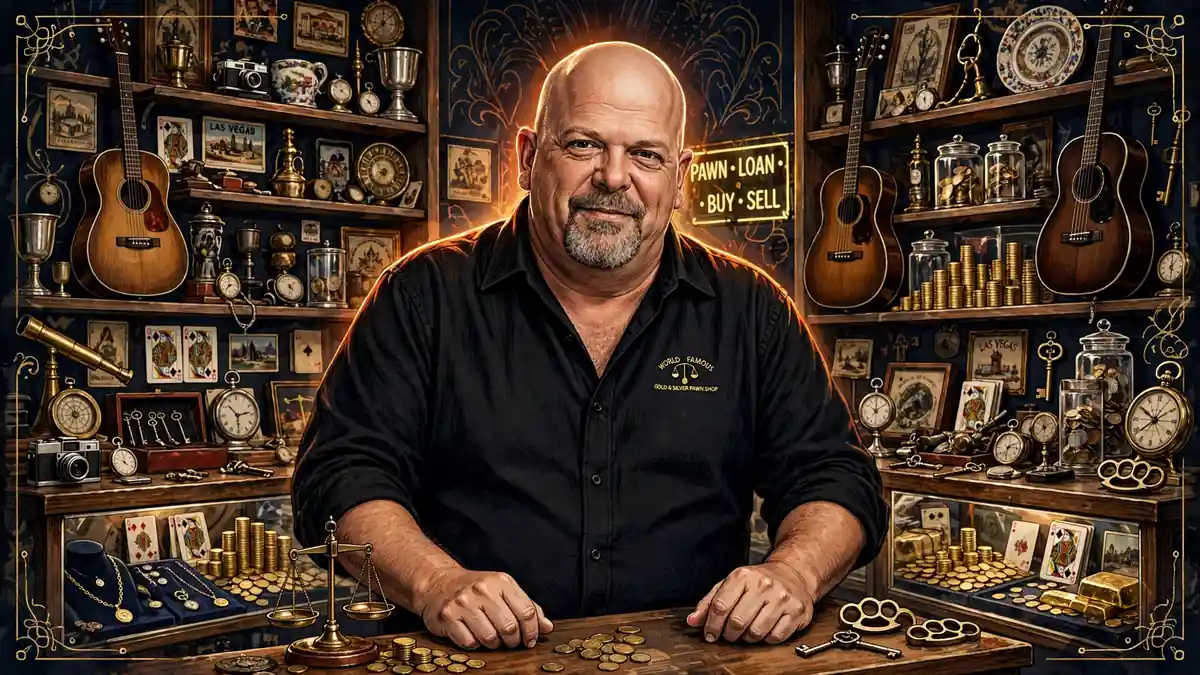
Rick Harrison‘s net worth is estimated at $9–10 million as of November 2026. The Pawn Stars frontman built that fortune the slow way first — a family pawn shop his father opened in 1989, loans that were already producing about $700,000 a year in interest by 2005 — and the fast way second, when the History Channel turned that shop into the network’s highest-rated show and kept it on the air for roughly 700 episodes across 25 seasons. He owns about 95 percent of the Gold & Silver Pawn Shop, a business Celebrity Net Worth values at roughly $10 million, and his 2026 has been the most eventful year of his life off camera: a fifth wedding in January, emergency heart bypass surgery in October, and new Pawn Stars episodes returning without his son Corey for the first time.
Rick Harrison: Quick Facts
| Estimated net worth | $10 million (range: $9–10 million) |
|---|---|
| Profession | Businessman, reality television personality, author |
| Nationality | American |
| Born | March 22, 1965 (age 61) |
| Height | About 5 feet 11 inches (182 cm) |
| Primary income sources | Gold & Silver Pawn Shop, Pawn Stars salary, Pawn Plaza rents, Rick’s Rollin Smoke BBQ & Tavern, book royalties, podcast |
| Active years | 1989–present |
| Last reviewed | November 2026 |
- Early Life and Background
- Education
- Career Journey
- Rise to Fame
- Main Sources of Income
- Salary and Earnings
- Businesses and Investments
- Brand Deals and Sponsorships
- Houses, Cars and Other Assets
- Awards and Achievements
- Net Worth Growth Over the Years
- Social Media Presence
- Personal Life
- Sources & Reporting
- Frequently Asked Questions
- Final Thoughts
Early Life and Background
Richard Kevin Harrison was born on March 22, 1965, in Lexington, North Carolina, the third child of Richard Benjamin Harrison Jr., a U.S. Navy veteran, and Joanne Rhue Harrison. His father, later known to television viewers as “the Old Man,” had already spent years in the pawn business by the time Rick was a boy, and the trade shaped the household. Rick grew up around the mechanics of lending against collateral — what things were worth, what people would pay, and how fast a price could change when a customer needed cash the same day.
Childhood did not run smoothly. Rick developed epilepsy as a boy, and the seizures kept him in bed for long stretches. He filled those hours reading, and the books that stuck were John D. Fitzgerald’s Great Brain series, about a ten-year-old Utah con artist named Tom D. Fitzgerald who dreamed up money-making schemes. Harrison has said in interviews that the character left a mark on how he thought about deals: look for the angle, know the value before you open your mouth, and never pay more than a thing is worth to you.
The family moved from North Carolina to San Diego, and then to Las Vegas in 1981, when Rick was 16. Las Vegas in the early 1980s was a smaller city than the one tourists know now, and the Harrisons arrived with pawn experience and little else. Rick left high school in the tenth grade. He has never hidden that fact; he treats it as part of the story, not a gap in it. School had not held him. Buying and selling did.
As a teenager he found his first real income stream selling counterfeit Gucci handbags, and at his peak he was making about $2,000 a week — serious money for a teenager in the early 1980s, and a number Harrison himself has repeated in interviews and in his memoir. The work was illegal, and he does not present it as a triumph. He presents it as the moment he learned he could move product, read a customer, and close a sale. The next step was doing the same thing legally, with his father, in a licensed shop.
That step took patience. Las Vegas capped pawn licenses based on the city’s population, so a new license was not simply a matter of applying and paying a fee. Harrison tracked the city’s population statistics week by week, waiting for Las Vegas to cross the threshold that would let him apply. When the numbers lined up, he and his father moved. The Gold & Silver Pawn Shop opened in 1989, less than two miles from the Las Vegas Strip, at 713 South Las Vegas Boulevard. The shop’s early years were quiet — a handful of customers a day, in a storefront that looked like any other pawn shop in town. The family kept it open around the clock in those years, working the counter in shifts.
Two details from this period explain a lot about the fortune that followed. First, the Harrisons owned the business outright, father and son, with no outside partners and no franchise fees. Second, Rick treated the shop as a school for pricing. Every item that crossed the counter — a guitar, a coin collection, a military medal, a piece of jewelry — was a lesson in what collectors would pay and what a desperate seller would accept. By the time a television camera arrived twenty years later, he had already spent two decades building the eye that made the show work.
Education
Rick Harrison has no college degree and no high school diploma. He dropped out of school in the tenth grade, and the record is consistent across every profile of him: formal education ended early, and the pawn counter became his classroom. That is not a euphemism in his case. The skills that built his wealth — appraising objects, judging authenticity, negotiating under pressure — were learned across a counter, not in a lecture hall.
What he did read, he read on his own. The Great Brain books of his sickbed childhood gave him a model for thinking about schemes and margins. Later, the shop itself supplied a daily education in history: coins, firearms, artwork, musical instruments, sports memorabilia, and military artifacts, each with its own market, its own forgers, and its own tells. Harrison’s on-screen nickname, “the Spotter,” refers to this skill — his ability to detect a forgery or a fake signature at a glance. That ability came from handling thousands of objects a year for decades, and from a network of experts he learned to call when an item sat outside his knowledge.
He has been open about the trade-off. A tenth-grade dropout who became a millionaire is a story that flatters the dropout and says little about the work. Harrison’s version includes the unglamorous parts: years of seven-day weeks, a shop that barely drew customers at first, and a father who kept the doors open while the business grew slowly. The education that mattered was the one he paid for with time behind the counter.
Career Journey
The Gold & Silver Pawn Shop spent its first decade and a half as a working Las Vegas pawn business and not much else. Rick and his father, Richard “the Old Man” Harrison, ran it together, with Rick’s son Corey joining the counter as he grew up. The shop lent money against jewelry, electronics, tools, and collectibles, and sold the items that borrowers never reclaimed. It was steady, unglamorous work, and for years the customer count stayed low. One account of the early shop puts the traffic at roughly seven visitors on a good day.
The numbers improved as Las Vegas grew. By 2005, the shop was issuing roughly $3 million in loans a year and generating about $700,000 a year in interest income, according to Celebrity Net Worth’s reporting on the business. That figure matters because it predates television entirely. The pawn shop was already a profitable, million-dollar-scale business before a single camera arrived. The television money that followed was built on top of a real business, not instead of one.
Television found the shop before the shop found television. In 2003, the Gold & Silver was featured on Insomniac with Dave Attell, and Harrison saw what a camera did to foot traffic. He spent the next several years pitching a show built around the shop, and the pitch kept failing. Networks liked the setting and doubted the format. Harrison kept going back. The version that finally sold was simple: real customers bringing real objects across a real counter, with Harrison, his father, his son, and the shop’s longtime employee Austin “Chumlee” Russell deciding what each item was worth.
Pawn Stars premiered on the History Channel on July 19, 2009. The cast was the family itself — three generations of Harrisons plus Chumlee, who had been around the shop since childhood. The format gave each episode several items to appraise, a negotiation, and usually a visit from one of the show’s roster of outside experts: a historian, a firearms specialist, a coin dealer, an art authenticator. Harrison’s role was the center of the machine. He set the price, he called the expert, and he decided whether the deal closed.
The shop changed the moment the show aired. A storefront that had once counted its daily visitors in single figures began drawing thousands of people a day, many of them tourists who had no intention of pawning anything and simply wanted to stand where the show was filmed. The Harrisons adapted fast. In June 2013, Rick opened an “Express Pawn” counter so regular pawn customers could be served while the main floor was closed for filming. The showroom’s hours settled at 10:00 a.m. to 5:30 p.m. daily, closed only on Christmas and Thanksgiving, and the shop began selling tickets for meet-and-greets and behind-the-scenes tours.
Behind the counter, the business also changed shape. The shop’s inventory became a tourist attraction in itself — vintage guitars, militaria, casino memorabilia, rare coins, and Super Bowl rings among the items on the floor — and the retail side of the business grew alongside the lending side. Harrison’s son Corey, known on the show as “Big Hoss,” moved from the counter into a management role, and the family began buying the land around the shop. That land became Pawn Plaza, the retail center next door, which is covered in the businesses section below.
The cast changed over the years in ways the show could not script. Richard “the Old Man” Harrison died on June 25, 2018, at 77, after living with Parkinson’s disease. Corey left Las Vegas in September 2024, moving to Tulum, Mexico, and starting his own podcast, The Corey Harrison Show. In early 2025 he said publicly that he would not return to the series, telling interviewers he could not play another season of a 41-year-old pretending to be 23. The show went on an indefinite hiatus in 2025 after its most recent original episodes aired in September 2024. Then, in December 2025, the History Channel confirmed new episodes would film in early 2026, with Rick Harrison and Chumlee as the featured co-stars — the first season in the show’s history without Corey as a principal cast member. Listings show the new run, billed as season 25, airing from October 7, 2026, with episodes scheduled into November.
Rise to Fame
Pawn Stars did not climb slowly. Within eighteen months of its July 2009 premiere, it was the highest-rated program on the History Channel, and in January 2011 it ranked as the second-highest-rated reality show on American television, behind only Jersey Shore. The show’s appeal was the negotiation itself: a stranger walking in with an object, Harrison sizing it up, an expert confirming or destroying its value, and a price agreed or a deal walked away from. Viewers learned the value of things alongside the cast, and the format proved easy to repeat — roughly 700 episodes over 25 seasons, broadcast in 150 countries and dubbed into 38 languages, according to the Marin Independent Journal’s December 2025 reporting on the revival.
Fame changed the economics of the shop in two directions. First, the show paid. Business Insider reported in 2014 that Harrison was paid about $15,000 per episode, or roughly $300,000 per season, and the same figure was still being cited in 2016. Later reports put the per-episode figure closer to $25,000. Second, fame made the shop itself a destination. Rick has said that more than 4,000 visitors a day enter the store, and on busy days the number reaches 5,000. Even if only a fraction of those visitors buy anything, the foot traffic supports the retail floor, the plaza next door, and the tour business in a way a normal pawn shop never could.
Harrison turned the fame into a book. License to Pawn: Deals, Steals, and My Life at the Gold & Silver, published on June 7, 2011, reached number 22 on the New York Times bestseller list on June 26, 2011. The memoir told the story competitors had been guessing at: the counterfeit handbags, the population charts, the years of near-empty shop days. It also fixed his public image. He was not a television creation. He was a pawnbroker who had spent twenty years learning to price things before anyone filmed him doing it.
The fame also made him a regular figure in Las Vegas business coverage. He told Forbes that his investment allocation ran about 10 percent gold and silver — which he called an insurance policy — 80 percent in blue-chip companies, and 10 percent set aside to have, in his words, a little crazy fun with. That split tells its own story about the fortune: most of it sits in the shop and in conservative holdings, not in the television paycheck. The show made him famous. The shop and the investments made him rich.
In February 2025, Harrison and Chumlee added a podcast, Pawn After Dark, recorded in a studio in the back of the shop after hours. The format is looser than the television show — long conversations about the items and customers that never make it past the network’s lawyers — and it gives Harrison a second audience that does not depend on the History Channel’s schedule. It also arrived at the right moment: with the television show on hiatus through 2025, the podcast kept the brand in front of fans and added digital advertising income to a business that had previously run on the shop floor and the screen.
Main Sources of Income
Rick Harrison’s money comes from five streams, and the pawn shop still sits at the center of all of them. The order below runs from the largest to the smallest, as far as public reporting allows.
The Gold & Silver Pawn Shop. This is the foundation. The shop earns money two ways: interest on pawn loans and profit on retail sales of items borrowers never reclaim. By 2005, the lending side alone was producing about $700,000 a year in interest on roughly $3 million in annual loans. Celebrity Net Worth values the business at about $10 million and reports that Harrison owns an estimated 95 percent of it, with his son Corey holding the remaining 5 percent. Since the show premiered, the retail side has grown far beyond what a normal pawn shop sees, because thousands of tourists a day walk through a showroom that doubles as a television set. The shop also sells branded merchandise and runs paid tours and meet-and-greets, which turn foot traffic into direct revenue.
Pawn Stars salary and production income. Harrison is paid per episode as the show’s star, and he also carries an executive producer credit, which adds a separate stream from the production side. Business Insider’s reporting put his pay at about $15,000 per episode in 2014 and 2016, with later reports closer to $25,000. Across roughly 700 episodes, even the lower figure represents millions of dollars in career television earnings, before residuals from syndication in 150 countries. The exact current per-episode figure is not public, and the salary section below works through the conflicting reports in detail.
Pawn Plaza rents. Harrison owns the retail center directly next to the shop. Pawn Plaza leases storefronts to tenants including his own Rick’s Rollin Smoke BBQ & Tavern, Chumlee’s Candy on the Blvd, the CBD coffee vendor Nfused Coffee, and the empanada restaurant Q’Rico. Rent from third-party tenants is the quietest income stream in the portfolio — it never appears on television — but it is also the most stable, because it does not depend on ratings or filming schedules. Looper’s 2021 reporting on the plaza noted that four restaurants had closed there in its first six years, a reminder that the landlord business carries its own risks.
Rick’s Rollin Smoke BBQ & Tavern. The barbecue restaurant and bar inside Pawn Plaza is Harrison’s own hospitality business rather than a tenant. The shop’s own visitor information says Rick can be found bartending there on Friday and Saturday nights, and the restaurant sells $10 barbecue plates to tour groups. Hospitality margins are thinner than pawn margins, but the restaurant converts the shop’s tourist traffic into food and drink sales that would otherwise leave the property.
Books, podcast, and appearances. License to Pawn earned royalties as a New York Times bestseller in 2011 and continues to sell as a backlist title. Pawn After Dark, the podcast he launched with Chumlee in February 2025, brings in digital advertising income. Paid appearances, autograph sessions, and the shop’s tour packages add smaller sums. None of these streams rivals the shop, but together they keep money coming in during the months when the show is not filming.
Salary and Earnings
Ask how much Rick Harrison makes per episode of Pawn Stars and the internet will give you four different answers. The honest answer is that the figure has changed over time, the reliable reporting clusters in a narrow band, and the biggest numbers floating around are not trustworthy.
The strongest reporting comes from Business Insider, which reported in 2014 that Harrison was paid about $15,000 per episode, or roughly $300,000 per season, and the same $15,000 figure was still being cited in 2016. PopCulture’s later reporting repeats the $15,000 figure for 2016 and notes that the show itself was generating about $3 million per episode for the network — a useful reminder that the cast’s pay was a small slice of what the show earned. TVOverMind, reporting on the cast’s pay, put the figure at about $25,000 per episode in later seasons, with annual earnings of $300,000 to $500,000 depending on the size of the season. That $15,000-to-$25,000 band is the range we use: it is anchored in named reporting, and the two ends reflect different points in the show’s run.
Then there is the outlier. A cluster of low-quality net worth sites claims Harrison earns $100,000 per episode, and one goes further, claiming $300,000 per episode. Neither figure traces to a named outlet, a filing, or an interview. The $100,000 claim appears on sites that also print mutually contradictory net worth figures for the same person on the same page — one such page lists $8 million, $13 million, and $18 million for Harrison within a few paragraphs. We do not use those numbers. A reader who sees $100,000 per episode quoted elsewhere should know it has no credible source behind it.
What does the per-episode pay add up to? Across roughly 700 episodes, $15,000 an episode would mean about $10.5 million in gross career pay before tax, agents, and the long gaps between seasons — but Harrison was not paid that rate from the start, seasons vary in length, and no one outside the production knows the current rate. The safe way to say it is this: television has paid him millions over seventeen years, and the paycheck is the second-largest stream in his fortune, behind the shop. His executive producer credit adds income the per-episode figure does not capture, and syndication residuals from 150 countries add more, but no outlet has published a reliable number for either.
One more earnings detail belongs here because it shows how Harrison thinks about money. He told Forbes that his portfolio runs about 10 percent in gold and silver, 80 percent in blue-chip companies, and 10 percent in speculative bets. That is the allocation of a man who made his money buying things cheap and selling them dear, and who treats precious metals as insurance rather than a gamble. It also explains why his net worth has moved slowly rather than spiking: the shop compounds, the television money arrives in seasons, and the portfolio sits in large, dull companies.
Businesses and Investments
Harrison’s business life divides into the shop, the land around the shop, and the portfolio. The shop came first and still matters most. The land came second, and it is the part of the fortune most profiles overlook.
The shop as a business. The Gold & Silver Pawn Shop at 713 South Las Vegas Boulevard is a licensed pawnbroker, a retailer, and a tourist attraction in a single storefront. The lending side is the classic pawn model: a customer brings in an item, the shop lends a fraction of its resale value, and the shop earns interest if the loan is repaid or keeps the item if it is not. The retail side sells reclaimed items, collectibles, and merchandise. The tourism side sells access — tours, meet-and-greets, and the chance to stand on a television set. All three run from the same floor, and all three feed each other: the show brings the tourists, the tourists buy the merchandise, and the merchandise includes items the cameras made famous.
Pawn Plaza. Harrison owns the two-story retail center immediately beside the shop, and it functions as a small commercial landlord business. Tenants have included his own barbecue restaurant, Chumlee’s candy shop, a CBD coffee vendor, and an empanada restaurant. The plaza is not officially affiliated with Pawn Stars the television series — it never appears on the show — but for anyone visiting the shop it is impossible to miss. The rents are steady income that does not depend on whether the History Channel is filming. The risk is ordinary commercial real estate risk: Looper reported in 2021 that four restaurants had closed in the plaza during its first six years, which is a normal churn rate for food tenants and a reminder that the landlord’s income depends on keeping the storefronts filled.
Earlier ventures. Harrison has owned a Quiznos franchise and several other small businesses around Las Vegas over the years, according to TVOverMind’s reporting on his business history. None of them approached the scale of the pawn shop, and none of them survived as a public part of his portfolio. They matter as evidence of a habit: Harrison has always run more than one business at a time, and he has always been willing to close one that does not work.
The investment portfolio. The clearest public statement of Harrison’s investing sits in the Forbes interview where he described his allocation: about 10 percent in gold and silver, 80 percent in blue-chip companies, and 10 percent in speculative positions. The gold and silver holding is both a business hedge — his shop’s inventory is priced in precious metals every day — and a personal one. The blue-chip majority is the unglamorous core of the fortune, and it is the reason his net worth has grown steadily rather than swinging with television ratings. He has not published the size of the portfolio, and we do not estimate it. What the allocation tells us is temperament: a pawnbroker who buys low, sells high, and keeps most of his money in large, established companies.
What he does not own. For completeness: there is no reliable reporting that Harrison owns a second pawn shop, a franchise chain, or a major stake in a public company. His wealth is concentrated in one shop, one plaza, one restaurant, and a personal portfolio. That concentration is also a risk — a downturn in Las Vegas tourism would hit the shop, the plaza, and the restaurant at the same time — but it is a risk he has carried for more than thirty-five years.
Brand Deals and Sponsorships
Harrison is not a brand-deal celebrity in the usual sense. He does not front sneaker campaigns or post paid endorsements for watches, and there is no reliable reporting of a major endorsement contract with a national brand. His commercial life runs through businesses he owns rather than brands that pay him, and that distinction is worth stating plainly: the absence of endorsement income is a real feature of his fortune, not a gap in the reporting.
What he does have is licensing and merchandising tied to the show. The shop sells Pawn Stars branded merchandise — shirts, mugs, and memorabilia — and the brand extends to the tour packages and the paid meet-and-greet sessions. These are retail sales from his own counter, not sponsorship fees, and they scale with foot traffic rather than with a contract.
The closest thing to a sponsorship in his portfolio is the podcast. Pawn After Dark carries digital advertising, and podcast advertising is, in effect, a series of small sponsorships sold by the episode. No advertiser list or rate has been published, so we do not put a number on it. The show’s value to Harrison is strategic as much as financial: it keeps the Pawn Stars brand in front of listeners during the months when the television show is dark, and it does so on a platform he controls with Chumlee rather than one the network controls.
He has also monetized his own appearances. The shop’s visitor program includes paid VIP tours with meet-and-greets, and Harrison appears at scheduled events around Las Vegas. These are modest, event-by-event payments, and they depend on his willingness to show up — which, in 2026, has been interrupted by surgery and family events. No one should model his income as if the appearance fees run on autopilot. They stop when he stops.

Houses, Cars and Other Assets
Harrison’s real estate is better documented than his cars, and the house story has a clear arc: a large Las Vegas home bought, renovated, listed, and eventually left behind for a quieter property out of state.
The Summerlin house. His best-known home was the 8,845-square-foot house at 2556 Red Arrow Drive in Summerlin, Las Vegas, with five bedrooms and eight bathrooms. He listed it in 2019 with an asking price of nearly $4 million — $3.99 million — after spending more than $600,000 on renovations. The listing showed off the owner’s taste: a home theater, a wine cellar, a gym, acid-washed granite floors, and a 12th-century stained glass window installed among the pawned finds he had collected over the years. The house did not sell quickly, and reporting on it stops there. What is certain is that he no longer lives there. More recent reporting places his current residence at a ranch property near Port Orford, Oregon, described as an off-grid retreat, and the exact address is not public. We do not publish it, and neither should anyone else.
The first Las Vegas house. Before the Summerlin property, Harrison owned a smaller Las Vegas home — a 3,932-square-foot single-family house with four bedrooms — on a 0.54-acre lot he bought on February 13, 1998, for $85,000. That purchase price is a useful anchor for the whole story. In 1998, Harrison was nine years into running the pawn shop and still years away from television. The $85,000 lot was a working businessman’s purchase, not a celebrity’s. The fortune grew from that scale of decision, repeated over decades.
The Oregon ranch. The Port Orford property is the least documented of his homes, and the reporting on it is thin: an off-grid ranch outside a small coastal town in Oregon, valued for privacy rather than for display. It fits the pattern of the later Harrison — a man who spent thirty years in the most public shop in Las Vegas and then chose a home where no one can find him. We do not estimate its value. Rural Oregon land records and celebrity-home blogs disagree on the details, and a guess would add nothing.
Cars. Harrison’s car collection is often asserted and rarely documented. He has handled famous vehicles on the show and he has spoken about classic cars, but no outlet has published a verified inventory of the cars he personally owns, and no reliable source puts a value on them. We do not invent one. Readers looking for a list of his cars will not find a sourced one here, and they should treat any site that prints one without a source with suspicion.
Other assets. The shop’s inventory is the asset most people miss. Gold, silver, coins, art, and militaria sit on the shelves as retail stock, and their value moves with the metals markets. In early 2026, with gold and silver prices climbing sharply, that inventory was worth more than it had been a year earlier — a point several 2026 profiles of Harrison noted. The inventory is also the least liquid part of the fortune: it is worth its resale value only when someone buys it. We count it as part of the shop’s $10 million valuation rather than as a separate line.
Awards and Achievements
Rick Harrison has no Emmy, no Oscar, and no industry trophy on his shelf, and this section does not pretend otherwise. His achievements are commercial and cultural, and they are measurable in ratings, seasons, and sales rather than in awards ceremonies.
The book. License to Pawn reached number 22 on the New York Times bestseller list on June 26, 2011, three weeks after publication. For a first-time author writing about a pawn shop, that is the standout formal achievement of his career, and it is the one with a date and a ranking attached.
The ratings record. By January 2011, Pawn Stars was the highest-rated program on the History Channel and the second-highest-rated reality show on American television. The show has since run for roughly 700 episodes across 25 seasons, aired in 150 countries, and been dubbed into 38 languages. Longevity at that scale is the achievement: most reality shows do not survive five seasons, let alone twenty-five.
The business record. The shop itself is the achievement that predates the fame. A pawn license obtained by tracking a city’s population, a storefront opened in 1989, a lending book of about $3 million a year by 2005, and a retail center built on the land beside it. Harrison also built the shop into a Las Vegas tourist destination that draws 4,000 to 5,000 visitors a day — a feat no other pawn shop in America has matched.
The brand. The Gold & Silver Pawn Shop is one of the few small businesses in America that became a global brand without franchising. Its name, its counter, and its owner’s face are recognized in 150 countries. That recognition is an asset in itself: it fills the shop, it fills the plaza, and it is the reason a podcast recorded in the back of the store finds listeners on its first episode.
Net Worth Growth Over the Years
The table below uses figures reported by named outlets at the time, not a smooth curve drawn backward. Net worth reporting for a private businessman is patchy before television, so the early years are blank by design. A blank is more honest than a guess.
| Year | Reported estimate | What was driving it |
|---|---|---|
| 2005 | Not published | Shop lending about $3 million a year, about $700,000 in interest income |
| 2014 | About $8 million | Pawn Stars at its ratings peak; $15,000 per episode reported by Business Insider |
| 2016 | About $8 million | History Channel figure repeated in reporting; same per-episode pay cited |
| 2018 | About $8 million | Old Man’s death; Rick takes full control of the shop |
| 2021 | $8–9 million | Most outlets converge on $8 million; some move to $9 million |
| 2024 | About $9 million | Most outlets report $9 million; shop valued near $10 million |
| 2026 | $9–10 million | Celebrity Net Worth snapshot of $10 million (Nov 6, 2026); other outlets hold at $9 million |
Two things stand out. First, the growth is slow. Harrison’s reported wealth roughly doubled in a decade, from about $5 million in the early television years to $9–10 million now — a steady climb, not a spike. Second, the range has narrowed rather than widened. In 2021, outlets printed anything from $8 million to $13 million for the same man. In 2026, the serious reporting clusters at $9–10 million, and the wilder numbers survive only on sites that print several different figures on the same page. That convergence is why we anchor at $10 million with a $9–10 million range.
How he compares with the cast. The people around Harrison on the show are worth less than he is, and the gap is instructive. His son Corey was reported at about $4 million in 2021, and Chumlee at about $5 million in the same year, with a reported $25,000 per episode for Chumlee. His father, Richard “the Old Man” Harrison, was reported at about $5 million when he died in 2018, though some outlets put his figure at $8 million. The pattern is consistent: the man who owns 95 percent of the shop is worth roughly twice the people who work in it. Ownership, not screen time, is what separates the fortunes.
| Person | Reported net worth | Role |
|---|---|---|
| Rick Harrison | $9–10 million (2026) | Owner, about 95 percent of the shop |
| Austin “Chumlee” Russell | About $5 million (2021) | Employee, later shop owner next door |
| Corey Harrison | About $4 million (2021) | Son, 5 percent of the shop |
| Richard “the Old Man” Harrison | $5–8 million at death (2018) | Co-founder, father |
Social Media Presence
Harrison’s social media presence is built around one account and one habit: he posts when something real happens, and the posts that travel are the ones with news in them. His Instagram account, under the handle @rick_harrison, is where he announced the new season of Pawn Stars in October 2026, days after his emergency heart bypass surgery, and where he has shared the milestones of the last two years — the engagement to Angie Polushkin in March 2025, the wedding in January 2026, and the loss of his mother in November 2025. The account mixes shop floor photographs, items brought into the store, and family pictures, and it functions as the most direct channel between Harrison and the show’s audience.
He is also active on Facebook, where the shop’s pages for the Gold & Silver Pawn Shop, Pawn Plaza, and Rick’s Rollin Smoke BBQ & Tavern post appearance schedules — including the Friday and Saturday nights when Rick tends bar at the restaurant. The shop’s own visitor information points fans to those pages for the latest schedule rather than to any fixed timetable, which is honest: Harrison’s appearances depend on filming, travel, and health, and the schedule changes week to week.
We do not publish follower counts in this section. The numbers change constantly, different trackers report different figures on the same day, and a count that is right this morning is wrong by the evening. What matters for the fortune is the function: social media is Harrison’s announcement channel, not a revenue stream. He does not sell sponsored posts, and the accounts exist to bring people to the shop, the plaza, and the podcast — the three places where the money actually changes hands.
Personal Life
Rick Harrison’s personal life has been public for as long as his business life, and the last three years have held more loss and more change than the previous thirty. He has been married five times, and the record is worth setting out plainly because so many profiles get the order wrong.
His first marriage was to Kim Harrison, whom he married in 1982. They had two sons, Corey and Adam, and divorced in 1985. In 1986 he married Tracy Harrison, with whom he had a third son, Jake; that marriage lasted until 2011. He married DeAnna Burditt in 2013 and divorced quietly in 2020, after seven years together. He married Amanda Palmer in 2021, and that marriage ended in a split in 2023. His fifth marriage is to Agripina “Angie” Polushkin, a registered nurse from Las Vegas. They met in early 2024, went public with the relationship in June of that year, and Harrison proposed on March 6, 2025, under a tree at a vineyard in the Casablanca Valley in Chile. They married on January 3, 2026, at the Little White Wedding Chapel in Las Vegas, with an Elvis Presley impersonator officiating, and held a second family wedding in Cancun, Mexico, on January 27, 2026. Corey missed the Mexico ceremony: he was in the hospital recovering from a solo motorcycle crash that had shattered eleven of his ribs the day before.
The losses came close together. His son Adam, who stayed out of the spotlight and later worked as a plumber, died on January 19, 2024, at the age of 39, from an accidental overdose. The Clark County coroner found fentanyl and methamphetamine toxicity, as reported by the Los Angeles Times. Harrison has spoken about Adam’s death in interviews since, and has said plainly that his son struggled with addiction for years. His mother, Joanne Harrison, died on November 5, 2025, at the age of 85, days before the engagement to Angie was announced. His father, Richard “the Old Man” Harrison, died on June 25, 2018, at 77, from Parkinson’s disease. And in September 2026, his ex-wife Tracy Harrison died at 61 after a diagnosis of brain cancer, a loss Harrison marked publicly before returning to work.
His own health made news in October 2026, when he underwent emergency heart bypass surgery and then posted on Instagram from recovery to announce the new season of Pawn Stars. The post was characteristic: no long statement, just an update and a return to business. By the end of the month he was back in front of the cameras for the new episodes.
He is 61 years old, a father of three sons, and a grandfather. He lives between Las Vegas, where the shop and the plaza are, and the ranch property in Oregon. He still works the shop floor most weeks, still tends bar at his restaurant on weekend nights, and still records the podcast in the back of the store after hours. The personal life and the business life have never been separate for Harrison, and at 61 they show no sign of separating.
Sources & Reporting
How this article was reported. Figures in this article were checked against named outlets between 2014 and November 2026, with the freshest reporting coming from 2025–2026 coverage of the wedding, the surgery, and the show’s return. Where outlets disagree, the article prints the range and names the disagreement rather than picking a winner.
- Celebrity Net Worth — the $10 million net worth figure (snapshot November 6, 2026), the 95 percent ownership stake, the shop’s approximate $10 million valuation, and the 2005 lending figures of about $3 million a year in loans and $700,000 in interest.
- Business Insider — the $15,000-per-episode pay figure reported in 2014 and 2016, and the roughly $300,000-per-season figure from the same reporting.
- History Channel — the show’s premiere date of July 19, 2009, and the $8 million net worth figure cited in the network’s own reporting.
- People — the engagement announcement in March 2025, the proposal in Chile, and the relationship timeline with Angie Polushkin.
- TMZ — Harrison’s comments after the January 2026 wedding at the Little White Wedding Chapel.
- Los Angeles Times — the Clark County coroner’s finding on Adam Harrison’s death in January 2024.
- Forbes — Harrison’s investment allocation of about 10 percent gold and silver, 80 percent blue-chip companies, and 10 percent speculative positions.
- The New York Times — the bestseller list placing License to Pawn at number 22 on June 26, 2011.
- PopCulture — the $15,000-per-episode figure for 2016, the $25,000-per-episode figure for Chumlee, and the show’s roughly $3 million-per-episode revenue for the network.
- TVOverMind — the $25,000-per-episode figure for Harrison in later seasons, the $300,000–$500,000 annual earnings range, and his earlier Quiznos franchise and small-business history.
- Looper — the Old Man’s $5 million net worth at death, the Pawn Plaza tenant history, and the four restaurant closures in the plaza’s first six years.
- Wide Open Country — the October 2026 reporting on Harrison’s emergency heart bypass surgery, Tracy Harrison’s death from brain cancer, and the new-season announcement.
- Gold & Silver Pawn Shop — the shop’s address at 713 South Las Vegas Boulevard, showroom hours of 10:00 a.m. to 5:30 p.m., and the Pawn Plaza appearance schedule.
- TV Insider — the January 2026 wedding details, the five-marriage history, and the death of Tracy Harrison in September 2026.
Reporting window. Core business figures trace to 2014–2016 reporting (Business Insider, History) and the November 2026 Celebrity Net Worth snapshot. Personal-life reporting covers January 2024 (Adam Harrison’s death) through October 2026 (surgery and new-season announcement). Figures labeled as reported estimates are not audited financial statements, and this article will be corrected if new evidence emerges.
Frequently Asked Questions
What is Rick Harrison’s net worth in 2026?
Rick Harrison’s net worth is estimated at $9–10 million as of November 2026, anchored at $10 million. Celebrity Net Worth carries the $10 million figure in its November 6, 2026 snapshot, while most other outlets reporting in 2025 and 2026 land on $9 million. The fortune is built on the Gold & Silver Pawn Shop, which he owns about 95 percent of, plus his Pawn Stars salary, Pawn Plaza rents, and his barbecue restaurant.
How much does Rick Harrison make per episode of Pawn Stars?
Business Insider reported $15,000 per episode in 2014 and 2016, or about $300,000 per season. Later reports put the figure closer to $25,000 per episode. Claims of $100,000 per episode circulate on low-quality sites but trace to no named outlet, interview, or filing, and we do not use them. The reliable range is $15,000–$25,000 per episode, with additional income from his executive producer credit and syndication residuals.
Is Rick Harrison still alive?
Yes. Rick Harrison is alive and working at 61. He underwent emergency heart bypass surgery in October 2026 and posted on Instagram from recovery to announce the new season of Pawn Stars. New episodes, billed as season 25, began airing on the History Channel on October 7, 2026.
Who is Rick Harrison’s wife?
Rick Harrison’s wife is Agripina “Angie” Polushkin, a registered nurse from Las Vegas. They married on January 3, 2026, at the Little White Wedding Chapel in Las Vegas, with an Elvis Presley impersonator officiating. Angie is his fifth wife; they met in early 2024, went public in June 2024, and got engaged on March 6, 2025, at a vineyard in Chile’s Casablanca Valley.
What happened to Rick Harrison’s son Adam?
Adam Harrison died on January 19, 2024, at the age of 39, from an accidental drug overdose. The Clark County coroner found fentanyl and methamphetamine toxicity, as reported by the Los Angeles Times. Adam stayed out of the spotlight, unlike his brother Corey, and later worked as a plumber. Harrison has said publicly that his son struggled with addiction for years.
How much is the Gold & Silver Pawn Shop worth?
Celebrity Net Worth values the Gold & Silver Pawn Shop at approximately $10 million, and reports that Rick Harrison owns an estimated 95 percent of it, with his son Corey holding the remaining 5 percent. The shop at 713 South Las Vegas Boulevard was already lending about $3 million a year by 2005, generating roughly $700,000 a year in interest, before television fame turned it into a tourist destination drawing thousands of visitors a day.
How old is Rick Harrison?
Rick Harrison was born on March 22, 1965, in Lexington, North Carolina, which makes him 61 years old as of November 2026. He opened the Gold & Silver Pawn Shop with his father in 1989 at the age of 24, and Pawn Stars premiered on the History Channel on July 19, 2009, when he was 44.
Does Rick Harrison still own the pawn shop?
Yes. Rick Harrison still owns about 95 percent of the World Famous Gold & Silver Pawn Shop in Las Vegas, and he works the floor most weeks. He also owns Pawn Plaza, the retail center next door, and runs Rick’s Rollin Smoke BBQ & Tavern inside it. He launched the Pawn After Dark podcast with Chumlee in February 2025, and new Pawn Stars episodes returned in fall 2026 with Rick and Chumlee as the co-stars.
Final Thoughts
Rick Harrison’s $9–10 million fortune is the least surprising thing about him once the numbers are laid out. A tenth-grade dropout who sold counterfeit handbags as a teenager, waited for a city’s population to cross a licensing threshold, and then spent twenty years learning to price everything from pocket watches to Super Bowl rings before a camera ever found him — that is not a lottery winner. It is a shopkeeper who got famous for being good at his job.
The figure itself is modest by celebrity standards, and that is the point. Harrison owns 95 percent of a single shop, a plaza beside it, and a restaurant inside the plaza, and he keeps most of his portfolio in blue-chip companies. There is no endorsement empire, no franchise chain, and no venture portfolio. The television money — $15,000 to $25,000 an episode across roughly 700 episodes — is real, but it sits second in the fortune behind the business his father opened in 1989.
What 2026 changed is the shape of the story, not the size of the fortune. A fifth wedding, a son’s motorcycle crash, an ex-wife’s death, emergency heart surgery, and a new season of television without Corey — all inside ten months. The shop is still open from 10:00 a.m. to 5:30 p.m., the tourists still line up at 713 South Las Vegas Boulevard, and the man behind the counter is still the same one who tracked population statistics in the 1980s waiting for his license. The net worth estimate is $9–10 million. The career behind it is the rarer thing.
Published on 2026-11-08. Last reviewed November 2026. Found an error? See our corrections policy.