
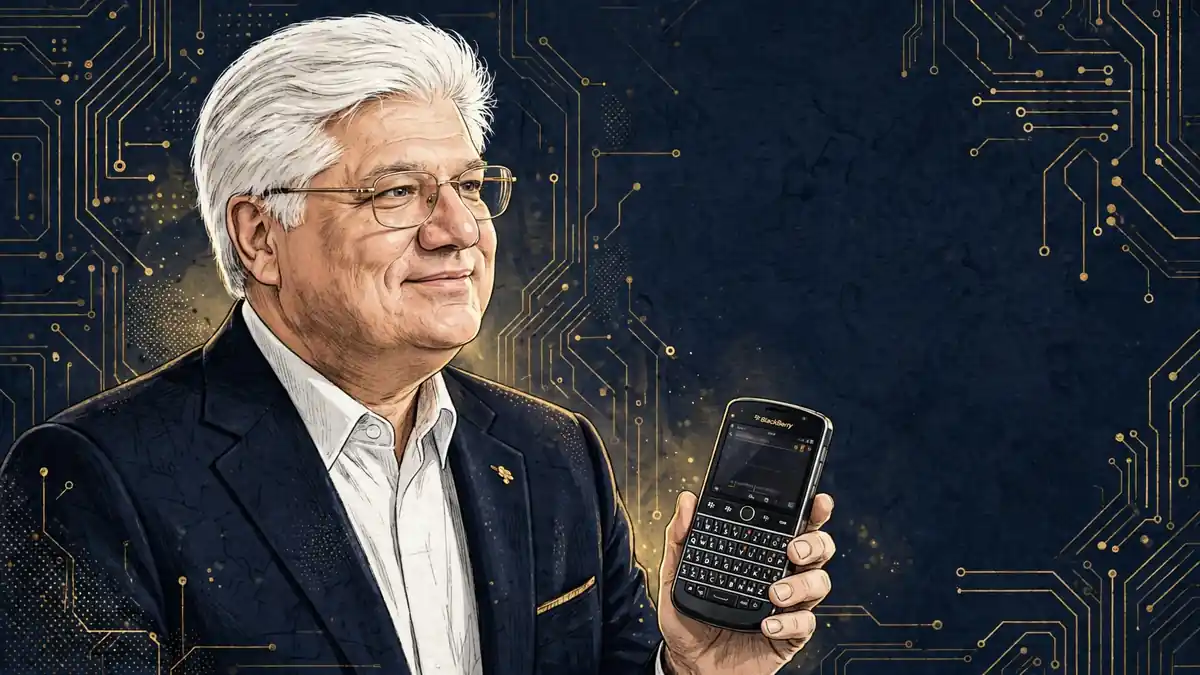
Mike Lazaridis‘s net worth is estimated at $600 million to $800 million as of November 2026. The Greek-Canadian engineer who co-founded Research In Motion and put the BlackBerry in the pockets of presidents, bankers and celebrities was worth close to $4 billion at the company’s 2008 peak — then watched most of it evaporate as the iPhone rewrote the smartphone market, sold the last of his big BlackBerry stake for about $26.5 million in December 2013, and has since given more than $400 million of his own money to physics and quantum computing research in Waterloo, Ontario.
Mike Lazaridis: Quick Facts
| Estimated net worth | $600 million (range: $600 million to $800 million) |
|---|---|
| Profession | Entrepreneur, electrical engineer, investor, philanthropist |
| Nationality | Greek-Canadian |
| Born | March 14, 1961 (age 65) |
| Height | Not publicly disclosed |
| Primary income sources | BlackBerry (RIM) equity, Quantum Valley Investments, private technology investments |
| Active years | 1984–present |
| Last reviewed | November 2026 |
- Early Life and Background
- Education
- Career Journey
- Rise to Fame
- Main Sources of Income
- Salary and Earnings
- Businesses and Investments
- Brand Deals and Sponsorships
- Houses, Cars and Other Assets
- Awards and Achievements
- Net Worth Growth Over the Years
- Social Media Presence
- Personal Life
- Sources & Reporting
- Frequently Asked Questions
Early Life and Background
Mike Lazaridis was born on March 14, 1961, in Istanbul, Turkey, to Greek parents. When he was five years old, the family emigrated to Canada and settled in Windsor, Ontario, across the river from Detroit. The move shaped everything that followed: a boy who arrived in a new country with a new language grew up taking radios apart and rebuilding them, and by his teens he was the kid neighbours called when a television broke.
His closest friendship from those Windsor years became a business partnership. Lazaridis and Douglas Fregin were friends from grade school — Fregin later said they had been close since grade five — and the two stayed in touch through university. That friendship is the reason Research In Motion existed at all: when Lazaridis left school to start a company in 1984, Fregin was the first person he called. The two men would go on to found a company together, lose a fortune together, and, decades later, fund a quantum research ecosystem together.
The Windsor years also explain Lazaridis’s later philanthropy. He has said the public library and the public school system gave an immigrant kid room to build things, and his giving has run heavily toward public institutions — the University of Waterloo, Wilfrid Laurier University, the Stratford Festival — rather than private foundations with his name on the door, even though several buildings now carry it anyway.
Education
Lazaridis enrolled in electrical engineering at the University of Waterloo in the late 1970s, a school already known for its co-op programme and its pipeline into Canada’s technology industry. He was a strong student with a practical streak: he won a prize for a science project in high school, and at Waterloo he gravitated toward the hands-on work of building wireless devices rather than the theory.
He never finished the degree. In 1984, two months short of graduation, he dropped out to found Research In Motion with Fregin. The decision looks reckless on paper and sensible in context — he already had a contract in hand and a clear idea of what the company would build. Waterloo did not hold it against him: the university later awarded him an honorary doctorate, and he has given it more than $120 million for quantum computing and related science since 2002, according to Quantum Valley Investments’ own history. The dropout who left two months early became one of the university’s largest benefactors.
The education gap is worth stating plainly because net-worth profiles often inflate it. Lazaridis holds no completed university degree. His credentials are the ones that came after the money: Officer of the Order of Canada, Member of the Order of Ontario, Fellow of the Royal Society, and Fellow of the Royal Society of Canada — honours earned for building an industry and funding science, not for coursework.
Career Journey
Research In Motion began in 1984 in Waterloo with a government grant, a small loan from Lazaridis’s parents, and two founders working on barcode technology and wireless data. The company’s first real business was unglamorous and profitable: building wireless data networks and devices that moved small packets of information over the Mobitex network, the same kind of system that let delivery drivers and field workers send messages before mobile phones were common.
The first product that mattered arrived in 1996. RIM shipped the Inter@ctive Pager 950, the first two-way pager — a device that could send a message back as well as receive one. It was a genuine first, and it put RIM on the map with business customers who needed to reach people in the field. Behind it sat the engineering idea that made Lazaridis’s reputation: a system that could push a tiny packet of data to a device on a shared wireless network without draining the battery or clogging the channel. The film BlackBerry (2023) dramatises this period, with Jay Baruchel playing Lazaridis as a soft-spoken engineer who is right about the technology and slow to see the market shifting around him.
Jim Balsillie joined in 1992, eight years after the founding, and changed the company’s trajectory. Balsillie put his own money in — he mortgaged his house to do it, by most accounts — and took the co-CEO role alongside Lazaridis, handling sales, finance and deal-making while Lazaridis ran the engineering. The partnership worked for two decades: the engineer built the product, the deal-maker sold it, and by the late 1990s RIM was ready for its defining device.
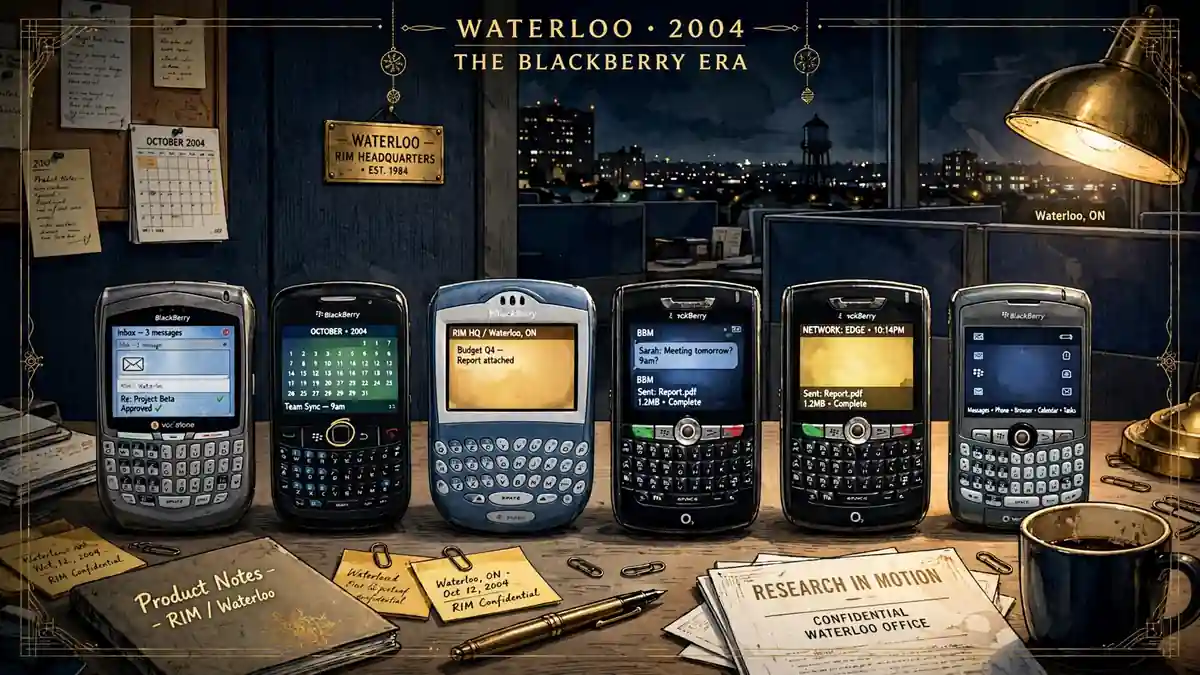
The BlackBerry 850 launched in 1999, followed by the 957 and then the 7200 series. The pitch was simple and, at the time, new: secure wireless email on a device with a thumb-friendly QWERTY keyboard, a small screen, and a battery that lasted days because the system only woke the device when a message arrived. Investment banks, law firms and government departments bought them by the thousand. Within a few years the BlackBerry was the status device of the business world — the “CrackBerry”, as the press nicknamed it — and RIM’s revenue climbed from tens of millions into the billions.
Growth brought a fight that nearly killed the company at its peak. NTP Inc., a small Virginia patent-holding company, claimed BlackBerry’s push-email system infringed patents held by inventor Thomas Campana. The dispute ran from 2002 to 2006, and at one point a US court threatened an injunction that would have shut the BlackBerry service down across the United States. RIM settled in March 2006 for $612.5 million. The payment was a fraction of the company’s value by then, but the case exposed how exposed a hardware company could be to a single courtroom — and it foreshadowed the harder lesson coming the next year.
That lesson arrived on June 29, 2007, when Apple launched the iPhone. Lazaridis and Balsillie had built a device for email; Apple had built a pocket computer with a web browser, a music player and a touchscreen. RIM’s leadership dismissed the threat in public — the BlackBerry’s keyboard and battery life and security were, in their view, what serious users wanted — and kept shipping variations of the same formula. The market disagreed. By 2010 RIM still controlled close to half the North American smartphone market, but the direction of travel was set, and the company’s share price began the slide that would cut Lazaridis’s fortune by more than ninety per cent.
The end of the RIM era came fast. Lazaridis and Balsillie stepped down as co-CEOs in January 2012, with Thorsten Heins taking over. Lazaridis stayed on the board and chaired its innovation committee until 2013. In October 2013 he and Fregin disclosed they were considering a bid to buy the struggling company, as an alternative to a $4.7 billion offer led by Fairfax Financial at $9 a share. The bid never materialised. In November 2013 BlackBerry abandoned the sale process, took a $1 billion investment instead, and hired John Chen as chief executive. A month later Lazaridis began selling.
Rise to Fame
Lazaridis did not become famous the way a film star does. He became famous the way an inventor does when his device ends up in the hands of a US president: Barack Obama fought to keep his BlackBerry when he entered the White House in 2009, and the image of world leaders thumbing messages on the little keyboard made RIM’s founder a household name in business circles. At the company’s peak in 2008, RIM’s market capitalisation reached roughly $85 billion, and Lazaridis’s personal fortune was estimated at close to $4 billion. He had joined the ranks of the world’s billionaires on the strength of a device he had helped design in a Waterloo office.
The fame had a second act. When the 2023 film BlackBerry, adapted from Jacquie McNish and Sean Silcoff’s 2015 book Losing the Signal, became a critical success, a new generation learned the story — and Lazaridis’s name circulated again, this time as the engineer who saw the technology clearly and the market too late. The film is a dramatisation, not a documentary, and it compresses years of engineering into a few scenes, but its broad shape matches the record: two friends from Windsor, a device nobody else thought to build, a deal-maker who scaled it, and a rival in Cupertino who changed the rules.
What the film leaves out is what Lazaridis did next, which is the more interesting half of the story. While the BlackBerry collapsed, the institutions he had funded with his peak fortune — the Perimeter Institute for Theoretical Physics, founded in 1999, and the Institute for Quantum Computing at Waterloo, founded in 2002 — kept growing. By the time the film premiered, the engineer who lost a billion-dollar fortune had become one of the largest private funders of fundamental science in Canadian history.
Main Sources of Income
Lazaridis’s money has always come from equity, not a salary. He owned a large slice of the company he founded, and for two decades that slice was the whole story. The three income streams that built and now sustain his fortune are easy to separate by era.
BlackBerry equity (1984–2013). This was the fortune. At the 2008 peak, with RIM’s market value near $85 billion, Lazaridis’s holding was worth an estimated $4 billion, according to Celebrity Net Worth’s reporting. The same stake was the loss: as the share price fell from above $140 in 2008 to under $8 by late 2013, the paper value of his holding fell with it. The contrast with his co-founder is the sharpest detail in the whole story. Fregin sold his shares near the company’s absolute peak in 2007 and banked the money; Lazaridis held on through the decline, convinced the company could fight its way back against the iPhone. Celebrity Net Worth’s account of the period is blunt about the consequence: by the time he had fully exited his positions, a multi-billion-dollar fortune had shrunk to the hundreds of millions.
Quantum Valley Investments (2013–present). In March 2013, Lazaridis and Fregin co-founded Quantum Valley Investments, a venture fund built to turn quantum research from Waterloo’s labs into companies. The fund started with $100 million of their money and backs startups in quantum computing, quantum-safe security and related deep technology. It is the main engine of Lazaridis’s current income: returns from portfolio companies, advisory roles and the fund’s management. Portfolio names that have surfaced in public reporting include ISARA Corporation, a pioneer in quantum-safe encryption; Cognitive Systems, which uses home wireless networks to detect motion; and High Q Technologies, which works on medical devices. None of these is publicly valued in a way that lets anyone put a precise figure on Lazaridis’s share, which is exactly why the honest estimate for his net worth is a range rather than a single number.
Private investments and advisory work (2013–present). Lazaridis has kept investing outside the fund as well. The freshest example is public and dated: in February 2026 he and Fregin led a $3.4 million private placement in Railtown AI Technologies, a Vancouver company building AI developer tools, and Lazaridis joined Railtown’s advisory board. The placement is small next to a BlackBerry fortune, but it shows where his attention is in 2026 — Canadian AI and deep technology, the same theme as the quantum fund. Some low-quality net-worth sites claim he earns roughly $30 million a year from dividends and advisory roles; no credible outlet supports that figure, and we do not repeat it as fact. His income today is lumpy venture income, not a salary.
Salary and Earnings
There is no public record of a large executive salary for Lazaridis, and that absence is itself informative. As co-CEO of a public company he drew a salary, but the money that mattered was always the stock. RIM’s filings show a founder who was paid like an owner, not like a hired chief executive: the wealth sat in shares, and the shares did the rising and the falling.
The dated figures that do exist are share-sale figures, and they are precise because they come from regulatory filings. In December 2013, Lazaridis sold 3.5 million BlackBerry shares across two days — 3,166,893 shares at an average of $7.55 and 333,107 at $7.63 — for proceeds of roughly $26.5 million, according to Forbes’ reporting carried by ValueWalk; other outlets put the total at about $27.4 million, a difference that reflects the two days’ different prices. The sale cut his stake from 5.7 per cent to 4.99 per cent. The half-point mattered: dropping below five per cent freed him from the SEC’s 13D rules that require large holders to report every trade. Cantech Letter, which covered the filing on Christmas Eve 2013, called it a historic step — the founder of the company quietly stepping below the disclosure line.
The low point of the fortune can be dated almost to the day. In June 2012, with BlackBerry shares closing at $7.39, AllThingsD calculated from Canadian regulatory filings that Lazaridis’s paper fortune had fallen to $219.2 million, and Balsillie’s to $198.8 million — from about $4 billion each at the peak. It is the most exact snapshot of the collapse in the public record, and it is the figure that makes the $600 million current estimate credible: the fortune did not vanish, it fell to roughly $200 million and then recovered part of the way as Lazaridis redeployed what remained into quantum ventures and the broader market recovered.
What does he earn now? Nobody outside his fund knows, and any site that prints a yearly income figure for him is guessing. Quantum Valley Investments is private, its portfolio companies are private, and Lazaridis files no public salary disclosure. The honest statement is that his current income comes from venture returns and advisory roles, that it varies sharply year to year, and that it is a small fraction of what the BlackBerry stake produced in a single good year at the peak.
Businesses and Investments
Research In Motion / BlackBerry. The company Lazaridis founded in 1984 became, by 2011, a business with nearly $20 billion in annual revenue and 18,000 employees worldwide, according to a 2026 company release from Railtown AI that recounted the founders’ record. At its peak the company’s market value was about $85 billion in 2008 by the most commonly cited figure, though that same Railtown release puts the peak at $68 billion — a reminder that even “peak market cap” depends on which day and which measure you pick. Either way, it was one of the largest companies Canada had ever produced, and Lazaridis’s stake in it was the source of his billionaire status.
Quantum Valley Investments. Founded in March 2013 with Fregin, the fund exists to commercialise quantum information science out of Waterloo. Its stated aim is to build a “Quantum Valley” in the region — a cluster where research turns into companies and companies stay in Canada. The fund’s portfolio leans toward quantum-safe encryption, sensing and computing hardware. A $100 million fund is modest by venture standards, but its influence in Waterloo is outsized: the fund, the research institutes and the Ideas Lab together anchor a quantum ecosystem that the Waterloo Region’s own economic development agency says has drawn more than $480 million from Lazaridis and Fregin over twenty years.
The Waterloo quantum ecosystem. The line between business and philanthropy blurs here, and that is the point. In 2019, four Waterloo quantum companies and organisations — the Quantum Valley Ideas Lab, Cognitive Systems, ISARA Corp and High Q Technologies — received a combined $41 million boost, with the Ideas Lab taking $20 million to staff a new facility. Lazaridis was quoted at the announcement saying the investments would help build an international brand for Canadian quantum technology and attract researchers, entrepreneurs and venture capital. He is not a passive donor in this ecosystem; he is its organiser.
Railtown AI Technologies (2026). The February 2026 private placement — $3.4 million, led by Lazaridis and Fregin, with Lazaridis joining the advisory board — is the newest public investment on his record. Railtown builds AI developer tools and agent platforms, and the release announcing the deal framed it as a bet on Canadian AI sovereignty: secure, transparent, developer-centred infrastructure hosted in Canada. It is the clearest sign that his investment focus in 2026 extends beyond quantum into AI, and that he and Fregin still invest as a pair, thirteen years after they started the fund.
What he does not own. Two common claims in low-quality profiles deserve correction. First, Lazaridis does not “own” the Perimeter Institute or the Institute for Quantum Computing; he founded and funded them, and they are independent research institutes with their own boards. Second, the BlackBerry PlayBook tablet — sometimes listed among his ventures — was a BlackBerry product, not a personal investment, and it failed commercially. Keeping those distinctions straight matters, because the gap between founding a thing and owning it is the gap between philanthropy and a balance sheet.
Brand Deals and Sponsorships
Lazaridis has no brand deals or sponsorships, and that is consistent with his whole public profile. He is not a celebrity endorser; he is an engineer and an investor who has spent the last decade funding research institutes. No credible reporting links him to a paid endorsement, a spokesperson role or a sponsored social media post, and none should be expected: his income comes from equity and funds, and his public appearances are lectures, university events and funding announcements.
The closest thing to a commercial association is the BlackBerry brand itself, which he created rather than endorsed. The device’s ubiquity among politicians, bankers and celebrities in the 2000s was the best advertising RIM ever had, and it cost the company nothing — Obama’s fight to keep his BlackBerry did more for the brand than any campaign could. That association is history now: BlackBerry phones are no longer produced, and the company that bears the name is a software and security business.

Houses, Cars and Other Assets
Public reporting on Lazaridis’s personal property is thin, and the thinness is deliberate. He lives in the Waterloo region, where he has lived since the RIM days, and he is not known for the public displays of wealth that fill other net-worth profiles — no reported supercar collection, no yacht, no string of mansions in the property press. What is documented is the property he gave away rather than the property he kept: the buildings.
The most visible is the Mike & Ophelia Lazaridis Quantum-Nano Centre at the University of Waterloo, opened in September 2012. Lazaridis gave $50 million toward it, matched by the federal and Ontario governments, with a further $10 million from Fregin. The centre houses researchers from the Institute for Quantum Computing and the university’s nanotechnology programmes in a purpose-built facility on the main campus. It is an asset in the sense that it carries his name; it is not his property, and it earns him nothing.
The Perimeter Institute’s building in Waterloo, a Governor General’s Award-winning design on the edge of Silver Lake, was likewise built with his money and belongs to the institute. The pattern repeats at Wilfrid Laurier University, where his $20 million gift in 2015 built the Lazaridis School of Business & Economics, and at the Stratford Festival, where he and Ophelia gave $10 million in 2018 toward rebuilding the Tom Patterson Theatre. If there is a Lazaridis property portfolio, it is a portfolio of public buildings that other people use.
For the record, no reliable source lists a car collection, a private jet or a real-estate portfolio for Lazaridis, and this profile does not invent one. The absence is the point: the measurable assets are the fund, the remaining investments and whatever BlackBerry stock he retained after 2013, and the rest of the fortune is visible in the institutions, not in a garage.
Awards and Achievements
Lazaridis’s honours fall into two groups: the ones for building BlackBerry, and the ones for funding the science that came after it.
- Officer of the Order of Canada — one of the country’s highest civilian honours, awarded for his contribution to technology and philanthropy.
- Member of the Order of Ontario — the province’s highest honour.
- Fellow of the Royal Society (FRS) and Fellow of the Royal Society of Canada (FRSC) — rare honours for an engineer without a completed degree, recognising the impact of his work on wireless communication and his support for research.
- IEEE 2027 Masaru Ibuka Consumer Technology Award — announced by the IEEE for his role in creating the BlackBerry and advancing consumer technology; the award citation notes he has contributed more than $290 million to quantum research and education, and describes him as founder and managing partner of Quantum Valley Investments.
- Honorary doctorate, University of Waterloo — the university he left two months before graduation, which now hosts the research institutes he funded.
- Founder, Perimeter Institute for Theoretical Physics (1999) — an institute that has become one of a handful of leading centres for theoretical physics in the world, and the single largest act of private science philanthropy in Canadian history at the time of its founding.
- Founder, Institute for Quantum Computing (2002) — the experimental research institute at Waterloo that anchors Canada’s quantum programme.
The achievement that matters most for the net-worth story is the one that cost him money rather than making it. In 1999 he gave a third of his fortune at the time — $100 million — to establish the Perimeter Institute. Most founders give after they have cashed out. Lazaridis gave while the fortune was still growing, and kept giving as it fell.
Net Worth Growth Over the Years
| Year | Estimated net worth | What drove it |
|---|---|---|
| 1999 | ~$300 million | RIM growing; $100 million gift to found Perimeter was reported as a third of his fortune at the time |
| 2007–2008 | ~$4 billion (peak) | RIM market cap near $85 billion; BlackBerry at its height, close to half the North American smartphone market |
| June 2012 | ~$219 million | Share price $7.39; paper fortune calculated from Canadian regulatory filings by AllThingsD |
| December 2013 | Hundreds of millions | Sold 3.5 million shares for ~$26.5 million; stake cut below 5%; Quantum Valley Investments founded |
| 2025–2026 | $600 million – $800 million | Celebrity Net Worth $600 million (March 2026); other estimates to $800 million; private quantum holdings not publicly valued |
The shape of that table is the story: a fortune built on one company’s stock, cut by more than ninety per cent in four years, then partly rebuilt through venture investing. The recovery from $219 million to $600 million is not a BlackBerry recovery — the company never came back as a phone maker. It is a redeployment recovery: the money that remained went into quantum ventures, and the value of those ventures, plus the passage of time, did the rest.
For comparison, his co-founder Fregin sold near the 2007 peak and kept the proceeds; Balsillie’s paper fortune fell to $198.8 million in the same June 2012 calculation that put Lazaridis at $219.2 million. The three men who built RIM ended the smartphone era in very different financial positions, and the difference came down to a single decision: when to sell.
Social Media Presence
Lazaridis keeps no public social media presence that any credible source has verified. He has no public X, Instagram or LinkedIn profile used for personal commentary, and he does not post about his investments or his wealth. The social media footprint attached to his name belongs to other people: the BlackBerry film’s cast and crew, the Perimeter Institute, the Institute for Quantum Computing, and Quantum Valley Investments, all of which post about his work rather than his life.
That absence is worth a sentence because net-worth searches often surface impersonator accounts. Any account claiming to be Mike Lazaridis and soliciting investment or offering financial advice should be treated as fake: the real Lazaridis does not promote investments on social media, and his public statements come through university and institutional announcements.
Personal Life
Lazaridis is married to Ophelia Lazaridis, and the couple’s philanthropy is joint in practice as well as in name — the Quantum-Nano Centre carries both their names, and the Perimeter and IQC gifts are described by the institutes as gifts from Mike and his family. They live in the Waterloo region and keep their family life private; the names and details of their children are not part of the public record, and this profile does not publish them.
The private life that is public is the institutional one. He serves on boards and chairs fundraising for the institutes he founded, recruits researchers, and appears at Waterloo events. Friends and colleagues describe a man who still thinks like an engineer — happiest talking about a technical problem, impatient with ceremony — and the 2023 film’s portrait of a soft-spoken obsessive who fixes the prototype himself is, by most accounts, not far off.
Sources & Reporting
Celebrity Net Worth — current $600 million estimate (updated March 2026); peak fortune of about $4 billion in 2008; more than $400 million donated to scientific research; Fregin selling at the 2007 peak while Lazaridis held.
AllThingsD (Wall Street Journal) — June 2012 calculation from Canadian regulatory filings: Lazaridis’s paper fortune at $219.2 million and Balsillie’s at $198.8 million, with BlackBerry shares at $7.39; Perimeter Institute funding and operations.
ValueWalk — December 2013 share sale details: 3,166,893 shares at $7.55 and 333,107 at $7.63, about $26.5 million per Forbes, leaving a stake under 5 per cent.
Cantech Letter — December 2013 sale of 3.5 million shares for about $27.4 million, stake cut from 5.7 per cent to 4.99 per cent, and the 13D reporting consequence.
IEEE Awards — 2027 Masaru Ibuka Consumer Technology Award citation; more than $290 million contributed to quantum research and education; Quantum Valley Investments role.
Waterloo EDC — 2019 quantum funding: $41 million across four Waterloo organisations; Lazaridis and Fregin investing more than $480 million in the region’s quantum ecosystem over twenty years.
Wikipedia — biography and philanthropy detail: March 14, 1961 birth in Istanbul; $100 million Perimeter gift as a third of his fortune; $20 million Laurier gift in 2015; $10 million Stratford Festival gift in 2018; Quantum Valley Investments founded March 2013.
FrogHeart / Quantum Valley Investments history — Perimeter donations totalling more than $170 million; IQC donations of more than $120 million to Waterloo; $50 million Quantum-Nano Centre gift matched by governments, plus $10 million from Fregin; centre opened September 2012.
VentureBeat — 2012 Quantum-Nano Centre donation coverage; about $150 million to Perimeter and more than $100 million to IQC at that date.
Wikipedia — BlackBerry (film) — 2023 film details: Jay Baruchel as Lazaridis, adapted from Losing the Signal; BlackBerry’s 45 per cent market share at its height; Lazaridis resigning as CEO in 2012.
Reporting window: sources published 2012–2026; net-worth estimates current as of November 2026. Where sources disagreed — the current estimate, the peak market capitalisation, the December 2013 sale proceeds — this article publishes the range and names who says what, rather than picking a single figure.
Frequently Asked Questions
What is Mike Lazaridis’s net worth in 2026?
Mike Lazaridis’s net worth is estimated at $600 million to $800 million as of November 2026. Celebrity Net Worth, the most-cited current source, puts him at $600 million (updated March 2026), while other 2025–2026 estimates run up to $800 million. The range exists because his private quantum-venture holdings are not publicly valued.
Is Mike Lazaridis still a billionaire?
No. Lazaridis was worth an estimated $4 billion at BlackBerry’s 2008 peak, but he is no longer a billionaire. His fortune fell to about $219 million by June 2012 as BlackBerry’s share price collapsed, and although it has since recovered to an estimated $600 million to $800 million, it remains below a billion dollars. A large part of the decline is explained by philanthropy: he has given more than $400 million of his personal wealth to scientific research.
How did Mike Lazaridis make his money?
He made it as the co-founder of Research In Motion (RIM), the Waterloo company behind the BlackBerry. He founded RIM with Douglas Fregin in 1984, two months before finishing his electrical engineering degree, and served as co-CEO until January 2012. At the company’s 2008 peak its market value reached roughly $85 billion, and his stake was worth about $4 billion. Since 2013 his money has come from Quantum Valley Investments, the quantum venture fund he co-founded with Fregin.
Why did Mike Lazaridis lose his billionaire fortune?
Two reasons. First, he held on to his BlackBerry shares while the iPhone took the smartphone market: his co-founder Doug Fregin sold near the 2007 peak, while Lazaridis kept his stake as the share price fell from above $140 to under $8. Second, he gave a large share of it away — more than $400 million to physics and quantum computing research, including $100 million to found the Perimeter Institute in 1999, when that gift alone was a third of his fortune.
How much did Mike Lazaridis donate to science?
More than $400 million of his personal wealth, according to Celebrity Net Worth, and more than $290 million to quantum research and education alone, according to the IEEE. The documented gifts include $100 million to found the Perimeter Institute for Theoretical Physics in 1999 (more than $170 million given to Perimeter in total since), more than $120 million to the University of Waterloo for the Institute for Quantum Computing, $50 million for the Mike & Ophelia Lazaridis Quantum-Nano Centre, $20 million to Wilfrid Laurier University in 2015, and $10 million to the Stratford Festival in 2018.
What is Quantum Valley Investments?
Quantum Valley Investments is the venture fund Lazaridis co-founded with Douglas Fregin in March 2013, starting with $100 million of their money. It invests in companies commercialising quantum information science — quantum computing, quantum-safe encryption and related deep technology — mostly around Waterloo, Ontario. Its portfolio includes companies such as ISARA Corporation, Cognitive Systems and High Q Technologies.
Who is Mike Lazaridis’s wife?
His wife is Ophelia Lazaridis. The couple’s philanthropy is joint: the Mike & Ophelia Lazaridis Quantum-Nano Centre at the University of Waterloo carries both their names, and the Perimeter Institute and Institute for Quantum Computing gifts are described as coming from Mike and his family. They live in the Waterloo region and keep their family life private.
What happened to Mike Lazaridis after BlackBerry?
After stepping down as co-CEO in January 2012 and leaving the board in 2013, Lazaridis turned to quantum technology full time. He co-founded Quantum Valley Investments in 2013, kept funding the Perimeter Institute and the Institute for Quantum Computing, and in February 2026 he and Fregin led a $3.4 million private placement in Railtown AI Technologies, with Lazaridis joining its advisory board. His story was dramatised in the 2023 film BlackBerry, with Jay Baruchel playing him.
Final Thoughts
Mike Lazaridis’s net worth — $600 million to $800 million in November 2026 — is the remainder of one of the great fortunes of the smartphone age, and the interesting thing about it is how much of the original is missing on purpose. The $4 billion peak of 2008 is gone for two reasons, and only one of them was a mistake. Holding BlackBerry stock through the iPhone era cost him billions; giving $400 million-plus to physics and quantum computing was a choice, made while the fortune was still growing, and it is the part of the story that will outlast the phones. The BlackBerry is no longer manufactured. The Perimeter Institute, the Institute for Quantum Computing and the Quantum-Nano Centre are still standing, still funded, and still producing the research he bet on. Most billionaires are remembered for what they kept. Lazaridis is increasingly remembered for what he gave away — and for the bet, made in 2013 with a $100 million fund, that the next fortune in Waterloo would come from quantum machines rather than pocket ones.
Published on November 9, 2026. Last reviewed November 2026. Found an error? See our corrections policy.