
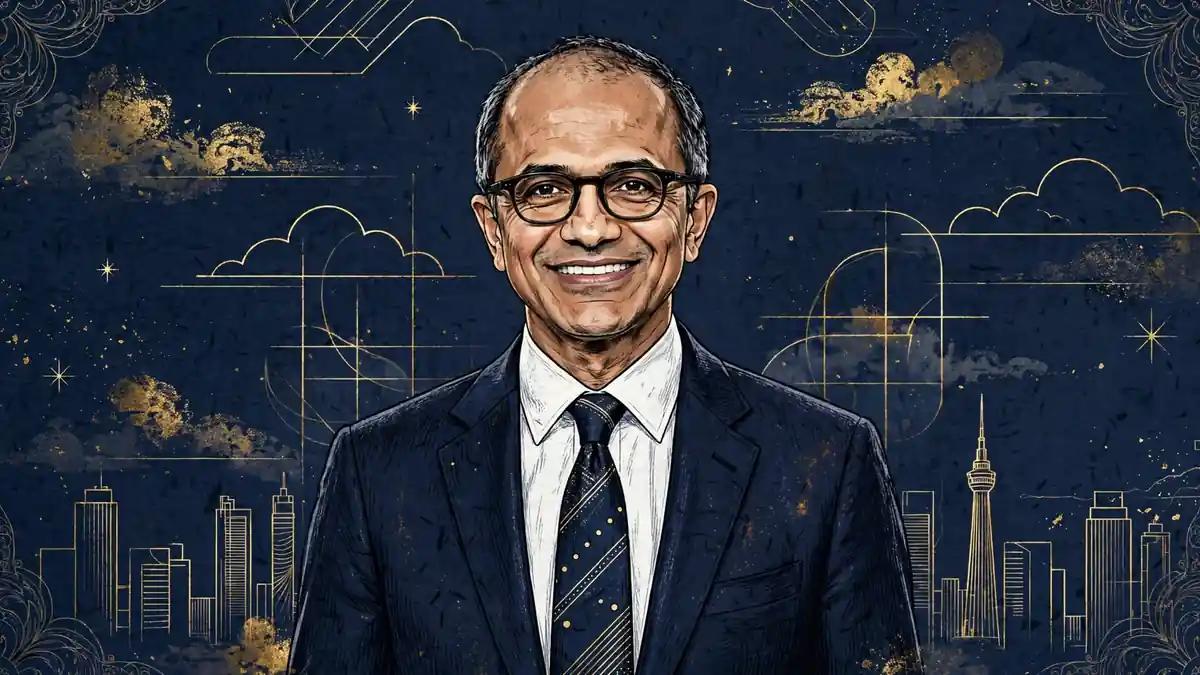
Satya Nadella‘s net worth is estimated at $1.3 billion to $1.5 billion as of November 2026. Forbes put the figure at $1.4 billion in its real-time estimate of 10 October 2026, ranking him 2,746th among the world’s billionaires, while Celebrity Net Worth lists him at $1.5 billion. The fortune rests on one asset above all else: Microsoft stock — more than 900,000 shares held outright, plus a decade of performance-based equity grants from the company he has run since February 2014, a period in which Microsoft’s value rose from roughly $300 billion to more than $4 trillion.
Satya Nadella: Quick Facts
| Estimated net worth | $1.4 billion (range: $1.3 billion – $1.5 billion) |
|---|---|
| Profession | Chairman and Chief Executive Officer, Microsoft |
| Nationality | Indian-American |
| Born | 19 August 1967 (age 59) |
| Height | 5 ft 9 in (175 cm) — most published profiles; figures vary |
| Primary income sources | Microsoft salary and equity awards, Microsoft shares, share sales, book royalties, sports-team stakes |
| Active years | 1990 – present (Microsoft since 1992; CEO since 2014) |
| Last reviewed | November 2026 |
- Early Life and Background
- Education
- Career Journey
- Rise to Fame
- Main Sources of Income
- Salary and Earnings
- Businesses and Investments
- Brand Deals and Sponsorships
- Houses, Cars and Other Assets
- Awards and Achievements
- Net Worth Growth Over the Years
- Social Media Presence
- Personal Life
- Sources & Reporting
- Frequently Asked Questions
- Final Thoughts
Early Life and Background
Satya Narayana Nadella was born on 19 August 1967 in Hyderabad, in what was then Andhra Pradesh and is now Telangana, India. His father, Bukkapuram Nadella Yugandhar, was an Indian Administrative Service officer of the 1962 batch who rose to senior posts in the Andhra Pradesh government; his mother, Prabhavati, taught Sanskrit. The household prized books, argument and public service, and the young Nadella grew up watching his father run districts and departments — an early education in how large organisations actually work.
He attended Hyderabad Public School, Begumpet, one of India’s best-known schools, where he played competitive cricket and developed the love of the game that still shapes his public image. Cricket gave him his first lessons in captaincy: he has said since that the sport taught him more about leadership than any management course, because a captain must get the best out of eleven very different people under pressure. The school also gave him his first sustained exposure to computers, at a time when Indian classrooms had almost none.
Hyderabad in the 1970s and 1980s was not yet the technology hub it is today, and the Nadella home was not wealthy by the standards of the fortune he would later build. What it offered was stability and ambition: a civil-servant father who expected his son to aim high, and a mother whose Sanskrit scholarship gave the house a literary streak. That combination — administrative discipline from his father, humanities from his mother — shows up repeatedly in his later writing, where he pairs cloud strategy with poetry and cricket metaphors in the same breath.
Two threads from those years still run through his career. The first is cricket, which he returns to in interviews and in his book as a model for team-building. The second is a habit of reading widely outside technology, something colleagues have noted since his earliest Microsoft years. Neither thread made him rich on its own, but both shaped the leader Microsoft’s board would eventually bet on.
Education
Nadella earned his bachelor’s degree in electrical engineering from the Manipal Institute of Technology in Karnataka in 1988. Manipal, then affiliated with Mangalore University, was one of India’s strongest engineering schools, and the degree gave him the technical grounding that every later Microsoft role would build on. He left India almost immediately after graduating, crossing the world for graduate study in the United States.
He completed a master’s degree in computer science at the University of Wisconsin–Milwaukee in 1990. The degree arrived at the exact moment the American software industry was taking off, and it put him in the job market with a credential that opened doors at Silicon Valley’s established firms. His first job was at Sun Microsystems, where he worked as a member of the technical staff from 1990 to 1992, learning enterprise systems engineering at a company that then defined workstation computing.
While working at Microsoft he added a third degree: an MBA from the University of Chicago Booth School of Business, completed in 1997. He studied part-time while holding a full-time engineering job, a detail that matters because it shows how deliberately he built the business half of his skill set. The Booth MBA gave him the finance and strategy vocabulary he would later use to explain Azure’s economics to Wall Street — and, eventually, to run the company.
The three degrees map neatly onto his career: engineering from Manipal, computer science from Milwaukee, business from Chicago. Few chief executives of his generation hold that exact combination, and it helps explain why his wealth is built on operating performance rather than founding a company. He did not arrive at Microsoft with a startup to sell. He arrived with credentials, and the fortune came from turning those credentials into twelve years of compounding equity.
Career Journey
Nadella joined Microsoft in 1992, when Bill Gates still ran the company and Windows was the centre of the software universe. His first assignments were in the Windows NT group, the enterprise operating system that put Microsoft servers into corporate data centres. It was unglamorous infrastructure work, far from the consumer spotlight, but it taught him the enterprise customer — the CIOs and IT departments who would later buy Azure by the billions.
He moved through a series of roles that now read like a tour of Microsoft’s future: he led the company’s online services division, including the Bing search engine, at a time when Google dominated search and Bing lost money year after year. The experience taught him how to run a business that was losing, and how to keep investing in it anyway. He later ran the Server and Tools division, the business that sold Windows Server and SQL Server to enterprises, and in 2013 he was named executive vice president of the newly formed Cloud and Enterprise group — the job that put him in charge of Azure.
Azure is the hinge of his career and his fortune. When he took over the cloud business, Microsoft was still widely seen as a Windows company that had missed mobile and was losing the internet to Google and Amazon. Under Nadella, Azure grew from a side project into Microsoft’s growth engine, and by the time he became CEO the cloud business was the company’s most credible claim on the future. The board’s choice of Nadella in February 2014 was, in that sense, a bet on the cloud over the company’s past.
He became Microsoft’s third chief executive on 4 February 2014, succeeding Steve Ballmer. The first years were defined by repair work: rebuilding a culture that insiders described as combative and siloed, ending the Windows-first orthodoxy that had held the company back, and opening Microsoft to open-source software and rival platforms — a shift symbolised by joining the Linux Foundation as a Platinum member in 2016. In June 2021 he added the chairman’s role, succeeding John W. Thompson, giving him control of both the board and the executive suite.
The deals followed the strategy. LinkedIn arrived in 2016 for $26.2 billion, the largest acquisition in Microsoft’s history at the time. GitHub followed in 2018 for $7.5 billion, a purchase that bought credibility with the developers Microsoft needed for Azure. Nuance Communications came in 2021 for $19.7 billion, bringing healthcare AI. Activision Blizzard closed in October 2023 for $69 billion, the largest deal in the company’s history and the biggest in the gaming industry. Each acquisition added a revenue stream, and each one pushed the share price — and Nadella’s equity — higher.
The OpenAI partnership may matter more than any of them. Microsoft invested $1 billion in OpenAI in 2019 and extended the alliance in January 2023 with a multi-year, multi-billion-dollar commitment reported at around $10 billion. The partnership put Microsoft’s cloud at the centre of the generative AI boom and gave Azure a product — Copilot — that no rival could match. By fiscal 2025, Azure revenue had passed $75 billion, growing 34 percent in a single year.
Rise to Fame
Nadella was not famous when he became CEO. Inside the industry he was respected as the cloud executive; outside it, almost nobody knew his name. The first announcement coverage in February 2014 treated him as a safe internal pick, and the early stories focused on what he was not: not a founder, not a showman, not Steve Ballmer. His public profile was built the slow way, through results rather than personality.
The results arrived quickly enough. Microsoft’s market value stood at roughly $300 billion when he took over. It crossed $1 trillion in 2019, passed $2 trillion in 2021, crossed $3 trillion in January 2024, and first crossed $4 trillion in July 2025, according to Celebrity Net Worth’s reporting — making Microsoft one of only two companies ever to reach that mark. Revenue roughly tripled over the same period, reaching $281.7 billion in fiscal 2025, and net income reached about $101.8 billion.
His 2017 book, Hit Refresh: The Quest to Rediscover Microsoft’s Soul and Imagine a Better Future for Everyone, turned a corporate turnaround story into a personal one. Written with Greg Shaw and Jill Tracie Nichols and published by HarperCollins, it mixed the Azure strategy with the story of his son Zain’s cerebral palsy and the empathy it taught him. The book’s proceeds went to Microsoft Philanthropies and through it to nonprofit organisations, and it gave the public its clearest picture of the man running the world’s most valuable company.
By 2019 the recognition had caught up with the results. The Financial Times named him its Person of the Year, Fortune named him Businessperson of the Year, and he had already appeared on the Time 100 list in 2018. In 2022 the Government of India awarded him the Padma Bhushan, the country’s third-highest civilian honour. Fame, for Nadella, has always been a by-product of the share price — and the share price has been the engine of his wealth.
Main Sources of Income
Almost all of Nadella’s money comes from one place: Microsoft. His pay is structured so that the overwhelming majority arrives as stock, not cash, and his wealth is the accumulated result of twelve years of those grants compounding as Microsoft’s share price rose roughly tenfold during his tenure. There is no family fortune, no startup exit and no second career behind the number. The table below breaks the fortune into its parts.
| Income source | How it pays | Scale |
|---|---|---|
| Microsoft equity awards | Annual performance stock grants, vesting over years | $84.2 million in stock awards in fiscal 2025 alone |
| Microsoft shares held | 900,572 shares in the 2025 proxy; 918,226 by September 2026 | worth roughly $450 million at late-2026 prices |
| Share sales | Periodic sales of vested stock | more than $700 million in total sales, per Forbes |
| Base salary and cash bonus | $2.5 million salary plus an annual cash incentive | $12.1 million combined in fiscal 2025 |
| Book royalties | Hit Refresh (2017), proceeds donated to nonprofits | modest; proceeds went to charity |
| Sports-team stakes | Minority stakes in Seattle Sounders FC and Seattle Orcas | small relative to Microsoft equity |
| Angel investing | Advisory and angel stake in Groww, an Indian investment platform | undisclosed; Groww valued near $3 billion |
The structure matters because it explains why his net worth moves with Microsoft’s stock. Roughly 87 percent of his fiscal 2025 pay arrived as stock awards, and more than 95 percent of his target compensation is performance-based, according to the proxy statement. When Azure grows 34 percent and the share price follows, his fortune grows with it. When the stock falls, so does the estimate — which is why Forbes’s real-time figure moved between $1.3 billion and $1.5 billion across different trackers in 2026, and why stale pages still floating around the web show $377 million or $420 million, figures that predate the recent run-up and the 2026 proxy disclosures.
Dividends add a quieter stream. Microsoft pays a quarterly dividend, and on a holding of roughly 900,000 shares that produces a meaningful annual cash flow even before any sale. Bloomberg calculated in July 2023 that the value of Nadella’s Microsoft equity awards, salary, bonuses and dividends had passed $1 billion in cumulative terms — the moment his career earnings crossed ten figures, two years before Forbes first put his net worth above $1 billion.

Salary and Earnings
Nadella’s pay is disclosed in unusual detail because Microsoft, as a public company, must file it with the Securities and Exchange Commission every year. The proxy statement’s Summary Compensation Table is the single most reliable document on his income, and the figures below come from it directly. Fiscal years at Microsoft end on 30 June, so fiscal 2025 covers July 2024 to June 2025.
For fiscal 2025 his total compensation was $96,496,790, the highest of his tenure and a 22 percent rise on the $79.1 million he received in fiscal 2024. The board’s compensation committee credited what it called an “exceptional” year — revenue up 15 percent, operating income up 17 percent, cloud revenue up 23 percent to nearly $169 billion — and paid him 117 percent of his target cash incentive and 103.69 percent of his target performance stock awards. Bloomberg reported the package the day the proxy was filed, on 21 October 2025, noting that about 90 percent of it was in shares.
| Fiscal 2025 pay component | Amount |
|---|---|
| Base salary | $2,500,000 |
| Stock awards (grant-date value) | $84,245,496 |
| Annual cash incentive | $9,555,000 |
| Other compensation | $196,294 |
| Total | $96,496,790 |
For fiscal 2026 the total fell to $90.6 million, about 6 percent below the prior year, according to Celebrity Net Worth’s reading of the 2026 proxy statement: a $2.5 million salary, $77.6 million in stock awards, a $10.3 million cash incentive and $259,203 in other compensation. The dip is a reminder that the headline total is an accounting figure — stock awards are valued at their grant date, not at what the shares are eventually worth when they vest — so the cash Nadella actually receives in any year is different from the number in the table.
The base salary is the smallest part of the story. It has sat at $2.5 million for years, and it accounts for barely 3 percent of his annual package. The cash incentive, tied to revenue, operating income and cloud growth targets, is worth roughly four times the salary. But the stock awards are the fortune: $84.2 million in fiscal 2025, $77.6 million in fiscal 2026, $71.2 million in fiscal 2024. Each year’s grant vests over several years and only pays in full if Microsoft hits its performance targets, which is why the board can describe more than 95 percent of his target pay as performance-based without exaggerating.
His pay history shows the compounding clearly. The table in the growth section below lists every fiscal year from 2015, when his total was $18.3 million, through the $96.5 million peak in 2025. The jump from $48.5 million in fiscal 2023 to $79.1 million in fiscal 2024 — a 63 percent rise — coincided with the AI boom and the Azure acceleration that followed the OpenAI extension. The pay committee’s message has been consistent: the bigger Microsoft gets, the more of Nadella’s pay arrives as shares, and the more his wealth depends on the company’s future rather than its past.
One uncomfortable contrast followed the 2025 package. Microsoft cut more than 15,000 jobs during 2025, and the $96.5 million figure landed in the same news cycle as the layoffs, drawing criticism that the chief executive’s record pay sat uneasily beside the cuts. The company has not linked the two decisions, and the pay was set by performance targets agreed before the year began, but the optics are part of the record — and part of why his compensation now attracts the kind of scrutiny usually reserved for founders.
Businesses and Investments
Nadella is not a serial founder, and his investment record is deliberately narrow. He has never started a company of his own, and he holds no operating role outside Microsoft. What he does hold is a small set of minority stakes that reflect his two personal passions — sport, and the Indian technology scene — plus the Microsoft shares that dominate his balance sheet.
The Microsoft holding is the investment. The 2025 proxy statement, filed on 21 October 2025, listed him as the beneficial owner of 900,572 shares, under 0.1 percent of the company’s outstanding stock. The 2026 proxy raised that to 918,226 shares as of 30 September 2026, including shares held through trusts, according to Celebrity Net Worth’s reading of the filing. At late-2026 prices near $500 a share, the direct holding is worth roughly $450 million — less than half his estimated net worth, because the rest sits in cash from past share sales, unvested grants and dividends.
The sales are a major part of the story. Forbes reports that Nadella has sold more than $700 million of Microsoft stock over the years, and Bloomberg reported in November 2021 that he sold roughly 838,000 shares for about $285 million in a single transaction — the largest sale of his career, made shortly before Washington state introduced a capital-gains tax. Sales like that are the mechanism by which equity grants turn into spendable wealth, and they explain why his net worth is far larger than the value of the shares he still holds.
Outside Microsoft, his best-known holding is in sport. He is part of the ownership group of Seattle Sounders FC, the Major League Soccer club, having joined a group of local investors in 2019. He is also a co-owner of the Seattle Orcas, the Major League Cricket franchise, a stake that pairs his love of cricket with his Seattle base. Neither stake is large enough to move his net worth — MLS and MLC valuations are a rounding error beside Microsoft — but both are consistent with a man who has said cricket taught him leadership.
His one notable technology investment is in India. He is an angel investor and adviser to Groww, the Indian investment platform, which Business APAC reported as valued at around $3 billion. The stake is undisclosed in size, and Groww’s valuation has moved with India’s fintech cycle, so it contributes little to any published estimate — but it is the clearest sign of where his money goes when it leaves Microsoft: back toward the country where he grew up, and toward the retail-investor market he understands from the other side.
What he does not do is equally telling. There is no venture fund in his name, no string of startup stakes, no real-estate empire. His wealth is concentrated in a single stock by design: the pay structure he accepted as CEO ties his fortune to Microsoft’s performance, and the investment record shows a man who has mostly left it that way.
Brand Deals and Sponsorships
Nadella has no endorsement deals, no brand ambassadorships and no sponsored content. That is not an oversight — it is a function of who he is. Chief executives of public companies do not take personal endorsement money, and Microsoft’s own policies would make it a conflict of interest. His public appearances are Microsoft appearances: product launches, earnings calls, the annual Build developer conference, and the occasional interview.
His book is the closest thing to a commercial venture outside Microsoft. Hit Refresh, published by HarperCollins in 2017, sold well enough to make bestseller lists, but Nadella directed the proceeds to Microsoft Philanthropies and through it to nonprofit organisations, so the royalties never became a personal income stream. The book’s value to him was reputational: it established the “growth mindset” language that became Microsoft’s internal vocabulary, and it gave investors a story about culture change to pair with the cloud numbers.
He does appear at paid speaking events, including the World Economic Forum in Davos and university commencements, and he accepted an honorary doctorate from the Georgia Institute of Technology in 2024. Fees for such appearances, where they exist, are not disclosed and are small beside his Microsoft pay. The honest summary of this section is that brand money is a zero in his income statement — and that absence is itself informative. His fortune is a single-company fortune, built on salary, stock and share sales, with no side income worth naming.

Houses, Cars and Other Assets
Nadella’s property record is modest by billionaire standards, and the best-documented home is one he no longer owns. In August 2000 he bought a house in Clyde Hill, Washington — an affluent suburb between Seattle and Microsoft’s Redmond headquarters — for roughly $1.38 million. The house, built in 1963 and later renovated in a contemporary style, covered about 4,050 square feet with four bedrooms and three bathrooms, floor-to-ceiling glass walls and views across Lake Washington to the Seattle skyline and the Olympic Mountains.
He listed the Clyde Hill house in January 2016, two years after becoming CEO, at $3.488 million through Redfin, and sold it later that year for about $2.8 million — roughly double what he had paid sixteen years earlier. The sale was widely reported at the time, including by the Los Angeles Times, and the listing photographs remain the public’s clearest view of his domestic life: open-plan living, exposed beams, a library and a loft office. Where he lives now is not a matter of public record, and his current home has never been listed or photographed for publication.
Cars are a blank in the public record. Unlike founders who collect supercars, Nadella has never been photographed with a notable vehicle and no credible report names his cars. That is consistent with everything else about his spending: low-profile, Seattle-suburban, and far removed from the lifestyle content that surrounds celebrity wealth. His one visible indulgence is sport — the Sounders and Orcas stakes — and even those are investments as much as pleasures.
The rest of his assets are the ordinary holdings of a wealthy executive: the Microsoft shares already counted, cash from share sales, retirement and deferred-compensation accounts disclosed in the proxy, and the unvested equity grants that will convert into shares over the coming years. None of it is flashy. The striking fact about Nadella’s balance sheet is how little of it sits in things you can photograph — no yacht, no jet on the public record, no art collection in the news. The fortune is financial, not physical.
Awards and Achievements
The honours list is long, and it tracks the arc from respected insider to global statesman. The Government of India gave him the Pravasi Bharatiya Samman in 2015, for overseas Indians of distinction, and the Padma Bhushan in 2022, India’s third-highest civilian award, for his contributions to trade and industry. He received the Padma Bhushan in a ceremony that made the news in both countries — a Hyderabad-born engineer recognised by the country he left, for the company he now runs.
The business press followed. The Financial Times named him Person of the Year for 2019, the year Microsoft’s cloud strategy visibly overtook its rivals, and Fortune named him Businessperson of the Year the same year. He appeared on the Time 100 list of the world’s most influential people in 2018. CNBC-TV18 named him Global Indian Business Icon at its India Business Leader Awards in 2020, and the Georgia Institute of Technology awarded him an honorary doctorate in 2024.
The business achievements behind the awards are easier to measure than the medals. Market value from roughly $300 billion to more than $4 trillion. Revenue from about $87 billion in the year he took over to $281.7 billion in fiscal 2025. Net income from roughly $22 billion to about $101.8 billion. Azure from a promising side business to more than $75 billion in annual revenue. The LinkedIn, GitHub and Activision Blizzard acquisitions, each the largest of its kind when announced. The OpenAI partnership, which put Microsoft at the centre of the AI era. And the cultural turnaround — the shift from a company famous for internal rivalry to one famous, at least in its own telling, for a growth mindset.
Not every bet paid off. The $7.5 billion Nokia phone acquisition, made just before he arrived, was written down under his watch. The Windows phone business was abandoned. Bing never caught Google. But the record the awards recognise is the net one: a company that was widely written off as a legacy software vendor in 2014, and that by 2025 was the most valuable company on earth.
Net Worth Growth Over the Years
There is no audited year-by-year record of Nadella’s net worth, because he has never disclosed it. The table below uses the next best thing: his disclosed total compensation from Microsoft’s proxy filings, which shows how the fortune was built, alongside the best available net-worth estimates for the recent years. Compensation totals are the company’s own disclosed figures, taken from the SEC filings via CompBrief’s filing-by-filing record.
| Fiscal year | Reported total compensation | What was happening |
|---|---|---|
| 2015 | $18.3 million | First full year as CEO; cloud rebuild under way |
| 2016 | $17.7 million | LinkedIn acquired for $26.2 billion |
| 2017 | $20.0 million | Hit Refresh published; GitHub deal in preparation |
| 2018 | $25.8 million | GitHub acquired for $7.5 billion |
| 2019 | $42.9 million | Microsoft crosses $1 trillion; FT Person of the Year |
| 2020 | $44.3 million | Cloud growth accelerates through the pandemic |
| 2021 | $49.9 million | Nuance acquired; Nadella becomes chairman |
| 2022 | $54.9 million | Activision Blizzard deal announced; Padma Bhushan |
| 2023 | $48.5 million | Pay dips; Bloomberg puts career earnings past $1 billion |
| 2024 | $79.1 million | Microsoft crosses $3 trillion; AI boom lifts Azure |
| 2025 | $96.5 million | Record pay; Microsoft crosses $4 trillion |
| 2026 | $90.6 million | Pay eases 6 percent; Forbes estimates net worth at $1.4 billion |
The pattern is the story. Pay roughly tripled between 2018 and 2024, and the net worth followed the share price with a lag: the equity granted in the late 2010s vested into a stock that had multiplied, and the sales of those vested shares — more than $700 million in total, per Forbes — turned paper grants into cash. That is also why the low figures still circulating online are wrong: a $377 million or $420 million estimate is a snapshot from before the 2024–2025 run-up, or a count of shares held that ignores the sales, the unvested grants and the dividends. Any estimate that does not use the 2025 and 2026 proxy filings is out of date.
How does he compare with his peers? The table below uses approximate Forbes estimates from 2025–2026, and the dates matter — founder fortunes move by billions in a week.
| Tech leader | Estimated net worth | Source of wealth |
|---|---|---|
| Bill Gates | ~$106 billion | Microsoft co-founder; diversified investments |
| Steve Ballmer | ~$150 billion | Microsoft, former CEO; large shareholding |
| Tim Cook | ~$2 billion | Apple CEO; salary and equity, like Nadella |
| Satya Nadella | ~$1.4 billion | Microsoft CEO; salary and equity |
| Sundar Pichai | ~$1 billion | Alphabet CEO; salary and equity |
The comparison makes the point plainly. Nadella is a billionaire, but he is a hired chief executive’s kind of billionaire, not a founder’s. Gates and Ballmer own, or owned, far larger slices of Microsoft because they were there at the start. Cook and Pichai, the two closest comparators, sit in the same band as Nadella — $1 billion to $2 billion — because they were paid the same way: a modest salary, and equity that compounded over a decade at the top of a trillion-dollar company.
Social Media Presence
Nadella is active on X, posting as @satyanadella, and on LinkedIn, where his posts about artificial intelligence, accessibility and cricket reach a large professional audience. His feed is corporate in the best sense: product announcements, reflections on AI’s effect on work, tributes to colleagues, and the occasional cricket post. He does not post about his wealth, his home or his family, and he has never used social media to discuss his net worth.
The tone is consistent with the book and the public persona — measured, bookish, and focused on technology’s human consequences rather than on himself. His most-shared posts tend to be the ones about accessibility, a subject tied to his son Zain’s life, and about AI’s potential in education and healthcare. For a net-worth reader, the feed is useful for one thing above all: it is the fastest way to see what Microsoft’s chief executive thinks matters next, which is usually where the company’s money — and his equity — is heading.
Personal Life
Nadella married Anupama Priyadarshini — known as Anu — in 1992, the same year he joined Microsoft. Anu, the daughter of a senior Indian Administrative Service officer, had been his school friend in Hyderabad before they married. The couple have three children: a son, Zain, and two daughters, Tara and Divya. The family has lived in the Seattle area since the early 1990s, close to Microsoft’s Redmond campus.
Zain was born in 1996 with cerebral palsy, and his life shaped his father’s public thinking more than any business event. Nadella has written and spoken openly about how caring for Zain taught him empathy, and how that empathy changed the way he led — from a manager who prized being the smartest person in the room to one who prized listening. Zain died in February 2022, at the age of 25. Nadella’s book and his accessibility advocacy — including Microsoft’s work on inclusive design — both trace back to his son.
Anu Nadella has kept a low public profile, and the family’s life outside work is deliberately private. What is public is the cricket: Nadella still plays, still follows the Indian team, and still describes himself first as a fan. His Seattle Orcas stake is the commercial expression of that fandom. He is also a trustee of the University of Chicago, his MBA alma mater, a role that keeps him connected to the school that gave him his business education.
He became a United States citizen after moving to America, and he is usually described as Indian-American — a label that matters in India, where his success is followed as closely as any cricketer’s, and in the United States, where he is one of the most prominent Indian-born chief executives in corporate history. The Padma Bhushan in 2022 formalised the Indian half of that identity; the Microsoft chairmanship formalised the American half.
Sources & Reporting
Forbes — real-time billionaire estimate of $1.4 billion, 10 October 2026, ranking Nadella 2,746th in the world; also the source for more than $700 million in cumulative Microsoft share sales. Reporting window: October 2026.
Celebrity Net Worth — net worth estimate of $1.5 billion; fiscal 2026 pay breakdown ($90.6 million total, $2.5 million salary, $77.6 million stock awards, $10.3 million cash incentive); 918,226 shares as of 30 September 2026; Microsoft crossing $4 trillion in July 2025. Reporting window: October–November 2026.
U.S. Securities and Exchange Commission — Microsoft’s 2025 proxy statement (DEF 14A, filed 21 October 2025): fiscal 2025 total compensation of $96,496,790, 900,572 shares beneficially owned, and the performance-payout figures (117 percent cash incentive, 103.69 percent performance stock). Reporting window: October 2025.
Bloomberg — reporting on the fiscal 2025 pay package ($96.5 million, up 22 percent, highest of his tenure) and the board’s reasoning, via Moneyweb, 22 October 2025; July 2023 calculation that his cumulative equity awards, salary, bonuses and dividends had passed $1 billion. Reporting window: 2023–2025.
TheStreet — fiscal 2025 compensation breakdown and the 900,572-share holding from the 2025 proxy, plus the 15 percent revenue growth and 17 percent operating-income growth cited by the board. Reporting window: October–November 2025.
The Motley Fool — analysis of the $96.5 million package, the 34 percent Azure growth and $75 billion Azure revenue, and the performance-based structure of his pay. Reporting window: August 2026.
Wikipedia — biography: born 19 August 1967 in Hyderabad; education at Manipal (1988), Wisconsin–Milwaukee (1990) and Chicago Booth (1997); Sun Microsystems 1990–1992; CEO from 4 February 2014; chairman from 2021; Padma Bhushan 2022; Pravasi Bharatiya Samman 2015. Reporting window: November 2026.
Business APAC — net worth reporting at $1.1 billion (April 2026 update), fiscal 2024 pay of $79.1 million, and the Groww angel investment and advisory role. Reporting window: 2025–2026.
Los Angeles Times — reporting on the January 2016 listing of the Clyde Hill home at $3.488 million and its sale at about $2.8 million, as carried in contemporary coverage. Reporting window: 2016.
FourWeekMBA — methodology note on the Forbes $1.4 billion estimate (10 October 2026), the 900,572-share holding from the 2025 proxy, and the model behind the estimate (shares times share price, plus sale proceeds). Reporting window: October 2026.
Height is reported inconsistently across published profiles — 5 ft 7 in to 5 ft 11 in — so this article uses the most commonly cited figure, 5 ft 9 in (175 cm), and flags the disagreement rather than presenting any single figure as settled. No figure in this article is sourced from a single weak outlet; where sources conflict, the range is shown and the outlets are named.
Frequently Asked Questions
What is Satya Nadella’s net worth in 2026?
Satya Nadella’s net worth is estimated at $1.3 billion to $1.5 billion as of November 2026. Forbes put it at $1.4 billion in its real-time estimate of 10 October 2026, ranking him 2,746th in the world, while Celebrity Net Worth lists him at $1.5 billion. The figure moves with Microsoft’s share price, since most of his wealth is Microsoft stock.
What is Satya Nadella’s salary?
His base salary is $2.5 million a year, but that is a small part of his pay. In fiscal 2025 his total compensation was $96.5 million — the $2.5 million salary, $84.2 million in stock awards, a $9.6 million cash incentive and $196,294 in other compensation — and in fiscal 2026 the total was $90.6 million, according to the company’s proxy filings.
How many Microsoft shares does Satya Nadella own?
Microsoft’s 2025 proxy statement, filed on 21 October 2025, listed him as the beneficial owner of 900,572 shares, under 0.1 percent of the company. The 2026 proxy raised the figure to 918,226 shares as of 30 September 2026, including shares held through trusts.
How did Satya Nadella become a billionaire?
Through twelve years of performance-based Microsoft equity. He joined Microsoft in 1992 and became CEO in February 2014, when the company was worth roughly $300 billion. His annual pay is about 87 percent stock, and Microsoft’s share price rose roughly tenfold during his tenure, crossing $4 trillion in July 2025. Bloomberg calculated in July 2023 that his cumulative equity awards, salary, bonuses and dividends had already passed $1 billion.
Is Satya Nadella richer than Bill Gates?
No — not by a wide margin. Bill Gates is worth roughly $106 billion, about 75 times Nadella’s estimated $1.4 billion. Gates co-founded Microsoft and held a far larger stake; Nadella is a hired chief executive whose fortune comes from salary and equity grants, not founding shares. Former CEO Steve Ballmer, who also held a large stake, is worth roughly $150 billion.
What does Satya Nadella own outside Microsoft?
He holds minority stakes in Seattle Sounders FC, the Major League Soccer club, and the Seattle Orcas, the Major League Cricket team, and he is an angel investor and adviser to Groww, an Indian investment platform valued at around $3 billion. He has sold more than $700 million of Microsoft stock over the years, according to Forbes, and those sale proceeds make up a large part of his wealth outside his remaining shareholding.
Where does Satya Nadella live?
He lives in the Seattle area, near Microsoft’s Redmond headquarters. His best-documented home was in Clyde Hill, Washington, which he bought in August 2000 for about $1.38 million and sold in 2016 for about $2.8 million after listing it at $3.488 million. His current home is not a matter of public record.
Who is Satya Nadella’s wife?
His wife is Anupama Priyadarshini Nadella, known as Anu. They married in 1992, the same year he joined Microsoft, and have three children: a son, Zain, and two daughters, Tara and Divya. Zain, who was born with cerebral palsy, died in February 2022 at the age of 25.
Final Thoughts
Satya Nadella’s estimated $1.3 billion to $1.5 billion fortune is the cleanest example in corporate America of a particular kind of wealth: the hired chief executive’s fortune. He did not found Microsoft, inherit money, or sell a startup. He took a $2.5 million salary and a mountain of performance-based stock, ran the company through the cloud transition and the AI boom, and let the share price do the compounding. Microsoft was worth roughly $300 billion when he became CEO; it is worth more than $4 trillion now, and his net worth is the personal shadow of that transformation.
That is also why the number is fragile in a specific way. It is not a pile of cash in a vault — it is 900,000-odd shares, unvested grants, and the proceeds of past sales, all priced off a single stock. If Microsoft’s AI bet stumbles, the estimate falls with it. If Azure keeps growing at 30 percent-plus, the estimate rises. The $96.5 million pay package of fiscal 2025 and the $90.6 million of fiscal 2026 are the annual instalments of the same deal: the board pays him mostly in shares, and the shares pay him back only if the company keeps winning.
For readers, the figure to remember is the range, not the headline. Forbes said $1.4 billion on 10 October 2026. Celebrity Net Worth says $1.5 billion. The honest answer is $1.3 billion to $1.5 billion, dated November 2026, built from filings anyone can check — and worth revisiting every time Microsoft reports earnings.
Published on 9 November 2026. Last reviewed November 2026. Found an error? See our corrections policy.