
Hakeem Olajuwon‘s net worth is estimated at $200 million to $300 million as of November 2026, anchored at $300 million. The figure comes from Celebrity Net Worth, updated in April 2025, and matches the 2026 estimates published by BounceMojo, SportsDunia and ClutchPoints. What makes the number unusual is how little of it traces to basketball: Olajuwon banked a little over $110 million in NBA salary across 18 seasons, then built a Houston real estate portfolio worth roughly three times that — every building bought with cash, without a single mortgage, in line with his Muslim faith. By 2006, four years after his last NBA game, his holdings had already passed $100 million in value.
Hakeem Olajuwon: Quick Facts
| Estimated net worth | $300 million (range: $200 million to $300 million) |
|---|---|
| Profession | Retired NBA player, real estate investor, basketball mentor |
| Nationality | Nigerian-American |
| Born | January 21, 1963 (age 63) |
| Height | 7 ft 0 in (2.13 m) |
| Primary income sources | NBA salary (1984–2002), Houston real estate, post-career coaching clinics |
| Active years | 1984–2002 (NBA); real estate investing from the 1990s to today |
| Last reviewed | November 2026 |
- Early Life and Background
- Education
- Career Journey
- Rise to Fame
- Main Sources of Income
- Salary and Earnings
- Businesses and Investments
- Brand Deals and Sponsorships
- Houses, Cars and Other Assets
- Awards and Achievements
- Net Worth Growth Over the Years
- Social Media Presence
- Personal Life
- Sources & Reporting
- Frequently Asked Questions
Early Life and Background
Hakeem Abdul Olajuwon was born on January 21, 1963, in Lagos, Nigeria, to Salim and Abike Olajuwon, Yoruba parents who ran a cement business. The household was middle-class and built on enterprise — a detail that matters, because the boy who grew up watching his parents run a small business would later run a property portfolio with the same patience. Lagos in the 1960s and 1970s offered almost no organised basketball. Olajuwon grew up playing soccer, where he was a goalkeeper, and team handball. The footwork that later became the Dream Shake started there, in goal, where quick feet and balance counted for everything.
He did not touch a basketball seriously until he was 15, when a local coach spotted his height and coordination and invited him to try the sport. The story Olajuwon has told since is that a coach in his hometown showed him how to dunk by having him stand on a chair — a small, strange detail that captures how late and how fast his basketball education ran. Within two years he was playing for the Nigerian junior national team. At 17 he travelled to the United States for the first time, playing in youth tournaments that put him in front of American college coaches who could barely believe a teenager with almost no basketball background moved the way he did.
The late start shaped everything about his game. Because he had not spent childhood drilling centre habits, he played like a guard trapped in a seven-foot frame: he could dribble the length of the floor, spin, fake, and shoot soft jumpers. Coaches who tried to box him into a traditional post role found a player whose instincts came from soccer — footwork first, power second. That blend became the foundation of a career that ended with him ranked as the NBA’s all-time leader in blocked shots and the only centre ever to sit among the league’s career top ten in steals.
Nigeria remained part of his identity long after he left. He became a United States citizen in 1993 and played for Team USA at the 1996 Atlanta Olympics, winning gold, but he never cut his ties to Lagos. In later years his business attention turned back toward West Africa, and in late 2025 he bought two luxury residences in the TAJ DIAMOND community in Guyana — his first reported property purchase outside the United States, according to Basketball Network — a sign that the investor who spent two decades buying Houston was starting to look further afield.
Education
Olajuwon arrived at the University of Houston in 1981, recruited by head coach Guy Lewis after Lewis’s staff saw him at a youth tournament in the United States. He redshirted his first year, 1981–82, while he learned the American game and adjusted to life far from Lagos. The year on the sideline was not wasted: Houston’s staff rebuilt his fundamentals from scratch, and by the time he stepped on the floor he was already the most athletic big man in college basketball.
His three seasons with the Cougars, 1982–84, produced one of the most famous teams in college history: Phi Slama Jama, built around Olajuwon and guard Clyde Drexler, a team that ran the floor and dunked with a joy that made Houston a national attraction. The Cougars reached the NCAA championship game twice. In 1983 they lost to North Carolina State on Lorenzo Charles’s last-second dunk — one of the great upsets in tournament history — and Olajuwon was still named the Final Four’s Most Outstanding Player, a rare honour for a player on the losing side. In 1984 Houston lost the final to Patrick Ewing’s Georgetown team. Olajuwon left college after his junior year as a two-time All-American, having averaged 13.5 points and 11.4 rebounds across his college career and established a reputation as a defender and rebounder with no equal in the college game.
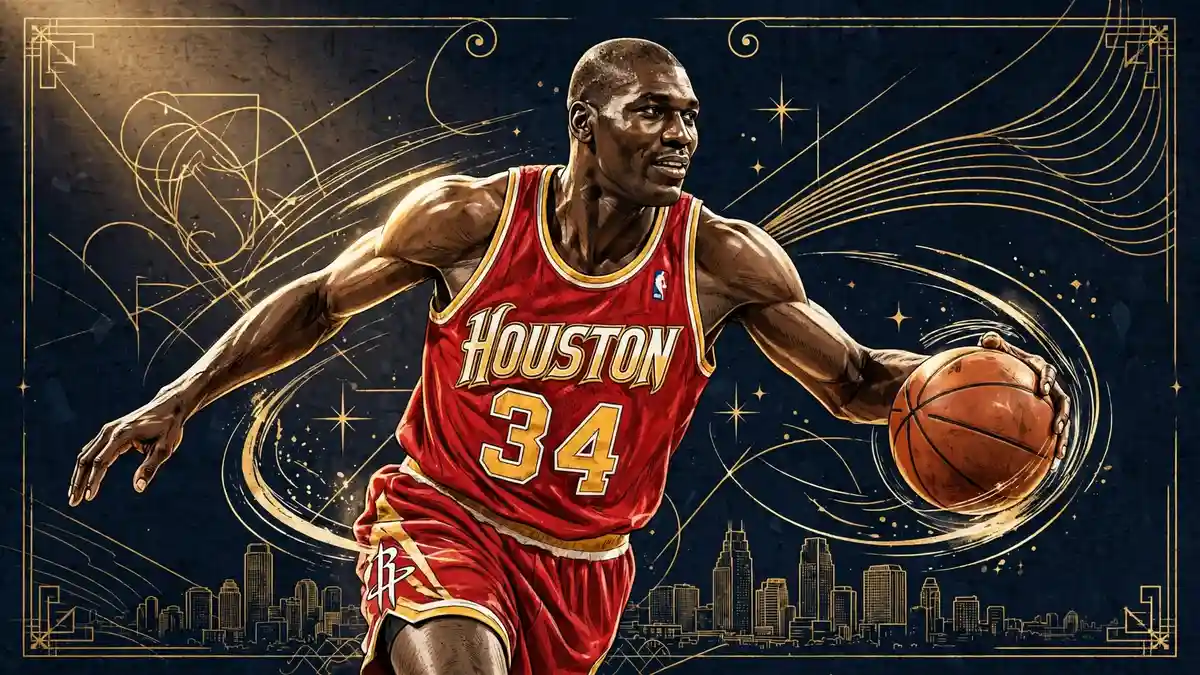
He never completed a degree at Houston, leaving early for the NBA draft — the standard path for a player of his standing in that era. The university later honoured him anyway: Houston retired his number 34 jersey, and he remains the defining figure of the Phi Slama Jama era. The education that mattered most to his fortune came later, and it was self-taught: in the 1990s, while still playing, he began studying Houston’s city development plans, satellite images and infrastructure projects, teaching himself to read a city the way he read a defence.
Career Journey
The Houston Rockets selected Olajuwon first overall in the 1984 NBA draft — the same draft that produced Michael Jordan, whose own fortune would later dwarf every athlete on the planet, along with Charles Barkley and John Stockton. Houston’s choice was never really in doubt: Olajuwon was the hometown college star, seven feet tall, and the Rockets needed a centre to build around. He signed and went straight into the starting lineup.
His rookie season, 1984–85, delivered 20.6 points and 11.9 rebounds a game and a second-place finish in Rookie of the Year voting behind Jordan. Paired with Ralph Sampson, the 7-foot-4 centre Houston had drafted the year before, he formed the “Twin Towers” — the tallest front line the league had seen. In 1986 the pair carried Houston to the NBA Finals, where the Rockets fell to Larry Bird’s Boston Celtics in six games. It was the first sign of what the franchise had: a 23-year-old centre who could already dominate both ends of the floor.
The late 1980s tested him. Sampson’s knees gave out and he was traded in 1987, leaving Olajuwon as the lone star on a middling team. Houston missed the playoffs in 1992, and that summer produced the ugliest chapter of his career: a contract dispute in which Olajuwon, earning about $3.17 million a year while rival centres such as Patrick Ewing earned roughly $9 million, asked for a new deal worth $15 million for the 1994–95 season. His contract barred renegotiation before 1995 — a clause that would have cost him $6 million if he forced the issue — and the standoff ended with the Rockets suspending him for a few games. Basketball Network’s 2022 account of the dispute records the details: a franchise star grossly underpaid by the standards of his position, a front office that would not bend, and a player who answered by playing the best basketball of his life. The Rockets eventually gave him a four-year extension worth $30 million, and the very next season he delivered the greatest single season any centre has produced.
The end came fast. A blood clot in his leg in 1996 put him on blood thinners and cost him part of his prime. By 2001, after turning down a $13 million offer to stay in Houston, he was traded to the Toronto Raptors, where he played one final season — 61 games, 7.1 points a night — before retiring in the autumn of 2002. He finished with 26,946 points, 13,747 rebounds and 3,830 blocked shots, the last figure still the NBA record. He was inducted into the Naismith Memorial Basketball Hall of Fame in 2008 and the FIBA Hall of Fame in 2016.
Rise to Fame
Olajuwon’s rise was not a single breakout but a slow accumulation of proof. The 1986 Finals run made him a national name at 23. The 1988–89 and 1989–90 seasons made him a statistical marvel: in 1989–90 he recorded 376 blocks and 213 steals, the only season in NBA history in which a player has topped 200 in both categories. He led the league in rebounding in 1989 and 1990, and in blocks in 1990, 1991 and 1993. By the early 1990s every serious list of the league’s best players had him in the top three, even as his team hovered around .500.
The 1993–94 season turned respect into legend. Olajuwon won the regular-season MVP, the Defensive Player of the Year award and the Finals MVP in the same year — the only player in NBA history to sweep all three in one season. He averaged 27.3 points, 11.9 rebounds and 3.7 blocks, then beat the New York Knicks in a seven-game Finals, scoring 25 points with 10 rebounds in the deciding game. The following spring he did it again, and the second title was the harder one: the 1994–95 Rockets finished sixth in the West, then beat Utah, Phoenix — the series remembered for Robert Horry’s “Kiss of Death” — and San Antonio, where Olajuwon outplayed David Robinson, the reigning MVP, head to head. In the Finals he swept Shaquille O’Neal’s Orlando Magic, averaging 32.8 points a game against a 23-year-old centre many already called the future of the position. Two championships, two Finals MVPs, and a permanent place in the argument about the greatest centre ever.
Fame followed him into retirement in a different form. The Dream Shake — the spin, the fake, the soft jumper — became the most studied post move in basketball, and from 2009 onward the game’s biggest stars travelled to Houston to learn it from the source. Kobe Bryant came first, in September 2009, after losing the Finals to Boston; two more championships followed. LeBron James arrived in the summer of 2011, after the Miami Heat’s Finals loss to Dallas, and worked with Olajuwon for three days, three hours a day, on post footwork he had never used before — then won the next two titles. The teacher had become as famous as the player.
Main Sources of Income
Three streams built Olajuwon’s fortune, and their order matters: the smallest came first. His NBA salary, a little over $110 million across 18 seasons according to Celebrity Net Worth, was the seed capital. His endorsement income, always modest by the standards of a player his size, added a few million more. And his Houston real estate portfolio — built quietly, in cash, over two decades — is now worth roughly $300 million on its own, according to 2026 reporting from BounceMojo and Billionaires.Africa. In other words, the basketball money was the down payment; the property money is the fortune.
The split is unusual among retired stars. Most players of his generation earned more from endorsements than from property, and many saw their wealth shrink after retirement as the paycheques stopped. Olajuwon did the opposite: his net worth kept climbing for twenty years after his last game, because the portfolio he built with his salary appreciated while he paid no interest on any of it. By 2006 his holdings had already passed $100 million in value, per the New York Times profile that first brought his second career to wide attention, and Celebrity Net Worth’s 2025 reporting puts his total transactions at well over $150 million worth of real estate purchases.
A third stream arrived after retirement: coaching. Starting with Kobe Bryant in 2009, Olajuwon began charging the game’s biggest names for private post-move clinics in Houston. The reported rate was $50,000 a week — revealed by Kelly Dwyer in 2012, when Amar’e Stoudemire paid $100,000 for two weeks of work, and repeated by The SportsRush across its reporting on the sessions. Even a handful of such weeks a year adds up to a serious income line, and it costs him nothing but time: the gym, the ball, and the move he invented.
What he did not have also matters. Olajuwon never took the kind of nine-figure shoe deal that defined his peers’ wealth — Jordan’s Nike fortune, LeBron’s lifetime Nike contract — and he never chased the broadcasting or front-office jobs that keep many retired stars on a salary. His money came from two things he controlled completely: his own labour on the court, and land he bought with cash and held. That control is the theme of the whole story.

Salary and Earnings
Olajuwon’s NBA pay tells a story about timing. He entered the league in 1984, a decade before salaries exploded, and spent his prime years dramatically underpaid relative to his value. The numbers below come from contract data compiled by PlayersWiki and the Spotrac-derived totals cited by ClutchPoints; gaps reflect seasons where exact figures were not publicly reported.
| Season | Team | Salary |
|---|---|---|
| 1985–86 | Houston Rockets | $882,500 |
| 1987–88 | Houston Rockets | $1,452,666 |
| 1988–89 | Houston Rockets | $1,677,666 |
| 1990–91 | Houston Rockets | $3,175,000 |
| 1992–93 | Houston Rockets | $5,305,000 |
| 1993–94 | Houston Rockets | $3,170,000 |
| 1997–98 | Houston Rockets | $11,156,000 |
| 1998–99 | Houston Rockets | $12,943,000 |
| 1999–00 | Houston Rockets | $14,302,001 |
| 2000–01 | Houston Rockets | $16,700,000 |
| 2001–02 | Toronto Raptors | $5,061,539 |
Two totals circulate for his career earnings, and the gap between them is worth explaining rather than hiding. ClutchPoints, citing Spotrac contract data, puts his total NBA earnings at $97,356,426 — the sum of his signed contracts. Celebrity Net Worth puts the figure at a little over $110 million, which includes bonuses and incentive payments on top of base salary. Both can be right: the difference is bonuses, playoff money and the final Toronto years, where his deal included deferred money. We use the $110 million figure as the career total, with the contract-only $97.4 million as the floor.
His best-paid season was 2000–01, when Houston paid him $16.7 million — about $27 million in today’s dollars, according to Celebrity Net Worth’s inflation adjustment. The irony is that the cheque arrived after his prime: he was 37, averaging 11.9 points, and the Rockets were rebuilding. His most valuable seasons, 1993–94 and 1994–95, paid him about $3.17 million and $5.3 million respectively — less than a third of what the league’s top centres earned at the time. The 1992 dispute explains the gap: the contract he signed as a young star locked his salary down through 1995, and the clause that barred renegotiation before then cost him, by his own side’s estimate, $6 million. He got his money eventually — the four-year, $30 million extension that followed the dispute, and then the late-career deals that pushed his annual pay past $11 million from 1997 onward — but the richest seasons of his career, in basketball terms, were among the cheapest in money terms.
Set against the modern game, the totals look modest. A single season of a current max contract now pays more than Olajuwon’s entire career. That is exactly why the second half of this article matters more than the first: his salary was never going to make him one of the richest players in NBA history. His property portfolio did.
Businesses and Investments
Olajuwon started buying Houston property while he was still playing, and he bought it with a rule no other major investor in American sports has followed: never borrow a dollar. As a devout Muslim he does not pay or charge interest, and that religious commitment became an investment strategy. “It’s against Islamic law to charge or pay interest,” he told the New York Times, which profiled his portfolio in 2006. “I have been blessed to be able to work with my own capital, which gives me the ability to decide when I want to sell as opposed to having a bank loan hanging over my head that in some cases can force you to sell even though you may not be ready to.” The advantage is real: with no mortgage, no lender and no interest bill, every dollar of rent and appreciation stays with him, and no downturn can force a sale.
His method was research, not instinct. He studied Houston’s development plans, tracked where the city planned rail lines, stadiums and medical facilities, and bought undervalued land in the path of that growth. The deals that define the portfolio show the pattern. In 2000 he bought the Houston Federal Reserve Bank building and its adjacent parking lot for $4.3 million, then leased the building straight back to the Federal Reserve — collecting rent from the most reliable tenant in the country before selling the asset to a developer a few years later. In 1994 he bought a historic 1928 bank building downtown, the former home of Houston National Bank, spent years restoring it, and reopened it in 2002 as the Islamic Da’wah Center, a mosque and cultural hub. He owns the city’s former World Trade Center building near Minute Maid Park, parking garages, apartment complexes, commercial buildings and single-family homes, and he bought land near the Metro rail lines, the Texas Medical Center and the downtown ballpark.
The largest single project came in November 2006, when he bought a 41-acre tract near NASA’s Johnson Space Center and developed it into a retirement community. By that point, four years after his final NBA game, his portfolio of about 25 properties had already passed $100 million in value, according to the New York Times profile and Celebrity Net Worth’s later reporting. He also bought an abandoned shopping mall in Missouri City and repositioned it, and he contributed roughly $400,000 toward the construction of what became the largest mosque in Houston, personally supervising the project from start to finish. The mosque work shows the other side of the portfolio: several holdings double as community anchors, and the downtown building he converted into a mosque is both an asset and a gift to the city.
The portfolio kept growing after 2006. Celebrity Net Worth’s 2025 reporting puts his total real estate transactions at well over $150 million, and 2026 reporting from BounceMojo and Billionaires.Africa values the portfolio at roughly $300 million — a near-tripling since the 2006 mark. In late 2025 he made his first reported purchase outside the United States, acquiring two luxury residences in the TAJ DIAMOND community in Guyana, developed by the US-based Coastal Rim Properties, according to Basketball Network. The Jim West mansion on Clear Lake — a historic Mediterranean-style estate on 41 acres of waterfront land beside the Johnson Space Center — has also been reported as one of his acquisitions by Billionaires.Africa, a trophy purchase with development logic behind it.
Investors who study the record usually land on the same point: Olajuwon outperformed most professional funds on a risk-adjusted basis while taking none of the risk that borrowed money brings. He bought only what he could pay for outright, held through downturns because no bank could force a sale, and sold when he chose. It is a strategy almost nobody else at his scale can copy, because almost nobody else at his scale is willing to wait — or to leave the borrowed money on the table.
Brand Deals and Sponsorships
Endorsements were never a major pillar of Olajuwon’s income, and the reason is timing and temperament. He reached stardom in the 1980s, when shoe deals for big men were a fraction of what guards commanded, and he never chased the spotlight the way his peers did. His signature shoe deal was with Etonic, the American athletic brand, which released “The Dream” line — a genuine signature shoe, but one that sold in far smaller numbers than Nike’s Jordan line. He also endorsed Spalding basketballs and LA Gear during his playing career, according to ClutchPoints’ summary of his ventures. None of these deals approached the money his on-court rivals earned from sponsors, and none of them is the reason he is worth $300 million.
That gap is one of the more striking facts in his financial story. Jordan turned a Nike deal into a multi-billion-dollar fortune; Olajuwon turned a modest Etonic deal into a footnote. What he understood, earlier than most athletes, was that a sponsor’s cheque is rented income and a building is owned income. He put his energy into the second kind.
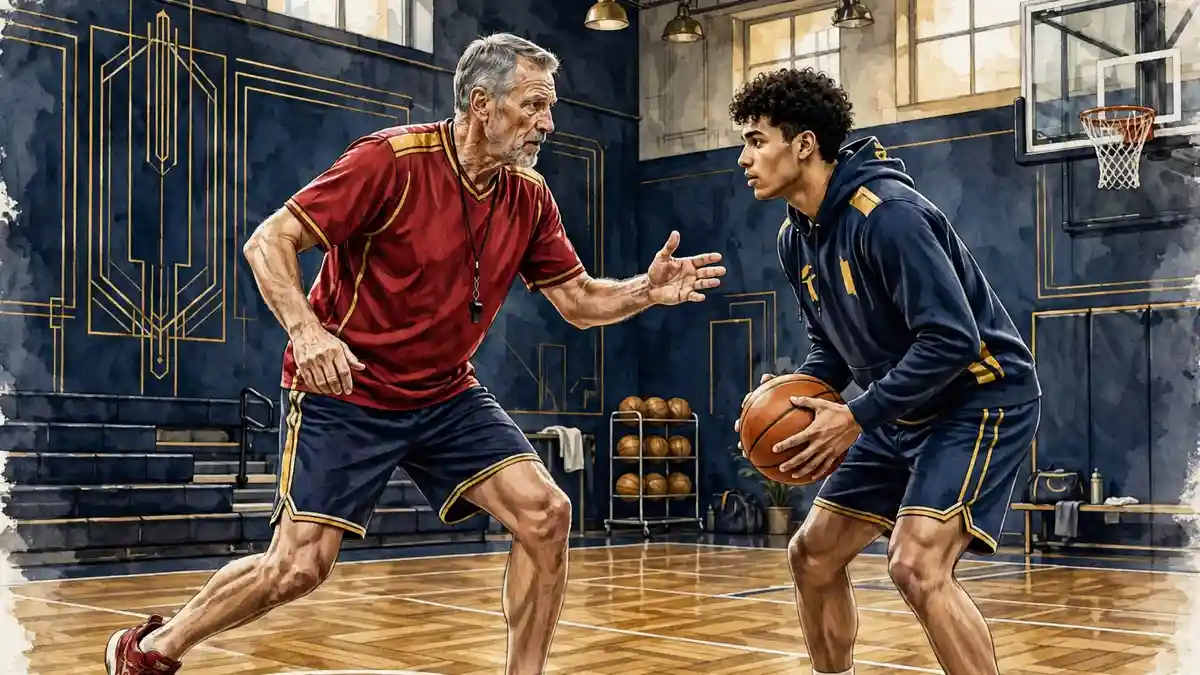
After retirement, the commercial work that did come his way was tied to his skill rather than his face. In 2012 the Sun-Sentinel reported that he was preparing a line of lifestyle gear, including personally designed basketball shoes, built around the Dream Shake — the move itself as a brand. His coaching clinics, at a reported $50,000 a week, are the purest version of the same idea: he sells the move, not the image. Students have included Kobe Bryant, LeBron James, Dwight Howard, Amar’e Stoudemire, Yao Ming, Emeka Okafor and, in recent years, Houston’s young centre Alperen Şengün. The fee is high because the lesson is scarce: there is exactly one person alive who invented the Dream Shake.
Houses, Cars and Other Assets
Olajuwon’s personal property is modest next to his investment portfolio, and that is the point: the houses he owns for himself are a rounding error against the buildings he owns for income. His main residence is a custom-built 7,200-square-foot home in North Houston with a lagoon pool, a wine cellar and a guest house, according to BounceMojo’s 2026 profile. Comfortable, but deliberately unflashy — the home of a man who put his money into apartment blocks and parking garages rather than into showing it off.
On cars, the public record is thin, and that thinness is itself informative. Unlike many retired stars, Olajuwon has no reported supercar collection, no garage features in lifestyle magazines, and no social media posts showing off vehicles. The reporting that exists describes a low-key lifestyle: he drives, he lives in Houston, and he spends his visible money on property and on his community, including the mosque construction he personally supervised. We do not invent a car collection where none has been documented, and readers should treat any site that lists specific luxury cars for Olajuwon without a source as guessing.
The assets that matter are the ones that pay him. His holdings, as documented by Celebrity Net Worth and the New York Times, include apartment buildings, commercial buildings, parking garages and single-family homes across Houston, the former Federal Reserve building, the former World Trade Center building near Minute Maid Park, the 41-acre retirement community site near Johnson Space Center, and the two Guyana residences acquired in late 2025. Parking garages deserve a special mention: they are among the least glamorous assets in real estate and among the most reliable, throwing off cash every day with almost no maintenance. It is exactly the kind of asset a patient, cash buyer accumulates — boring, durable, and profitable.
He also owns something no balance sheet captures cleanly: the Dream Shake itself. The move is his intellectual property in the practical sense — the reason stars pay $50,000 a week to spend a few days in a Houston gym with him. It will keep paying as long as young centres want to learn post footwork from the man who perfected it.
Awards and Achievements
Olajuwon’s trophy record is the reason his name sits in every serious argument about the greatest centre in NBA history. The headline honours:
- 2× NBA champion — 1994, 1995, Houston Rockets
- 2× NBA Finals MVP — 1994, 1995
- NBA Most Valuable Player — 1994 (the only player ever to win MVP, Defensive Player of the Year and Finals MVP in the same season)
- 2× NBA Defensive Player of the Year — 1993, 1994
- 12× NBA All-Star — 1985–1990, 1992–1997
- 6× All-NBA First Team — 1987, 1988, 1989, 1993, 1994, 1997
- 5× NBA All-Defensive First Team — 1987, 1988, 1990, 1993, 1994
- 2× NBA rebounding leader — 1989, 1990; 3× NBA blocks leader — 1990, 1991, 1993
- Olympic gold medal — Atlanta 1996, Team USA
- NBA’s all-time leader in blocked shots — 3,830, a record that still stands
- Naismith Memorial Basketball Hall of Fame — inducted 2008; FIBA Hall of Fame — inducted 2016
- NBA 50th Anniversary All-Time Team (1996) and NBA 75th Anniversary Team (2021)
- NCAA Final Four Most Outstanding Player — 1983, on the losing side
- Houston Rockets retired his number 34
The numbers behind the honours are just as strong. His career totals — 26,946 points, 13,747 rebounds, 3,830 blocks and 2,162 steals — make him the only player in league history with 3,000 blocks and 2,000 steals, and the only centre among the NBA’s career top ten in steals. His 1989–90 season, with 376 blocks and 213 steals, remains the only 200-and-200 season ever recorded. In the 1995 playoffs he averaged 33 points a game across 22 games, one of the great postseason runs by any player at any position, and his Finals average of 32.8 points against Shaquille O’Neal’s Orlando Magic is the highest of his three Finals appearances.
The honours also include one that money cannot buy and that his business career echoes: in 1996 he was named to the NBA’s 50 Greatest Players list while still active, and in 2021 to the 75th Anniversary Team. The league keeps returning to him because the record keeps holding up — nobody has passed his blocks total in the two decades since he retired, and nobody is close.
Net Worth Growth Over the Years
Olajuwon’s wealth grew in two distinct phases: the salary phase, which ended in 2002, and the property phase, which is still running. The table below is our editorial estimate, built from the dated reporting cited in this article — the salary figures are documented, the portfolio values are the published estimates for each period, and the net worth column is our reading of the two together.
| Year | Estimated net worth | What drove it |
|---|---|---|
| 1984 | Under $1 million | Rookie contract; first NBA paycheques |
| 1990 | $5 million – $8 million | Early salaries; first Houston land purchases |
| 1995 | $12 million – $18 million | Championship years; $30 million extension signed |
| 2002 | $45 million – $60 million | Career salary past $110 million; property buying under way |
| 2006 | $100 million+ | 25-property portfolio passes $100 million (New York Times) |
| 2015 | $150 million – $200 million | Portfolio appreciation; coaching clinics begin |
| 2021 | $300 million | Celebrity Net Worth updates its figure to $300 million |
| 2026 | $200 million – $300 million | Current reporting consensus at $300 million; older $200 million estimates retained as the range floor |
The shape of the curve is the story. Between 1984 and 2002 his wealth tracked his salary, rising in steps each time he signed a new deal. After 2002 it tracked Houston real estate, rising steadily while he spent nothing on interest and sold nothing under pressure. The 2008 financial crisis, which wiped out debt-loaded property investors across America, barely touched a man with no mortgages: he could simply wait, collect rent, and keep buying. That is why the 2006-to-2026 stretch shows the steepest growth of his life, in years when he earned no salary at all.
For context, his $300 million puts him around seventh or eighth among the richest NBA players alive, depending on the list — BounceMojo ranks him seventh, Sportsbet’s 2026 ranking places him eighth. The players above him are almost all guards and forwards who earned far more from endorsements: Michael Jordan’s $4.7 billion fortune, per Forbes’ real-time tracker in October 2026, and LeBron James at $1.4 billion, per Forbes’ October 2026 estimate, sit in a different universe. Olajuwon’s achievement is different in kind: he is the richest player whose fortune was built primarily after basketball, with cash, in a single city.
Social Media Presence
Olajuwon keeps almost no public social media profile of his own, and that is consistent with everything else about him. As of November 2026 there is no widely verified personal Instagram, X or TikTok account run by Olajuwon himself; fan-run pages carry his name, and the Houston Rockets and the Naismith Memorial Basketball Hall of Fame mark his milestones on their own accounts. He does not post about his property deals, his coaching sessions or his daily life, and the few public appearances he makes — a Rockets anniversary night, a Hall of Fame event, a visit to a Houston gym to work with a young centre — reach the public through other people’s cameras.
The absence is a business choice as much as a personal one. A man whose income comes from rent cheques and private coaching weeks has no need for an audience, and his brand — the Dream Shake — is taught in person, not sold through posts. It also means readers should be sceptical of accounts claiming to be him: any profile soliciting money or selling access in his name is not verified, and the Rockets’ official channels are the reliable source for news about his public appearances.
Personal Life
Olajuwon married Dalia Asafi in 1996, and the couple have raised their family in Houston, the city he has called home since arriving at the University of Houston in 1981. His children include daughter Abi Olajuwon, who followed him into professional basketball and played in the WNBA — a rare father-daughter pair of professional players. He keeps his family life private, and little beyond that is on the public record.
His faith is the most public fact of his personal life, and the one that shaped his money most directly. A devout Muslim, he studies the Qur’an daily, according to Celebrity Net Worth, and he observed the Ramadan fast throughout his playing career — playing full NBA games without food or water during daylight hours, including during the regular season and playoffs. The discipline that let him fast and play is the same discipline that let him buy property only with cash he actually held: a refusal to take shortcuts, applied to the body and the balance sheet alike.
He also gave back to Houston in ways that blur the line between business and community. The downtown bank building he restored and reopened as the Islamic Da’wah Center in 2002 is a mosque and cultural hub, not a commercial let. The $400,000 he contributed toward Houston’s largest mosque, a project he personally supervised, sits in the same category. He served as a pioneer president of the Muslim community in Houston, according to Billionaires.Africa’s account of the mosque project. None of this shows up in a net worth figure, but it explains why Houston treats him as more than a former player: he invested in the city, and then he stayed.
Today, at 63, he divides his time between his property interests, occasional coaching work with NBA players who seek him out, and family life in Houston. The Guyana purchases in late 2025 suggest the investor is not finished, and the steady stream of stars arriving at his gym suggests the teacher is not either.
Sources & Reporting
Celebrity Net Worth — the $300 million net worth figure and the $110 million career salary total, including the $16.7 million peak season in 2000–01 (about $27 million in today’s dollars); the debt-free real estate reporting, the $150 million-plus transaction total, the Federal Reserve building purchase and the mosque conversion. Profile updated April 6, 2025.
BounceMojo — 2026 net worth estimate of $300 million, year-by-year framing, the $100 million portfolio mark by 2006, and the 7,200-square-foot North Houston home. Page updated September 2026.
ClutchPoints — $300 million net worth with Spotrac-derived career earnings of $97,356,426 and an annual average salary of $5.4 million; endorsement summary (Spalding, Etonic, LA Gear) and real estate work. Richest NBA players ranking, updated November 2026.
SportsDunia — $300 million net worth, career statistics table from ESPN archives, championship and contract history. Profile accessed November 2026.
Basketball Network — the 1992 contract dispute in full (the $15 million demand, the $3 million salary, the renegotiation clause, the suspension, the four-year $30 million extension); the 2026 report on the Guyana property purchases; and the 2024 account of the 2011 LeBron James summer workouts. Articles dated 2022, 2024 and March 2026.
Billionaires.Africa — the debt-free fortune narrative, the Federal Reserve building and mosque deals, the 41-acre Johnson Space Center tract, and the Jim West mansion acquisition. Published June 15, 2026.
The SportsRush — the $50,000-a-week coaching fee, revealed by Kelly Dwyer in 2012; Amar’e Stoudemire’s $100,000 for two weeks; the Kobe Bryant 2009 sessions and the Dream Shake’s history. Articles dated 2022.
The New York Times — the 2006 profile of Olajuwon’s real estate portfolio (25 properties, $100 million-plus in transactions, the interest-free investing philosophy and the “work with my own capital” quote), as cited by Celebrity Net Worth and Basketball Network. Reporting window: November 2006, cited in 2025–2026 coverage.
Sportsbet — richest NBA players 2026 ranking, including Forbes’ October 2026 real-time estimates for Michael Jordan ($4.7 billion) and LeBron James ($1.4 billion), and Olajuwon at $300 million. Accessed November 2026.
PlayersWiki — season-by-season salary table for Olajuwon’s career, including the $16.7 million 2000–01 season and the $5,061,539 Toronto season. Page updated February 2023.
ESPN — career statistics archives cited by SportsDunia for season-by-season points, rebounds and shooting numbers. Reporting window: career 1984–2002.
NBA.com — official career totals (26,946 points, 13,747 rebounds, 3,830 blocks), championship history and Hall of Fame record. Career record, accessed November 2026.
Reporting window for this article: April 2025 – November 2026. Figures are estimates from public reporting; private property values and personal finances are not publicly audited, so the net worth is published as a range. Where sources disagreed — $200 million in older profiles, $300 million in current reporting, $350 million in a 2021 syndication — we named the sources and anchored on the current consensus.
Frequently Asked Questions
What is Hakeem Olajuwon’s net worth in 2026?
Hakeem Olajuwon’s net worth is estimated at $300 million in 2026, within a range of $200 million to $300 million. Celebrity Net Worth, BounceMojo, SportsDunia and ClutchPoints all land on $300 million; older profiles that say $200 million predate the recent reporting on his property portfolio. Most of the fortune comes from Houston real estate, not from his NBA salary.
How much money did Hakeem Olajuwon make in the NBA?
Olajuwon earned a little over $110 million in salary during his 18-year NBA career, according to Celebrity Net Worth. Contract-only data from Spotrac, cited by ClutchPoints, totals $97,356,426 — the gap is bonuses and incentive payments. His highest-paid season was 2000–01, when the Houston Rockets paid him $16.7 million, roughly $27 million in today’s dollars.
How did Hakeem Olajuwon get rich after basketball?
He built a Houston real estate empire with cash, buying apartment buildings, commercial property, parking garages and land near rail lines, stadiums and the Texas Medical Center. By 2006, four years after retiring, his portfolio of about 25 properties had already passed $100 million in value. He never used a mortgage or a credit line, because his Muslim faith forbids paying interest — so every dollar of rent and appreciation stayed with him, and no downturn could force a sale.
Is Hakeem Olajuwon a billionaire?
No. His net worth is estimated at $300 million, well short of a billion. Among NBA players, only Michael Jordan and LeBron James have reached billionaire status, according to Forbes. Olajuwon ranks around seventh or eighth among the richest NBA players alive, and his fortune is the largest built primarily after basketball through property rather than endorsements.
What is the Dream Shake?
The Dream Shake is Olajuwon’s signature post move: a spin, a pump fake and a soft jumper, built on footwork he first learned as a soccer goalkeeper in Lagos. It made him nearly unguardable in the post during the 1994 and 1995 championship runs. After retirement he began teaching it to the game’s biggest stars — Kobe Bryant, LeBron James, Dwight Howard and Amar’e Stoudemire — at a reported $50,000 a week.
How tall is Hakeem Olajuwon?
Hakeem Olajuwon is 7 feet tall (2.13 m). His height, combined with the quick feet of a former soccer goalkeeper, is what made his game so unusual: a centre who moved like a guard, could dribble the length of the floor, and is still the NBA’s all-time leader in blocked shots with 3,830.
How many championships did Hakeem Olajuwon win?
Olajuwon won two NBA championships, both with the Houston Rockets, in 1994 and 1995 — and he was named Finals MVP both times. In 1994 he also won the regular-season MVP and the Defensive Player of the Year award, the only player in NBA history to sweep all three honours in a single season. He added an Olympic gold medal with Team USA at Atlanta 1996.
What does Hakeem Olajuwon do now?
He lives in Houston, manages his real estate portfolio, and coaches NBA players who travel to work with him on post footwork — most recently Houston’s young centre Alperen Şengün. In late 2025 he bought two luxury residences in Guyana, his first reported property purchase outside the United States. He keeps no verified personal social media accounts.
Final Thoughts
Hakeem Olajuwon’s $300 million is the most interesting fortune in basketball, because it breaks the usual pattern. He did not get rich from a shoe deal, a broadcast contract or a front-office job. He got rich by treating his salary as seed money, buying land in a city he understood, and refusing — on principle — to borrow a dollar to do it. The 1992 contract fight, when Houston paid its franchise centre $3.17 million while rivals earned three times as much, taught him what his labour was worth; the property portfolio taught him what patience was worth.
Two numbers sum him up. The first is 3,830, his career blocks, still the NBA record two decades after he retired — proof of a player who dominated without needing the ball. The second is zero: zero mortgages, zero credit lines, zero interest payments across a portfolio now valued at roughly $300 million. Most athletes spend their careers chasing the next paycheque. Olajuwon spent his building something that pays him whether he plays or not, and that is why his net worth was still climbing twenty years after his last game.
Published on November 11, 2026. Last reviewed November 2026. Found an error? See our corrections policy.