
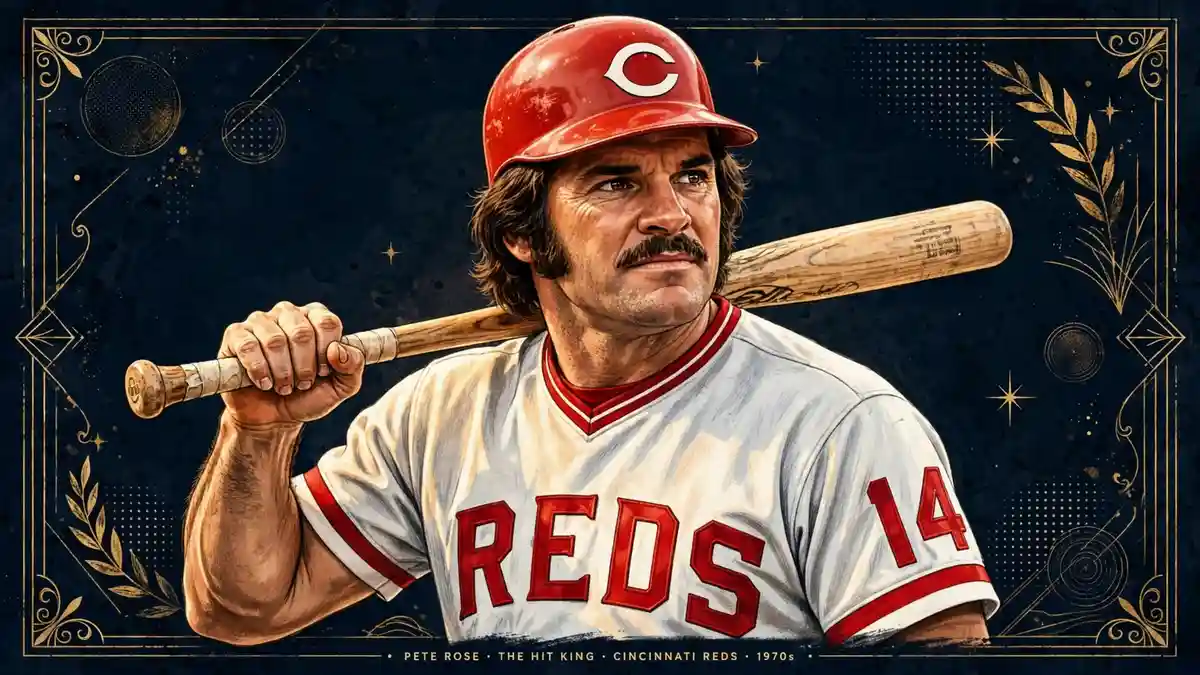
Pete Rose‘s net worth is estimated at $3 million to $5 million as of November 2026. The Hit King collected 4,256 hits — still the most in Major League Baseball history — earned $7.1 million in career salaries, then watched a lifetime ban for betting on baseball erase the fortune his talent should have built. In his final years he rebuilt a living from autograph tables in Las Vegas, pulling in a reported $50,000 to $100,000 a month, and eight months after his death in September 2024, Commissioner Rob Manfred lifted the ban that had kept him out of Cooperstown for 36 years.
Pete Rose: Quick Facts
| Estimated net worth | $3 million (range: $3 million to $5 million) |
|---|---|
| Profession | Former MLB player and manager |
| Nationality | American |
| Born | April 14, 1941 – September 30, 2024 (aged 83) |
| Height | 5 ft 11 in (1.80 m) |
| Primary income sources | MLB salaries; autograph signings and memorabilia; books and public appearances |
| Active years | 1963–1989 (player 1963–1986, manager 1984–1989) |
| Last reviewed | November 2026 |
- Early Life and Background
- Education
- Career Journey
- Rise to Fame
- Main Sources of Income
- Salary and Earnings
- Businesses and Investments
- Brand Deals and Sponsorships
- Houses, Cars and Other Assets
- Awards and Achievements
- Net Worth Growth Over the Years
- Social Media Presence
- Personal Life
- Sources & Reporting
- Frequently Asked Questions
- Final Thoughts
Early Life and Background
Peter Edward Rose was born on April 14, 1941, in Cincinnati, Ohio, and grew up in the city’s Anderson Ferry neighborhood on the west side. His father, Harry Rose, played semi-professional football and worked as a bank employee, and he drilled into his son a simple rule that later became the player’s entire identity: run hard to first base on every ball in play, even a walk. Young Pete took the instruction literally. Teammates, coaches and eventually the whole sport would know him by the style that came out of it — headfirst slides, full-speed sprints on routine grounders, a refusal to coast that looked reckless and turned out to be a career.
Cincinnati shaped Rose in a second way. He was a hometown kid who grew up a Reds fan, and the Reds were the team he would carry to two World Series titles and the franchise record books. The city later named a stretch of riverfront street Pete Rose Way, and after his death the Reds held a Pete Rose Night at Great American Ball Park in May 2025, the day after Manfred’s reinstatement ruling. That hometown bond explains part of why his fall hit so hard in Cincinnati: the ban removed a manager, and it exiled the city’s favorite son from the game he had played in front of his own neighbors since 1963.
Rose’s family life was working-class and sports-mad. His father played for the Cincinnati Bengals of the old American Football League in the 1930s — a different Bengals from the modern NFL team — and coached youth sports. Pete played baseball, football and basketball growing up, and the competitive streak showed early: he was the kid who treated a sandlot game like a playoff. The nickname that would follow him for life, “Charlie Hustle,” arrived during spring training in 1963, when New York Yankees pitcher Whitey Ford watched the rookie sprint to first on a walk and tagged him with the name. Ford meant it as a joke. Rose wore it as a badge for the next six decades.
One detail from those early years matters to the money story. Rose was not a bonus baby. He signed with the Reds in 1960 for a reported $7,000 — the kind of figure that barely registers against modern signing bonuses, which routinely run into seven figures. He spent three seasons in the minor leagues, hitting .300 or better at every stop, before forcing his way onto the big-league roster. The low starting point frames everything that followed: his fortune was built hit by hit, contract by contract, across 24 seasons, and it was never large enough to survive what he did to it off the field.
Education
Rose attended Western Hills High School in Cincinnati, where he played baseball and football. His school career was undistinguished in the classroom — he was held back a year and repeated a grade — and his grades were poor enough that college baseball was never a realistic path. That is not a footnote; it shaped his economics. Without a college degree or a fallback profession, baseball was the only trade he had. When the ban took it away in 1989, at age 48, he had no second career to fall back on, no broadcasting chair waiting, and no front-office job in the sport that had employed him since he was 19.
The Reds signed him out of high school in 1960, and his real education happened in the minor leagues: Geneva in the New York-Penn League, Tampa in the Florida State League, and Macon in the South Atlantic League. At Macon in 1962 he hit .330 and won the league batting title, the season that convinced the Reds he was ready. He debuted in the majors on April 8, 1963, against the Pittsburgh Pirates, went 0-for-3, and then collected his first hit — a triple — three days later. He finished that rookie season hitting .273, won National League Rookie of the Year, and never spent another day in the minors.
What Rose learned in those years was the value of durability. He played 162 games in a season six times and appeared in at least 150 games in 17 different seasons. That availability was itself an income strategy in an era before guaranteed mega-contracts: a player who never missed games kept his salary climbing year after year. By the time free agency arrived, his body of work — and his body, still intact after thousands of headfirst slides — was the asset that earned him the richest contract in baseball.
Career Journey
Rose played 24 major-league seasons, from 1963 to 1986, for three clubs: the Cincinnati Reds (1963–1978 and 1984–1986), the Philadelphia Phillies (1979–1983) and the Montreal Expos (1984). He then managed the Reds from 1984 to 1989, the final five years as a full-time manager. The raw totals still sit at the top of baseball’s record book: 4,256 hits, 3,562 games played, 15,890 at-bats and 3,215 singles — all major-league records. He finished with a .303 career batting average, 160 home runs and 1,314 runs batted in, and he played five positions — second base, third base, first base, left field and right field — a versatility that kept him in the lineup through three decades of roster change.
The career breaks into four acts. The first, 1963 to 1969, was the ascent: Rookie of the Year in 1963, the first of 17 All-Star selections in 1965, back-to-back batting titles in 1968 and 1969, and two Gold Gloves at second base and in the outfield. The second, 1970 to 1978, was the Big Red Machine — the Reds teams managed by Sparky Anderson that won back-to-back World Series in 1975 and 1976 with a lineup that included Johnny Bench, Joe Morgan and Tony Pérez. Rose was the engine of those teams: he hit .300 or better in eight of those nine seasons, won the 1973 National League MVP award and was named World Series MVP in 1975 after hitting .370 against Boston.
The third act was Philadelphia. After the 1978 season, Rose became a free agent and signed the four-year, $3.225 million contract with the Phillies that made him the highest-paid player in baseball. The bidding had been fierce — the Kansas City Royals offered a reported $4 million plus a stake in the owner’s oil investments, and Atlanta offered $3 million over three years plus a pension paying $100,000 a year for life, according to FanBuzz — and Rose chose Philadelphia. The choice paid off on the field: in 1980 he helped the Phillies win the first World Series in franchise history, tagging out Frank White on a dropped third strike to end the clinching Game 6. In 1981 he added a Silver Slugger award.
The fourth act was the record chase. Traded to Montreal in January 1984, Rose played half a season with the Expos before the Reds brought him home that August as player-manager. On September 11, 1985, in front of a packed Riverfront Stadium crowd, he singled off San Diego’s Eric Show for hit number 4,192, passing Ty Cobb’s record of 4,189 that had stood for 57 years. Fireworks went off, play stopped for 10 minutes, and his son Pete Jr. — then 15 — ran onto the field to hug him. Rose played one more season, retiring as a player in November 1986 with 4,256 hits, and stayed on as the Reds’ full-time manager. Three years later, the game threw him out for good.
Rise to Fame
Rose became famous the way few athletes do: not for one signature moment but for a style that television could not ignore. The headfirst slide into first base, the sprint on a walk, the collision with catcher Ray Fosse at home plate in the 1970 All-Star Game that broke Fosse’s shoulder — every highlight reel of the 1970s had Rose in it, running at full speed. That 1970 All-Star collision remains one of the most replayed plays in baseball history, and it tells you everything about the economics of his fame: his brand was effort, and effort was always on display.
The Big Red Machine years made him a national figure. The 1975 World Series against Boston, a seven-game classic, drew huge television audiences, and Rose’s .370 average and World Series MVP award put him on magazine covers across the country. The 1976 team swept the Yankees and is still argued about as one of the best teams ever assembled. By the late 1970s, Rose was one of the most recognizable athletes in America, and his salary reflected it: the Phillies deal in 1979 made him the best-paid player in the sport, and he was the rare baseball star whose fame crossed over into mainstream culture — game-show appearances, commercials, and a public profile that extended well beyond the sports pages.
Fame had a second act after the playing career ended, and it paid differently. The ban made Rose a permanent controversy, which kept him famous but cut off the income that fame normally produces. He could not work for a major-league team, could not appear at official MLB events, could not be elected to the Hall of Fame, and could not take the coaching or broadcasting jobs that former stars rely on. What he could do was sign autographs, and the same fame that the ban had frozen became the product he sold — at card shows, casinos and memorabilia shops, mostly in Las Vegas, where he lived in his final years. The 2024 HBO documentary series “Charlie Hustle & The Matter of Pete Rose” put him back on screen months before his death and gave him a final platform to argue his case; at a Q&A after the premiere, he told the audience that gambling had cost him “a hundred million dollars.”
Main Sources of Income
Rose’s money came from three distinct eras, and the shape of his fortune only makes sense when they are kept separate. The first era was baseball salary: $7.1 million across his playing and managing career, according to Celebrity Net Worth, earned between 1963 and 1989. The second was the post-ban autograph and memorabilia economy, which ran from roughly 1990 until his death in 2024 and produced, at its peak, a reported $600,000 to $1.2 million a year. The third was books, media appearances and one-off deals — smaller money, but the only kind available to a man barred from the sport itself.
Baseball salary was the foundation and, by modern standards, a modest one. Rose played his best years before free agency pushed salaries into the stratosphere. His rookie deal paid about $7,000 in 1963. Even his biggest contract — the Phillies’ $3.225 million over four years — is less than a single season’s pay for a mid-tier player today. Adjusted for inflation, his $7.1 million in career salaries equals roughly $30 million in today’s dollars, according to Glows Magazine’s calculation. That sounds like plenty until you set it against 24 seasons, two divorces, tax trouble, gambling losses and three decades of living without a salary.
The autograph business was the surprise second career. After the ban, Rose discovered that his signature was worth more than his labor. Fans paid $50, $75 or $100 a signature at shows, and he signed by the thousands. Divorce documents filed by his second wife Carol in April 2018 put the scale on the record: she claimed he earned about $100,000 a month — $1.2 million a year — from autographs alone. Rose disputed the number in his response, saying it was closer to $50,000 a month, or $600,000 a year. Either figure is striking for a man in his late 70s, and the dispute itself is the best evidence available: the two sides argued over the size of the income, not whether it existed. That income was the reason his net worth held at $3 million rather than collapsing to nothing in the 35 years after his last paycheck from baseball.
Books and media filled the gaps. His 2004 book “My Prison Without Bars,” written with Rick Hill, was the one in which he finally admitted betting on baseball, and it sold on the strength of that confession. His 1989 autobiography, written with Roger Kahn, had denied it. The HBO documentary in 2024 paid him for participation and gave him a final burst of attention. Reality television added a little more: TLC’s “Pete Rose: Hits & Mrs.” ran in 2013, following Rose and his fiancée Kiana Kim. None of these paid like baseball. All of them mattered because, after 1989, there was no baseball money at all.
Salary and Earnings
Celebrity Net Worth puts Rose’s total career earnings from baseball salaries at $7.1 million, and the year-by-year breakdown shows how slowly money grew in his era. He started at roughly $7,000 as a rookie in 1963. Salaries climbed through the late 1960s and early 1970s as he stacked batting titles and All-Star selections, but the reserve clause kept players tied to their teams, and pay stayed far below what the same performance would command today. The 1979 Phillies contract changed the scale: $905,000 in 1979, $805,000 in 1980, $705,000 in 1981 and $910,000 in 1982, per Celebrity Net Worth’s salary table. Those four seasons alone — $3.325 million by the site’s year-by-year accounting, against the $3.225 million headline figure — were nearly half his lifetime baseball income.
His single highest-earning year came after his playing days, when the Reds paid him $1 million to manage the team in 1986. That figure matters because it shows what the ban destroyed. Had Rose stayed in baseball as a manager into the 1990s and 2000s, when managerial salaries climbed into the millions, he would have earned many times his playing total. Rose himself put a number on that loss: at the HBO documentary premiere in July 2024, he said gambling had cost him “a hundred million dollars,” adding, “That’s what I’d have made in baseball if I hadn’t got suspended.” He had earlier used a lower figure, telling interviewers the ban cost him at least $80 million in potential earnings. The two numbers disagree, and both are his own estimates rather than audited figures — but the direction is not in doubt. The ban was the single most expensive event of his financial life.
The table below lays out the verified salary milestones. Figures are nominal dollars of the year, not inflation-adjusted, and come from Celebrity Net Worth’s career-earnings research and contemporary reporting of the Phillies contract.
| Year / period | Amount | What it was |
|---|---|---|
| 1963 | ~$7,000 | Rookie salary with the Cincinnati Reds |
| 1979 | $905,000 | First year of the Phillies free-agent deal |
| 1980 | $805,000 | Second year; Phillies win the World Series |
| 1981 | $705,000 | Third year of the Phillies deal |
| 1982 | $910,000 | Final year of the Phillies deal |
| 1986 | $1,000,000 | Highest single year — managing the Reds |
| 1963–1989 total | $7,100,000 | All playing and managing salaries combined |
Set that $7.1 million against his peers and the gap is stark. Michael Jordan earned $90 million in NBA salary alone — and billions from endorsements — while Rose’s entire baseball income would not cover a single season of a modern star’s pay. Aaron Judge signed a nine-year, $360 million contract with the Yankees in 2022; Rose’s lifetime earnings equal about two percent of that deal. The comparison is not a criticism of Rose. It is the context that explains his net worth: he was the best-paid player of his era and still retired from baseball with career earnings that a modern All-Star makes in a month.
The gambling losses sit on the other side of the ledger. The Dowd Report’s investigator heard testimony that Rose lost $450,000 in a three-month span in 1987, according to his associate Michael Bertolini, known as Janszen. FBI documents released in August 2025 — 130 pages, made public after Rose’s death — showed he once owed his bookie Ronald Peters as much as $90,000, and that he regularly bet $1,000 to $2,000 per football game, about ten games a weekend, in 1986. Those are documented losses, not estimates, and they explain why a man who earned $7.1 million in salary and up to $1.2 million a year signing autographs died with a net worth of $3 million.
Businesses and Investments
Rose was never a businessman in the way modern athletes are. He owned no restaurant chain, no clothing line, no equity portfolio of startups, and no real-estate empire. The businesses he ran were extensions of his name: autograph signings, memorabilia sales, personal appearances at card shows and casinos, and a steady trade in signed baseballs, bats, jerseys and photographs. That trade was the business, and it was a good one for three decades because demand for his signature never faded — if anything, the ban increased it, since he could not be seen anywhere else.
The mechanics were simple and cash-heavy. Promoters booked him for shows, fans paid per signature, and Rose kept the bulk of the take. At his peak the divorce filings say he cleared $50,000 to $100,000 a month. The work was physical — hours at a table, thousands of signatures a weekend — and it depended entirely on his presence, which is why his death ended the income stream overnight. Unlike a business that can be sold or inherited, the autograph trade was Rose himself. His estate holds the memorabilia and the name, but the signing table is gone.
He tried other ventures with mixed results. A Las Vegas memorabilia shop carried his name. He made paid appearances at casinos and fan conventions, including the annual Cooperstown induction weekend, where he signed for fans outside the official events he was barred from attending. He licensed his name for a line of memorabilia and for the “Hit King” brand that appeared on shirts and collectibles. None of these produced the kind of passive income that builds lasting wealth, and none of them appear in any public filing as a major asset. The honest summary is that Rose’s only durable business was himself — and that business paid by the signature, not by the month.
On investments, the public record is thin, which is itself informative. There is no record of Rose holding significant stock portfolios, property portfolios or business equity at his death. The $1.96 million figure that one aggregator site attaches to a 2014 property transaction has no corroboration in mainstream reporting, and we do not rely on it. What the record does show is the opposite of investment: gambling losses, tax penalties, two expensive divorces and decades of cash spending. A man who earned $7.1 million in salary and millions more from autographs, yet died with $3 million, did not lose the difference to bad investments. He spent it and bet it.
Brand Deals and Sponsorships
During his playing peak, Rose’s endorsements were typical of a 1970s baseball star: modest by today’s standards, meaningful at the time. Contemporary reports name Aqua Velva aftershave and the Japanese sporting-goods maker Mizuno among the brands he represented, and he appeared in commercials that traded on the Charlie Hustle image — the hard-charging, blue-collar ballplayer. The deals paid in the tens of thousands, not millions, because baseball endorsements in that era were a fraction of what basketball and football stars commanded, and because Rose’s appeal was regional as much as national.
The ban ended that income permanently. Sponsors do not hire a man Major League Baseball has declared permanently ineligible, and the Hall of Fame’s 1991 rule — barring anyone on the ineligible list from its ballots — removed the last platform that could have kept him commercially relevant. Floyd Mayweather, a fighter from a later era who built a fortune on pay-per-view and self-promotion, shows the contrast: a controversial athlete with control of his own promotion can still earn nine figures. Rose had no promotion to control and no league willing to employ him.
What replaced endorsements was the memorabilia market, which is sponsorship in reverse: instead of a brand paying Rose to wear its logo, fans paid Rose to put his name on their belongings. The economics were similar in scale to a mid-tier endorsement deal — hundreds of thousands a year at peak — but the work never stopped and the brand never grew. His 2004 book deal for “My Prison Without Bars” was the closest thing to a modern endorsement: a publisher paid for the confession, and the confession sold the book. It was also the moment he gave up the denial that had protected his marketability for 15 years, trading it for a payday and, eventually, a path back toward the Hall of Fame.
Houses, Cars and Other Assets
Rose’s property record is modest, and the modesty is the point. He lived most of his later life in Las Vegas, Nevada, where he moved to be close to the autograph and casino-appearance circuit that paid his bills. He died at his home in Las Vegas on September 30, 2024, at age 83, after being found by a family member; the Clark County coroner later determined the cause was hypertensive and atherosclerotic cardiovascular disease, according to the Associated Press. No public record describes a portfolio of homes, and no reporting at his death listed a mansion, a ranch or a collection of investment properties. The Las Vegas home was his base, not a showpiece.
Earlier in life he kept a home in the Cincinnati area, where his family lived during his playing and managing years, and the 2018 divorce proceedings with Carol Woliung fought over the division of marital property, including the Las Vegas residence and the memorabilia collection. Those proceedings are the main reason any of his asset details are public at all: divorce filings forced the autograph income onto the record, and with it the picture of a man whose wealth sat in signatures and collectibles rather than in deeds and portfolios.
The memorabilia collection itself was an asset of a particular kind. Rose owned game-used bats, balls from milestone hits, uniforms and a deep personal archive of his career — items with real market value, since his signature and his game-used gear command strong prices among collectors. The 4,192nd-hit ball from September 11, 1985, is the kind of object that would sell for six figures at auction, and his collection included pieces from all 4,256 hits, three World Series and 17 All-Star Games. Whether the estate has sold any of it, and for how much, has not been publicly disclosed, and we do not guess at a value.
On cars, the record is quiet. Rose was not known as a collector of exotic automobiles, and no reporting links him to the kind of garage that fills net-worth articles about modern athletes. He drove what a working ballplayer drove in the 1970s and 1980s, and in Las Vegas he was known for showing up to signings in ordinary clothes with a pen in his hand. The absence of a car collection is consistent with the rest of the picture: his money went to gambling, taxes, divorces and living, not to assets that appreciate.
Awards and Achievements
Rose’s trophy case is one of the fullest in baseball history, and it is also the reason his absence from the Hall of Fame still draws headlines. The achievements: 17 All-Star selections (1965, 1967–1982), three World Series championships (1975, 1976, 1980), the 1973 National League Most Valuable Player award, the 1963 National League Rookie of the Year award, the 1975 World Series MVP award, two Gold Glove awards (1969, 1970), three National League batting titles (1968, 1969, 1973), a Silver Slugger award in 1981, and the 1976 Roberto Clemente Award for sportsmanship and community involvement. He was named to the Major League Baseball All-Century Team in 1999 and to the Cincinnati Reds Hall of Fame in 2016, an honor the team could bestow because it is separate from Cooperstown.
The records are the heart of the case. Most career hits (4,256), most career games played (3,562), most career at-bats (15,890), most career singles (3,215), most seasons with 200 or more hits (10), and the only player in history with 4,000 hits and 500 doubles. He hit .300 or better in 15 seasons and collected 200 or more hits in a season 10 times. The 44-game hitting streak in 1978 — the longest in the National League since 1897 — fell one game short of Joe DiMaggio’s 56-game record and produced one of the great summer storylines in baseball history, with nightly crowds tracking each game.
The Hall of Fame story is where the achievements meet the money. In February 1991, the Hall’s board adopted a rule barring anyone on baseball’s permanently ineligible list from appearing on its ballots — a rule written, in effect, for Rose. He applied for reinstatement in 1997, 2015 and 2022, and was turned down each time. Manfred’s May 13, 2025 ruling changed the underlying policy: permanent ineligibility now ends at death, so Rose and 16 other deceased individuals, including Shoeless Joe Jackson, came off the ineligible list. Hall of Fame chairman Jane Forbes Clark confirmed the ruling restored eligibility for consideration. Under the Hall’s current rules, the Classic Baseball Era Committee — which considers players whose greatest contributions came before 1980 — next votes in December 2027, and election requires 12 of 16 votes. The earliest Rose could be inducted is 2028, and betting markets in October 2026 put his chances at about 83 percent, according to Sports Radio Service.
That 2027 vote is the last financial event in Rose’s story, and it is a strange one: induction would not pay his estate directly, but it would almost certainly raise the value of his memorabilia, his autograph market and the licensing of his name. A Hall of Fame plaque is the one asset his career never produced while he was alive to enjoy it, and it may still be the most valuable thing his name ever earns.
Net Worth Growth Over the Years
Rose’s wealth followed a shape that no other all-time great shares: a slow climb, a sudden cliff, and a long flat line. The table below tracks the estimate at key points, using the figures documented in the sections above. Early figures are salary-based; later figures are estimates drawn from Celebrity Net Worth, divorce filings and contemporary reporting.
| Year | Estimated net worth | What changed |
|---|---|---|
| 1963 | Under $10,000 | Rookie season; $7,000 salary |
| 1973 | ~$500,000 | NL MVP; salaries rising through the Big Red Machine years |
| 1979 | ~$2,000,000 | Phillies free-agent deal; highest-paid player in baseball |
| 1986 | ~$3,000,000 | $1 million managing salary; peak of his baseball wealth |
| 1989 | ~$2,000,000 | Lifetime ban; salary and endorsements end |
| 1991 | ~$1,000,000 | Prison, tax penalties and legal costs after the 1990 guilty plea |
| 2004 | ~$2,000,000 | Book advance and autograph income rebuilding the balance |
| 2018 | ~$3,000,000 | Autograph income $600,000–$1.2 million a year at peak |
| 2024 | $3 million–$5 million | Net worth at death, September 30, 2024 |
Two things stand out. First, the peak was low: even at his richest, in the mid-1980s, Rose’s net worth was roughly $3 million — the same number he died with. He never had a big year that changed the scale, because his era did not pay them. Second, the recovery after 1989 is the remarkable part. A man banned from his profession, with no pension from the league, no broadcasting contract and a prison sentence behind him, rebuilt his wealth to $3 million by signing his name thousands of times a year. The autograph table was not a hobby. It was the pension baseball never paid him.
The comparison that puts the whole arc in perspective is the one Rose made himself. He said the ban cost him $80 million, then $100 million. Those are his numbers, not ours, and they assume a career path — decades of managing, coaching, broadcasting and endorsements — that he never got to test. What the documented record proves is narrower and sadder: he earned $7.1 million in salary, lost hundreds of thousands at the track and the bookmaker’s window, paid the taxman and two ex-wives, and still finished with $3 million because fans kept lining up for his signature. The range we publish — $3 million to $5 million — reflects the consensus of the outlets that tracked him at his death, with the top end acknowledging the higher figure Net Worth List published and the bottom end anchored on Celebrity Net Worth.
Social Media Presence
Rose was 83 when he died, and he belonged to the last generation of sports stars whose fame was built before social media existed. He had no verified personal account with a large following, and no official presence that he managed himself. His public visibility in his final years came through other channels: the Reds’ official accounts, MLB’s tributes after his death, HBO’s promotion of the “Charlie Hustle” documentary, and the memorabilia promoters who advertised his signing appearances on Facebook and Instagram.
That absence is part of the money story. Modern athletes monetize attention directly — sponsored posts, YouTube channels, podcast deals — and a player with Rose’s name recognition today would earn seven figures a year from social media alone. Rose’s attention was monetized the old way: in person, one signature at a time, at a table in a casino or a card show. The documentary’s release in July 2024 gave him a final surge of online attention, and after his death the tributes from MLB, the Reds and the Phillies drew millions of views. After the May 2025 reinstatement, the conversation moved to X and sports radio, where the December 2027 Era Committee vote is already being debated. He never posted. The internet argued about him anyway.
Personal Life
Rose was married twice and engaged once more, and the relationships map closely onto the financial story. His first marriage, to Karolyn Englehardt, began in January 1964, the year after his rookie season, and produced two children: Fawn, born in 1964, and Pete Rose Jr., born in 1969. The marriage ended in divorce in 1980. Pete Jr. followed his father into baseball, playing mostly in the minor leagues and reaching the majors for 11 games with the Cincinnati Reds in 1997 — the same franchise, 34 years after his father’s debut.
His second marriage, to Carol J. Woliung, began in 1984 and produced two more children: Tyler, born in 1984, and Cara, born in 1989. Carol was a former Philadelphia Eagles cheerleader and model, and she was at Rose’s side when the ban came down in 1989. The marriage broke down in the 2000s, Rose filed for divorce in 2011, and the proceedings dragged on for years — the financial disputes, including the autograph income figures that became public in 2018 filings, were the reason it took so long to settle.
Rose also acknowledged a fifth child, Morgan Erin Rubio, born in 1978 from a relationship outside his first marriage; he acknowledged her as his daughter in a 1996 settlement. In 2011 he began a relationship with model Kiana Kim, and the two were engaged for more than a decade, appearing together on the TLC reality show “Pete Rose: Hits & Mrs.” in 2013. They never married. Kim was the partner at his side in his final years in Las Vegas, and she was among those who spoke publicly after his death. At the time of his death he was not married, and he was survived by his five children.
The personal story and the money story are the same story told twice. The gambling that ended his career also strained both marriages. The tax case that sent him to prison in 1990 grew out of unreported autograph income — the same income that later supported him. And the divorce that exposed his autograph earnings is the reason the public knows, to the dollar, what a banned baseball legend’s signature was worth. Rose lived the last 35 years of his life in public, arguing his case in interviews, documentaries and books, and he never stopped believing the Hall of Fame would eventually take him. He died 15 months before the ruling that made it possible.
Sources & Reporting
Reporting window: October–November 2026. Net worth figures are estimates built from public reporting, not audited statements. Where outlets disagreed, this article publishes the range and names who says what.
- Celebrity Net Worth — the $3 million net-worth figure at death, the $7.1 million career-salary total, the Phillies contract year-by-year breakdown, and the 2018 divorce-filing autograph income ($100,000 a month claimed by Carol Woliung, $50,000 a month claimed by Rose).
- Associated Press — Rose’s death on September 30, 2024, the coroner’s cause of death, and the May 13, 2025 reinstatement by Commissioner Rob Manfred, including the family petition and the December 2027 Era Committee timetable.
- MLB.com — Manfred’s May 13, 2025 ruling that permanent ineligibility ends at death, and the Hall of Fame’s confirmation that reinstated players are eligible for consideration.
- Sporting News — the Dowd Report findings, including bets on 52 Reds games from 1985 to 1987, and the August 24, 1989 permanent-ineligibility agreement.
- National Baseball Hall of Fame — Era Committee election rules, the 12-of-16 vote threshold, and the December 2027 voting date for the Classic Baseball Era Committee.
- FanBuzz — the competing 1978 free-agency offers from Kansas City and Atlanta, and the 2018 divorce-filing income dispute.
- HBO — the July 2024 documentary series “Charlie Hustle & The Matter of Pete Rose” and Rose’s statement at its premiere that gambling cost him $100 million.
- Glows Magazine — the $3 million consensus figure, the inflation-adjusted value of his career earnings, and the $50,000–$100,000 monthly autograph range.
Frequently Asked Questions
What was Pete Rose’s net worth at the time of his death?
Pete Rose’s net worth was estimated at $3 million to $5 million when he died on September 30, 2024. Celebrity Net Worth and most outlets put the figure at $3 million; Net Worth List published $5 million. We publish the range because the estate’s finances were never disclosed publicly, and the two figures reflect different treatments of his memorabilia and remaining assets. A $18 million figure on some aggregator sites was checked and rejected — it conflicts with his documented $7.1 million in career salaries and every mainstream obituary.
How much money did Pete Rose make in his baseball career?
Rose earned $7.1 million in salaries across his playing and managing career, according to Celebrity Net Worth. His biggest contract was the four-year, $3.225 million deal he signed with the Philadelphia Phillies in 1979, which made him the highest-paid player in baseball at the time. His single best year was 1986, when the Reds paid him $1 million to manage the team. Adjusted for inflation, the $7.1 million equals roughly $30 million in today’s dollars.
Why was Pete Rose banned from baseball?
Major League Baseball investigated Rose in 1989 after evidence surfaced that he bet on baseball games, including games involving the Cincinnati Reds while he managed them. The Dowd Report found evidence he bet on 52 Reds games from 1985 to 1987. On August 24, 1989, Rose signed an agreement with Commissioner Bart Giamatti accepting permanent ineligibility. In February 1991 the Hall of Fame barred anyone on the ineligible list from its ballots. The ban was lifted posthumously on May 13, 2025, when Commissioner Rob Manfred ruled that permanent ineligibility ends at death.
Is Pete Rose in the Hall of Fame now?
Not yet. Manfred’s May 13, 2025 ruling restored his eligibility, but election is a separate step. Rose will be considered by the Classic Baseball Era Committee, which next votes in December 2027; election requires 12 of 16 votes, and the earliest he could be inducted is 2028. Betting markets in October 2026 put his chances at about 83 percent. His name had never appeared on a Hall of Fame ballot before the 2025 ruling.
How many hits did Pete Rose have?
Rose finished with 4,256 hits, the most in Major League Baseball history. He passed Ty Cobb’s record of 4,189 with a single off San Diego’s Eric Show on September 11, 1985, at Riverfront Stadium in Cincinnati. He also holds the records for most games played (3,562), most at-bats (15,890) and most singles (3,215), and he collected 200 or more hits in a season 10 times.
How did Pete Rose die?
Rose died on September 30, 2024, at his home in Las Vegas, Nevada, at age 83. He was found by a family member. The Clark County coroner determined the cause of death was hypertensive and atherosclerotic cardiovascular disease, according to the Associated Press.
Who was Pete Rose married to?
Rose was married twice. His first wife was Karolyn Englehardt, married in 1964 and divorced in 1980; they had two children, Fawn and Pete Rose Jr. His second wife was Carol J. Woliung, married in 1984; they had two children, Tyler and Cara, and their divorce proceedings, begun in 2011, dragged on for years amid disputes over money. He also had a daughter, Morgan Erin Rubio, from a relationship outside his first marriage, and was engaged for more than a decade to model Kiana Kim, whom he never married. He had five children in total.
How much did Pete Rose earn signing autographs?
Divorce documents filed by his second wife Carol in April 2018 put the figure on the record: she claimed he earned about $100,000 a month — $1.2 million a year — from autograph signings and appearances. Rose disputed the number, saying it was closer to $50,000 a month, or $600,000 a year. Either way, autographs were his main income for the 35 years after the 1989 ban, and the work was entirely dependent on his presence at card shows, casinos and memorabilia events.
Final Thoughts
Pete Rose’s net worth — $3 million to $5 million at his death — is the smallest fortune ever attached to the biggest record in baseball, and that gap is the story. He earned $7.1 million in salary across 24 seasons, a total a modern star makes in a month, and then a lifetime ban took away the decades of managing, broadcasting and endorsement income that should have followed. What saved him financially was the same thing that made him famous: people wanted his name. At $50,000 to $100,000 a month, the autograph table rebuilt a fortune that gambling, taxes and two divorces kept tearing down.
The 2025 reinstatement adds a final twist. Rose died believing he would never reach Cooperstown, and eight months later the door opened. The Classic Baseball Era Committee votes in December 2027, and if 12 of its 16 members say yes, the Hit King takes his place in the Hall in 2028 — 39 years after the ban, four years after his death. Induction would not change his net worth. It would change what his name is worth, and for the family that inherited it, that may be the largest payday his career ever produces.
Published on November 12, 2026. Last reviewed November 2026. Found an error? See our corrections policy.