
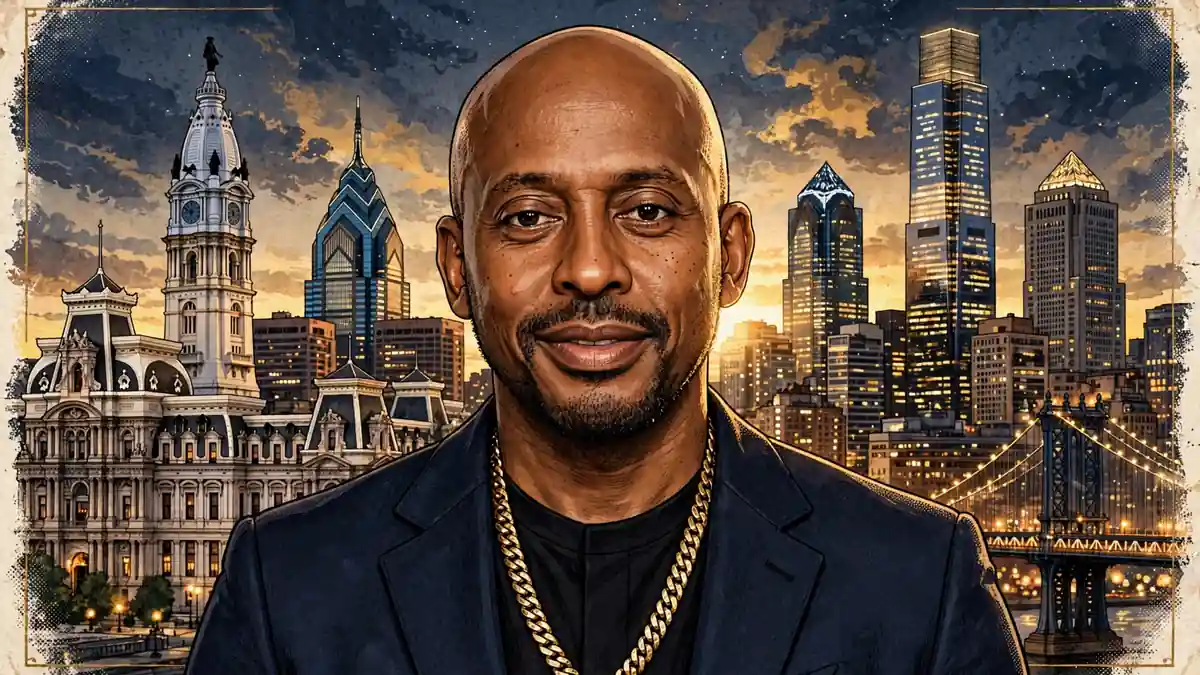
Gillie Da Kid‘s net worth is estimated at $5 million to $8 million as of November 2026. The Philadelphia rapper turned podcast star built that fortune across three separate careers: a late-1990s rap breakout with Major Figgas, a short and stormy run at Cash Money Records that ended in a public feud with Lil Wayne, and a second act as co-host of Million Dollaz Worth of Game, one of the most listened-to hip-hop podcasts in the United States. The spread in the estimate is honest, not hedging for its own sake. Celebrity Net Worth still lists an older figure of $2 million from 2022, a cluster of 2024 and 2025 profiles puts him at $5 million to $6 million, and a 2026 profile puts him at $8 million. No audited statement exists, so this article anchors on the $5 million to $8 million band and shows, source by source, where every dollar figure comes from.
Gillie Da Kid: Quick Facts
| Estimated net worth | $5 million to $8 million (range: $5 million to $8 million) |
|---|---|
| Profession | Rapper, podcaster, actor, entrepreneur |
| Nationality | American |
| Born | January 1, 1984 (age 42) — see note on the birth-date dispute below |
| Height | 5 feet 9 inches (175 cm) |
| Primary income sources | Podcasting, music royalties, acting roles, merchandise, brand deals and appearances |
| Active years | 1999–present |
| Last reviewed | November 2026 |
- Quick Facts
- Early Life and Background
- Education
- Career Journey
- Rise to Fame
- Main Sources of Income
- Salary and Earnings
- Businesses and Investments
- Brand Deals and Sponsorships
- Houses, Cars and Other Assets
- Awards and Achievements
- Net Worth Growth Over the Years
- Social Media Presence
- Personal Life
- Sources & Reporting
- Frequently Asked Questions
Early Life and Background
Nasir Fard was born in North Philadelphia, Pennsylvania, in 1984, and grew up in the same streets that later filled his verses. Two dates circulate for his birthday, and the disagreement is worth stating plainly because so many profiles pick one without flagging the other. Wikipedia lists January 1, 1984. A long tail of biography and net worth sites lists July 31, 1984 instead. Both dates put him at 42 years old in November 2026, so the age is settled even where the exact day is not. This article uses the Wikipedia date in the facts table and treats the July 31 date as the widely repeated alternative, not as a confirmed fact.
North Philadelphia in the 1990s was a hard place to come of age, and Gillie has never softened that part of the story. He started rapping as a teenager, trading verses on street corners and in local studios, and he found his first real crew close to home. His cousin Wallace Peeples — the man the world now knows as Wallo267 — was part of that circle from the start, along with fellow rapper Ab Liva. The three of them, plus four more members, became Major Figgas, a seven-man group that carried the sound of North Philly’s underground into the national conversation.
The group’s name doubled as a statement of intent. Philadelphia had produced stars before, but the city’s underground scene in the late 1990s ran on independent records, mixtapes, and hand-to-hand sales, and Major Figgas learned the business from the pavement up. They pressed their own records, moved units locally, and built a following that was loyal before it was large. That grind matters to the money story because it explains the shape of Gillie’s whole career: he has always earned as an independent operator first and a label artist second, and the biggest paydays of his life arrived after he stopped chasing a traditional record deal.
Gillie’s parents are named in some secondary profiles as Gil Scott and Valarie Scott, but that detail traces to low-quality biography aggregators, so this article does not present it as verified. What is solidly documented is the family that shaped his public life: his cousin Wallo, his long-term partner Regina Little, and his children, including his late son Devin Spady, the rapper known as YNG Cheese. The personal cost of that loss, in July 2023, is covered in the personal life section below, because it changed the tone and the stakes of everything Gillie has done since.
Before the fame, before the podcast, before the feud that made him a national name, Gillie was a North Philly kid who could rap and who refused to sell his publishing. That refusal — first articulated in a 2006 interview with XXL magazine — would define his finances for the next two decades. He walked away from money that came with strings attached, and he kept the rights to his own words. In the streaming era, that decision looks less like stubbornness and more like foresight.
Education
Almost nothing verifiable has been published about Gillie Da Kid’s formal schooling, and this article will not fill that gap with guesses. No profile from a major outlet names a high school he attended or a college he enrolled in, and the biography aggregators that claim to know his education history contradict each other or cite nothing at all. What Gillie himself has said, across interviews and on his podcast, is that his education came from the streets of North Philadelphia and from the music business itself — learning how records were made, how deals were structured, and how quickly a bad contract could cost an artist everything.
That second education is the one that shows up in his money story. By the time he sat down with XXL in 2006, Gillie could talk publishing splits, advances, and label deal-making like a music lawyer. He told the magazine he was the only artist on Cash Money Records who held 100 percent of his publishing, and that the label pressed him to sell a share of it. He refused. Whatever classroom he sat in, the lesson that stuck was the one about owning your work.
His cousin Wallo’s story runs alongside his own here. Wallo was sentenced to 20 years in prison for armed robbery at age 17 and served the full term before coming home. The two men have spoken openly about what those lost years taught them, and the podcast they built together is, in part, a classroom of its own — part comedy, part street wisdom, part business advice for listeners who never had a formal financial education either. That framing is a large part of why the show found an audience far beyond hip-hop fans.
For readers looking for a degree or a diploma in Gillie’s past, the honest answer is that there is none on the public record. His credentials are a charting single, a publishing catalogue he refused to sell, a record label he co-founded, and a podcast that a major sports media company pays to distribute. The market has treated those as qualifications, and the money followed.
Career Journey
Gillie Da Kid’s career breaks into three acts, and each one paid him in a different currency. Act one was the group years with Major Figgas, which paid in local fame and a national chart single. Act two was the solo years — Cash Money, Babygrande, his own label — which paid in lessons, advances, and a feud that kept his name in the press. Act three is the podcast era, which is paying in the kind of steady, diversified media income that a rap career alone rarely delivers.
Major Figgas came together in 1999. The seven-man crew signed first with Houston-based Suave House Records toward the end of the 1990s, but that deal stalled when the label lost its distribution with Universal, and Gillie went looking for a better home. The group then signed with RuffNation Records, releasing their debut album Figgas 4 Life in 2000. The album’s lead single, “Yeah, That’s Us,” climbed to number two on the Hot Rap Songs chart, a genuine national hit for an independent-minded Philly crew, and the song earned the group an ASCAP Songwriter award. The album’s sales never matched the single’s chart run, and the group broke apart — Wikipedia dates the split to 2003, while some profiles put it as early as 2001 — but the single proved Gillie could write a hit, and the industry noticed.
The solo years began with a deal that looked like a breakthrough and turned into a trap. Gillie signed as a solo artist to Cash Money Records after meeting the label’s chief executive, Bryan “Baby” Williams, backstage at a Philadelphia concert. In his 2006 XXL interview, Gillie said Cash Money paid him a $150,000 advance — a real, documented figure, and one of the few hard dollar amounts in his entire career record. What the label wanted in return, by his account, was a share of his publishing. He would not sell it. No solo album ever came out of the Cash Money deal, and Gillie left the label in 2006.
What happened next is the most argued-over episode of his life. Gillie has maintained for nearly twenty years that he ghostwrote for Lil Wayne during the Tha Carter era, helping shape the verses that turned Wayne from a Hot Boys alumnus into a superstar. Cash Money has denied the claim, and no reference tracks or paperwork have ever surfaced to settle it either way. The dispute spilled into the open in 2006, when Wayne took jabs at Gillie on a mixtape and Gillie answered with the diss track “Blow the Whistle.” The feud gave Gillie national exposure he had never had as a recording artist, and it fixed his public image as a lyricist who would rather fight in public than stay quiet for a paycheque.
After Cash Money, Gillie went back to the independent route. He signed with Babygrande Records, which released The Best of the GDK Mixtapes compilation in March 2007. He launched his own imprint, Figgas 4 Life Entertainment, and in August 2011 he co-founded Relumae Records with Kansas City Chiefs linebacker Tamba Hali. BiographyHost reports that the Relumae deal was worth $2 million to Gillie, a figure this article repeats only as a reported claim from a single secondary source, not as a confirmed payment. His solo album Welcome to Gilladelphia arrived in 2015 under Relumae. Alongside the music, he built a small acting career, appearing in Caged Animal (2010), Streets (2011), Blood Brotha, and Force of Execution (2013) opposite Steven Seagal.
None of those projects made him rich on its own. What they did was keep him visible, keep him working, and keep his name warm for the opportunity that finally changed his finances. In 2017, Wikipedia records, Gillie and Wallo launched the podcast Million Dollaz Worth of Game. Some profiles date the launch to 2019, which appears to mark the show’s wider breakout rather than its first episode; this article follows Wikipedia’s 2017 date. The show mixed hip-hop talk, comedy, relationship advice, and street-level business wisdom, and it found an audience fast. Barstool Sports came aboard to host and distribute the show, introducing Gillie to Dave Portnoy through Barstool podcaster Adam Ferrone, known as Rone. Guests have included basketball player Tyrese Maxey, football coach Deion Sanders, and rapper Ice Cube. The duo later signed with the talent agency WME to expand the Million Dollaz brand into unscripted television, touring, literary projects, and more, according to the booking agency MN2S.
Rise to Fame
Gillie Da Kid first became famous in Philadelphia, then became notorious nationally, and only much later became wealthy. The order matters, because the gap between fame and money is the whole story of his first two decades in the business.
The first fame came with Major Figgas. “Yeah, That’s Us” reaching number two on the Hot Rap Songs chart in 2000 put a North Philly group on national radio, and the ASCAP Songwriter award that followed was the kind of industry recognition that usually leads to a bigger deal. It led, instead, to a group that could not turn a hit single into hit album sales, and to a split that left Gillie starting over as a solo artist. Philadelphia never forgot the group, though. To this day, older Philly rap fans treat Major Figgas as a foundational crew, and that local loyalty is an asset Gillie still draws on — the podcast’s live shows in Philadelphia sell on the strength of it.
The second fame came from the Cash Money feud. When Gillie claimed he had ghostwritten for Lil Wayne on Tha Carter, the hip-hop press covered it wall to wall. XXL’s 2006 “Behind the Music” feature, built around a long interview with Gillie, remains the single best primary source on his career, and it is where the $150,000 advance figure and the publishing standoff are documented in his own words. The feud made him a national name, but it did not make him money in any direct way. There was no album to sell, no tour built on the controversy, and no settlement. What it bought was attention, and Gillie spent the next decade converting that attention into a durable career rather than a single payday.
The third fame — the one that finally paid — came from the podcast. Million Dollaz Worth of Game worked because it was not a rap podcast in the narrow sense. Gillie and Wallo talked about money, relationships, prison, fatherhood, and the music business with a bluntness that felt unfiltered, and the show’s catchphrases and clips travelled far beyond its core audience. Barstool Sports gave it distribution and scale. WME gave it a path into television, touring, and books. By 2024, profiles were describing Gillie as a media personality first and a rapper second, and the net worth estimates started climbing to match. The $2 million figure that Celebrity Net Worth attached to him in 2022 belongs to the pre-podcast-peak era; the $5 million to $8 million band in this article belongs to the era in which the podcast became his main business.
There is also a darker strand to his fame, and any honest profile has to include it. In February 2025, Gillie appeared on Shannon Sharpe’s Club Shay Shay podcast and spoke at length about the killing of his son, naming the person he believes was responsible. The appearance was widely covered — XXL, PlayersBio, and The SportsGrail all reported it — and it put Gillie back in the headlines for the most painful reason possible. Fame, for him, has never been a clean asset. It has arrived mixed with grief, controversy, and public argument, and the money came last of all.
Main Sources of Income
Gillie Da Kid’s money now comes from five streams, and the order of importance has flipped completely since his rap-only years. Podcasting sits at the top. Music royalties, acting fees, merchandise, and appearances fill out the rest. No single stream is large enough to explain the $5 million to $8 million estimate on its own; the total is the product of all five running at once, year after year, with the podcast doing the heavy lifting.
The podcast is the engine. Million Dollaz Worth of Game earns through Barstool Sports distribution, advertising and sponsorships sold against the show, YouTube revenue from video episodes and clips, and live touring, where Gillie and Wallo take the show on the road. The terms of the Barstool arrangement have never been made public, and this article will not invent a figure for it. What can be said with confidence is that the show is one of Barstool’s flagship hip-hop properties, that it has run continuously since 2017, and that its hosts signed with WME — the kind of agency that does not take on a podcast without a serious revenue line to grow. Secondary profiles describe the Barstool arrangement as a multi-million-dollar deal, but no outlet has published a verified number, so the honest description is “multi-million-dollar” as reported, with the exact figure undisclosed.
Music royalties are the second stream, and they are steadier than most people assume. Gillie kept 100 percent of his publishing through the Cash Money years, by his own account, which means the writing royalties on his catalogue flow to him rather than to a label. The Major Figgas catalogue, his solo mixtapes, Welcome to Gilladelphia, and the streaming revenue on his back catalogue all contribute. None of this is stadium money. It is the kind of long-tail income that adds up quietly: a chart single from 2000 still earning, a mixtape compilation still streaming, a verse here and a feature there. Over twenty-five years, that tail gets long.
Acting is the third stream. His film roles — Caged Animal, Streets, Blood Brotha, Force of Execution — were independent and mid-budget productions, not studio tentpoles, so the fees were working-actor fees rather than star salaries. Even so, acting paid him during years when the music business was not, and it kept his face in front of audiences that the rap world alone would not have reached. He has also appeared on television and in web series tied to the podcast brand, blurring the line between acting and hosting income.
Merchandise is the fourth stream, and it is more substantial than it looks from outside. The Million Dollaz Worth of Game brand sells clothing and accessories to a fan base that treats the show’s catchphrases as identity markers. One low-quality net worth aggregator puts the clothing line’s value in the millions; that figure is unsourced and this article does not repeat it as fact. What is verifiable is that the merch line exists, that it is promoted heavily on the show and on social media, and that direct-to-fan merchandise is among the highest-margin income in the podcast business.
The fifth stream is appearances and bookings. MN2S, the booking agency that lists Gillie Da King on its roster, markets him for brand collaborations, speaking engagements, and community events. He is paid for podcast guest spots, club appearances, hosting gigs, and live events, and his Instagram following — more than two million followers, as reported in 2022-era profiles — gives him a direct channel to sell those appearances. Add touring revenue from live podcast shows, where tickets, meet-and-greets, and on-site merch combine into a single night’s income, and the picture is of a performer who monetises attention from five directions at once.
What Gillie does not appear to earn from, despite what some pages claim, is worth naming. A cluster of content-farm profiles credits him with tech investments, cryptocurrency holdings, and a real estate portfolio in Philadelphia. No credible reporting supports any of those claims — no property records, no investment announcements, no interviews where he discusses them. This article treats them as invented filler and excludes them from the estimate. The same goes for the $15 million net worth figure that a single high-volume aggregator repeats across several near-identical pages; it is unsourced, it contradicts every other published estimate, and it is best read as a debunked outlier.
Salary and Earnings
There is no public salary figure for Gillie Da Kid, and any article that prints one as fact is guessing. He is not a salaried employee, he has never disclosed his tax returns, and neither Barstool Sports nor WME has published what the podcast pays him. What the public record does offer is a set of dated, sourced data points that let a reader see how his earnings changed over time, and an estimate range that this article labels clearly as its own.
The earliest hard number is the $150,000 advance from Cash Money Records, which Gillie disclosed himself in his 2006 XXL interview. Advances are not salary — they are recoupable payments against future earnings — but the figure is useful because it shows the scale of money a major label was willing to put behind him in the mid-2000s, and because Gillie walked away from the deal rather than trade his publishing for more of it. The second dated figure is the reported $2 million Relumae Records agreement from 2011, reported by BiographyHost; it is a single-source claim and should be read as “reported”, not confirmed. The third set of figures is the net worth estimates themselves: $2 million in 2021–2022 per Celebrity Net Worth, $5 million across 2024–2025 profiles, $6 million in several 2025 profiles, and $8 million in a 2026 profile.
On the strength of the podcast’s scale — a Barstool-distributed show with a WME deal, a merch line, touring, and millions of social followers — NetWorthCraft estimates Gillie’s current annual income at roughly $400,000 to $800,000 before tax and expenses. That is our estimate, built from the public shape of his business, not a leaked figure. The low end assumes the podcast and its offshoots are his main earner with modest touring; the high end assumes strong live-show and sponsorship years. Either way, the annual income is a fraction of the net worth, which is exactly what one would expect for a performer whose wealth was built slowly over twenty-five years rather than in a single breakout year.
| Period | Reported figure | Source and status |
|---|---|---|
| 2006 | $150,000 Cash Money advance | Gillie Da Kid, in his own words to XXL magazine — confirmed |
| 2011 | $2 million Relumae Records agreement | BiographyHost — reported, single source, unconfirmed |
| 2021–2022 | $2 million net worth | Celebrity Net Worth — dated estimate, pre-podcast peak |
| 2024–2025 | $5 million to $6 million net worth | Multiple independent profiles — the central cluster |
| 2026 | $8 million net worth | NetWorthPrime 2026 profile — the high end |
| 2026 | $400,000 to $800,000 annual income | NetWorthCraft estimate — modelled, not a reported figure |
Two cautions belong here. First, an unverified aggregator page puts the podcast’s yearly earnings near $1 million; that number has no sourcing behind it and this article does not adopt it. Second, gross income is not net worth. A podcast star’s revenue passes through managers, agents, taxes, production costs, and the cost of touring before any of it becomes wealth. The $5 million to $8 million estimate already reflects that reality — it is a net figure built from decades of earnings minus decades of living, not a pile of gross revenue.
Businesses and Investments
Gillie Da Kid’s business life has always run on ownership. He learned early that a record deal could pay an advance and still leave the artist with nothing, so he built the structures that let him keep control: his own label, a label co-founded with a professional athlete, and a podcast brand that he co-owns with his cousin rather than renting from a network.
Figgas 4 Life Entertainment was his first independent vehicle, the label he launched after leaving Cash Money. It gave him a home for his own releases and a name under which to do business without asking a major label for permission. Relumae Records, co-founded in August 2011 with Kansas City Chiefs linebacker Tamba Hali, was the more ambitious version of the same idea — a label with outside capital and a sports-world partner, built to sign and develop artists rather than simply release Gillie’s own music. The reported $2 million agreement attached to Relumae is the largest single deal figure ever linked to his name, and it remains unconfirmed by a second source.
The Million Dollaz Worth of Game brand is the business that matters most today. Gillie and Wallo own the show’s identity, its catchphrases, and its merchandising, while Barstool Sports handles distribution. That split — ownership on their side, scale on Barstool’s — is the arrangement that modern podcasters aim for, and it is the reason the show can survive platform changes. The WME signing, reported by MN2S, extends the brand into unscripted television, live touring, and literary projects, which is agency language for turning a podcast into a multi-product company.
On investments beyond his own companies, the record is thin, and this article says so rather than inventing a portfolio. Some aggregator pages credit Gillie with cryptocurrency and blockchain investments and with a Philadelphia real estate portfolio. No property record, filing, interview, or credible report backs those claims, and the pages that make them also get basic facts wrong — one lists his age as 20, another as 51, another claims a birth year of 1974. A source that cannot get a birth year right is not a source for an investment portfolio. As far as the verifiable record shows, Gillie’s investments are his label, his podcast brand, and his publishing catalogue. That is a narrower portfolio than the aggregators describe, and it is also a more believable one.
The publishing catalogue deserves a final word here, because it is the quietest and most valuable asset he owns. Keeping 100 percent of his publishing through the Cash Money years meant that every song he wrote, including the Major Figgas material, continued to pay him. In an era when artists routinely sell their catalogues for lump sums, Gillie held his. The catalogue will never be worth as much as a superstar’s, but it is his outright, and it pays every year without him having to record a note.
Brand Deals and Sponsorships
Gillie Da Kid’s brand deals look different from a pop star’s endorsement portfolio, and that difference explains a lot about his income. He does not front global campaigns for soft drinks or sneakers. His deals are podcast sponsorships, Barstool-adjacent partnerships, live-event tie-ins, and the kind of brand collaborations that MN2S books for a personality with a loyal, largely male, hip-hop and sports audience.
The Barstool Sports relationship is the anchor. Distribution through Barstool puts the show in front of the company’s large sports-media audience and brings with it the advertising infrastructure that an independent podcast cannot build alone. Sponsors buy into the show’s audience rather than into Gillie personally, which is why the deal’s value is hard to separate from the show’s overall revenue. The WME signing added a second layer: a global agency shopping the Million Dollaz brand to television, touring, and publishing partners, and positioning Gillie and Wallo as a duo rather than as two solo acts.
Beyond those two structures, the deals are smaller and more personal. Gillie promotes the show’s own merchandise heavily, which is effectively a brand deal with himself — the margin stays in-house. He appears at sponsored live events and club dates, hosts branded segments on the podcast, and lends his name and likeness to collaborations that fit the show’s audience. His Instagram account, with more than two million followers as reported in 2022-era profiles, is the distribution channel for all of it.
What is missing is also informative. There is no record of a major sneaker deal, a liquor brand, a car endorsement, or a fashion house partnership — the deals that fill out a mainstream celebrity’s income. Gillie’s commercial life is built on the podcast’s audience, not on a global brand’s marketing budget. That keeps his income tied to the show’s health, which is a risk, and it also keeps his endorsements believable to the audience that buys them, which is the reason the show’s sponsors keep renewing.
Houses, Cars and Other Assets
This is the section where most net worth profiles about Gillie Da Kid go wrong, so it is kept short on purpose. There are no verified property records, no published home purchases, and no confirmed car collection attached to his name in any credible reporting. The aggregator pages that list Philadelphia houses and luxury cars for him cite no deeds, no listings, and no interviews. This article does not repeat those claims as fact, and the $5 million to $8 million estimate does not depend on them.
What can be said is narrower and more useful. Gillie lives and works in Philadelphia, the city he has never left in any meaningful sense, and the podcast is recorded there. He is regularly photographed and filmed in jewellery, designer clothing, and luxury vehicles, as most successful rappers are — but a photograph of a car is not proof of ownership, and jewellery is a depreciating asset, not an investment. The visible lifestyle is real; the balance-sheet value behind it is not public.
His verifiable assets are the ones this article has already described: the publishing catalogue he refused to sell, his stake in the Million Dollaz Worth of Game brand and its merchandise line, his interests in Figgas 4 Life Entertainment and Relumae Records, and the back catalogue of Major Figgas and solo recordings. None of those has a public valuation. Together, they are the reason the net worth band is $5 million to $8 million rather than $2 million — the older Celebrity Net Worth figure captured a rapper with a catalogue, while the newer figures capture a media owner with a brand.
Readers who want a mansion tour or a garage inventory will not find one here, because none exists in the public record. That absence is itself a data point. The celebrities with the most inflated net worth pages are usually the ones with the least verifiable property, and Gillie’s profile is a case in point: the pages that claim the most about his houses are the same pages that cannot agree on his age. The honest version of this section is that his wealth sits in rights, brands, and a business, not in a property portfolio anyone can document.
Awards and Achievements
Gillie Da Kid has never won a Grammy, and he has never been nominated for one. That fact belongs in this section, because the aggregator pages that pad his awards shelf with vague honours do their readers no favours. His real achievements are fewer, more specific, and more interesting than a padded list.
The first is the ASCAP Songwriter award for “Yeah, That’s Us,” the Major Figgas single that reached number two on the Hot Rap Songs chart in 2000. ASCAP awards are industry recognition from the performing rights organisation itself, and for an independent Philly crew, the award was proof that the songwriting was real even when the album sales were not. It is the only formal music award attached to Gillie’s name in the verifiable record.
The second achievement is the chart single itself. A number-two rap single in 2000, on an independent-minded label, from a seven-man crew out of North Philadelphia, was a genuine commercial feat. It put Major Figgas on national radio and it put Gillie on the radar of every label A&R in the country, including the Cash Money executives who signed him.
The third achievement is the podcast. Million Dollaz Worth of Game is consistently described in profiles as one of the top-ranking hip-hop podcasts in the United States, and its longevity — running since 2017 — is an achievement in a medium where most shows fold within a year. The Barstool Sports distribution deal and the WME signing are the industry’s version of awards: a major media company and a major agency both decided the show was worth investing in. The guest list tells the same story — Tyrese Maxey, Deion Sanders, and Ice Cube do not sit for a podcast that nobody listens to.
The fourth achievement is survival. Gillie has been professionally active since 1999, through a group split, a label feud, a stalled solo career, and the violent death of his son. He is still working, still relevant, and earning more now than at any earlier point in his career. Longevity is not an award with a trophy, but in the music business it is rarer than one.
Net Worth Growth Over the Years
Gillie Da Kid’s wealth grew slowly, then all at once — slowly through the music years, then faster once the podcast became a business. The table below uses only dated, published figures. Where a figure comes from a single weak source, the table says so. Nothing in it is an audited balance sheet.
| Year | Estimated net worth | What changed |
|---|---|---|
| 2000 | Under $500,000 (estimate) | “Yeah, That’s Us” hits number two on the rap chart, but album sales lag and the group splits |
| 2006 | Under $1 million (estimate) | $150,000 Cash Money advance, then the split with the label and no album |
| 2011 | $1 million to $2 million (estimate) | Relumae Records co-founded with Tamba Hali; reported $2 million agreement |
| 2015 | $2 million (estimate) | Welcome to Gilladelphia released; acting roles continue |
| 2021–2022 | $2 million | Celebrity Net Worth figure, widely repeated at the time |
| 2023 | $3.5 million | Aggregator projection tied to touring and the podcast’s growth — treat as an estimate |
| 2024–2025 | $5 million to $6 million | Central cluster across independent profiles as the podcast peaks |
| 2026 | $5 million to $8 million | NetWorthCraft’s current band; $8 million is the 2026 high-end figure |
The shape of that curve tells the story better than any single number. For more than twenty years, Gillie’s net worth barely moved — a working rapper’s money, earned and spent in the same years it arrived. The podcast changed the slope. A show that earns every week, sells merchandise, tours, and signs agency deals compounds in a way that a rap career built on advances and features does not. The $2 million figure from 2022 is not wrong for its time; it is simply a photograph of a man before his best business arrived.
There is a peer comparison worth making here, because it puts the $5 million to $8 million band in context. Meek Mill, the other great Philadelphia rapper of his generation, is worth far more — his fortune runs into the tens of millions, built on major-label albums, touring at arena scale, and business ventures far larger than Gillie’s. The comparison is not a slight on Gillie. It shows the difference between a mainstream rap career and an independent one, and it makes Gillie’s late-career reinvention more impressive, not less. He did not get rich the way Meek Mill did. He got rich by outlasting the system that was supposed to make him rich and building his own instead. Readers who want the full picture of Philly’s rap economy can start with our profile of Meek Mill’s net worth, which shows what the major-label path pays when it works.
Social Media Presence
Social media is not a side project for Gillie Da Kid. It is the distribution system for his whole business — the place where podcast clips go viral, where merchandise is sold, where live shows are announced, and where his public arguments play out in real time.
Instagram is his main platform. Profiles from the 2021–2022 period report more than two million followers on his account, and his feed mixes podcast clips, family photos, Philadelphia street scenes, and the kind of blunt commentary that his audience expects. No current verified follower count has been published by a major outlet, so this article repeats the two-million-plus figure as the last reported number rather than as a live count. The account’s value is not the follower number alone. It is the engagement: clips from the show travel from Instagram to X, TikTok, and YouTube, and each viral clip is free advertising for the podcast and the merch line.
YouTube carries the video version of Million Dollaz Worth of Game, including full episodes and the short clips that do much of the show’s recruiting. The channel’s audience is the reason sponsors buy in, and it is also the reason Gillie and Wallo can tour: a viewer in another city who has watched a hundred clips is a ticket buyer waiting for a date. Gillie also appears constantly as a guest on other people’s platforms — Club Shay Shay, The Pivot Podcast, The Breakfast Club — and each appearance feeds his own channels in return.
There is a cost to living this publicly, and Gillie has paid it. His February 2025 Club Shay Shay appearance, in which he named the person he believes killed his son, was clipped, argued over, and condemned by the Philadelphia Police Department within days. His social feeds have also carried his feuds, his grief, and his opinions on everything from other rappers to local politics. That openness is the product. An audience that trusts a host to say what he really thinks will also trust him enough to buy his merchandise and his live show. It is also an audience that watches him grieve in public, which is a price no net worth figure captures.
Personal Life
Gillie Da Kid’s personal life is the part of this profile where the reporting is thinnest and the emotions run highest, so it is handled here with the care the subject deserves and the sourcing the reader is owed.
His long-term partner is Regina Little, a makeup artist known to friends as Tudie, and to Gillie as Toot. Gillie calls her his wife in public, and many profiles list them as married. CelebrityGen, one of the more careful secondary sources, notes that the couple has never officially announced a marriage, and that Regina has never stepped into the public eye alongside him. This article describes her as his long-term partner, whom he calls his wife, and leaves the formal question where the record leaves it: unconfirmed.
Reports differ on how many children the couple has, and the disagreement is wide enough that no single number can be printed with confidence. Some profiles say two children, a son and a daughter. Others list four — Nasir Jr., Nasirah, Nala, and Nia. Still others count five, adding YNG Cheese and Mac to the list. What is consistent across the better reporting is that his sons include Devin Spady, the rapper YNG Cheese, and Mac, also known as TR3Y Seven7, who records as well. Rather than pick a number from a hat, this article says the couple have several children, that public reports differ on the total, and that two of his sons followed him into music.
On July 20, 2023, his son Devin Spady — YNG Cheese, aged 25 — was shot and killed in a triple shooting in Philadelphia’s Olney neighbourhood, on the 5800 block of Mascher Street, at around 8:24 in the evening. He was taken to Einstein Medical Center, where he died. Two other men were injured. The Philadelphia Inquirer, CBS News, and the Philadelphia Police Department all reported the killing, and HotNewHipHop, Revolt, Okayplayer, and PhillyVoice covered it in the days that followed. A funeral service was held at The Met Philadelphia on July 24, 2023. Wallo, Gillie’s cousin and co-host, announced the death on Instagram with a tribute that was shared across hip-hop media.
YNG Cheese had been building his own rap career, performing with his brother in the group Macc N Cheese and recording songs including “Ignore,” “Pesos,” and “Detroit Flow” with Icewear Vezzo and Lil Yachty. He was, by every account, following his father’s path. Gillie has spoken about his son’s death rarely and with visible pain, most notably on The Pivot Podcast in 2023 and on Club Shay Shay in February 2025, when he said that the late high school basketball star Noah Scurry was the person responsible. Scurry, 17, was himself shot and killed on January 14, 2025, while being dropped off at school by his mother. The Philadelphia Police Department objected to Gillie’s claim about Scurry, and no arrest has been publicly reported in the YNG Cheese case. This article reports Gillie’s statement as his statement, the police objection as theirs, and the underlying killing as unsolved in the public record.
In July 2024, on the first anniversary of his son’s death, Gillie bought a billboard in Times Square to commemorate him. It was a private act of grief carried out in the most public place in America, and it says more about how he carries the loss than any interview could. The podcast continued through it all — Wallo has said openly that the show kept them both going — and the audience stayed with them.
Sources & Reporting
Every figure in this article traces to a named source. Net worth figures are estimates from published profiles, not audited statements, and the reporting window runs from Gillie’s 2006 XXL interview through November 2026.
- Wikipedia — birth date (January 1, 1984), Major Figgas timeline, Cash Money departure in 2006, podcast launch in 2017, Barstool Sports distribution, the July 2023 killing of Devin Spady, and the February 2025 Club Shay Shay appearance.
- XXL — the 2006 “Behind the Music” interview: the $150,000 Cash Money advance, the publishing standoff, the “Yeah, That’s Us” chart run and ASCAP award, and the ghostwriting claim; plus February 2025 coverage of the Club Shay Shay appearance.
- HotNewHipHop — July 2023 reporting on the killing of YNG Cheese, including the funeral at The Met Philadelphia.
- PhillyVoice — July 2023 reporting on the Olney triple shooting, with police details from the scene.
- CBS News — reporting on the July 2023 shooting, cited through the coverage of the incident.
- PEOPLE — confirmation from the Philadelphia Police Department that Devin Spady, 25, was killed in the triple shooting.
- Revolt — July 2023 reporting on YNG Cheese, including his Macc N Cheese work and songs.
- Okayplayer — July 2023 reporting on the shooting and on Major Figgas history.
- Celebrity Net Worth — the $2 million net worth figure from 2021–2022, the low anchor for the estimate band.
- NetWorthPrime — the $8 million 2026 estimate, the high anchor for the estimate band.
- Trendland Magazine — the $6 million 2025 estimate and biographical detail.
- MN2S — booking-agency profile confirming the WME signing, the Barstool Sports relationship, and the podcast’s 2017 launch.
- BiographyHost — the reported $2 million Relumae Records agreement and the 2015 Welcome to Gilladelphia release.
- Last.fm — Major Figgas history, the Suave House and Cash Money deals, and the 2007 Babygrande compilation.
Reporting window: primary sources 2006–2025; net worth profiles 2021–2026; last reviewed November 2026. Where sources disagree — most notably the birth date and the net worth total — this article prints the disagreement instead of picking a side silently.
Frequently Asked Questions
What is Gillie Da Kid’s net worth in 2026?
Gillie Da Kid’s net worth is estimated at $5 million to $8 million as of November 2026. The band reflects the spread in published estimates: Celebrity Net Worth lists an older $2 million figure from 2022, a cluster of 2024–2025 profiles puts him at $5 million to $6 million, and a 2026 profile puts him at $8 million. His main income now comes from the Million Dollaz Worth of Game podcast, not from record sales.
How old is Gillie Da Kid?
Gillie Da Kid is 42 years old as of November 2026. He was born in 1984 in North Philadelphia, though sources disagree on the exact day: Wikipedia lists January 1, 1984, while many biography sites list July 31, 1984. Both dates give the same age.
What is Gillie Da Kid’s real name?
Gillie Da Kid’s real name is Nasir Fard. He was born Nasir Fard in North Philadelphia and performed first as Gillie Da Kid, later styling himself Gillie Da King. His cousin and podcast co-host is Wallace “Wallo267” Peeples.
Did Gillie Da Kid ghostwrite for Lil Wayne?
Gillie Da Kid has claimed for nearly twenty years that he ghostwrote for Lil Wayne during the Tha Carter era, after signing to Cash Money Records. Cash Money has denied the claim, and no reference tracks or paperwork have ever surfaced to prove it either way. The dispute led to a public feud in 2006, including Gillie’s diss track “Blow the Whistle.”
How does Gillie Da Kid make his money?
His main income comes from the Million Dollaz Worth of Game podcast, which is distributed by Barstool Sports and supported by advertising, sponsorships, YouTube revenue, merchandise, and live touring. He also earns from music royalties — he kept 100 percent of his publishing through the Cash Money years — plus acting roles, appearances, and his stakes in Figgas 4 Life Entertainment and Relumae Records.
Who is Gillie Da Kid’s wife?
Gillie Da Kid’s long-term partner is Regina Little, a makeup artist known as Tudie, whom Gillie calls Toot. He refers to her publicly as his wife, but the couple has never officially announced a marriage, so profiles describe her as his long-term partner. Reports differ on how many children they have; his sons include the late rapper YNG Cheese and Mac, also known as TR3Y Seven7.
What happened to Gillie Da Kid’s son YNG Cheese?
Devin Spady, the rapper known as YNG Cheese and Gillie Da Kid’s son, was shot and killed at age 25 in a triple shooting in Philadelphia’s Olney neighbourhood on July 20, 2023. His funeral was held at The Met Philadelphia on July 24, 2023. In February 2025, Gillie said on Club Shay Shay that the late high school basketball star Noah Scurry was responsible; the Philadelphia Police Department objected to that claim, and no arrest has been publicly reported in the case.
How much does the Million Dollaz Worth of Game podcast make?
No verified figure has ever been published for the podcast’s earnings. Secondary profiles describe the Barstool Sports arrangement as a multi-million-dollar deal, but the exact terms are private. NetWorthCraft estimates Gillie Da Kid’s total annual income at roughly $400,000 to $800,000 across the podcast, music royalties, acting, merchandise, and appearances — an estimate, not a reported figure.
Final Thoughts
Gillie Da Kid’s net worth — $5 million to $8 million by our estimate — is the least interesting number in his story until you ask how it was made. He did not get rich the way rap is supposed to make you rich. He had the hit single, he had the major-label deal, and both of them came with terms he would not accept. He kept his publishing when Cash Money wanted a share of it. He walked away from a label that would not release his album. He spent a decade as a working rapper and actor, visible but never wealthy, and then he built a podcast with his cousin and turned a conversation into a company.
That is the shape of the money. A $150,000 advance in 2006, a reported $2 million label agreement in 2011, a $2 million net worth in 2022, and a $5 million to $8 million band in 2026. The curve bends upward only when ownership replaces employment — when the show, the brand, and the catalogue belong to him instead of to a label. The same lesson runs through the careers of the artists he is measured against, from Drake’s net worth, built on a Cash Money machine that worked for him in the way it never worked for Gillie, to Jay-Z’s net worth, built on the same ownership-first instinct at a far larger scale.
There is also a loss in this story that no estimate can absorb. His son Devin Spady was killed in 2023, and Gillie has carried that grief in public ever since, on the podcast, on social media, and in a Times Square billboard on the first anniversary. The show went on because it had to. The money, such as it is, is real — but it arrived late, it arrived slowly, and it arrived after the hardest year of his life. That is the honest bottom line: a Philadelphia rapper who refused to sell his words, outlasted the industry that undervalued them, and finally got paid for talking.
Published on November 12, 2026. Last reviewed November 2026. Found an error? See our corrections policy.