
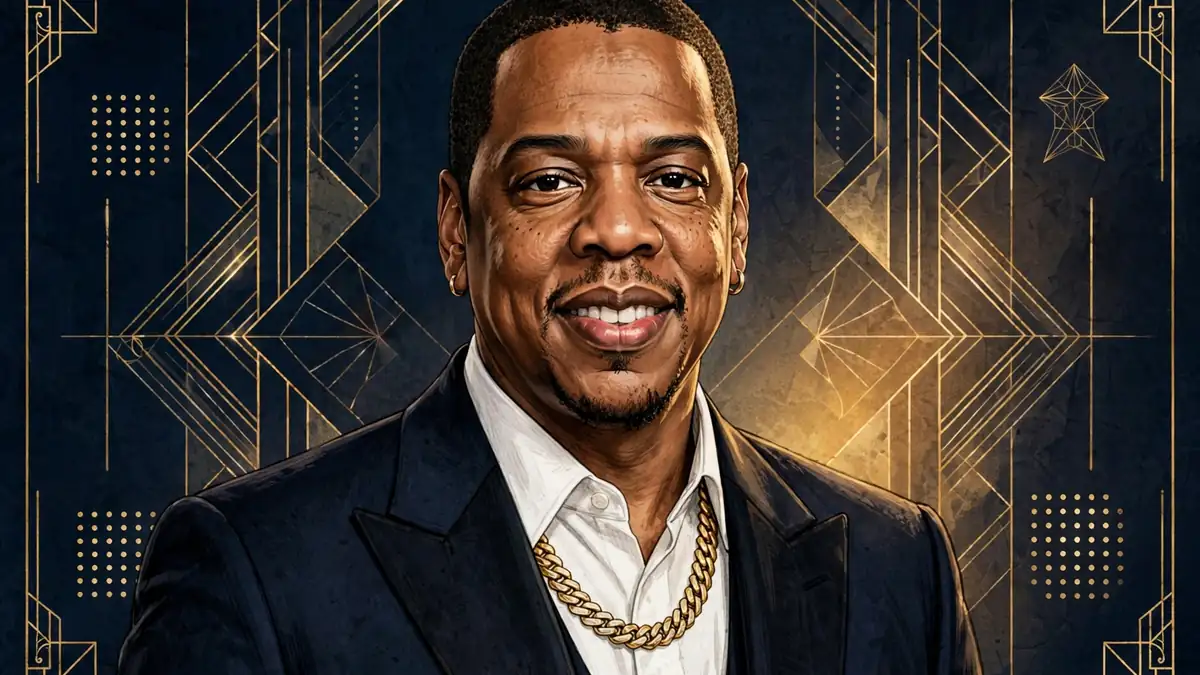
Jay-Z‘s net worth is estimated at $2.5 billion to $2.8 billion as of November 2026. Forbes prints the top of that range — about $2.8 billion on its live profile, updated in March 2026 and still showing the same figure into October — and Celebrity Net Worth independently lists $2.8 billion as of April 1, 2026. The fortune was built on champagne and cognac equity, not album sales: a 2021 deal that handed half of Armand de Brignac to LVMH, a 2023 Bacardi buyout of most of his D’Ussé stake for a reported $750 million, and a Roc Nation empire that turns fame into ownership stakes.
Jay-Z: Quick Facts
| Estimated net worth | $2.8 billion (range: $2.5 billion to $2.8 billion) |
|---|---|
| Profession | Rapper, songwriter, record executive, businessman |
| Nationality | American |
| Born | December 4, 1969 (age 56) |
| Height | 6 ft 2 in (1.88 m) |
| Primary income sources | Spirits equity (Armand de Brignac, D’Ussé), Roc Nation, music catalog and touring, venture investments |
| Active years | 1986–present |
| Last reviewed | November 2026 |
- Early Life and Background
- Education
- Career Journey
- Rise to Fame
- Main Sources of Income
- Salary and Earnings
- Businesses and Investments
- Brand Deals and Sponsorships
- Houses, Cars and Other Assets
- Awards and Achievements
- Net Worth Growth Over the Years
- Jay-Z vs the Richest Musicians
- Social Media Presence
- Personal Life
- Sources & Reporting
- Frequently Asked Questions
- Final Thoughts
Early Life and Background
Shawn Corey Carter was born on December 4, 1969, in Brooklyn, New York, and raised in the Marcy Houses public housing project in Bedford-Stuyvesant. His father, Adnis Reeves, left the family when Carter was 11, and he was raised by his mother, Gloria Carter, alongside three older siblings. The two reconciled before Reeves died in 2003 — a story Carter later folded into the song “Moment of Clarity” and, years later, into his most personal album, 4:44.
Marcy shaped the business mind as much as the rapper. Carter has said in interviews and lyrics that he sold crack cocaine as a teenager in the 1980s, was shot at three times, and at 12 shot his older brother in the shoulder during a fight over stolen jewelry — an episode he recounts in his own lyrics. None of that is offered here as colour for its own sake: it is the reason his later career reads as a deliberate escape plan rather than a lucky break. The kid who ran a corner learned margins, risk, and how to turn a small stake into a bigger one; he just applied those lessons to champagne instead of the street.
His stage name came from his mentor, the rapper Jaz-O, under whom he was known around the neighbourhood as “Jazzy” before adopting Jay-Z. He spent the late 1980s and early 1990s as a protégé and guest voice — early verses on Jaz-O records, a spot on Big Daddy Kane’s 1994 posse cut “Show and Prove” — while no major label would sign him. That rejection became the founding story of everything that followed: if nobody would give him a deal, he would own the label.
Education
Carter attended Eli Whitney High School and George Westinghouse Career and Technical Education High School in Brooklyn, then Trenton Central High School in New Jersey. He dropped out during his sophomore year at Trenton Central and never finished high school, let alone college. The formal education stopped there; the informal one did not.
What he learned instead came from the Marcy Houses economy, from Jaz-O’s studio sessions, and from watching the music business from the outside. By the time he co-founded Roc-A-Fella Records in 1995, he understood the two things that would define his fortune: own the masters, and own the brand. No diploma appears on his résumé because the résumé is the catalogue and the cap table. He has since been honoured by institutions that once would have admitted him as a student — the Songwriters Hall of Fame inducted him in 2017, the first rapper ever, and the Rock and Roll Hall of Fame followed in 2021.
Career Journey
With Damon “Dame” Dash and Kareem “Biggs” Burke, Carter created Roc-A-Fella Records as an independent label in 1995 after striking a distribution deal with Priority. His debut album, Reasonable Doubt, arrived in June 1996, reached No. 23 on the Billboard 200, and went gold that year. Critics loved it; the public took longer. The follow-up, In My Lifetime, Vol. 1 (1997), went platinum under a new Def Jam distribution deal, and Vol. 2… Hard Knock Life (1998) turned him into a commercial force — the title track became his biggest hit of the decade, and the album was certified 6× Platinum in the United States, selling more than six million copies.
The run that followed is one of the longest hot streaks in popular music. Vol. 3… Life and Times of S. Carter (1999) sold more than three million copies. The Dynasty: Roc La Familia (2000) introduced producers who would define the next decade, including Kanye West, Just Blaze, and The Neptunes. The Blueprint, released on September 11, 2001, sold more than 427,000 copies in its first week, debuted at No. 1, and was later selected by the Library of Congress for the National Recording Registry. The Blueprint 2 (2002), The Black Album (2003), and a staged “retirement” concert at Madison Square Garden in November 2003 closed the first chapter.
Retirement lasted about three years. In 2004 he became president and CEO of Def Jam Recordings, a post he held until 2007, signing and developing Rihanna, Kanye West, and Ne-Yo. He returned to recording with Kingdom Come (2006), American Gangster (2007), and The Blueprint 3 (2009), home of “Empire State of Mind” with Alicia Keys — his only No. 1 on the Hot 100 as a lead artist. Magna Carta… Holy Grail (2013) and the raw, confessional 4:44 (2017) followed, then Everything Is Love (2018), recorded with Beyoncé as The Carters. Across the catalogue he has 14 No. 1 albums on the Billboard 200, the third-most in chart history, and has sold about 125 million records worldwide.
The business timeline runs in parallel, and it is the one that matters for the net worth figure. Rocawear, the clothing line he co-founded in 1999, sold its rights to Iconix Brand Group in 2007 for $204 million. The 40/40 Club sports-bar chain opened in 2003. Roc Nation, the entertainment company he founded in 2008, grew from a label into management, publishing, touring, film, and sports. Tidal, bought in 2015 for $56 million, sold in 2021. The two spirits deals — LVMH in 2021, Bacardi in 2023 — are covered in detail below, because they are the fortune.
Rise to Fame
Fame arrived in stages. The first was “Hard Knock Life (Ghetto Anthem)” in 1998, a Broadway sample turned street anthem that gave him his first Grammy and his first real radio ubiquity. The second was the Nas feud: “Takeover” at Summer Jam 2001, Nas’s “Ether” in reply, and a rivalry that dominated hip-hop for four years before the two settled their differences in 2005. Feuds sell records, and this one sold a lot of them — but it also cemented Carter as the genre’s sharpest lyricist, a reputation Billboard and Vibe formalised in 2023 when both ranked him the greatest rapper of all time.
The third stage was the pivot from rapper to mogul, and it is the one the public remembers. The 2003 “retirement” at Madison Square Garden, filmed for the documentary Fade to Black, was a masterclass in scarcity: leave at the top, come back on your own terms. The Def Jam presidency gave him the executive credential. The 2008 marriage to Beyoncé made the couple the most powerful household in music. By the time Forbes put him on its billionaires list in 2019 — the first hip-hop artist ever — the fame story and the money story had merged into one narrative: the kid from Marcy who bought the building.
What competitors usually miss is that the fame never really converted into the fortune through the obvious route. Album sales and touring made him rich; they did not make him a billionaire. The billion came from owning things other people wanted to buy — champagne, cognac, a streaming service, a clothing brand — and selling pieces of them at the right moment. That is the thread this article follows.
Main Sources of Income
Five streams feed the estimate, and their order matters. Spirits equity comes first: the retained half of Armand de Brignac champagne after the 2021 LVMH deal, and the retained slice of D’Ussé cognac after the 2023 Bacardi buyout. These two brands are the core of the fortune. Forbes’ own reporting credits the liquor businesses as the main reason his wealth has nearly tripled since 2019.
Second is Roc Nation, the operating company founded in 2008. It earns from artist management, publishing, touring, and its sports division, Roc Nation Sports, launched in 2013. Forbes valued the firm at about $75 million in its 2019 breakdown; no public sale has re-priced it since, so the current mark is an estimate built on its deal flow, including a first Live Nation pact reported at $150 million and a 2017 follow-on reported at $200 million over ten years. Those are contract headlines, not cash in hand, and this article does not treat them as deposits.
Third is music itself: the catalogue, streaming royalties, and touring. The catalogue is the smallest of the big pieces — Forbes put it at about $75 million in 2019, while Celebrity Net Worth now marks it at at least about $200 million. Recaps of the 2026 figures put music at under 4% of the total fortune. Touring pays in bursts: the two joint On the Run tours with Beyoncé grossed about $109 million in 2014 and about $253 million in 2018, according to Billboard’s Boxscore reporting, though gross is not profit and neither tour’s net to Carter is public.
Fourth is venture investing through Marcy Venture Partners, founded in 2018 with Jay Brown and Larry Marcus, which raised $85 million from 54 investors for consumer startups, according to Forbes in 2020, and merged into MarcyPen Capital Partners in 2024. Named holdings reported by Celebrity Net Worth include stakes in SpaceX, Oatly, Ethos, Uber, and Sweetgreen. Fifth is the property and art book — stores of value rather than income — covered in the assets section below.
Salary and Earnings
Jay-Z draws no salary in the conventional sense. There is no employer, no paycheque, no annual contract to quote. His yearly earnings arrive as lumps: a tour gross, a royalty statement, a distribution from a fund, a dividend from a brand. Forbes’ annual earnings rankings give the clearest public picture of the rhythm. The magazine estimated $76.5 million for 2018 and $81 million for 2019, years when touring and the 4:44 cycle overlapped with business income. In quiet years, when he is not touring, the music income falls back to streaming and catalogue royalties, which run into the tens of millions rather than the hundreds.
The catalogue deserves a careful look because most net-worth pages get it wrong in both directions. Forbes’ 2019 billionaire breakdown put the music catalogue at about $75 million — already smaller than the champagne brand at about $310 million. Celebrity Net Worth now marks the catalogue at at least about $200 million, reflecting a decade of streaming growth and the rising market for proven songbooks. Even at the higher mark, the catalogue is a single-digit slice of a $2.8 billion fortune. That is the point: when a rapper’s songs are worth less than a tenth of his wealth, the wealth is not a music story.
Touring is the most visible earner and the least efficient. The On the Run tour with Beyoncé in 2014 grossed about $109 million across 21 shows; On the Run II in 2018 grossed about $253 million, according to Billboard Boxscore figures. Split two ways, minus production, crew, venues, and promoters, the net to Carter is a fraction of the headline — real money, but not the kind that moves a billion-dollar estimate. A new album is an income event. It is not how this fortune was minted.
What does move the estimate is the sale of a business stake, and those events are irregular by design. The 2021 LVMH deal and the 2023 Bacardi deal each re-priced the fortune in a single announcement. Between such events, the number drifts with private-company marks and the share price of Block, in which he still holds a slice from the Tidal sale. Forbes’ live profile reflects that drift — it moved by about $2 million on a quiet day in August 2026, according to one recap. That is noise. The $750 million-class Bacardi story was signal.
Businesses and Investments
The champagne chapter starts with a boycott. In 2006, after the head of Cristal’s producer made dismissive remarks about hip-hop’s embrace of the brand, Carter stopped featuring Cristal in his lyrics and videos and began promoting Armand de Brignac — “Ace of Spades” — instead. He became majority owner in 2014, according to Celebrity Net Worth, and in February 2021 sold 50 percent to Moët Hennessy, the drinks arm of LVMH. CNBC confirmed the purchase on February 22, 2021, and reported that financial terms were not disclosed. Celebrity Net Worth has used a $640 million valuation for the deal — an estimate, not a filing — and this article keeps the two facts separate: the sale happened, the price did not go public. He still owns the other half, now with LVMH’s distribution muscle behind it. Forbes said the champagne sale, together with Tidal in the same two-week window, lifted his fortune by 40 percent at the time.
The cognac chapter is the hinge of the whole fortune. Carter partnered with Bacardi in 2012 on a 50/50 joint venture for D’Ussé. The relationship soured into a lawsuit over control and accounting, and the dispute ended the way these things usually end when both sides have something to lose: with a sale. In February 2023 he sold about half of his half — 25.1 percent — back to Bacardi for a reported $750 million in cash, keeping about 24.9 percent of a brand the sale valued at roughly $3 billion. Variety, citing Forbes that March, described a majority stake reportedly worth about $750 million as a key factor in a then $2.5 billion print. Celebrity Net Worth’s reconstruction says the deal pushed him above $2 billion for the first time, from about $1.3 billion before the sale. The exact split of cash, tax, and retained paper is not public, and neither outlet’s version should be added to the $2.8 billion as if the cheque were still sitting unspent.
Tidal is the cleanest flip in the portfolio. Carter became majority owner in March 2015 through a $56 million acquisition of the Swedish company Aspiro, then sold the service to Square — now Block — in March 2021. Forbes put Square’s payment at $297 million and the company valuation at about $450 million, estimating that Carter netted about $149 million in cash and stock after buying back a T-Mobile slice, plus a board seat and a small remaining percentage. He joined Block’s board of directors, a seat he still holds. The 2026 fortune still carries a slice of Tidal inside Block, not a second streaming service.
Rocawear taught him the method early. The clothing brand he co-founded in 1999 sold its rights to Iconix Brand Group in 2007 for $204 million, with Carter keeping a small stake and a marketing role, according to Celebrity Net Worth. It was the first nine-figure exit, and it funded the stakes that followed. The Brooklyn Nets investment is the smallest deal with the best story: he bought into the team for about $1 million in 2004 and sold for $2.35 million in 2013, forced out by conflict-of-interest rules when Roc Nation Sports began representing NBA players — keeping a piece of the Barclays Center arena in the process.
Marcy Venture Partners, launched in 2018 with Jay Brown and Larry Marcus, is the staking vehicle: a fund, not a hobby. TechCrunch reported the launch, noting a prior Uber Series B investment; Forbes reported in 2020 that the fund had raised $85 million from 54 investors for consumer startups. The fund merged into MarcyPen Capital Partners in 2024. The Uber position is the famous one: Forbes’ 2019 math included an Uber stake worth an estimated $70 million, bought — by several accounts — for about $2 million in the company’s early rounds. Fund size is not personal net worth, and this article does not add the $85 million to the $2.8 billion. It is how stakes in other people’s companies get made.
October 2026 brought the freshest wrinkle. Media reports said MarcyPen was nearing a deal to buy LVMH’s 50 percent stake in Fenty Beauty, Rihanna’s cosmetics line — a deal that would reunite the LVMH relationship from the champagne sale on the other side of the table. As of late October 2026, no agreement had been signed or announced by LVMH, MarcyPen, or Rihanna, and no financial terms had been disclosed. The reports rest on unnamed sources. It is worth one paragraph here because it shows where the money is pointed next; it is worth zero dollars in the estimate until a signature exists.

Brand Deals and Sponsorships
Carter’s endorsement history reads like a manual for the difference between renting your name and owning the product. Early on he rented it well: the S. Carter sneaker line with Reebok in 2003, one of the first rapper signature shoes; a Hewlett-Packard campaign; Budweiser; Hublot watches. The Samsung deal for Magna Carta… Holy Grail in 2013 was the most inventive of the era — the company bought one million copies at $5 each to give free to Galaxy phone owners, guaranteeing the album a platinum certification before release day and paying Carter a reported $5 million in the process.
The pattern after 2013 is ownership first, endorsement second. Armand de Brignac and D’Ussé began as endorsements and became equity. The 2019 partnership between Roc Nation and the NFL, covering music and social-justice programming under the Inspire Change banner, was a services deal rather than a cheque for his face — Carter’s company curates the Super Bowl halftime show, a role that has put Roc Nation at the centre of the biggest annual stage in American entertainment. Monogram, the cannabis line launched in 2020, and Life + Times, the media platform, sit in the same bucket: named activity without a sourced 2026 appraisal, so this article names them and stops there.
The honest accounting is that endorsements are now a rounding error in the fortune. A $5 million phone deal mattered in 2013. In 2026, against a $2.8 billion estimate, it is a footnote. The deals that count are the ones where he kept a piece — and that is the filter this section applies.
Houses, Cars and Other Assets
Real estate is the most overstated part of most Jay-Z net-worth pages, because the biggest purchases are joint ones. The Bel Air mansion, bought in 2017 for $88 million, is a household purchase with Beyoncé, and Celebrity Net Worth notes a $52 million mortgage on the property — a liability that net-worth math ignoring it would miss. The Malibu compound, bought in May 2023 for a reported $200 million, is likewise a joint purchase, and it was the most expensive home sale in California history at the time. Counting either roof in full on both his estimate and hers would count the same house twice. Forbes tracks the two fortunes separately for exactly this reason.
With that warning in place, the property book is substantial. Celebrity Net Worth puts the jointly held art collection at at least about $100 million in one summary, with other summaries reaching about $200 million, and a United States property book it can find above an estimated $350 million in public records. The portfolio reported across outlets includes the Bel Air and Malibu homes, a Tribeca penthouse in New York, and a Hamptons property. Forbes’ 2019 breakdown, the last time the magazine itemised the pieces, put real estate at about $50 million and art at about $70 million — marks that predate both the Malibu purchase and the post-2020 art market, so they should be read as a photograph from before the current total, not as components of it.
Cars get less space here than on most celebrity pages, because they deserve less. The collection reported in the motoring press includes a Maybach Exelero — a one-off concept car reported to be worth about $8 million — a Rolls-Royce Phantom, a Bugatti Veyron, and a Pagani Zonda, among others. Even at the top of those estimates, the garage is a fraction of one percent of the fortune. It is a lifestyle line, not a wealth line, and Forbes’ 2019 methodology said as much when it subtracted a large sum for what it called a superstar lifestyle before arriving at its total.
Art is the harder asset to price and the more interesting one. The collection, built jointly with Beyoncé, is reported to include works by Jean-Michel Basquiat, Andy Warhol, and other blue-chip names. Unlike a house, a painting’s value is only tested at auction, and unlike a private company stake, it produces no income while it hangs on a wall. The range in the published estimates — $70 million in Forbes’ 2019 split, $100 million-plus in Celebrity Net Worth’s summary, $200 million in its fuller discussion — is itself the honest answer: the art is worth a great deal, and nobody outside the household can say exactly how much.

Awards and Achievements
The trophy count is the easiest part of this article to verify and the least relevant to the money — which is precisely why it belongs here in full. Carter has won 25 Grammy Awards, the eighth-most of any artist in history and the second-most of any hip-hop artist. He has 14 No. 1 albums on the Billboard 200, the third-most in chart history, and four No. 1 singles on the Hot 100: “Empire State of Mind” as a lead artist, plus guest turns on Mariah Carey’s “Heartbreaker,” Beyoncé’s “Crazy in Love,” and Rihanna’s “Umbrella.” He has sold about 125 million records worldwide.
The institutional honours matter more than the Grammys for what they say about longevity. He was the first rapper inducted into the Songwriters Hall of Fame in 2017, and the eighth hip-hop act inducted into the Rock and Roll Hall of Fame in 2021. The Blueprint was selected by the Library of Congress for the National Recording Registry in 2019. He has four Emmy Awards, including three Primetime Emmys, an NAACP President’s Award, and a Tony nomination. Time named him one of the 100 most influential people in the world in 2013.
On the business side, the achievements are the firsts: first hip-hop billionaire (Forbes, 2019), wealthiest musician in history (Forbes, 2026), first rapper in the Songwriters Hall of Fame. The Book of Hov exhibition at the Brooklyn Public Library in 2023 — a full-scale tribute built in his home borough — drew crowds that treated a library like a stadium. In 2026 he launched the JAŸ-Z30 tour, tied to his own jayz30.com platform, a reminder that the touring income line is still live three decades after the first album.
Net Worth Growth Over the Years
Two ladders tell the story, and they agree on the shape even where they differ on the rungs. Celebrity Net Worth’s dated staircase — the most widely cited public ladder beside Forbes — runs from about $300 million when it began tracking him in September 2009, to about $475 million by 2012, about $500 million in 2013, about $600 million in 2015, about $700 million in 2017, about $930 million in 2019, then $1 billion in 2020, about $1.3 billion in 2022, $2 billion in 2023 after the cognac sale, about $2.2 billion in 2024, about $2.5 billion in 2025, and $2.8 billion in 2026. Forbes’ ladder is more conservative at every step: $1 billion in 2019, $2.5 billion after the Bacardi deal in 2023, $2.8 billion in 2026. The gap between the two firms is a methodology gap — Forbes discounts private-company stakes and subtracts a lifestyle allowance; Celebrity Net Worth prices more of the paper at face value — and the honest presentation is the range, not a pick.
| Year | Estimated net worth | What moved it |
|---|---|---|
| 2009 | About $300 million | Celebrity Net Worth begins tracking; Rocawear cash and touring base |
| 2013 | About $500 million | Roc Nation growth; D’Ussé venture with Bacardi begins |
| 2017 | About $700 million | 4:44 cycle; spirits brands appreciating |
| 2019 | $1 billion (Forbes) | First hip-hop billionaire; champagne, cognac, Tidal and art itemised |
| 2021 | About $1.3 billion | Half of Armand de Brignac to LVMH; Tidal sold to Square |
| 2023 | $2 billion–$2.5 billion | D’Ussé majority sale to Bacardi for a reported $750 million |
| 2025 | About $2.5 billion | Forbes celebrity print; retained spirits equity re-marked |
| 2026 | $2.5 billion–$2.8 billion | Forbes live profile and Celebrity Net Worth both at $2.8 billion |
Three things stand out in that table. First, the fortune roughly tripled in seven years, and almost all of the growth came after 2019 — after the billionaire headline, not before it. Second, the jumps cluster around exits: 2021 and 2023 are the two big steps, and both are drinks deals. Third, nothing in the table comes from a new album. The last studio album, 4:44, arrived in 2017, before the biggest gains. The music made the brand; the exits made the billions.
Jay-Z vs the Richest Musicians
On Forbes’ March 2026 celebrity-billionaire list, $2.8 billion makes Jay-Z the richest musician in the world and sixth among the 22 famous-first names on the list, behind Steven Spielberg, George Lucas, Michael Jordan, Vince McMahon, and Oprah Winfrey, and ahead of Taylor Swift at an estimated $2 billion. Below him in the musician column sit Bruce Springsteen at an estimated $1.2 billion, and Beyoncé, Rihanna, and Dr. Dre at about $1 billion each. The ordering is the argument: the top of the musician list is occupied by people who sold something other than records — a drinks portfolio, a song catalogue at Springsteen scale, a cosmetics line, a headphone company.
| Musician | Estimated net worth (2026) | How the fortune was mainly built |
|---|---|---|
| Jay-Z | $2.8 billion | Champagne and cognac equity, Roc Nation, venture stakes |
| Taylor Swift | $2 billion | Touring and re-recorded catalogue |
| Bruce Springsteen | $1.2 billion | Catalogue sale to Sony, touring |
| Beyoncé | $1 billion | Touring, Parkwood, music |
| Rihanna | $1 billion | Fenty Beauty, Savage X Fenty |
| Dr. Dre | $1 billion | Beats sale to Apple |
| Drake | About $400 million | Streaming, UMG deal, OVO |
| Eminem | About $300 million | Catalogue, touring, Shady Records |
The comparison with Drake and Eminem is the one that surprises readers, and it is worth spelling out. Drake, at about $400 million on Celebrity Net Worth, is the streaming era’s biggest earner and still sits about $2.4 billion behind Jay-Z. Eminem, at about $300 million on the same outlet, is further back still. Neither has had the nine-figure exit that minted the billionaires above them — no Beats-style sale, no liquor buyout. Swift is the exception that proves the rule in the other direction: she reached $2 billion without selling a brand, on touring and catalogue alone, which makes her the only musician in the top tier whose fortune is actually a music fortune. For the full picture on his closest streaming-era peer, see our profile of how much Drake is worth versus Jay-Z, and for the other half of the household, Beyoncé’s net worth in 2026.
Social Media Presence
Jay-Z keeps one of the lowest social profiles of any star at his level, and that is a deliberate choice rather than an absence. He holds an X account under the handle @sc, where posts are rare and usually tied to a release or a business announcement. He has no regular personal Instagram posting routine; his brief 2021 appearance on the platform was tied to the film The Harder They Fall, which he produced. Announcements more often travel through Roc Nation’s channels — the company’s accounts carry tour news, signings, and the NFL partnership work — than through a personal feed.
The commercial consequence is that his social following is not a revenue line the way it is for influencers. No brand pays him for a post; brands pay him for a stake. The Roc Nation accounts, with millions of followers across platforms, function as the company’s press office, while Carter himself stays off the timeline. In an era when most celebrities monetise attention directly, he monetises the companies that attention built — and then leaves the posting to them.
Personal Life
Carter married Beyoncé Knowles on April 4, 2008, after a relationship that began in the early 2000s and produced the duet “’03 Bonnie & Clyde” in 2002. Their daughter Blue Ivy was born in January 2012; twins Rumi and Sir followed in June 2017. The family lives principally between Los Angeles and New York, in the Bel Air and Tribeca homes described above. The marriage has been conducted largely in public through the music — Lemonade in 2016, 4:44 in 2017, Everything Is Love in 2018 — and largely in private everywhere else.
His mother, Gloria Carter, came out publicly as a lesbian in 2017, in the song “Smile” on 4:44, with her son’s support; she later married her longtime partner. His father died in 2003, before the reconciliation the two had begun could run its course. Philanthropy runs through the Shawn Carter Foundation, founded in 2003 with his mother, which funds college scholarships and has paid out millions to students from backgrounds like his own. Roc Nation’s work with the NFL on social-justice programming, and Carter’s public advocacy for criminal-justice reform — including support for the REFORM Alliance — extends the same instinct into policy.
One legal episode belongs in any honest 2026 profile. In December 2024, a lawsuit filed in federal court accused Carter and Sean Combs of sexually assaulting a 13-year-old at a party in 2000. Carter denied the claim immediately and forcefully, calling it a blackmail attempt. In February 2025 the plaintiff voluntarily dismissed the case with prejudice, meaning it cannot be refiled, and Carter then sued the plaintiff’s lawyer. The allegation was never tested at trial, and this article records the filing, the denial, and the dismissal without treating any of the three as a finding of fact.
Sources & Reporting
Forbes — the $2.8 billion live profile (updated March 10, 2026, still showing $2.8 billion into October 2026), the March 2026 celebrity-billionaire ranking, the 2019 first-billionaire cover story and its component breakdown, the 2020 Marcy Venture Partners fund report ($85 million from 54 investors), and the Tidal sale figures ($297 million to Square, about $149 million netted). Reporting window: 2019–October 2026.
Celebrity Net Worth — the $2.8 billion figure dated April 1, 2026, the dated net-worth staircase from 2009, the D’Ussé sale reconstruction ($750 million for 25.1 percent at a roughly $3 billion valuation), the $640 million Armand de Brignac valuation estimate, the Rocawear $204 million sale, the Nets $1 million-to-$2.35 million flip, and the property and art summaries. Reporting window: 2009–April 2026.
Variety — coverage of the 2023 Bacardi majority stake (reportedly worth about $750 million) and its effect on Forbes’ then $2.5 billion print, and recaps of the 2019 Forbes billionaire announcement. Reporting window: 2019–March 2023.
CNBC — confirmation of Moët Hennessy’s 50 percent purchase of Armand de Brignac on February 22, 2021, with terms undisclosed, and the March 2023 report of the $2.5 billion Forbes figure. Reporting window: 2021–2023.
Billboard — Boxscore grosses for the On the Run tours (about $109 million in 2014, about $253 million in 2018), the 2023 ranking of Jay-Z as the greatest rapper of all time (with Vibe), and chart records (14 No. 1 albums). Reporting window: 2014–2023.
TechCrunch — the 2018 launch of Marcy Venture Partners and its 2024 merger into MarcyPen Capital Partners. Reporting window: 2018–2024.
Parade — the November 2026 update confirming Forbes’ $2.8 billion figure, the $3.8 billion combined household estimate with Beyoncé, and Beyoncé’s 2025 billionaire entry. Reporting window: January–November 2026.
Wikipedia — biographical spine: birth date and place, Marcy Houses upbringing, schooling, Roc-A-Fella founding, album chronology and sales, Def Jam presidency, Grammy count (25), Rock and Roll Hall of Fame and Songwriters Hall of Fame inductions, and the 2026 JAŸ-Z30 tour. Accessed November 2026.
Reporting note: where outlets disagree — most visibly on the $2.5 billion versus $2.8 billion prints — this article publishes the range and names who says what, rather than picking the bigger number. Where deal terms were never disclosed, notably the LVMH champagne purchase and the reported MarcyPen–Fenty talks, the article says so and assigns no dollar value. Figures are estimates from public reporting, not audited financial statements, and were last reviewed in November 2026.
Frequently Asked Questions
What is Jay-Z’s net worth in 2026?
Jay-Z’s net worth is estimated at $2.5 billion to $2.8 billion as of November 2026. Forbes’ live profile lists about $2.8 billion, updated in March 2026 and still showing that figure into October 2026, and Celebrity Net Worth independently lists $2.8 billion as of April 1, 2026. We widen the range to $2.5 billion because Forbes’ own 2023 and 2025 prints sat there and some recaps still carry the older number. Either way, he is the wealthiest musician in the world, according to Forbes.
How did Jay-Z become a billionaire?
Forbes named him hip-hop’s first billionaire in 2019, at $1 billion, and music was the smallest part of it. The 2019 breakdown put his catalogue at about $75 million against Armand de Brignac champagne at about $310 million, plus cash and investments, D’Ussé cognac, Tidal, Roc Nation, art, and real estate. The fortune then nearly tripled on two drinks deals: half of Armand de Brignac to LVMH in 2021, and most of his D’Ussé stake to Bacardi in 2023 for a reported $750 million. Ownership, not album sales, made him a billionaire.
What is Jay-Z and Beyoncé’s combined net worth in 2026?
About $3.8 billion, by adding the two separate Forbes estimates: his $2.8 billion and her $1 billion. Beyoncé joined Forbes’ billionaire rankings in 2025 after the Renaissance World Tour and the 2025 Cowboy Carter Tour. The combined figure is a household sum, not Forbes’ method — the magazine tracks the two fortunes separately, and shared assets like the $200 million Malibu home should not be counted twice.
How much did Jay-Z make from D’Ussé?
In February 2023 he sold about 25.1 percent of D’Ussé back to Bacardi for a reported $750 million in cash, keeping about 24.9 percent of a brand the sale valued at roughly $3 billion. Celebrity Net Worth’s reconstruction says the deal pushed him above $2 billion for the first time, from about $1.3 billion before the sale. The exact split of cash, tax, and retained paper is not public, so the $750 million is a sale price, not a deposit to add to the $2.8 billion total.
How much of Jay-Z’s fortune comes from music?
Under 4%, according to recaps of the 2026 figures. Forbes put the music catalogue at about $75 million in its 2019 breakdown; Celebrity Net Worth now marks it at at least about $200 million. Even at the higher mark, the catalogue is a single-digit slice of a $2.8 billion fortune. Touring pays in bursts — the two On the Run tours with Beyoncé grossed about $109 million in 2014 and about $253 million in 2018 — but the fortune was built on champagne, cognac, and equity stakes.
How much is Jay-Z’s music catalogue worth?
Estimates disagree, which is why this article gives a range rather than a single number. Forbes valued the catalogue at about $75 million in 2019. Celebrity Net Worth now marks it at at least about $200 million, reflecting a decade of streaming growth and rising prices for proven songbooks. He has never sold the catalogue, so there is no transaction price to settle the question — unlike the drinks brands, which have both been partly sold at disclosed valuations.
Is Jay-Z the richest rapper in the world?
Yes. At an estimated $2.8 billion he leads every other rapper by a wide margin, and he is the richest musician of any genre on Forbes’ 2026 list. The next musicians are Taylor Swift at about $2 billion and Bruce Springsteen at about $1.2 billion. Among rappers, Dr. Dre sits at about $1 billion, Drake at about $400 million, and Eminem at about $300 million. He has held the top spot since becoming hip-hop’s first billionaire in 2019.
What businesses does Jay-Z own in 2026?
He still owns half of Armand de Brignac champagne (the other half belongs to LVMH) and about a quarter of D’Ussé cognac (the rest belongs to Bacardi). He owns Roc Nation, the entertainment company founded in 2008, including Roc Nation Sports. He holds a board seat at Block from the 2021 Tidal sale, and his venture firm MarcyPen Capital Partners invests in consumer startups. In October 2026, reports said MarcyPen was nearing a deal for LVMH’s half of Fenty Beauty, but no agreement had been signed or announced.
Final Thoughts
Jay-Z’s $2.5 billion to $2.8 billion fortune is the music industry’s clearest lesson in the difference between being paid and being an owner. The records made him famous and rich. The champagne, the cognac, the streaming service, and the clothing brand made him a billionaire — because he owned pieces of them and sold those pieces when the market wanted them most. The catalogue, the thing most fans assume is the fortune, is worth less than a tenth of it.
That is also why the number is likely to move in lumps rather than drift. A sale of the remaining D’Ussé slice or the remaining Armand de Brignac half would re-price the file in a single announcement, as the 2023 Bacardi deal did. A MarcyPen deal for the Fenty Beauty stake, if it is ever signed, would do the same. Until then, the honest figure is the range Forbes and Celebrity Net Worth agree on: $2.8 billion at the top, $2.5 billion at the bottom, built on drinks and stakes, not on another album cycle.
Published on 2026-11-07. Last reviewed November 2026. Found an error? See our corrections policy.