
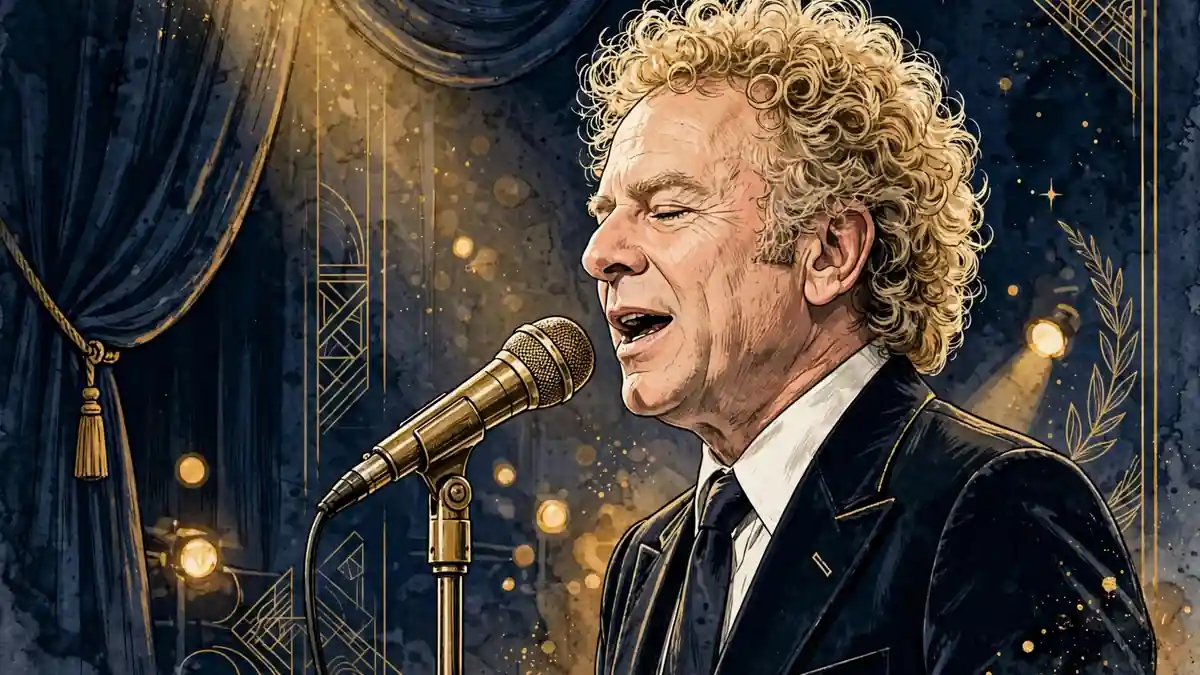
Art Garfunkel‘s net worth is estimated at $70 million to $95 million as of November 2026. The figure rests on six decades of royalties from one of the best-selling catalogues in popular music, a platinum solo career, film work, and a touring life that — at age 85 — is still adding dates: his What a Wonderful World tour played American theatres in November 2026, weeks after a respiratory infection forced four UK shows into March 2027. The top of the range, $95 million, is the number Celebrity Net Worth carries; newer 2026 profiles put him closer to $70 million, and the gap between those two numbers says something real about how a singer who never wrote his biggest songs still built a fortune from them.
Art Garfunkel: Quick Facts
| Estimated net worth | $95 million (range: $70 million to $95 million) |
|---|---|
| Profession | Singer, poet, actor |
| Nationality | American |
| Born | November 5, 1941 (age 85) |
| Height | 5 ft 9 in (175 cm) |
| Primary income sources | Simon & Garfunkel royalties, solo record sales, reunion and solo touring, film roles, books |
| Active years | 1956–present |
| Last reviewed | November 2026 |
- Early Life and Background
- Education
- Career Journey
- Rise to Fame
- Main Sources of Income
- Salary and Earnings
- Businesses and Investments
- Brand Deals and Sponsorships
- Houses, Cars and Other Assets
- Awards and Achievements
- Net Worth Growth Over the Years
- Social Media Presence
- Personal Life
- Sources & Reporting
- Frequently Asked Questions
Early Life and Background
Arthur Ira Garfunkel was born on November 5, 1941, in Forest Hills, Queens, New York City, to Jacob Garfunkel, a travelling salesman, and Rose Garfunkel. He grew up in a middle-class Jewish household in a neighbourhood that also produced his future partner: Paul Simon lived a few blocks away, and the two met at school, sang together in a school production of Alice in Wonderland, and started harmonising as teenagers. The voice that would later carry “Bridge Over Troubled Water” was already the thing people noticed — a clear, high tenor with almost no strain in it, the kind of instrument that sounds effortless and is anything but.
Forest Hills in the 1950s was a long way from the music business, and Garfunkel’s family treated music as a gift rather than a plan. He sang in the school chorus, taught himself the blend that made the duo work — Simon’s lower, earthier voice underneath, Garfunkel floating above it — and kept singing while his classmates moved on to ordinary careers. The two teenagers cut their first record as Tom & Jerry in 1957, when Garfunkel was 15 and Simon 16. Their single “Hey, Schoolgirl” reached No. 49 on the Billboard Hot 100, a small hit that paid almost nothing and taught them both how the business worked: the record sold, the money went elsewhere, and the lesson stuck. Garfunkel has spent the rest of his career on the performing side of that split, and it explains a lot about the shape of his fortune.
His father sold goods on the road, and Garfunkel has said the travelling-salesman life left its mark — long stretches away from home, a living made one stop at a time. It is a fair description of a touring singer’s life too. By the time he finished high school at Forest Hills High School alongside Simon, he had already decided he would keep both lives running at once: the books and the singing. That decision, made at 17, shaped everything that followed, including the master’s degree he finished while his records were topping charts on two continents.
One early story from his Columbia years is worth keeping because it shows the character behind the voice. His roommate lost his sight to glaucoma, and Garfunkel read textbooks aloud to him every day so the young man could keep up with his studies and graduate with honours. It is the kind of loyalty that later defined his long, difficult friendship with Simon — patient, stubborn, and willing to do the unglamorous work while someone else took the spotlight.
Education
Garfunkel enrolled at Columbia University in New York, where he first majored in architecture before switching to art history. He earned his bachelor’s degree in art history in 1965, then a master’s degree in mathematics education from Teachers College, Columbia University, in 1967. He went further still, completing coursework toward a doctorate in mathematics education at Teachers College while Simon & Garfunkel were at the peak of their commercial success — then dropped out before finishing the dissertation. Few pop stars have ever held a firmer academic footing while selling 25 million copies of a single album.
The maths background is not a footnote. Garfunkel taught geometry to high-school sophomores at the short-lived Litchfield Academy in Connecticut from late 1971 into early 1972, in the gap between the duo’s break-up and his first solo album. He has described teaching as work he genuinely enjoyed, and the discipline shows up in the way he talks about music: precise, patient, and allergic to shortcuts. He also kept a reading habit that became a small legend of its own — his official website carries a year-by-year list of every book he has read since 1968, more than a thousand titles, a public record of a private life that no other major pop star of his generation has matched.
He was a brother in the Alpha Epsilon Pi fraternity at Columbia and lived in Carman Hall. The university years also gave him his first professional discipline: singing through college, recording solo tracks under the name Artie Garr, and learning to treat a career as something you build in parallel with a life, not instead of one. That habit — degree first, fame second — is one reason his money story looks different from most rock biographies. There were no early bankruptcies, no lost fortunes to rebuild, and no years when the income stopped entirely, because the catalogue never stopped selling and he never stopped working.
Career Journey
Garfunkel’s career falls into three clear acts, and the money follows the same shape. Act one is Simon & Garfunkel, 1964 to 1970: five studio albums, three American No. 1 singles, and a catalogue that has never gone out of print. Act two is the solo years, 1973 onward, when he proved he could sell records under his own name — Angel Clare reached No. 5 on the Billboard 200, Breakaway went platinum, and “I Only Have Eyes for You” topped the UK singles chart. Act three is the long reunion era, from the 1981 Central Park concert to the present day, when the duo’s old recordings and periodic tours turned a 1960s career into a permanent income stream.
The duo’s story starts with a flop. Their debut album as Simon & Garfunkel, Wednesday Morning, 3 A.M. (1964), sold so poorly that the pair split up — Simon went to England, Garfunkel went back to Columbia. Then a producer overdubbed electric instruments onto the acoustic “The Sound of Silence” without telling them, released it as a single, and watched it climb to No. 1 in the United States in early 1966. The duo reformed in a hurry and recorded Sounds of Silence in weeks. That accident is the foundation of the fortune: a song neither man expected to be a hit became the first of three chart-toppers, and the catalogue it opened has sold for sixty years since.
What followed was a run few acts have matched. Parsley, Sage, Rosemary and Thyme (1966) gave them “Homeward Bound” and “Scarborough Fair/Canticle”. Bookends (1968) hit No. 1 in both the US and the UK. The soundtrack to Mike Nichols’s The Graduate (1967) put “Mrs. Robinson” — a song that won the Grammy for Record of the Year — into cinemas around the world and tied Garfunkel’s voice to one of the defining films of the decade. Then came Bridge Over Troubled Water in January 1970: No. 1 in ten countries, the best-selling album of the 1970s, more than 25 million copies sold worldwide, and six Grammy Awards in a single night in 1971, including Album of the Year, Record of the Year and Song of the Year.
The partnership broke apart almost at the moment of its greatest success. Recording Bridge Over Troubled Water strained the relationship — Garfunkel was away in Mexico filming Catch-22 for long stretches, Simon was writing alone, and the two men wanted different things from the next record. They announced the split in 1970 and have never recorded original material together since. The break-up cost Garfunkel the songwriting income that made Simon rich: Simon wrote the songs, so Simon owned the publishing. Garfunkel’s share came from the recordings themselves — artist royalties, which pay less than publishing and split two ways — and from the stage. That single fact explains most of the gap between the two men’s fortunes today.
His solo career began slowly and deliberately. After three years spent acting and teaching, he released Angel Clare in 1973, co-produced by Roy Halee, the engineer behind the duo’s sound. It reached No. 5 in the US and went gold on the strength of Jimmy Webb’s “All I Know”, a US Top 10 single. Breakaway followed in 1975, produced by Richard Perry, and became the most successful album of his solo career, going platinum; it included “My Little Town”, a brief reunion with Simon that reached the Top 10, and his version of “I Only Have Eyes for You”, which hit No. 1 in Britain. Watermark (1977), built almost entirely from Jimmy Webb songs, completed a run of three strong albums in four years. Later records — Fate for Breakfast (1979), Scissors Cut (1981), Lefty (1988), Songs from a Parent to a Child (1997), Everything Waits to Be Noticed (2002) — sold more modestly, but they kept him on the road and on the radio, and they kept the royalty cheques coming.
Acting ran alongside the music through the early 1970s. Mike Nichols cast him as the naive Lieutenant Nately in Catch-22 (1970), then as Sandy, the idealistic friend of Jack Nicholson’s Jonathan, in Carnal Knowledge (1971) — a performance that earned Garfunkel a Golden Globe nomination for Best Supporting Actor. Later film work included Nicolas Roeg’s Bad Timing (1980), Good to Go (1986), Boxing Helena (1993) and a cameo in 54 (1998). The film roles never paid like the records, but they kept his name in front of audiences that had stopped buying albums, and they gave him a second craft to fall back on when the charts moved on.
The reunion years turned the catalogue into a touring business. The free concert in Central Park on September 19, 1981, drew more than 500,000 people — one of the largest concert crowds in history — and the live album The Concert in Central Park went double platinum. The duo toured again in 1983, in 1993, and most profitably in 2003–2004, when the Old Friends tour played 40 dates in North America and Europe and closed with a free concert in Rome before more than 600,000 people. A 2009 tour of Asia and Australia followed. In 2010, Garfunkel was diagnosed with vocal cord paresis — a partial paralysis of a vocal cord — and the remaining dates were cancelled. He spent the next four years rebuilding his voice, note by note, and returned to the stage in his seventies. That recovery is the reason he can still tour at 85, and it is also the reason the 2026 dates matter so much to his fans.
Rise to Fame
Fame arrived twice for Garfunkel, and the second time was louder. The first arrival was “The Sound of Silence” in 1966, when a folk duo from Queens suddenly had the No. 1 record in America. The second was Bridge Over Troubled Water in 1970, when the title song — Garfunkel’s voice carrying Simon’s gospel-soaked melody over a piano — became one of the most played records of the decade and the album became, for a time, the best-selling album in history, until Michael Jackson’s Thriller passed it. The song has now been streamed more than 300 million times on Spotify alone, according to Vivascene‘s 2025 survey of the record, and the album’s 25-million-plus sales put it among the best-selling albums ever made.
The duo’s numbers still hold up against any act of their era. Together they sold more than 100 million records, won ten Grammy Awards including a Lifetime Achievement Award in 2003, and were inducted into the Rock and Roll Hall of Fame in 1990. Rolling Stone ranked them 40th on its 2010 list of the greatest artists of all time and third on its list of the greatest duos. Their greatest-hits album, released in 1972, has sold 14 times platinum in the US — one of the best-selling compilations ever released — which means the songs Garfunkel sang in 1969 were still paying him in the 2020s.
What made the rise unusual was how little of it Garfunkel chased. He never became a frontman in the usual sense; he was the harmony, the high line above Simon’s writing, and he was content to let the songs do the work. That modesty shaped his solo career too: he chose producers like Roy Halee and Richard Perry, songwriters like Jimmy Webb, and material that suited a voice built for beauty rather than volume. The result was a career that never had a second No. 1 album but never had a dead year either. The catalogue did the heavy lifting, and the touring filled the gaps.
The most recent chapter of the rise is the one still being written. In late 2024, Garfunkel and Simon met for lunch — arranged, both men later said, to clear the air after years of distance — and Garfunkel described the meeting in tears to The Guardian in November 2024, calling himself a fool for the years lost to the feud. Simon, who retired from full-scale touring in 2018, has said a reunion tour will not happen. But the lunch mattered to fans and to the story: the two men who made the music are speaking again, and the 2026 tour — Garfunkel alone on stage, singing the songs they made together — is the closest thing to a victory lap the catalogue will get.
Main Sources of Income
Simon & Garfunkel record royalties. This is the foundation of the fortune. The duo sold more than 100 million records, and their catalogue has stayed in print continuously since the 1960s. Bridge Over Troubled Water alone accounts for more than 25 million album sales, and the 1972 greatest-hits collection is certified 14-times platinum in the US. Artist royalties on those sales — a smaller slice than songwriting publishing, but paid on every copy, stream and licence — have run for six decades. Streaming added a new layer: “Bridge Over Troubled Water” alone has passed 300 million Spotify streams, and the duo’s songs appear in films, adverts and television, each use paying a synchronisation fee.
Solo record sales. Garfunkel’s solo catalogue is smaller but real: Angel Clare went gold, Breakaway went platinum, and his singles — “All I Know”, “I Only Have Eyes for You”, “My Little Town” — still earn Adult Contemporary radio royalties. His solo career produced one US Top 10 hit, three Top 20 hits, six Top 40 hits and five Adult Contemporary No. 1 singles, according to Wikipedia‘s chart summary. Those are not the numbers of a superstar, but they are the numbers of a working singer whose records never left the shops.
Touring. The reunion tours were the biggest paydays of his life. The 2003–2004 Old Friends tour played 40 dates across North America and Europe, including arena shows and the 600,000-strong free concert in Rome. His solo touring has been steadier and smaller — theatres rather than stadiums — but it has run for decades, and in 2026 it is still running: the What a Wonderful World tour launched in February 2026, played US and European dates through the year, and charged $101 to $159 a ticket at the Mayo Performing Arts Center in Morristown, New Jersey, for its November 6 show. Theatre tours at those prices, even with a band and crew to pay, remain a solid income for an 85-year-old singer.
Film and television. The Nichols films paid acting fees rather than royalties, and the Golden Globe nomination for Carnal Knowledge raised his asking price for the roles that followed. Later film and television appearances, including a 1998 spot on the children’s show Arthur, added modest fees and kept his name current with new generations.
Books and poetry. Garfunkel published a book of poetry, Still Water, in 1989, and his memoir What Is It All But Luminous: Notes From an Underground Man was released by Knopf in September 2017. Book advances and royalties are a small slice of the total, but the memoir — part poetry, part reflection on a life spent walking across America and reading a book a week — sold on the strength of a story no ghostwriter could have invented.
The one income stream he does not have. Paul Simon wrote the duo’s songs, so Simon owned the publishing — the most valuable asset in the catalogue. In March 2021, Simon sold his complete songwriting catalogue to Sony Music Publishing in a deal Forbes reported at $250 million, and in June 2023 he sold a large stake in Simon & Garfunkel recording royalties to BMG. Garfunkel had no equivalent asset to sell. That is the structural reason Celebrity Net Worth puts Simon at $200 million and Garfunkel at $95 million: the singer earned the performer’s share, the writer earned the writer’s share, and the writer’s share was worth roughly twice as much.

Salary and Earnings
No record label or promoter has ever published Garfunkel’s per-show fee, and no filing exists that breaks out his annual income, so any yearly figure is an estimate built from the pieces that are public. The pieces point to a comfortable, steady income rather than a spectacular one. One third-party estimate, published by Salemiga in 2025, put his ongoing royalties and licensing income at around $1.5 million a year — a plausible order of magnitude for a catalogue of this size, but an unverified one, and we treat it as a guide rather than a fact. What is documented is the touring arithmetic: theatre shows in 2026 priced at $101 to $159 a ticket, with venues of 1,000 to 2,500 seats, put a single night’s gross in the region of $100,000 to $350,000 before costs. A singer’s share of that, after the band, crew, travel and the promoter’s cut, is a fraction of the gross — but across a 30- or 40-date tour it adds up to real money, and Garfunkel has run tours like that for most of his adult life.
The reunion tours were a different scale. The 2003–2004 Old Friends tour played arenas, not theatres, and the duo’s 1981 Central Park concert drew half a million people for free — the live album that followed went double platinum, so the free show paid twice: once in goodwill, once in record sales. The 2009 tour of Asia and Australia added another international leg. None of these tours published a gross, and the split between the two men was never disclosed, but the pattern is clear: the big money in Garfunkel’s career came in bursts — the 1970 album, the 1981 reunion, the 2003 tour — with long stretches of steady catalogue income in between.
That pattern is worth stating plainly because it is the opposite of how most modern pop fortunes work. A singer like Taylor Swift earns most of her money from touring and new recordings; Garfunkel earns most of his from recordings made before 1970. The catalogue is the salary. Every stream of “The Sound of Silence”, every licence of “Mrs. Robinson” to a film, every copy of the greatest-hits album sold in a supermarket — each one pays a small amount, and sixty years of small amounts is how $95 million accumulates. It is also why the number barely moves year to year: the catalogue does not grow, it endures.
One more honest note: Garfunkel has never had a public financial scandal, a bankruptcy, or a lawsuit over money with his partner. The two men fought about art, not accounting. For a net-worth estimate, that matters — it means the fortune is a story of accumulation, not recovery, and the range we publish reflects uncertainty in the size of the catalogue income, not doubt about whether the money exists.
Businesses and Investments
Garfunkel has never built a business empire, and that is itself a useful fact. There is no restaurant chain, no clothing line, no tequila brand, no venture fund with his name on it. His business life has been the music business: recordings, publishing of his own solo work where he held a share, touring companies, and the books. He has invested in the ordinary way a working musician invests — in property, in a home base in New York, and in the long, unglamorous work of keeping a voice in shape for sixty years.
The most valuable business decision of his career was arguably a negative one: he never sold his artist-royalty stream. Where Paul Simon cashed out his publishing for a reported $250 million in 2021, Garfunkel kept the income flowing from the recordings. That choice cost him a headline payday and bought him a pension that no market crash can take away, because people keep playing the records. It is also a reminder that the two men’s fortunes are not really comparable: Simon’s wealth is a writer’s wealth, built on owning songs; Garfunkel’s is a singer’s wealth, built on performing them.
His publishing venture of a different kind is the reading list. Since 1968 he has kept a public, year-by-year list of every book he has read on his official website — more than 1,000 titles and counting. It earns no money directly, but it has become one of the most visited corners of artgarfunkel.com and a genuine piece of personal branding: the singer as a reader, a walker, a man who crossed America on foot in stages and read his way through the journey. He walked across the United States and later across Europe, long-distance walks that became part of his public identity and the raw material for his memoir. The walks cost money rather than making it — months on the road, hotels, time away from the stage — and he did them anyway, which tells you something about how he values his time now that the fortune is made.
On investments more broadly, nothing is public. There are no filed disclosures, no reported property deals with prices attached, and no company directorships on record. We do not invent a portfolio. What the record shows is a man who lives in New York City, tours when his health allows, and draws his income from work he did decades ago. For a fortune of this size, that is a strikingly simple financial life — and a stable one.
Brand Deals and Sponsorships
Garfunkel has never been a brand ambassador in the modern sense. There are no sneaker deals, no watch campaigns, no fragrance launches with his name on the bottle. His commercial work has been the old-fashioned kind: songs licensed to films, television and advertising, where the fee is paid for the recording rather than for his face. “Mrs. Robinson” in The Graduate is the classic example — the song was written for the film, the film made the song famous, and the two have paid each other ever since. “The Sound of Silence” has appeared in films and trailers for decades, most famously in a 2017 trailer that sent the song back up the charts, and each placement carries a synchronisation fee split between the publisher and the recording owner.
That absence of endorsement income is another structural difference between Garfunkel and the pop stars of today. A singer of his generation earned from records and concerts; the endorsement market barely existed for folk singers in the 1970s, and by the time it did, Garfunkel was not the kind of celebrity brands chased. His public image — the curly hair, the clear voice, the book list — was never packaged for sale, and his fortune is smaller for it. It is also cleaner: there is no line in his accounts for a deal that aged badly, because there were no deals.
The one commercial relationship that has run his whole career is with Columbia Records, the label that released the duo’s albums and most of his solo work. Columbia’s parent company, Sony, now controls the Simon & Garfunkel catalogue, and the relationship has been continuous since 1964 — one of the longest artist-label associations in popular music. It is the kind of loyalty that pays in catalogue care: remasters, box sets, anniversary editions, and the steady presence of the records in shops and on streaming services, all of which keep the royalty stream alive.
Houses, Cars and Other Assets
Garfunkel has been based in New York City for most of his adult life, and the city is where his property story begins and ends. He has never publicised a purchase price, a sale, or a mortgage, and no property record with a verified figure is attached to his name in the reporting we reviewed, so we do not attach numbers to his homes. What is documented is the life, not the ledger: a Manhattan base, a family life with his wife Kim and their two sons, and a touring schedule that keeps him on the road for months at a time.
Cars have never been part of his public image. There are no reported collections, no auction records, and no interviews in which he discusses vehicles — a contrast with rock stars of his generation who turned garages into museums. His spending, as far as the public record shows, has gone to the things he talks about: books, walking, travel, and time with family. The memoir describes long walks across America and Europe, taken in stages over years, with nights in ordinary hotels and days spent reading. It is not the spending pattern of a man showing off a fortune; it is the spending pattern of a man who made one and then got on with his life.
The assets that matter to his net worth are not things you can photograph. They are the artist-royalty stream on the Simon & Garfunkel catalogue, the solo catalogue, and the right to keep touring the songs. Those are intangible assets, and they are the reason the estimate holds up: unlike a house or a car, a catalogue that has sold for sixty years does not depreciate, and unlike a business, it does not need him to run it. It needs only for people to keep listening — and they do, in numbers that would make most current chart acts envious.
Awards and Achievements
The awards list is short, specific, and heavy. With Simon & Garfunkel, Garfunkel won ten Grammy Awards, including a Lifetime Achievement Award in 2003. The night that defines the list is the 1971 Grammys, when Bridge Over Troubled Water won six awards — Album of the Year, Record of the Year, Song of the Year, Best Contemporary Song, Best Arrangement Accompanying Vocalists, Best Engineered Recording, and Best Contemporary Pop Performance by a Duo or Group — a sweep that put the album in the record books and the duo on top of the music world. “Mrs. Robinson” had already won Record of the Year in 1969, and the duo’s total of seven competitive Grammys plus the lifetime award is a haul few partnerships have matched.
The duo were inducted into the Rock and Roll Hall of Fame in 1990, and four of their recordings have entered the Grammy Hall of Fame. Rolling Stone ranked them 40th on its 2010 list of the 100 Greatest Artists of All Time and third on its list of the greatest duos. Bridge Over Troubled Water was named one of the greatest albums of all time in multiple critics’ polls, and the title song was ranked among the greatest songs ever recorded.
As an actor, Garfunkel’s peak recognition was the Golden Globe nomination for Best Supporting Actor for Carnal Knowledge in 1971, playing Sandy opposite Jack Nicholson. He did not win, but the nomination put him on a different map — the film world’s — and it remains the most formal recognition of his acting career. His solo music earned its own honours: five Adult Contemporary No. 1 singles in the US, a platinum album in Breakaway, and a UK No. 1 single in “I Only Have Eyes for You”. The memoir What Is It All But Luminous was published by Knopf, one of America’s most respected literary houses, in 2017 — a different kind of honour, and one he valued as much as the gold records.
Set against his peers, the list is distinctive for what it lacks: no solo Grammy, no Oscar, no chart-topping solo album. Garfunkel’s honours are almost all shared — with Simon, with Nichols, with the duo’s producers and engineers. That is the honest shape of the career. The voice was extraordinary; the career was a partnership. The fortune follows the same pattern, and the awards explain why: the biggest cheques in his life were written for work done with someone else.
Net Worth Growth Over the Years
The table below is our own estimate, built from the documented milestones of his career — album sales, reunion tours, and the steady catalogue income between them. These are NetWorthCraft estimates, not reported figures; no outlet has published a year-by-year series for Garfunkel, and the early numbers are rough by necessity. What the shape shows is the real story: a fortune made in the 1960s and 1970s, consolidated by reunions, and held steady by a catalogue that never stopped selling.
| Year | Estimated net worth | What drove it |
|---|---|---|
| 1970 | $5 million | Bridge Over Troubled Water sells 25 million copies; duo at its peak |
| 1975 | $8 million | Breakaway goes platinum; “I Only Have Eyes for You” tops the UK chart |
| 1981 | $15 million | Central Park reunion draws 500,000; live album goes double platinum |
| 1990 | $25 million | Rock and Roll Hall of Fame induction; catalogue reissues and compilations |
| 2004 | $45 million | Old Friends reunion tour: 40 dates, Rome finale before 600,000 |
| 2010 | $55 million | Catalogue streaming begins; vocal cord paresis pauses touring |
| 2020 | $70 million | Streaming growth; 2026 profiles begin citing $70 million |
| 2026 | $70–$95 million | Celebrity Net Worth holds $95 million; What a Wonderful World tour at 85 |
Two things stand out. First, the fortune grew slowly after 2004 — there were no more blockbuster albums, no catalogue sale, and no new revenue line. Second, it never fell. That is the catalogue effect: a body of work that sells every year, in every format, in every country, is a remarkably stable asset. Compare that with Mick Jagger, whose fortune kept growing through decades of stadium touring, or with Prince, whose estate was valued at around $300 million after his death — and the shape of Garfunkel’s wealth becomes clear. He made his money early, kept it, and let the songs do the work.
The peer gap is worth one more look, because readers always ask it. Paul Simon’s $200 million is roughly double Garfunkel’s $95 million, and the reason is the $250 million Sony catalogue sale of 2021 — money that only the songwriter could collect. Dave Grohl, a generation younger, built a fortune of a similar order through constant touring and recording with Foo Fighters. The comparison that flatters Garfunkel most is the simplest: he is 85, still singing the songs, and still selling tickets at $101 to $159 a seat. Very few singers of any era can say that.
Social Media Presence
Garfunkel keeps a light footprint online, and that is a deliberate choice rather than a failure of marketing. His hub is his official website, artgarfunkel.com, which carries tour dates, ticket links, the reading list he has kept since 1968, and news of postponements and reschedulings — it was the site that confirmed the March 2027 dates after the October 2026 UK postponements. He has a presence on the major social platforms, where tour announcements and archival photographs appear, but he does not run the kind of daily content operation that younger stars do, and his following is modest by pop-star standards. For a singer whose audience is largely over 50, that is not a weakness: his fans buy tickets and records, not hashtags.
The practical effect on his income is small. Social media earns him almost nothing directly — there are no sponsored posts, no brand partnerships, and no merchandise operation of the scale that younger acts run. What it does is keep the tour dates visible: the November 2026 American shows in Morristown, Austin, St Charles, Des Plaines and Los Angeles were all listed and ticketed online, and the rescheduled London date at the Royal Albert Hall on March 14, 2027, was announced the same way. In 2026, a tour lives or dies on its listings, and Garfunkel’s listings are kept current. That is the whole of his social media strategy, and it is enough.
One corner of his online presence deserves a mention because no competitor covers it properly: the reading list. Year by year since 1968, he has published the books he read — fiction, poetry, history, biography — more than a thousand titles in all. It is a strange, generous, completely uncommercial piece of self-publishing, and it tells you more about the man than any interview. The singer who spent his twenties memorising textbooks for a blind roommate is still, at 85, keeping a public record of what he reads. Fans visit it, journalists quote it, and it costs him nothing but time.
Personal Life
Garfunkel has been married to Kathryn Luce Garfunkel — known as Kim Cermak, a performing artist — since 1988. The couple have two sons: James Arthur, born in 1990, who has performed with his father on stage, and Beau Daniel, born in 2005. Kim has been a visible part of his recent touring life: it was she who insisted he keep a doctor’s appointment during rehearsals in October 2026, an appointment that led to the diagnosis of the respiratory infection and the postponement of the UK dates. Garfunkel said so himself in the statement announcing the postponement, crediting his wife with catching a problem he would have walked past. It is a small, human detail, and it says more about the marriage than any profile could.
His first marriage, to Linda Marie Grossman, an architect, ran from 1972 to 1975 and ended in divorce. He has spoken rarely about it. The long second marriage, now in its fourth decade, has been the stable centre of his adult life — the reason, friends say, that he could spend four years rebuilding his voice after the 2010 vocal cord paresis without the career collapsing around him. Family, in Garfunkel’s case, has been a form of wealth management: the steady base that let the catalogue do its work.
Health has shaped the last fifteen years of his career. The vocal cord paresis diagnosed in 2010 cancelled a tour and took four years of patient rehabilitation before he could sing reliably again. The respiratory infection of October 2026 was a smaller scare, but at 84 it was serious enough to move four shows — Watford, Manchester, Wolverhampton and London — into March 2027. He has been open about both episodes, and the openness has worked in his favour: audiences at 85 are not expecting a young man’s voice, they are expecting the voice they grew up with, cared for and still standing. His 85th birthday fell on November 5, 2026, the day before his Morristown show — a scheduling coincidence that his fans, and the local press, noticed.
He remains close to his roots in other ways too. He has lived in New York for decades, and the city — Forest Hills, Columbia, the stages of Manhattan — is the backdrop of the whole story. He is not a man who moved to a tax haven or bought a ranch in Montana. The fortune stayed where it was made, and so did he.
Sources & Reporting
Celebrity Net Worth — the $95 million net-worth figure for Garfunkel (page updated October 2024) and the $200 million figure for Paul Simon, including the $250 million Sony Music Publishing catalogue sale reported by Forbes.
Far Out — 2026 artist profile listing Garfunkel’s net worth at $95 million, height, and career summary; also the 2025 survey of Bridge Over Troubled Water as the best-selling folk album, with 12.5 million-plus sales cited for the folk category.
Bored Panda and TVOverMind — November 2026 profiles putting Garfunkel’s net worth at $70 million, the lower end of our range, with height at 5 ft 9 in and age 85.
NME — October 10, 2026 report of the UK tour postponement after the respiratory-infection diagnosis, including the four affected dates and Garfunkel’s statement crediting his wife Kim.
The Guardian — November 11, 2024 report by Ben Beaumont-Thomas on Garfunkel’s tearful reunion lunch with Paul Simon.
Mayo Performing Arts Center — November 6, 2026 What a Wonderful World concert listing, Morristown, New Jersey, with ticket prices of $101–$159.
Official Charts Company — Simon & Garfunkel chart history: Bridge Over Troubled Water at more than 25 million copies sold, the best-selling album of the 1970s, and two UK No. 1 albums.
Wikipedia — Art Garfunkel and Simon & Garfunkel entries: birth and education details, solo chart record (one US Top 10 hit, five Adult Contemporary No. 1 singles), acting roles, vocal cord paresis in 2010, and the 2003–2004 Old Friends tour.
Reporting window: October–November 2026, with catalogue and sales figures drawn from the sources above. Where sources disagree on the net worth — $70 million in 2026 profiles against $95 million at Celebrity Net Worth — we publish the range and name both sides. The growth table in this article is a NetWorthCraft estimate, not a reported series.
Frequently Asked Questions
What is Art Garfunkel’s net worth in 2026?
Art Garfunkel’s net worth is estimated at $70 million to $95 million as of November 2026. Celebrity Net Worth carries the $95 million figure, while newer 2026 profiles from Bored Panda and TVOverMind put him at $70 million. We publish the range because the two sides disagree, and the truth sits between a catalogue that has sold for sixty years and a singer who never owned the songwriting publishing behind it.
How old is Art Garfunkel?
Art Garfunkel was born on November 5, 1941, in Forest Hills, Queens, New York City. He turned 85 on November 5, 2026, the day before his What a Wonderful World tour played the Mayo Performing Arts Center in Morristown, New Jersey.
Is Art Garfunkel still alive and performing?
Yes. He is alive and still touring at 85. His What a Wonderful World tour launched in February 2026 and played American dates in November 2026, including Morristown, Austin, St Charles, Des Plaines and Los Angeles. Four UK dates in October 2026 were postponed after he was diagnosed with a respiratory infection and rescheduled for March 2027, including the Royal Albert Hall on March 14, 2027.
Who is Art Garfunkel’s wife?
Art Garfunkel has been married to Kathryn Luce Garfunkel, known as Kim Cermak, since 1988. She is a performing artist, and the couple have two sons, James Arthur (born 1990) and Beau Daniel (born 2005). Kim was the one who insisted he keep the doctor’s appointment in October 2026 that led to his respiratory-infection diagnosis.
What happened to Art Garfunkel’s voice?
In 2010, Garfunkel was diagnosed with vocal cord paresis, a partial paralysis of a vocal cord, and the remaining dates of the Simon & Garfunkel tour were cancelled. He spent about four years rebuilding his voice before returning to the stage. He has also dealt with a respiratory infection in October 2026 that postponed four UK shows. His voice is not what it was at 25, but he is still singing the songs live at 85.
Are Paul Simon and Art Garfunkel friends now?
They are speaking again. In late 2024 the two men met for lunch to clear the air after years of distance, and Garfunkel described the meeting in tears to The Guardian in November 2024. Simon has said a reunion tour will not happen, and he retired from full-scale touring in 2018, so the friendship is personal rather than professional — but after decades of silence, that is a real change.
How much is Paul Simon worth compared to Art Garfunkel?
Paul Simon is worth about $200 million, according to Celebrity Net Worth — roughly double Garfunkel’s $95 million. The gap comes down to songwriting: Simon wrote the duo’s songs and owned the publishing, which he sold to Sony Music Publishing in 2021 in a deal Forbes reported at $250 million. Garfunkel, as the singer, earned artist royalties and touring income but never had a publishing catalogue to sell.
What was Art Garfunkel’s biggest hit as a solo artist?
His biggest solo hit was “I Only Have Eyes for You”, from the 1975 album Breakaway, which reached No. 1 on the UK singles chart. In the US, his biggest solo single was “All I Know”, written by Jimmy Webb, which reached the Top 10 in 1973 from his debut solo album Angel Clare. Breakaway went platinum and remains the most successful album of his solo career.
Final Thoughts
Art Garfunkel’s $70 million to $95 million fortune is the quiet kind: no catalogue sale, no endorsement empire, no scandal and no comeback from bankruptcy. It was built the old way — a voice, a partnership, and a set of songs that people have refused to stop playing for sixty years. The $95 million at the top of the range is the number the record keepers carry; the $70 million at the bottom is what the newest profiles say. Either way, the story is the same. He sang the high harmony on some of the most durable music ever recorded, kept the royalty stream alive through reunions and solo tours, and at 85 is still standing on a stage singing those songs to rooms full of people who learned them from their parents. Paul Simon got the songwriter’s fortune. Garfunkel got the singer’s — smaller, steadier, and still paying out, one stream and one theatre ticket at a time.
Published on 2026-11-14. Last reviewed November 2026. Found an error? See our corrections policy.