
Alicia Witt‘s net worth is estimated at $4 million to $5 million as of November 2026. The figure rests on a four-decade career that began when David Lynch cast her in Dune at age eight, ran through four seasons as a network sitcom regular on Cybill, and settled into a second act as one of the Hallmark Channel’s most dependable Christmas-movie leads — a run of ten holiday films in which she often sang her own songs and, on Christmas Tree Lane, also worked as executive producer and storywriter. Her fortune is modest beside the nine-figure totals of the biggest film stars, and that is the honest shape of it: steady television and film paychecks, music income from five albums and a Billboard-charting single, producing fees, and a late-career lift from 2024’s horror hit Longlegs, which earned about $129 million at the box office.
Alicia Witt: Quick Facts
| Estimated net worth | $4 million (range: $4 million to $5 million) |
|---|---|
| Profession | Actress, singer-songwriter, pianist, producer, author |
| Nationality | American |
| Born | August 21, 1975 (age 51) |
| Height | 5 feet 9 inches (175 cm) |
| Primary income sources | Film and television acting, Hallmark movies, music sales and streaming, producing and songwriting |
| Active years | 1984–present |
| Last reviewed | November 2026 |
- Early Life and Background
- Education
- Career Journey
- Rise to Fame
- Main Sources of Income
- Salary and Earnings
- Businesses and Investments
- Brand Deals and Sponsorships
- Houses, Cars and Other Assets
- Awards and Achievements
- Net Worth Growth Over the Years
- Social Media Presence
- Personal Life
- Sources & Reporting
- Frequently Asked Questions
Early Life and Background
Alicia Roanne Witt was born on August 21, 1975, in Worcester, Massachusetts, to Diane Pietro Witt, a junior high school reading teacher, and Robert Witt, a science teacher and photographer. She grew up with one sibling, her brother Ian Rob Witt, who also worked as an actor. The household was bookish and disciplined rather than show-business connected: her mother taught reading, her father taught science and shot photographs, and the children were raised in a home where learning was treated as a daily habit.
Witt was a child prodigy by any reasonable measure. She was talking by age two and reading by age four, and at five she appeared on the television show That’s Incredible! in 1980 reciting Shakespeare’s Romeo and Juliet from memory. That single television appearance changed the direction of her life. Casting director Jane Jenkins saw the segment and brought her to director David Lynch, who was casting his science-fiction epic Dune. Lynch cast the flame-haired seven-year-old as Alia Atreides, the younger sister of Paul Atreides, and she turned eight during filming. She had never even seen a movie before she was cast in one, a detail she has repeated in interviews across her career.
The Lynch connection shaped her more than any single job that followed. He cast her again at fourteen as Gersten Hayward, the younger sister of Lara Flynn Boyle’s Donna, in an episode of Twin Peaks in 1990 — a role she returned to twenty-seven years later in Twin Peaks: The Return in 2017. Lynch also had her perform a piano piece over the end credits of the second season premiere, an early sign of how her two talents, acting and music, would keep crossing over. When Lynch died in January 2025, Witt’s grief was public and direct; her 2026 album Between Heaven and Earth is a tribute to their relationship, and she has said she told Lynch, about a year before his death, that the performance in Twin Peaks: The Return that won her the role in Longlegs was something she owed to him.
Worcester stayed part of her story in a painful way. Her parents lived in the family home there into old age, fiercely independent and resistant to help with home repairs, as Witt later wrote. On December 20, 2021, both were found dead in that house — her father Robert at 87, her mother Diane at 75 — after Witt, who had not heard from them in some time, asked a relative to check on them. Death certificates obtained by The Telegram & Gazette later gave the cause as “probable cardiac dysrhythmia” due to the cold of their neglected and improperly heated home. The loss arrived three weeks after Witt had begun chemotherapy for breast cancer, a collision of events that defined the hardest stretch of her life and paused her screen career for more than a year.
Education
Witt was homeschooled, and her schooling moved at the same accelerated pace as the rest of her childhood. She completed her high school equivalency credential by age fourteen, years ahead of her peers, and then turned to acting full time. There was no university degree and no drama-school training on her record; her education in performance came from working sets, starting with a Lynch production at eight and continuing through guest roles on prestige television while other teenagers were still in school.
Her musical education ran on a parallel track and was just as serious. Witt trained as a classical pianist from childhood, and the piano became the spine of her music career — the instrument she writes on, performs with, and built her albums around. The combination of an early diploma and a working musician’s discipline explains a career pattern that repeats across four decades: Witt rarely stops working, and she keeps adding skills — writing, producing, composing — to the jobs she already holds.
Career Journey
Witt’s screen career divides cleanly into four phases, and each one paid her in a different way. The first phase, 1984 to 1994, was child acting and the slow build toward adult roles. After Dune, she worked steadily rather than spectacularly, taking film and television parts while she grew up in public. The second phase began with Fun in 1994, in which she played a disturbed teenager; the performance won Special Jury Recognition at the Sundance Film Festival and marked her as a serious young actor rather than a former child star. She followed it with Mr. Holland’s Opus in 1995, playing a music student opposite Richard Dreyfuss in a film that earned about $106 million worldwide, and with the horror film Urban Legend in 1998, which took in roughly $72.5 million worldwide and gave her a durable genre credit.
The third phase was television. Witt’s longest-running job was Cybill, the CBS sitcom built around Cybill Shepherd, in which she played Shepherd’s dry-witted daughter Zoey Woodbine for four seasons from 1995 to 1998, across 87 episodes. A four-season network sitcom regular role is the kind of job that pays an actor twice: once in salary while it airs, and again in residuals for years afterward. Around and after Cybill, she stacked guest and recurring roles across the prestige dramas of the era — The Sopranos, Friday Night Lights as Cheryl, Justified as Wendy Crowe, The Walking Dead as Paula in two episodes in April 2016, Nashville as Autumn Chase, Two and a Half Men, Law & Order: Criminal Intent, The Mentalist, The Librarians, CSI: Miami, and Zelda in the final season of Netflix’s Orange Is the New Black. She also returned to film with the romantic comedy Two Weeks Notice in 2002, opposite Sandra Bullock and Hugh Grant, which earned about $199 million worldwide.
The fourth phase began in 2011 with Backyard Wedding, her first Hallmark film, and it became the most reliable income stream of her career. Between 2013 and 2020 she starred in eight Hallmark Christmas films, and her total Hallmark holiday count reaches ten, according to her booking agency MN2S. The list runs through A Very Merry Mix-Up (2013), Christmas at Cartwright’s (2014), I’m Not Ready for Christmas (2015), Christmas List (2016), The Mistletoe Inn (2017), Christmas on Honeysuckle Lane (2018) and Christmas Tree Lane (2020). She also appeared in three Christmas films in a single year, 2013: Tyler Perry’s A Madea Christmas in cinemas, A Snow Globe Christmas for Lifetime, and A Very Merry Mix-Up for Hallmark. In 2020, Christmas Tree Lane let her combine every skill she owned — she starred in it, executive-produced it, wrote the story, and contributed two original songs her character sings on screen.
The most recent phase is a comeback shaped by hardship. Witt stepped back from acting in 2021 to work on her album The Conduit and her book Small Changes, and then the cancer diagnosis and her parents’ deaths stopped her almost entirely. She returned with the EP Witness in 2023, an appearance on Fox’s The Masked Singer the same year — winning her first episode with a rendition of “Over the Rainbow” — and then the role that reset her film career: Ruth Harker, the deeply troubled mother of FBI agent Lee Harker, in Osgood Perkins’ horror thriller Longlegs (2024), opposite Nicolas Cage. She never auditioned for the part. Perkins told her he cast her because of her wordless forest scene in Twin Peaks: The Return, and she has said the role was profoundly cathartic after the trauma of 2021 and 2022. The film earned about $129 million at the box office, according to her agency biography, making it 2024’s biggest independent film. She followed it with the indie drama Fuzzy Head, another turn as a troubled mother, and a full-length Christmas album, I Think I’m Spending Christmas with You, in November 2024, plus a “Spending Christmas With Alicia Witt” concert tour each December.
Rise to Fame
Witt never had one breakout moment; she had three, spread across thirty years, and each one reached a different audience. The first was Dune in 1984. The film itself was a commercial disappointment, earning about $30.9 million against a large budget, but the image of the flame-haired child reciting lines well beyond her years stuck with directors and critics, and it put her on the path that led to Lynch’s television work. The second was Cybill. Playing Zoey Woodbine from 1995 to 1998 introduced her to a weekly network audience of millions and gave her the steadiest paycheck of her young career — four seasons, 87 episodes, and a character viewers associated with her for years afterward. The third was Hallmark. From 2013 onward, Witt became one of the network’s familiar Christmas faces, and the holiday films gave her something the earlier phases never had: a loyal, returning audience that watches the same movies every December, which keeps her residuals and her name recognition renewing year after year.
What makes her rise unusual is how little of it depended on a single hit. Her biggest box-office films — Two Weeks Notice at about $199 million, Mr. Holland’s Opus at about $106 million, Urban Legend at about $72.5 million, Longlegs at about $129 million — all cast her in supporting roles. She was never the star whose name sold the ticket, and she was never paid like one. Instead, she built a career out of volume and range: a sitcom regular, a horror regular, a Hallmark lead, a recording artist, a producer. That breadth is exactly why her net worth sits where it does — solid, earned over forty years, and nowhere near the nine-figure totals of actors who carried franchises.
The 2024 turn in Longlegs added a new layer. Critics singled out her performance — one Cinema Femme account described scenes that drew audible gasps from audiences — and the film’s box-office run put her back in front of casting directors who had not thought of her for theatrical features in years. She told Variety she refused to watch the finished film, saying what came out of her in the role was something she did not want to see. The candour of that admission, and the catharsis she has attached to the part, turned a supporting role into the most talked-about performance of her later career.
Main Sources of Income
Acting is the largest share of Witt’s income, and it comes in three distinct streams. The first is film, where she has worked since 1984 across studio releases and independent features, from Dune and Mr. Holland’s Opus to Two Weeks Notice and Longlegs. The second is television, where a four-season sitcom regular role, recurring parts on cable and streaming dramas, and guest spots on long-running series produced both salaries and residuals. The third, and the steadiest in the last fifteen years, is Hallmark: ten holiday films as a lead, with fees per film plus repeat-airing residuals every Christmas season.
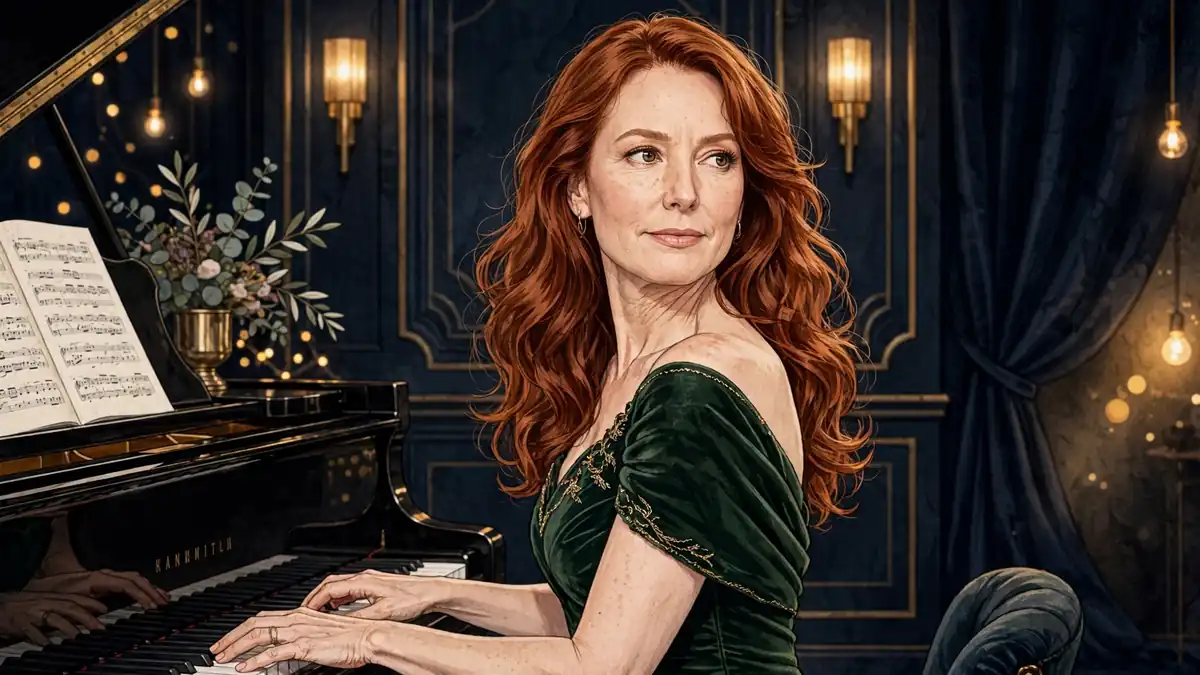
Music is the second pillar, and it is more substantial than most net-worth roundups allow. Witt has released five albums: Revisionary History (2015), produced by Ben Folds; 15,000 Days (2018), produced by Grammy-winning producer Jacquire King; The Conduit (2021), which she co-produced with Jordan Lehning and Bill Reynolds; the EP Witness (2023); and Between Heaven and Earth (2026), released through Thirty Tigers and produced by Joe Henry. Her single “Chasing Shadows,” from The Conduit, spent five weeks on the Billboard Top 30 AC radio chart. She also writes and performs original songs for her Hallmark films — “Christmas Miracle” in Christmas on Honeysuckle Lane, two songs in Christmas Tree Lane — and tours as a concert performer, including her annual December “Spending Christmas With Alicia Witt” tour and regular dates at Nashville’s Bluebird Cafe. Album sales, streaming royalties, sync fees for songs placed in her own films, and live performance fees all feed the same line.
Producing and writing form a third stream that grew late in her career. On Christmas Tree Lane she was executive producer and storywriter as well as star, which means producer fees on top of her acting fee and a writing credit that carries its own payment. Her book Small Changes: A Rules-Free Guide to Add More Plant-Based Foods, Peace and Power to Your Life, published in 2021, added author royalties. She is also featured as an artist by Casio, highlighting her musical career and her album The Conduit, a brand association that sits closer to an endorsement than a one-off appearance.
Residuals tie all of it together. A career with 87 episodes of a network sitcom, a dozen recurring television roles, and ten Hallmark films that air every December generates repeat payments long after the original work ends. The SAG-AFTRA residual system pays performers when shows are syndicated, redistributed, released on streaming services or re-aired, and Hallmark’s annual Christmas rotation is one of the most reliable re-airing schedules in American television. Witt’s income in any given year is therefore a mix of new work and old work paying again — a pattern that explains how a working actor without a franchise can hold a multi-million-dollar net worth for years.

Salary and Earnings
No studio or network has ever published Witt’s per-project pay, so this section reports what the industry pays for the kind of work she does and labels the rest as estimates. The clearest public benchmark covers her Hallmark work. Industry reporting collected by MrDustbin puts Hallmark actors at $400 to $1,200 per day, with a typical Hallmark movie shooting over 14 to 20 days — which works out at roughly $5,600 to $24,000 per film depending on the performer’s standing. Witt, as an established lead who also executive-produces and writes songs for her films, sits at the top of that band, and her producer and songwriting fees on a film such as Christmas Tree Lane sit on top of the acting fee. Across ten holiday films, even at the top of the published day-rate band, Hallmark acting fees alone total in the low hundreds of thousands of dollars — meaningful money, and a long way from the seven-figure paydays of the network’s biggest stars, which is why the $4 million net-worth figure is consistent with the record rather than low.
Her network television pay followed a different scale. As a regular on Cybill for four seasons and 87 episodes in the late 1990s, she earned a weekly network sitcom salary — the kind of contract that, for a supporting regular on a CBS sitcom of that era, typically ran into five figures per episode by the later seasons, plus residuals that continue to pay when episodes are syndicated or streamed. Recurring roles on cable dramas such as Justified and The Walking Dead, and a final-season arc on Netflix’s Orange Is the New Black, paid at the standard SAG-AFTRA scale for recurring guest stars, with streaming residuals attached. None of these figures is public, and we do not invent them; what the record shows is a continuous run of paid television work from 1990 to the present, with almost no fallow years.
Film pay is the hardest to pin down because her biggest box-office hits cast her in supporting roles. Two Weeks Notice earned about $199 million worldwide, Mr. Holland’s Opus about $106 million and Longlegs about $129 million, but supporting players on such films are paid a negotiated flat fee rather than a share of the gross. Witt has never been reported to hold backend points on a film, and no reporting ties her to profit participation. Her music income is easier to describe: five albums, a Billboard Top 30 single, streaming royalties, sync fees, and live touring, including her December concert runs. Taken together, her annual earnings in a working year plausibly sit in the low-to-mid six figures — enough to sustain a $4 million to $5 million net worth over forty years, and far below the eight-figure annual hauls of franchise leads.
One financial detail from her own account deserves attention because it shows the other side of a working actor’s balance sheet. In an interview with American Songwriter, Witt said she had to keep working through her cancer treatment in order to keep her health insurance. A performer whose income depends on staying employed cannot simply stop, and the cost of American health coverage is a real line in her finances. It is a reminder that a $4 million net worth for a working actor is not a pile of cash in a vault; it is the accumulated remainder of forty years of fees, residuals and royalties after taxes, agents’ commissions, living costs and medical bills.
Businesses and Investments
Witt has never been reported as the founder of a company, the owner of a production shingle, or an investor in a startup, and this article does not invent a business portfolio for her. What she has built is a one-person creative business with three product lines — acting, music and writing — and the closest thing to a venture in her record is the way she began packaging those lines together. On Christmas Tree Lane, she was star, executive producer, storywriter and songwriter on the same project, which is a producer’s way of capturing more of a film’s budget instead of a single fee. Her albums are released through established partners — Thirty Tigers handled the 2026 release — rather than through a label she owns, and her book came through a traditional publisher.
On investments, the public record is silent. No property portfolio, stock holding, or business stake has been reported for Witt, and no outlet has ever described her as a real-estate investor or a venture backer. TheMost10’s claim of a $10 million net worth built on “business ventures” and “entrepreneurial endeavors” is a good example of the problem with thin net-worth sites: it names no business, no deal and no source. We treat it as unsupported. What can be said with confidence is that her wealth comes from fees and royalties rather than from equity, and that the absence of a reported investment portfolio is itself information — her fortune is a career’s earnings, not a dealmaker’s windfall.
Her music operation is the nearest thing to a business asset. Five albums, a touring show, a Christmas concert brand that returns every December, and a catalogue of original songs that keep earning sync and streaming royalties form a small, durable enterprise that she controls directly. The 2026 album Between Heaven and Earth, produced by Joe Henry and released through Thirty Tigers, shows that enterprise still growing in her fifties, with the Times UK describing it as “gorgeously sung” and praising what it called directing from beyond — a reference to the Lynch tribute at its heart.
Brand Deals and Sponsorships
Witt’s brand work is narrow and music-led rather than the endorsement-heavy portfolio of a social-media star. The clearest association is with Casio, which features her as an artist and highlights her musical career and her album The Conduit — a partnership built around her piano playing rather than a paid advertisement. She has no reported fashion, beauty, or consumer-goods endorsement deals, no product line, and no sponsored-content business of the kind that now funds many actors of her generation.
That absence is consistent with her public profile. Witt’s audience is built on long-running television and Christmas films, not on influencer marketing, and her social-media presence is personal and professional rather than commercial. The brand value she holds is in the Hallmark association itself: ten holiday films make her a familiar face to the network’s large, loyal audience, and that familiarity is what keeps the film offers and the concert tickets coming. It is a quieter kind of sponsorship — a network’s trust, renewed film after film — and it pays in work rather than in endorsement cheques.

Houses, Cars and Other Assets
Witt lives in Nashville, Tennessee, and she has described the move there as the most important choice she has made. She told The Hollywood Reporter in May 2021, “Living full-time in Nashville is the most important choice I’ve made.” The city is the centre of her music life — her albums are Nashville records, her touring base is Nashville, and the Bluebird Cafe is a regular stage for her. No public record gives the purchase price, size or address of her Nashville home, and this article does not guess at one. Property records for Witt have never been reported by the outlets that track celebrity real estate, which suggests a home bought at working-musician scale rather than at mansion scale.
Her parents’ home in Worcester, Massachusetts, enters the record only through tragedy: the house where Robert and Diane Witt died in December 2021 was described in reporting as neglected and improperly heated, and Witt wrote that her parents had refused help with repairs. There is no reporting that Witt inherited property of significant value from them, and no estate figure has ever been published.
On cars, there is nothing to report — no vehicle collection, no luxury-car purchase, and no car endorsement has ever been attached to her name. The same goes for watches, jewellery, art, or any other collectible asset class. Witt’s public image has never been built around visible luxury, and the absence of such reporting matches the modest scale of her net worth. Her real assets, as far as the record shows, are her home, her music catalogue, and the residual streams from forty years of screen work.
Awards and Achievements
Witt’s most significant early honour came at the Sundance Film Festival, where her performance in Fun (1994) won Special Jury Recognition. The award marked her transition from child actor to serious performer and remains the standout prize on her record. She has not been nominated for an Emmy, an Oscar, or a Golden Globe, and her career has never depended on awards-season attention.
Her achievements sit in other columns. Four seasons and 87 episodes as a network sitcom regular. Ten Hallmark holiday films as a lead, with producing and writing credits on the most personal of them. Five albums, including one produced by Ben Folds and one by Grammy winner Jacquire King, and a single that spent five weeks on the Billboard Top 30 AC chart. A published book. A role in 2024’s biggest independent film. And a career that survived the two hardest years of her life — cancer treatment and the loss of both parents within weeks of each other — and returned with new work in 2023, 2024 and 2026. The durability is the achievement: very few child actors are still working at a high level at 51, and fewer still are releasing their best-reviewed music in their fifties.
Net Worth Growth Over the Years
The table below is a NetWorthCraft estimate of Witt’s trajectory, built from the milestones in her career rather than from published yearly figures — no outlet has ever reported her net worth year by year, and any table that claims exact annual numbers would be inventing them. The shape of it is what matters: slow growth through steady television work, a lift during the Hallmark years, and a flat-to-rising line through the 2020s as music, producing and the Longlegs revival added new income.
| Period | Estimated net worth | What drove it |
|---|---|---|
| 1984–1994 | Under $1 million | Child acting in Dune and early roles; first adult film work |
| 1995–1998 | $1 million–$2 million | Four seasons as a regular on Cybill; Mr. Holland’s Opus and Urban Legend |
| 1999–2010 | $2 million–$3 million | Guest and recurring television roles; Two Weeks Notice; first album work |
| 2011–2020 | $3 million–$4 million | Hallmark lead roles begin; Revisionary History and 15,000 Days; book deal |
| 2021–2023 | $3 million–$4 million | Career pause for cancer treatment and family loss; The Conduit and Witness EP |
| 2024–2026 | $4 million–$5 million | Longlegs box-office run; Christmas album and tours; Between Heaven and Earth |
Two things stand out in that arc. First, the line never spikes, because Witt never had a franchise payday or a backend windfall; it climbs the way a working actor’s savings climb, a few hundred thousand dollars at a time. Second, the line never falls, even through the cancer year, because residuals from Cybill, the Hallmark rotation and her music catalogue kept paying while she was not working. That is the financial logic of a forty-year career: the old work funds the gaps between the new work.
Social Media Presence
Witt is active on Instagram and Threads, where she shares tour dates, new music, behind-the-scenes pictures from her films, and personal reflections — including, in December 2024, a candid series of posts in which she revealed that she lives with prosopagnosia, or face blindness, a lifelong condition that has caused her countless awkward social encounters. She described the disclosure as deeply embarrassing and deeply relieving at the same time, and the posts drew a warm response from fans who recognised the condition in themselves. Her social presence is personal rather than commercial: concert announcements and new songs sit beside tributes to Lynch and reflections on grief, with no sponsored-content business attached.
Her standing among her contemporaries is easy to place. Fellow Hallmark lead Lacey Chabert is also estimated at $4 million, according to Celebrity Net Worth via Wide Open Country — the same figure as Witt, and a fair measure of what a long Hallmark career is worth. Actresses who built their fortunes on different scales include Reese Witherspoon, Jennifer Aniston, Margot Robbie, Emma Stone and Angelina Jolie, each of whom combined acting with producing or franchise work in ways Witt’s career never did. The comparison is instructive rather than unkind: Witt’s $4 million to $5 million is the fortune of a working actor and musician, not of a mogul, and it was earned without a single franchise or studio windfall. Readers browsing the site’s actresses archive will find the same pattern repeated — long careers, steady pay, and a wide gap between working stars and the very richest names in the category.
Personal Life
Witt married Nathan Foulger in 2003, and the marriage ended in divorce in 2006. She has no children, and she has kept her romantic life largely private since the divorce. Her brother Ian Rob Witt, also an actor, is her closest surviving family.
The defining chapter of her personal life began in late 2021. On November 4, 2021, she received a diagnosis of HER2-positive breast cancer, an aggressive form of the disease. She began chemotherapy in December, and three weeks later, on December 20, her parents were found dead in their Worcester home. She chose not to disclose the diagnosis publicly until she had completed six rounds of chemotherapy and a unilateral mastectomy on April 27, 2022, telling followers in June 2022 that keeping the news private until she was healed had mattered to her, given how public the tragedy around her parents had become. She rang the bell after her final treatment and was declared cancer-free in the spring of 2022, continuing immunotherapy through the end of that year. She has also said she quit drinking alcohol for her overall well-being, and in 2023 she released the song and EP Witness, written out of gratitude for the people who carried her through the eighteen months of illness and grief.
Today Witt lives in Nashville, tours most Decembers with her Christmas show, and continues to record. The 2026 album Between Heaven and Earth closes a circle that began when she was five years old reciting Shakespeare for a television camera: a record about the director who discovered her, made in the city she chose as home, sung by a woman who has survived the worst years of her life and gone back to work.
Sources & Reporting
Reporting window: October 2025–November 2026, with career history drawn from earlier reporting. Celebrity Net Worth provides the anchor $4 million net-worth figure, as cited across the field. Wide Open Country confirms the $4 million figure and the Hallmark career details, and supplies the peer figures for Lacey Chabert, Candace Cameron Bure and Catherine Bell. Urban Splatter (updated November 9, 2026) gives the freshest $4 million estimate. Wikipedia supplies the biographical spine — birth, family, the Lynch discovery, Cybill, Hallmark filmography, the 2021 deaths and cancer timeline, and the 2026 album. American Songwriter covers the Witness EP, the Masked Singer appearance, the cancer recovery and the health-insurance detail. Entertainment Now reports the prosopagnosia disclosure, the Hallmark return, and the breast-cancer and parents’ timeline. MN2S and Fleming Artists provide the booking biography, the ten-film Hallmark count, the album history, the Billboard Top 30 run for “Chasing Shadows,” and the $129 million Longlegs box-office figure. The List covers the child-prodigy background and the cancer and parents’ story. MrDustbin supplies the Hallmark day-rate benchmark of $400 to $1,200 per day over 14 to 20 days. The Hollywood Reporter carries Witt’s 2021 statement on moving to Nashville full time. Box-office totals for Mr. Holland’s Opus, Urban Legend, Two Weeks Notice and Dune are the widely reported worldwide grosses for those films. Figures labelled as estimates are NetWorthCraft’s own, built from the sources above; where sources disagree, the range is shown and the disagreement is named in the text.
Frequently Asked Questions
What is Alicia Witt’s net worth in 2026?
Alicia Witt’s net worth is estimated at $4 million to $5 million as of November 2026. Celebrity Net Worth puts her at $4 million, and the same figure appears in Wide Open Country, Urban Splatter’s November 2026 update and several other outlets. A few thin sites claim $10 million or $50 million, but they name no source for those numbers, so we do not treat them as credible.
How old is Alicia Witt?
Alicia Witt was born on August 21, 1975, in Worcester, Massachusetts, which makes her 51 years old as of November 2026. She was a child prodigy — talking by age two, reading by age four — and she made her film debut in Dune at age eight.
Is Alicia Witt married?
No. Alicia Witt was married to Nathan Foulger from 2003 until their divorce in 2006, and she has been single since. She has no children and keeps her romantic life private.
What happened to Alicia Witt’s parents?
On December 20, 2021, Witt’s parents — Robert Witt, 87, and Diane Witt, 75 — were found dead in their home in Worcester, Massachusetts, after Witt asked a relative to check on them. Death certificates later gave the cause as “probable cardiac dysrhythmia” due to the cold of their neglected and improperly heated home.
Did Alicia Witt have cancer?
Yes. Witt was diagnosed with HER2-positive breast cancer on November 4, 2021. She underwent six rounds of chemotherapy and a unilateral mastectomy in April 2022, and she was declared cancer-free in the spring of 2022. She kept the diagnosis private until her treatment was complete.
How many Hallmark movies has Alicia Witt been in?
Alicia Witt has starred in ten Hallmark holiday movies, including A Very Merry Mix-Up (2013), Christmas at Cartwright’s (2014), Christmas List (2016), The Mistletoe Inn (2017), Christmas on Honeysuckle Lane (2018) and Christmas Tree Lane (2020). On Christmas Tree Lane she was also executive producer and storywriter and contributed two original songs.
How did Alicia Witt get discovered?
At age five, Witt appeared on the television show That’s Incredible! in 1980 reciting Shakespeare’s Romeo and Juliet from memory. Casting director Jane Jenkins saw the segment and brought her to director David Lynch, who cast her as Alia in Dune (1984). Lynch cast her again in Twin Peaks in 1990, a role she reprised in 2017.
What is Alicia Witt doing now in 2026?
In 2026 Witt released her fifth album, Between Heaven and Earth, through Thirty Tigers — a tribute to David Lynch, who died in January 2025. She continues to tour, including her annual December “Spending Christmas With Alicia Witt” concert run, and her most recent major film role was Ruth Harker in 2024’s Longlegs, which earned about $129 million at the box office.
Final Thoughts
Alicia Witt’s net worth of $4 million to $5 million is the honest total of a forty-year working life in entertainment: a child discovered by David Lynch, a sitcom regular for four seasons, a Hallmark lead for ten Christmas films, a recording artist with five albums, and, late in the story, a scene-stealing turn in one of 2024’s biggest films. There is no franchise windfall in the number and no hidden business empire behind it — just fees, residuals, royalties and producing work, accumulated steadily and spent carefully.
What the number cannot show is the cost of earning it. Witt kept working through chemotherapy to hold on to her health insurance, buried both parents three weeks into that treatment, and came back with some of the best work of her life: the Witness EP, a Masked Singer win, Longlegs, and a 2026 album that the Times UK praised as gorgeously sung. That is the real measure of her career — not the size of the fortune, but the fact that it was built twice over, once as a child star and again as a woman in her fifties who refused to stop.
Published on November 15, 2026. Last reviewed November 2026. Found an error? See our corrections policy.