
Mike Ditka‘s net worth is estimated at $20 million to $30 million as of November 2026, anchored at $30 million at the time of his death. Celebrity Net Worth puts the Hall of Fame tight end and Super Bowl-winning coach at $30 million when he died on October 9, 2026, at age 86 — and the freshest reporting, from Men’s Journal and The Spun on the day of his death, lands on the same number. Football made him famous, but the money arrived in waves: a $12,000 rookie contract in 1961, a $5.5 million to $6 million Saints coaching deal in 1997, a $550,000-a-year NBC broadcasting contract, and three decades of restaurants, wine, cigars and sausages carrying his name.
Mike Ditka: Quick Facts
| Estimated net worth | $30 million at death (October 2026) (range: $20 million to $30 million) |
|---|---|
| Profession | Former NFL tight end, head coach, television analyst, businessman |
| Nationality | American |
| Born | October 18, 1939, Carnegie, Pennsylvania (died October 9, 2026, aged 86) |
| Height | 6 ft 3 in (1.91 m) |
| Primary income sources | NFL playing and coaching salaries, broadcasting (NBC, CBS, ESPN), Ditka’s restaurants, licensed wine, cigars and sausages, endorsements |
| Active years | 1961–1999 in football; broadcasting 1993–2015; business ventures into the 2020s |
| Last reviewed | November 2026 |
- Quick Facts
- Early Life and Background
- Education
- Career Journey
- Rise to Fame
- Main Sources of Income
- Salary and Earnings
- Businesses and Investments
- Brand Deals and Sponsorships
- Houses, Cars and Other Assets
- Awards and Achievements
- Net Worth Growth Over the Years
- Social Media Presence
- Personal Life
- Sources & Reporting
- Frequently Asked Questions
- Final Thoughts
Early Life and Background
Mike Ditka was born Michael Keller Dyczko on October 18, 1939, in Carnegie, Pennsylvania, a mill town outside Pittsburgh, and grew up in nearby Aliquippa — steel country, where his father worked as a welder and where football was the surest way out of the mills. He was the eldest child of Mike Sr. and Charlotte Keller Dyczko, raised with siblings Ashton, David and Mary Ann in a Polish and Ukrainian family that had come to western Pennsylvania for coal and steel work. The nickname that followed him for life, “Iron Mike,” was minted in that town: tough, blunt, allergic to complaint.
Ditka attended St. Titus School, served as an altar boy, and starred in three sports at Aliquippa High School under head coach Press Maravich. Football was never a hobby in Aliquippa; it was the town’s one reliable export, and Ditka played it with a temper that coaches loved and opponents dreaded. He has said plainly in interviews over the years that the mills were the alternative, and he wanted no part of them. The University of Pittsburgh offered the scholarship that made the escape real.
That working-class origin stayed with him and became the commercial engine of his later life. Chicago embraced Ditka because he sounded and carried himself like the city — direct, blue-collar, loyal to his own. When he opened restaurants and put his name on wine and cigars decades later, the pitch was never luxury. It was a steel-town kid who had made it and was inviting you to eat at his table. The brand worked because the biography was true.
Education
Ditka played at the University of Pittsburgh from 1958 to 1960, a three-sport athlete who also played basketball and baseball for the Panthers. He arrived at Pitt considering a career in dentistry and left as the best college football player in the country, a unanimous All-America selection in 1960. Pitt retired his number 89, and the College Football Hall of Fame inducted him in 1986.
His college years explain the player he became: a tight end who blocked like a lineman and ran routes like a receiver, at a time when the position was mostly an extra blocker. NFL scouts noticed. The Chicago Bears took him fifth overall in the 1961 NFL Draft, while the Houston Oilers of the rival AFL took him eighth overall in their draft the same year. Ditka chose Chicago, and the $12,000 contract he signed there — with a $6,000 signing bonus — was the first entry in a financial story that would stretch across 65 years.
Career Journey
Ditka’s rookie season set the tone: 56 receptions for 1,076 yards and 12 touchdowns in 1961, UPI NFL Rookie of the Year, and the first tight end in league history to reach 1,000 receiving yards in a season. He made the Pro Bowl in each of his first five seasons with Chicago and helped the Bears win the 1963 NFL championship, the franchise’s last league title before the Super Bowl era. Over 12 playing seasons he caught 427 passes for 5,812 yards and 43 touchdowns for the Bears, the Philadelphia Eagles and the Dallas Cowboys.
The middle of his playing career shows how little money even stars made in the 1960s. After a contract dispute with Bears founder George Halas, Ditka signed a three-year, $300,000 contract with the Houston Oilers just before the AFL-NFL merger, with a $50,000 signing bonus — and was traded to the Philadelphia Eagles, where he played in 1967 and 1968. He finished as a player with Dallas, winning Super Bowl VI with the Cowboys in January 1972, and announced his retirement on March 1, 1973. The Cowboys hired him the same day as an assistant coach.
Eight seasons as a Dallas assistant under Tom Landry followed, including a Super Bowl XII win, and then the call that defined him. In 1982 the Bears hired Ditka as head coach, and he signed his first contract — three years at $100,000 a year, agreed at Halas’s kitchen table — as the lowest-paid head coach in the NFL. Eleven seasons in Chicago produced 106 regular-season wins, second in franchise history behind Halas himself, five division titles and the 1985 Super Bowl XX championship. The Bears fired him after a 5-11 season in 1992. He spent 1993 in the broadcast booth, then returned to the sideline with the New Orleans Saints from 1997 to 1999 on a three-year deal worth $5.5 million to $6 million — the biggest contract of his football life. The Saints stint ended badly, at 15-33, after the 1999 draft-day trade of his entire draft class for running back Ricky Williams, a gamble that still gets cited as one of the worst trades in NFL history.
Ditka never coached again after New Orleans. He worked as a television analyst for NBC, CBS and ESPN — most visibly on ESPN’s Sunday NFL Countdown from 2006 to 2015 — and spent his later decades running businesses, doing commercials and speaking engagements, and advocating for retired players. In 2020 he became owner and chairman of the X League, a women’s tackle football venture. He died in Chicago on October 9, 2026, nine days short of his 87th birthday, and the Bears wore a tribute helmet decal and jersey patch for the rest of the 2026 season.
Rise to Fame
Ditka changed what a tight end could be. Before him the position was a blocking afterthought; his rookie year proved a tight end could lead a team in receiving, and the modern stars of the position all play in the shadow of that 1961 season. He was the first tight end inducted into the Pro Football Hall of Fame, in 1988, and was named to the NFL’s 75th- and 100th-Anniversary All-Time Teams. With Tom Flores, he is one of only two people to win an NFL title as a player, an assistant coach and a head coach — Super Bowl VI as a Cowboy, Super Bowl XII as a Dallas assistant, and Super Bowl XX as Chicago’s head coach.
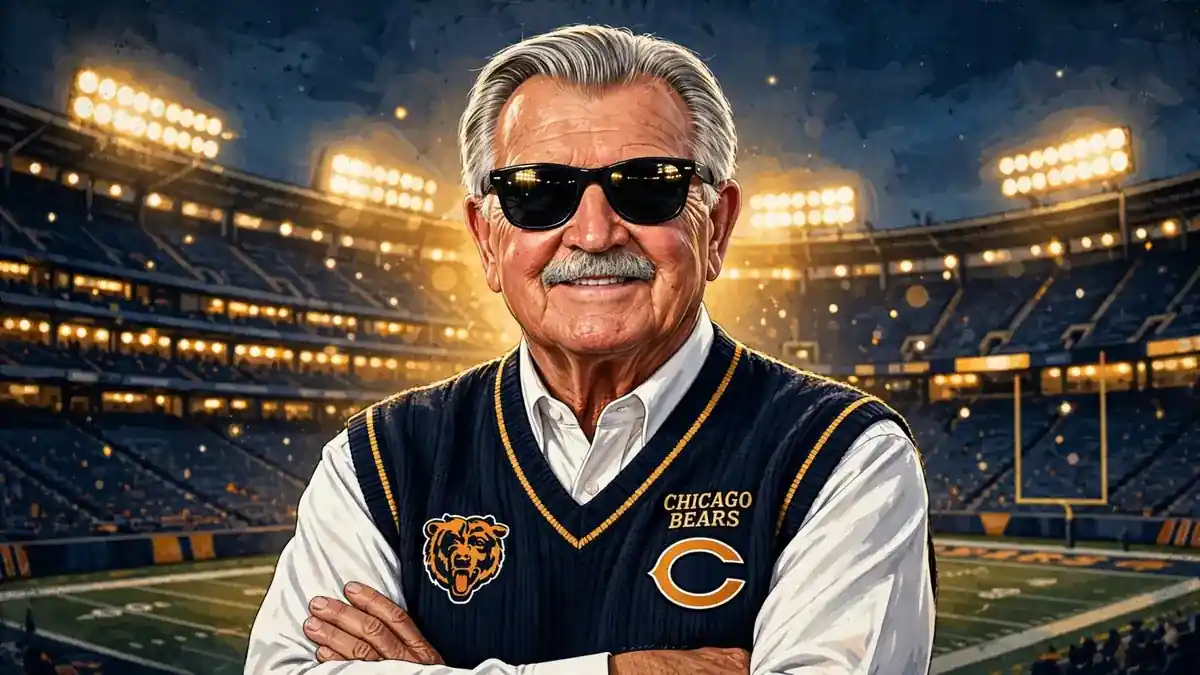
The 1985 Bears made him a national figure. That team went 15-1, beat New England 46-10 in Super Bowl XX, and recorded “The Super Bowl Shuffle,” a rap single by the players that reached the charts and turned a football team into a pop-culture event. Ditka was the face of it: the mustache, the dark sunglasses, the sweater vest, the sideline temper. A year earlier, Joe Montana’s 49ers had ended Chicago’s 1984 run in the NFC championship game; in 1985 nobody stopped the Bears. Jerry Rice’s 49ers ended Ditka’s 1988 season in the divisional round, a reminder that the decade’s other dynasty kept crossing his path.
Saturday Night Live finished the job of turning a coach into a folk hero. The “Bill Swerski’s Superfans” sketches, with their chanting of “Da Bears” and “Ditka,” made his name a punchline Chicago was proud to own. Ditka leaned into it rather than fighting it, and that decision — to be a character as well as a coach — is what made his name worth licensing for the next thirty years. Fame, for Ditka, was not a byproduct of the money. It was the asset that produced it.
Main Sources of Income
Ditka’s money came in four distinct waves, and the order matters. First, playing salaries — real money for the 1960s, small by any modern measure. Second, coaching salaries, which climbed from $100,000 a year in Chicago to roughly $1.8 million to $2 million a year in New Orleans. Third, broadcasting, where a one-year NBC deal in 1993 paid $550,000 and two decades of network work followed. Fourth, and largest over time, the business of being Ditka: restaurants, resorts, wine, cigars, sausages, endorsements and speaking fees, all monetizing a name that Chicago and the NFL had spent thirty years building.
The shape of that fortune is unusual for a sports figure. Most athletes earn the bulk of their money while playing; Ditka earned the bulk of his after he stopped. His playing career paid him, by one retrospective estimate, around $1.2 million in total across 12 seasons — a figure that looks thin beside a single year of his Saints contract. The coaching and broadcasting years multiplied it, and the licensing years compounded it. That is why the $30 million figure only makes sense as a lifetime accumulation, not as a salary story, and why the low-end $20 million estimates from a few years ago look dated beside the October 2026 reporting.
Speaking engagements and appearances filled the gaps between the big deals. Ditka was a sought-after motivational speaker for corporate audiences for decades, and his booking profile listed brand partnerships with Camacho Cigars, Terlato Wines and Vienna Beef alongside his broadcasting work. He also co-authored books, including his autobiography, and licensed his name to a video game, “Mike Ditka Ultimate Football.” None of these deals was individually huge. Stacked across thirty years, they were the difference between a comfortable retirement and a $30 million estate.

Salary and Earnings
The contract ledger below is the clearest picture of how Ditka’s earnings grew — and how modest the early numbers were. His rookie deal in 1961 paid $12,000 with a $6,000 signing bonus. For scale, the highest-paid player in the league in 1964, Cleveland’s Jim Brown, earned $50,000; the average NFL salary in 1969 was about $25,000, and by the early 1970s it had reached roughly $36,000. Ditka played in an era when stars took offseason jobs, and his own numbers show it.
| Year | Deal | Figure |
|---|---|---|
| 1961 | Chicago Bears rookie contract (5th overall pick) | $12,000 + $6,000 signing bonus |
| 1967 | Houston Oilers, three years (traded to Philadelphia Eagles) | $300,000 + $50,000 signing bonus |
| 1982 | Chicago Bears head coach, three years | $100,000 per year — lowest-paid head coach in the NFL |
| Mid-1980s | Chicago Bears contract extension | $250,000 base salary |
| 1993 | NBC television analyst, one year plus option year | $550,000 (reported by the Los Angeles Times) |
| 1997 | New Orleans Saints head coach, three years | $5.5 million to $6 million |
Two things stand out in that ledger. The first is the jump: his Saints deal paid roughly 18 times his first Bears coaching salary per year, and the $300,000 Oilers contract of 1967 was nearly 17 times his rookie deal. The second is how late the real money arrived — Ditka was 57 when he signed the Saints contract, 35 years after his first NFL paycheck. The broadcasting money sat in between: the NBC deal alone paid more in one year than his entire first Bears coaching contract, and his ESPN years that followed kept a steady television income running into his seventies.
His coaching record also carried a financial logic of its own. The 106 regular-season wins in Chicago made him the franchise’s second-winningest coach, and winning coaches get second contracts; the $250,000 extension after the Super Bowl was the market catching up to the results. The Saints paid for the name as much as the record — $5.5 million to $6 million for a coach coming off a broadcasting stint was a bet on the Ditka brand, and it was the biggest single payday of his career. The 15-33 record that followed is why no team made a similar bet again.
Businesses and Investments
Ditka opened his first restaurant in Chicago’s Gold Coast neighborhood in 1997, and the Ditka’s steakhouse chain became the anchor of his business life. The original Chicago location operated for 23 years before closing permanently in May 2020; the Ditka Restaurant Group also ran locations in Oakbrook Terrace, Illinois, and Pittsburgh, Pennsylvania, along with Grill 89 in Westmont, Illinois. Ditka was a business partner in the group, and his name and football legacy were the center of its identity — the restaurants sold the coach as much as the steak.
The licensing deals that followed were the purest form of that model: his name on other people’s products. In 2007 he formed Mike Ditka Resorts near Orlando with X Management and Geneva Hospitality. In 2012 he teamed with Terlato Wines on Mike Ditka Wines, a California collection that launched with eight labels tied to his career — “The Player,” “The Coach,” “The Hall of Famer” and “The Restaurateur” among them — born from a 20-year friendship with Bill Terlato. The same year he partnered with Camacho Cigars on “The Mike Ditka Kickoff Series” of cigars, and in 2013 he and Vienna Beef launched Ditka Sausages: eight inches long, one-third of a pound, in “Hot Beef Polish Sausage” and “Chicken Sausage with Mozzarella and Sun-Dried Tomatoes.” The financial terms of these licensing deals were never disclosed, which is exactly why his net worth is an estimate rather than a counted sum.
His sports investments were a mixed record, and the honest version includes the misses. He co-owned the Chicago Rush of the Arena Football League, invested in the Elite Football League of India in 2011, and in 2020 became owner and chairman of the X League, the women’s tackle football venture formerly known as the Lingerie Football League. The X League role came with a title and an ownership stake whose size was never publicly disclosed. None of these ventures produced the kind of documented windfall that a restaurant chain or a television contract did, but they kept the Ditka name in the sports business for another decade — and name recognition was the product that paid.
Brand Deals and Sponsorships
Ditka’s endorsement career ran on the same fuel as his restaurants: a persona America already knew. He did commercials for McDonald’s and Overstock.com, appeared as himself on television shows including “Cheers,” and played himself in the 2005 Will Ferrell comedy “Kicking & Screaming.” His booking agency profile listed brand partnerships with Camacho Cigars, Terlato Wines and Vienna Beef, and he worked the corporate speaking circuit for years, telling steel-town and Super Bowl stories to audiences that had grown up watching him.
The most valuable endorsement he ever received cost his sponsors nothing: Saturday Night Live’s Superfans sketches. The “Da Bears” and “Ditka” chants turned his name into a catchphrase, and Ditka was smart enough to treat the joke as an asset rather than an insult. Every parody kept his name in circulation between coaching jobs and between television contracts, which is precisely what made the wine labels and the sausage deals possible in his seventies. Coaches who win one Super Bowl are remembered by their team’s fans; Ditka was remembered by people who had never watched a down of football.
Later coaches who built personal brands — the kind of sideline figure who becomes a commercial property — followed a path Ditka helped cut, though his paydays stayed modest beside theirs. Where a modern head coach’s name can command eight-figure endorsement portfolios, Ditka’s deals were steady, mid-sized licensing arrangements stacked over decades. The comparison that matters is not with today’s coaches but with his own era: no other coach of the 1980s turned a sideline persona into a restaurant chain, a wine label, a cigar line and a sausage brand. Bill Belichick’s coaching fortune was built on wins and longevity; Ditka’s was built on wins plus a name people wanted on a bottle.

Houses, Cars and Other Assets
Ditka’s property record is unusually well documented, thanks to the property reporting that followed his death. In 2000 he and his wife Diana paid $700,000 for a two-bedroom, 1,904-square-foot condominium on the 39th floor of a high-rise in Chicago’s Streeterville neighborhood. In November 2024, after returning to Chicago from Florida, the couple paid $575,000 for a larger condominium on the 30th floor of the same building. The couple also owned a custom-built home in the Wilshire Lakes community of North Naples, Florida: they bought the land for $70,000 in 2002, built a 3,436-square-foot residence on it, and listed the property for $1.375 million in December 2024. Earlier homes included Bannockburn, Illinois, and the English Turn neighborhood of New Orleans during his Saints years.
The Naples numbers tell the quieter half of the wealth story. Land bought for $70,000 in 2002 and a house listed at $1.375 million in 2024 is the kind of long, boring appreciation that does more for a net worth than any single contract — and it is also the kind of figure that explains why the $30 million estimate holds up even though his playing salaries were small. Property records, not press releases, are the hardest evidence in this article, and they point to a man who bought real estate early, held it for decades, and sold into a strong market.
On cars, the public record is silent, and this article will not invent a collection. No credible reporting documents a garage of exotic vehicles, and Ditka was never photographed or profiled as a car collector. His visible assets were property and business equity — the restaurants, the licensing deals, the resorts stake, the Chicago and Naples homes — rather than a showroom. That absence is itself informative: the fortune was built on a name and on land, not on depreciating toys.
Awards and Achievements
Ditka’s trophy record is the reason the brand existed at all, and it is worth listing straight. As a player: UPI NFL Rookie of the Year in 1961, five Pro Bowl selections, repeated All-Pro honors, the 1963 NFL championship with Chicago, and Super Bowl VI with Dallas. As an assistant coach: Super Bowl XII with the Cowboys. As a head coach: Super Bowl XX with the 1985 Bears, five division titles, and AP and UPI NFL Coach of the Year in both 1985 and 1988. He was inducted into the College Football Hall of Fame in 1986 and the Pro Football Hall of Fame in 1988 — the first tight end ever inducted — and was named to the NFL’s 75th- and 100th-Anniversary All-Time Teams.
Two records carry weight beyond the medals. His 106 regular-season wins in Chicago remain second in Bears history behind only George Halas, the franchise’s founder. And his three Super Bowl victories in three different roles — player, assistant, head coach — put him in company with exactly one other person in league history, Tom Flores. The 1985 team he coached is still argued, forty years on, as the most dominant single-season team the league has seen: 15-1, a 46-10 Super Bowl win, and a defense that allowed 10 points in three playoff games. That season is the foundation under everything else in this article, including the $30 million.
Net Worth Growth Over the Years
The growth of Ditka’s fortune tracks the four waves of his income, and the table below uses only figures that trace to named reporting. Early entries are contract values rather than net worth — nobody estimated his wealth in 1961 — and the later entries are the published estimates that the October 2026 obituaries consolidated.
| Year | Milestone | Figure |
|---|---|---|
| 1961 | First NFL contract and signing bonus | $18,000 combined |
| 1967 | Houston Oilers contract (three years) | $300,000 |
| 1982 | First Bears head-coaching salary | $100,000 per year |
| 1997 | New Orleans Saints head-coaching deal | $5.5 million to $6 million |
| 2018 | Published net worth estimate | About $30 million |
| October 2026 | Net worth at death (Celebrity Net Worth; Men’s Journal) | $30 million |
Read the table as a story of compounding rather than a single windfall. The playing years built a reputation. The coaching years built a salary base. The broadcasting years kept income flowing while the restaurant and licensing businesses matured. The property — bought in 2000 and 2002, sold or re-bought in 2024 — appreciated quietly in the background. The $30 million figure had already appeared in published estimates by 2018, and the October 2026 reporting did not revise it upward; the obituaries simply confirmed it. That stability is worth noting: unlike many celebrity fortunes, Ditka’s estimate did not swing wildly from year to year, because it rested on contracts and property rather than on a stock portfolio or a startup valuation.
One caution belongs here. A handful of sites still carry a $7 million figure for Ditka, and a few older pages say $20 million. The $7 million number comes from a 2024 profile that predates the October 2026 reporting and contradicts every newer estimate; we treat it as stale, not as a competing estimate. The $20 million figure is the low end of the honest range — it appears in older profiles and in at least one October 2026 roundup that acknowledged estimates running from $20 million to $50 million. We anchor at $30 million because Celebrity Net Worth, Men’s Journal, The Spun and TheRichest all land there, and the $50 million top end has no named source behind it.
Social Media Presence
Mike Ditka had no meaningful personal social media presence, and that is part of the story rather than a gap in it. His fame was built in the broadcast era — network television, newspaper columns, the SNL sketches — and he never became a poster, a streamer or an influencer. There were no verified personal accounts driving his brand in his later years; his name circulated through the Chicago Bears’ and the NFL’s accounts, through ESPN segments, and through the restaurant and product brands that carried it.
His death was announced the same way his career had been covered: through other people. His family released its statement through Jarrett Payton, the son of Walter Payton, who shared it live on his Chicago radio show, and the tributes that followed came from the Bears, the Pro Football Hall of Fame, the NFL and former players. The absence of a personal feed meant there was no final post to quote — only the family’s words, “the heart of our family,” and a league-wide outpouring that needed no hashtag to find its audience.
Personal Life
Ditka married his first wife, Marge Dougherty, in 1961. They had four children — Mark, Matt, Mike III and Megan — and divorced in 1973. In 1977 he married Diana Trantham, who remained his wife for the rest of his life; they were married 49 years. The couple lived in Bannockburn, Illinois, in the English Turn neighborhood of New Orleans during his Saints years, and in Naples, Florida, before moving back to Chicago in late 2024. He is survived by Diana and by all four of his children.
His health was public knowledge for decades. He suffered a heart attack in 1988 while coaching the Bears, a minor stroke in 2012, and further heart trouble and hip surgeries in his later years. His longtime agent and business partner, Steve Mandell, told USA Today that Ditka died of natural causes; the family’s announcement itself did not state a cause. Ditka was open about his Catholic faith — an altar boy at St. Titus, a member of the Knights of Columbus — and the National Catholic Reporter noted that faith was not incidental to his upbringing but central to it.
Off the field he put real effort into retired players. He co-founded the Gridiron Greats Assistance Fund, which provides financial grants and medical help to former players in need, and he testified before Congress on behalf of retired players’ health care. He also supported Chicago charities including Misericordia Heart of Mercy, Maryville Academy and Little City. The advocacy was not a side note to the fortune; it was the other half of the same reputation. The man who would not back down on a sideline spent his seventies arguing that the league owed its old players more than applause.
Sources & Reporting
Celebrity Net Worth — the $30 million net worth figure at the time of his death in October 2026; the contract ledger (rookie deal, Oilers contract, Bears and Saints salaries); the restaurant history; and the Streeterville and Naples property records with exact purchase and listing prices. Reporting window: updated October 2026.
Men’s Journal — “Mike Ditka Net Worth: Bears Legend’s Fortune at His Death,” October 9, 2026: the $30 million estimate, the business list (restaurants, wine, cigars), and the family and marriage details.
The Spun — October 9, 2026 net worth report: the $30 million figure and the same business breakdown, published the day of his death.
Pro Football Hall of Fame — career record, Hall of Fame induction in 1988, and the October 9, 2026 death announcement.
Chicago Bears — official obituary, October 12, 2026: career summary, the 1985 season, the restaurant and product businesses, charity work, and the tribute decal and jersey patch for the rest of the 2026 season.
PlayersBio — the detailed salary history: the $12,000 rookie contract and $6,000 bonus, the $300,000 Oilers deal, the $100,000 Bears coaching contract and $250,000 extension, the $550,000 NBC contract reported by the Los Angeles Times, and the $5.5 million to $6 million Saints deal.
TheRichest — the $30 million estimate and the 1982–1983 coaching salary of $100,000.
USA Today — agent Steve Mandell’s statement that Ditka died of natural causes, as reported in the October 2026 obituary coverage.
National Catholic Reporter — October 10, 2026 obituary: the family announcement, his survivors, and his Catholic faith.
Wikipedia — cross-checks on dates, career statistics (427 receptions, 5,812 yards, 43 touchdowns), the 1961 draft position, and the business timeline (Terlato Wines, Camacho cigars, Vienna Beef sausages, X League). Used only to confirm facts reported elsewhere.
Reporting window: career reporting 1961–2026, with the net worth figure and death details drawn from October 2026 coverage. Figures are estimates built from public reporting; no estate filing or audited statement has been published.
Frequently Asked Questions
What was Mike Ditka’s net worth when he died?
Mike Ditka’s net worth was estimated at $30 million at the time of his death on October 9, 2026, according to Celebrity Net Worth, with Men’s Journal and The Spun reporting the same figure that day. Older estimates ran closer to $20 million, so we publish a $20 million to $30 million range anchored at $30 million. No estate filing has been published, so the figure remains an estimate.
How did Mike Ditka die?
Mike Ditka died on Friday, October 9, 2026, in Chicago, at the age of 86. His family announced his death through Jarrett Payton, son of Walter Payton, describing Ditka as “the heart of our family.” The family’s statement did not give a cause of death; his longtime agent and business partner, Steve Mandell, told USA Today that he died of natural causes. He had suffered heart attacks in 1988 and later years, a minor stroke in 2012, and hip surgeries.
How old was Mike Ditka when he died?
Mike Ditka was 86 when he died on October 9, 2026 — nine days short of his 87th birthday. He was born Michael Keller Dyczko on October 18, 1939, in Carnegie, Pennsylvania.
Who was Mike Ditka’s wife?
Mike Ditka’s wife was Diana Trantham Ditka, whom he married in 1977; they were married for 49 years until his death. He was previously married to Marge Dougherty from 1961 to 1973, and they had four children together: Mark, Matt, Mike III and Megan. He is survived by Diana and all four children.
How much did Mike Ditka make as a coach?
Ditka’s first head-coaching contract with the Chicago Bears in 1982 paid $100,000 a year over three years, making him the lowest-paid head coach in the NFL at the time; a later extension raised his base salary to $250,000. His biggest coaching payday came with the New Orleans Saints in 1997: a three-year deal worth $5.5 million to $6 million, roughly $1.8 million to $2 million a year.
What teams did Mike Ditka play for and coach?
As a player, Ditka spent 1961–1966 with the Chicago Bears, 1967–1968 with the Philadelphia Eagles, and 1969–1972 with the Dallas Cowboys, winning the 1963 NFL championship with Chicago and Super Bowl VI with Dallas. As a coach, he was a Dallas assistant from 1973 to 1981, head coach of the Chicago Bears from 1982 to 1992 — winning Super Bowl XX — and head coach of the New Orleans Saints from 1997 to 1999.
What businesses did Mike Ditka own?
Ditka’s main business was the Ditka’s steakhouse chain, starting with the Gold Coast location in Chicago in 1997, plus restaurants in Oakbrook Terrace and Pittsburgh and Grill 89 in Westmont. He also formed Mike Ditka Resorts near Orlando in 2007, partnered with Terlato Wines on Mike Ditka Wines in 2012, launched a cigar line with Camacho Cigars the same year, created Ditka Sausages with Vienna Beef in 2013, co-owned the Chicago Rush arena football team, and became owner and chairman of the X League women’s tackle football league in 2020.
Was Mike Ditka in the Hall of Fame?
Yes. Mike Ditka was inducted into the College Football Hall of Fame in 1986 and the Pro Football Hall of Fame in 1988, becoming the first tight end ever inducted into the Pro Football Hall of Fame. He was also named to the NFL’s 75th- and 100th-Anniversary All-Time Teams, and with Tom Flores he is one of only two people to win an NFL title as a player, an assistant coach and a head coach.
Final Thoughts
Mike Ditka’s $30 million fortune is the least flashy $30 million in sports. There was no single windfall, no franchise sale, no venture-capital exit — just a steel-town kid who turned a $12,000 rookie contract into a lifetime of escalating bets on his own name. The playing years paid little. The coaching years paid well. The broadcasting years paid steadily. And the name — “Iron Mike,” “Da Coach,” the mustache and the sweater vest — paid for thirty years after the whistle, on restaurant menus and wine labels and cigar boxes across Chicago.
The number itself deserves the range we publish. No estate filing has been made public, and the gap between the $20 million older estimates and the $30 million figure in the October 2026 obituaries is a reminder that every celebrity net worth is a reasoned estimate, not a bank statement. What is not in doubt is the shape of it: a fortune built after football, not during it, by a man who understood that fame is an asset only if you put it to work. The 1985 Bears gave him the fame. The restaurants, the licensing deals and the property gave him the money. Chicago gave him the rest — a city that still chants his name, and a team that wore his memory on its helmets for the remainder of the 2026 season.
Published on November 15, 2026. Last reviewed November 2026. Found an error? See our corrections policy.