
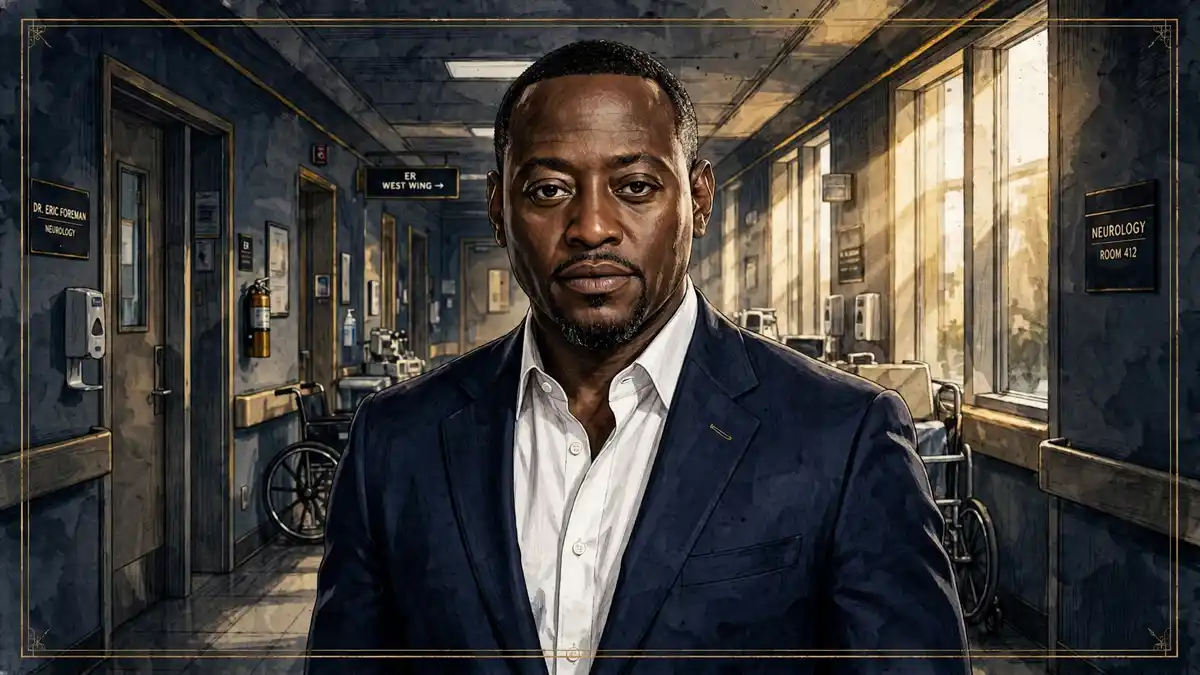
Omar Epps‘s net worth is estimated at $10 million–$15 million as of November 2026. Omar Epps built that fortune across more than three decades in film and television — eight seasons as Dr. Eric Foreman on House, where his pay climbed from $100,000 to $175,000 an episode, a film run that started opposite Tupac Shakur in Juice and peaked with Love & Basketball, and a Sherman Oaks home bought for $430,000 in 2001 and sold for $3.995 million in February 2025.
Omar Epps: Quick Facts
| Estimated net worth | $12 million (range: $10 million–$15 million) |
|---|---|
| Profession | Actor, rapper, producer, author |
| Nationality | American |
| Born | July 20, 1973 (age 53) |
| Height | 5 ft 10½ in (1.79 m) |
| Primary income sources | Television salaries, film roles, residuals and syndication, books, music, producing |
| Active years | 1988–present |
| Last reviewed | November 2026 |
- Early Life and Background
- Education
- Career Journey
- Rise to Fame
- Main Sources of Income
- Salary and Earnings
- Businesses and Investments
- Brand Deals and Sponsorships
- Houses, Cars and Other Assets
- Awards and Achievements
- Net Worth Growth Over the Years
- Social Media Presence
- Personal Life
- Sources & Reporting
- Frequently Asked Questions
Early Life and Background
Omar Hashim Epps was born on July 20, 1973, in Brooklyn, New York, and raised by his mother, Bonnie Maria Epps, an elementary school principal, after his parents divorced when he was a small child. The family moved between Brooklyn neighborhoods — Bedford-Stuyvesant, East New York, and East Flatbush — and money was tight enough that the moves themselves became part of the story Epps later told in his 2018 memoir, From Fatherless to Fatherhood. He started writing poetry and songs in elementary school, a habit that never left him: the kid writing verses in Brooklyn became the teenager in a rap group, the actor who co-produced a sitcom theme song, and the adult who published novels.
Brooklyn in the 1980s shaped the performer Epps became. He grew up a few subway stops from the street life that would fill his first film roles, and he has talked in interviews about watching the neighborhood’s hustlers and ballplayers the way other kids watched television — as case studies in ambition, risk, and consequence. That eye for detail showed up early on screen. His first characters were not generic tough kids; they were specific young men caught between talent and trouble, and casting directors kept hiring him for that exact tension.
One long-running piece of internet confusion deserves a straight answer here: Epps is not the brother of comedian Mike Epps, and he denied the rumor in a 2018 interview. The two share a surname and a lane in Black Hollywood, which is enough for the mix-up to survive online, but they are not related as brothers. Some gossip pages still describe them as cousins; the reliable reporting is that Omar himself has pushed back on the family connection, and no credible outlet has documented a blood relationship.
Epps also spent his teens performing as a backup dancer for Queen Latifah and rapping with a group called Wolfpack, which he co-founded in 1991. The music work paid little at the time, but it taught him stage presence and put him in rooms with people who made records and films. By the time he was 18, he had a foot in two industries at once — a position that later let him earn from acting, music, and writing instead of depending on any single paycheck.
Education
Epps attended the Fiorello H. LaGuardia High School of Music & Art and Performing Arts in Manhattan, the public arts school whose alumni run through American film, music, and theater. LaGuardia gave him formal training in performance at the same time his street-level education in Brooklyn was teaching him the characters he would play. He has described the school as the place where acting stopped being a hobby and became a craft he could study — voice, movement, scene work — rather than raw instinct alone.
He did not go on to a university drama program. Instead, his first feature film arrived while he was still a teenager, and the working set became his classroom. That choice carried a cost early on: without a college network, he had to build industry relationships job by job. It also carried a benefit that shows up in his earnings record — he started collecting professional paychecks at 18, a full four years before a college-trained peer would have entered the market, and he has worked without a long break since 1988.
The education thread that matters most to his later income is the writing. Epps kept writing through his acting career — first songs, then a memoir, then fiction — and by 2022 he was a published novelist with a series he hopes to carry into film and television. That is a second career built on the same discipline LaGuardia drilled into him: show up, revise, finish the work.
Career Journey
Epps began acting professionally in the late 1980s, and his feature debut came in 1992 with Juice, Ernest Dickerson’s crime drama starring Tupac Shakur. Epps played Q, a DJ pulled toward a robbery that goes wrong, and the film’s raw energy made him an instant name in Black cinema. He was 18, acting opposite one of the defining rappers of the era, and the performance set the template for the next decade: young, gifted, and one bad decision from ruin.
The 1990s film run came fast. The Program (1993) put him on a college football field beside James Caan. Major League II (1994) handed him the Willie Mays Hayes role originated by Wesley Snipes. John Singleton’s Higher Learning (1995) cast him as Malik Williams, a track star navigating race and politics on a college campus — a part that asked more of him than the athlete roles before it and proved he could carry a serious drama. Scream 2 (1997) gave him a seat in a blockbuster franchise, and the HBO film First Time Felon (1997) won him a best-actor prize at the Monte Carlo Television Festival for playing a small-time criminal working through Chicago’s boot-camp system.
Television found him in 1996, when he joined NBC’s ER as Dr. Dennis Gant, a surgical intern. The run lasted only a season — Gant’s storyline ended in a train accident that remains one of the show’s bleakest turns — but it mattered for two reasons. First, it proved Epps could hold a role on the biggest drama on American television. Second, it introduced the medical-drama lane he would later own. He was playing a doctor eight years before House made him famous for it.
The late 1990s kept the film work coming: The Wood (1999) with Taye Diggs and Richard T. Jones, a coming-of-age story that has aged into a cult favorite; In Too Deep (1999) opposite LL Cool J and Stanley Tucci; and The Mod Squad (1999), a box-office disappointment that dented his momentum. The bounce-back arrived in 2000 with Love & Basketball, Gina Prince-Bythewood’s romantic sports drama. Epps played Quincy McCall, an NBA hopeful, opposite Sanaa Lathan’s Monica, and the film earned strong reviews, solid box office, and a shelf of award nominations for both leads. It remains the film most fans name first when they talk about him.
The 2000s mixed supporting film parts — Dracula 2000, Big Trouble, Conviction, Brother, Alfie (2004) with Jude Law, and Against the Ropes (2004) opposite Meg Ryan — with the television role that changed his finances. In late 2004 he joined Fox’s House as Dr. Eric Foreman, the neurologist who stood up to Hugh Laurie’s Dr. Gregory House week after week. The show ran eight seasons, through 2012, and turned a working actor into a household face in more than 60 countries.
After House, Epps kept a steady television pace rather than chasing a single next hit. He played J. Martin Bellamy in ABC’s Resurrection (2014–2015), Isaac Johnson in Shooter (2016–2018) alongside Ryan Phillippe, and Darnell Hodges in a recurring guest run on season four of This Is Us. He starred in Netflix’s psychological thriller Fatal Affair in July 2020, returned to the Best Man franchise as Lance Sullivan in the Peacock limited series The Best Man: The Final Chapters (2022), and joined Starz’s Power Book III: Raising Kanan — part of the Power universe built by 50 Cent — in 2022 as Detective Malcolm Howard, a conflicted NYPD officer with deep ties to the Thomas family. In 2024 he appeared in Lee Daniels’s Netflix horror film The Deliverance as Melvin, keeping his film work alive alongside the television roles.
The through-line across 35-plus years is durability. Epps never had a single payday that made him rich; he had three decades of paychecks that never stopped. That is the shape of his net worth — a long career of solid television salaries, film fees, and residuals, topped up by a property sale and a growing sideline as an author.
Rise to Fame
Epps’s rise happened in two waves. The first wave was film: Juice in 1992 made him a face, and Love & Basketball in 2000 made him a romantic lead with staying power. The second wave was television, and it was bigger. House premiered in November 2004, and by its second season it was one of the most-watched dramas in the world, peaking at more than 80 million viewers across 66 countries. Foreman was the show’s moral counterweight — the brilliant, ambitious neurologist who challenged House’s methods while learning from them — and Epps played him for 174 episodes.
The role changed his pay scale in a way film never had. Movie fees for a supporting actor in the 1990s were one-off sums; a series-regular contract on a hit network drama paid every week for eight years, with raises built in and residuals that keep arriving long after the finale. Epps’s salary story on House is the clearest single window into his wealth: $100,000 an episode in season five, a $75,000 raise that took him to $175,000 an episode, and then a pay cut in the final season — undisclosed in size — that he accepted to stay with the show to its finale while co-star Lisa Edelstein walked away. Staying cost him short-term money and bought him eight full seasons of credits, syndication, and visibility.
Awards followed the visibility. He won the NAACP Image Award for Outstanding Supporting Actor in a Drama Series for House in 2007, 2008, and 2013, and Celebrity Net Worth credits him with nine NAACP Image Awards in total across his career, plus a Screen Actors Guild Award. The Image Awards matter beyond the trophy shelf: they kept him visible to Black audiences and to the casting directors who hire for Black-led projects, which is where much of his post-House work — Raising Kanan, The Best Man: The Final Chapters, The Deliverance — has come from.
The other half of his fame is the Love & Basketball afterlife. The film’s reputation has grown steadily since 2000, helped by anniversary screenings, a Criterion Collection release, and a generation of viewers who found it on streaming. Epps and Lathan were nominated for Teen Choice and MTV Movie Awards for the film, and the chemistry between them is still cited whenever the movie is discussed. A film that keeps finding new viewers is a film that keeps its stars relevant — and relevance is what keeps the next television offer coming.
Main Sources of Income
Television salaries are the spine of Epps’s fortune. House alone paid him for eight seasons as a series regular, and the per-episode figures — $100,000 in season five, $175,000 after his raise — translate into several million dollars across the run even after the final-season pay cut. His later series-regular and recurring work — Resurrection, Shooter, Raising Kanan — added further seasons of television pay at rates that, while never publicly disclosed, sit well above the film fees of his early career. A working television actor with his credits commands high-six-figure to low-seven-figure sums per season; stacked across a decade of post-House work, that is the largest single block of his earnings.
Film fees form the second block. Epps has more than 30 film credits, from Juice through Almost Christmas (2016), which grossed $42.49 million worldwide according to TheRichest’s box-office records, and Traffik (2018), which took $9.56 million worldwide. Lead and prominent supporting roles in studio films pay in the mid-six to low-seven figures per picture for an actor at his level; his 1990s and 2000s film run, taken together, added several million dollars before television took over as his main earner.
Residuals and syndication are the quiet third block, and the one most net-worth pages undercount. House has aired in syndication and on streaming platforms continuously since 2012, and SAG-AFTRA residuals pay the cast each time episodes re-air or stream. Some low-quality estimates put House residuals alone at $1–2 million a year for Epps; that figure is not verified by any named source, so we do not publish it as fact — but the mechanism is real, and over 14 years of re-runs it adds up to a meaningful sum. The same applies in smaller measure to ER, Love & Basketball replays, and his other catalog titles.
Books are a newer, smaller block with real upside. His memoir From Fatherless to Fatherhood (2018) sold on the strength of his name and story; the young-adult Afrofuturist novel Nubia: The Awakening (2022), co-written with Clarence A. Haynes, launched a series with a sequel, Nubia: The Reckoning (2023), and a planned third book. Epps has said he created the Nubia universe with film and television in mind, which means the books are also an intellectual-property play: if the series is ever adapted, the rights are worth far more than the royalties alone.
Music brings in a modest fifth stream. He released the hip-hop album Omar Epps Presents… The Get Back in 2004 under the BKNYC label, co-produced the theme song for The Wayans Bros., the sitcom starring Damon Wayans and Shawn Wayans, and appeared as a playable character in the 2004 video game Def Jam: Fight for NY. None of these made him rich on its own. Together they show a pattern: Epps has always kept more than one income line open, so a slow year in film still left him with television, music, or writing money coming in.
Producing rounds out the picture. His production company, BrooklynWorks Films, has been attached to projects across genres, and producing credits carry fees and, on the right project, backend participation. Public records do not break out what BrooklynWorks has earned, so we count it as a real but unquantified stream rather than inventing a number for it.

Salary and Earnings
The best-documented pay in Epps’s career is House, and the numbers tell a story most summaries flatten. Celebrity Net Worth puts his House salary at $100,000 per episode. TheRichest and Startefacts add the detail that changes the math: in season five he was earning $100,000 an episode, his character’s rising popularity won him a $75,000 raise to $175,000 an episode, and he then took a pay cut in the final season — the size of which was never disclosed — to stay through the finale. That arc means his peak-season earnings were far higher than the flat $100,000 figure suggests. At $175,000 an episode across a 22- to 24-episode season, a single season paid roughly $3.9–4.2 million before tax, agent, and manager fees.
His co-stars’ pay puts his own in context. TheRichest’s cast salary ranking lists Hugh Laurie at a peak of $700,000 per episode, Lisa Edelstein at $175,000 alongside Epps, and Olivia Wilde starting at $40,000 an episode. Epps sat in the show’s second pay tier — behind Laurie, level with Edelstein — which is exactly where a series regular who is not the title character lands on a hit network drama. The table below uses TheRichest’s published figures:
| House cast member | Reported per-episode pay |
|---|---|
| Hugh Laurie (Dr. House) | $700,000 at peak |
| Omar Epps (Dr. Foreman) | $175,000 after raise; $100,000 in season five |
| Lisa Edelstein (Dr. Cuddy) | $175,000 |
| Olivia Wilde (Thirteen) | $40,000 starting pay |
What did he earn on his other series? No outlet has published per-episode figures for ER, Resurrection, Shooter, or Raising Kanan, and we will not guess. What can be said is structural: a series regular on a cable drama in the late 2010s and early 2020s typically earned $50,000–$150,000 per episode depending on seniority and the show’s budget, and Epps — a veteran with a hit series on his résumé — would have been at the upper end of that band. His Raising Kanan role ran from 2022 through the show’s third season, when Detective Howard’s storyline reached its turning point, and the part was central enough to the show’s marketing that his fee would have reflected it.
Film pay is harder to pin down because studios rarely disclose supporting-actor fees. His lead role in Love & Basketball came when he was a rising name rather than a proven box-office draw, so the fee was likely in the mid-six figures; his later film work, including Almost Christmas and Traffik, would have paid comparable or better sums as his television fame grew. The honest summary: Epps’s career earnings are dominated by television, with film providing a steady second layer and residuals smoothing out the gaps between jobs.
Speaking work adds a visible extra line. All American Speakers lists Epps as an award-winning actor and producer available for speaking engagements, billing him on his House and Love & Basketball fame and his three NAACP Image Award wins for the show. Speaking fees for actors of his profile typically run into five figures per appearance; no fee is published, so we list the stream without inventing a rate.
Businesses and Investments
Epps’s most visible business is BrooklynWorks Films, his production company. The company has been involved in projects across genres, and it gives him a producer’s seat — and a producer’s fee — on work he helps develop, rather than limiting him to acting pay. Public filings and trade coverage do not disclose the company’s revenues, and no outlet has published a valuation, so the honest treatment is to name it as an active venture with unquantified returns. What it does tell us is intent: Epps has spent his career building the kind of ownership stake that turns a hired actor into a stakeholder.
The Nubia book series is his clearest investment in intellectual property. He and co-author Clarence A. Haynes built a full universe — a drowned African utopia, three teenagers with powers, a climate-ravaged New York — across Nubia: The Awakening (2022) and Nubia: The Reckoning (2023), with a third volume planned. EURweb reported that Epps hopes to expand the universe to film and television. A book series with screen ambitions is a long-dated asset: the royalties are modest now, but a single adaptation deal would pay more than the books ever will. Competitors that list Epps as “actor only” miss this entirely.
His music catalog is a smaller asset of the same kind. The 2004 album Omar Epps Presents… The Get Back, his Wolfpack-era recordings, and his songwriting credits — including the Wayans Bros. theme he co-produced — generate streaming and licensing income in small amounts. His appearance as a playable character in Def Jam: Fight for NY (2004) was a one-off licensing deal, but it shows how early he understood that a performer’s likeness itself is an asset.
What Epps does not appear to do, based on the public record, is splashy venture investing. There are no reported startup stakes, crypto holdings, restaurant chains, or fashion lines attached to his name, and no endorsement empire of the kind some of his peers built. That absence is itself informative: his wealth comes from work and property, not from a portfolio of side bets. It also means his net worth is less exposed to a single bad investment than a celebrity whose fortune rests on one company.
One more stream deserves a mention because it recurs in his public life: advocacy. Epps serves on the Cultural Council of RepresentUs, the nonprofit focused on anti-corruption and democracy reform, and in June 2020 he narrated an educational video for the group explaining the structure of America’s criminal justice system. Advocacy work is not a major income source — board and council roles at nonprofits are usually unpaid or lightly paid — but it keeps his public profile active between acting jobs, and an active profile is what keeps the acting offers coming.
Brand Deals and Sponsorships
Epps has never built his fortune on endorsements, and the record reflects that. Unlike actors who fronted sneaker lines or liquor brands, his public brand work is thin: a video-game likeness deal for Def Jam: Fight for NY, speaking engagements booked through All American Speakers, and appearances tied to his books and his RepresentUs advocacy. Search the trade press and you will find no long-running sneaker deal, no watch ambassadorship, no fashion capsule attached to his name.
That is a choice as much as a gap. Epps’s career has been built on acting credibility and longevity rather than on selling his image to advertisers, and the trade-off shows in his earnings mix: television and film dominate, endorsements barely register. For a net-worth estimate, the point is that there is no hidden endorsement fortune to add — and no endorsement income to lose if a brand deal ends. His wealth is steadier for it.
The closest thing to a modern brand play is the Nubia series itself. Books, convention appearances, and the planned screen expansion give him a brand he owns outright, rather than one he rents from a sponsor. If the series finds a screen home, the deal will look, in financial terms, a lot like an endorsement — a lump sum for the use of his name and story — except he keeps the underlying rights.

Houses, Cars and Other Assets
Real estate is the most concrete asset in Epps’s portfolio, because the numbers are on the public record. Celebrity Net Worth reports that he paid $430,000 in 2001 for a home in Sherman Oaks, a Los Angeles suburb in the San Fernando Valley, and sold that home in February 2025 for $3.995 million. That is a gain of roughly $3.57 million on a single property held for 24 years — a return of more than nine times the purchase price, driven by two decades of Los Angeles price growth rather than by any flip or renovation story. Few of his peers can point to a single documented asset gain of that size.
The picture has a second property in it, and the sources do not line up neatly. Money Inc reported that Epps and his wife sold a Woodland Hills home for just under $1 million and then bought a 5,434-square-foot Sherman Oaks home in 2006 for $2.2 million, with five and a half baths, a three-car garage, Brazilian cherry floors, a wrought-iron staircase, and a French limestone fireplace. Read alongside the Celebrity Net Worth account, that suggests the couple held more than one Los Angeles property across the 2000s and 2010s. We present both reports as reported, without merging them into a single house, because the public record does not let us reconcile the addresses or the timeline with certainty. What is certain is the direction: the family bought Los Angeles real estate early, held it through the market’s long climb, and cashed out a large gain in 2025.
Epps and his wife live in California with their children, and the family home is the asset that matters most to the estimate after his career earnings. A $3.995 million sale in 2025 is fresh money in the picture — it postdates most of the $8 million estimates still floating around online, which is one reason those older figures read low today.
Cars are the weakest-documented part of his asset list. No outlet has published a verified inventory of Epps’s vehicles, and car-enthusiast pages that claim specific models for him cite no sources. We will not repeat those claims. What can be said is that a household with his income and a three-car garage in Sherman Oaks plainly owned vehicles, and that cars — which lose value — are a footnote in his net worth, not a driver of it. The same applies to jewelry, watches, and other personal property: real, but small next to the house sale and the television money.
Put together, the asset side of the ledger is simple and strong: a long-held Los Angeles property sold at a large profit, a California home base, and a catalog of screen work that keeps paying residuals. There is no evidence of heavy debt, no reported bankruptcy, and no lawsuit or tax lien in the public record that would cut against the estimate.
Awards and Achievements
Epps’s trophy case is built on House. He won the NAACP Image Award for Outstanding Supporting Actor in a Drama Series in 2007, 2008, and 2013 for his work as Dr. Eric Foreman, and Celebrity Net Worth credits him with nine NAACP Image Awards in total across his career, alongside a Screen Actors Guild Award. The Image Awards are voted by the NAACP and carry weight inside Black Hollywood; three wins for a single role is a record of sustained respect from the audience that has followed him since Juice.
The film nominations came earlier. For Love & Basketball he was nominated for a Black Reel Award for Best Theatrical Actor, an MTV Movie Award for Best Male Performance, an NAACP Image Award for Outstanding Actor in a Motion Picture, and two Teen Choice Awards — Choice Film Actor and Choice Film Chemistry with Sanaa Lathan. None of those turned into wins, but the spread of nominations across critics’ groups, fan-voted awards, and industry bodies shows how widely the performance landed.
His first acting prize arrived in 1996, when he won best actor at the Monte Carlo Television Festival for Deadly Voyage, the true story of Kingsley Ofusu, the sole survivor of nine African stowaways aboard the cargo ship MC Ruby. It was an early sign that he could carry a dramatic film on his own — a sign the industry took a few more years to act on.
The achievement that sits outside the trophy case is the career itself: 35-plus years of continuous work from a teenage debut to a 2024 Netflix film, with no long fallow stretch. In an industry where most actors who debut at 18 are gone by 30, Epps was still a series regular at 50. Longevity is the achievement that pays the bills, and it is the one his net worth reflects most directly.
Net Worth Growth Over the Years
The published estimates for Epps disagree by millions, and the disagreement is the story. Different outlets use different methods, different update dates, and different assumptions about residuals and property — so the year-by-year table below tracks what outlets reported, not a bank balance. Read it as a record of the estimates, with the range narrowing as better data arrived.
| Year | Reported estimate | What changed |
|---|---|---|
| Early 2000s | Under $5 million | Film career plus early television; pre-House |
| 2012 | $5–8 million | House ends after eight seasons; residuals begin |
| 2020 | $8 million | Common figure in profiles of the period; Fatal Affair on Netflix |
| 2023 | $8–15 million | Estimates split: older profiles hold $8 million; newer ones move to $15 million |
| 2024 | $15 million | TheRichest and several 2024 profiles; Raising Kanan and The Deliverance in production |
| May 2025 | $10 million | Celebrity Net Worth update; Sherman Oaks sale ($3.995 million) closes in February 2025 |
| November 2026 | $10–15 million | Our estimate: the two most recent named figures, with the 2025 property sale factored in |
Two things stand out. First, the $8 million figure that still appears on many pages is old: it predates the 2025 house sale and the Raising Kanan run, and outlets that updated after 2024 moved up to $10 million or $15 million. Second, the spread between $10 million and $15 million is mostly a methods gap — Celebrity Net Worth is conservative on residuals and private holdings, while TheRichest credits more of his career earnings. Our $12 million midpoint is not a new measurement; it is the middle of the two most recent named estimates, and we show the range so readers can see the uncertainty instead of meeting a single number dressed up as fact.
What would move the number next? A Nubia screen adaptation, a new series-regular role, or another property sale would push it up. A long gap between roles would let it drift down as living costs draw on savings. The base is sturdy either way: eight seasons of a global hit, a catalog that still earns, and a property gain already banked.
Social Media Presence
Epps is active on Instagram under the handle @omarepps, where he posts a mix of career news, book promotion, family moments, and advocacy work for RepresentUs. His feed functions as a working actor’s noticeboard rather than an influencer operation: new roles, Nubia updates, and throwbacks to House and Love & Basketball do most of the work, with personal posts filling in the gaps. He also maintains a presence on X, where he comments on sports, culture, and criminal-justice reform.
Social media is a minor income line for him, not a business. He does not run the kind of sponsored-post operation that pays some celebrities six figures a year, and no outlet has published a per-post rate for him. The value of his accounts is indirect: they keep him visible to casting directors and to the audiences who stream his old work, which is what keeps the residuals and the new offers flowing. A verified account with a large following also protects his name from impersonators, a real problem for actors whose likeness is used to sell fake endorsements.
Personal Life
Epps has been married to Keisha Epps, née Spivey, since the mid-2000s. Keisha was a member of the R&B group Total, the Bad Boy Records trio behind 1990s hits, and the couple’s story goes back further than the wedding: they first dated in 1992, parted, and reconnected in 2003. The wedding date itself is a small reporting conflict — Celebrity Net Worth dates the marriage to 2005, while several biographical profiles put the private ceremony in 2006. Either way, they have been together for two decades, and the marriage is one of the steadier ones in Hollywood.
The couple have two children together: daughter K’mari Mae, born in July 2004, and son Amir, born in 2007. Epps also has an older daughter, Aiyanna Yasmine, from a previous relationship. The family lives in California. K’mari has followed her parents into music and songwriting, which gives the household a second generation of the same mix — performance and writing — that built her father’s career.
His memoir, From Fatherless to Fatherhood (2018), is the most personal document he has published. It traces his upbringing without a father present, the lessons he took from his mother, and his own approach to raising three children. The book is also the clearest statement of his values: family stability, honesty about where he came from, and a refusal to treat fame as a substitute for showing up at home. Those values show up in his public life too — he keeps his children largely out of the press, and his social media posts about family are occasional rather than constant.
Epps is trilingual, fluent in Spanish and French as well as English, a skill that rarely comes up in his roles but that he has mentioned in profiles. He is 5 ft 10½ in tall (1.79 m), and he has kept the athletic build that casting directors noticed in his early sports roles — the same build that made him believable as a college football player in The Program and a basketball hopeful in Love & Basketball.
Outside work, his most consistent public commitment is criminal-justice reform. His seat on the Cultural Council of RepresentUs and his 2020 narration of the group’s explainer video on the justice system are part of a longer pattern of speaking about the system that shaped the neighborhoods he grew up in. It is the one cause he returns to across interviews, and it connects directly to the stories — Juice, First Time Felon, Raising Kanan — that have defined his screen career.
Sources & Reporting
Every figure in this article traces to a named source, and where sources disagree we show the range. Celebrity Net Worth supplied the anchor estimate of $10 million (updated May 14, 2025), the $100,000-per-episode House salary, the Sherman Oaks purchase ($430,000 in 2001) and sale ($3.995 million, February 2025), the marriage to Keisha Epps, and the nine NAACP Image Awards plus Screen Actors Guild Award credits. TheRichest supplied the $15 million estimate, the $175,000-per-episode House figure and the cast salary ranking, and the box-office figures for Almost Christmas ($42.49 million) and Traffik ($9.56 million). Startefacts corroborated the season-five $100,000 salary, the $75,000 raise, and the undisclosed final-season pay cut. Wikipedia supplied the biographical spine — birth date, LaGuardia schooling, filmography, and the 2007, 2008, and 2013 Image Award wins for House. EURweb supplied the Nubia: The Reckoning sequel details and Epps’s plan to expand the series to film and television. Money Inc supplied the second-property account of the 2006 Sherman Oaks purchase. All American Speakers supplied the speaking-engagement listing. Reporting window: May 2025–November 2026, with the estimate reviewed in November 2026.
Frequently Asked Questions
What is Omar Epps’s net worth in 2026?
Omar Epps’s net worth is estimated at $10 million–$15 million as of November 2026, with a $12 million midpoint. Celebrity Net Worth lists $10 million (updated May 2025) and TheRichest lists $15 million. Older profiles still showing $8 million predate his February 2025 Sherman Oaks home sale and his Raising Kanan run.
How much did Omar Epps make per episode on House?
He earned $100,000 per episode in season five of House, then received a $75,000 raise that took him to $175,000 per episode. He took a pay cut of undisclosed size in the final season to stay with the show through its 2012 finale. At $175,000 an episode, a full 22- to 24-episode season paid roughly $3.9–4.2 million before tax and fees.
Who is Omar Epps’s wife?
Omar Epps is married to Keisha Epps, née Spivey, a singer who was a member of the R&B group Total. They first dated in 1992, reconnected in 2003, and married in the mid-2000s — Celebrity Net Worth dates the marriage to 2005, while several profiles put the ceremony in 2006. They have two children together, K’mari Mae and Amir.
How old is Omar Epps and how tall is he?
Omar Epps was born on July 20, 1973, in Brooklyn, New York, which makes him 53 years old as of November 2026. He is 5 ft 10½ in tall (1.79 m).
Is Omar Epps related to Mike Epps?
No — or at least, no credible reporting documents a family relationship, and Omar Epps denied the rumor that he is related to comedian Mike Epps in a 2018 interview. The two share a surname and a lane in Black Hollywood, which is why the mix-up survives online.
What are Omar Epps’s most famous movies and TV shows?
His best-known films are Juice (1992), Higher Learning (1995), The Wood (1999), and Love & Basketball (2000). On television he is best known as Dr. Eric Foreman on House (2004–2012), Dr. Dennis Gant on ER (1996–1997), Isaac Johnson on Shooter (2016–2018), and Detective Malcolm Howard on Power Book III: Raising Kanan (2022 onwards).
How many children does Omar Epps have?
Omar Epps has three children: daughter K’mari Mae (born July 2004) and son Amir (born 2007) with his wife Keisha, and an older daughter, Aiyanna Yasmine, from a previous relationship.
What is Omar Epps doing now in 2026?
His most recent screen work includes the Starz series Power Book III: Raising Kanan, where he played Detective Malcolm Howard, and the 2024 Netflix horror film The Deliverance. He is also continuing his Nubia young-adult book series with co-author Clarence A. Haynes, with a third volume planned and a screen adaptation as the stated goal.
Final Thoughts
Omar Epps’s $10 million–$15 million fortune is a study in staying power. He never landed a single franchise payday or a billionaire backer; he worked for 35 years, collected eight seasons of network-television pay, banked residuals from a show that still streams around the world, and turned a $430,000 house into a $3.995 million sale. The range in the estimate is honest — two serious outlets land $5 million apart — but the direction is not in doubt. A career that runs from Juice to House to Raising Kanan, with books and a production company on the side, is a career that pays for a long time after the cameras stop. If the Nubia series ever reaches a screen, the next update to this page may need a bigger number.
Published on 2026-11-15. Last reviewed November 2026. Found an error? See our corrections policy.