
Bill Wyman‘s net worth is estimated at $10 million–$80 million as of November 2026. Most outlets put the former Rolling Stones bassist at $80 million, while Celebrity Net Worth — the best-known tracker in this niche — lists him at $10 million, and one older profile went as high as $100 million. The gap says a lot about Wyman himself: he spent 31 years in the biggest rock band on earth, walked away in 1993 just before the stadium-tour money exploded, and then rebuilt his fortune quietly through books, a London restaurant, a record-breaking archive auction, and royalties that still arrive every time a Stones record plays. He turned 90 in October 2026, still recording, still writing, and still the richest former Stone never to sing lead.
Bill Wyman: Quick Facts
| Estimated net worth | $80 million (most-reported figure) (range: $10 million–$80 million) |
|---|---|
| Profession | Musician, songwriter, record producer, author, restaurateur |
| Nationality | English |
| Born | 24 October 1936 (age 90) |
| Height | 5 ft 6 in (1.68 m) |
| Primary income sources | Rolling Stones performance royalties, solo and Rhythm Kings recordings, book sales, Sticky Fingers restaurant, archive auctions, art and photography |
| Active years | 1960–present |
| Last reviewed | November 2026 |

- Early Life and Background
- Education
- Career Journey
- Rise to Fame
- Main Sources of Income
- Salary and Earnings
- Businesses and Investments
- Brand Deals and Sponsorships
- Houses, Cars and Other Assets
- Awards and Achievements
- Net Worth Growth Over the Years
- Social Media Presence
- Personal Life
- Sources & Reporting
- Frequently Asked Questions
Early Life and Background
Bill Wyman was born William George Perks Jr. on 24 October 1936 in Lewisham, south London, to William George Perks Sr. and Kathleen May Perks, known as Molly. The family lived in modest circumstances, and Wyman grew up in the shadow of the Second World War — an experience that shaped two habits he kept for life: he started keeping a diary as a child in the years after the war, and he developed a magpie instinct for collecting and preserving things other people threw away. The diary habit later became the raw material for his books. The collecting habit became an archive so large that, six decades on, it filled more than 1,000 auction lots.
Music entered his life through his grandmother, who encouraged him, and through the records played at home. Lewisham in the 1950s was not a place that handed a working-class teenager a career in music, and nobody in the Perks household had money to spare for instruments or lessons. Wyman bought his first guitar in 1956, when he was 19, and taught himself to play. He joined a local skiffle-influenced group, the Cliftons, and when the band needed a bass player and had three guitarists and no bass, he switched — a practical decision that defined the rest of his life. He did not own a bass guitar, so he built one himself, removing the frets from a cheap bass to create a fretless instrument. That homemade fretless bass gave his playing its sliding, growling tone, and he kept playing fretless for much of his career.
The detail matters because it explains Wyman’s whole approach to money and fame. He was a maker and a saver, not a spender. While his bandmates bought country estates and sports cars, Wyman kept diaries, filed away posters and setlists, photographed everything, and held on to his instruments. By the time he left the Stones, the archive he had assembled almost by accident was worth more than most musicians earn in a lifetime.
At 25 he was the oldest member of the band he joined, and also its most unassuming. The Stones had already cycled through bass players — Dick Taylor, the original bassist, had left to study art — when Wyman turned up to audition in December 1962. He got the job partly because he could play, and partly because he turned up with his own amplifier, a 1962 Vox AC30, at a time when the band’s equipment was held together with hope. That same amplifier, the one he carried into the audition, sold at auction in 2020 for $106,250, setting a world record for the most expensive amplifier ever sold at auction.
Education
Wyman left school before sitting his final exams. His father had found him a bookkeeping job and insisted he take it, and the teenage Wyman did as he was told. The bookkeeping job lasted, but the education did not stop: he learned music by listening, copying records, and playing in bands, and he learned business the same way — by watching the Stones’ early managers and, later, by watching what bad management cost the band.
The bookkeeping background is easy to miss, yet it runs through his later life. He ran his own companies, kept his own archive in order, negotiated his own book deals, and opened a restaurant that survived for more than three decades. For a man who left school early, he built a second career on paperwork: diaries, contracts, catalogues, and the seven books that turned his record-keeping into income.
He also became, almost by accident, a serious amateur archaeologist. Metal detecting on the grounds of his Suffolk home turned up Roman coins and medieval artefacts, and his interest grew into genuine expertise — he designed and marketed a patented metal detector under his own name, and The Times once published a letter from him on the hobby. It was education of a different kind: self-taught, patient, and eventually profitable.
Career Journey
Wyman joined the Rolling Stones in December 1962, replacing Dick Taylor, and stayed for 31 years until his departure was announced in January 1993. In that time the band went from a London rhythm-and-blues club act to the biggest touring machine in rock history, and Wyman played on every Stones album from the 1964 debut through 1989’s Steel Wheels. He played on 11 number-one hits and on records that have sold more than 250 million copies worldwide, according to the band’s own sales reporting.
His role inside the band was unusual. Mick Jagger and Keith Richards wrote the songs and took the spotlight; Charlie Watts held the beat; Wyman held the low end and, quietly, the band’s memory. He was the Stones’ unofficial archivist, keeping posters, handbills, photographs, costumes, and setlists from the earliest club dates onward. He also wrote and sang “In Another Land,” the only Stones track with Wyman on lead vocals, released on the 1967 album Their Satanic Majesties Request. It remains a curiosity in the catalogue — the one moment the quietest Stone stepped forward — and it is also the reason he still earns performance royalties on that record today.
Wyman was the first member of the Stones to release a solo album. Monkey Grip arrived in 1974 and peaked at No. 39 on the charts, a respectable showing for a bass player’s side project in the middle of the band’s imperial phase. He followed it with Stone Alone in 1976 and a surprise hit single in 1981, “(Si Si) Je Suis un Rock Star,” which charted in several countries and proved he could write a pop song when he wanted to. Solo work never became his main income, but it established a pattern: whenever the Stones went quiet, Wyman worked.
The quiet periods grew longer in the 1980s. The band barely toured for seven years, and the Jagger–Richards relationship frayed badly enough that the group nearly split. Wyman later told Classic Rock in 2024 that he felt he should have left in the 1980s, when the band was falling apart. Instead he stayed on for the three legs of the Steel Wheels and Urban Jungle tours in 1989 and 1990 — the band’s comeback — and then decided he was done. He announced his departure in January 1993, after telling the band in December 1992. The BBC reported the exit as the end of a three-decade tenure, and the Stones carried on with Darryl Jones on bass, a hired musician rather than a full member — a telling detail about how hard Wyman was to replace.
Freedom suited him. In 1997 he formed Bill Wyman’s Rhythm Kings, a blues and rock-and-roll band built around veteran players including guitarists Peter Frampton and Albert Lee. The Rhythm Kings recorded and toured on Wyman’s terms — smaller rooms, lower overhead, no stadium circus — and kept him working steadily for decades. In August 2024 he released Drive My Car, his ninth solo album, at the age of 87. He has also reunited with the Stones from time to time, including a guest appearance at the band’s 50th anniversary shows in London in 2012, and he played bass on one track of the Stones’ 2023 album Hackney Diamonds, his first recording with the band in 30 years.
Rise to Fame
Fame arrived fast and stayed for six decades. The Stones’ first flush of success came with “(I Can’t Get No) Satisfaction” in 1965, and by the end of the decade they were the defining rock band of their generation, with Let It Bleed, Sticky Fingers, and Exile on Main St. forming a run of albums that still anchor classic-rock radio. Wyman’s bass lines on “Sympathy for the Devil,” “Paint It Black,” “Jumpin’ Jack Flash,” and “Start Me Up” are among the most played in the world, and each play still generates a small royalty payment.
Unlike Jagger and Richards, Wyman never chased the front of the stage. He stood at the back, barely moved, and let the music do the work — a stage manner that became a signature in itself. The contrast worked in his favour financially in one respect: he never built the kind of lifestyle that required stadium money to maintain. While the band’s finances seesawed through bad management deals in the 1960s — the Allen Klein era, when the Stones discovered how little of their early earnings they actually controlled — Wyman’s tastes stayed modest. He has said himself that he could live nicely on a small nest egg, a statement he made to Ultimate Classic Rock in 2015 when explaining why leaving the band had not ruined him.
The band’s induction into the Rock and Roll Hall of Fame in 1989, during Wyman’s tenure, sealed the legacy, and the 50th anniversary celebrations in 2012 — including the reunion shows Wyman guested at — reminded the world how long the Stones had lasted. For Wyman, the real rise to fame came in two waves: the first as a Stone, the second as the Stone who walked away and kept working. His 90th birthday in October 2026 was covered by music outlets on both sides of the Atlantic, a measure of how durable his name remains.
The wealth gap inside the band is the starkest fact in this story, and it needs stating plainly. Most current estimates put Mick Jagger’s net worth at around $500 million and Keith Richards at a similar figure, with Ronnie Wood near $200 million. Wyman, at $80 million on the most common estimate, sits far below his former bandmates. The reason is structural, not personal: Jagger and Richards own the songwriting royalties — the money that flows every time a Stones song is played, covered, licensed, or streamed — while Wyman, as a performer on the recordings, earns performance royalties only. The songwriting split is the single biggest reason the four Stones’ fortunes diverge so sharply, and it is also why Wyman’s decision to leave before the Voodoo Lounge tour cost him so much.
Main Sources of Income
Wyman’s income has always come from several streams at once, and the mix changed completely after 1993. During his Stones years, the money came from record sales, touring, and publishing. After he left, the balance shifted toward royalties, books, hospitality, and the slow conversion of his archive into cash. Here is how each stream works.
Rolling Stones performance royalties. This is the foundation. Wyman performed on every Stones album from 1964 to 1989, and he earns a performance royalty every time one of those recordings is bought, streamed, downloaded, broadcast, or licensed. As music site Famuse and Grunge both note, he still gets paid whenever a Stones album he played on is purchased or streamed. The rate is far smaller than a songwriter’s share — the Jagger–Richards publishing income is a different order of money — but the catalogue is enormous and it never stops selling. The Stones’ 2023 album Hackney Diamonds, on which Wyman played one track, topped charts in 2023 and refreshed the catalogue all over again. This stream is the closest thing Wyman has to a pension, and it is the main reason his fortune held up after he stopped touring stadiums.
Touring — then and now. In the Stones, touring paid well but erratically: the band’s early tours were poorly managed, the 1980s brought seven fallow years, and Wyman has said he ended the Steel Wheels/Urban Jungle run with a bank overdraft of £200,000 because the band was not earning anything at that point. After 1993 he toured on his own scale with the Rhythm Kings — theatres and clubs rather than stadiums, with costs to match — and the economics were steadier, if smaller. He missed the post-1993 stadium era entirely: the Voodoo Lounge tour grossed a reported $320 million, the Bridges to Babylon tour around $274 million, and the A Bigger Bang tour more than $550 million. None of that money reached him, and that missed decade is the single largest reason his net worth trails his former bandmates by hundreds of millions.
Solo recordings and the Rhythm Kings. Nine solo albums, the last of them Drive My Car in August 2024, plus the Rhythm Kings’ catalogue, generate modest but steady recording income. The Rhythm Kings also toured regularly, and Wyman’s ownership of the project — his name, his band — meant he kept a larger share of the proceeds than he ever did as a sideman in the Stones.
Books and publishing. Wyman has written seven books, which have sold a reported two million copies. Stone Alone (1990), his memoir of the Stones years, and Rolling with the Stones (2002), a vast illustrated history built from his archive, were both bestsellers, and Bill Wyman’s Blues Odyssey took him back to the music that started it all. Book advances and royalties are rarely disclosed, but two million copies across seven titles represents a substantial second career — and one that no other Stone pursued at anything like the same scale.
Hospitality. Sticky Fingers, the American-themed restaurant he opened in London’s Kensington in 1989, ran for more than 30 years before closing in 2021. It won awards — including The Sunday Times award for Best Hamburger in 1999 — and at its peak expanded to Cambridge and Manchester. The business is covered in detail below.
Archive sales and collecting. The 2020 Julien’s Auctions sale turned a lifetime of collecting into a single large payday, and his art collection — including a reported £1.2 million sale of a David Hockney painting in 2014 — has been another source of capital. His photography, exhibited in galleries around the world, adds a smaller but real income stream.
Salary and Earnings
There is no public record of Wyman’s salary in any given Stones year, and that absence is itself informative. The Stones’ early finances were chaotic: bad contracts, a manager who controlled the money, and tax exile in the 1970s, when the band left Britain to escape punitive tax rates. Wyman has been candid that the big money did not arrive until late. “The big money wasn’t there yet,” he told Ultimate Classic Rock in 2015, describing his position when he left in 1993. He had a small nest egg, he said, “and I can live nicely” — but he could not have lived on Stones royalties alone at that point.
The clearest single number he has ever given about his finances is the £200,000 bank overdraft he described in 2024, looking back at the end of the Steel Wheels/Urban Jungle tours in 1989 and 1990. After seven years of almost no band activity, he said, he stayed on for the three tour legs and still ended up overdrawn “because we weren’t earning anything.” The quote, given to Classic Rock magazine and widely reported in October 2026, is a useful corrective to the assumption that every Stone was rich from the start. The band’s costs — crew, staging, tax, management — ate most of what the tours grossed, and the split between five members and a large organisation left far less than the headlines suggested.
What changed after 1993 was the shape of his earnings, not the size of any single cheque. Performance royalties arrive in small amounts, thousands of times a year, from every territory where a Stones record plays. Book royalties arrive in lumps when a title is published and then taper. The restaurant paid a steady operating income for decades. The auction paid once, in a large lump, in September 2020. None of these streams matches a stadium tour fee, but together they explain how a man who left the biggest band in the world with a modest nest egg ended up, three decades later, with an estimated fortune in the tens of millions.
The honest way to state his earnings is that they are unknowable in detail and clear in outline: a working musician’s income for 31 years, then a diversified portfolio of royalties, books, hospitality, and collectibles. The outlets that publish a single number for him — $80 million in most cases — are estimating the capital value of those streams, not reporting a salary. That is why the range in this article matters more than any single figure: the low end, $10 million, reflects a conservative reading of his documented assets; the high end, $80 million, reflects the full value of a 60-year catalogue, a famous archive, and three decades of business income.
Businesses and Investments
Sticky Fingers. Wyman opened Sticky Fingers in 1989 at 1A Phillimore Gardens, Kensington, London — an American-themed restaurant and bar named after the Stones’ 1971 album, decorated with band memorabilia, framed posters, and album artwork. He opened it the same year he married Mandy Smith, and the restaurant became a Kensington fixture. It won The Sunday Times award for Best Hamburger in 1999, and one American critic called it “the San Lorenzo of burger restaurants.” Wyman later expanded to Cambridge and Manchester, and in 2000 Maxwell’s Restaurant Group bought a majority stake in the business, reportedly worth about £2 million, with Wyman keeping a smaller share. The Cambridge and Manchester branches were sold, and the Kensington original carried on as a standalone brand until it closed in 2021, during the pandemic, after more than 30 years in business. Wyman also proposed to his third wife, Suzanne Accosta, at the restaurant — a detail that ties the business to his personal life as well as his balance sheet.
The Ripple Group. Wyman’s business interests are grouped under the Ripple Group of companies, which has covered his restaurant, publishing, and archive activities. He has run his affairs as a small group of related ventures rather than a single company, which fits the pattern of his career: several modest income streams, none of them dependent on the others.
Art collecting. Wyman is a serious art collector, and his collection has been both a passion and an investment. One 2026 profile reports that he sold a David Hockney painting for £1.2 million in 2014, and his taste runs to modern British art and photography. He is also a photographer in his own right, and his photographs have been exhibited in galleries around the world — a sideline that earns money and keeps his name in front of a different audience from the rock crowd.
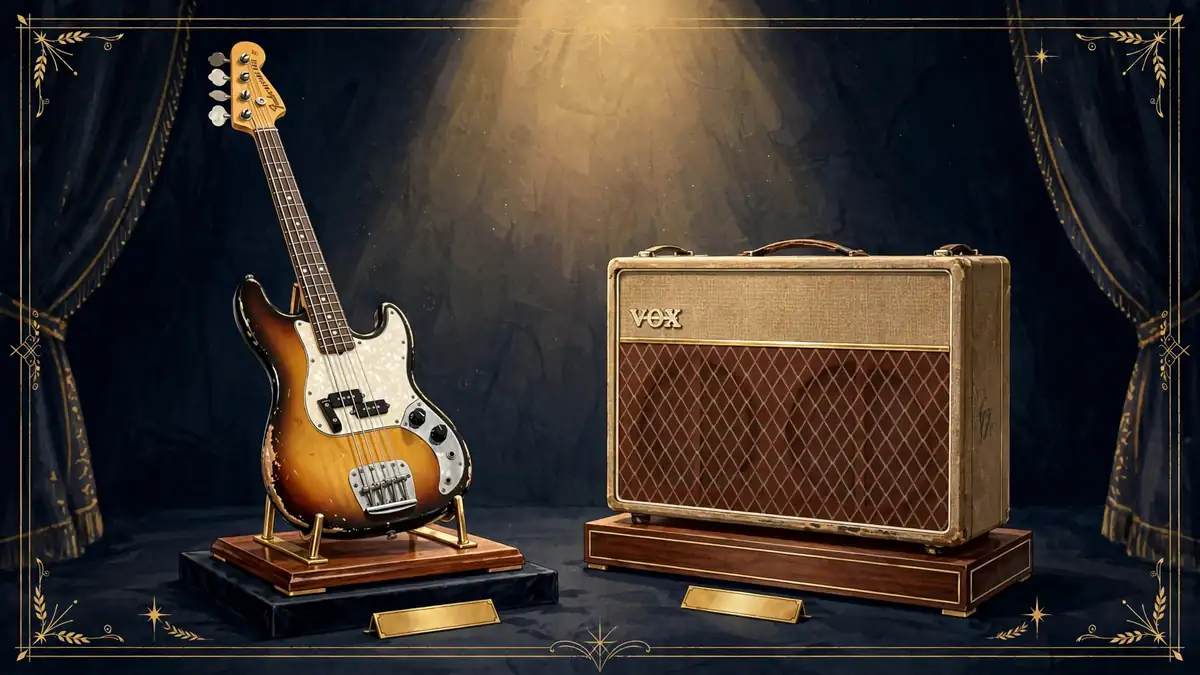
The archive as an asset. The most unusual investment in Wyman’s portfolio was his own past. The archive he built by keeping everything — instruments, stage outfits, posters, handwritten setlists, awards — became a saleable asset in its own right. The September 2020 Julien’s Auctions sale in Beverly Hills, “Property from Bill Wyman and His Rolling Stones Archive,” ran for three days, 11–13 September, and offered more than 1,000 lots. The results were extraordinary: his 1969 Fender Mustang bass, used on Stones recordings in 1969 and 1970, sold for $384,000, a world record for a bass guitar at auction, beating the $204,800 paid for Paul McCartney’s Hofner bass in 2013. Brian Jones’s 1968 Gibson Les Paul Goldtop, which Wyman had kept since Jones’s death in 1969, sold for $704,000 — three and a half times its $200,000 estimate and, at the time, the most valuable piece of Stones memorabilia ever sold. His 1962 Vox AC30 amplifier sold for $106,250, a record for an amplifier at auction. His early-1960s Framus Star bass fetched $51,200, a Travis Bean bass $125,000, and his 1978 stage outfit from the Hyde Park show $11,520. Even a plush yellow toilet seat cover bearing the Stones’ tongue logo, a souvenir of the 1975 American tour, sold for $1,152 — a world record for a toilet seat cover. A portion of the proceeds went to The Prince’s Trust, Macmillan Cancer Support, and the Central Caribbean Marine Institute. The sale did not empty the archive — Wyman kept plenty back — but it converted a lifetime of collecting into a substantial, documented sum, and it gave the public the clearest single window into the scale of his holdings.
Metal detecting. His hobby became a small business too. Wyman designed and marketed a patented metal detector under his own name, the Bill Wyman signature metal detector, and used it to find Roman-era relics in the English countryside. It will never rival the restaurant or the books as income, but it is characteristic: he turned a pastime into a product, the same way he turned a diary into a book and a poster collection into an auction.
Brand Deals and Sponsorships
Wyman never built a career on endorsements, and that is a deliberate contrast with his former bandmates. The Stones as a band have licensed their name to everything from whisky to slot machines, but Wyman’s own name has appeared on very few commercial products. The exceptions are personal rather than corporate: his signature metal detector, his books, and his photography exhibitions. He has never fronted a fashion campaign, a watch brand, or a drinks label, and there is no public record of a major sponsorship deal in his name.
That restraint is consistent with his public image. He is the Stone who stayed out of the spotlight, and advertisers pay for spotlight. His commercial value has always been tied to the archive and the catalogue — licensing photographs, selling books, auctioning instruments — rather than to his face. In that sense his brand deals are his books and his auction catalogue: products that sell because of what he kept, not because of what he endorsed.
The one deal with a number attached is the Maxwell’s purchase of a majority stake in Sticky Fingers in 2000, reportedly worth about £2 million. It was a business sale rather than a sponsorship, but it is the closest thing in his record to a headline commercial transaction — and it shows the scale of his business thinking. He built a restaurant, proved it over a decade, sold most of it at a reported seven-figure valuation, and kept a share in the brand.

Houses, Cars and Other Assets
Gedding Hall, Suffolk. Wyman bought Gedding Hall in 1968, at the height of the Stones’ first fame. It is a 15th-century moated manor near Bury St Edmunds in Suffolk, set in countryside with ancient fishponds, and it has been his main home for more than half a century. He has spoken about the house on BBC Radio Suffolk, and he has metal-detected its grounds for years, turning up Roman coins and medieval artefacts beneath the lawn. The house is the single most valuable property in his portfolio, and its value has risen steadily since 1968, when a medieval manor in Suffolk cost a fraction of what it does today. No public record states what he paid for it, and no recent valuation is published, so we do not put a figure on it — but a moated 15th-century manor held for 58 years is a substantial asset by any measure.
Saint-Paul-de-Vence, France. Wyman also keeps a home in Saint-Paul-de-Vence, in the south of France, a village long popular with artists — fitting for a collector and photographer. The French house puts him among the many British rock stars who kept a base on the Côte d’Azur, and it adds a second property market to his holdings.
Instruments and the archive. The instruments he kept — the Mustang bass, the Framus basses, the Vox amplifier, the Mellotron — were assets before they were auction lots, and the 2020 sale proved their value in cash terms. What remains in the archive, including instruments he chose not to sell, still holds value, and his collection of Stones memorabilia is one of the most complete private holdings of its kind. His art collection, including modern British works, is a further store of value.
Cars. Unlike many rock stars, Wyman has no public record of a supercar collection, and he has never been photographed with a fleet of expensive vehicles. His tastes run to the understated, and his most recent solo album is called Drive My Car — a title that owes more to the Beatles than to any garage he owns. We do not invent a car collection where none is documented.
Awards and Achievements
Wyman’s honours are mostly shared with the band, and they are considerable. The Rolling Stones were inducted into the Rock and Roll Hall of Fame in 1989, during his tenure, and the band received a Grammy Lifetime Achievement Award in 1987. The Stones’ albums have won multiple Grammy Awards over the years, including Best Rock Album for Voodoo Lounge in 1995 — after Wyman’s departure — but the Hall of Fame induction and the lifetime honours belong to the line-up he played in for 31 years.
His personal achievements sit outside the trophy cabinet. He was the first Stone to release a solo album, the first to write a memoir of the band, and the only member to build a second career as an author and archivist. His seven books have sold a reported two million copies, a figure few rock memoirs reach. His 2020 auction set three world records in a single weekend — most expensive bass guitar, most expensive amplifier, and most expensive toilet seat cover ever sold at auction — a set of records that is unlikely ever to be matched by another musician. And in August 2024, at 87, he released his ninth solo album, Drive My Car, extending a recording career that began in the early 1960s into its seventh decade.
He has also been recognised for his photography, with his work exhibited in galleries around the world, and for his archaeology, with The Times publishing his letter on metal detecting — a small honour, but one he seems to value as much as any gold record.
Net Worth Growth Over the Years
The table below is an estimate built from the published figures and the documented events in Wyman’s life. Early figures are approximate — nobody published a net worth for a Stones bassist in the 1960s — and the 2026 figure is the range this article reports. Treat the trajectory, not any single year, as the story: slow accumulation, a lean exit, and steady growth after 1993.
| Year | Estimated net worth | What changed |
|---|---|---|
| 1962 | Under $50,000 | Joins the Stones; a working musician with a homemade bass |
| 1970 | Around $1 million | Stones albums selling worldwide; tax exile years begin |
| 1980 | Around $5 million | Catalogue royalties accumulate; solo albums and first book plans |
| 1990 | Around $5–$8 million | Sticky Fingers opens 1989; Steel Wheels comeback tour; £200,000 overdraft shows how thin the cash was |
| 1993 | Around $8–$10 million | Leaves the Stones with a small nest egg; misses the stadium-tour era that follows |
| 2000 | Around $15–$20 million | Maxwell’s buys majority stake in Sticky Fingers; books selling; Rhythm Kings touring |
| 2010 | Around $30–$40 million | Catalogue value rises with digital sales; art collection appreciates |
| 2020 | Around $50–$60 million | Julien’s archive auction converts 1,000+ lots into cash |
| 2026 | $10 million–$80 million | Most outlets report $80 million; Celebrity Net Worth lists $10 million |
Two things stand out. First, the growth after 1993 is steadier than the growth before it — books, a restaurant, and an auction are more reliable than a band’s touring schedule. Second, the gap between Wyman and his former bandmates widened after he left, not before. In 1993 the four Stones were not that far apart in wealth; by 2026, Jagger and Richards are worth roughly six times what Wyman is, on the most common estimates. The difference is the touring money he walked away from and the songwriting money he never had.
Social Media Presence
Wyman keeps a low profile online, in keeping with everything else about him. His official website, billwyman.com, carries news of his albums, books, and archive, along with interviews and updates from his team. He is not a daily poster, and he does not run the kind of personal social media presence that younger musicians use to sell records. Announcements — the Drive My Car album in 2024, the 90th birthday coverage in October 2026 — arrive through the website and through music press coverage rather than through his own feeds.
That restraint is a choice, not a gap. His audience finds him through the Stones’ catalogue, through his books, and through the Rhythm Kings, and his income does not depend on social media reach. For a man who kept a diary for 70 years, the website is the public version of the same habit: a record, kept in order, updated when there is something to say.
Personal Life
Wyman has been married three times. His first marriage, to Diane Cory, lasted from 1959 to 1969, and their son Stephen was born in 1962 — the same year Wyman joined the Stones. His second marriage, to Mandy Smith, was the most publicised of his life: they married on 2 June 1989, when she was 19 and he was 52, and divorced in 1991. The age gap drew heavy press attention at the time and still colours profiles of him today. His third marriage, to Suzanne Accosta, began in 1993, the year he left the Stones, and it has lasted ever since. He proposed to her at Sticky Fingers, the restaurant he had opened four years earlier.
He lives mainly at Gedding Hall in Suffolk, with time also spent at his home in Saint-Paul-de-Vence in France. His daily life is closer to a country historian’s than a rock star’s: metal detecting, photography, writing, and tending the archive. He gave up smoking in 2009 after 55 years, and in March 2016 he was diagnosed with prostate cancer. He recovered fully, and the 2020 auction — held the year he turned 84 — was reported at the time as the work of a man in good health and good spirits, sorting out a lifetime of possessions on his own terms.
He turned 90 on 24 October 2026, and the milestone brought a round of profiles in the music press, most of them making the same point: he is the Stone who chose a quiet life and kept it. He still records — Drive My Car arrived in August 2024 — and he still writes. The diaries he started as a child after the war are still the backbone of his books, and the archive he built by refusing to throw anything away is still the most valuable thing he owns, after the houses.
Sources & Reporting
Celebrity Net Worth — the $10 million figure for Wyman, updated 30 June 2025; the low end of the range in this article.
Far Out — the $80 million figure, plus biographical details: born 24 October 1936, height 5 ft 6 in, Stones tenure 1962–1993, and the Rhythm Kings.
BBC — reporting on Wyman’s 1993 departure from the Rolling Stones after three decades with the band.
Ultimate Classic Rock — Wyman’s 2015 interview, including “the big money wasn’t there yet” and his account of living on a small nest egg after leaving the band.
Classic Rock — Wyman’s 2024 reflections on his departure, including the £200,000 overdraft after the Steel Wheels/Urban Jungle tours and his view that he should have left in the 1980s.
Goldmine — full results of the September 2020 Julien’s Auctions sale, including the $704,000 Les Paul, the $384,000 Mustang bass, and the $106,250 Vox amplifier.
Stereogum — coverage of the 2020 auction records and Wyman’s recovery from prostate cancer.
Grunge — account of Wyman’s departure, his role as the band’s archivist, and his ongoing performance royalties.
Design Week — Maxwell’s Restaurant Group’s 2000 purchase of a majority stake in Sticky Fingers, reportedly worth about £2 million.
Just Collecting — auction detail on the record-breaking bass and the 1,000-lot archive sale.
Reporting window: October–November 2026, with the 90th-birthday coverage of October 2026 as the freshest material. Where sources disagree on the net worth figure, this article publishes the range and names who says what, rather than picking a single number. No figure in this article is drawn from an unnamed source.
Frequently Asked Questions
What is Bill Wyman’s net worth in 2026?
Bill Wyman’s net worth is estimated at $10 million to $80 million as of November 2026. Most outlets, including Far Out, Biography Radar and Gemtracks, put him at $80 million, while Celebrity Net Worth lists him at $10 million and Wealthy Persons once reported $100 million. The range reflects genuine disagreement between trackers, not a single settled figure.
Why did Bill Wyman leave the Rolling Stones?
Wyman left the Rolling Stones in 1993 after 31 years because he no longer wanted the pressure of life in the band. He announced his departure in January 1993, having told the band in December 1992. He later said he felt he should have left in the 1980s, when the band was barely active and its two leaders were barely speaking, and he described ending the 1989–1990 comeback tours with a £200,000 bank overdraft.
Does Bill Wyman still get royalties from the Rolling Stones?
Yes. Wyman earns performance royalties every time a Rolling Stones recording he played on is bought, streamed, downloaded or broadcast. He performed on every Stones album from 1964 to 1989, so the catalogue keeps paying. He does not receive songwriting royalties, which belong to Mick Jagger and Keith Richards — the main reason his fortune is far smaller than theirs.
How old is Bill Wyman?
Bill Wyman was born on 24 October 1936, which makes him 90 years old as of November 2026. He celebrated his 90th birthday in October 2026, and released his ninth solo album, Drive My Car, in August 2024 at the age of 87.
What is Bill Wyman’s real name?
Bill Wyman was born William George Perks Jr. in Lewisham, London. He legally changed his name to Bill Wyman in 1964, two years after joining the Rolling Stones.
How tall is Bill Wyman?
Bill Wyman is 5 feet 6 inches tall (1.68 metres). He was the oldest member of the Rolling Stones when he joined at 25, and the shortest of the classic line-up.
Who is Bill Wyman’s wife?
Bill Wyman has been married to Suzanne Accosta since 1993, the year he left the Rolling Stones. He proposed to her at Sticky Fingers, the London restaurant he opened in 1989. He was previously married to Diane Cory (1959–1969), with whom he has a son, Stephen, and to Mandy Smith (1989–1991).
What happened to Bill Wyman’s Sticky Fingers restaurant?
Sticky Fingers, the American-themed restaurant Wyman opened in London’s Kensington in 1989, ran for more than 30 years and won The Sunday Times award for Best Hamburger in 1999. Maxwell’s Restaurant Group bought a majority stake in 2000, reportedly worth about £2 million. The Kensington restaurant closed in 2021, during the pandemic, after the Cambridge and Manchester branches had already been sold.
Final Thoughts
Bill Wyman’s fortune is the least flashy fortune in rock, and that is the point. He joined the biggest band in the world, played on records that sold more than 250 million copies, and walked away in 1993 before the money got truly enormous — then spent three decades turning the by-products of that career into a second fortune: books, a restaurant, an archive, and royalties that arrive a little at a time, thousands of times a year. Most outlets say he is worth $80 million; the best-known tracker says $10 million. The truth sits somewhere in that range, and it is built from things you can check — a $384,000 bass, a $704,000 guitar, a restaurant that ran for 32 years, seven books that sold two million copies — rather than from a single number anyone should take on trust. At 90, still recording and still writing, he is the rare rock star whose money story is really a story about patience.
Published on 16 November 2026. Last reviewed November 2026. Found an error? See our corrections policy.