
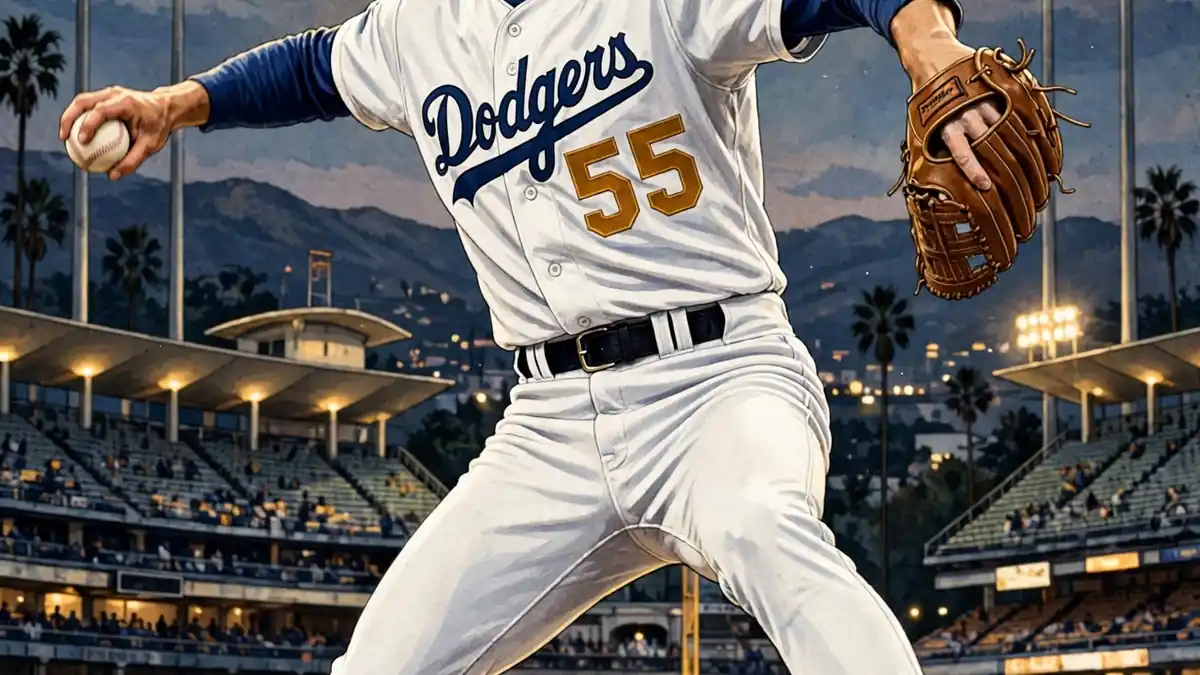
Orel Hershiser‘s net worth is estimated at $14 million to $20 million as of November 2026. The former Los Angeles Dodgers ace banked $37.6 million in playing salary across 18 big-league seasons, turned one of the greatest pitching seasons ever played into a broadcasting career that has now run for more than two decades, and added a Hollywood Walk of Fame star in August 2026 — 38 years after the season that made him famous.
Orel Hershiser: Quick Facts
| Estimated net worth | $14 million–$20 million (range: $14 million to $20 million) |
|---|---|
| Profession | Former MLB pitcher, pitching coach, sports broadcaster |
| Nationality | American |
| Born | September 16, 1958 (age 68) |
| Height | 6 feet 3 inches (1.91 m) |
| Primary income sources | MLB salaries ($37.6 million career), SportsNet LA broadcasting, ESPN analyst work, Texas Rangers coaching and front-office roles, book royalties, poker |
| Active years | 1983–2000 (playing); 2000–present (broadcasting and coaching) |
| Last reviewed | November 2026 |
- Early Life and Background
- Education
- Career Journey
- Rise to Fame
- Main Sources of Income
- Salary and Earnings
- Businesses and Investments
- Brand Deals and Sponsorships
- Houses, Cars and Other Assets
- Awards and Achievements
- Net Worth Growth Over the Years
- Social Media Presence
- Personal Life
- Sources & Reporting
- Frequently Asked Questions
Early Life and Background
Orel Leonard Hershiser IV was born on September 16, 1958, in Buffalo, New York, the oldest of four children of Orel Leonard Hershiser III and Mildred Hershiser. His father ran a business that printed newspaper advertising inserts. The family later moved to Cherry Hill, New Jersey, where Hershiser attended Cherry Hill High School East. Baseball history has a small curiosity attached to his family tree: he is descended from a Hessian soldier who came to North America to fight in the American Revolutionary War.
Hershiser did not arrive in professional baseball as a touted prospect. He was a skinny right-hander with a sinking fastball and a reputation for out-thinking hitters rather than overpowering them. That profile followed him for his whole career. Scouts questioned his size and his velocity; managers kept finding that he won anyway. The nickname that stuck to him, “Bulldog,” came from his refusal to leave a game and his habit of grinding through trouble on the mound instead of waiting for a reliever.
His younger brother Gordie Hershiser also played professional baseball, reaching the minor leagues in the Dodgers system. The two brothers grew up in a household where baseball was a daily subject, and Orel’s path through high school ball in New Jersey led him to a college program that would change his life. Nothing in his early years suggested a record-breaking major leaguer. He was not an early-round draft pick, he was not a physical specimen by scouting standards, and his first years in the minor leagues were a slow climb. The money story of Orel Hershiser starts with that slow climb, because it explains why his peak earnings arrived late and why his post-playing career mattered so much to his wealth: he was never the highest-paid player of his generation, and he built his fortune over 26 years of continuous work in baseball rather than in one giant contract.
Cherry Hill in the 1970s was a long way from Dodger Stadium, and Hershiser’s route ran through a mid-major college program, five minor-league seasons, and a September call-up at age 24. Every step of that route is documented in the public record, from his high-school days at Cherry Hill East to the 1979 draft, and it is the foundation of the estimate in this article: a player who earned his money the hard way, in installments, across nearly two decades.
Education
Hershiser attended Bowling Green State University in Ohio, where he pitched for the Falcons. He received only a partial scholarship, a detail that matters because it underlines how lightly regarded he was at the time: the school did not bet a full ride on him. At Bowling Green he developed the sinker and the command that would carry him to the majors, working under a college program that gave him innings and responsibility rather than hype.
He left Bowling Green after three years when the Los Angeles Dodgers selected him in the 17th round of the 1979 MLB draft. The 17th round is the kind of round where teams take flyers, not where they find franchise pitchers. Hershiser was the 179th player taken in that draft, and almost nobody in the Dodgers front office expected him to reach the majors, let alone to anchor a World Series rotation. His college coach had seen something the draft order missed: a pitcher who studied hitters, who changed speeds, and who got better the longer a game went on.
Bowling Green stayed in Hershiser’s life long after he left. In the spring of 2025 he returned to the university as a commencement speaker, telling graduates the story of a partial-scholarship pitcher who became a Cy Young winner. Bowling Green State University covered the appearance in its own news pages, and the invitation itself says something about how the school views him: not as a famous alumnus who happened to pass through, but as one of its own success stories. For a net-worth profile, the education section matters because Hershiser never had the bargaining power of a bonus-baby signing. His first professional contract paid minor-league wages, and his earnings curve stayed flat for years before it spiked in the late 1980s.
He spent five seasons in the minor leagues after signing, pitching at every level of the Dodgers system. The long apprenticeship taught him the sinker-slider mix and the mound presence that Tommy Lasorda, the Dodgers manager, would later lean on. Lasorda famously told Hershiser early on that he was too timid on the mound and gave hitters too much respect — a criticism Hershiser took to heart and turned into the Bulldog persona that defined his prime.
Career Journey
Hershiser made his major-league debut on September 1, 1983, at age 24, as a September call-up. He appeared in eight games that season, all in relief, with a 3.38 ERA. The Dodgers moved him into the rotation in 1984, and he went 11-8 with a 2.66 ERA in 45 games, 20 of them starts. By 1985 he was one of the best pitchers in the National League: 19-3 with a 2.03 ERA in 239.2 innings, third in Cy Young voting. The record hid a strange detail — he lost only three games all season while winning 19, a winning percentage of .864 that would match his famous 1988 mark.
The middle of the decade was a financial education in itself. After the 1985 season he won $1 million in arbitration for 1986, beating the Dodgers’ offer of $600,000. He followed with a 14-14 season and a 3.86 ERA in 1986, and when he asked for $1.1 million for 1987 the Dodgers countered at $800,000 — the maximum 20 percent cut the collective bargaining agreement allowed. Hershiser became only the second player in history to take a pay cut through salary arbitration, after Aurelio Lopez in 1983. He told the Associated Press at the time that the arbitrator had judged his 1986 season, not his 1985 season. He pitched 1987 on that $800,000 deal, went 16-16 with a 3.06 ERA, made his first All-Star team, and set up the season that would change his finances forever.
After 1988, Hershiser’s body began to charge him for the workload. He underwent shoulder surgery in April 1990 for a torn labrum, an operation that cost him most of two seasons. He won 10 games in 1992 and 12 in 1993, but the dominant pitcher of 1988 never fully returned. He left the Dodgers after the 1994 season, a free agent at 36, and signed with the Cleveland Indians. In Cleveland he found a second act: 16-6 with a 3.87 ERA in 1995, an American League Championship Series MVP award, and a trip to the World Series, the Indians’ first since 1954. He went 15-9 in 1996 and 14-6 in 1997, reaching a second World Series in 1997, which Cleveland lost to Florida.
He signed a one-year, $3.45 million contract with the San Francisco Giants for 1998 and went 11-10 with a 4.41 ERA in 202 innings. He moved to the New York Mets in 1999, going 13-12 with a 4.58 ERA, and returned to the Dodgers for a final season in 2000. That last season was hard to watch: 1-5 with a 13.14 ERA in 10 games, and his final appearance came on June 26, 2000, at age 41. He retired with a career line of 204 wins against 150 losses, a 3.48 ERA, 2,014 strikeouts, 68 complete games and 25 shutouts across 3,130.1 innings in 510 games. His postseason record was 8-3 with a 2.59 ERA in 132 innings — the numbers of a pitcher who was better in October than he was in the regular season.
His contemporaries in the National League included hitters such as John Kruk, the Phillies first baseman whose $12 million fortune came from the same era of baseball economics, and the gap between their careers and today’s contracts is the central theme of Hershiser’s money story. When Hershiser became baseball’s first $3 million player in 1990, that figure made headlines around the sport. A generation later, a single season of a star pitcher costs more than Hershiser earned in his entire playing career.
Rise to Fame
The 1988 season is one of the greatest single seasons by a pitcher in baseball history, and it is the reason Orel Hershiser is still a household name in Los Angeles nearly four decades later. He went 23-8 with a 2.26 ERA, led the National League in wins, innings pitched (267), complete games (15) and shutouts (8), and finished third in the league in ERA. He threw five shutouts in his last six regular-season starts. He was a unanimous choice for the National League Cy Young Award, won a Gold Glove, and was named Sports Illustrated’s Sportsman of the Year and the Associated Press Male Athlete of the Year.
The number that defines him is 59. Beginning on August 30, 1988, Hershiser pitched 59 consecutive scoreless innings, breaking the record of 58 and two-thirds innings set by Dodger great Don Drysdale in 1968. The streak ended the season in a 10-inning shutout of the San Diego Padres on September 28, 1988, on 116 pitches, with Tony Gwynn — the National League batting champion that year — among the hitters he shut down. The record still stands. As of April 2025, only four pitchers in history have thrown scoreless streaks of more than 50 innings: Hershiser, Drysdale, Walter Johnson and Jack Coombs. The Society for American Baseball Research documented the streak game by game, and its account notes that Hershiser allowed 30 hits, walked nine and struck out 34 during the run.
The postseason was even better. In the National League Championship Series against the New York Mets, Hershiser started Games 1 and 3, recorded the final out of Game 4 in relief for a save, and threw a complete-game shutout in Game 7. He was named NLCS MVP. In the World Series against the Oakland Athletics, he threw a three-hit shutout in Game 2 — going 3-for-3 at the plate with two doubles — and then pitched a complete-game, four-hit, two-run victory in the clinching Game 5. He was named World Series MVP. Hershiser remains the only player ever to win the Cy Young Award, the Championship Series MVP and the World Series MVP in the same season. Kirk Gibson’s Game 1 walk-off home run is the moment people remember from that Series; Hershiser’s pitching is the reason the Dodgers were in a position to win it.
Fame arrived with a White House invitation: after the 1988 season, Hershiser and his first wife Jamie were invited to a state dinner on November 16, 1988, honoring British Prime Minister Margaret Thatcher. A year later he published his autobiography, Out of the Blue, written with Jerry B. Jenkins. The book gave him his first income stream outside baseball and fixed his public image as the thoughtful, religious pitcher who outworked more talented arms. That image has followed him into the broadcast booth, where it still earns him a salary at 68.
Main Sources of Income
Hershiser’s wealth comes from four streams, and the balance between them is unusual for a retired athlete. Playing salary is the largest by far: $37,582,001 across 18 seasons, according to Celebrity Net Worth’s salary records. Broadcasting is second. He has worked as a national or regional baseball broadcaster almost continuously since 2000 — ABC and ESPN’s Little League World Series coverage in 2000 and 2001, ESPN’s Wednesday Night Baseball and Baseball Tonight, and the Dodgers’ SportsNet LA broadcasts since the network launched in 2014. CollegeNetWorth, which covers his broadcast contract in detail, estimates his current analyst pay in the mid-to-high six figures a year.
Coaching and front-office work is the third stream. He was the Texas Rangers’ pitching coach from 2002 to 2005, then moved into the front office as an executive director in 2006. Major-league coaching salaries in that era ran into the low-to-mid six figures, and the Rangers role kept him on a baseball payroll for five years after his playing career ended. The fourth stream is smaller and harder to measure: book royalties from Out of the Blue and a later book, Between the Lines: Nine Things Baseball Taught Me About Life (2002), plus poker. Hershiser is a serious poker player who took part in the World Series of Blackjack in Las Vegas in 2007 and has played in televised poker events. He has never disclosed poker winnings, and this article does not count them as a major income source.
Endorsements never became a large part of his income. He played before the modern endorsement economy, when a pitcher’s shoe deal was modest and regional, and his peak fame arrived in 1988, before athletes routinely monetized a single season into a brand. That is the honest shape of his fortune: a working pitcher’s salary, stretched by a long second career in the booth, rather than a windfall from one contract or one deal. Readers comparing him with today’s stars should note that the modern Dodgers payroll includes players whose single-season salaries exceed Hershiser’s career total — a fact that belongs in the athletes section of this site, where the economics of each era are visible side by side.
The table below breaks down the four streams as far as the public record allows. Broadcasting pay is estimated from industry reporting because neither ESPN nor SportsNet LA discloses analyst salaries.
| Income stream | Period | Estimated contribution |
|---|---|---|
| MLB playing salary | 1983–2000 | $37.6 million (documented) |
| Broadcasting (ESPN, SportsNet LA) | 2000–present | Mid-to-high six figures per year (estimated) |
| Coaching and front office (Rangers) | 2002–2006 | Low-to-mid six figures per year (estimated) |
| Books, poker, appearances | 1989–present | Modest; not publicly disclosed |

Salary and Earnings
The salary record is the most solid part of Hershiser’s financial picture, because baseball salaries are public. Celebrity Net Worth, drawing on contract records, puts his career earnings at $37,582,001. The shape of that curve tells its own story. He earned minor-league wages through 1983, then $212,000 in 1984, $1 million in 1986 after winning arbitration, and $800,000 in 1987 after the pay cut. His 1988 season, the greatest of his life, was played on a salary that would look like a rounding error today.
The payoff came on February 16, 1989, when the Dodgers signed him to a three-year, $7.9 million contract extension with a $1.1 million signing bonus and base salaries of $2.4 million in 1989, $1.6 million in 1990 and $2.8 million in 1991. Because the bonus was spread evenly across the three years, his 1990 pay came to $3,166,000, making him the first $3 million player in Major League Baseball history. His 1989 salary of $2.76 million, counting the bonus share, was itself a record at the time. DodgerBlue and True Blue LA both document the deal in detail, and the numbers agree across outlets: this was the contract that turned a working pitcher into a wealthy man.
After the extension expired, his salaries stayed in the same band. His peak single-season pay came late: $3.45 million from the San Francisco Giants in 1998 on a one-year deal. The Cleveland years paid well — he was a valued veteran on a contending team — but none of his contracts approached the scale of modern pitching deals. For scale, Shohei Ohtani‘s $700 million Dodgers contract, signed in December 2023, is worth more than eighteen times Hershiser’s entire career salary. The comparison is not a criticism of Hershiser; it is the economics of a sport whose television money exploded after he retired. Hershiser pitched in the last era when a Cy Young winner could be paid less than a modern middle reliever.
His arbitration history deserves a closer look because it shows a player who bet on himself and lost a round before winning the war. The 20 percent pay cut in 1987 was the maximum the rules allowed, and it stung: he had just posted a 2.03 ERA and a 19-3 record the year before. The Dodgers’ case was his 14-14 record in 1986, and the arbitrator sided with the club. Hershiser’s response was the 1988 season, which made the cut irrelevant within eighteen months. The $7.9 million extension that followed was, in effect, the market correcting itself. Players today rarely face that kind of swing, because arbitration salaries are now anchored by comparable-player data that barely existed in the 1980s.
Year-by-year salary highlights from the public record:
| Season | Team | Salary / contract note |
|---|---|---|
| 1984 | Dodgers | $212,000 |
| 1986 | Dodgers | $1,000,000 (won in arbitration) |
| 1987 | Dodgers | $800,000 (20% arbitration pay cut) |
| 1989–1991 | Dodgers | 3 years, $7.9 million; $1.1 million signing bonus |
| 1990 | Dodgers | $3,166,000 — first $3 million player in MLB history |
| 1998 | Giants | $3,450,000 (one year) |
| Career total | Five clubs | $37,582,001 |
Broadcasting pay is the second-longest earnings stream of his life. He rejoined ESPN as an analyst on February 13, 2006, working Baseball Tonight, Sunday Night Baseball and the Little League World Series, and he has been the Dodgers’ television analyst on SportsNet LA since 2014. He has worked alongside Joe Davis as the primary Dodgers broadcast team since Vin Scully retired after the 2016 season. National baseball analysts of his standing commonly earn mid-to-high six figures a year, and CollegeNetWorth applies that range to Hershiser. Over 26 years, even at the low end of that range, broadcasting has added several million dollars to his career earnings — and unlike a playing contract, it has no expiry date built in. At 68, he is still calling games.
Businesses and Investments
Hershiser never became a serial entrepreneur, and the public record contains no startup portfolio, restaurant chain or product line attached to his name. That absence is itself a finding: unlike some retired athletes whose wealth grew through business ventures, Hershiser’s fortune is almost entirely a salary story — playing salary first, broadcasting salary second, coaching salary third. The blog posts that credit him with tech-startup stakes, sports-bar empires or a $25 million to $30 million net worth built on “smart asset allocation” cite no filings, no company names and no transactions. This article does not repeat those claims, because they cannot be verified.
What can be verified is steadier and less dramatic. He worked as a special assistant to Texas Rangers general manager John Hart in the fall of 2001 before becoming the club’s pitching coach on June 22, 2002, and he stayed in the organization as an executive director after leaving the coaching job in 2005. Those were salaried baseball jobs, not equity positions. He also monetized his name in the conventional ways available to a retired star of his era: a memoir, speaking engagements, and baseball camps and clinics. None of these produced a public windfall, and none needed to. A player who banks $37.6 million before taxes, lives in Las Vegas rather than Los Angeles, and keeps working into his late sixties does not need a business empire to stay comfortable.
His most visible investment is real estate, covered in the assets section below: a Pasadena mansion bought and sold during his playing career, and a Summerlin home bought in 2009 and sold in 2019. Both were primary residences rather than flips, and both appreciated. Beyond property, there is no public record of stock portfolios, private equity or venture stakes, and this article does not invent one. The honest summary is that Hershiser invested in the ordinary way a high-earning athlete of his generation did — a house, a long career, and a second career that kept the paychecks coming.
One venture that does carry his name is the “Off Air” podcast he launched with Joe Davis in April 2020, during the pandemic shutdown, built from the road-trip conversations the two broadcast partners had been sharing on social media. It was a small project rather than a business, but it showed how his broadcasting brand works: the value is in the voice and the credibility, not in a product. The same logic applies to his occasional motivational speaking. He has spoken about the 1988 season and the discipline behind it for decades, including the Bowling Green commencement address in 2025. Speaking fees for a figure of his stature are typically in the low five figures per appearance, a useful supplement rather than a fortune-maker.
Brand Deals and Sponsorships
Endorsements were never a major income line for Hershiser, and the reason is timing. His fame peaked in 1988 and 1989, when athlete endorsement deals were smaller, shorter and far less lucrative than they are now, and when pitchers — even Cy Young winners — were not the faces of national campaigns. He had local and regional deals in Los Angeles during his Dodgers years, the kind of appearances and print work that came with being a World Series hero, but no national shoe or soft-drink contract of the kind that defines modern athlete wealth.
PlayersBio and BioScops both credit endorsements as a contributor to his net worth, but neither names a brand, a deal value or a year, and no primary source confirms a major endorsement contract. This article treats endorsements as a minor, unquantified stream rather than a pillar of the estimate. The contrast with today’s game is sharp: Aaron Judge‘s fortune, estimated at $50 million to $100 million, rests heavily on endorsement income that did not exist at anything like that scale in 1988. Hershiser’s era paid pitchers in salary and not much else.
What he did have, and still has, is a durable personal brand inside baseball. The Dodgers have kept him on their broadcast for more than a decade, the Hollywood Chamber of Commerce put him on the Walk of Fame in 2026, and his number 55 remains one of the most recognized in franchise history. That brand pays in the form of a broadcasting contract, not in the form of sneaker deals. It is also the reason his name still sells memorabilia: signed 1988 World Series items, game-used jerseys and rookie cards trade actively, and PSA’s autograph records note his 1988 season as the centerpiece of his collectible value. He does not earn from the secondary memorabilia market directly, but the demand keeps his appearance and signing fees alive.
One more honest note: some low-quality sites claim Hershiser earned $1 million or more a year from ESPN alone, or that he held Nike collaborations and MLB Network brand deals. No credible reporting supports those figures, and the $25 million to $30 million net-worth claims that circulate on content-farm blogs trace back to a single unverified post that also gets his career wins, strikeout total and Hall of Fame status wrong. Readers should treat any Hershiser endorsement figure without a named brand and a named source as guesswork.
Houses, Cars and Other Assets
Real estate is the best-documented part of Hershiser’s asset picture, and Celebrity Net Worth’s property reporting gives it in detail. During his years playing in Los Angeles he lived in a 12,000-square-foot mansion in Pasadena. He sold the house in 1995, when he left for Cleveland, for an undisclosed amount. The buyers later sold the same house in 2021 for $13 million — a figure that says more about Pasadena real estate over 26 years than it does about Hershiser’s own gain, since he sold long before the run-up.
After his divorce in 2005 he moved to Las Vegas, where he still lives. In 2009 he paid $985,000 for a home in Summerlin, the Las Vegas suburb built around the Red Rock Country Club golf course. He listed the two-story house for sale in 2015 at $1 million — a 4,100-square-foot home built in 2004 with stone floors, coffered ceilings, four bedrooms and a golf-course view — and sold it in 2019 for a little over $1 million. The numbers are modest by celebrity standards, and they fit the rest of his profile: a comfortable house in a golf community, bought near the bottom of the market and sold for a small gain a decade later.
He now lives in Las Vegas with his second wife, Dana Deaver, and her two children. The family home is not publicly listed in property records attached to his name in the sources reviewed for this article, and this article does not publish an address or a value for it. Cars are the same story: Hershiser has never been a public car collector, and no verified reporting attaches a luxury fleet to him. The absence of a supercar collection is consistent with everything else in his record. His visible spending went to golf, poker and family life in Las Vegas, not to display assets.
The Pasadena sale deserves one clarification, because it is often misreported. Some sites imply Hershiser himself sold the house for $13 million. He did not. He sold it in 1995 for an undisclosed price, and the $13 million sale in 2021 was by the later owners. Counting that $13 million as Hershiser’s money would be wrong, and this article flags the distinction because it is exactly the kind of stale-figure error that spreads across net-worth sites. His own property gains were real but modest: a Pasadena home bought in the 1980s and sold in 1995, and a Summerlin home bought for $985,000 and sold for just over $1 million.
Awards and Achievements
Hershiser’s trophy case is the reason his name still carries weight, and it is also the reason his broadcasting career has lasted so long: he is introduced, in every booth, as the man who did something no one else has done. The list below is drawn from Baseball-Reference, SABR and the Baseball Hall of Fame’s own records.
- World Series champion, 1988 (Los Angeles Dodgers)
- National League Cy Young Award, 1988 — unanimous selection
- World Series MVP, 1988
- National League Championship Series MVP, 1988 and 1995 (with Cleveland)
- American League Championship Series MVP, 1995 — the only player to win LCS MVP in both leagues
- Gold Glove Award, 1988
- Silver Slugger Award, 1993
- 3× All-Star, 1987, 1988, 1989
- National League wins leader, 1988 (23)
- MLB record: 59 consecutive scoreless innings, 1988 — still standing
- Sports Illustrated Sportsman of the Year, 1988
- Associated Press Male Athlete of the Year, 1988
- Hollywood Walk of Fame star, August 13, 2026 — 2,853rd star, sports entertainment category
- Legend of Dodger Baseball honoree
- Bowling Green State University commencement speaker, spring 2025
The Hall of Fame question follows him everywhere, and the answer is no — not yet. He appeared on the Hall of Fame’s Today’s Game ballot in 2019 and was not elected. FanGraphs credits him with 48.0 career WAR; Cooperstown Cred, which has made his case in detail, puts his Baseball-Reference WAR at 51.6 and argues that his peak — and in particular two months in 1988 — is Hall-worthy. The voters have so far disagreed, and the case against him is his career counting stats: 204 wins is strong but not automatic, and his 3.48 ERA sits in the borderline band for starting pitchers. The case for him is the peak: a unanimous Cy Young, two LCS MVPs, a World Series MVP, and a record that has stood for 38 years. Whether he ever gets in, the debate itself keeps his name in circulation, which is worth something to a broadcaster.
The Walk of Fame star in August 2026 was the freshest honor of his career, and it arrived with a detail only baseball fans would appreciate. The star sits at 6755 Hollywood Boulevard. The “67” honors his scoreless-innings streak — 59 in the regular season plus 8 more in the 1988 NLCS — and the “55” is his jersey number. Bob Costas hosted the ceremony, Dodgers manager Dave Roberts, broadcast partner Joe Davis and retired broadcaster Jaime Jarrin spoke, and Clayton Kershaw attended. Hollywood Chamber of Commerce president Ron Frierson proclaimed August 12 as Orel Hershiser Day in Hollywood. Hershiser became the fifth person honored in the Walk of Fame’s sports entertainment category and only the third former major leaguer with a star, joining Chuck Connors and John Beradino.
Peer comparison puts his fortune in context. The table below uses Celebrity Net Worth for Clemens and Maddux and Velontia for Glavine, with career salary totals from the same sources. The gap is not about talent; it is about timing. Clemens and Maddux pitched into the era of $100 million contracts. Hershiser’s peak pay arrived a decade earlier.
| Pitcher | Career wins | Cy Young Awards | Career salary (reported) | Net worth (reported) |
|---|---|---|---|---|
| Orel Hershiser | 204 | 1 (1988) | $37.6 million | $14M–$20M |
| Roger Clemens | 354 | 7 | $150 million | $70 million |
| Greg Maddux | 355 | 4 | Just under $160 million | $70 million |
| Tom Glavine | 305 | 2 | Over $120 million | $40 million |
Net Worth Growth Over the Years
Hershiser’s wealth grew in three phases, and the table below is an estimate built from the salary record rather than from any leaked financial statement. No outlet has published a year-by-year net-worth series for him, so the figures below are NetWorthCraft’s own estimates, anchored to the documented salary milestones and labeled as such.
| Period | What happened | Estimated net worth |
|---|---|---|
| 1983–1987 | Minor-league wages, then $212,000 to $1 million a year; arbitration pay cut in 1987 | Under $1 million |
| 1988–1991 | Historic season, then the $7.9 million extension; first $3 million player | $3 million–$5 million |
| 1992–2000 | Steady veteran salaries in Los Angeles, Cleveland, San Francisco and New York; $3.45 million peak year in 1998 | $8 million–$12 million |
| 2001–2013 | Coaching, front-office and ESPN work; Pasadena home sold, Las Vegas home bought | $10 million–$14 million |
| 2014–2026 | SportsNet LA broadcasting; Summerlin home sold; Walk of Fame star in 2026 | $14 million–$20 million |
The growth curve is flatter than a modern star’s, and that flatness is the point. Hershiser never had a single year that doubled his wealth. He had eighteen years of salary, then a coaching contract, then two decades of broadcasting. The $14 million to $20 million range in 2026 reflects the disagreement between the two most-cited estimators: Celebrity Net Worth at $14 million, PlayersBio and BioScops at $20 million. CollegeNetWorth splits the difference at $14 million to $20 million, which is the range this article publishes. The outlier claims — $100,000 to $1 million from CelebsMoney, which uses a generic formula, and $25 million to $30 million from an unverified blog post that also misstates his career wins — are both set aside in the Sources section with reasons.
Two forces pushed the estimate up after retirement, and both are still working. The first is longevity in the booth: every additional season on SportsNet LA adds a high-six-figure salary to a man whose playing income stopped in 2000. The second is the Dodgers brand itself. The franchise’s television money, its World Series wins in 2020 and 2024, and its status as baseball’s biggest draw have kept its former stars relevant and employable. Hershiser called the 2020 championship as a broadcaster, 32 years after winning one as a player, and that continuity is a commercial asset no spreadsheet captures. As long as he keeps the booth job, the range should hold or rise slowly. If he retires from broadcasting, the estimate would flatten at the lower end of the range.
Social Media Presence
Hershiser keeps a modest, baseball-focused social media presence. He is on X (formerly Twitter) as @OrelHershiser, an account listed by Baseball-Reference’s directory of player accounts, and on Instagram as @orelhershiser55. His posting is what a working broadcaster’s should be: Dodgers game notes, road-trip photos with Joe Davis, tributes to former teammates and managers, and the occasional look back at 1988. He was among the first Dodgers figures to post publicly after Tommy Lasorda’s death in January 2021, and his posts from that week were picked up by Dodgers Nation and other outlets.
Follower counts are modest by modern athlete standards — roughly 130,000 on X and around 46,000 on Instagram, according to PlayersBio and InstaStatistics — and that modesty fits his generation. He did not build his brand on social media; he brought a pre-internet brand to it. The accounts matter to his net worth only indirectly: they keep him visible to Dodgers fans between broadcasts and they gave him and Joe Davis the audience for the “Off Air” podcast they launched in April 2020, during the pandemic shutdown, after fans kept asking for a show built around their road-trip conversations.
He does not run a YouTube channel, a TikTok account or a paid newsletter, and he does not appear to monetize his social following through sponsored posts. That is a choice, and it is consistent with the rest of his post-playing life: the paycheck comes from the broadcast booth, and social media is a way to talk to fans, not a business. Readers looking for daily content from him will find it on X during the baseball season, when he posts most often, and on Instagram, where the account leans toward photos from the ballpark and the road.
Personal Life
Hershiser married his first wife, Jamie Byars, in 1981. They had two sons, Orel Leonard Hershiser V — known as Quinton — and Jordan. The marriage ended in divorce in 2005, after 24 years. Jordan graduated from St. Mark’s School of Texas in 2007, where he earned all-conference honors in baseball and basketball, played college baseball at the University of Southern California as a pitcher and first baseman, and was drafted by the Dodgers in the 34th round of the 2012 MLB draft. The father-son draft symmetry — both drafted by the Dodgers, 33 years apart — is one of the quieter stories in his biography.
He met his second wife, Dana Deaver, in Minneapolis in 2005, while she was traveling for work as an educational specialist. They married in December 2010 in Las Vegas, at the Bellagio, and live in Las Vegas with Deaver’s two children, Spencer and Sloane. The move to Las Vegas followed the divorce, and it stuck: he has lived there for two decades now, close to the golf courses and the poker rooms that fill his time away from the ballpark. Hershiser is an active Christian, a faith he has spoken about publicly since his playing days, and he co-wrote his memoir with Jerry B. Jenkins, a Christian author.
His parents were Orel Leonard Hershiser III and Mildred Hershiser. His father ran the printing business in Buffalo and later New Jersey. His brother Gordie played in the Dodgers’ minor-league system. The family story is one of steady, middle-class mobility rather than wealth: a printing business, a partial college scholarship, a 17th-round draft pick, and then a career that no one in the family could have predicted. That background shows in how he has handled money since — no public bankruptcies, no lawsuits over debts, no splashy spending stories. The two divorces in the public record are his own in 2005; the financial terms were not disclosed, and this article does not speculate about them.
Off the field, poker is his best-known hobby. He is described by Wikipedia and Baseball-Reference as a professional poker player, and he competed in the World Series of Blackjack in Las Vegas in 2007. He has also played in celebrity and charity poker events around Las Vegas. Golf is the other constant: his Summerlin home sat on the Red Rock Country Club course, and his broadcasting schedule still leaves him time on the course in the offseason. He has done charity work around Las Vegas and Los Angeles, including events for the Cystic Fibrosis Foundation with his family, but he keeps that work low-profile and it does not feature in his public earnings story.
Sources & Reporting
Celebrity Net Worth — the $14 million net-worth estimate and the $37,582,001 career salary total, including the 1989 contract details and the Pasadena and Summerlin property records. Reporting window: page updated October 8, 2024. This is the primary source for the estimate’s lower bound and for all salary figures in this article.
PlayersBio — the $20 million net-worth estimate, the 2015 Las Vegas listing at $1 million, and biographical details. Reporting window: page updated November 2026. This is the primary source for the estimate’s upper bound.
CollegeNetWorth — the $14 million to $20 million range, the SportsNet LA broadcasting role, the Texas Rangers coaching dates, and the mid-to-high six-figure analyst pay estimate. Reporting window: page updated July 8, 2025.
Wikipedia — career record (204-150, 3.48 ERA, 2,014 strikeouts), team history, the 59-inning streak, the August 13, 2026 Walk of Fame star, family details and post-retirement career. Reporting window: page updated November 2026.
SABR — the game-by-game account of the 59 consecutive scoreless innings, including the September 28, 1988 record-breaking game against San Diego. Reporting window: Society for American Baseball Research, Games Project.
Baseball-Reference — career statistics, the @OrelHershiser account listing, and season-by-season pitching lines. Reporting window: accessed November 2026.
DodgerBlue — the February 16, 1989 three-year, $7.9 million extension, the $1.1 million signing bonus, the $3,166,000 first-$3-million-player figure, and the 2026 Walk of Fame ceremony details. Reporting window: February and August 2026.
True Blue LA — the 1987 arbitration pay cut to $800,000, the $1 million arbitration win in 1986, and the context of the 20 percent maximum cut. Reporting window: January 2015.
FanGraphs — the 48.0 career WAR figure and the Hall of Fame Today’s Game ballot analysis. Reporting window: accessed November 2026.
Bowling Green State University — the spring 2025 commencement speaker announcement and Hershiser’s account of his college career. Reporting window: April 2025.
Figures set aside: CelebsMoney’s $100,000 to $1 million estimate uses a generic formula with no salary data and conflicts with the documented $37.6 million in career pay. An unverified blog post claiming $25 million to $30 million misstates his career wins (253 instead of 204), his strikeouts and his Hall of Fame status, and cites no source for its figures. Both are excluded from the estimate.
Reporting window for this article: November 2026. Net worth is an estimate built from public reporting, not an audited statement, and it will move with new contracts, property sales and broadcasting renewals.
Frequently Asked Questions
What is Orel Hershiser’s net worth in 2026?
Orel Hershiser’s net worth is estimated at $14 million to $20 million as of November 2026. Celebrity Net Worth puts him at $14 million, while PlayersBio and BioScops put him at $20 million. The range reflects disagreement over his post-playing income from broadcasting and coaching, since no audited financial statement exists.
How much did Orel Hershiser earn in his MLB career?
Hershiser earned $37,582,001 in salary across 18 major-league seasons from 1983 to 2000, according to Celebrity Net Worth’s contract records. His biggest single contract was a three-year, $7.9 million extension with the Dodgers in 1989, and his highest single-season salary was $3.45 million with the San Francisco Giants in 1998.
What was Orel Hershiser’s highest salary?
His highest single-season salary was $3.45 million, paid by the San Francisco Giants in 1998 on a one-year deal. His most famous payday was the 1989 Dodgers extension: three years and $7.9 million with a $1.1 million signing bonus, which made him the first $3 million player in MLB history when his 1990 pay reached $3,166,000.
What is Orel Hershiser’s scoreless innings record?
Hershiser pitched 59 consecutive scoreless innings in 1988, breaking Don Drysdale’s record of 58 and two-thirds innings from 1968. The streak began on August 30, 1988 and ended with a 10-inning shutout of San Diego on September 28, 1988. The record still stands, and he added 8 more scoreless innings in the 1988 NLCS, which is why his Walk of Fame star sits at 6755 Hollywood Boulevard.
Is Orel Hershiser in the Hall of Fame?
No. Hershiser appeared on the Hall of Fame’s Today’s Game ballot in 2019 and was not elected. His case rests on his peak — a unanimous Cy Young Award, two LCS MVPs and a World Series MVP in 1988, plus the 59-inning scoreless streak — while the case against him is his career totals of 204 wins and a 3.48 ERA. He was honored with a Hollywood Walk of Fame star on August 13, 2026.
What does Orel Hershiser do now?
He is the Los Angeles Dodgers’ television color analyst on SportsNet LA, a role he has held since the network launched in 2014. He works alongside play-by-play announcer Joe Davis as the primary Dodgers broadcast team. Before that he was an ESPN analyst on Baseball Tonight and Sunday Night Baseball, and he coached the Texas Rangers as pitching coach from 2002 to 2005.
Who is Orel Hershiser’s wife?
Hershiser is married to Dana Deaver, a former literacy specialist. They met in Minneapolis in 2005 and married in December 2010 in Las Vegas. His first wife was Jamie Byars, whom he married in 1981 and divorced in 2005; they have two sons, Orel Leonard V (Quinton) and Jordan.
How old is Orel Hershiser and how tall is he?
Orel Hershiser was born on September 16, 1958, in Buffalo, New York, which makes him 68 years old as of November 2026. He is 6 feet 3 inches tall (1.91 m) and pitched right-handed, wearing No. 55 for most of his career with the Dodgers.
Final Thoughts
Orel Hershiser’s $14 million to $20 million fortune is a story about durability rather than excess. He was a 17th-round draft pick on a partial college scholarship who took a pay cut in arbitration, then produced the greatest pitching season of his generation and turned it into the first $3 million contract in baseball history. He banked $37.6 million as a player, then kept earning for another 26 years as a coach, an ESPN analyst and the voice of the Dodgers on SportsNet LA. The 59 scoreless innings still stand as a record, the Walk of Fame star in August 2026 put his name on Hollywood Boulevard, and at 68 he is still calling games. Players with far bigger contracts have come and gone since 1988. Hershiser is still in the booth, still working, and still cashing the checks that a single historic season made possible.
Published on November 16, 2026. Last reviewed November 2026. Found an error? See our corrections policy.