
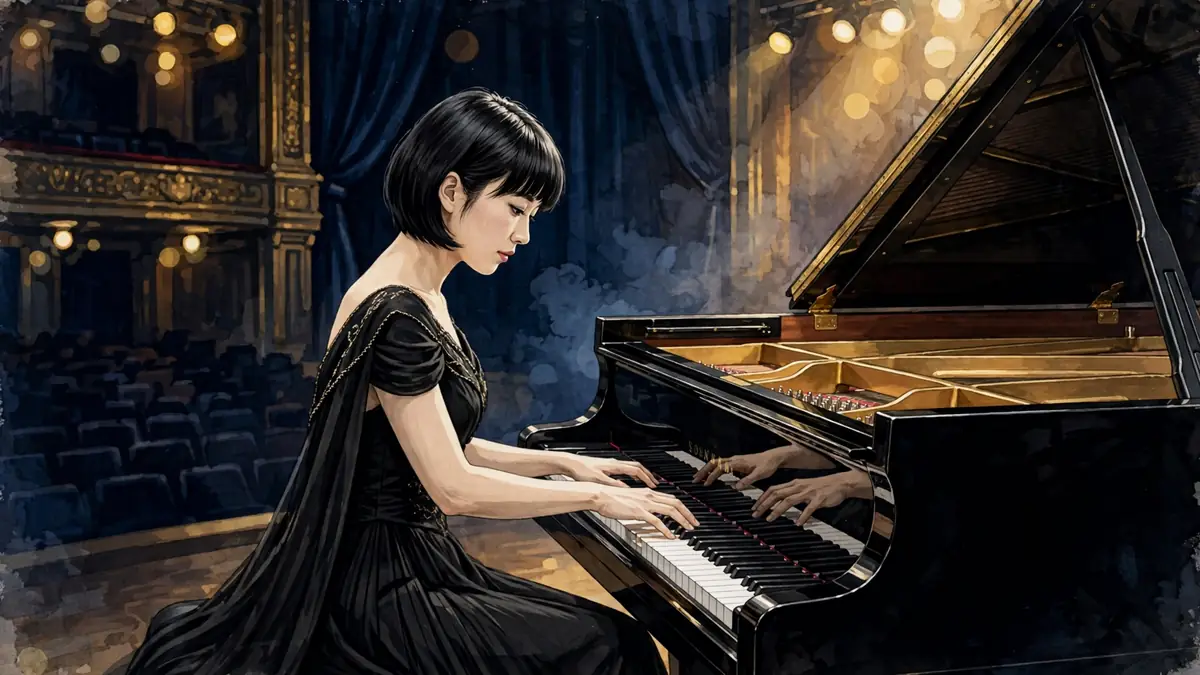
Yuja Wang‘s net worth is estimated at $20 million to $30 million as of November 2026. The Beijing-born pianist built that fortune one sold-out hall at a time — more than 100 concerts a year with the finest orchestras on earth, an exclusive Deutsche Grammophon contract running since 2009, a Rolex partnership of the same vintage, and a January 2023 Carnegie Hall marathon in which she played every note Sergei Rachmaninoff ever wrote for piano and orchestra in a single sitting.
Yuja Wang: Quick Facts
| Estimated net worth | $20 million – $30 million (range: $20 million to $30 million) |
|---|---|
| Profession | Classical concert pianist |
| Nationality | Chinese-born American |
| Born | February 10, 1987 (age 39) |
| Height | 5 ft 2 in (1.57 m) — widely reported, not officially confirmed |
| Primary income sources | Concert fees, Deutsche Grammophon recordings, endorsements (Rolex, Steinway, Rimowa), streaming and royalties |
| Active years | 1998–present |
| Last reviewed | November 2026 |
- Early Life and Background
- Education
- Career Journey
- Rise to Fame
- Main Sources of Income
- Salary and Earnings
- Businesses and Investments
- Brand Deals and Sponsorships
- Houses, Cars and Other Assets
- Awards and Achievements
- Net Worth Growth Over the Years
- Social Media Presence
- Personal Life
- Sources & Reporting
- Frequently Asked Questions
Early Life and Background
Yuja Wang was born in Beijing on February 10, 1987, into a household where music was the family trade. Her mother, Zhai Jieming, was a dancer; her father, Wang Jianguo, was a percussionist. The piano arrived early — she began lessons at six — and the talent announced itself fast. By seven she was studying at Beijing’s Central Conservatory of Music, working with Ling Yuan and Zhou Guangren, two of the most respected piano teachers in China.
Childhood for Wang was practice rooms and competitions, not playgrounds. At eleven she travelled to Germany and took third prize at the Ettlingen International Competition for Young Pianists in 1998, her first result on the international stage. A year later she crossed the Pacific for the Morningside Music Bridge summer programme at Mount Royal College in Calgary, Canada, where she was the festival’s youngest student. The move stuck. In 2001 she won the Sendai International Music Competition in Japan — the first breakthrough outside China — and the same year she left Beijing to study full-time in Calgary with Hung-Kuan Chen at the Mount Royal College Conservatory.
The Sendai win carried a cash prize reported at 500,000 Japanese yen (about $3,731 at the time) for a finalist showing exceptional talent under the age of twenty. Small money by the standards of her later fees, but it was the first time her playing paid. More valuable than the cheque was the attention: teachers and managers in North America started tracking the teenager from Beijing who could already handle the hardest repertoire in the book.
Beijing in the late 1990s was producing a remarkable generation of pianists — Lang Lang, born in 1982, was already a star, and Yundi Li had won the Chopin Competition in 2000. Wang grew up in that slipstream, measured against the same standard and, within a few years, mentioned in the same breath. Her parents’ artistic background gave her something the others did not advertise as loudly: a dancer’s sense of the body on stage and a percussionist’s sense of rhythm, both visible in the physical, almost athletic way she plays.
Education
Wang’s schooling reads like a map of the classical world’s best addresses. After the Central Conservatory in Beijing came two years in Calgary, then the Aspen Music Festival in Colorado, where she studied with John Perry and won the festival’s concerto competition in 2002. That win opened the door that mattered most: the Curtis Institute of Music in Philadelphia, where she enrolled at fifteen to study with Gary Graffman.
Graffman was the teacher of Lang Lang and a pianist of the old school — a man who had played with the great conductors of the twentieth century and expected his students to think about music, not just fingerwork. Wang studied with him for five years and graduated from Curtis in 2008 with an Artist Diploma. She was already a working professional by then; her career had started while she was still a student, which is rare even at Curtis.
The education that shaped her most was not a classroom. It was the sequence of high-stakes substitutions that began in her teens: stepping in for established soloists, learning a concerto in days, walking onto stages she had never rehearsed on. That apprenticeship — paid in nerves rather than tuition — is the thread that runs from her student years straight into the 2007 breakthrough that made her famous.
Two early honours marked her out while she was still at Curtis. In 2006 she received the Gilmore Young Artist Award, given to the most promising American pianists aged twenty-two and younger. She later received the Avery Fisher Career Grant, one of the most prestigious career awards in American classical music. Both awards carry cash and, more importantly, the attention of every orchestra manager in the country.
Career Journey
Wang’s professional career began with a debut that most pianists would call a career peak. In 2003, aged sixteen, she made her European debut with the Tonhalle-Orchester Zürich, playing Beethoven’s Piano Concerto No. 4 under David Zinman. Two years later came her North American debut in Ottawa with the National Arts Centre Orchestra, stepping in for Radu Lupu to play the same Beethoven concerto under Pinchas Zukerman. She made her New York Philharmonic debut at the Bravo! Vail Music Festival in 2006.
The pattern was set early: orchestras called her when the plan fell apart, and she delivered. In 2008 she toured the United States with the Academy of St Martin in the Fields. The following year she signed her exclusive recording contract with Deutsche Grammophon and released her debut album, Sonatas & Etudes, a programme of Chopin, Scriabin, Liszt and Ligeti that earned a Grammy nomination and was named one of the notable debuts of the year.
The 2010s turned her from a rising soloist into a fixture. She played with the Boston, Chicago, Cleveland, Los Angeles, New York, Philadelphia and San Francisco orchestras in the United States, and with the Berlin and Vienna Philharmonics, the Royal Concertgebouw Orchestra, the Orchestre de Paris, La Scala’s orchestra and the St Petersburg Philharmonic in Europe. Her Carnegie Hall solo recital debut came in 2011; she has returned to the hall every season since, drawing capacity crowds and standing ovations, according to her official biography.
Her Berlin Philharmonic debut arrived in May 2015, playing Prokofiev’s Second Piano Concerto under Paavo Järvi. She was the Lucerne Festival’s “artiste étoile” in 2021, helping to shape that summer’s programming. In the 2025–26 season she appeared with the Philadelphia and Cleveland Orchestras, the San Francisco Symphony, the New York Philharmonic, the Royal Concertgebouw Orchestra and the Swedish Radio Symphony Orchestra, while serving as artistic partner to the Mahler Chamber Orchestra — a relationship that puts her at the centre of one of Europe’s most flexible ensembles.
Recording kept pace with the stage. After Sonatas & Etudes (2009) came Transformation (2010), Rachmaninov (2011), Fantasia (2012), a 2014 album of Prokofiev’s Second and Rachmaninoff’s Third concertos with Gustavo Dudamel and the Simón Bolívar Symphony Orchestra, a Brahms violin-sonata album with Leonidas Kavakos the same year, The Berlin Recital (2018) and The American Project (2023), the album that finally won her a Grammy. She has also appeared on the soundtrack of the film Summer in February.
Rise to Fame
The night that changed everything was March 2007. Martha Argerich — the most revered living pianist, and the artist Wang is most often compared to — fell ill before a series of concerts with the Boston Symphony Orchestra. Wang, twenty years old and still a Curtis student, stepped in to play Tchaikovsky’s First Piano Concerto. She did not merely survive the evening; she owned it. The performance made her name in the American press overnight and fixed her reputation as the pianist orchestras call when there is no room for error.
The Argerich substitution is the kind of story classical music loves because it is also true: a young player, a last-minute call, a warhorse concerto, a great orchestra. It gave her the two things a career needs — a headline and a network of conductors who had seen her under pressure. Within two years she had the Deutsche Grammophon contract, and within five she was playing the Berlin Philharmonic.
Fame in classical music looks different from fame in pop. There are no stadium tours and no chart positions. Wang’s version of it is subtler and, in money terms, steadier: a calendar packed months ahead, fees that rise with each season, and a public profile that spills beyond the concert hall. Her concert dress — short, sharp, often sparkling — became a talking point in its own right, and her willingness to play encores that run from Gluck to Gershwin made her recitals events rather than obligations.
The moment that proved her fame had become something larger came in January 2023. To mark the 150th anniversary of Rachmaninoff’s birth, she played all four of his piano concertos plus the Rhapsody on a Theme of Paganini in a single Carnegie Hall concert lasting three and a half hours — a feat The New York Times called one of the most herculean concerts of her career. She had already played the same cycle across two concerts with the Philadelphia Orchestra at Verizon Hall, and she repeated the marathon with the Los Angeles Philharmonic under Dudamel in February 2023. Few pianists have ever attempted the full set in one sitting; fewer still have sold it out.
The marathon also showed how her career works as a business. A single evening generated a live recording, a filmed release on Deutsche Grammophon’s Stage+ platform, press coverage across three continents and a surge in streaming for her Rachmaninoff catalogue — five revenue streams from one night’s work.
Main Sources of Income
Wang’s income rests on four legs, and the balance between them is what makes her fortune unusually solid for a classical musician. Concert fees dominate — she plays more than 100 concerts a year, according to Celebrity Net Worth, a workload that puts her among the busiest soloists alive. Recording royalties from Deutsche Grammophon come second: seventeen years of catalogue, from the 2009 debut to the 2023 Grammy winner, still earning every time a track streams or a box set sells. Endorsements come third, led by Rolex and Steinway, and the fourth leg is the long tail of filmed performances, festival appearances and residencies.
Concerts are the engine because classical music pays its stars by the appearance. A solo recital at Carnegie Hall, a concerto week with the Berlin Philharmonic and a festival headline in Lucerne are three different paydays in the same month, each negotiated separately. Wang’s schedule — the Lucerne Festival biography lists her 2025–26 season across at least six major orchestras on two continents — means she is rarely dependent on any single engagement. When one orchestra’s season ends, another’s begins.
Recordings pay differently. Deutsche Grammophon is the oldest and most prestigious classical label in the world, and an exclusive contract there carries an advance, royalties and marketing muscle that a smaller label cannot match. Wang has been exclusive to DG since January 2009, and the label has released her albums, filmed her concerts and built her into its flagship piano artist. The 2023 Rachmaninoff marathon alone produced a filmed release on the label’s Stage+ streaming platform — a product that earns long after the applause fades.
Streaming has changed the arithmetic for classical artists. A single track from The American Project or the Rachmaninoff cycle can be streamed millions of times, and while per-stream rates in classical music are modest, a deep catalogue across Spotify, Apple Music and DG Stage+ adds up. Her albums also sell as physical objects — vinyl and CD box sets — to a collector audience that pop artists have largely lost. That physical market, small but loyal, is one reason her back catalogue keeps earning.
Festivals and residencies are the quiet earners. An “artiste étoile” role at Lucerne, an artistic partnership with the Mahler Chamber Orchestra and a headline slot at the inaugural DG Music Festival in Guangzhou in November 2026 — where she opened the festival with the Mahler Chamber Orchestra — are multi-concert commitments with fees to match, and they double as marketing: every festival appearance puts her name in front of the donors and subscribers who buy the next season’s tickets.

Salary and Earnings
No orchestra or label publishes what it pays Yuja Wang, and she has never discussed her fees in public. What exists is informed reporting about the market she works in. WOWally, reporting on her earnings, puts the going rate for pianists of her standing at $25,000 to $75,000 per performance — a range that reflects the gap between a festival recital and a gala concerto with a top-five orchestra. At more than 100 concerts a year, even the middle of that range implies annual concert income in the low millions before expenses, management commission and tax.
CineNetWorth, one of the sites that tracks her finances, estimates her annual income at around $3 million, drawn mostly from concert tours and album sales, with endorsements on top. That figure is an estimate, not a disclosure, and it moves with her touring schedule: a year with a Rachmaninoff marathon and a festival residency earns more than a year built around a single recording project. We treat $2 million to $4 million a year as the honest range for her current annual earnings, with concerts supplying the largest share.
Management takes its cut. Wang is represented by IMG Artists, one of the biggest classical agencies in the world, which typically charges 15 to 20 percent of performance fees. Touring costs — flights, hotels, a piano technician’s travel, insurance on her hands — come off the top as well. The net-worth figure in this article is a stock of accumulated wealth, not a salary, and it reflects seventeen years of those earnings compounding after costs.
Her most lucrative single engagements are the ones that combine fee, recording and broadcast: the Carnegie Hall marathon, the LA Phil Rachmaninoff cycle with Dudamel, the duo recital with Icelandic pianist Víkingur Ólafsson at Carnegie Hall in February 2025. Each paid a performance fee, generated a commercial recording and kept her catalogue selling. The 2023 marathon, for instance, was filmed and released as Yuja Wang & Gustavo Dudamel: Rachmaninoff Concertos — a product with a shelf life far longer than the night itself.
For scale, her peer group sets the market. Lang Lang, the best-known Chinese pianist of the previous generation, is listed at around $30 million by the same outlets that track Wang — a reminder that the ceiling for a global piano star is high, and that Wang, a decade younger, is still in her peak earning years. The piano world has no equivalent of a football transfer fee; its stars earn by showing up, night after night, in halls that hold two or three thousand people paying premium prices.
Businesses and Investments
Wang is not a business builder in the way a pop star with a cosmetics line is. She has founded no company, launched no brand and bought no sports team. Her business is herself: a solo practice with a global client list, run through her management and her label. That focus is itself a financial decision — every hour spent on a side venture is an hour not spent practising or performing, and for a pianist at her level the stage pays better than the boardroom.
What she does own is a career infrastructure that functions like a business. The Deutsche Grammophon relationship, running since 2009, is a long-term commercial partnership: advances, royalties, filmed content and joint marketing. Her festival residencies — Lucerne’s “artiste étoile” role in 2021, the Mahler Chamber Orchestra artistic partnership — are multi-year arrangements that guarantee income and visibility. Her appearance at the inaugural DG Music Festival in Guangzhou in November 2026, opening the label’s first-ever in-person festival, shows how far that partnership now extends: she is not just an artist on the roster, she is the face the label puts on its biggest new venture in China.
On investments, the public record is thin, and we will not invent a portfolio. No property purchase, stock holding or business stake of hers has been reported in verifiable press. What is known is that she lives in New York City, one of the most expensive property markets in the world, and that a musician earning at her level for seventeen years would be expected to hold substantial savings and investments even without any public record of them. Her wealth, as far as anyone outside her circle can see, is the accumulated surplus of a very well-paid performance career, not the product of deals or speculation.
One asset deserves a note because it is central to her work: the piano. Wang performs on Steinway pianos and has been a Steinway Artist since 2011. Concert grands of that quality cost hundreds of thousands of dollars, and while the instruments she plays on stage usually belong to the hall, her association with the maker is a commercial relationship in its own right — and a mark of standing that only a small group of pianists holds.
Brand Deals and Sponsorships
Endorsements are the most visible part of Wang’s income after concerts, and the oldest of them is also the most prestigious. She became a Rolex Testimonee in 2009 — the same year she signed with Deutsche Grammophon — joining a roster of artists the Swiss watchmaker has cultivated for decades. Rolex does not publish what it pays its testimonees, but the relationship has now run for seventeen years, which in endorsement terms is a lifetime: brands do not renew for that long unless the association is working for both sides. Rolex features her in its arts pages, and she wears the brand on stage and in portraits.
Steinway & Sons, the piano maker, made her a Steinway Artist in 2011. The title is an honour as much as a commercial deal — Steinway Artists choose Steinway pianos for their performances — but it also ties her to the most valuable name in her profession. Steinway’s own artist pages describe her as one of the most famous Chinese-born female pianists in the world, and the relationship gives her access to the company’s instruments, technicians and concert network wherever she tours.
Rimowa, the German luggage maker, is the third name most often linked to her. Reporting on her endorsements lists Rimowa alongside Rolex and Steinway, and the fit is obvious: a musician who flies to more than 100 concerts a year is the ideal ambassador for premium luggage. Louis Vuitton has also been named in some profiles as a brand she has worked with, though the evidence there is thinner and we list it as reported rather than confirmed. Taken together, the endorsement portfolio is small, luxury-focused and long-running — the pattern of an artist who picks a few partners and keeps them, rather than one who chases every offer.
Her fashion choices are part of the brand, too. Wang’s short, sparkling concert dresses became a signature early in her career and a regular subject of press coverage — a visual identity that makes her instantly recognisable in photographs and posters. That distinctiveness has commercial value: it is why a watchmaker and a luggage brand want her image, not just her playing.
Houses, Cars and Other Assets
Wang lives in New York City, a fact confirmed across her biographies and press profiles. The city is the natural base for a pianist whose work splits between North America and Europe: Carnegie Hall is a short trip, the airports reach everywhere, and the classical world’s managers, labels and press are all within a few blocks. No verifiable report has published the address, price or details of her home, and we will not guess at them. A New York residence at her income level represents a substantial asset, but without a property record in the public domain it stays out of the numbers.
Cars, jewellery and other luxury purchases are equally undocumented. Wang is not a social-media car collector and does not flaunt purchases in interviews; her public image is built around the stage, not the showroom. Her most photographed possessions are the gowns she wears to perform — couture pieces that are part of her working wardrobe — and the watches that come with the Rolex relationship.
The honest summary is that her assets are her career: a catalogue of seventeen years of recordings, a calendar booked months ahead, and relationships with the most powerful institutions in classical music. Those do not appear on a balance sheet, but they are what generate the next million. Anything beyond that — property, investments, savings — is private, and the range we publish reflects that uncertainty rather than pretending it away.
Awards and Achievements
Wang’s trophy shelf is the record of a career that has collected honours at every stage. The early ones announced her: third prize at Ettlingen in 1998, the Sendai International Music Competition win in 2001, the Gilmore Young Artist Award in 2006 and the Avery Fisher Career Grant. The middle ones confirmed her: Gramophone magazine named her Young Artist of the Year in 2009 after her debut album, and she took the ECHO Klassik Young Artist of the Year award in 2011. In 2017, Musical America — the American classical industry’s journal of record — named her Artist of the Year.
The Grammy story took longer, and it is worth telling in full because it shows how the industry measures her. Her debut album Sonatas & Etudes was nominated for a Grammy in 2009. Fifteen years later, at the 66th Grammy Awards in February 2024, she won her first Grammy — Best Classical Instrumental Solo — for The American Project, an album of works by American composers including John Adams and Michael Tilson Thomas. The win made her one of the few pianists of her generation to hold the award, and it arrived at the peak of her earning power.
The achievements that matter most to her fee, though, are not trophies but firsts: the first pianist to play the complete Rachmaninoff piano-and-orchestra works in a single Carnegie Hall concert; a solo recital debut at Carnegie Hall in 2011 followed by a return every season since; a Berlin Philharmonic debut in 2015; and the Lucerne “artiste étoile” role in 2021. Each one is a line on a biography that concert promoters read before they set a fee.
Her discography is the other half of the achievement list. Seventeen years with Deutsche Grammophon have produced a catalogue that runs from Chopin and Scriabin to Prokofiev, Rachmaninoff, Brahms and contemporary American music — a range wide enough to fill a recital programme in any city on earth. The 2023 Rachmaninoff marathon, filmed and released by the label, is the single most ambitious entry in it.
Net Worth Growth Over the Years
The table below is an illustrative reconstruction, not a set of audited figures. Nobody outside Wang’s circle knows her balance sheet year by year; what the table shows is how the published estimates and her career milestones line up. The pattern is a slow build through the 2010s, a step up after the Grammy win and the Rachmaninoff marathon, and a plateau at the current range.
| Year | Career marker | Estimated net worth |
|---|---|---|
| 2009 | Deutsche Grammophon contract; debut album; Rolex partnership begins | $1 million – $2 million |
| 2012 | Fourth DG album (Fantasia); Carnegie Hall recitals established | $3 million – $5 million |
| 2015 | Berlin Philharmonic debut; full international schedule | $5 million – $8 million |
| 2018 | The Berlin Recital; 100+ concerts a year | $8 million – $12 million |
| 2021 | Lucerne “artiste étoile”; streaming catalogue deepens | $12 million – $16 million |
| 2023 | Rachmaninoff marathon; The American Project | $16 million – $20 million |
| 2024 | First Grammy win | $20 million – $25 million |
| 2026 | Mahler Chamber Orchestra partnership; DG Music Festival Guangzhou | $20 million – $30 million |
Two things explain the shape of that curve. First, classical careers compound slowly: fees rise a little each season, the catalogue grows one album at a time, and there is no single payday to spike the line. Second, the published estimates themselves moved: the most common figure in circulation for years was $20 million, and it was Celebrity Net Worth’s October 2025 update to $30 million that stretched the top of the range. Older profiles quoting $10 million date from before the marathon and the Grammy, and they read as stale now.
Where does she sit among her peers? The comparison below uses published estimates only; where no reliable estimate exists for a peer, we say so rather than inventing one.
| Pianist | Signature achievement | Reported net worth |
|---|---|---|
| Yuja Wang | Rachmaninoff marathon, Carnegie Hall 2023; Grammy 2024 | $20 million – $30 million |
| Lang Lang | Global stadium-scale classical stardom since the 2000s | About $30 million (Celebrity Net Worth, via Famuse) |
| Víkingur Ólafsson | Carnegie Hall duo recital with Wang, February 2025 | Not publicly estimated |
| Daniil Trifonov | Grammy-winning DG recording artist | Not publicly estimated |
| Seong-Jin Cho | Chopin Competition winner, 2015; DG artist | Not publicly estimated |
The comparison carries a useful lesson: Wang and Lang Lang are the only pianists of their generation whose fortunes are tracked in the press at all, and both sit at the same level. That is the market speaking. A pianist who fills Carnegie Hall and holds a Rolex contract earns in the same band as the most famous pianist alive — and Wang, nine years younger than Lang Lang, has more peak years ahead of her.
Fellow keyboard star Prince’s piano-driven fortune shows the other end of the same skill: a pop genius whose piano playing anchored some of the most valuable songs ever recorded. The comparison is a reminder that the piano itself, mastered at Wang’s level, is one of the most bankable instruments in music.
Social Media Presence
Wang’s social media presence is modest by pop standards and substantial by classical ones. Her Instagram account, under her name, mixes performance clips, rehearsal photographs, backstage moments and fashion — the visual diary of a touring musician. It was there, on New Year’s Eve 2022, that she appeared to confirm her relationship with Finnish conductor Klaus Mäkelä by posting a photograph of the two of them celebrating together, a post that classical-music press around the world picked up within hours.
She does not run her accounts as a content business. There are no sponsored-post grids, no product launches and no daily vlog — the feed serves the career rather than the other way round, pointing followers toward the next concert, the next recording, the next festival. That restraint fits the rest of her public image: the work is the content.
Her reach beyond social media is where the numbers get serious. Her Deutsche Grammophon recordings stream in the millions, her filmed performances circulate on the label’s Stage+ platform and on YouTube, and her name appears in the programmes of every major orchestra season. For a classical artist, that distribution — label, hall and festival, all at once — is the equivalent of a pop star’s chart presence.
Personal Life
Wang is not married, and she has kept her private life largely out of the press. The relationship the public knows about is with Finnish conductor and cellist Klaus Mäkelä, one of the fastest-rising conductors of his generation — chief conductor of the Oslo Philharmonic, music director of the Orchestre de Paris, and from 2027 music director of both the Chicago Symphony Orchestra and the Royal Concertgebouw Orchestra. The two were first linked in late 2022, when Wang’s New Year’s Eve Instagram post appeared to confirm the romance; Classic FM, in a profile updated in February 2026, still describes her as in a relationship with Mäkelä.
The record is not tidy. Spanish press reported in November 2024 that the pair had split, after they stopped following each other on social media. Neither Wang nor Mäkelä has discussed the relationship in public since, and no engagement or marriage has been announced by either of them. We report both accounts because both are published, and the current status is not publicly confirmed.
Outside the relationship headlines, little is known — and that is by design. Wang rarely gives personal interviews, and the ones she does give are about music: repertoire, practice, the physical demands of the instrument. She has spoken about the loneliness of the touring life and the discipline of practising for hours a day, but she does not discuss family plans, homes or health in public. Her parents remain in her story as the musicians who started her at six; beyond that, her family life stays private.
Her height is one of the small mysteries that follows her online. Profiles variously list her at 5 ft 2 in and at 5 ft 7 in, and no verified measurement exists. The shorter figure appears more often, so we carry it in the facts box with a clear warning that it is unconfirmed — the kind of detail that matters to searchers but should never be stated as fact without a source.
Sources & Reporting
Celebrity Net Worth — the $30 million estimate, updated October 2025; the 100-plus-concerts-a-year workload; the Deutsche Grammophon contract since 2009. Reporting window: profile updated October 2025, checked November 2026.
Wikipedia — birth date and place, education history (Central Conservatory, Mount Royal, Curtis, Gary Graffman), debut dates, discography and award list. Checked November 2026.
Rolex — Wang became a Rolex Testimonee in 2009; biography and career summary on the brand’s arts pages. Checked November 2026.
Steinway & Sons — Wang has been a Steinway Artist since 2011; biography and repertoire notes. Checked November 2026.
Curtis Institute of Music — the January 2023 Rachmaninoff marathon at Carnegie Hall (three and a half hours, four concertos plus the Rhapsody, over 400 pages of music), her enrolment at fifteen and graduation in 2008. Reporting window: January–February 2023.
Lucerne Festival — 2025–26 season engagements, Mahler Chamber Orchestra artistic partnership, 2021 “artiste étoile” role. Checked November 2026.
Deutsche Grammophon — the inaugural DG Music Festival in Guangzhou, November 15–18, 2026, opened by Wang with the Mahler Chamber Orchestra. Reporting window: November 2026.
Classic FM — age, education, career facts and relationship status, profile updated February 2026.
The Classical Review — review of the January 2023 Carnegie Hall Rachmaninoff marathon. Reporting window: January 2023.
Famuse — the $20 million estimate repeated across profiles; the $25,000–$75,000 per-performance range for pianists of her standing appears in WOWally’s earnings reporting, cited in our salary section. Checked November 2026.
CineNetWorth — the $16 million 2025 estimate and the roughly $3 million annual-income estimate, both labelled as estimates in this article. Checked November 2026.
eBiographyPost — the $20 million figure in its ranking of the richest classical musicians. Checked November 2026.
Net-worth figures in this article are estimates drawn from the published sources above, not audited financial statements. Where sources disagree, we publish the range and name the outlets on each side of it.
Frequently Asked Questions
What is Yuja Wang’s net worth in 2026?
Yuja Wang’s net worth is estimated at $20 million to $30 million as of November 2026. Celebrity Net Worth lists $30 million (updated October 2025), while most other published estimates cluster at $20 million. The range reflects that disagreement honestly rather than picking one number.
How much does Yuja Wang make per concert?
No exact fee is published, but reporting on her market puts top pianists of her standing at $25,000 to $75,000 per performance. With more than 100 concerts a year, her annual concert income alone runs into the low millions before management commission, travel and tax. Her total annual income is estimated at roughly $2 million to $4 million.
Is Yuja Wang married?
No. Yuja Wang is not married. She was publicly linked to Finnish conductor Klaus Mäkelä from late 2022, when she posted a photograph of them together on New Year’s Eve, but Spanish press reported in November 2024 that the pair had split, and neither has confirmed her current relationship status in public.
How old is Yuja Wang?
Yuja Wang is 39 years old. She was born in Beijing, China, on February 10, 1987, and turns 40 on February 10, 2027.
What piano does Yuja Wang play?
Yuja Wang performs on Steinway pianos and has been a Steinway Artist since 2011. She has played Steinways in concert halls around the world, including Carnegie Hall, and Steinway’s own artist pages describe her as one of the most famous Chinese-born female pianists in the world.
Where does Yuja Wang live?
Yuja Wang lives in New York City. The city is her base between tours of North America, Europe and Asia. No verified details of her home have been published.
How tall is Yuja Wang?
Her height is not officially confirmed. Most profiles list her at 5 ft 2 in (1.57 m), though some list 5 ft 7 in. We carry the more common figure with a clear note that it is unverified.
Did Yuja Wang win a Grammy?
Yes. Yuja Wang won her first Grammy in February 2024 — Best Classical Instrumental Solo — for her album The American Project. Her debut album, Sonatas & Etudes, had been nominated for a Grammy back in 2009.
Final Thoughts
Yuja Wang’s $20 million to $30 million fortune is the product of a career built the hard way: a child prodigy who became the pianist orchestras call when the plan falls apart, a Deutsche Grammophon artist for seventeen years, and the only pianist of her generation to play the complete Rachmaninoff piano-and-orchestra works in a single Carnegie Hall evening. The money follows the work — more than 100 concerts a year, a catalogue that keeps selling, and endorsements from Rolex and Steinway that have lasted longer than most marriages in the music business.
The range matters. At $20 million she is already among the richest classical musicians alive; at $30 million she stands level with Lang Lang, the most famous pianist of the previous generation. Either way, the direction is clear: she is 39, in her peak earning years, with a Mahler Chamber Orchestra partnership, a festival-opening role in Guangzhou and a Grammy on the shelf. The next decade should add to the fortune faster than the last one did — one sold-out hall at a time.
Published on November 16, 2026. Last reviewed November 2026. Found an error? See our corrections policy.