
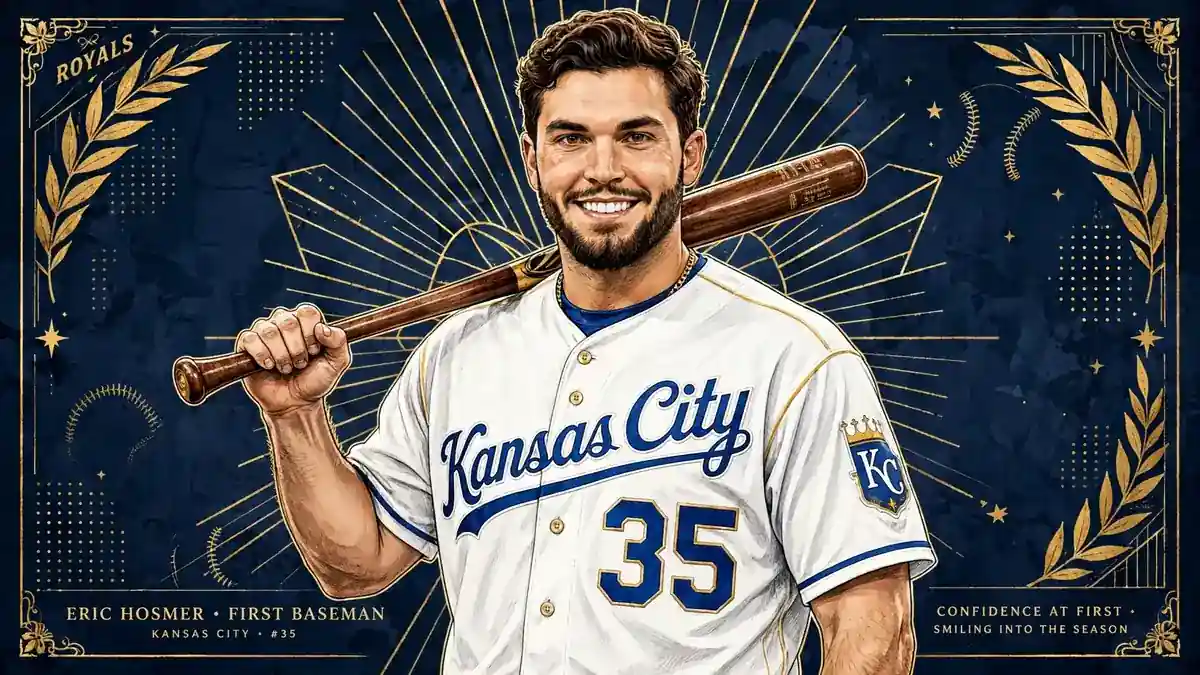
Eric Hosmer‘s net worth is estimated at $50 million to $70 million as of November 2026. The former Kansas City Royals first baseman banked about $143 million in cash across a 13-season major league career, signed an eight-year, $144 million contract with the San Diego Padres in 2018, and retired in February 2024 to build a media company — then returned to baseball in 2026 as a Royals television analyst and an MLB Network analyst.
Eric Hosmer: Quick Facts
| Estimated net worth | $50 million – $70 million (range: $50 million to $70 million) |
|---|---|
| Profession | Former MLB first baseman; media founder and baseball broadcaster |
| Nationality | American |
| Born | October 24, 1989 (age 37) |
| Height | 6 feet 4 inches (193 cm) |
| Primary income sources | MLB salaries and signing bonus, deferred contract payments, broadcasting, MoonBall Media |
| Active years | 2011–2023 (MLB); 2024–present (media and broadcasting) |
| Last reviewed | November 2026 |
- Early Life and Background
- Education
- Career Journey
- Rise to Fame
- Main Sources of Income
- Salary and Earnings
- Businesses and Investments
- Brand Deals and Sponsorships
- Houses, Cars and Other Assets
- Awards and Achievements
- Net Worth Growth Over the Years
- Social Media Presence
- Personal Life
- Sources & Reporting
- Frequently Asked Questions
- Final Thoughts
Early Life and Background
Eric John Hosmer was born on October 24, 1989, in South Miami, Florida, to Mike and Ileana Hosmer. His father worked in firefighting, and his mother, Ileana, was born in Cuba — a family background Hosmer has spoken about with pride, and one that placed him in the long line of Cuban-American ballplayers who shaped South Florida baseball. He grew up in a household where baseball was a daily language: his older brother, Mike Hosmer Jr., born in 1985, played the game seriously enough to earn a baseball scholarship to Florida State University before choosing a different path as a stockbroker in Miami.
South Florida in the 1990s and 2000s was one of the most competitive amateur baseball nurseries in the United States, and Hosmer’s talent surfaced early. He was a big, left-handed-hitting first baseman with a smooth swing and soft hands around the bag — the kind of prospect scouts circle in a notebook the first time they see him take batting practice. By his mid-teens he was already on the radar of every major league club, and the question was never whether he would be drafted, but how high.
What set Hosmer apart from other tall, powerful high school hitters was plate discipline that looked years ahead of his age. He did not chase pitches out of the zone the way most teenage sluggers do, and he used the whole field instead of selling out for pull-side power. That approach followed him through every level of professional baseball and became the foundation of a career that produced a .276 lifetime average and nearly 200 home runs. It also mattered financially: players who reach the majors young and stay healthy through their arbitration years arrive at free agency at peak value, and Hosmer’s timeline — drafted at 18, in the majors at 21 — put him in line for a nine-figure contract before his 29th birthday.
The family stayed close as his career took off. His brother’s move into finance gave Hosmer a sounding board inside his own family when the money started arriving in eight-figure sums, and his parents remained a steady presence through the moves from Kansas City to San Diego to Boston to Chicago. That stability shows up in the way his post-playing life has unfolded: rather than chasing a comeback or a coaching job, he retired on his own terms at 34 and went straight into building a business.
Education
Hosmer attended American Heritage School in Plantation, Florida, one of the strongest high school baseball programs in the country. American Heritage has produced a steady stream of major leaguers, and its Broward County campus plays a schedule loaded with elite travel-ball talent and nationally ranked opponents — exactly the environment a top prospect needs to be tested before the draft.
His senior season made the decision easy for scouts. Hosmer hit for average and power against the best pitching Florida high schools could offer, and he carried himself like a player who already understood the professional game. The Kansas City Royals selected him with the third overall pick in the 2008 MLB draft, and he signed for a $6 million signing bonus — the largest bonus ever given to a draft pick in Royals history, according to Wikipedia’s account of the signing.
He never played college baseball. The $6 million bonus, the third-overall pedigree, and a direct path to the majors made the professional route the obvious choice, and the Royals moved him aggressively through their system. That decision shaped his earnings curve in a way that is easy to miss: by skipping college and three years of development outside pro ball, Hosmer reached the major leagues at 21 and reached free agency at 28, the sweet spot for a position player. A college player drafted at the same talent level would typically have arrived two or three years later and hit the open market closer to 30, when teams start discounting for decline.
His schooling, in the practical sense, happened in the minor leagues — Burlington, Wilmington, Northwest Arkansas and Omaha — where he learned to handle failure, travel, and the daily grind of professional baseball. At Wilmington in 2010 he won a batting crown, a sign that the hit tool scouts loved in high school was translating against professional pitching. The education that mattered most to his bank account, though, was the one he got from his first contract negotiation: the Royals paid a record bonus for a teenager because they believed he was a franchise cornerstone, and seven years later that belief was repaid with a World Series title.
Career Journey
Hosmer’s professional career began in the Royals’ farm system in 2008, and his rise was fast by any measure. After the record signing bonus, he spent 2009 working through the low minors, then broke out at Wilmington in 2010, where his batting title announced him as one of the best hitting prospects in baseball. The Royals promoted him aggressively, and on May 6, 2011, at 21 years old, he made his major league debut with Kansas City.
His rookie season set the tone: a .293 average with 19 home runs and 78 runs batted in, numbers that placed him among the best first-year players in the American League. The Royals had a core coming together at the same moment — Hosmer at first, Salvador Pérez behind the plate, Mike Moustakas at third, Lorenzo Cain and Alex Gordon in the outfield, and a bullpen built to shorten games. Kansas City’s plan was to grow a contender from within rather than buy one, and Hosmer was the highest-drafted piece of it.
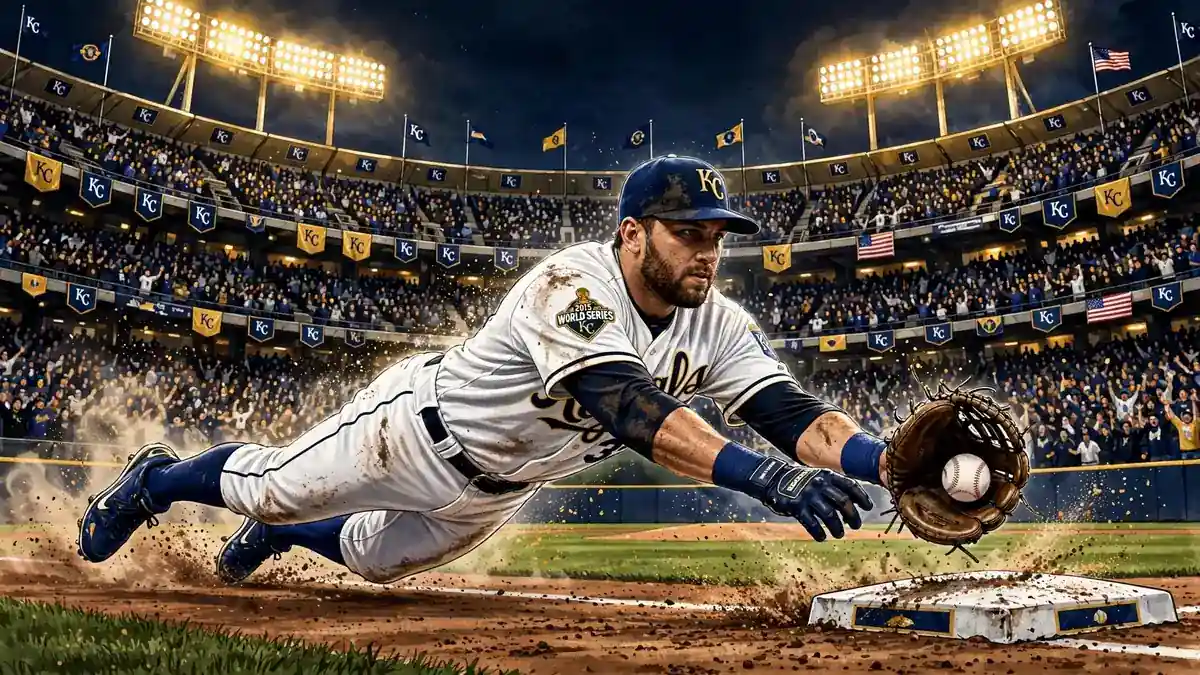
The middle years tested him. His sophomore season in 2012 was a sharp step back, a .232 average that raised questions about whether pitchers had found a hole in his swing. He answered in 2013 with a .302 season and his first Gold Glove, the first of four he would win in Kansas City. The Royals reached the World Series in 2014, losing a seven-game classic to the San Francisco Giants, and then finished the job in 2015, beating the New York Mets in five games for the franchise’s first championship in 30 years. Hosmer drove in the tying run in the ninth inning of the decisive Game 5 with a daring dash home on a ground ball — a play that still ranks among the most famous baserunning moments in World Series history.
Over seven seasons in Kansas City, Hosmer hit .284 with 127 home runs and 566 runs batted in, according to MiLB.com’s account of his Royals tenure. He won Gold Gloves in 2013, 2014, 2015 and 2017, made the All-Star team in 2016 and was named the All-Star Game’s Most Valuable Player, and won a Silver Slugger in 2017 after hitting .318 with 25 home runs and 94 runs batted in — the best offensive season of his life. He also won a gold medal with Team USA at the 2017 World Baseball Classic, a tournament that added an international honour to a résumé already full of team and individual prizes.
Free agency arrived after the 2017 season, and the bidding for a 28-year-old first baseman coming off a career year was fierce. The Royals wanted him back. The Boston Red Sox and others circled. On February 17, 2018, he signed with the San Diego Padres: eight years and $144 million, with a $5 million signing bonus, the richest contract in Padres history at the time. The structure was front-loaded — $105 million over the first five seasons and $39 million over the final three — with an opt-out clause after five seasons that Hosmer ultimately never used.
San Diego did not go as planned. Hosmer’s bat never matched his Kansas City peak in a Padres uniform, and as the club’s young core matured around Fernando Tatis Jr. and Manny Machado, his contract became the one the front office most wanted to move. The end came in stages: first, a blocked trade — he used his limited no-trade clause to veto a deal that would have sent him to Washington as part of the Juan Soto blockbuster in August 2022 — then a trade to the Boston Red Sox on August 2, 2022, along with minor leaguers Max Ferguson and Corey Rosier, for pitcher Jay Groome. Boston released him that December, and he signed a one-year, $720,000 deal with the Chicago Cubs on January 13, 2023, essentially playing for the league minimum while San Diego kept paying the bulk of his contract. The Cubs released him on May 25, 2023, after he hit .234 with two home runs in 31 games. His final major league appearance came on May 16, 2023.
He did not play in 2023 after the release, and on February 21, 2024, he announced his retirement in an Instagram post, closing a 13-season career with a .276 average, 198 home runs and 893 runs batted in. The same announcement launched his second act: MoonBall Media, a media and production company built with former minor league teammate Anthony Seratelli.
Rise to Fame
Hosmer’s fame was built the old-fashioned way — by winning, young, on a team America could root for. The Royals’ 2014–2015 run turned a group of homegrown players into national figures, and Hosmer, the former third overall pick who had been hyped since high school, was the face of it at first base. The 2015 World Series made him a household name in a way that regular-season numbers never could: his ninth-inning dash home in Game 5 is replayed every October, and it tied his name permanently to one of the most joyful championship runs of the decade.
The 2016 All-Star Game sharpened his profile further. Hosmer homered and was named the game’s Most Valuable Player, a showcase moment that put him in front of a national audience as the Royals’ representative star. The following season, his .318 average and Silver Slugger gave him the best statistical season of his career at exactly the right time — the walk year before free agency, when every hit was worth money.
What made his rise unusual was its timing inside baseball’s economics. Hosmer reached free agency at 28, fresh off a career year, in a winter when teams were still paying premiums for first basemen with his track record. The $144 million Padres deal made him one of the highest-paid players at his position and put his name on every list of the game’s richest contracts. That contract, more than any single season, is what turned a very good career into a $50 million-plus fortune: the guaranteed money kept flowing even after his production faded, because baseball contracts are fully guaranteed and San Diego remained on the hook for the deal through 2025.
His fame also carried a second current that mattered later. Hosmer was known as a clubhouse leader and a thoughtful interview — the player reporters sought out after a tough loss and the one young teammates looked to in a pennant race. That reputation is the reason his retirement pivot into media felt natural rather than forced: he had spent 13 years telling the game’s stories in clubhouses, and in 2024 he started telling them on his own platforms. The 2026 move into the Royals’ television booth and onto MLB Network completed the circle, bringing him back to the franchise where he became famous, this time with a microphone instead of a glove.
Main Sources of Income
Hosmer’s wealth comes from four streams, and the first dwarfs the other three. Major league salaries and bonuses account for the overwhelming majority of his fortune: roughly $143 million in cash received during his playing career, with more still arriving in deferred payments from the Padres contract. Everything else — equipment deals, media work, and broadcasting — is real income, but it sits in the low seven figures at most, a rounding error next to the baseball money. That split is typical of players whose value was set by one huge free-agent contract: the contract is the fortune, and the rest is the life built around it.
The second stream, deferred and residual contract payments, is the one fans most often misunderstand. When the Padres traded Hosmer in 2022, they did not escape his contract — they kept paying it. San Diego remained responsible for the bulk of the $144 million deal, covering the difference between his $13 million annual salary in the final years and the league-minimum amounts Boston and then Chicago paid. That is why the gap between Spotrac’s $142.95 million in cash earnings and Salary Sport’s $169.47 million career total exists: the higher figure counts the full value of the contract, including money scheduled to arrive after he stopped playing. By the end of 2025, the Padres’ obligation on the deal was complete, which means Hosmer’s playing income is now fully in the rear-view mirror and his 2026 earnings come from media work.
The third stream is media and broadcasting. MoonBall Media, launched at retirement, produces the Diggin’ Deep podcast and original unscripted programming, with revenue from advertising, sponsorships, and free ad-supported streaming television channels. In 2026 he added two salaried broadcast roles: analyst for Royals.TV, the Royals’ television home, and analyst for MLB Network, where he debuted on March 25, 2026, on MLB Central and MLB Now. Local and national analyst pay for a former star with his profile runs into six figures a year — meaningful income, and a durable one, but not the kind of money that moves a $50 million-plus net worth by itself.
The fourth stream, endorsements and equipment deals, was always modest for Hosmer. First basemen without huge home run totals or a massive social following do not command the shoe and beverage deals that outfielders and pitchers do, and Hosmer’s commercial profile reflected that. He earned money from his glove, bat and apparel relationships and from trading-card and memorabilia deals, but no single endorsement ever approached his baseball salary. His public profile also includes paid appearances and the kind of alumni and team events that pay former champions for their time — steady, small-scale income that adds up over a decade without ever making headlines.
Salary and Earnings
The cleanest way to understand Hosmer’s fortune is to walk through the money year by year. The Baseball Cube’s salary record, which tracks the public figures for every season of his career, shows a classic star-player curve: a slow climb through the league-minimum and arbitration years, a sharp jump at free agency, and a long, guaranteed tail.
He began at the bottom of the scale. In 2011, his rookie season, he earned $414,000 — the major league minimum at the time — on top of the $6 million signing bonus he had banked three years earlier. His pay stayed modest through his first arbitration years: $528,000 in 2013, then a two-year, $13.9 million deal signed in February 2015 that paid $5.65 million in 2015 and $8.25 million in 2016. His final arbitration season, 2017, paid $12.25 million — the reward for a career year and a Gold Glove.
Then came the Padres contract, and the numbers changed completely. Hosmer earned $20 million in 2018, $20 million in 2019, $21 million in 2020 and $21 million in 2021, before the deal stepped down to $13 million a year for its final three seasons. The Baseball Cube totals his major league salaries at $134,539,750 across 13 seasons — and that figure excludes the $6 million signing bonus, which lifts his playing compensation past $140 million before any deferred accounting.
| Season | Team | Salary |
|---|---|---|
| 2011 | Kansas City Royals | $414,000 |
| 2013 | Kansas City Royals | $528,000 |
| 2015 | Kansas City Royals | $5,650,000 |
| 2016 | Kansas City Royals | $8,250,000 |
| 2017 | Kansas City Royals | $12,250,000 |
| 2018 | San Diego Padres | $20,000,000 |
| 2019 | San Diego Padres | $20,000,000 |
| 2020 | San Diego Padres | $21,000,000 |
| 2021 | San Diego Padres | $21,000,000 |
| 2022 | San Diego Padres / Boston Red Sox | $20,000,000 |
| 2023 | Chicago Cubs | $720,000 |
Two points about that table deserve attention because they explain the net worth range. First, the 2022 and 2023 rows hide the contract’s real mechanics: Hosmer’s pay in those years still came mostly from San Diego, which covered the gap between the $13 million-plus he was owed under the Padres deal and the league-minimum salaries Boston and Chicago paid. Second, the $6 million signing bonus from 2008 is easy to forget, but it was life-changing money for an 18-year-old and the seed capital of everything that followed — invested early, it had 15 years to compound before retirement.
How does his pay stack up against his peers? Salary Sport ranks Hosmer 50th on baseball’s all-time career earnings list at $169,472,156, a remarkable position for a first baseman who never led the league in home runs. The comparison with the game’s current giants is instructive: Shohei Ohtani’s $700 million Dodgers deal and Aaron Judge’s $360 million Yankees contract show how far the market has moved since Hosmer signed in 2018 — his $144 million deal, the richest in Padres history when he inked it, would barely crack the top tier today. That is not a knock on Hosmer; it is a measure of how quickly baseball salaries inflated, and it explains why his fortune, while large, sits below the sport’s current superstars.
One more number frames the whole picture: taxes, agent fees and living costs. A player who grosses $143 million in cash does not keep $143 million. Federal and state taxes on multi-million-dollar salaries in California, Missouri, Massachusetts and Illinois, plus a standard agent commission of around 3–5% and the costs of a professional athlete’s life, take a large share before a dollar is invested. That is the honest reason our estimate is $50 million to $70 million rather than $100 million-plus — and it is also why the $2 million figures still floating around on old bio pages are impossible to defend: they date from before the Padres contract even existed, and they ignore $143 million in documented cash earnings.
Businesses and Investments
MoonBall Media is Hosmer’s main business, and it is also his retirement plan. He launched the company on the same day he announced his retirement — February 21, 2024 — with former minor league teammate Anthony Seratelli, telling Forbes’ John Perrotto that it would produce original unscripted programming, a weekly podcast, social media content and free ad-supported streaming television (FAST) channels. The flagship show, Diggin’ Deep, features Hosmer digging into the routines and mindsets of players and coaches, with former major league reliever Peter Moylan and process and development coach Justin Su’a as his original co-hosts; by 2025 the hosting group included former Royals teammate Mike Moustakas alongside Moylan.
The business model is the one every ex-athlete media company chases: own the audience, sell the attention. Podcast advertising, YouTube revenue, brand partnerships and FAST channel distribution each pay a slice, and the company’s value lies in its library and its host’s Rolodex rather than in hard assets. InfoSeeMedia’s November 2026 profile of Hosmer notes the venture is still early-stage and its earnings speculative — a fair assessment. A realistic read is that MoonBall Media is a six-to-seven-figure annual business in its early years, not a nine-figure one, and its real payoff would come if it scales into a multi-show network or a sale to a larger media group.
Broadcasting is the steadier half of his second act. In March 2026 the Royals announced he would join their television broadcast crew as an analyst for Royals.TV, and days later MLB Network added him as an on-air analyst for the 2026 season, with his debut on March 25 on MLB Central and MLB Now. He had already worked as a guest analyst for MLB Network in 2025 and contributed to pregame and postgame coverage for Friday Night Baseball on Apple TV+. The two roles complement each other — local credibility in Kansas City, national exposure in New Jersey — and together they give him a reliable six-figure income with a public profile that keeps MoonBall Media’s audience growing. Like other retired stars who moved into the booth — Mike Ditka built a long second career in broadcasting after coaching — Hosmer has turned name recognition into a durable paycheck.
On investments, the public record is thin, and we will not fill the gap with guesses. No filing, interview or reliable report ties Hosmer to a named startup stake, a fund, or a business outside MoonBall Media. His brother’s career as a Miami stockbroker is a matter of public record, and it is reasonable to assume Hosmer had professional advice on his money, but the specifics of his portfolio — stocks, bonds, private deals — are not public and do not belong in an estimate dressed up as fact. What the record does show is the shape of a sensible post-career plan: guaranteed money still arriving through 2025, a media company with low overhead, and two broadcast chairs that pay him to talk about the game he knows best.
Brand Deals and Sponsorships
Hosmer’s endorsement portfolio was built around his tools, not his fame. What Pros Wear, which tracks the gear professionals actually use, records his path through the equipment world: he started his career in Under Armour cleats and batting gloves, shifted to Adidas for cleats and gloves after the move to San Diego, swung Dove Tail and Zinger maple bats with a Lizard Skin wrap, and carried one of the prettiest gloves in the game — a blue Rawlings Heart of the Hide DCT first base mitt with gold labels. Those relationships were working deals with equipment companies, the kind that pay in gear, appearances and modest fees rather than in national television campaigns.
CelebBlinks lists Gatorade, Rawlings and Topps among his endorsement associations, and that trio tells the story accurately: a sports drink, a glove maker, and a trading card company — all baseball-native brands, none of them a lifestyle or fashion deal. Topps matters more than it might look: a player of Hosmer’s standing earns from autograph and memorabilia agreements for years after retirement, as collectors chase signed cards from the 2015 championship team. Gatorade’s presence on the list reflects the standard hydration deals offered to established major leaguers, not a signature campaign.
The honest assessment is that endorsements were never a major pillar of Hosmer’s wealth. He played first base, hit for average rather than tape-measure power, and built his reputation on defence and leadership — qualities that win Gold Gloves and clubhouse respect, not sneaker lines. The sport’s endorsement money concentrates on a small group of global stars, and Hosmer was never in that group. His equipment deals likely added low six figures a year at their peak, a useful supplement to a $20 million salary and nothing more. That restraint is part of why his net worth estimate is built almost entirely on his contracts: there is no hidden endorsement fortune to add, and we will not invent one.
Houses, Cars and Other Assets
Hosmer’s property record reads like a map of his career: a home for each stop, bought and sold as the teams changed. The best-documented sale came after the Boston stint, when he listed his West Newton, Massachusetts, home for $6.5 million in early 2023, shortly after the Red Sox released him. The five-bedroom, five-bathroom house, marketed by Douglas Elliman, was the kind of property a player buys when he expects to stay — and the listing was the market’s verdict that he would not.
The purchase that followed tells the other side of the story. In September 2022, as his first child was about to arrive, Hosmer and his wife Kacie bought a home in Studio City, Los Angeles, for $6.15 million, according to The Wall Street Journal’s reporting on the deal. The 6,053-square-foot estate came with a gourmet kitchen, an outdoor bar gazebo, a pool, a basketball court, lush landscaping and a one-bedroom guest house — a family home, bought to put down roots, in Hosmer’s own words to the Journal. The timing matters: he bought it while still under the Padres contract, with guaranteed money still flowing, and it remains the clearest single asset in his public property record.
Earlier stops left fewer traces. He kept a base in the San Diego area during his Padres years and has longstanding ties to South Florida, where he grew up and where his family still has roots, but no verified purchase prices attach to those homes in the public record, so we will not assign numbers to them. The same discipline applies to cars: no reliable report documents a Hosmer car collection, a signature vehicle, or a luxury purchase, and his public image has always been low-key on that front. A first baseman who spent his career being praised for hustle and humility does not advertise his garage, and the absence of car stories is itself a small piece of evidence about how he spends.
What can be said with confidence is that real estate is a meaningful but modest slice of his wealth. Two homes in the $6 million range, even held outright, represent a fraction of a $50 million-plus fortune — and the Studio City purchase, made with a young family in mind, looks like a home first and an investment second. The bulk of his assets sits where it sits for most retired athletes with guaranteed contracts: in the bank, in investments managed with professional advice, and in the deferred money that kept arriving through 2025.
Awards and Achievements
Hosmer’s trophy case is the record of a player who was excellent at more things than the box score captures. The headline honours: a World Series championship with Kansas City in 2015, an All-Star selection in 2016 with the All-Star Game’s Most Valuable Player award, four Gold Glove Awards (2013, 2014, 2015 and 2017), a Silver Slugger Award in 2017, and a gold medal with Team USA at the 2017 World Baseball Classic.
The Gold Gloves deserve a closer look because they explain his value to the Royals. First base defence is easy to underrate — the position looks simple until a bad throw sails and the inning falls apart — and Hosmer was the best in the American League at it for most of a decade. He won three straight from 2013 to 2015 and a fourth in 2017, and his scoops and stretches saved his infielders’ errors so often that it became a running feature of Royals broadcasts. His 2017 season paired the fourth Gold Glove with the Silver Slugger, making him one of the rare first basemen to be honoured as the league’s best at his position on both sides of the ball in the same year.
The 2015 World Series is the achievement that defines him. The Royals beat the Mets in five games, and Hosmer’s ninth-inning dash home in the clincher — scoring from third on a ground ball to first, a play that should have ended the inning — forced extra innings and set up the title. It was a pure instinct play, the kind that cannot be taught, and it is the single moment most fans picture when they hear his name. The 2016 All-Star MVP added a national showcase honour, and the 2017 World Baseball Classic gold gave him an international title in the same year as his best statistical season.
For a sense of how his era compares with the one before it, consider Orel Hershiser, the Dodgers ace whose 1988 season remains one of the great pitching years ever: Hershiser’s entire career earnings were a fraction of Hosmer’s single Padres contract, because the salary scale of the 1980s and 1990s was a different world. Hosmer’s honours are not bigger than Hershiser’s — but the money attached to them was, and that gap is the story of baseball economics as much as of either player.
Net Worth Growth Over the Years
No outlet has published a year-by-year audit of Hosmer’s wealth, so the table below is our modelled path, built from his documented earnings and labelled as an estimate. It shows the shape of the story rather than a bank statement: slow growth while he was on rookie and arbitration pay, a steep jump when the Padres contract landed, and a plateau in retirement as playing income stopped and media income began.
| Year | Estimated net worth | What moved it |
|---|---|---|
| 2011 | $4 million – $6 million | $6 million signing bonus, rookie salary of $414,000 |
| 2013 | $6 million – $8 million | First Gold Glove, arbitration pay beginning |
| 2015 | $12 million – $16 million | World Series title, $5.65 million salary |
| 2017 | $20 million – $25 million | Career year, $12.25 million salary, free agency ahead |
| 2018 | $30 million – $38 million | Eight-year, $144 million Padres contract signed |
| 2021 | $40 million – $50 million | Four $20M+ seasons banked, $21 million salary |
| 2023 | $45 million – $55 million | Final playing year, deferred Padres money still flowing |
| 2025 | $50 million – $60 million | Padres obligation completing, MoonBall Media under way |
| 2026 | $50 million – $70 million | Broadcast roles added, freshest reporting at $70 million |
Three things stand out in that path. First, the $144 million contract is the whole story of the jump between 2017 and 2021: without it, Hosmer’s career would have produced a comfortable fortune in the $20 million range, and with it, he entered the $50 million class. Second, the range widens rather than narrows at the top, because the published figures disagree — $50 million across several 2024–2025 outlets, $70 million in InfoSeeMedia’s November 2026 update — and the honest response to disagreement is a range, not a false point estimate. Third, the 2026 plateau is a feature, not a failure: a retired player whose guaranteed money has run out should expect his net worth to grow slowly, from investment returns and media income, rather than by $20 million a year.
The stale figures that still circulate deserve a direct answer. Several bio pages still list Hosmer’s net worth at $2 million, and one at $8 million. Both date from before the Padres contract, and both are impossible to square with $143 million in documented cash earnings. They survive because low-quality bio sites copy each other without checking, and they are a reminder of why this article leads with its method: a number without a source and a date is not information.
Social Media Presence
Hosmer’s social media presence is professional rather than personal-brand driven. His Instagram account, @hosmer305 — the 305 is Miami’s area code, a nod to where he grew up — was the platform he chose for his retirement announcement in February 2024, and it remains his main channel for career news, family moments and MoonBall Media promotion. He is also active on X, where his posts mix baseball commentary with podcast clips and the occasional throwback to the Royals’ championship run.
He has never been a volume poster or a controversy merchant, and his following reflects that: a solid audience of Royals and Padres fans, baseball media, and former teammates, rather than the multi-million follower counts of the game’s global stars. That matters commercially — a smaller, baseball-focused audience is worth more to a baseball podcast’s advertisers than a large, indifferent one — and it fits the MoonBall Media strategy, which sells depth of engagement to baseball brands rather than raw reach.
The most important social platform for his second act is not his personal account at all, but the Diggin’ Deep podcast’s feeds, where clips of his conversations with players and coaches circulate among baseball fans. His 2026 broadcast roles give that content a new engine: every Royals.TV appearance and MLB Network segment is a chance to point viewers toward the podcast, and every podcast episode is a chance to show the networks what he can do on camera. The loop is the business.
Personal Life
Hosmer is married to Kacie McDonnell, a television host and reporter who works as a Fox News talent and hosts Mansion Global on Fox Business. Born on July 30, 1990, in Pottsville, Pennsylvania, McDonnell graduated from Villanova University in 2012 and built a career in local television — including a stint as a traffic reporter at KSHB in Kansas City, where the two met in April 2015 — before moving to Fox. She previously worked for the New England Sports Network covering Boston sports, a posting that overlapped with Hosmer’s brief Red Sox stay in 2022.
The couple made their relationship public in June 2015, got engaged in October 2020, and married on December 31, 2021, at The Breakers resort in Palm Beach, Florida, with members of the 2015 Royals championship team among the guests. Their son, Jack Francis Hosmer, was born in September 2022 — InfoSeeMedia gives the date as September 11, 2022 — and the couple bought their Studio City home that same month, timing the move to the baby’s arrival. InfoSeeMedia also reports a daughter, Portia Knight Hosmer, born on September 27, 2024; other outlets list only one child, so we note the second child as reported by that single outlet rather than as settled fact.
Family shapes the public picture of Hosmer more than most ballplayers’ families do, because his wife’s job puts her on television too. McDonnell has spoken about the move from Kansas City to San Diego to Boston as a shared professional decision that shaped both of their careers, and her own career — she has reported a net worth of around $1 million in her own right — means the household has two media incomes rather than one. The couple now splits time between their California home and his broadcast work, with Kansas City a regular stop again since the Royals.TV role began.
Off the field, Hosmer keeps a lower profile than his salary might suggest. He has supported children’s health causes, a focus his wife shares, and he has stayed connected to the Royals organisation through alumni events and the 2015 team’s reunions. He does not court celebrity outside baseball, and his social feeds are notably free of the luxury flexing that fills other athletes’ accounts — a choice that fits with everything else in his story, from the Studio City family home to the media company built on long conversations rather than hot takes.
Sources & Reporting
Spotrac — career cash earnings of $142.95 million and the $144 million Padres contract total; the baseline for the salary section. Reporting window: career through retirement, accessed November 2026.
Forbes — John Perrotto’s February 21, 2024 report of Hosmer’s retirement and the launch of MoonBall Media, including the company’s planned programming. Reporting window: February 2024.
Sporting News — retirement coverage and the Spotrac earnings summary, including the $168.95 million total contract value once deferred money is counted. Reporting window: February 2024.
Wikipedia — career statistics (.276 average, 198 home runs, 893 runs batted in), teams, awards, the $6 million signing bonus as the largest in Royals draft history, and the February 21, 2024 retirement date. Reporting window: career record, last checked November 2026.
The Baseball Cube — year-by-year salaries totalling $134,539,750, the $6 million bonus, and the Padres contract structure ($105 million over five years, $39 million over the final three). Reporting window: 2008–2023 contracts.
Salary Sport — career earnings total of $169,472,156 and the all-time ranking (50th of 2,957 players). Reporting window: career earnings, accessed November 2026.
Barrett Media — MoonBall Media and Diggin’ Deep launch details, and the March 12, 2026 report of Hosmer joining MLB Network as an analyst. Reporting window: February 2024 and March 2026.
Awful Announcing — the March 6, 2026 announcement that Hosmer would join the Royals’ television broadcast crew for Royals.TV. Reporting window: March 2026.
CelebBlinks — the $50 million net worth estimate, marriage date of December 31, 2021, and the Gatorade, Rawlings and Topps endorsement associations. Reporting window: 2025 profile.
InfoSeeMedia — the $70 million November 2026 net worth estimate, family dates including the children’s birth dates, and the MoonBall Media summary. Reporting window: updated June 2026, figures as of November 2026.
MiLB.com — Hosmer’s Royals totals (.284, 127 home runs, 566 runs batted in) and the February 2018 Padres signing announcement. Reporting window: 2017–2018.
What Pros Wear — equipment history: Under Armour to Adidas, Dove Tail and Zinger bats, Lizard Skin wrap, and the Rawlings Heart of the Hide DCT glove. Reporting window: gear record, accessed November 2026.
Yardbarker (syndicating MLB Trade Rumors) — the note that Baseball Reference lists his career earnings at just under $175 million. Reporting window: February 2024.
The Wall Street Journal — the September 2022 Studio City home purchase for $6.15 million, as reported in listing coverage. Reporting window: September 2022.
Douglas Elliman — the $6.5 million listing of Hosmer’s West Newton, Massachusetts home in early 2023. Reporting window: January 2023.
Where sources disagree — most visibly on the net worth figure itself — this article publishes the range and names who says what, rather than picking the number that makes the best headline. Figures labelled as NetWorthCraft estimates, including the year-by-year growth table, are modelled from the documented earnings above and are not attributed to any outside outlet.
Frequently Asked Questions
What is Eric Hosmer’s net worth in 2026?
Eric Hosmer’s net worth is estimated at $50 million to $70 million as of November 2026. The $50 million figure appears across several 2024–2025 outlets, while the freshest reporting, from InfoSeeMedia in November 2026, puts it at $70 million. We publish the range because no outlet shows its math, and the gap between the two figures is the honest measure of the uncertainty.
How much money did Eric Hosmer make in his MLB career?
Spotrac puts his cash earnings at $142.95 million across 13 seasons, built on a $6 million signing bonus and the eight-year, $144 million Padres contract. Salary Sport’s fuller tally, which counts deferred money still owed after his release, reaches $169,472,156, and MLB Trade Rumors noted that Baseball Reference lists his career earnings at just under $175 million. The differences come down to cash received versus total contract value including deferred payments.
What is Eric Hosmer doing now after retirement?
He runs MoonBall Media, the media and production company he co-founded with Anthony Seratelli when he retired in February 2024, and hosts its Diggin’ Deep podcast. In 2026 he added two broadcast roles: analyst for Royals.TV, the Royals’ television home, and analyst for MLB Network, where he debuted on March 25, 2026.
Why did the Padres trade Eric Hosmer?
His production had fallen below the level his $144 million contract implied, and the Padres wanted his salary off their books as their younger core matured. He first used his limited no-trade clause to veto a deal that would have sent him to Washington as part of the Juan Soto trade in August 2022, then accepted a trade to the Boston Red Sox on August 2, 2022. San Diego kept paying the bulk of his contract after the trade, because baseball contracts are fully guaranteed.
Is Eric Hosmer married?
Yes. He married television host Kacie McDonnell on December 31, 2021, at The Breakers in Palm Beach, Florida. McDonnell hosts Mansion Global on Fox Business. Their son, Jack Francis Hosmer, was born in September 2022, and InfoSeeMedia reports a daughter, Portia Knight Hosmer, born in September 2024.
How tall is Eric Hosmer?
Eric Hosmer is 6 feet 4 inches tall (193 cm). His size was part of his profile as a first baseman — a big target at the bag with the reach to save errant throws, which helped him win four Gold Glove Awards.
When did Eric Hosmer retire?
He announced his retirement on February 21, 2024, in an Instagram post, after 13 major league seasons. His final game had come on May 16, 2023, for the Chicago Cubs, who released him nine days later. He was 34 when he retired.
What teams did Eric Hosmer play for?
He played for four teams: the Kansas City Royals (2011–2017), the San Diego Padres (2018–2022), the Boston Red Sox (2022) and the Chicago Cubs (2023). He won the 2015 World Series with the Royals, the team that drafted him third overall in 2008.
Final Thoughts
Eric Hosmer’s fortune is a story about one contract and the discipline to let it do its work. The $144 million Padres deal, signed at 28 after the best season of his life, guaranteed him generational wealth even as his bat faded and the teams changed around him — and the $50 million to $70 million estimate reflects what survives of $143 million in cash earnings after taxes, fees and a decade of living. The stale $2 million figures still floating around the web belong to a different era, before the contract existed, and they are worth ignoring.
What makes his case interesting in 2026 is the second act. Most retired players with his money disappear into private life; Hosmer went the other way, building a media company at retirement and then taking two broadcast chairs in the same spring. MoonBall Media and the Royals.TV and MLB Network roles will not double his fortune, but they do something more valuable for a 37-year-old with decades ahead of him: they keep him relevant, employed, and in control of his own story. The World Series ring bought the first fortune. The microphone is how he protects it.
Published on November 17, 2026. Last reviewed November 2026. Found an error? See our corrections policy.