
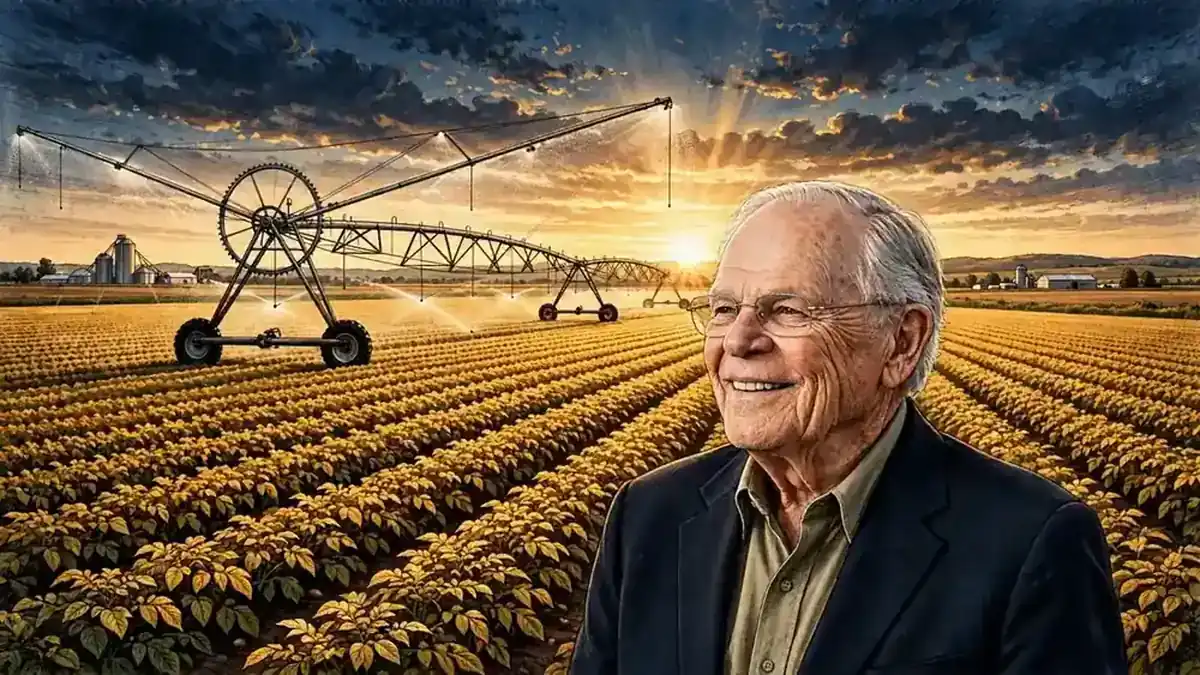
Ron Offutt‘s net worth is estimated at $500 million to $600 million as of November 2026. The North Dakota farmer who started with a 200-acre family potato farm built R.D. Offutt Company into the largest potato grower in the United States, turned a single John Deere dealership bought for $100,000 into the biggest Deere network on earth, and became the richest person in his state along the way — all while supplying the potatoes behind McDonald’s french fries.
Ron Offutt: Quick Facts
| Estimated net worth | $500 million (range: $500 million to $600 million) |
|---|---|
| Profession | Agricultural entrepreneur; founder of R.D. Offutt Company and RDO Equipment Co. |
| Nationality | American |
| Born | November 13, 1942 (age 84) |
| Height | Not publicly disclosed |
| Primary income sources | Potato farming, food processing, John Deere equipment dealerships, farmland |
| Active years | 1964–present |
| Last reviewed | November 2026 |
- Early Life and Background
- Education
- Career Journey
- Rise to Fame
- Main Sources of Income
- Salary and Earnings
- Businesses and Investments
- Brand Deals and Sponsorships
- Houses, Cars and Other Assets
- Awards and Achievements
- Net Worth Growth Over the Years
- Social Media Presence
- Personal Life
- Sources & Reporting
- Frequently Asked Questions
Early Life and Background
Ronald D. Offutt Jr. was born on November 13, 1942, in Orrick, Missouri, and moved with his parents to Moorhead, Minnesota, shortly after. He grew up on his family’s potato farm outside Moorhead, the fourth generation of a farming family whose roots in American agriculture stretch back to the late 1600s, according to RDO Equipment’s own company history. His father, Ronald Offutt Sr., ran a 200-acre potato operation with what Ron later described as only a moderate amount of success — enough to keep the family going, not enough to make anyone rich.
The farm gave Ron his first job before he was old enough for school. He has told interviewers that his earliest memory of farming is potato harvest in the fall with his father, driving the truck at six years old while people walked alongside with potato sacks. By 12, his father was giving him real responsibility: the company history records that the young Offutt was allowed to fire four farm workers at that age. It was an unusual childhood, and it shaped a businessman who later said he learned more about managing people on that farm than anywhere else.
Moorhead sits on the Minnesota side of the Red River, across from Fargo, North Dakota, in some of the best potato country in America. The Red River Valley’s sandy soils and long summer days grow the russet potatoes that fry best, and the region has produced potato growers for generations. Offutt’s family was one of them, but nothing in his early years suggested the scale of what would follow. The farm was 200 acres. Six decades later, the company he founded farms roughly 190,000 acres across several states — nearly a thousand times the ground his father worked.
That leap did not come from one lucky break. It came from a pattern Offutt repeated for 60 years: spot the next shift in how America eats, buy the ground and the machines to serve it, and keep the profits inside the family business. The first shift he spotted was the french fry. In the late 1960s, quick-service restaurants were spreading across the country, McDonald’s was going national, and Burger King was coming into the picture. Offutt saw what that meant before most farmers did: the future of potato growing could be expressed in two words — french fry. He said exactly that in a 1999 Minnesota Public Radio interview, and the line has followed him ever since.
Offutt has been called the “Sultan of Spuds” and the “Lord of the Fries” in press coverage, nicknames that stuck because the numbers behind them are hard to argue with. Minnesota Public Radio reported in 1999 that he grew more potatoes than anyone else in the world. Forbes made the same point in 2013, calling him the fourth-generation Great Plains farmer who grows more potatoes than anyone else on the planet. The nicknames sound like jokes. The acreage behind them is not.
Education
Offutt attended Moorhead High School, then Concordia College in Moorhead, Minnesota, where he graduated in 1964 with a degree in economics. Concordia’s own account of his life notes that he juggled academics, farming, and football on his way through college, keeping a close eye on the family farm while he studied. He played football — an All-Conference selection in 1963 — and wrestled, and former coaches and colleagues have pointed to both sports as the source of a competitive streak that stayed with him through a 55-year business career.
The economics degree mattered more than the diploma suggests. Offutt left Concordia in 1964, interviewed with four insurance companies, and received no job offers. He went back to the farm instead, and within months he had talked his father into selling him half of the property. In his own telling on the RDO Equipment agriculture technology podcast in 2024, he signed a $40,000 note to his father for that half — the property was worth about $80,000 at the time — and farmed it the way his father had for three years. A company history gives a slightly different figure, $48,000, for the same transaction; either way, the deal put a 22-year-old in charge of half a farm with debt he had to work off in the dirt.
Concordia stayed part of his life long after graduation. He served on the college’s Board of Regents for more than 20 years, including several years as its chair, and the school’s business school now carries his name — the Offutt School of Business. That naming followed a large confidential gift from Offutt, reported by BizEd magazine in 2011. One detail worth correcting: some coverage has described the gift as $50 million. The $50 million figure was actually the school’s fundraising goal for its business program and facility, not the size of Offutt’s gift, which Concordia has never disclosed. The distinction matters, because the inflated number now circulates as fact in lower-quality net-worth roundups.
His education also included the kind of training no college offers. Working beside his father taught him potato growing from the ground up — literally — and the three years he farmed after graduation taught him the cash-flow discipline of a business where one bad season can wipe out a year’s work. When the John Deere dealership opportunity arrived in 1968, he was 26, married with two children, and already thinking like an owner rather than an employee.
Career Journey
Offutt’s career divides into three acts, each one built on the last: the farmer, the dealer, and the empire builder. The first act began in 1964, when he partnered with his father to grow potatoes. He farmed for three years, learning the rhythms of planting and harvest and the economics of a crop that has to be sold before it rots. In 1968, the second act arrived by accident. A family friend — the John Deere dealer in Casselton, North Dakota — told Offutt he planned to retire that year and asked whether the young farmer could come up with $100,000 to buy the store.
A hundred thousand dollars was far beyond Offutt’s reach in 1968. He went home, talked to his father, and put together the money the only way he could: they sold a quarter of their land and a potato warehouse, and his grandmother — his father’s mother — lent him $10,000 to close the gap. That is how RDO Equipment Co. began, with borrowed money, sold ground, and a grandmother’s loan. The first tractor he sold was a John Deere 4020, for $6,800. Today a large mower costs twice that, as Offutt himself pointed out on the company podcast in 2024.
He ran the Casselton store for eight years, then started buying more. Lisbon, North Dakota, followed in 1976, LaMoure in 1979, Breckenridge in 1983, Kindred in 1986, and Fargo in 1987. Each purchase followed the same logic: buy a dealership in farm country, keep the staff, and run it as part of a network instead of a single store. The majors in the equipment business wanted nothing to do with multi-store dealership groups at the time, according to Farm Equipment magazine, which profiled Offutt for its Hall of Fame in 2024. Offutt built one anyway, and the model became the industry standard. RDO Equipment is now the largest network of John Deere construction and agricultural equipment dealerships in the world, with more than 75 locations in 10 states according to Concordia College, and 86 stores across 12 states according to Farm Equipment’s 2024 count, plus partnerships in Russia, Ukraine, and Australia. Farm Equipment ranks it the eighth-largest farm equipment company in North America.
The third act — the farming empire — grew alongside the dealerships. In 1970, Offutt started raising irrigated potatoes in the sandy soil of Hubbard County, Minnesota, betting that irrigation and sandier ground would produce the uniform potatoes french-fry buyers wanted. The bet paid off. The big break came in 1973 and 1974, when McDonald’s demand for fries surged and Offutt moved fast: he went out in the winter of 1974 and almost tripled his operation, buying land at a reported $600 an acre to supply the fast-food giant with potatoes for hash browns and fries. That winter changed everything. From there the farming operation grew state by state — Minnesota, North Dakota, South Dakota, Missouri, Texas, Wisconsin, and beyond — until R.D. Offutt Farms was farming more than 100,000 acres in 11 states by 1999, according to Minnesota Public Radio, and about 190,000 acres of farmland in total by 2024, according to Front Office Sports.
Processing came next, because growing potatoes is only half the business. Offutt bought a french-fry processing plant in Atlanta, then built a bigger one in Minnesota — Lamb Weston RDO Frozen — in which he owns half. The Minnesota plant alone used about a billion potatoes a year at the end of the 1990s, according to Minnesota Public Radio, and Farm Equipment reported in 2024 that the company’s fry plant processes 450 million pounds of french fries a year. In 2006, R.D. Offutt formed a joint venture with Japan’s Calbee Corporation to build a plant in Boardman, Oregon, supplying potato products for snack food in Japan and other markets. PotatoPro reported in 2026 that the company manages 11 potato processing facilities across four states. The company also farmed 22,000 acres near Krasnodar, Russia, close to the Black Sea — a reminder that the empire reached well beyond the Red River Valley.
Leadership has now passed to the next generation in daily terms, though Offutt remains chairman emeritus of both companies. His daughter Christi is chair of the company, and his son-in-law Keith McGovern serves as president. Offutt himself said on the Future Farmer podcast circuit in 2024, at 81 years old, that he still enjoys going to work. The Emerging Prairie organization gave him its Lifetime Impact Award in February 2024, honoring a career that started with a $40,000 note and ended with the largest potato operation in the country.
Rise to Fame
Offutt never sought the spotlight, and for most of his career he did not need it. His rise to wider public notice came in two waves: first in the farming and equipment press, where his dealership model and his acreage made him a known figure by the 1990s, and then in the national sports and business press, where his grandson became the story that carried his name to a new audience.
The first wave was built on scale. By 1999, Minnesota Public Radio was calling him the biggest potato grower in the world, farming more than 100,000 acres in 11 states and running 1.8 billion pounds of potatoes a year through his operation, most of them bound for McDonald’s fries. The two-part MPR series — “Spud King’s Success Comes at a Price” and “What Price Success?” — also showed the other side of that scale: neighbors and environmental critics questioning the water use and land conversion behind the growth. That tension has followed the company ever since, and it is part of the story, not a footnote to it.
The second wave arrived in November 2024, when Front Office Sports published its feature “The NFL’s Quiet Heir to a Potato Empire,” about Offutt’s grandson Connor McGovern, then a center for the New Orleans Saints. The piece reported that the Offutt family is the richest in North Dakota, worth more than $500 million, and that McGovern had walked away from more money in the family business than he could earn in the NFL — his grandfather told him so at a family dinner before the 2016 draft. The story ran across sports media within days: 247Sports, talkSPORT, and Total Pro Sports all picked it up, each repeating the $500 million figure and the McDonald’s connection. For a man who had spent 60 years avoiding publicity, it was the most public week of his life, delivered through his grandson’s football career.
Forbes had already put him on the map in 2013, describing him as the farmer who grows more potatoes than anyone else in the world. Celebrity Net Worth followed with its $500 million estimate, published in October 2025. Locally, his standing was settled long before that: he has at times been the richest person in North Dakota, a title that has passed between him, hotel magnate Gary Tharaldson, and former governor Doug Burgum depending on the year and the source. Money Inc, cited by US1033 in 2024, called Tharaldson the state’s only billionaire; Forbes put Burgum at $1.1 billion after his sale of Great Plains Software to Microsoft in 2001. Offutt’s $500 million sits just below that billionaire line — close enough that the “richest in North Dakota” label has genuinely been contested.
His public honors track the same arc. The Theodore Roosevelt Rough Rider Award — North Dakota’s highest commendation for its citizens — came in 2011, when Governor Jack Dalrymple presented it to him in Fargo. He was the 38th North Dakotan to receive it. The North Dakota Agriculture Hall of Fame followed in 2015, and Farm Equipment magazine inducted him into its inaugural Hall of Fame class in 2024. None of these made him famous in the ordinary sense. They made him respected in the rooms where farming, equipment, and North Dakota business get decided — which is where he has always preferred to operate.
Main Sources of Income
Offutt’s wealth comes from three operating units that R.D. Offutt Company divides its business into: agriculture, food processing, and retail equipment. The farming arm grows the potatoes. The processing arm turns them into fries, flakes, and fresh-pack potatoes. The equipment arm sells and services the machines that every other farmer in the region uses. Each unit makes money on its own; together they make money three times from the same acre of ground — once growing the crop, once processing it, and once selling the tractor that harvested it.
Agriculture is the foundation. R.D. Offutt Farms is the largest potato farming operation in the United States, with more than 50,000 acres of potatoes grown each year, according to PotatoPro, and total farmland of about 190,000 acres across several states, according to Front Office Sports. The company also grows beans and corn on that ground, spreading risk across crops. Its own information sheet puts the farming operation’s revenue at $505 million, with a payroll of $69 million and more than 1,500 team members. Civil Eats, in a 2021 investigation, described RDO as a $2.5-billion-a-year agribusiness — a larger figure that appears to cover the whole group, including equipment sales, rather than the farming unit alone. The gap between those two numbers is a useful warning: private-company revenue figures depend on what the source counts, and neither number is audited.
Food processing is the second stream, and the one that captures the most value per potato. A raw potato sold at the farm gate is worth cents; the same potato cut, fried, frozen, and bagged as fries is worth far more. The Lamb Weston RDO Frozen joint venture processes 450 million pounds of french fries a year, according to Farm Equipment, and the company’s processing network spans 11 facilities in four states, according to PotatoPro. Customers include McDonald’s, Wendy’s, Raising Cane’s, Frito-Lay, and Idahoan Instant Mashed Potatoes — a customer list that reads like a map of American fast food. The Calbee joint venture in Boardman, Oregon, adds snack-food production for Japan and other Asian markets.
Equipment is the third stream, and in some years the steadiest. RDO Equipment sells new and used John Deere agricultural and construction equipment, plus Vermeer and other lines, and earns money on sales, parts, service, rentals, and financing. A dealership network of more than 80 stores across a dozen states, in farm country where a single combine can cost more than a house, generates revenue that does not depend on the weather in any single county. That diversification is the point: when potato prices fall, equipment service revenue holds; when equipment sales slow, the farm keeps producing.
Land itself is the fourth, quieter stream. Farmland in the Red River Valley and the other states where R.D. Offutt operates has appreciated for decades, and the company bought much of its ground early — including the parcels it picked up at $600 an acre in the 1970s. Land does not show up in annual revenue, but it shows up in net worth: 190,000 acres of farmland, much of it irrigated and improved, is worth far more today than the company paid for it. That appreciation is a large part of why a $500 million estimate is plausible even though the farming unit’s reported revenue is $505 million — the balance sheet holds decades of land gains that the income statement never shows.
There is no public record of endorsement income, speaking fees, or media earnings, and none should be assumed. Offutt is not a public figure who monetizes attention. His income is ownership income: distributions from private companies, land appreciation, and the retained earnings of businesses he still owns outright with his family.
Salary and Earnings
There is no public salary figure for Ron Offutt, and any article that prints one is guessing. R.D. Offutt Company and RDO Equipment Co. are privately held family companies. They file no public proxy statements, publish no executive pay tables, and Offutt has never discussed his personal pay in an interview. His earnings come from ownership, not a paycheck, and ownership income in a private company is not disclosed.
What can be said with evidence is how the money flows. As founder and chairman emeritus of both companies, Offutt’s returns arrive as distributions from company profits, appreciation in the farmland the companies own, and the rising value of the dealership network. The farming operation’s own information sheet reports revenue of $505 million and a payroll of $69 million for more than 1,500 employees — a business of that size, run by a family that owns it outright, can distribute substantial sums to its owners in a good year. But revenue is not profit, and profit is not personal income: the companies reinvest heavily in land, irrigation, plants, and stores, which is exactly how a 200-acre farm became a 190,000-acre operation.
The clearest public benchmark for the family’s wealth is the reporting around his grandson. Front Office Sports reported in November 2024 that the family is worth more than $500 million, and that Connor McGovern was walking away from more money in the family business than his NFL career would pay. McGovern earned about $34.3 million over seven NFL seasons, according to talkSPORT’s tally of his contracts, and Front Office Sports put his career contract earnings at $33 million. The family business, in other words, was worth more to an heir than a $33 million football career — a comparison that says more about the scale of the Offutt fortune than any salary figure could.
For context, the dealership business alone operates at a scale where owner earnings are significant. RDO Equipment is the eighth-largest farm equipment company in North America, according to Farm Equipment magazine, with 86 stores in total. A group that size sells hundreds of millions of dollars of machinery a year. Offutt’s share of that, as founder and majority family owner, is private — but it is the second leg of a fortune that does not rest on potatoes alone.
Readers should treat any site that lists a precise annual salary or yearly earnings figure for Offutt as unreliable. The honest statement is this: his income is private-company ownership income, it varies with harvests, potato prices, and equipment sales, and the best public evidence of its scale is the $500 million net-worth figure that two separate outlets have now attached to him and his family.
Businesses and Investments
The R.D. Offutt Company is really three businesses under one family roof, and understanding the structure is the key to understanding the fortune. The company describes itself as having three operating units — agriculture, food processing, and retail equipment — and each one is a substantial business in its own right.
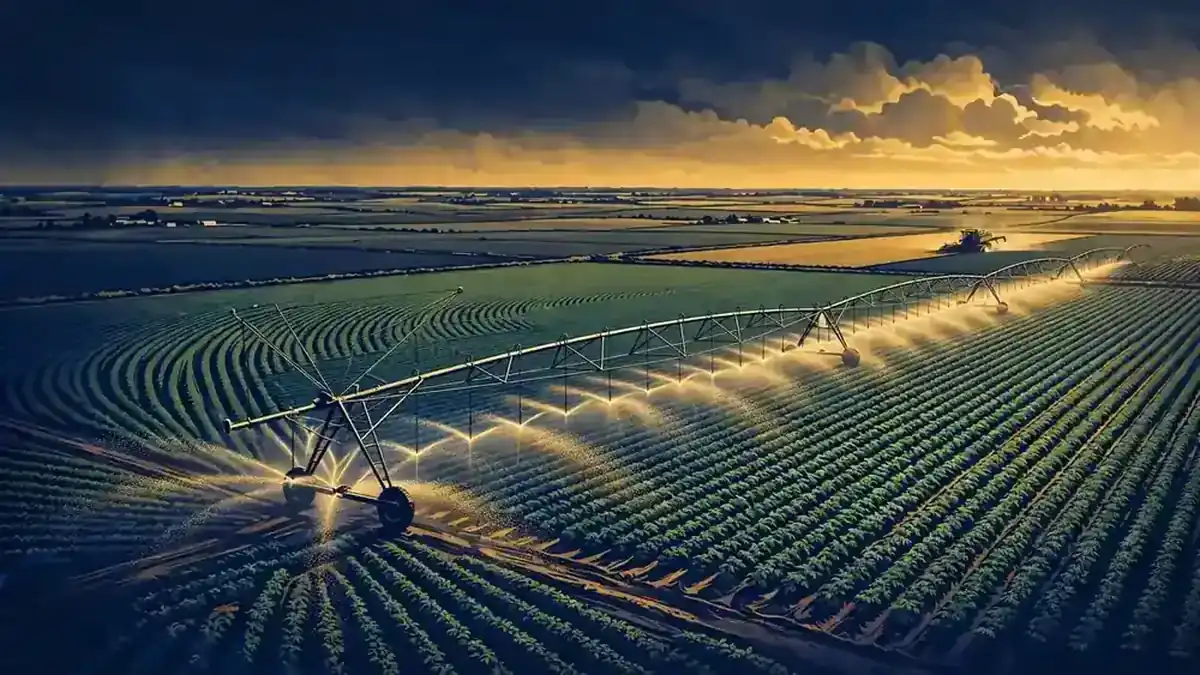
The agriculture unit, R.D. Offutt Farms, is the best known. It farms about 190,000 acres across Minnesota, North Dakota, South Dakota, Missouri, Texas, Wisconsin, and other states, with 50,000 to 60,000 acres in potatoes in any given year, most of it under center-pivot irrigation. The unit was renamed R.D. Offutt Farms in 2018, but the operation dates to the early 1960s, when Ron partnered with his father. Its scale has drawn both admiration and scrutiny: The Land Report’s 2021 ranking tied it for second place as the largest farm in the United States, and The Circle News reported in 2024 that it is the largest independent potato grower in the world. The same reporting noted the company’s long-running disputes over groundwater on and near the White Earth reservation in Minnesota, where it has farmed for more than 40 years — a reminder that scale on this level brings regulatory fights with it.
The food-processing unit turns the crop into products. Lamb Weston RDO Frozen, the joint venture with Lamb Weston, runs the Minnesota fry plant that processes 450 million pounds of fries a year. The Calbee joint venture, formed in 2006, runs the Boardman, Oregon, plant serving snack markets in Japan and beyond. PotatoPro counts 11 processing facilities across four states under the company’s management, producing frozen fries, fresh-pack potatoes, and potato flakes for retail and foodservice. Processing is where the margin lives: it converts a commodity crop into branded, packaged food, and it locks in demand from the fast-food chains that buy in volume.
The retail equipment unit, RDO Equipment Co., is the sleeper of the three. Founded in 1968 with that single Casselton store, it now owns the largest network of John Deere dealerships in the world. The network sells agricultural equipment, construction equipment, and Vermeer machinery, with more than 75 locations in 10 states on Concordia College’s count and 86 stores across 12 states on Farm Equipment’s 2024 count. It also has partnerships in Russia, Ukraine, and Australia. In 2000, the company sold its rental division to United Rentals, a deal that freed capital for the dealership expansion that followed. The equipment business also includes truck centers — RDO agreed to acquire Hall GMC and Hall Truck Center in Fargo and Grand Forks, North Dakota, adding heavy-duty trucks to the portfolio.
Beyond the three units, Offutt’s investments are the kind a farmer makes: land, irrigation, storage, and processing capacity. He bought land early and held it. He invested in center-pivot irrigation when it was still new, in sandy-soil ground other farmers passed over, and in processing plants that guaranteed a buyer for his crop. He also invested abroad — the 22,000-acre farm near Krasnodar, Russia, and the partnerships in Ukraine and Australia — though the Russian operation’s current status is not publicly documented, and the war in Ukraine has plainly complicated farming partnerships in that region. We do not speculate on its value today.
His expansion model is worth comparing with other self-made founders who scaled by buying one location at a time. Adam Neumann’s WeWork grew by adding locations fast and collapsed when the model outran its economics; Offutt’s dealership network grew over five decades, one store at a time, funded by farm profits rather than venture capital, and it is still growing. The contrast is the lesson: same playbook, different discipline. Mark Cuban’s fortune came from selling a company at the right moment; Offutt’s came from never selling at all.
Brand Deals and Sponsorships
Offutt has no endorsement deals in the usual sense — no shoe contract, no watch campaign, no paid social posts. He is a private businessman, not a public endorser, and his name does not appear on consumer products. The commercial relationships that matter to his wealth are business-to-business partnerships, and they are worth more than any endorsement could be.
The most important is McDonald’s. R.D. Offutt Farms is the primary supplier of the potatoes used in McDonald’s french fries, a relationship that began with the fast-food boom of the early 1970s and has lasted more than 50 years. The company’s big break came in 1973, when McDonald’s demand for uniform frying potatoes created a market Offutt was positioned to serve, and the winter of 1974 — when he nearly tripled his operation to meet it — set the pattern for everything that followed. Wendy’s, Raising Cane’s, Frito-Lay, and Idahoan Instant Mashed Potatoes now buy from the same operation, but McDonald’s remains the anchor customer, and the one most often named in coverage.
The second is John Deere. RDO Equipment is a John Deere dealer, not a John Deere employee, but the relationship is the foundation of the equipment business: the right to sell and service Deere machinery across a dozen states, built store by store since 1968. The dealership network also carries Vermeer and other lines, and its construction-equipment stores serve a different customer base from the farm stores, spreading the business across two cycles.
The third is Lamb Weston, the frozen-potato giant, through the Lamb Weston RDO Frozen joint venture, and Calbee Corporation of Japan, through the 2006 Boardman, Oregon, joint venture. Both are partnerships in the true sense: shared ownership of processing plants, shared risk, and shared access to markets Offutt could not have reached alone. Offutt has said repeatedly that partnerships are the reason he has been so successful, telling a Manitoba potato conference in 2016 that finding a void in the marketplace and filling it — with a partner — was the key to his business. That is as close as he comes to a business philosophy, and the record supports it: every major step after 1968 involved a partner, a joint venture, or a customer who became a long-term ally.

Houses, Cars and Other Assets
Offutt lives in Fargo, North Dakota, where he and his wife Karen have resided for decades. The family home is not a matter of public record in the way a celebrity mansion is: no listing, no published address, no real-estate feature. That is normal for a private businessman in Fargo, and we do not publish private residential details. What is public is the corporate footprint: the R.D. Offutt Company headquarters in downtown Fargo, a glass-fronted office building that Minnesota Public Radio described in 1999 as looking like it belonged to a big insurance company, with plate-glass windows, deep carpets, and leather furniture. The building is a landmark of the city’s business district, and it is where the potato empire is run from.
The real assets are the working ones. The farmland — about 190,000 acres, much of it irrigated — is the largest single asset on the family’s balance sheet, and its value has risen with farmland prices for decades. The irrigation systems, potato warehouses, and storage facilities across Minnesota and North Dakota are the second. The processing plants — the Lamb Weston RDO Frozen facility and the Calbee plant in Boardman, Oregon, among 11 facilities — are the third. And the dealership network, with more than 80 stores, their parts inventories, and their service bays, is the fourth. These are not the assets of a lifestyle; they are the assets of a business, and they are worth more together than apart.
Vehicles, for Offutt, mean farm machinery. The company’s fleet includes the tractors, combines, and potato harvesters that work 190,000 acres, and the dealerships hold hundreds of millions of dollars of new and used equipment inventory at any given time. There is no public record of a personal car collection, and none should be invented. A man who sold his first tractor for $6,800 and now owns the largest Deere network in the world does not need a garage full of sports cars to prove anything.
One asset deserves a separate mention: the Offutt School of Business at Concordia College, which carries his name after his confidential gift. It is not a financial asset, but it is the most visible thing he has put his name on, and it says something about where he thinks wealth should go. The school’s building, completed in fall 2012, cost $12.9 million to build, according to Concordia’s student newspaper — a figure sometimes confused with the $50 million fundraising goal for the school’s program and facility. The building is real. The $50 million gift is not.
Awards and Achievements
Offutt’s awards shelf is long, and it spans farming, equipment, education, and North Dakota civic life. The highest honor came in 2011, when Governor Jack Dalrymple presented him with the Theodore Roosevelt Rough Rider Award, North Dakota’s highest commendation for its citizens, at the Fargo Moorhead West Fargo Chamber of Commerce annual meeting. He was the 38th North Dakotan to receive it. The citation praised his companies’ creation of more than 500 jobs in the state, an average annual payroll of more than $25 million, and three farm partnerships growing nearly 12,000 acres of potatoes a year in North Dakota alone — as well as his philanthropy and board service.
The farming world honored him the same year, when the Northern Plains Potato Growers Association gave him its 2011 Meritorious Service Award. The association’s citation noted that the R.D. Offutt Company had 1,500 employees and was the nation’s largest producer of potatoes, with most of its 54,000 potato acres under center-pivot irrigation at the time. In 2015, he entered the North Dakota Agriculture Hall of Fame, with a citation listing his other honors: the Northwest Farm Managers Pioneer of the Year Award, NDSU’s Harvest Bowl AgriBusiness Award, the Red River Valley Development Association Builder of the Year, Midwest Region Entrepreneur of the Year, the North Dakota Entrepreneur Hall of Fame, and the World Potato Congress Potato Industry Award.
The equipment industry followed in 2024, when Farm Equipment magazine inducted him into the inaugural class of its Farm Equipment Hall of Fame, recognizing a 55-year career that began with one store and ended with the largest Deere network in the world. Emerging Prairie, the Fargo entrepreneurship organization, gave him its Lifetime Impact Award in February 2024, celebrating the same career from the startup community’s side. Concordia College, his alma mater, has honored him repeatedly — including the naming of its business school — and he served as chair of its Board of Regents.
None of these awards carries a cash prize that moves a net-worth estimate. Their value is different: they are independent confirmation, from four separate industries, that the scale attributed to Offutt is real. A $500 million estimate attached to a man nobody had heard of would invite doubt. The same estimate attached to a Rough Rider Award recipient, a Hall of Fame inductee, and the founder of the largest potato operation in the country is a different proposition.
Net Worth Growth Over the Years
No year-by-year net-worth record exists for Offutt, because no rich list tracked him annually and his companies are private. The growth table below is built from the dated business milestones that are on the record, with the net-worth figures marked as estimates at each stage. The pattern it shows is the point: slow growth for a decade, then a step-change in the 1970s, then steady compounding for 50 years.
| Year | Milestone | Estimated net worth |
|---|---|---|
| 1964 | Partners with his father; buys half the 200-acre farm on a $40,000 note | Not publicly estimated |
| 1968 | Buys the Casselton John Deere dealership for $100,000; RDO Equipment founded | Not publicly estimated |
| 1974 | McDonald’s demand triples the farming operation in one winter | Not publicly estimated |
| 1999 | Farms 100,000+ acres in 11 states; 1.8 billion pounds of potatoes a year (MPR) | Not publicly estimated |
| 2011 | Receives the Rough Rider Award; R.D. Offutt employs 1,500 people | Not publicly estimated |
| 2013 | Forbes calls him the farmer who grows more potatoes than anyone in the world | Not publicly estimated |
| 2024 | Front Office Sports: family worth more than $500 million; farms 190,000 acres | $500 million+ |
| 2025 | Celebrity Net Worth publishes a $500 million estimate (October 2025) | $500 million |
| 2026 | NetWorthCraft estimate, November 2026 | $500 million to $600 million |
The honest reading of that table is that the fortune was built long before anyone put a number on it. By 1999, when Minnesota Public Radio profiled him, Offutt was already farming more ground than any potato grower on earth and running the biggest Deere chain in the country. The $500 million figure only appeared in print in 2024 and 2025, when his grandson’s NFL story dragged the family into the spotlight. That lag is typical for private-company wealth: the business grows for decades in silence, and the estimate arrives all at once.
Why a range of $500 million to $600 million, rather than a single number? Two reasons. First, the two published anchors point the same way but not to the same place: Celebrity Net Worth says $500 million, and Front Office Sports says the family is worth more than $500 million. A range with a $500 million floor respects both. Second, the underlying assets — 190,000 acres of farmland, 80-plus dealerships, 11 processing plants — have appreciated since those figures were published, and farmland values in the Upper Midwest have continued to rise. The top of the range is our judgment, not a published figure, and we label it as such. What we will not do is repeat the $100 million to $300 million figures that appear in some low-quality roundups: those come from a different, unrelated Ron Offut in Kentucky, a namesake whose land and political story has been mixed into the North Dakota farmer’s biography by careless sites. That confusion is one of the reasons this article exists.
Compared with other self-made founders on this site, Offutt’s growth curve is the slow one — and the durable one. Mark Cuban’s net worth jumped in a single sale; Offutt’s compounded over 60 harvests. Mike Lindell’s fortune rose and fell with a single product and a single company; Offutt spread his across three businesses and 190,000 acres. The peer comparison that matters most is the North Dakota one: Tharaldson and Burgum crossed a billion; Offutt sits at half a billion with a business his children and grandchildren already run. For a family company, that may be the better outcome.
Social Media Presence
Ron Offutt has no public personal social media presence that we could verify — no public Instagram, X, or Facebook account in his name, and no YouTube channel. That is consistent with everything else about him: he is a private businessman in his eighties who built his companies before social media existed and has never used it to promote himself. Any account claiming to be him should be treated with doubt.
The companies are a different story. RDO Equipment Co. runs active social channels and a podcast — the Agriculture Technology Podcast, where Offutt himself appeared in 2024 to talk about farming — and R.D. Offutt Farms maintains a web presence for recruiting and community relations. Those channels promote the businesses, not the man, and they are the right place to follow the companies’ work. We do not link to unverified personal accounts, and we do not invent follower counts for channels we cannot verify.
Personal Life
Offutt and his wife Karen live in Fargo, North Dakota, and have six children and 11 grandchildren. The family is the business and the business is the family, more literally than in most profiles on this site: his daughter Christi is now chair of R.D. Offutt Company, his son-in-law Keith McGovern is its president, and his grandson Connor McGovern played eight seasons in the NFL as a center, most recently with the New Orleans Saints, before the family business called him back into the conversation about succession.
That succession is already happening in plain sight. Christi chairs the company, Keith runs it day to day, and the third generation — Connor among them — grew up riding in trucks during harvest season, learning to pull potatoes out of the ground while picking up the workings of the family business. Front Office Sports reported that Connor was told at a family dinner before the 2016 NFL draft that he was walking away from more money in the family business than football would pay him. He went to the NFL anyway, earned about $34 million, and the business kept growing without him. The story is often told as a curiosity — a football player who turned down a potato fortune — but it is really a succession story: a family business strong enough that its heir could leave, and strong enough to welcome him back.
Family businesses on this scale usually end in a sale or a split. The Offutts have avoided both, so far, by keeping ownership inside the family and by putting the next generation in charge while the founder is still alive to advise them. Anant Ambani’s family business works the same way at a much larger scale — the next generation running operating units while the founder watches — and the parallel is instructive: the families that keep their fortunes are the ones that hand over the work, and the shares follow.
Offutt’s private life outside the family and the business is low-profile by choice. He has served on the Concordia College Board of Regents for more than 20 years, including several years as chair, and on the board of North Dakota State University’s Center for the Study of Public Choice and Private Enterprise. He and Karen have supported Concordia and other North Dakota institutions for decades, quietly and without the naming-rights fanfare that usually accompanies gifts of that size — the business school that carries his name is the exception, not the rule. He does not give interviews about his wealth, does not appear on rich lists by choice, and has never, as far as the public record shows, discussed his net worth in his own words.
Sources & Reporting
Celebrity Net Worth — the $500 million net-worth estimate, published October 9, 2025 and updated October 10, 2025; the only published point estimate for Offutt, and the anchor for our range.
Front Office Sports — “The NFL’s Quiet Heir to a Potato Empire” (November 5, 2024): the family is worth more than $500 million, farms 190,000 acres, and supplies McDonald’s, Wendy’s, Raising Cane’s, Frito-Lay, and Idahoan; the Forbes 2013 description of Offutt as the world’s biggest potato grower.
Concordia College — the Offutt Story: 140,000-acre nine-state farming enterprise, largest potato operation in the country, largest John Deere dealer network in the world with 75-plus locations in 10 states, economics degree in 1964, Board of Regents service.
Farm Equipment — Hall of Fame profile (2024): 86 stores across 12 states, eighth-largest farm equipment company in North America, 450 million pounds of fries a year, store-by-store expansion history from 1968; Rough Rider Award and Agriculture Hall of Fame coverage.
Minnesota Public Radio — “Spud King’s Success Comes at a Price” and “What Price Success?” (September 1999): 100,000-plus acres in 11 states, 1.8 billion pounds of potatoes a year, the french-fry insight, and the environmental costs of the expansion.
PotatoPro — R.D. Offutt Company profile (updated August 2026): largest potato grower in the United States, 50,000-plus acres of potatoes a year, 11 processing facilities in four states, Calbee joint venture (2006), 22,000-acre farm in Krasnodar, Russia; 90-acre research farm established February 2026.
RDO Equipment Co. — Agriculture Technology Podcast (June 2024): Offutt’s own account of the $40,000 note, the $100,000 dealership purchase, the $10,000 grandmother’s loan, and the first $6,800 tractor sale.
Perishable News — Northern Plains Potato Growers Association Meritorious Service Award (2011): born November 13, 1942, in Orrick, Missouri; 1,500 employees; 54,000 potato acres under irrigation; six children and 11 grandchildren.
Civil Eats — “The High Cost of Cheap McDonald’s Fries” (April 2021): the $2.5-billion-a-year agribusiness figure, the Pineland Sands environmental criticism, and the 8,000-acre forest-land purchase in 2015.
The Circle News — R.D. Offutt groundwater lawsuit (June 2024): 190,000 acres, tied for second-largest farm in the United States in The Land Report’s 2021 ranking, and the White Earth Band groundwater-regulation dispute.
Future Farmer — Lifetime Impact Award profile (February 2024): the 400-to-3,000-acre jump in one year, and Offutt at 81 still enjoying work.
talkSPORT — Connor McGovern profile (November 2024): the $600-an-acre land purchases in 1974 and McGovern’s $34.3 million in NFL career earnings.
Reporting window: October 2025 – November 2026 for the net-worth figures; 1999 – 2026 for the business history. Figures that appear only in low-quality roundups — including a Kentucky namesake’s $100 million to $300 million range — were checked and excluded. Where sources disagree on a detail, such as the 1964 farm-purchase price or the dealership store count, both versions are noted in the text.
Frequently Asked Questions
What is Ron Offutt’s net worth in 2026?
Ron Offutt’s net worth is estimated at $500 million to $600 million as of November 2026. Celebrity Net Worth puts the figure at $500 million, and Front Office Sports reported in November 2024 that the Offutt family is worth more than $500 million. The range reflects the fact that his companies are privately held, so no audited figure exists.
How did Ron Offutt make his money?
He made it in three connected businesses: potato farming through R.D. Offutt Farms, the largest potato grower in the United States; food processing through the Lamb Weston RDO Frozen joint venture and a Calbee joint venture; and farm-equipment sales through RDO Equipment Co., the largest John Deere dealer network in the world. The turning point was the 1970s, when McDonald’s demand for french fries let him nearly triple his farming operation in a single winter.
Who is the richest person in North Dakota?
It depends on the year and the source. Ron Offutt has at times been called the richest person in North Dakota, with a fortune of $500 million or more. Hotel magnate Gary Tharaldson has been described as the state’s only billionaire, and former governor Doug Burgum was valued at $1.1 billion by Forbes after selling Great Plains Software to Microsoft in 2001. Offutt sits just below the billionaire line on the published figures.
How many acres does Ron Offutt farm?
About 190,000 acres of farmland in total, according to Front Office Sports reporting from 2024, with 50,000 to 60,000 acres in potatoes in a given year, most of it under center-pivot irrigation. The operation spans Minnesota, North Dakota, South Dakota, Missouri, Texas, Wisconsin, and other states. He started on a 200-acre family farm in Moorhead, Minnesota.
Is Ron Offutt related to Connor McGovern?
Yes. Connor McGovern, the NFL center who played for the New Orleans Saints, is Ron Offutt’s grandson. His father Keith McGovern is president of R.D. Offutt Company, and his aunt Christi is the company’s chair. Front Office Sports reported in 2024 that McGovern was told before the 2016 NFL draft that he was walking away from more money in the family business than football would pay.
Does R.D. Offutt supply McDonald’s?
Yes. R.D. Offutt Farms is the primary supplier of the potatoes used in McDonald’s french fries, a relationship that began in the early 1970s and has lasted more than 50 years. The company also supplies Wendy’s, Raising Cane’s, Frito-Lay, and Idahoan Instant Mashed Potatoes.
How old is Ron Offutt?
Ron Offutt was born on November 13, 1942, in Orrick, Missouri, which makes him 84 years old as of November 2026. He graduated from Concordia College in Moorhead, Minnesota, in 1964, and he was still working at 81, according to a 2024 profile.
Where does Ron Offutt live?
He lives in Fargo, North Dakota, with his wife Karen. The R.D. Offutt Company is headquartered in downtown Fargo, and the family has lived in the Fargo-Moorhead area since Ron’s childhood on the family farm in Moorhead, Minnesota.
Final Thoughts
Ron Offutt’s $500 million fortune is the least flashy half-billion in American business. There was no IPO, no viral product, no single deal that made him rich overnight. There was a 200-acre farm, a $40,000 note, a $100,000 dealership bought with sold land and a grandmother’s loan, and then 60 years of buying ground, building plants, and opening stores — one at a time, in farm country, with partners who stayed. The french fry did the rest: America decided it wanted fries with everything, and the farmer who saw that coming first ended up growing more potatoes than anyone else on earth.
The number to remember is not $500 million. It is 190,000 acres, 80-plus dealerships, 11 processing plants, and 1,500 employees — the working assets behind the estimate, and the reason the estimate is likely to hold. Private wealth built on land and operating businesses does not vanish in a market crash the way paper wealth does. It also does not get counted precisely, which is why we publish a range and show our work. If new reporting puts a firmer figure on the Offutt family fortune, this article will be updated — and the range will narrow.
Published on 2026-11-18. Last reviewed November 2026. Found an error? See our corrections policy.