
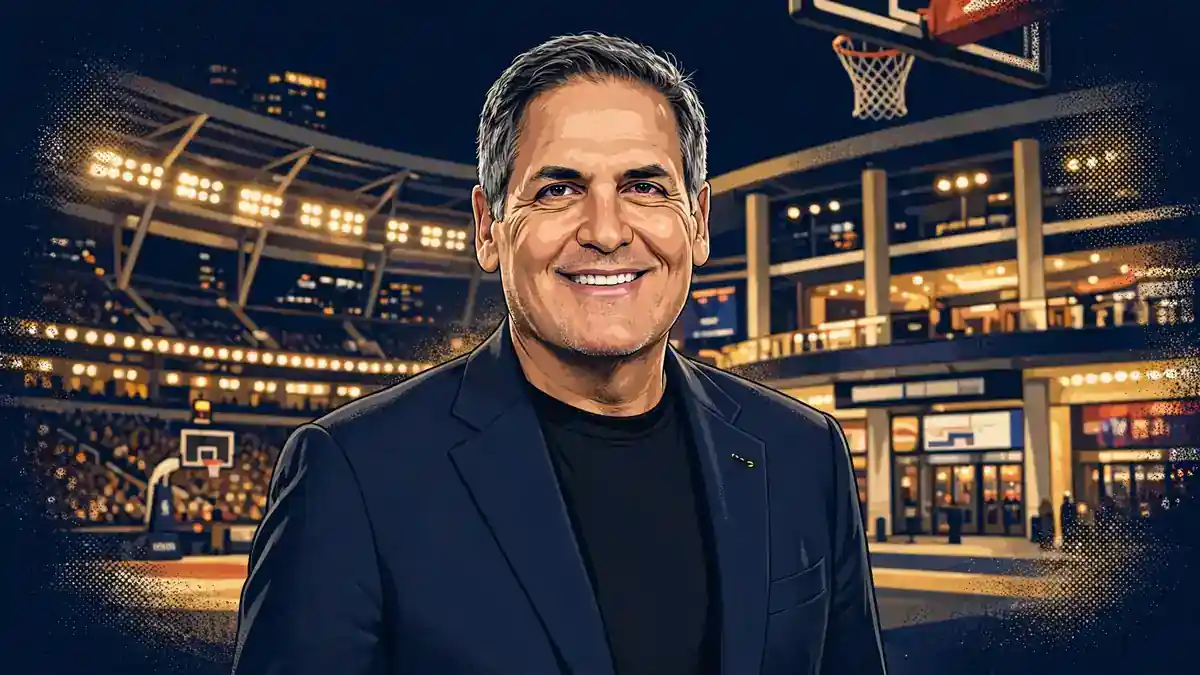
Mark Cuban‘s net worth is estimated at $6.8 billion as of November 2026. The figure comes from the Forbes real-time list, reported in October 2026, and it sits inside a wider range of $6 billion to $9.6 billion across the major trackers. Cuban built the fortune in three acts: a $5.7 billion Yahoo buyout of Broadcast.com in 1999, a Dallas Mavericks franchise bought for $285 million in 2000 and partly sold at a $3.5 billion valuation in 2023, and a second career as a television investor and drug-price reformer that now centers on Cost Plus Drugs.
Mark Cuban: Quick Facts
| Estimated net worth | $6.8 billion (Forbes real-time, October 2026) (range: $6 billion to $9.6 billion) |
|---|---|
| Profession | Entrepreneur, investor, television personality, sports team owner |
| Nationality | American |
| Born | July 31, 1958 (age 68) |
| Height | 6 feet 2 inches |
| Primary income sources | Dallas Mavericks minority stake, Cost Plus Drugs, startup investments, media companies, public stocks |
| Active years | 1982–present |
| Last reviewed | November 2026 |
- Early Life and Background
- Education
- Career Journey
- Rise to Fame
- Main Sources of Income
- Salary and Earnings
- Businesses and Investments
- Brand Deals and Sponsorships
- Houses, Cars and Other Assets
- Awards and Achievements
- Net Worth Growth Over the Years
- Social Media Presence
- Personal Life
- Sources & Reporting
- Frequently Asked Questions
Early Life and Background
Mark Cuban was born on July 31, 1958, in Pittsburgh, Pennsylvania, and grew up in the suburb of Mount Lebanon. His father worked in an auto upholstery shop, and the family lived a middle-class life that left little room for extravagance. Cuban started selling early. At 12 he sold garbage bags door to door so he could buy a pair of shoes he wanted. As a teenager he sold baseball cards, coins and stamps, and during a strike at the Pittsburgh Post-Gazette he ran newspapers from Cleveland to Pittsburgh and sold them himself.
That habit — spotting a gap, moving first, keeping the margin — never left him. Cuban has told the story for years as the origin of his business education: nobody handed him a customer, a product or a price. He had to find all three. The same instinct shows up in every deal that followed, from a $6 million software sale to a $5.7 billion internet exit. He has two younger brothers, Brian and Jeff, and the family stayed close as his profile grew.
Pittsburgh in the late 1970s was a steel city losing its steel. Cuban watched mills close and neighbors lose work, and the lesson he took was that a salary could vanish while a skill and a customer list could not. He left Pennsylvania for college with that idea already formed, and he never worked a conventional corporate job for long after.
Education
Cuban spent a year at the University of Pittsburgh, then transferred to Indiana University Bloomington, where he studied at the Kelley School of Business and graduated in 1981. He paid his way in part by running a chain letter, giving dance lessons and tending bar — the same mix of small hustles he had run as a boy, now funding a degree.
Indiana gave him two things that mattered more than the diploma. The first was a formal grounding in accounting and finance, which later let him read a balance sheet faster than the founders pitching him. The second was a network: he met people in Bloomington who stayed in his orbit for decades. Cuban has said repeatedly that college taught him how to learn a business quickly, a skill he used every time he entered a new industry cold.
After graduation he moved to Dallas in 1982 with little money and no contacts. He took a job tending bar at a Greenville Avenue spot called Elan, then moved into sales at Your Business Software, one of the first PC software retailers in Dallas. The bar job taught him how to read a room; the software job taught him how much small businesses would pay someone who could make their computers work. Both lessons paid off within a year.
Career Journey
Cuban was fired from Your Business Software after closing a sale instead of opening the store one morning. He had spotted the pattern that would define his career: the person who brings in the customer holds the power, and an employee who can sell does not need permission to build something. He started MicroSolutions, a computer consulting firm, with a former customer as his first client. The company grew through the 1980s on systems integration work for small Dallas businesses, and in 1990 Cuban sold it to CompuServe for a reported $6 million. He was 32, and he had his first fortune.
He did not retire. In 1995 he teamed up with Todd Wagner, a fellow Indiana graduate he had met years earlier, to build AudioNet, a company that streamed live sports and radio over the internet — an idea most people in 1995 thought was absurd, since dial-up connections could barely carry audio. AudioNet became Broadcast.com, and the timing was perfect. The dot-com market was hungry for internet stocks, and in 1999 Yahoo bought Broadcast.com for $5.7 billion in Yahoo stock. Cuban owned about 28 percent of the company, which translated to roughly $1.4 billion in Yahoo shares, according to Net Worth Rankings. He was a billionaire at 40.
The sale could have ended in disaster. Yahoo’s stock collapsed in the dot-com crash, and paper billionaires across Silicon Valley watched their fortunes evaporate. Cuban did something his peers did not: he hedged. He used collar options to lock in the value of his Yahoo shares, protecting most of the proceeds while the stock fell. The hedge is the least glamorous part of the story and the most important. It is the difference between a man who was briefly rich in 1999 and a man who stayed rich. Readers who want the full arc of his life, from the Pittsburgh childhood to the Yahoo deal and beyond, can read Mark Cuban’s full biography and career timeline on our sister site Guide Net Worth.
With the Yahoo money secured, Cuban went shopping for a second act. In January 2000 he bought a controlling interest in the Dallas Mavericks for $285 million from H. Ross Perot Jr. The team was a laughingstock, losing games and money, and Cuban turned it into a model franchise: new arena energy, better facilities, a front office rebuilt around data. Eleven years later the Mavericks won the 2011 NBA championship, beating the Miami Heat. He also co-founded 2929 Entertainment with Wagner, a media company spanning film production, distribution and exhibition, and launched HDNet in 2001, a high-definition television network later rebranded as AXS TV.
Television made him a household name. Cuban first appeared on ABC’s Shark Tank as a guest shark in Season 2 in 2011, joined full time from Season 3, and stayed for fourteen years and more than 300 episodes before his final episode aired on May 16, 2025. He left to spend more time with his family and to focus on his operating businesses, above all Cost Plus Drugs, the online pharmacy he co-founded in January 2022. In 2026 his newest moves reached into baseball: in July, Harbinger Sports Partners, a private equity firm he backs, acquired a minority stake in the Athletics, the Major League Baseball franchise preparing to move to Las Vegas in 2028, according to Parade.
Rise to Fame
Cuban became famous in stages, and each stage reached a different audience. The Yahoo sale made him famous in business circles. The Mavericks made him famous in sports: he sat courtside, shouted at referees, paid fines by the millions and matched them with donations, and turned a losing team into a champion. The NBA fined him repeatedly for criticizing officials, and the fines became part of his public image — a billionaire who cared enough about a basketball team to lose his temper in public.
Shark Tank made him famous everywhere else. For fourteen years he was the shark founders most wanted: the one who had actually built and sold companies, who asked about margins and customer acquisition costs instead of branding, and who wrote real checks on camera. The show’s audience learned his biography in fragments — the garbage bags, the $6 million sale, the Yahoo hedge — and the fragments added up to a coherent story about self-made wealth.
Fame also brought a serious test. In 2008 the Securities and Exchange Commission sued Cuban, alleging insider trading over a 2004 stock sale in a company called Mamma.com. Cuban fought the case instead of settling, and in 2013 a federal jury cleared him. He later said the fight cost him millions in legal fees and years of distraction, and he treated the acquittal as proof that a defendant with resources could beat the government in court — a point he has made often since. The case never dented his business standing: by the time the jury ruled, the Mavericks were champions and Shark Tank was a hit.
By 2026 the fame had a different shape. Cuban was no longer the loudest owner in the NBA or a weekly television fixture. He was the billionaire who sold most of his team, quit his television show, sold most of his bitcoin in May 2026, and spent his time arguing that prescription drugs should cost what they cost plus a visible markup. It is a quieter kind of fame, and it fits the third act of his career.
Main Sources of Income
Cuban’s money comes from assets, not a salary. No employer pays him a wage that matters next to his holdings. The fortune rests on five pillars, and each one behaves differently: a sports franchise stake that rises with league valuations, a pharmacy company whose value is private and growing, a portfolio of startup equity, a media business, and a stock portfolio built over 25 years.
| Source | What it is | Reported value / note |
|---|---|---|
| Dallas Mavericks minority stake | About 27% retained after the 2023 sale | Team valued at $5.8 billion in October 2026 (Forbes); his stake worth about $1.57 billion, per Celebrity Net Worth |
| Mavericks sale proceeds | Majority stake sold December 2023 | About 58% sold for roughly $2 billion before taxes, per Forbes via Parade |
| Cost Plus Drugs | Co-founder, online pharmacy | Valuation undisclosed; the main reason trackers disagree by billions |
| Startup portfolio | Shark Tank deals plus outside investments | Mark-to-market equity of at least $250 million from Shark Tank holdings alone, per Cuban in January 2026 |
| Media (2929 Entertainment, AXS TV) | Co-founder, film and television | Private; Magnolia Pictures and Landmark Theatres among the holdings |
| Public stocks | Amazon, Netflix and others | Amazon was his largest single holding in 2019 at nearly $1 billion, per Celebrity Net Worth |
The Mavericks stake is the easiest piece to price, because NBA franchises change hands in public deals and Forbes values them every year. The pharmacy is the hardest, and that gap explains why Forbes says $6.8 billion while Bloomberg says $9.6 billion. Bloomberg prices private growth companies higher; Forbes discounts them. Neither side is guessing blindly — they are applying different rules to the same private assets, and the honest answer is the range, not a single number.
What sets Cuban apart from other billionaires on the same lists is how little of the fortune depends on one company. Michael Jordan, whose own billionaire story also runs through an NBA franchise, built his wealth largely on one brand partnership; Cuban’s wealth is spread across a team, a pharmacy, a media company, a stock portfolio and dozens of startups. You can read how Jordan’s fortune compares in our Michael Jordan net worth profile. That spread is why his net worth kept climbing from about $4.2 billion in 2020 to about $6 billion in 2025, a gain of roughly $1.8 billion in five years, according to GOBankingRates — the Mavericks appreciated, the pharmacy grew, and the stocks compounded while he was busy doing other things.

Salary and Earnings
Cuban has no meaningful salary. His earnings are capital gains, dividends and distributions from businesses he owns, plus television pay that is small next to the portfolio. That distinction matters, because it explains why his net worth moves in jumps — a sale, a valuation, a market rally — instead of climbing in steady paycheck increments.
The closest thing to a salary in his career was Shark Tank. Variety reported in 2016 that each shark earned at least $50,000 per episode, which worked out to about $1.2 million for a 24-episode season. Parade noted in 2026 that the figure had likely risen since. Even at the higher end, fourteen years of television pay amounts to a rounding error beside a $6.8 billion fortune. The show paid him in deal flow, not wages: founders pitched him on camera, and the best ones became portfolio companies.
The investing record on the show is genuinely mixed, and Cuban has been unusually honest about it. In 2022 he said his Shark Tank portfolio, taken as a whole, was at a net loss — the televised handshake is only the start of a deal, and due diligence kills or shrinks many of them after filming. Published deal trackers disagree on the total, counting anywhere from about $20 million in closed on-air deals to roughly $62 million to $68 million in offers, because they measure different things. Cuban’s own account, given to Fortune in January 2026, splits the difference: he said he had invested about $33 million through the show, earned back about $35 million, and held mark-to-market equity worth at least $250 million. The cash return was modest; the equity value is where the money sits.
His biggest single payday of the decade came from the Mavericks. Forbes, via Parade, reported that Cuban sold approximately 58 percent of the franchise for an estimated $2 billion before taxes in December 2023. The headline number most outlets use is the $3.5 billion valuation of the deal — the price the Adelson and Dumont families paid for control. The two numbers describe the same transaction from different angles: $3.5 billion is what the team was worth in the deal, and about $2 billion is what Cuban personally received before taxes for the share he sold. His remaining 27 percent, worth about $1.57 billion at the October 2026 Forbes valuation of $5.8 billion, keeps paying in the form of franchise appreciation.
There was one more earnings stream that barely registers in the totals but says a lot about his style: his book. How to Win at the Sport of Business, published in 2011, collected his blog writing on running a company. It sold well for a business book, and Cuban has said he wrote it because he was tired of founders asking him the same questions. The royalties were never the point; the point was a playbook he could hand to a founder instead of repeating himself.
Businesses and Investments
MicroSolutions was the first proof that Cuban could sell a company. Broadcast.com was the proof that he could sell one at the top of a market. Everything since has been an attempt to repeat the pattern at a different scale: buy or build something early, add energy and distribution, and sell or hold as the market catches up.
2929 Entertainment, co-founded with Todd Wagner, is the media arm. It owns Magnolia Pictures, the independent film distributor behind acclaimed releases, and it once owned Landmark Theatres, the arthouse cinema chain, which was later sold. Cuban also launched HDNet in 2001, betting that high-definition television would become standard years before most households owned an HD set; the network later became AXS TV. The media business never produced a second Yahoo-sized exit, but it gave Cuban a permanent seat in entertainment and a library of assets that throw off steady cash. Tyler Perry, another entrepreneur who built a media empire from ownership rather than acting fees, followed a similar path from performer to studio owner; our Tyler Perry net worth profile traces how that model works at a $1.4 billion scale.
Cost Plus Drugs is the venture Cuban now calls his most important. He co-founded it with Dr. Alex Oshmyansky, a radiologist who had cold-emailed him about drug pricing years earlier, and the online pharmacy launched in January 2022. The model is printed on the name: the company sells generic drugs at the manufacturer’s cost plus a 15 percent markup, a small pharmacist fee and $5 shipping. There is no hidden spread, no rebate game, no pharmacy benefit manager taking a cut in the dark. The company has expanded its catalog and pharmacy partnerships since launch, and in April 2026 it began selling the blood thinner Eliquis at $345 for a 30-day supply to cash-paying patients, according to Bristol Myers Squibb. In October 2026, STAT reported that the company was committing part of a new Dallas plant to custom medicines for individual rare-disease patients — a step from selling cheap generics toward making drugs nobody else will make at a small scale.
Why does a pharmacy matter to a net worth estimate? Because it is the asset the trackers cannot agree on. Forbes prices it conservatively, which is one reason its figure sits at $6.8 billion. Bloomberg prices growth companies more generously, which is one reason its figure reaches $9.6 billion. Until Cost Plus Drugs raises money at a public valuation or sells a stake, both numbers are judgment calls, and the honest reporting is to print the range and explain it.
His public stock portfolio is the quietest part of the fortune. In 2019 he revealed that Amazon was his largest individual stock holding, valued at nearly $1 billion at the time, with Netflix another large position, according to Celebrity Net Worth. He has traded actively around those core holdings for years, and he has been open about owning crypto: he bought bitcoin and other tokens, talked about them constantly, and then told the Front Office Sports podcast in May 2026 that he had sold most of his bitcoin, without saying how much. The sale fits the pattern of his whole career — buy early, talk about it loudly, exit before the crowd.
Real estate as a business is a smaller thread. In 2021 Cuban bought the entire town of Mustang, Texas — 77 acres and a strip club — for a reported price of roughly $2 million, saying he wanted to help a friend who owned it and liked the idea of owning a town. It is a rounding error in a $6.8 billion fortune, but it is also the clearest illustration of how he invests: a cheap asset, a personal connection, a story worth telling. Larry Fink, who built BlackRock into the world’s largest asset manager, operates at the opposite end of the same instinct — scale through institutions rather than one-off deals — and our Larry Fink net worth profile shows what that path is worth.
The newest bet is sports again, but from the other side of the table. In July 2026, Harbinger Sports Partners, the private equity firm Cuban backs, acquired a minority stake in the Athletics, the Major League Baseball team preparing to move to Las Vegas in 2028. It is a small position in a team that has not yet moved, and it will be years before anyone knows whether it pays. That is how Cuban has always invested: early, small, and patient.
Brand Deals and Sponsorships
Cuban does not have a brand-deal portfolio in the way an athlete or a pop star does. No shoe company pays him to wear its product, and no soft-drink brand puts his face on a can. His endorsements, such as they are, run in the opposite direction: companies pay to be associated with him, and he invests in companies he wants to be associated with. The distinction is worth stating plainly, because many net-worth profiles pad this section with endorsement income that does not exist. For Cuban, the number is effectively zero — and the absence is itself a data point about how his money works.
What he does sell is access to his judgment. He is a paid speaker, a podcast regular, and a prolific poster on social media, where his opinions on business, crypto and drug pricing reach millions of people without an agent negotiating a fee. His book, his blog and his television years all served the same purpose: they turned his name into a distribution channel. A founder who takes his money gets more than capital; the founder gets a famous backer who will talk about the company in public. That is why founders pitch him, and it is why his Shark Tank portfolio kept growing even in years when he said it was losing money on paper.
The closest he comes to a traditional sponsorship is the Mavericks themselves. Team sponsorships, arena naming rights and broadcast deals are team revenue, not personal endorsement income, and they flow to the franchise rather than to Cuban directly. His personal brand deals are limited to the occasional commercial appearance and the speaking circuit, where top business speakers command five- and six-figure fees per event. None of it moves a $6.8 billion estimate by a visible amount, and this article does not pretend otherwise. Selena Gomez built a billion-dollar fortune the other way — a beauty brand, Rare Beauty, that turned her audience into customers — and our Selena Gomez net worth profile shows how endorsement-style wealth works when it is real.

Houses, Cars and Other Assets
Cuban’s real estate is modest by billionaire standards, and that is a deliberate choice. He has said for years that he lives in the same house he bought after the Yahoo sale, drives ordinary cars as often as expensive ones, and spends money on experiences — courtside seats, travel, time with his children — rather than on accumulating property. The portfolio is still worth tens of millions, but it is a footnote in a $6.8 billion fortune, not a driver of it.
The centerpiece is the Preston Hollow mansion in Dallas, a French chateau-style estate of about 23,676 square feet on roughly seven acres. Cuban bought it in 1999, shortly after the Broadcast.com sale, for a reported price between $13 million and $17.6 million — outlets disagree on the exact figure — and it has been his primary residence ever since. The house has 10 bedrooms, 13 to 16 bathrooms, a full-sized indoor basketball court, a lagoon-style pool, a tennis court and a detached three-story guest house. Current estimates put its value between $19 million and $22 million. The neighborhood is one of Dallas’s most private, and his neighbors have included a former president and professional athletes.
He also owns a beachfront home in Laguna Beach, California, bought in December 2018 for $19 million, according to Celebrity Net Worth, and the town of Mustang, Texas, bought in 2021 for a reported price of roughly $2 million. The Laguna house is the vacation property; Mustang is the conversation piece. Together with the Dallas estate, the portfolio is worth well over $55 million by most estimates, and none of it is borrowed against in a way that matters to the net worth figure.
The car collection follows the same pattern: a few interesting cars, not a fleet. It includes a rare 1955 Ford Customline and a bulletproof Mercedes-Benz S600 Pullman Guard, according to property reporting. The most famous vehicle he owns is not a car at all. In 1999 he bought a Gulfstream V private jet for $40 million in what was then the largest single online purchase ever recorded — he bought the plane over the internet, a detail he has enjoyed retelling ever since. The jet is a business tool as much as a luxury: it lets him attend a Mavericks road game, a Shark Tank taping and a pharmacy meeting in the same week.
None of these assets is what makes him rich, and that is the point the numbers support. The Dallas house has roughly doubled in value in 27 years, which is a fine return on a home and a trivial one beside a $3.5 billion team sale. Cuban’s wealth is in companies, not things, and the things exist to serve the life, not the balance sheet.
Awards and Achievements
Cuban’s trophy case is thin on personal awards and heavy on team results, which suits him. The achievement he cites most often is the one he shared with a roster: the Dallas Mavericks’ 2011 NBA championship, the franchise’s first title, won against a Miami Heat team built around LeBron James, Dwyane Wade and Chris Bosh. He bought a losing team, rebuilt it, and watched it win a title in his eleventh year as owner. The ring matters more to him than any business prize, and he has said so.
Television brought the industry recognition. Shark Tank won the Primetime Emmy Award for Outstanding Structured Reality Program four times during his run, in 2014, 2015, 2016 and 2017, and the show’s long run — sixteen seasons and more than 300 episodes with Cuban — is itself the achievement. He joined as a guest in 2011 and left in 2025 as the show’s most recognizable investor, the one whose presence signaled to founders that the pitch was serious.
The business lists are a different kind of record. Cuban has appeared on the Forbes billionaires list every year since 1999, when the Yahoo sale first put him on it, and his ranking has climbed as the fortune grew — from the low billions in the 2010s to $6 billion on the 2026 list and $6.8 billion on the real-time list in October 2026. Forbes also gives him a self-made score of 8 out of 10, meaning his wealth is substantially self-generated rather than inherited, according to InvestorMint’s summary of the Forbes profile.
His philanthropic record is quieter than the basketball fines that funded parts of it. The Mark Cuban Foundation runs free AI boot camps for high school students, teaching artificial intelligence skills in underserved communities. He has matched his NBA fines with donations for years, turning punishments into contributions. None of this appears in a net worth table, and it should not — giving money away reduces a fortune, it does not add to it — but it is part of why the public image survived the transition from loud owner to drug-price reformer.
Net Worth Growth Over the Years
Cuban’s wealth has grown in steps, not a smooth line. Each step is a transaction: a sale, a purchase, a valuation. Between steps, the fortune mostly sat in stocks and private holdings and moved with the market. The table below uses reported figures and labels each one, so the reader can see which numbers are Forbes estimates and which are transaction prices.
| Year | Milestone / estimate | What happened |
|---|---|---|
| 1990 | $6 million exit | MicroSolutions sold to CompuServe; first fortune |
| 1999 | Billionaire | Yahoo buys Broadcast.com for $5.7 billion in stock; Cuban’s 28% stake worth about $1.4 billion |
| 2000 | $285 million purchase | Buys controlling interest in the Dallas Mavericks |
| 2011 | NBA champions | Mavericks win the franchise’s first title; franchise value climbs |
| 2020 | About $4.2 billion | Forbes-based estimate reported by GOBankingRates |
| 2023 | $3.5 billion valuation | Majority Mavericks stake sold to the Adelson and Dumont families; about $2 billion before taxes to Cuban |
| 2025 | About $6 billion | Forbes estimate; leaves Shark Tank after Season 16 |
| 2026 | $6.8 billion (range $6B–$9.6B) | Forbes real-time, October 2026; Bloomberg $9.6B; Celebrity Net Worth $6.5B |
The 2020-to-2025 jump is the clearest proof that the fortune compounds without him doing anything dramatic. GOBankingRates reported the move from about $4.2 billion in 2020 to about $6 billion in 2025 — roughly $1.8 billion richer in five years, an increase of more than 40 percent — driven by the Mavericks’ rising value, the pharmacy’s growth and the stock market, not by a new windfall. The 2026 range widened the same way: in October 2026, Celebrity Net Worth reported that the Mavericks were valued at $5.8 billion, making Cuban’s retained 27 percent worth about $1.57 billion on its own.
How does he compare with other billionaires in the same lists? The peer table below uses figures from our own profiles and the trackers cited in this article, so every number can be checked.
| Person | Estimated net worth (2026) | Main source |
|---|---|---|
| Mark Cuban | $6.8 billion | Mavericks stake, Cost Plus Drugs, investments |
| Michael Jordan | $4.3 billion | NBA franchise sale, Nike brand partnership |
| Satya Nadella | $1.4 billion | Microsoft stock and compensation |
| Tyler Perry | $1.4 billion | Media studio and content library |
| Selena Gomez | $1.3 billion | Rare Beauty, acting, endorsements |
| Larry Fink | $1.3 billion | BlackRock stock and compensation |
Cuban sits well above the rest of the group, and the reason is visible in the table: he is the only one whose wealth comes from selling two companies and part of a sports franchise, rather than from a salary, a single brand or a stock grant. Satya Nadella, the Microsoft chief executive, built a $1.4 billion fortune almost entirely from stock compensation over a decade at the top; our Satya Nadella net worth profile shows how that path works. Cuban’s path — build, sell, hedge, repeat — produced roughly five times as much, and it produced it with far more risk along the way.
Social Media Presence
Cuban is one of the most active billionaires on social media, and he runs his own accounts. On X he posts daily about business, politics, crypto and drug pricing, often replying to strangers and arguing with critics in public. On LinkedIn he writes longer posts about hiring, management and the companies he backs. On Instagram the feed is lighter — family, basketball, behind-the-scenes shots from the pharmacy and the arena. He also joined Bluesky in 2024 as part of a wave of public figures looking for an alternative to X, and he posts there regularly.
The audience numbers in the millions across the platforms, and the counts move constantly, so this article does not print a follower figure that would be stale within a week. What matters for the net worth story is that the audience is a business asset. Cuban uses it the way a television network uses an audience: to launch a product, to pressure a supplier, to recruit a founder. When Cost Plus Drugs announces a new drug at a lower price, the announcement reaches millions of people without an advertising budget, because Cuban posts it himself.
He has also used the audience to pick public fights that cost him money and made him headlines — with the NBA over officiating, with the SEC over the insider-trading case, with crypto skeptics and drug-industry executives. The fights are part of the brand, and the brand is part of the deal flow: founders pitch him because they have seen him argue in public and want that energy on their side.
Personal Life
Cuban married Tiffany Stewart in September 2002 in a private ceremony in Barbados. They have three children — two daughters, born in 2003 and 2006, and a son, born in 2009 — and the family lives in the Preston Hollow mansion in Dallas that Cuban bought in 1999. He has said that the family eats dinner together most nights, that his children do chores, and that he wants them to understand work before they understand wealth. The decision to leave Shark Tank in 2025 was, by his own account, about the calendar: filming took place in June and September, the weeks his children were starting and finishing school, and after fourteen years he chose the school calendar over the show.
He reads for hours a day — three or more, by his own account — and he treats reading as the cheapest form of research available. He wakes early, answers his own email, and has said he responds to every cold email from a founder who makes a clear case. That habit is how Cost Plus Drugs started: Alex Oshmyansky cold-emailed him, and Cuban replied.
His politics are public and changeable. He has supported candidates from both parties, criticized both parties, and said he would consider running for office himself before deciding against it. In 2024 he campaigned for the Democratic presidential candidate and argued publicly with supporters of the Republican candidate; in other years he has backed Republicans. The one constant is his argument that the system should reward people who build things, a view that fits a man who started by selling garbage bags and ended up owning part of an NBA team.
Health and routine are unremarkable by design. He exercises, watches what he eats, and has joked that his basketball court at home gets more use from his children than from him. The personal life, in the end, is the least dramatic part of the story — and that is unusual for a billionaire with a television career. There are no scandals in the record, no divorces, no public feuds with family. The drama in Cuban’s life has always been in the deals.
Sources & Reporting
This article was reported from live sources in November 2026. The net worth anchor is the Forbes real-time figure of $6.8 billion from October 2026, as reported by Parade (October 2026) and Inc. (October 27, 2026). The Forbes 2026 Billionaires List figure of $6 billion comes via CultureMap Dallas coverage of the list. The Bloomberg Billionaires Index figure of $9.6 billion is summarized by Net Worth Rankings, and the Celebrity Net Worth figure of $6.5 billion, the Mavericks’ $5.8 billion valuation, the $1.57 billion value of the retained stake, and the Laguna Beach purchase price come from Celebrity Net Worth’s Mark Cuban profile, updated in November 2026.
The Mavericks purchase and sale are documented by ESPN (27 percent retained stake, $3.5 billion valuation) and Parade (Forbes: about 58 percent sold for roughly $2 billion before taxes). The March 2026 regret comments come from Cuban’s appearance on the Intersections podcast, reported by Wikipedia‘s Mark Cuban entry, which also records the July 2026 Dallas County petition and the biographical facts (birth date, family, education, MicroSolutions and Broadcast.com history). Shark Tank pay comes from Variety (2016, at least $50,000 per episode); the final episode date of May 16, 2025 and the fourteen-year run are reported by People. Cuban’s January 2026 account of his Shark Tank returns (about $33 million invested, about $35 million earned, at least $250 million in mark-to-market equity) comes from his Fortune interview, summarized in contemporaneous reporting. The Cost Plus Drugs model (cost plus 15 percent, $5 shipping) and the Eliquis launch at $345 for a 30-day supply in April 2026 come from the company and Bristol Myers Squibb; the October 2026 Dallas plant reporting comes from STAT. The July 2026 Athletics minority stake comes from Parade. The May 2026 bitcoin sale comes from Cuban’s Front Office Sports podcast appearance, reported by Front Office Sports coverage. The 2020-to-2025 growth figures ($4.2 billion to $6 billion) come from GOBankingRates (February 2026). The SEC insider-trading acquittal in 2013 and the 2011 NBA championship are matters of public record. Peer figures in the comparison table come from NetWorthCraft’s own profiles of Michael Jordan, Satya Nadella, Tyler Perry, Selena Gomez and Larry Fink.
Where sources disagree, the disagreement is printed in the article: the Mavericks sale percentages, the Shark Tank investment totals, and the net worth range itself. No figure in this article comes from a single weak source, and no figure is presented as a bank balance.
Frequently Asked Questions
What is Mark Cuban’s net worth in 2026?
Mark Cuban’s net worth is estimated at $6.8 billion as of October 2026, according to the Forbes real-time list, as reported by Parade and Inc. The honest range across the major trackers is $6 billion (Forbes 2026 Billionaires List) to $9.6 billion (Bloomberg Billionaires Index), with Celebrity Net Worth at $6.5 billion. The spread comes from different valuations of his private holdings, above all Cost Plus Drugs and his retained Mavericks stake.
How did Mark Cuban get rich?
He got rich twice. First he sold MicroSolutions, a computer consulting firm, to CompuServe for $6 million in 1990. Then he co-founded Broadcast.com with Todd Wagner and sold it to Yahoo for $5.7 billion in stock in 1999, keeping roughly $1.4 billion worth of Yahoo shares through a hedge that protected him when the dot-com market crashed. The Mavericks purchase in 2000 and the 2023 partial sale added billions more.
How much did Mark Cuban sell the Mavericks for?
He sold a majority stake in December 2023 at a team valuation of about $3.5 billion, to the families of Miriam Adelson and Patrick Dumont. Forbes reported that Cuban personally sold approximately 58 percent of the franchise for an estimated $2 billion before taxes. The $3.5 billion is the team’s value in the deal; the $2 billion is roughly what he received for the share he sold.
How much of the Mavericks does Mark Cuban still own?
About 27 percent. He retained that minority stake after the December 2023 sale. In October 2026 the Dumont family bought Miriam Adelson’s remaining shares, taking 69 percent ownership, while Cuban kept his 27 percent. At Forbes’ October 2026 team valuation of $5.8 billion, his stake is worth about $1.57 billion, according to Celebrity Net Worth.
How much money did Mark Cuban make on Shark Tank?
Less than the television suggested, by his own account. He told Fortune in January 2026 that he had invested about $33 million through the show, earned back about $35 million, and held mark-to-market equity worth at least $250 million. In 2022 he said the portfolio was at a net loss. Deal trackers disagree on the on-air total, from about $20 million in closed deals to roughly $62 million to $68 million in offers, because they count different things.
What is Mark Cuban Cost Plus Drugs?
It is an online pharmacy Cuban co-founded with Dr. Alex Oshmyansky that launched in January 2022. It sells generic prescription drugs at the manufacturer’s cost plus a 15 percent markup, a small pharmacist fee and $5 shipping, with the price printed openly. In April 2026 it began selling the blood thinner Eliquis at $345 for a 30-day supply, and in October 2026 it committed part of a new Dallas plant to custom medicines for rare-disease patients.
Is Mark Cuban still on Shark Tank?
No. He left after Season 16, with his final episode airing on May 16, 2025. He first appeared as a guest shark in Season 2 in 2011 and joined full time from Season 3, staying for fourteen years and more than 300 episodes. He said he left to spend more time with his family and to focus on Cost Plus Drugs and his other operating businesses.
How old is Mark Cuban and where does he live?
Mark Cuban was born on July 31, 1958, in Pittsburgh, Pennsylvania, which makes him 68 years old in November 2026. He lives in Dallas, Texas, in a roughly 24,000-square-foot mansion in the Preston Hollow neighborhood that he bought in 1999, shortly after the Broadcast.com sale. He is married to Tiffany Stewart, and they have three children.
Final Thoughts
Mark Cuban’s $6.8 billion is the most honestly complicated fortune on the Forbes list. The number is real — it is built from two company sales and a sports franchise that appreciated twelvefold — and it is also genuinely uncertain, because the two assets that matter most now are private and priced differently by every tracker that tries. The range of $6 billion to $9.6 billion is not a failure of reporting; it is the reporting, and any profile that prints one number without the range is hiding the most interesting fact about the money.
The career underneath the number is a pattern repeated four times: spot a market early, build or buy something in it, protect the downside, and exit or hold as the market catches up. Garbage bags at 12, MicroSolutions at 32, Broadcast.com at 40, the Mavericks at 41. Cost Plus Drugs is the fifth attempt, and it is the first one where the goal is not his own wealth but a price printed in the open. If it works at the scale he wants, the drug company will be worth more than the basketball team — and the next edition of this article will have a new anchor, a new range, and the same honest uncertainty about the exact number.
Published on 2026-11-10. Last reviewed November 2026. Found an error? See our corrections policy.