
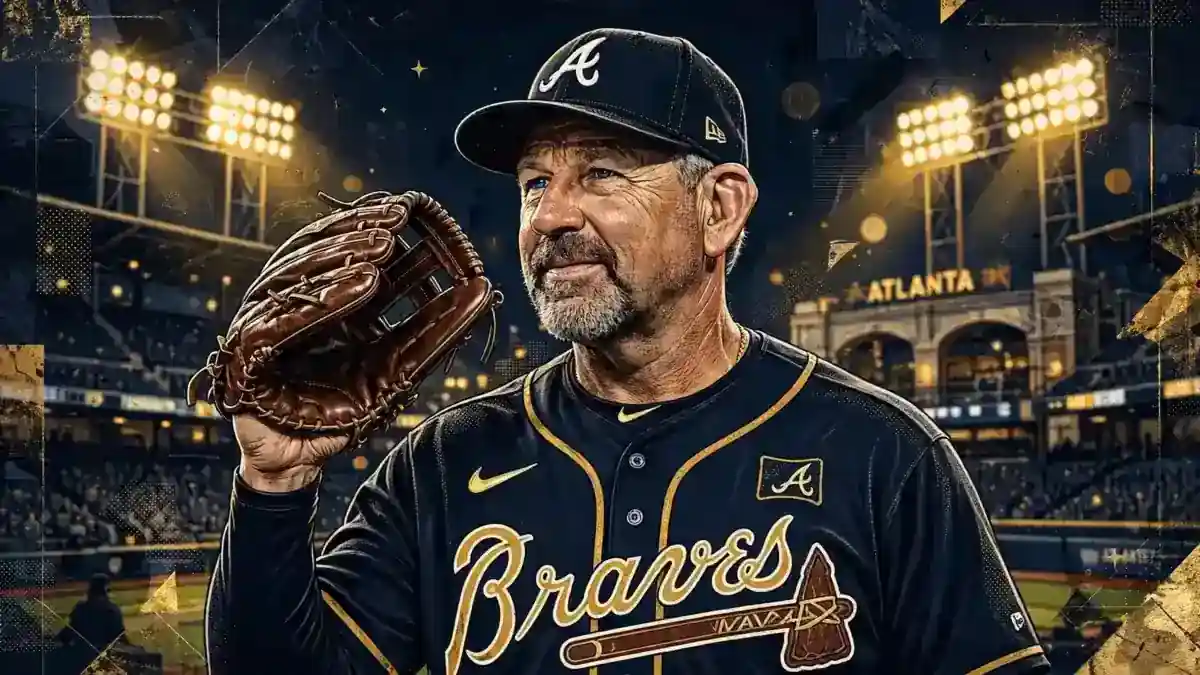
Walt Weiss‘s net worth is estimated at $5 million to $15 million as of November 2026. The former All-Star shortstop spent 14 seasons in the major leagues, banked close to $19.3 million in documented playing salaries, managed the Colorado Rockies for four seasons, and then — at 62 — took over the Atlanta Braves and won the National League East in his first year in charge.
Walt Weiss: Quick Facts
| Estimated net worth | $10 million (range: $5 million to $15 million) |
|---|---|
| Profession | MLB manager, former shortstop |
| Nationality | American |
| Born | November 28, 1963, Tuxedo, New York (age 62) |
| Height | 6 ft 0 in (183 cm), 175 lbs |
| Primary income sources | MLB playing salaries, managing and coaching salaries |
| Active years | 1987–2000 (player); 2013–2016, 2026–present (manager) |
| Last reviewed | November 2026 |
- Early Life and Background
- Education
- Career Journey
- Rise to Fame
- Main Sources of Income
- Salary and Earnings
- Businesses and Investments
- Brand Deals and Sponsorships
- Houses, Cars and Other Assets
- Awards and Achievements
- Net Worth Growth Over the Years
- Social Media Presence
- Personal Life
- Sources & Reporting
- Frequently Asked Questions
Early Life and Background
Walter William Weiss was born on November 28, 1963, in Tuxedo, New York, and grew up in Suffern, a small town in Rockland County about 30 miles northwest of Manhattan. As a boy he rooted for the New York Yankees, the team every kid in his neighbourhood seemed to follow, and he played his school ball at Suffern High School, where his glove work at shortstop marked him out early as a prospect worth watching.
The local connection runs deep enough that Suffern High School named its baseball field after him on April 13, 1999, while he was still an active player with the Atlanta Braves. It is the kind of honour usually reserved for hometown heroes, and it arrived a full year before he played his last major league game.
Two details from his youth still surface in profiles today. The first is that the Baltimore Orioles drafted him in the 10th round of the 1982 amateur draft straight out of high school — and he said no, choosing college instead. The second is that he holds a black belt in taekwondo, a discipline he picked up young and kept up through his playing days. Teammates from his Oakland years later described a shortstop who treated preparation like a craft: early work, clean footwork, and a calm that never seemed to leave him, even in October.
His family kept a low profile through all of it. Weiss married Terri, and the couple raised four sons — Blake, Brody, Bo and Brock — all of whom played baseball at a serious level. That family-first streak shaped the most unusual decision of his career: in 2008 he walked away from a front-office job with the Rockies to coach his sons’ high school teams, a move that eventually led him back to a major league dugout from the most unlikely route imaginable.
Education
Weiss turned down the Orioles in 1982 and enrolled at the University of North Carolina at Chapel Hill, where he played three seasons for the Tar Heels under head coach Mike Roberts. College baseball gave him two things the minor leagues could not: an education to fall back on and three years of daily reps against strong Atlantic Coast Conference pitching.
By his junior year he had turned himself into a first-round talent. The Oakland Athletics took him 11th overall in the 1985 amateur draft and signed him for a $95,000 bonus, according to The Baseball Cube’s contract record. That figure looks tiny beside modern signing bonuses — first-round picks today routinely sign for several million — but in 1985 it marked him as a premium prospect, and Oakland moved him quickly.
He spent parts of two seasons in the Athletics’ farm system before his call-up in July 1987, at 23. The education mattered in a quieter way, too: Weiss has always spoken about the game like a student of it, and the coaches who worked with him in Denver and Atlanta point to that same trait — a shortstop who understood positioning, counts and pitchers’ tendencies well enough to manage a game from the middle of the diamond long before he ever managed one from the dugout.
Career Journey
Weiss made his major league debut for the Oakland Athletics on July 12, 1987, and hit .462 across 16 games in that first taste of the big leagues. It was a small sample, but it was enough: Oakland handed him the starting shortstop job the following spring, and he never gave it back.
His rookie season in 1988 set the pattern for everything that followed. He hit .250 with three home runs, 39 runs batted in and 44 runs scored — modest numbers on paper — while playing defence that helped carry the Athletics to their first American League pennant since 1974. The Baseball Writers’ Association of America voted him the American League Rookie of the Year, and The Sporting News named him its rookie of the year as well. Oakland lost the World Series to the Los Angeles Dodgers that October, but Weiss had arrived.
A year later he had a ring. The 1989 Athletics swept the San Francisco Giants in a World Series interrupted by the Loma Prieta earthquake, and Weiss, earning $180,000 that season, played shortstop on one of the great teams of the era — a roster built around the Bash Brothers, Mark McGwire and Jose Canseco, and a pitching staff led by Dave Stewart and Dennis Eckersley. Oakland reached the World Series again in 1990 and lost to the Cincinnati Reds, giving Weiss three Fall Classics in his first four full seasons.
His Oakland years ended quietly. He hit .212 in 1992, his worst season at the plate, and the Athletics traded him to the expansion Florida Marlins that winter. In 1993 he played 158 games for the Marlins, a career high, and hit well enough to re-establish his value as an everyday shortstop. Florida was a one-year stop: he reached free agency and signed with the Colorado Rockies, another young franchise, ahead of the 1994 season.
Colorado gave him four steady seasons and the best pay of his career to that point. He played through the strike-shortened 1994 campaign, then helped the Rockies reach the postseason for the first time in 1995, when they lost to the Braves in the division series. His bat never carried a lineup — his career highs in Colorado were eight home runs and 48 runs batted in — but his glove and his .351 lifetime on-base percentage kept him in the lineup. In December 1997 he signed a three-year, $9 million contract with the Atlanta Braves, the richest deal of his playing life.
Atlanta was the perfect fit for the final act. In 1998 he hit .280, made the All-Star team for the only time in his career, and played shortstop for a Braves club that won 106 games. Injuries slowed him in 1999, when Atlanta reached the World Series and lost to the Yankees, and by 2000 he had lost playing time to Rafael Furcal, the rookie who would win the National League Rookie of the Year award — the same honour Weiss had won 12 years earlier. He retired after the 2000 season, his final appearance coming in early October of that year.
Fourteen seasons, four clubs, 1,495 games. The final line reads .258 with 25 home runs, 386 runs batted in, 1,207 hits and 623 runs scored. Two numbers in that line deserve a second look. His on-base percentage of .351 sat nearly 100 points above his batting average, a gap that marks a hitter with a sharp eye. And his career totals contain a quirk no other player of his era can match: exactly 658 walks and exactly 658 strikeouts, a perfect tie across a decade and a half.
Rise to Fame
Weiss never became famous the way sluggers do. His rise was quieter, built on reliability rather than highlight reels, and it happened in three distinct waves.
The first wave was 1988. A 24-year-old rookie shortstop winning Rookie of the Year on a pennant-winning team is a story that writes itself, and Weiss won the award on defence as much as anything: range to both sides, soft hands, and a habit of making the routine play look routine. The A’s went to three straight World Series from 1988 to 1990, and Weiss started at shortstop for all of them.
The second wave came a decade later, in 1998, when he made his only All-Star team at 34. Most glove-first shortstops never make one; Weiss made his in the season he hit .280 for a 106-win Braves team managed by Bobby Cox. It was a late-career validation that he belonged among the game’s best at his position, not just its most durable.
The third wave is happening now. After eight seasons as Brian Snitker’s bench coach in Atlanta — including the 2021 World Series title — Weiss was named the Braves’ manager on November 3, 2025, succeeding the retiring Snitker. He is the 49th manager in franchise history and only the fourth since Bobby Cox took over the dugout in 1990. Then, in his first season, he led Atlanta to a 94-68 record and the National League East title, and finished second in National League Manager of the Year voting with 86 points and seven first-place votes, behind Milwaukee’s Pat Murphy. For a man who was managing a high school team 14 years ago, it is one of the more remarkable second acts in recent baseball.
The contrast with today’s game puts his playing career in perspective. In 2026, Braves third baseman Austin Riley earned $22 million for a single season — more than the $19.3 million Weiss earned across all 14 seasons as a player. The gap says less about Weiss than about how baseball’s money has changed: a glove-first shortstop in the 1990s was paid like a role player, while a star in 2026 is paid like a franchise. Readers curious how the modern game’s biggest earners stack up can see the difference in Aaron Judge’s net worth story, another star whose single-season pay dwarfs an entire 1990s career.
Main Sources of Income
Weiss’s fortune comes from baseball, and almost entirely from salaries. There is no public record of a business empire, a product line, or a portfolio of endorsements behind his name. The money arrived in three waves: playing pay, managing pay, and coaching pay.
Playing salaries are the foundation. The Baseball Cube’s year-by-year record lists every season from his $60,000 debut in 1987 to the $3 million he earned in each of his final three seasons in Atlanta, and the 14 seasons add up to roughly $19.26 million. His three-year, $9 million Braves contract alone accounts for nearly half of that total, which tells you how back-loaded a 1990s career could be: he earned more in his last three seasons than in his first eleven combined.
Managing pay is the second wave. Denver reporting at the time put his Rockies salary near $700,000 a year, with a three-year extension in 2013 worth about $2 million in total, according to DNVR. Those are modest figures by modern managerial standards — top managers today earn several times that — but across four seasons in Colorado they added roughly $3 million to his career earnings.
Coaching pay is the third wave, and the least documented. He served as a special assistant to Rockies general manager Dan O’Dowd from 2002 to 2008, then coached at Regis Jesuit High School, where high-school coaching pay is modest by any measure. His eight seasons as Atlanta’s bench coach from 2018 to 2025 carried a major league coaching salary that the club has never disclosed, and his current salary as Braves manager is also undisclosed. Neither figure appears in any public reporting we could verify, so we do not guess at them — but eight years on a big league staff plus a manager’s chair in 2026 mean steady, six-figure-plus income for the best part of a decade.
What he did not have was the endorsement income that defines modern baseball wealth. Weiss played before the era of nine-figure shoe deals and social-media sponsorships, and his public profile was always that of a quiet professional rather than a marketable star. The richest active players now earn more off the field than Weiss earned on it in a year, a gap that shows up clearly in Shohei Ohtani’s net worth story — the two-way star’s endorsement portfolio alone is worth more than Weiss’s entire playing career.

Salary and Earnings
The year-by-year record below comes from The Baseball Cube, which lists a salary for every one of Weiss’s 14 major league seasons, cross-checked against the salary table published by faqs.org. The two sources agree on every season they both cover, which makes this one of the better-documented salary histories of any 1990s player.
| Season | Team | Salary |
|---|---|---|
| 1987 | Oakland Athletics | $60,000 |
| 1988 | Oakland Athletics | $62,500 |
| 1989 | Oakland Athletics | $180,000 |
| 1990 | Oakland Athletics | $235,000 |
| 1991 | Oakland Athletics | $780,000 |
| 1992 | Oakland Athletics | $760,000 |
| 1993 | Florida Marlins | $925,000 |
| 1994 | Colorado Rockies | $600,000 |
| 1995 | Colorado Rockies | $2,256,446 |
| 1996 | Colorado Rockies | $1,650,000 |
| 1997 | Colorado Rockies | $2,700,000 |
| 1998 | Atlanta Braves | $3,050,000 |
| 1999 | Atlanta Braves | $3,000,000 |
| 2000 | Atlanta Braves | $3,000,000 |
| Total | 14 seasons | $19,258,946 |
That total carries an important correction. Baseball Biographies, one of the sites that publishes a net-worth estimate for Weiss, puts his cumulative career earnings “in the range of $15 million”. The year-by-year record says otherwise: $19.26 million in playing salary alone, before a dollar of managing or coaching pay. The $15 million figure appears to undercount his late-career seasons, when he earned $3 million a year in Atlanta. We use the documented $19.26 million because it is built from 14 individually listed seasons rather than a single rounded claim.
His peak earning years were 1998 to 2000, when the Braves paid him $9.05 million over three seasons — more than his first eleven seasons combined. His lowest-paid full season was 1988, the year he won Rookie of the Year, when he earned $62,500. The arc is a reminder of how the old salary system worked: young players were cheap, veterans were paid, and a player who stayed healthy for 14 years could still finish with less career pay than a modern star earns in one season.
One viral claim from 2026 deserves a clear answer. In April 2026, a post on MLBonFax claimed Weiss had signed a two-year, $8.5 million contract with the Atlanta Falcons to play linebacker after tackling an Angels player during a bench-clearing brawl. The post was satire: no NFL team announced it, no transaction record exists, and no mainstream outlet reported it. Weiss did tackle Angels slugger Jorge Soler during a brawl in Anaheim on April 7, 2026 — that part is real, and it is documented in his Wikipedia biography — but the football contract is invented. We count zero dollars from it.
After his playing career, the pay continued at a lower level. His Rockies managing deal ran near $700,000 a year, according to DNVR, with a three-year extension in 2013 worth about $2 million. His eight years as Braves bench coach and his current manager’s salary are not public. Adding the documented playing total to the reported Rockies managing pay puts his known career baseball earnings above $22 million, before taxes, agent fees and living costs across nearly four decades in the game.
Businesses and Investments
There is no public record of Weiss owning a business, holding a stake in a company, or running an investment portfolio of any note. No filing, interview or report ties him to a restaurant group, a real-estate venture, a sports agency or a startup, and he has never spoken publicly about investing. That absence is itself the story of this section: unlike the modern stars whose wealth comes from equity and endorsements, Weiss’s money came from a paycheque, season after season.
What he did invest in was the game itself. After retiring in 2000 he returned to the Rockies as a special assistant to general manager Dan O’Dowd, a role he held from 2002 to 2008 that kept him close to player evaluation and front-office work. He left that job to spend more time with his family, coaching his sons’ teams at Regis Jesuit High School in Aurora, Colorado — first as an assistant for two years, then as head coach. The high-school job paid little, but it kept his baseball instincts sharp, and it produced the most improbable promotion in the sport: in November 2012 the Rockies hired him as their manager straight from the high-school dugout.
The investment that paid off best was patience. Eight seasons as a bench coach in Atlanta, from 2018 to 2025, put him beside Brian Snitker for seven postseason runs, six National League East titles and a World Series championship. When Snitker retired after the 2025 season, the Braves did not run a search — they promoted the man already sitting next to him. That internal promotion, announced on November 3, 2025, turned a coaching salary into a manager’s salary and gave Weiss his second chance to run a big league club.
Brand Deals and Sponsorships
No endorsement deal involving Walt Weiss appears in any public record we could find. He carried no national shoe contract, no beverage deal and no memorabilia line of the kind that now follows even mid-tier stars. The 1990s shortstop market was thin: glove-first infielders were not the faces of advertising campaigns, and Weiss, who kept his private life private, was never the type to chase that work.
The contrast with the current era is sharp. Today’s stars sign endorsement portfolios worth tens of millions before they sign their second contract, and a player’s off-field income can exceed his salary. Weiss played his whole career before that economy existed in its current form, and his post-playing career — front office, high school, bench coach — offered no platform for it either.
His one brush with viral fame came in 2026, and it earned him nothing. The April brawl in Anaheim, in which he tackled Jorge Soler, produced a flood of clips and a satirical story about a football contract. The attention was real; the money was not. His marketability, such as it is, rests on respect inside the game — the reason Atlanta trusted him with the manager’s job — rather than on any brand partnership.
Houses, Cars and Other Assets
Weiss has kept his homes and cars out of the press, and no property record or vehicle report tied to him appears in public reporting. There are no published stories about a mansion purchase, a car collection or a property portfolio, and we do not invent one. What is on the record is quieter: a family man who lived in Colorado through his Rockies years, coached his sons’ high-school teams in Aurora, and kept his private life exactly that.
Two honours attached to places rather than possessions tell you more about how he is regarded at home. Suffern High School named its baseball field after him in 1999, and his charitable giving has included donations to Watertown High School in Watertown, New York. Neither is an asset on a balance sheet, but both are the kind of local legacy that tends to outlast a car or a house.
The honest picture is that a $5 million to $15 million net worth built from $19.3 million in playing salary and two decades of coaching and managing pay looks like a comfortable, unflashy life: a family home, savings, and retirement security, without the property headlines that follow the game’s biggest earners. Anyone promising a list of his houses and cars is guessing.
Awards and Achievements
Weiss’s trophy case is modest by superstar standards and rich by any other measure. It holds two World Series rings earned fourteen years apart and in two very different jobs, an All-Star selection, a Rookie of the Year award, and — as of November 2026 — a second-place finish in Manager of the Year voting.
- 1988: American League Rookie of the Year (Baseball Writers’ Association of America) and Rookie Player of the Year (The Sporting News).
- 1989: World Series champion with the Oakland Athletics, who swept the San Francisco Giants.
- 1998: National League All-Star, his only All-Star selection, in a 106-win Braves season.
- 2021: World Series champion as Atlanta’s bench coach, beating the Houston Astros in six games.
- 2026: Led the Braves to a 94-68 record and the National League East title in his first season as manager; finished second in National League Manager of the Year voting with 86 points and seven first-place votes.
- Career: 1,495 major league games, 1,207 hits, a .351 on-base percentage, and the only 658-walk, 658-strikeout tie of his era.
The 2026 voting result deserves emphasis because it arrived a week before this article was written. The Baseball Writers’ Association of America announced the result on November 10, 2026: Milwaukee’s Pat Murphy won with 124 points, Weiss took second with 86, and Philadelphia’s Don Mattingly finished third with 25. Seven of the thirty voters put Weiss first. For a manager in his first season — and his first big league managing job in a decade — it was a strong verdict, and it arrived alongside a division title his predecessor’s team had missed the playoffs to win the year before.
Net Worth Growth Over the Years
Weiss’s wealth grew in a straight line rather than a spike: a slow climb through his playing years, a plateau during his coaching decade, and a lift as he returned to a manager’s chair. The table below tracks cumulative documented playing salary as the anchor, with net worth shown as an estimate where no salary record exists.
| Period | Career stage | Cumulative playing salary | Estimated net worth |
|---|---|---|---|
| 1987–1988 | Rookie years, Oakland | $122,500 | Under $1 million |
| 1993 | Florida Marlins, first big payday | $3,002,500 | $1 million – $2 million |
| 1997 | Final Rockies season | $10,208,946 | $3 million – $5 million |
| 2000 | Retirement, Atlanta | $19,258,946 | $5 million – $8 million |
| 2013–2016 | Rockies manager | $19,258,946 | $6 million – $10 million |
| 2018–2025 | Braves bench coach | $19,258,946 | $7 million – $12 million |
| 2026 | Braves manager, NL East title | $19,258,946 | $5 million – $15 million |
Three things stand out. First, the 1995 season was the hinge: his $2,256,446 salary that year was more than triple his previous best, and it moved his cumulative earnings past $5 million. Second, the Braves contract did the heavy lifting — $9.05 million across 1998 to 2000, nearly half his career pay. Third, the range widens rather than narrows over time, because the public record covers his playing pay in detail and his coaching pay not at all. Celebrity Birthdays put him at $5 million in December 2023, while Daily Wiki Bio and LuxLux put him at $15 million; Baseball Biographies splits the difference at about $10 million. Our $5 million to $15 million range, anchored at $10 million, is simply the honest span of what the published estimates say.
Social Media Presence
Weiss keeps a low profile online. No verified personal account in his name surfaces in searches, and he has never been a public figure on social media in the way modern managers are. That fits a career built before the social era and a personality that has always preferred the dugout to the spotlight.
What does exist is the Braves’ own coverage. The club’s official accounts, Atlanta’s beat writers and the national baseball press cover his managerial work daily — lineup decisions, post-game remarks and milestones such as the 2026 division title. Readers looking for his current work will find it there rather than on a personal feed.
Personal Life
Weiss is married to Terri, and the couple raised four sons: Blake, Brody, Bo and Brock. All four played baseball. Blake, the oldest, was a center fielder before turning to track and football. Brody played the infield in college at UC Santa Barbara and Westmont College. Bo pitched at the University of North Carolina, his father’s old school. Brock, the youngest, played shortstop and pitched at Regis Jesuit High School — the same school where his father coached.
The family has faced one public scare. While Weiss was playing in Atlanta, his three-year-old son contracted E. coli from a water amusement park in the city, and the infection caused his kidneys to shut down. His son made a full recovery, and the episode is one of the few personal details Weiss has ever discussed publicly.
Outside baseball he holds a black belt in taekwondo, and as a boy he cheered for the Yankees — a detail that still amuses Braves fans, given that he now manages the team that beat his childhood club in the 1996 World Series. He has given back to the schools that shaped him, with donations to Watertown High School and the field-naming honour at Suffern High.
Sources & Reporting
Every figure in this article traces to a named outlet. The Baseball Cube supplied the year-by-year salary record, the $95,000 signing bonus and the three-year, $9 million Braves contract. Wikipedia supplied the biography, career totals, managerial record and the 2026 season detail, including the April 7, 2026 brawl and the Manager of the Year voting result. ESPN (Jeff Passan, November 3, 2025) and Field Level Media (November 10, 2026) covered the Braves hiring and the Manager of the Year voting. DNVR reported the Rockies managing pay near $700,000 a year and the extension worth about $2 million. Baseball Biographies put cumulative earnings near $15 million and net worth near $10 million — a claim our salary table corrects to $19.26 million in playing pay. Daily Wiki Bio and LuxLux estimate $15 million; Celebrity Birthdays estimates $5 million (last updated December 2023). PlayersBio (November 2025) covered his wife Terri and four sons. Retrosheet and StatsCrew confirmed the career totals, including the 658-walk, 658-strikeout tie. MaxPreps covered the Regis Jesuit years and the jump from high school to the Rockies job. Sportsnet reported the 2013 three-year extension. Reporting window: November 2012 to November 2026; figures reviewed November 2026.
Frequently Asked Questions
What is Walt Weiss’s net worth in 2026?
Walt Weiss’s net worth is estimated at $5 million to $15 million as of November 2026, anchored at about $10 million. Celebrity Birthdays puts him at $5 million, Daily Wiki Bio and LuxLux at $15 million, and Baseball Biographies at about $10 million. The range reflects the disagreement between outlets, not a single audited figure.
How much did Walt Weiss earn as a baseball player?
His documented playing salaries total $19,258,946 across 14 seasons, according to The Baseball Cube’s year-by-year record. His best-paid years were 1998 to 2000 with the Atlanta Braves, when he earned $9.05 million on a three-year, $9 million contract. His lowest-paid full season was 1988, the year he won Rookie of the Year, at $62,500.
Is Walt Weiss the Atlanta Braves manager in 2026?
Yes. The Braves named him manager on November 3, 2025, promoting him from bench coach to replace the retiring Brian Snitker. In his first season he led Atlanta to a 94-68 record and the National League East title, and finished second in National League Manager of the Year voting with 86 points.
How old is Walt Weiss?
Walt Weiss was born on November 28, 1963, in Tuxedo, New York, which makes him 62 years old as of November 2026. He turns 63 on November 28, 2026.
What teams did Walt Weiss play for?
Weiss played for four clubs in 14 major league seasons: the Oakland Athletics (1987–1992), the Florida Marlins (1993), the Colorado Rockies (1994–1997) and the Atlanta Braves (1998–2000). He won the World Series with Oakland in 1989 and made the All-Star team with Atlanta in 1998.
Who is Walt Weiss’s wife?
Walt Weiss is married to Terri, and the couple have four sons: Blake, Brody, Bo and Brock. All four played baseball — Bo pitched at the University of North Carolina, Brody played the infield at UC Santa Barbara and Westmont College, and Brock played at Regis Jesuit High School, where his father once coached.
What is Walt Weiss’s managerial record?
His career managerial record is 353 wins and 412 losses. He went 283-365 with the Colorado Rockies from 2013 to 2016, then 94-68 with the Atlanta Braves in 2026, winning the National League East in his first season in charge.
Did Walt Weiss win a World Series?
Yes, twice. He won as a player with the Oakland Athletics in 1989, when they swept the San Francisco Giants, and again as the Atlanta Braves’ bench coach in 2021, when Atlanta beat the Houston Astros in six games.
Final Thoughts
Walt Weiss’s story is not the usual net-worth tale of a star cashing in. He earned $19.3 million across 14 seasons as a glove-first shortstop, then kept earning it the slow way: a front-office job, a high-school dugout, eight years as a bench coach, and finally — at 62 — a manager’s chair and a division title. The published estimates disagree, from $5 million to $15 million, and the honest answer is the range, anchored at about $10 million.
What makes him worth watching now is the timing. He took over a Braves team that had missed the playoffs, won 94 games and the National League East, and finished second in Manager of the Year voting a week before this article was published. If Atlanta keeps winning under him, his next contract — the first managerial deal of his career negotiated from a position of strength — could move his net worth more in a single signing than his entire playing career did in fourteen seasons.
Published on November 18, 2026. Last reviewed November 2026. Found an error? See our corrections policy.