
Paul Anka‘s net worth is estimated at $80 million as of November 2026. The Canadian-American singer-songwriter built that fortune across seven decades — first as a 16-year-old teen idol with “Diana,” then as the writer behind Frank Sinatra’s “My Way” and Tom Jones’s “She’s a Lady,” and later as a catalog owner who bought back his own publishing, collected half the publishing on three posthumous Michael Jackson hits, and kept touring into his mid-eighties with a new album in February 2026 and a sold-out theatre date in November 2026.
Paul Anka: Quick Facts
| Estimated net worth | $80 million (range: $80 million–$82 million) |
|---|---|
| Profession | Singer, songwriter, actor |
| Nationality | Canadian-American (naturalized U.S. citizen, 1990) |
| Born | July 30, 1941 (age 85) |
| Height | 5 feet 6 inches (1.68 m) — widely listed, not officially confirmed |
| Primary income sources | Songwriting and publishing royalties, touring and live performance, recordings, acting, real estate |
| Active years | 1955–present |
| Last reviewed | November 2026 |
- Early Life and Background
- Education
- Career Journey
- Rise to Fame
- Main Sources of Income
- Salary and Earnings
- Businesses and Investments
- Brand Deals and Sponsorships
- Houses, Cars and Other Assets
- Awards and Achievements
- Net Worth Growth Over the Years
- Social Media Presence
- Personal Life
- Sources & Reporting
- Frequently Asked Questions
Early Life and Background
Paul Albert Anka was born on July 30, 1941, in Ottawa, Ontario, Canada, to Camelia (née Tannis) and Andrew Emile “Andy” Anka. Both parents were of Lebanese Christian descent — his mother an immigrant from Lebanon, his father from Syria — and the family ran a restaurant in Ottawa called The Locanda. Anka grew up inside two worlds at once: the Lebanese-Canadian community around his family’s restaurant and the church choir at St. Elias Antiochian Orthodox Cathedral, where he sang as a boy.
Music reached him early and stayed. He studied piano under Winnifred Rees in Ottawa, and by his early teens he was singing in a vocal trio called the Bobby Soxers while attending Fisher Park High School. At 14 he recorded his first single, “I Confess,” a small local release that gave him his first taste of a recording studio. Nothing about the record suggested what would follow within three years, but it fixed a pattern that would define his whole career: Anka wrote his own material, and he treated songwriting as a trade to be learned young.
The Ottawa years also gave him the subject of his first fortune. Diana Ayoub was a slightly older girl in his church congregation — in a 2005 interview with NPR’s Terry Gross, Anka said she was a girl at his church whom he hardly knew. He turned a teenage crush into a song, and that song would pay him for the rest of his life. The detail matters because it explains the economics of everything that follows: Anka was a writer before he was a star, and writers who own their songs get paid every time anyone plays them, in any decade, in any country.
Education
Anka’s formal schooling ended at Fisher Park High School in Ottawa. He never attended college or a music conservatory; the classroom that shaped him was the choir loft at St. Elias, piano lessons with Winnifred Rees, and the trio rehearsals of the Bobby Soxers. By 15 he was travelling to New York to audition for record men, and by 16 he was a chart-topping recording artist. School, in the ordinary sense, was over before most teenagers pick a major.
That thin formal record is worth stating plainly because it frames his business education, which was real and hard-won. Anka learned the music business by living inside it: signing a recording contract as a minor (his father had to fly to New York to sign the paperwork for him), watching how record companies owned masters and publishing, and then — in 1963 — spending $250,000 of his own money to buy back the rights to his ABC-Paramount catalog. BiographyHost reports the $250,000 figure, and the move is the single most important financial decision of his life. A teenager who had just made a fortune on one song decided that owning the songs mattered more than the next advance. Six decades of royalty checks proved him right.
Career Journey
In 1956, at 15, Anka travelled to New York City with $100 from his uncle and auditioned for producer Don Costa at ABC-Paramount, singing “Diana.” Costa signed him. The single was recorded in May 1957 and released on July 2, 1957 — the month Anka turned 16. It reached number one on Billboard’s Best Sellers in Stores chart, number two on the composite Top 100, and number one in the UK, where it held the top spot for nine weeks and sold 1.25 million copies. Sales totals for the record vary by source — more than nine million copies is the figure most often cited, while the Canadian Songwriters Hall of Fame puts worldwide sales at 20 million and notes the song was recorded more than 300 times in 16 countries between 1957 and 1963. The gap between those two numbers is a good example of why net worth figures for artists of Anka’s era come as ranges: record-keeping in the 1950s was patchy, and global sales were tallied differently by different bodies. Either way, “Diana” made a 16-year-old from Ottawa one of the best-selling recording artists on the planet.
The hits kept coming fast. In 1958 Anka placed four songs in the American top 20, including “It’s Time to Cry” at number four and “(All of a Sudden) My Heart Sings” at number 15. “Lonely Boy” reached number one in 1959, “Put Your Head on My Shoulder” became a standard the same year, and “You Are My Destiny” and “Puppy Love” followed. He toured the UK and Australia, performing in Australia alongside Buddy Holly — and he wrote “It Doesn’t Matter Anymore” for Holly, the last song Holly recorded before his death in February 1959. Anka later gave his composer’s royalty on that song to Holly’s widow, a gesture he has described in interviews as the least he could do.
In 1960 Anka signed with RCA Victor, and in 1963 he bought back his ABC-Paramount catalog for a reported $250,000. The British Invasion then cut into his chart career as a performer — by the end of the 1960s he was working mainly in Las Vegas casinos and writing for other singers — but the pivot suited him. He was one of the first pop singers to build a lasting Las Vegas career, and he spent the decade writing songs that other people made famous: the theme for The Tonight Show Starring Johnny Carson, “Teddy” for Connie Francis in 1960, and the English lyrics for Frank Sinatra’s “My Way,” which Sinatra recorded in 1968 and released in 1969. The “My Way” lyrics were Anka’s adaptation of the French song “Comme d’habitude,” by Claude François and Jacques Revaux — a piece of writing that would generate royalties for the rest of his life and long after, since it became one of the most recorded songs of the twentieth century.
The 1970s brought a second act as a performer. He signed with Buddah Records and released Paul Anka (1971) and Jubilation (1972); “She’s a Lady,” written for that first album, failed to chart in his own version but became a huge hit when Tom Jones recorded it later in 1971. After more than a decade without a top-25 hit, Anka signed with United Artists and came back in 1974 with “(You’re) Having My Baby,” a duet with Odia Coates that reached number one. Two more Anka–Coates duets cracked the top 10 — “One Man Woman/One Woman Man” and “I Don’t Like to Sleep Alone” — and “(I Believe) There’s Nothing Stronger Than Our Love” reached number 15. In 1975 “Times of Your Life,” first recorded as a Kodak jingle, reached number seven on the American pop chart. His last American top-40 hit, “Hold Me ‘Til the Mornin’ Comes,” arrived in 1983.
The decades after that were a long, steady harvest rather than a chase for chart positions. A Body of Work arrived in 1998 with contributions from Patti LaBelle, Celine Dion and Kenny G; Rock Swings, big-band versions of modern rock songs, followed in 2005; Songs of December and Duets (2013) kept the catalog turning over. In 1983 he spent four weeks in a Carmel, California studio with Michael Jackson, co-writing songs for his own album Walk a Fine Line. One of them, “I Never Heard,” resurfaced after Jackson’s death in 2009 as “This Is It” — and Anka’s fight for credit on it became one of the most instructive episodes in music-business history, covered in detail below. He also wrote for Wayne Newton, Sammy Davis Jr. and Engelbert Humperdinck, hosted television variety shows including Hullabaloo and The Midnight Special, and acted steadily, from Girls Town (1959) and The Longest Day (1962) to Captain Ron (1992) and a voice role on The Simpsons in 1995.
The career did not slow down in his eighties. Making Memories arrived in 2021, the covers album Sessions in 2022, and his thirtieth studio album, Inspirations of Life and Love, on February 13, 2026 — nine new songs and two reworked hits, recorded mainly in his home studio in California with orchestral accompaniment tracked in Budapest, released by Green Hill Music and Sun Label Group. The HBO documentary Paul Anka: His Way, directed by John Maggio, premiered on December 1, 2025, bookended by his performance at the Times Square New Year’s Eve celebration at the close of 2023. American Songwriter reported a world tour on the calendar for 2026, running January through June, and his “You Are My Destiny Tour” played a sold-out show at MPAC in Morristown, New Jersey, in early November 2026 — with New Jersey Stage noting he is the only artist in history to have a song on the Billboard charts in seven consecutive decades, and crediting him with more than 100 million albums sold.
Rise to Fame
Anka’s rise was fast even by teen-idol standards: unknown in Ottawa in early 1957, number one in America and Britain before his seventeenth birthday. Three things made it stick where other teen idols faded. First, he wrote the songs, so his income did not depend on a record label handing him the next hit. Second, he was 16 when “Diana” topped the charts, which gave him a working life of sixty-plus years to compound the royalties. Third, he understood the business early — the 1963 catalog buyback is the proof — and he kept the rights that other young stars signed away.
The Ed Sullivan Show appearances in 1957 put him in front of the largest television audience in America, and the record’s nine-week run at number one in Britain made him an international act before he could legally sign his own contract. By 1958 he was touring internationally and writing for other artists, and by 1960 he was a Las Vegas headliner. The fame that followed was different in kind from the fame of a one-hit singer: Anka’s name stayed in circulation because his songs did. When Sinatra sang “My Way,” when Tom Jones sang “She’s a Lady,” when Johnny Carson’s show opened every night, Anka was being paid — and being remembered — without having to be on stage. That is the engine of the $80 million figure: not one payday, but seventy years of small payments from a catalog of more than 900 songs, as credited by Canada’s Walk of Fame.
Main Sources of Income
Songwriting and publishing royalties. This is the core of the fortune. Anka is credited with writing more than 900 songs, and he owns — or has owned and controlled — the publishing on much of his catalog since the 1963 buyback. Every play of “Diana,” “My Way,” “She’s a Lady,” “Put Your Head on My Shoulder,” “Lonely Boy” and the Tonight Show theme generates performance and mechanical royalties. “My Way” alone has been recorded hundreds of times, by artists from Elvis Presley to Sid Vicious, and the Tonight Show theme played nightly on American television for thirty years. Documentary coverage of his career reports that Johnny Carson’s lawyer told The New York Times the theme generated between $800,000 and $900,000 a year for three decades — a figure that, if accurate, means that one short piece of music produced roughly $25 million across its run, split between Anka and Carson under the publishing deal Anka struck when he offered Carson half the publishing to get the theme used.
Touring and live performance. Anka has performed live in every decade since the 1950s: teen-idol package tours, Las Vegas casino showrooms, international theatre and casino dates, and the “Anka Sings Sinatra: His Songs, My Songs, My Way” concept that has anchored his recent years. He plays prestige theatres and casino showrooms — Pearl Concert Theater at Palms in Las Vegas, Ruth Eckerd Hall in Clearwater, Casino Rama in Ontario — rather than arenas, which suits a catalogue act with a loyal, older audience and keeps his costs low. No verified per-show fee is public, and we do not invent one; what is public is the volume and the longevity. A performer who has toured for seventy years, including a 2026 world tour and a sold-out November 2026 date, has turned live performance into a durable annuity. Fellow veteran touring acts show the same pattern — Jimmy Buffett, whose touring machine ran for decades, built a billion-dollar fortune on the same model at a far larger scale.
Recordings and catalog. More than 100 million albums sold across his career, according to New Jersey Stage’s November 2026 tour coverage, plus streaming income from a catalog that spans seven chart decades. His later albums — Rock Swings (2005), Making Memories (2021), Sessions (2022), Inspirations of Life and Love (2026) — were recorded cheaply, largely in his own home studio, which keeps margins high. The 2026 album was recorded mainly at home in California, with the orchestra tracked in Budapest, a production choice that reads as a cost decision as much as an artistic one.
Acting and television. A smaller but real stream: film roles from the late 1950s onward, television guest spots, voice work, and his run as a variety-show host. The Longest Day (1962) gave him a role in a major film; Captain Ron (1992) and 3000 Miles to Graceland (2001) kept him on screen; Gilmore Girls gave him a running joke — a dog named Paul Anka — that introduced him to a new generation.
Books and documentaries. His autobiography My Way, written with David Dalton and published in 2013, added book royalties and a fresh round of publicity. The HBO documentary Paul Anka: His Way (2025) and the approved Broadway jukebox musical of his life and songs point to licensing income from his story itself — a revenue line that did not exist for most of his career and that his 2025–2026 activity is clearly built to grow.

Salary and Earnings
There is no public record of Anka’s annual salary, per-show fee or yearly income, and any site that prints a precise yearly figure for him is guessing. What the record does support is a clear picture of where the money comes from and how large the largest pieces are. The table below separates what is documented from what is estimated, because that distinction is the whole point of an honest net worth estimate.
| Income stream | What is documented | Role in the fortune |
|---|---|---|
| Tonight Show theme royalties | Reported at $800,000–$900,000 a year for three decades (Carson’s lawyer, via The New York Times, as reported in documentary coverage) | One of the largest single royalty streams of his career |
| “My Way” publishing | English lyrics written 1968; one of the most recorded songs of the 20th century | Perpetual global royalties, still earning in 2026 |
| “Diana” and early hits | 9 million+ copies reported; 20 million worldwide per Canadian Songwriters Hall of Fame | Foundational wealth, plus ongoing oldies and licensing income |
| Michael Jackson co-writes | 50% of publishing on “This Is It”; co-writer on two further posthumous Jackson hits | Major late-career royalty windfall from 2009 onward |
| Touring (1950s–2026) | Seventy years of live dates; 2026 world tour; sold-out November 2026 theatre show | Steady cash income across all seven decades |
| Real estate | Westlake Village home bought 2007 for $3.9 million; listed 2026 at $8.99 million | Paper gain of roughly $5 million if it sells near asking |
An illustrative allocation of the $80 million estimate — our own modelling, not a sourced breakdown — would put publishing and songwriting royalties at roughly half the total, touring and recordings at about a quarter, and real estate, acting, books and other holdings at the rest. The honest version of the sentence is simpler: the catalog is the fortune, touring is the cash flow, and the house is the visible asset. Nothing in the public record suggests debt, lawsuits or business losses large enough to cut materially into that total, and nothing suggests a hidden windfall — no catalog sale has been reported for Anka, unlike the nine-figure catalog deals of some of his peers. He still owns the songs, which is why the estimate keeps its value at 85 rather than fading the way a performer’s touring income normally would.
Businesses and Investments
Anka never built a consumer brand or a restaurant empire, and that restraint is part of the story. His business was the catalog, and he ran it like one. The 1963 buyback of his ABC-Paramount masters and publishing for $250,000 was the founding investment: he paid a sum that looked large at the time to own work he had already created, and then collected on it for sixty years. He also founded his own publishing and production arrangements early, keeping control of how his songs were licensed rather than handing the catalog to a major publisher outright.
His second great business move was the Tonight Show theme deal. Rather than simply selling a piece of music, Anka offered Johnny Carson half the publishing in exchange for the theme being used nightly — trading a share of the rights for guaranteed, decades-long exposure. The reported $800,000 to $900,000 a year that the theme generated for three decades shows how that trade paid off for both men. It is a textbook example of the point Anka has made in interviews for years: the writer is the business, and the song is the asset.
The Michael Jackson episode shows the same instinct in a different key. In 1983 Anka and Jackson co-wrote “I Never Heard” during four weeks of sessions in Carmel, California, for Anka’s album Walk a Fine Line. Jackson took the tapes, the song went nowhere, and it was later recorded by Sa-Fire. When Jackson’s estate released it in 2009 as “This Is It” — the title track of the posthumous album and concert film — Anka recognized his own song within hours, threatened legal action, and the estate granted him 50% of the copyright and the songwriting royalties. Pollstar reported at the time that Anka confirmed he would receive 50 percent of the song’s songwriting royalties. The same pattern then repeated twice more: “Love Never Felt So Good,” a hit from Jackson’s posthumous Xscape album in 2014, and “Don’t Matter to Me,” sampled by Drake in 2018, were both Anka co-writes from those same 1983 sessions. Three posthumous Jackson hits, all written in a month in 1983, all paying Anka decades later. No competitor’s net worth page we reviewed puts all three together; most mention “This Is It” and stop.
Beyond music, Anka’s investments are concentrated in property (covered below) and in his own production infrastructure — notably the professional recording studio inside his Westlake Village home, where he recorded his 2026 album. There is no public record of stock holdings, venture investments or endorsement portfolios, and we do not invent any. His autobiography, his documentary and the planned Broadway musical are best read as investments in the value of his own name and story — the kind of late-career brand work that raises the price of everything else he owns.
Brand Deals and Sponsorships
Anka’s brand work is thin by modern celebrity standards, and that is a feature of his era rather than a failure. His most famous commercial job was a jingle: “Times of Your Life,” written for Kodak, became so popular that he turned it into a full song, which reached number seven in 1975. The episode is a neat summary of his career — a commercial assignment became a hit record, which became a royalty stream.
He also wrote the theme for The Tonight Show under a deal that was itself a sponsorship in all but name, and his songs have been licensed to films, television and advertising for decades. In recent years the licensing has run the other way too: younger artists have sampled and covered him — Doja Cat has sampled his work, and his catalog has found a new audience on TikTok, a phenomenon his publisher Primary Wave tracks and that the HBO documentary covers. Billboard reported in December 2025 that Anka keeps TikTok on his phone and iPad and watches the numbers with Primary Wave. There are no reported sneaker deals, fragrance lines or paid social-media campaigns, and we list none. For Anka, the brand was always the songbook.
Houses, Cars and Other Assets
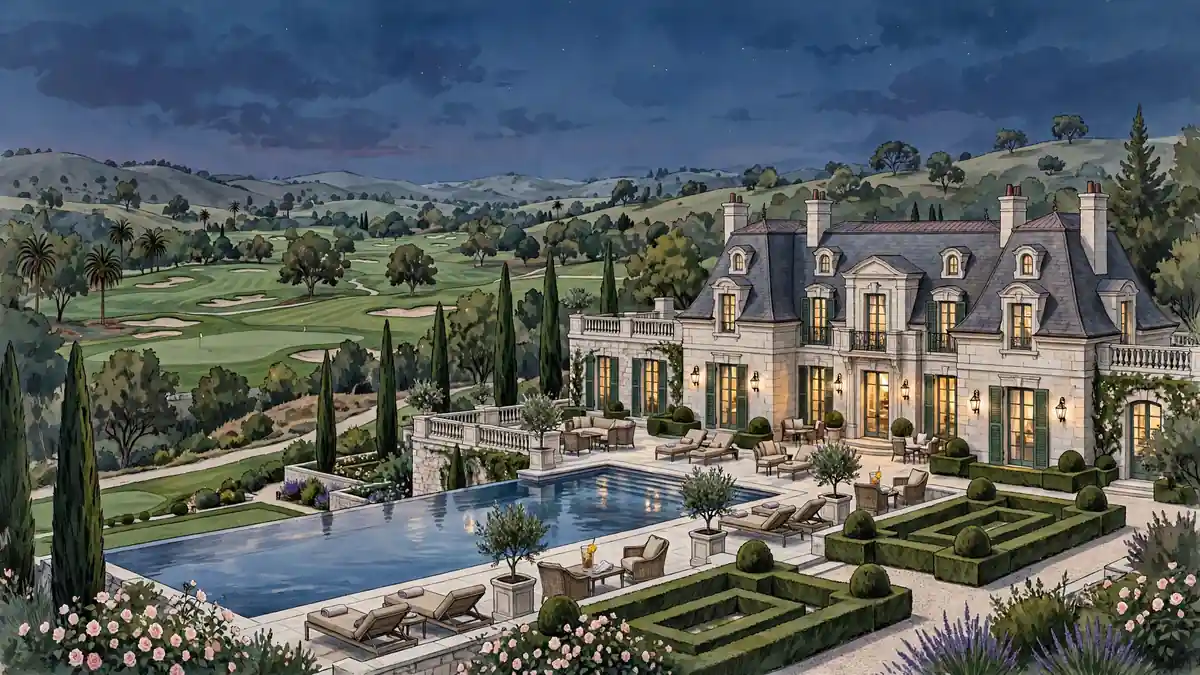
The one asset the public can price with confidence is Anka’s California home. In April 2007 he paid $3.9 million for a French-inspired estate inside the Sherwood Country Club in Westlake Village, California, on more than six acres — one of the largest private lots in the community, with views over the Jack Nicklaus-designed golf course. Listing descriptions vary on the size — Celebrity Net Worth describes a roughly 6,000-square-foot home, other listings put it at about 7,100 to 7,791 square feet — and on the bedroom count (four or five, with six bathrooms), so we give the range rather than pick one listing’s number. What the listings agree on: a gated, columned entry, a long driveway and motor court, a marble-accented dining room, a remodeled chef’s kitchen, a billiards room, a glass-walled gym with an outdoor shower, an infinity-edge pool, and a professional recording studio where Anka worked on his 2026 album Inspirations of Life and Love. One room displays more than 30 gold records from artists he has written for or produced, including Michael Jackson, Michael Bublé, Donny Osmond, Buddy Holly and Frank Sinatra.
Anka first listed the home in September 2023 at $10 million, pulled it to finish renovations and keep working from the studio, and relisted it in March 2026 at $8.99 million ($8,995,000). Parade and Celebrity Net Worth both covered the March 2026 relisting, and the listing was still live in the autumn of 2026. The sale is tied to a move: Anka has said he will relocate to Nevada, where he has lived before, while keeping a smaller home in Los Angeles. If the house sells near its asking price, the gain on his 2007 purchase is roughly $5 million before costs — a meaningful slice of the $80 million total, and the only piece of it that comes with a public price tag.
On cars, the record is silent. No verified reporting describes Anka’s car collection, and we will not fill the gap with a list of luxury models. The same honesty applies to other holdings: no yacht, no private jet and no second estate appear in the public record. His wealth is concentrated where his career was concentrated — in songs, in the house that contains his studio, and in the touring business that still fills theatres. That concentration is itself a finding: unlike many celebrities of his generation, Anka did not scatter his money across restaurants, clothing lines and car collections. He bought his songs back, bought one good house, and kept working.
Awards and Achievements
Anka’s honors read like a checklist of the institutions that matter in his two countries. He won the Juno Award for Composer of the Year in 1975. He was inducted into the Canadian Music Hall of Fame in 1980, the Songwriters Hall of Fame in 1993, and Canada’s Walk of Fame in 2005. He received the Johnny Mercer Award from the Songwriters Hall of Fame in 1998 and the BMI Film & TV Awards’ Classic Contribution Award in 2005. He has a star on the Hollywood Walk of Fame for recording, at 6840 Hollywood Boulevard, awarded in 1984. In October 2004 he was made an Officer of the Order of Canada, invested in June 2005; the Governor General of Canada’s citation calls him one of the most popular singer-songwriters of our time. A street in Ottawa, Paul Anka Drive, is named for him.
The achievements that never came with a trophy matter as much. He wrote more than 900 songs. He placed a song on the Billboard charts in seven consecutive decades — the only artist in history to do so, according to New Jersey Stage’s November 2026 coverage of his tour. “Diana” was the best-selling single of 1957 in Britain and one of the best-selling singles ever by a Canadian artist. “My Way” became Frank Sinatra’s signature song and one of the most recorded songs of the twentieth century. And he is still adding to the list at 85: a thirtieth studio album in February 2026, an HBO documentary in December 2025, a world tour in 2026, and a Broadway musical of his life approved for production. Most artists his age are being remembered. Anka is still being booked.
Net Worth Growth Over the Years
Year-by-year net worth figures for Anka do not exist in the public record, and we will not invent them. What exists is a dated trail of the deals and assets that built the fortune, and that trail is more honest than a fabricated growth curve. The table below gives the milestones that the reporting supports.
| Year | Milestone | Financial significance |
|---|---|---|
| 1957 | “Diana” tops the charts in the U.S. and UK | First fortune; 9 million+ copies reported, 20 million worldwide per Canadian Songwriters Hall of Fame |
| 1962 | Tonight Show theme written | Reported $800,000–$900,000 a year for three decades |
| 1963 | Buys back ABC-Paramount catalog for $250,000 | Takes ownership of his early publishing |
| 1969 | Sinatra releases “My Way” | Perpetual royalties from one of the most recorded songs ever |
| 1971 | “She’s a Lady” becomes a Tom Jones hit | Second career as a writer for other stars |
| 1974 | “(You’re) Having My Baby” reaches number one | Comeback as a performer after a decade away from the top 25 |
| 1983 | Co-writes three songs with Michael Jackson | 50% publishing on three posthumous Jackson hits, from 2009 onward |
| 2007 | Buys Westlake Village estate for $3.9 million | Main hard asset; listed 2026 at $8.99 million |
| 2013 | Autobiography My Way published | Book royalties and renewed licensing interest |
| 2025 | HBO documentary Paul Anka: His Way premieres | New audience, new licensing, Broadway musical approved |
| 2026 | 30th album; world tour; home relisted | Estimate stands at $80 million–$82 million |
How does $80 million compare with his peers? The comparison flatters Anka’s model rather than his total. Tom Jones, whose biggest hit Anka wrote, is listed by Celebrity Net Worth at about $300 million; Kenny G, who played on Anka’s 1998 album A Body of Work, is listed at about $100 million. Anka sits below both, and far below the billion-dollar touring estates — Jimmy Buffett‘s estate was valued at about $1 billion — but the comparison misses the point. Buffett built a hospitality empire; Anka built a catalog and kept it. A 1950s contemporary who sold his publishing in the 1960s would have little left to show for a career like Anka’s. Anka’s $80 million at 85, still earning from songs written before most of his current audience was born, is the payoff for the 1963 decision to buy the songs back. The peer who makes the sharpest contrast is Teddy Pendergrass, a 1970s contemporary whose career was cut short by a 1982 car accident: talent alone does not compound — time and ownership do. And the family connection runs through the same logic: Anka’s daughter Amanda is married to actor Jason Bateman, whose own career shows what a second act in Hollywood can be worth when it is managed over decades.
Social Media Presence
Anka’s online presence is modest for a man with his fame, and it is run like his career: personal, direct and tied to the work. His official site, paulanka.com, carries tour dates, news and the announcements for the 2026 album and the HBO documentary. He is active on TikTok, Instagram, Facebook and YouTube, where he posts tour clips, backstage moments and stories from seven decades in music. Billboard reported in December 2025 that he keeps TikTok on his phone and iPad and follows the numbers with his publisher, Primary Wave, as his songs find younger listeners through clips and samples. We do not publish follower counts here because they change daily and are not a meaningful measure of his wealth — but the direction is worth noting: the documentary and the TikTok discovery of his catalog are bringing him an audience that was not alive when “Diana” topped the charts, and that audience is the reason a 2026 album and a 2026 tour made commercial sense at 85.
Personal Life
Anka has been married three times and has six children. In 1962, on a trip to Puerto Rico, he met Anne de Zogheb, a model and the daughter of a Lebanese diplomat; they married in Paris on February 16, 1963, and had five daughters — Amelia, Anthea, Alicia, Amanda and Alexandra. The marriage ended in divorce in 2000 after 37 years. His daughter Amanda is married to actor Jason Bateman, making Bateman his son-in-law — a family link that still surprises people who know Anka only from the 1950s.
His second marriage was to Anna Åberg, a Swedish model and actress he had hired as a personal trainer in 1999. Their son Ethan was born in 2005; they married in Sardinia in the summer of 2008 and divorced in 2010. The split was bitter and public — Anna was arrested in 2009, Anka sued for defamation in 2010, and the suit was dismissed the same year — and custody of Ethan was contested for years until Anka gained full custody in June 2017. His third marriage, to Lisa Pemberton in Beverly Hills in October 2016, ended in divorce in 2020.
Anka became a naturalized citizen of the United States on September 6, 1990, while keeping his Canadian roots close: he was born in Ottawa, is honored with a street there, and the HBO documentary that premiered in December 2025 traces the whole arc from the Ottawa choir to the Las Vegas stage. He lives in California and, as the 2026 house listing makes clear, is planning a move to Nevada while keeping a smaller Los Angeles home. At 85 he still tours, still records and still writes — which, for a man who has said the writer is the whole business, is less a lifestyle choice than a job description.
Sources & Reporting
Celebrity Net Worth — net worth estimate of $80 million (updated March 24, 2026); career, personal-life and real-estate reporting, including the Westlake Village purchase ($3.9 million, April 2007), the 2023 listing at $10 million and the March 2026 relisting at $8.99 million, and the recording-studio detail on the 2026 album Inspirations of Life and Love. Reporting window: profile updated March 2026; real-estate article published March 24, 2026.
Canadian Songwriters Hall of Fame — “Diana” sales of 20 million copies worldwide and more than 300 recordings in 16 countries, 1957–1963. Reporting window: Hall of Fame song page, accessed November 2026.
American Songwriter — Inspirations of Life and Love released February 13, 2026 (11 tracks, nine new songs and two reworked hits); HBO documentary Paul Anka: His Way; 2026 world tour scheduled January–June; Broadway musical approved. Reporting window: March 13, 2026.
Billboard — Anka at 84 on longevity, TikTok use with publisher Primary Wave, and the 2026 album and jukebox musical plans, December 1, 2025. Reporting window: December 2025.
Parade — Westlake Village estate relisting at $8.995 million, March 2026; purchase price of about $4 million in 2007; planned move to Nevada. Reporting window: March 28–30, 2026.
Mix — 2026 album recorded largely in Anka’s Westlake Village home studio; home listed at $8.99 million; world tour underway; Broadway musical on the horizon. Reporting window: March–April 2026.
Pollstar — Anka’s 50% share of the songwriting royalties on Michael Jackson’s “This Is It,” October 13, 2009. Reporting window: October 2009.
Amoeba Music — biography: birth, early career, “My Way,” “She’s a Lady,” Songwriters Hall of Fame induction (1993), Canada’s Walk of Fame (2005), divorce date of September 28, 2000. Reporting window: biography page, accessed November 2026.
The Governor General of Canada — Officer of the Order of Canada, awarded October 29, 2004, invested June 10, 2005. Reporting window: official honours record, accessed November 2026.
Remind Magazine — HBO documentary Paul Anka: His Way premiering December 1, 2025; Inspirations of Life and Love scheduled for February 2026. Reporting window: November 30, 2025.
Paul Anka (official site) — album announcement for Inspirations of Life and Love (Green Hill Music / Sun Label Group, February 13, 2026) and Las Vegas performance history. Reporting window: October 2025 onward.
Other sources consulted for cross-checking: BiographyHost (1963 catalog buyback, $250,000); Encyclopedia.com and the Historical Society of Ottawa (awards and Ottawa history); New Jersey Stage (November 2026 sold-out “You Are My Destiny Tour” date, seven-decade Billboard record, 100 million albums sold); Goldmine and Rotten Tomatoes (documentary premiere, December 1, 2025, 99–100 minutes, directed by John Maggio). Where sources disagreed — Diana’s sales (9 million+ vs. 20 million), the Westlake Village square footage (about 6,000 vs. 7,100–7,791), the 2000/2001 divorce date — we published the range or the best-attributed figure and said so in the text.
Frequently Asked Questions
What is Paul Anka’s net worth in 2026?
Paul Anka’s net worth is estimated at $80 million as of November 2026. Celebrity Net Worth lists $80 million in its March 2026 update, and a second 2026 source gives a range of $80 million to $82 million. The fortune comes mainly from songwriting and publishing royalties on more than 900 songs, plus seven decades of touring, recordings and real estate.
How old is Paul Anka in 2026?
Paul Anka is 85 years old. He was born on July 30, 1941, in Ottawa, Ontario, Canada, so he turned 85 in July 2026. He is still touring and recording at that age, with a new album in February 2026 and a sold-out theatre show in November 2026.
Is Paul Anka still alive and performing?
Yes. Anka released his thirtieth studio album, Inspirations of Life and Love, on February 13, 2026, toured the world in 2026, and played a sold-out “You Are My Destiny Tour” show in Morristown, New Jersey, in early November 2026. The HBO documentary Paul Anka: His Way premiered on December 1, 2025.
What is Paul Anka’s most famous song?
As a performer, his most famous song is “Diana” (1957), which reached number one in the U.S. and UK when he was 16 and has reportedly sold more than nine million copies — 20 million worldwide by the Canadian Songwriters Hall of Fame’s count. As a songwriter, his most famous work is “My Way,” the English lyrics he wrote for Frank Sinatra in 1968.
Did Paul Anka write “My Way” for Frank Sinatra?
Yes — Anka wrote the English lyrics. The music came from the French song “Comme d’habitude” by Claude François and Jacques Revaux. Sinatra recorded Anka’s version in 1968 and released it in 1969, and it became Sinatra’s signature song and one of the most recorded songs of the twentieth century.
Who is Paul Anka’s wife?
Anka has been married three times and is not publicly reported to be currently married. His first wife was Anne de Zogheb (married 1963, divorced 2000), with whom he had five daughters. His second wife was Anna Åberg (married 2008, divorced 2010), mother of his son Ethan. His third wife was Lisa Pemberton (married 2016, divorced 2020).
How many children does Paul Anka have?
Paul Anka has six children: five daughters — Amelia, Anthea, Alicia, Amanda and Alexandra — with his first wife Anne de Zogheb, and one son, Ethan, born in 2005, with his second wife Anna Åberg. His daughter Amanda is married to actor Jason Bateman.
How much did Paul Anka make from the Tonight Show theme?
The Tonight Show theme was one of Anka’s biggest earners. Documentary coverage reports that Johnny Carson’s lawyer told The New York Times the theme generated between $800,000 and $900,000 a year for three decades — roughly $25 million across its run, shared between Anka and Carson under the publishing deal Anka struck when he offered Carson half the publishing to get the theme used.
Final Thoughts
Paul Anka’s $80 million is the least surprising number in this article once you see how it was built. A 15-year-old wrote a song about a girl at his church, and then — unlike almost every other teen idol of his era — he kept the songs. He bought his catalog back for $250,000 in 1963, traded half the publishing on a television theme for thirty years of nightly payments, wrote the lyrics that became Frank Sinatra’s signature, and collected half the publishing on three Michael Jackson hits that were written in a single month in 1983 and paid out decades later. The house in Westlake Village, bought for $3.9 million and listed at $8.99 million in 2026, is the visible asset. The catalog is the fortune.
What makes the story useful rather than just impressive is the discipline behind it. Anka never chased a second career as a brand; he never sold the catalog when the big checks were being written for other artists’ songbooks; and at 85 he is still adding to the asset, with a new album, a documentary, a tour and a Broadway musical all landing within a single year. That is why the estimate holds its value while other fortunes from the 1950s have faded: the money was never tied to being young, or famous this year. It was tied to owning work that people keep playing. For anyone measuring a music career in money, Anka’s is the worked example of the writer winning in the end.
Published on November 19, 2026. Last reviewed November 2026. Found an error? See our corrections policy.