
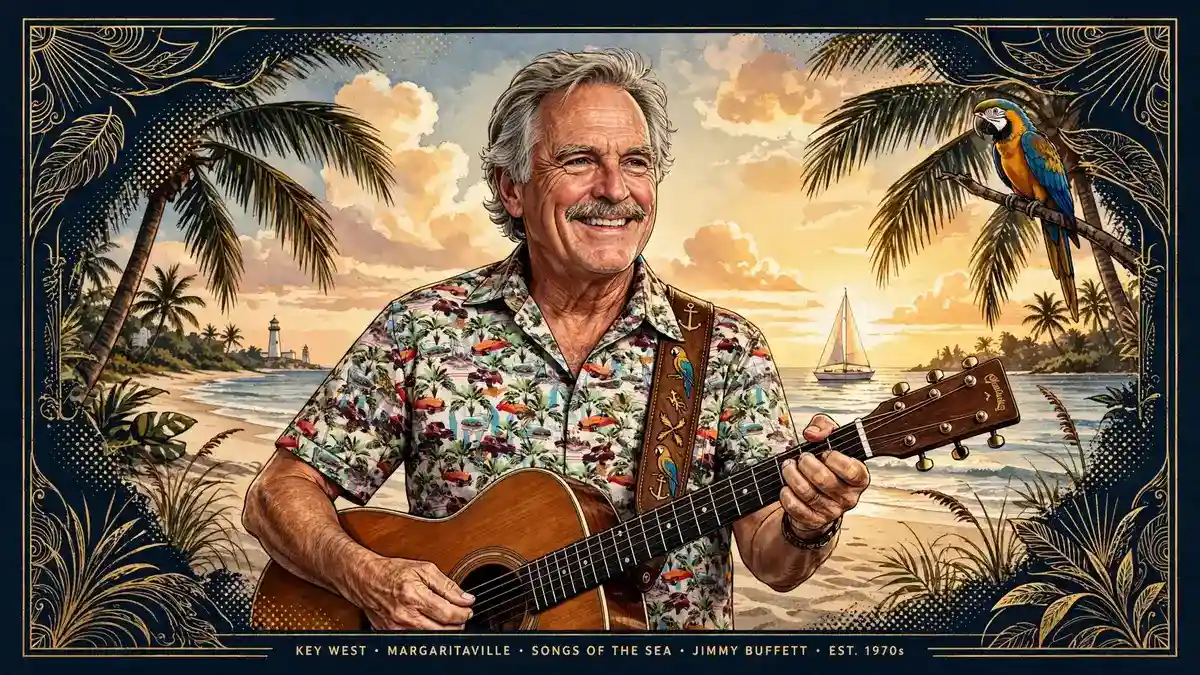
Jimmy Buffett‘s net worth is estimated at about $1 billion as of November 2026. That was the figure Forbes put on the singer’s fortune when it added him to its World’s Billionaires list in April 2023, and the magazine stood by the same estimate when Buffett died on September 1, 2023, at 76. The surprise is where the money sat: only about 5 percent of it came from his music catalog. The rest came from five decades of touring and from turning one 1977 song into the Margaritaville brand, a licensing machine that rang up about $2.2 billion in sales in 2022. Since his death, the fortune has taken a second act in court, where his widow and his longtime business manager are fighting over a family trust valued at about $275 million, with a trial set for January 2027.
Jimmy Buffett: Quick Facts
| Estimated net worth | About $1 billion at death (Forbes, 2023) (range: $1 billion) |
|---|---|
| Profession | Singer-songwriter, author, businessman |
| Nationality | American |
| Born | December 25, 1946, Pascagoula, Mississippi (died September 1, 2023, aged 76) |
| Height | 5 feet 7 inches (170 cm) |
| Primary income sources | Touring and recording, Margaritaville licensing, tequila and beer, music catalog, real estate and aircraft |
| Active years | 1970–2023 |
| Last reviewed | November 2026 |
- Early Life and Background
- Education
- Career Journey
- Rise to Fame
- Main Sources of Income
- Salary and Earnings
- Businesses and Investments
- Brand Deals and Sponsorships
- Houses, Cars and Other Assets
- Awards and Achievements
- Net Worth Growth Over the Years
- Social Media Presence
- Personal Life
- Sources & Reporting
- Frequently Asked Questions
Early Life and Background
James William Buffett was born on Christmas Day, December 25, 1946, in Pascagoula, Mississippi, a shipbuilding town on the Gulf Coast. His father, James Delaney Buffett Jr., worked in the shipyards and had been a sailor; his mother, Mary Lorraine Buffett, kept the family home. The sea was never far from the family’s life. Buffett grew up in Mobile, Alabama, and in Fairhope, a small town on the eastern shore of Mobile Bay, where the Gulf Coast’s heat, humidity, and salt air shaped the songs he would write for the next fifty years.
The Buffett household was middle class, and nothing in it pointed toward a billion-dollar brand. His grandfather had been a steamship captain, and family stories about the sea gave the boy a ready supply of characters: sailors, smugglers, fishermen, and drifters. Those figures kept showing up in his songs decades later, from “A Pirate Looks at Forty” to “Son of a Son of a Sailor,” a song that names the family trade in its title. Buffett learned guitar as a teenager and played in local bands while he was still in school, but music looked like a hobby rather than a plan. The plan, such as it was, involved college and a steady job.
Fairhope mattered to Buffett’s sound in a specific way. The town sat between the working port of Mobile and the beaches of the Gulf, and its mix of fishermen, retirees, and artists gave him a cast of people who lived outside the usual career ladder. He absorbed that atmosphere and later sold it back to America as a lifestyle. When he finally found his audience, it was not because he invented a beach fantasy from nothing. He had grown up inside it, watching men who worked on the water and spent their pay on boats, beer, and weekends that stretched a little too long.
Buffett’s childhood also explains the split that ran through his whole career. He was a college-educated songwriter who could write a tight pop hook, and he was a Gulf Coast kid who distrusted polish. The tension between those two halves produced the “Gulf and Western” sound — country storytelling, rock choruses, and Caribbean rhythm — that no Nashville producer had quite heard before. It also explains why his fans, who called themselves Parrotheads, treated his concerts as a reunion rather than a show. They were buying into a place he had actually come from.
Education
Buffett finished high school in Alabama and enrolled at Auburn University, where he lasted about a year before the fit wore thin. He transferred to the University of Southern Mississippi in Hattiesburg, where he studied history and graduated in 1969. The history degree shows up in his writing more than most fans notice: his songs and books are full of sailors, pirates, and coastal towns with real pasts, and his memoir reads like a man who paid attention in class even when he was skipping it.
College gave Buffett two things that mattered more than the diploma. The first was a guitar habit that had turned serious. He played folk and country songs at campus gatherings and local bars, learning how to hold a room with a story between songs. The second was a wife: he married Margie Washichek in 1969, the year he graduated. The marriage ended in divorce in 1972, and Buffett rarely discussed it afterward. What he carried out of Southern Miss was a degree, a failed first marriage, and a decision to try Nashville.
He moved to Nashville in 1969 with a guitar and a history degree, and found work as a reporter for Billboard magazine, covering the country music business from the inside. The job taught him how the industry priced songs, booked tours, and sold records, and it put him in rooms with the songwriters he wanted to become. He also learned how little a young songwriter earned. Billboard paid the rent; the songs did not, at least not yet. After a couple of years in Nashville, Buffett made the move that defined his career: he left the country music capital for Key West, Florida, a town at the end of the road where rent was cheap, the bars stayed open late, and nobody asked what you did for a living.
Career Journey
Buffett’s first album, Down to Earth, came out in 1970 on Barnaby Records and sold 324 copies. The number became a running joke in his act for the rest of his life, and he told it on himself because it was true: a debut that almost nobody bought. A second album, High Cumberland Jubilee, was recorded the same year and sat unreleased until 1976, when the label decided his name was finally worth printing. Neither record made money. Both taught him that Nashville’s idea of a country singer did not fit a songwriter who wanted to sing about the Caribbean.
Key West changed the math. Buffett arrived in 1971 and found a town full of shrimpers, smugglers, writers, and musicians who played for tips in bars like the Chart Room. He busked, played happy hours, and wrote songs that sounded like the place: “Come Monday,” “A Pirate Looks at Forty,” and the early sketches of “Margaritaville.” The Coral Reefer Band, the loose group of musicians who backed him on stage and in the studio, took shape in these years, and it stayed with him for five decades. The band’s name came from a reef off Key West, and its members rotated while Buffett stayed at the center, a frontman who treated his band like a crew.
The record deals followed the move. ABC Records signed Buffett, and A White Sport Coat and a Pink Crustacean arrived in 1973, followed by Living and Dying in 3/4 Time in 1974, which carried “Come Monday,” his first Top 40 single. A1A (1974) and Havana Daydreamin’ (1976) built the catalog steadily, and the touring circuit grew with it: college towns, beach bars, and amphitheaters where the audience drank margaritas and dressed like parrots. Buffett was not a chart star yet, but he was becoming a touring act with a loyal crowd, and the crowd was the asset that mattered. A singer who can fill a shed every summer for forty years does not need a No. 1 single. Buffett proved that for the rest of his career.
The business instinct showed early. In 1985, eight years after “Margaritaville” made him famous, Buffett started selling merchandise and opened the first Margaritaville stores and restaurant in Key West, betting that the song’s fans would pay to live inside it for an evening. The bet paid off so slowly that most observers missed it: a T-shirt stand became a restaurant chain, then a resort brand, then a licensing company. Buffett also started his own record labels, launching Margaritaville Records in 1992 with distribution through MCA, and later Mailboat Records, so his catalog stayed under his control. He wrote books between tours, and the books sold. By the 1990s, the singer who had once sold 324 copies of his first album was running a small empire from a tour bus, and the touring never stopped. Buffett played summer sheds into his seventies, and the annual tour was the engine that kept the whole machine running: the concerts sold the merchandise, the merchandise advertised the brand, and the brand sold the resorts.
Rise to Fame
The breakthrough came on February 14, 1977, when “Margaritaville” was released as a single from the album Changes in Latitudes, Changes in Attitudes. The song spent 22 weeks on the Billboard Hot 100 and peaked at No. 8, and it stayed on the radio for the next half century. Buffett later told Ellen DeGeneres in 2005 that he wrote it in about six minutes, a story the Library of Congress repeated when it selected the song for the National Recording Registry in 2023. The song’s spark came from a drink he had tried at Lung’s Cocina del Sur, a restaurant in Austin, Texas, and from a breakup with a woman he was dating — the lost shaker of salt was a souvenir of a bad day, not a party anthem. That mix of a joke and a bruise is why the song lasted: it sounds like a vacation and reads like a man taking stock of his life.
The album around the single did the rest. Changes in Latitudes, Changes in Attitudes went platinum and gave Buffett a second hit in its title track, while “Cheeseburger in Paradise,” from 1978’s Son of a Son of a Sailor, became a permanent part of the set list and, later, a restaurant chain. Buffett’s catalog filled out through the late 1970s and 1980s with songs his fans called the Big 8 — “Margaritaville,” “Come Monday,” “Fins,” “Volcano,” “A Pirate Looks at Forty,” “Cheeseburger in Paradise,” “Why Don’t We Get Drunk,” and “Changes in Latitudes, Changes in Attitudes” — and every concert ended with most of them. The 1985 greatest-hits set Songs You Know by Heart became his best-selling album, passing 7 million copies by 2005, a figure that says more about Buffett’s career than any single chart position: his fans bought the collection, then came back every summer to hear it live.
Fame, for Buffett, looked different from the usual pop arc. He never had a second Top 10 single, and he never needed one. His first No. 1 album did not arrive until 2004, when License to Chill topped the Billboard 200 when he was 57, helped by duets with country stars including Alan Jackson, whose “It’s Five O’Clock Somewhere” with Buffett won the Country Music Association’s Vocal Event of the Year award in 2003. The tours grew into stadium and amphitheater runs that grossed tens of millions of dollars a year, and the Parrothead crowd — fans in Hawaiian shirts, leis, and parrot hats — turned each show into a tailgate party. Buffett’s rise was slow, then durable: a singer who peaked on the charts in 1977 and kept getting richer for the next 46 years.
The song’s afterlife kept adding honors. “Margaritaville” entered the Grammy Hall of Fame in 2016 for its cultural and historic significance, and in 2023 the Library of Congress chose it for preservation in the National Recording Registry. The 2017 Broadway musical Escape to Margaritaville, built from Buffett’s songs, ran on Broadway in 2018 and then toured the country. Buffett himself earned two Grammy nominations, two Academy of Country Music Awards, and a Country Music Association Award, according to Pollstar’s obituary — a modest trophy shelf for a billionaire, and a reminder that his fortune was built on tickets and T-shirts rather than statuettes.
Main Sources of Income
Buffett’s money came from four places, and the order matters because it is the opposite of what most people assume. Touring and recording came first. Forbes estimated that Buffett earned about $570 million from touring and recording over his career, after taxes and costs — more than half of the billion. The Margaritaville brand came second: his 28 percent stake in the licensing company was worth about $180 million, with another $60 million from the tequila and beer business. His music catalog was worth about $50 million. The remainder sat in homes, planes, a yacht, and shares in Berkshire Hathaway, worth about $140 million combined. The table below lays out the Forbes breakdown, and the sections after it take each piece apart.
| Income source | Forbes estimate (2023) | What it covered |
|---|---|---|
| Touring and recording | About $570 million | Five decades of concerts with the Coral Reefer Band, album sales and royalties |
| Margaritaville Holdings stake (28%) | About $180 million | Licensing for restaurants, resorts, homes, food and retail products |
| Tequila and beer | About $60 million | Margaritaville tequila, ready-to-drink cocktails and LandShark Lager |
| Music catalog | About $50 million | Masters and publishing for songs including “Margaritaville” and “Come Monday” |
| Homes, planes, yacht and stock | About $140 million | Six homes, four planes, a yacht and Berkshire Hathaway shares |
| Total | About $1 billion | Forbes, April 2023, repeated at his death in September 2023 |
The brand’s scale is what turns those numbers from a rich musician’s ledger into a billion-dollar story. Forbes reported that businesses carrying the Margaritaville name generated about $2.2 billion in sales in 2022 through licensing and franchising, not counting the drinks business, which sold about $400 million a year. Buffett did not own those businesses outright. He owned the name and took a cut, through Margaritaville Holdings, the licensing company chaired by Buffett and run day to day by chief executive John Cohlan. That model — license the name, let other people build the hotels — is why the brand could grow to more than 30 resorts and around 150 restaurants without Buffett financing the construction himself. It is also why his 28 percent stake, worth $180 million, was only a fraction of the brand’s total sales. The licensing fees were the prize, and they arrived every year whether Buffett toured or not.
Books added a smaller but steady stream. Buffett wrote three books that reached the New York Times best-seller list, and his memoir A Pirate Looks at Fifty (1998) went straight to No. 1 on the nonfiction list, making him one of the few authors to top both the fiction and nonfiction lists. Tales from Margaritaville (1989) and Where Is Joe Merchant? (1992) each spent more than seven months on the fiction list. He also co-wrote two children’s books, The Jolly Mon and Trouble Dolls, with his eldest daughter, Savannah. Book money never rivaled touring or licensing, and Forbes did not break it out separately, but the books did something the songs could not: they put Buffett’s name on best-seller lists in bookstores, widening the audience for the brand.

Salary and Earnings
Buffett never drew a salary in the usual sense. He was the owner of his touring business, his brand company, and his catalog, so his income arrived as tour profits, licensing fees, and royalties rather than a paycheck. The best measure of his annual earnings comes from the reporting around his peak years. Celebrity Net Worth, which matched Forbes’ $1 billion figure, reported that during his most successful years Buffett earned $50 million to $100 million a year from music and business ventures combined. Forbes’ own reporting supports the top of that range: the magazine noted that Buffett was still receiving close to $200 million a year from his Margaritaville Holdings shares in the years before his death, a figure that reflects gross distributions from the brand business rather than take-home pay.
Touring was the steadiest earner. Buffett played summer amphitheater and stadium runs for decades, and the Coral Reefer Band’s shows were among the most reliable grossers in live music. His fans bought tickets, then bought the merchandise, then booked the resorts. The $570 million lifetime touring and recording figure from Forbes covers the whole arc, from bar gigs in Key West to stadium dates in his seventies, and it is net of taxes and costs — a rare piece of honesty in celebrity wealth reporting, where gross tour figures are usually quoted without subtracting the crew, the trucks, and the tax bill. Buffett’s catalog added royalties on top: more than 20 million certified records sold worldwide, with eight albums certified gold and nine certified platinum or multi-platinum by the Recording Industry Association of America, across more than 30 albums.
The record business itself changed under Buffett’s feet, and he changed with it. His early albums sold on vinyl and tape; Songs You Know by Heart sold on CD through the 1990s and 2000s; streaming added a long tail in his final decade. None of those formats made him rich on their own — the catalog was worth only about $50 million, or 5 percent of his fortune, by Forbes’ math. The records were the advertisement. The money was in the room: a concert ticket, a T-shirt, a frozen drink, and a hotel night, all carrying the same name. That is the arithmetic that separates Buffett from singers with bigger catalogs and smaller fortunes. A peer like Prince, whose catalog was the center of his wealth, left a fortune built on recordings; Buffett’s recordings were the smallest line on his balance sheet.
One more earnings detail belongs here because it shows how Buffett was paid at the end. Court filings from the trust dispute report that the trust’s roughly 20 percent stake in Margaritaville paid out about $14 million in distributions over an 18-month period — money that kept flowing after his death, since the brand did not stop selling rooms and margaritas when its founder died. The filings also show the other side of that coin: the trust reported only about $2 million in annual income over the same period, a gap his widow’s lawyers have made the center of their case. The numbers are disputed, and no court has ruled on them, but they show the shape of the estate Buffett left behind: a business that keeps earning, and a family arguing over who counts the money.
Businesses and Investments
Margaritaville Holdings LLC was the company at the center of everything. Buffett founded it in 1985, and it sits under Cheeseburger Holding Company LLC. Its first moves were modest — stores and a restaurant in Key West, with the first Margaritaville Café opening in 1987 — but the licensing model let it grow without Buffett paying for every building. By 2023 the brand covered more than 30 resorts and around 150 themed restaurants, plus casinos in Louisiana and Puerto Rico, apparel, drink mixes, pool floats, and pickleball sets. The company’s chief executive, John Cohlan, ran the operation while Buffett toured and wrote, and Forbes described the business as a “sprawling global licensing operation” that brought in $2.2 billion in sales in 2022.
The restaurant business grew in steps. In 2002 Buffett partnered with Outback Steakhouse to open the first Cheeseburger in Paradise restaurant in Southport, Indiana, turning another of his song titles into a chain. The Margaritaville restaurants themselves spread from Key West to Orlando, Las Vegas, Nashville, and resort towns across the United States and the Caribbean, with the Paradise Island location in the Bahamas among the best known. Casinos followed, and so did hotels: the Margaritaville Beach Resort in Hollywood, Florida, the Margaritaville Resort in Biloxi, Mississippi, and dozens more, most of them owned by developers who paid for the name.
The most ambitious branch of the brand was housing. Latitude Margaritaville, a 55-and-older retirement community built with Minto Communities, opened in Daytona Beach, Florida, in 2018, after the partnership was announced in 2017. The Daytona project was described as a $1 billion village with a planned 6,900 homes, and it sold its final new home in 2025. The concept spread to Hilton Head, South Carolina, and to Watersound in the Florida Panhandle, and by August 2026 the portfolio held nearly 20,000 homes and future lots, according to Builder magazine. In September 2026, Minto announced Latitude Margaritaville Galveston Bay, a 3,500-home community in Texas, with a sales center targeted for the first quarter of 2028. Buffett visited the Daytona community himself, knocked on neighbors’ doors to introduce himself, and owned a home there. The retirement villages turned his audience into his customers in the most literal way: fans who had spent forty summers singing along could now buy a house with his song’s name on the gate.
The brand also went to sea. In December 2021 Margaritaville announced a partnership with Bahamas Paradise Cruise Line, which rebranded as Margaritaville at Sea in 2022. Its ship, the Grand Classica, was refitted and renamed Margaritaville at Sea Paradise, running three-day, two-night cruises from the Port of Palm Beach to Grand Bahama Island. A second ship joined later. The cruise line put Buffett’s name on a floating resort, and it kept the brand in front of travelers who had never been to a Margaritaville hotel.
Buffett’s other investments were quieter. He owned shares in Berkshire Hathaway, the conglomerate run by Warren Buffett, and the two men were not related — a fact Warren Buffett joked about when he told Forbes in April 2023, “Tell Jimmy to keep me in his will!” He launched Margaritaville Records in 1992, with distribution through MCA, and later ran Mailboat Records, keeping his catalog and new releases under his own roof. Radio Margaritaville, his channel on SiriusXM, played his music and his friends’ music around the clock, and it doubled as an advertisement for the tours. None of these ventures was separately valued by Forbes, but together they explain the $140 million bucket of homes, planes, a yacht, and stock: Buffett’s wealth was spread across the brand, the road, and the sky.
Brand Deals and Sponsorships
Buffett’s brand deals were different from a typical celebrity’s because he was usually the brand, not the endorser. The biggest partnership was the one that built the restaurant chain: the 2002 deal with Outback Steakhouse to develop Cheeseburger in Paradise, which put a national restaurant operator behind his song title. The Latitude Margaritaville partnership with Minto Communities was the same idea at a larger scale — a developer with land and building expertise, and Buffett with a name that sold houses to his own fans. The Margaritaville at Sea partnership with Bahamas Paradise Cruise Line followed the same pattern, as did the licensing deals that put the Margaritaville name on tequila, ready-to-drink cocktails, and LandShark Lager, the beer brand tied to the resorts.
He also lent the name to causes and events that fit the brand. In 2018 Margaritaville became a primary sponsor of the Minto U.S. Open Pickleball Championships in Naples, Florida, a sport whose players overlapped neatly with the Latitude Margaritaville buyer. Buffett’s tours carried sponsors too, and his shows were natural fits for beer, rum, and resort advertisers who wanted the Parrothead crowd. The deals were rarely announced with dollar figures, and Buffett did not pose for the kind of endorsement campaigns that other stars chased. His model was the reverse: companies paid him to use his name, and the name was the product.
The drinks business deserves its own line because Forbes valued it separately. The magazine put Buffett’s share of the tequila and beer business at about $60 million, with the broader drinks operation selling about $400 million a year. Margaritaville tequila and its ready-to-drink cocktails sat on shelves in supermarkets and liquor stores, and LandShark Lager was sold at the resorts and beyond. The drinks were the most portable part of the empire: a fan who would never book a resort or buy a retirement home could still buy a bottle, and millions did.
Houses, Cars and Other Assets
Forbes put Buffett’s homes, planes, yacht, and stock at about $140 million, and the property list explains why the number is that large. Buffett owned six homes, including an estate in Palm Beach, Florida, where Margaritaville Holdings was based; a home in Sag Harbor, New York, on Long Island, where he died; and a home in St. Barts in the Caribbean, where he had lived for three decades and drew the inspiration for songs and characters in his books. He also owned a home in the Latitude Margaritaville community in Daytona Beach, the retirement village his own brand had built, and he was known for dropping by neighbors’ doors to say hello.
The Sag Harbor house was the center of his final years. Buffett died there on September 1, 2023, surrounded by family, friends, music, and dogs, according to the statement posted on his website. The Palm Beach property anchored his business life: Margaritaville Holdings was run from Palm Beach, and Buffett’s office and his company’s executives worked from the town. The St. Barts home reflected the other half of his life — the Caribbean sailor who had first traveled to the island in 1978 and moved there soon after, writing songs in a place that matched the world he sang about. Court filings in the trust dispute also mention a Bahamas property the trust maintained at a cost of more than $300,000 a year, a line item his widow’s lawyers have questioned.
Buffett was a pilot, and his aircraft were as famous among his fans as his songs. He owned four planes, including the Hemisphere Dancer, a Grumman Albatross seaplane that became a character in its own right: it appeared in his shows, his books, and his videos, and fans treated it as part of the act. He also owned a yacht, which he sailed in the Caribbean. The planes were working tools as much as toys — Buffett flew himself to gigs and to the islands he wrote about — and they were also the most Buffett-like assets he owned: a singer who sang about sailing and flying, and then bought the boat and the plane.
The Berkshire Hathaway shares were the quietest line on the list. Buffett held stock in the conglomerate run by Warren Buffett, and the two men shared a last name and nothing else. Warren Buffett’s joke about the will made the papers in April 2023, when Forbes named Jimmy a billionaire, and it captured the oddity of the pairing: the world’s most famous value investor owned the same stock as a beach singer, and the singer’s stake was a rounding error next to the investor’s. Forbes did not publish the size of the holding, and it sits inside the $140 million bucket with the homes, planes, and yacht rather than as its own line.
Awards and Achievements
Buffett’s trophy shelf was modest for a man of his wealth, and that gap is part of the story. He earned two Grammy nominations, two Academy of Country Music Awards, and a Country Music Association Award, according to Pollstar’s obituary. The CMA award came in 2003, when “It’s Five O’Clock Somewhere,” his duet with Alan Jackson, won Vocal Event of the Year. The two Grammy nominations recognized his collaborations rather than his solo work, a pattern that fits a singer whose strength was the room rather than the record.
The honors that mattered most to his legacy came from institutions rather than awards shows. “Margaritaville” was inducted into the Grammy Hall of Fame in 2016, and the Library of Congress selected it for the National Recording Registry in 2023, citing its cultural and historic significance. Buffett was inducted into the Florida Artists Hall of Fame in 2000, and the state of Florida’s own cultural agency credits him with more than 20 million albums sold and a career that carried Key West’s name around the world. His books gave him a rarer distinction: he was one of the few authors to reach No. 1 on both the New York Times fiction and nonfiction best-seller lists, a club whose members include Ernest Hemingway, John Steinbeck, and Dr. Seuss, according to the Florida Department of State’s biography.
The commercial achievements outran the awards. More than 30 albums, eight gold and nine platinum or multi-platinum certifications, more than 20 million certified records sold, a first No. 1 album at 57, a Broadway musical, a cruise line, a chain of retirement villages, and a place on Forbes’ billionaires list at 76 — five months before his death. The music industry’s own trade paper, Pollstar, called him a “live industry pioneer” in its obituary, and the label fits: Buffett built the modern model of the touring veteran whose concerts are a destination, and younger acts still copy it. A singer with one Top 10 single does not usually end up a billionaire. Buffett did it by treating the song as the start of the business rather than the business itself.
Net Worth Growth Over the Years
Buffett’s wealth grew slowly for most of his career and then jumped in his final decade, when the brand’s licensing income compounded and Forbes started valuing it. The table below uses Forbes’ own reporting where it exists and labels the earlier years as estimates from the record, because no rich list tracked Buffett before the 2010s. The arc is the point: a working musician in the 1970s, a comfortable touring star in the 1990s, a rich celebrity by 2016, and a billionaire in the last five months of his life.
| Year | Estimated net worth | What changed |
|---|---|---|
| 1970 | Near zero | Debut album Down to Earth sold 324 copies; Buffett played for tips in Nashville and Key West |
| 1977 | About $1 million (estimate) | “Margaritaville” reached No. 8; the album went platinum and touring became a steady living |
| 1985 | About $5 million (estimate) | Margaritaville Holdings founded; first stores and restaurant opened in Key West |
| 1998 | About $50 million (estimate) | Memoir A Pirate Looks at Fifty hit No. 1; touring and merchandising scaled up |
| 2004 | About $100 million (estimate) | License to Chill became his first No. 1 album; the brand’s resort and restaurant count grew |
| 2016 | $550 million (Forbes) | Forbes ranked him No. 13 on America’s Richest Celebrities; “Margaritaville” entered the Grammy Hall of Fame |
| 2022 | About $900 million (estimate) | Margaritaville brand sales hit about $2.2 billion; Margaritaville at Sea launched |
| April 2023 | $1 billion (Forbes) | Forbes added Buffett to the World’s Billionaires list at No. 2,543 |
| September 2023 | $1 billion at death (Forbes) | Buffett died on September 1, 2023; Forbes repeated the $1 billion estimate in its obituary coverage |
| 2025–2026 | Estate disputed | The marital trust at the center of the family lawsuit was valued at about $275 million in court filings; the brand kept operating and expanding |
The peer table puts Buffett’s billion in context. He was one of the very few musicians to reach ten figures, and he got there by a different road from the others. Taylor Swift reached billionaire status through music and touring, becoming the first musician Forbes credited with doing it from songs and shows alone. Rihanna’s fortune rests on her Fenty beauty business, and Jay-Z’s on music, streaming, and investments. Buffett’s road ran through a licensing company built on a single song — a model no other musician has repeated at the same scale, and one that kept paying after his death, when the brand’s resorts, restaurants, and retirement villages carried on without him.
Social Media Presence
Buffett was not a social media star, and his accounts reflected a man from an earlier era of fame. His official website, jimmybuffett.com, was the home of his tour dates, merchandise, and news, and it was the site that posted the statement announcing his death. His social media pages carried the same announcement on the night of September 1, 2023, and they have since served as a memorial and a brand channel, posting tributes, tour news for the Coral Reefer Band’s continuing shows, and Margaritaville promotions. The accounts never carried the follower counts of younger stars, and that was never the point: Buffett’s audience found him at the amphitheater, not on a feed.
The fan community did the social work for him. Parrotheads — the fans who dressed in Hawaiian shirts and parrot hats and tailgated before his shows — organized themselves into local chapters, ran charity events, and filled social media with photos from concerts for decades before the term “fan community” became a marketing phrase. The clubs raised money for coastal conservation and local causes, and Buffett played benefits for them. Radio Margaritaville, his SiriusXM channel, gave the community a place to gather between tours, playing his catalog and the music of his friends around the clock. The channel still broadcasts, and it is the closest thing to a living memorial Buffett has: his voice, on the radio, singing about the place he built.
Personal Life
Buffett married Jane Slagsvol in 1977, and the marriage lasted 46 years, until his death. Jane had co-written two songs on his 1976 album Havana Daydreamin’ before they married, and she stayed out of the spotlight for most of their life together, raising their family while Buffett toured. They had three children: Savannah Jane Buffett, who co-wrote children’s books with her father; Sarah Delaney Buffett; and Cameron Marley Buffett, whom they adopted. The family lived between Palm Beach, Sag Harbor, and St. Barts, and Buffett’s songs and books are full of their lives — Savannah’s name is on the children’s books, and the family’s sailing trips show up in the memoir.
His first marriage, to Margie Washichek, lasted from 1969 to 1972 and ended before fame arrived. Buffett rarely spoke about it, and it does not appear in his songs. The second marriage defined his adult life, and it is the marriage at the center of the estate fight that followed his death. Buffett’s will, first written more than 30 years before his death and amended in 2017 and again in 2023, sent most of his assets into a marital trust for Jane, with their three children as the remainder beneficiaries. He named Jane and his longtime business manager and accountant, Richard Mozenter, as co-trustees of the trust, a choice that was meant to balance family and professional oversight and instead produced a lawsuit.
Buffett’s health stayed private until the end. He was diagnosed with Merkel cell carcinoma, a rare and aggressive form of skin cancer, in 2019, and he fought it for four years while continuing to perform. His official obituary said he kept playing during treatment, and his last show was a surprise appearance in Rhode Island in early July 2023; his final full concert had been in San Diego in May 2023. He entered hospice care less than two weeks before his death, according to TMZ’s reporting, and died at home in Sag Harbor on September 1, 2023, at 76. The statement on his website said he “passed away peacefully on the night of September 1st surrounded by his family, friends, music and dogs.” Tributes followed from across music, including Paul McCartney, who had played with Buffett and called him a friend, and from the country stars who had shared his stage.
The estate fight began almost two years later. On June 2, 2025, Mozenter petitioned a court in West Palm Beach, Florida, to remove Jane as co-trustee, saying Buffett had set up the trust with an independent trustee because he worried about his wife’s ability to manage the assets. The next day, Jane sued in Los Angeles Superior Court to remove Mozenter, saying he had withheld basic financial information for more than a year, charged about $1.7 million in fees in 2024, and projected that a $275 million trust would pay her less than $2 million a year. Her filing pointed to the gap between the trust’s reported income and the roughly $14 million the trust’s Margaritaville stake paid out over 18 months. Mozenter disputed her account, and the case moved to Florida, where a judge denied Jane’s request for his immediate removal in August 2025 and ordered mediation. Reporting in 2026 added harsher detail: the Wall Street Journal described family messages in which Jane reminded her daughter Savannah that she stood between her and roughly $75 million, and Mozenter’s lawyers sought records about Jane’s prescription drug use. A bench trial is set for January 19, 2027, in Palm Beach County, and as of October 2026 no court had finally resolved the dispute. The allegations on both sides are claims in court filings, not findings, and this article reports them as such.
One misunderstanding about the fight is worth clearing up, because it drives most of the public confusion about Buffett’s money. The $275 million trust is not the whole fortune. Forbes’ $1 billion figure valued Buffett’s total wealth — his stake in the brand, his touring income, his catalog, his homes, planes, and stock — while the court filings list the specific assets held inside one marital trust. The trust is a piece of the estate, not the estate itself, and the lawsuit is about who controls that piece, not about whether Buffett was a billionaire. Forbes’ valuation stands on its own reporting, and the trust fight is a separate story about what happens to a fortune after its owner dies.
Sources & Reporting
Forbes — the headline $1 billion valuation, the April 2023 billionaires-list entry, and the line-by-line breakdown: $570 million from touring and recording, a $180 million 28 percent stake in Margaritaville Holdings, $60 million from tequila and beer, a $50 million catalog, and $140 million in homes, planes, a yacht, and Berkshire Hathaway shares; also the $2.2 billion in 2022 brand sales, the $400 million-a-year drinks business, and the 2016 richest-celebrities ranking of $550 million. Reporting window: April–September 2023.
Celebrity Net Worth — matched the $1 billion figure at death, reported the $50 million-to-$100 million annual earnings range in Buffett’s peak years, and covered the $275 million marital trust dispute, including the June 2025 filings, the $1.7 million in fees, and the January 2027 trial date. Reporting window: 2023–2026.
NBC News and the Associated Press — the death announcement and obituary reporting, and the AP’s account of the trust filings: Mozenter’s June 2, 2025 petition in West Palm Beach and Jane Buffett’s June 3, 2025 complaint in Los Angeles. Reporting window: September 2023 and June 2025.
Entertainment Tonight and NME — the cause of death: Merkel cell carcinoma, fought for four years, with the final surprise show in Rhode Island in July 2023. Reporting window: September 2023.
Pollstar — the live-industry obituary, including the two Grammy nominations, two Academy of Country Music Awards, and one Country Music Association Award. Reporting window: September 2023.
Builder — the Latitude Margaritaville portfolio reaching nearly 20,000 homes and future lots, and the community’s expansion to Hilton Head, Watersound, and Texas. Reporting window: August 2026.
CultureMap Houston — the September 2026 approval of Latitude Margaritaville Galveston Bay, a 3,500-home community with a sales center targeted for the first quarter of 2028. Reporting window: September 2026.
Wikipedia — biographical dates and catalog facts: birth and death dates, more than 30 albums, eight gold and nine platinum or multi-platinum certifications, more than 20 million certified records sold, the 2016 Grammy Hall of Fame induction, and the 2023 National Recording Registry selection. Cross-checked against Forbes, Pollstar, and the Florida Department of State where figures overlap. Reporting window: accessed November 2026.
Florida Department of State — the Florida Artists Hall of Fame biography, including the 2000 induction, the No. 1 fiction and nonfiction best-seller distinction, and the 20-million-albums figure. Reporting window: accessed November 2026.
Figures in this article are estimates from the outlets named above, not audited financial statements. Where outlets disagree — most visibly the $1 billion Forbes valuation against the $275 million trust figure in court filings — the article states both numbers and explains what each one measures. The trust-dispute allegations are claims in court filings, not findings by any court, and the case was unresolved as of October 2026.
Frequently Asked Questions
What was Jimmy Buffett’s net worth when he died?
About $1 billion, according to Forbes, which added Buffett to its World’s Billionaires list in April 2023 and repeated the estimate when he died on September 1, 2023. Celebrity Net Worth matched the $1 billion figure. The money came mostly from touring and the Margaritaville brand rather than record sales.
How did Jimmy Buffett become a billionaire?
He turned one song into a licensing business. Forbes credited about $570 million to five decades of touring and recording, about $180 million to his 28 percent stake in Margaritaville Holdings, about $60 million to tequila and beer, about $50 million to his music catalog, and about $140 million to homes, planes, a yacht, and Berkshire Hathaway shares. The Margaritaville brand generated about $2.2 billion in sales in 2022.
What was Jimmy Buffett’s cause of death?
Merkel cell carcinoma, a rare and aggressive form of skin cancer. His official obituary said he had fought the disease for four years before dying at home in Sag Harbor, New York, on September 1, 2023, at 76. He kept performing during treatment, with his last show a surprise appearance in Rhode Island in July 2023.
Who inherited Jimmy Buffett’s money?
Most of his assets went into a marital trust for his widow, Jane Slagsvol Buffett, with their three children — Savannah, Sarah Delaney, and Cameron Marley — as the remainder beneficiaries. Jane and Buffett’s longtime business manager, Richard Mozenter, were named co-trustees. The two have sued each other over control of the trust, and the dispute was still unresolved as of October 2026, with a trial set for January 2027.
Why is Jimmy Buffett’s estate worth $275 million if he was a billionaire?
The two numbers measure different things. Forbes’ $1 billion valued Buffett’s total wealth, including his brand stake, touring income, catalog, and property. The $275 million figure from court filings covers the specific assets inside one marital trust created for his widow. The trust is a piece of the estate, not the whole estate, and the lawsuit is about who controls it.
How much was Jimmy Buffett’s Margaritaville business worth?
Forbes valued Buffett’s 28 percent stake in Margaritaville Holdings at about $180 million in 2023, with another $60 million from the tequila and beer business. The brand itself was far bigger: businesses carrying the Margaritaville name generated about $2.2 billion in sales in 2022, and the drinks business sold about $400 million a year. Buffett owned the name and took licensing fees rather than owning every hotel and restaurant outright.
How many albums did Jimmy Buffett sell?
More than 20 million certified records worldwide, across more than 30 albums. Eight of his albums were certified gold and nine were certified platinum or multi-platinum by the Recording Industry Association of America. His best-selling album was the 1985 greatest-hits set Songs You Know by Heart, which passed 7 million copies by 2005. His first album, Down to Earth (1970), sold only 324 copies.
Was Jimmy Buffett related to Warren Buffett?
No. The two men shared a last name and nothing else. Jimmy Buffett owned shares in Warren Buffett’s Berkshire Hathaway, and when Forbes named Jimmy a billionaire in April 2023, Warren Buffett joked, “Tell Jimmy to keep me in his will!” The shared name produced years of confusion, and both men played along with it.
Final Thoughts
Jimmy Buffett’s net worth at death was about $1 billion, and the figure says less about his songs than about what he did with one of them. “Margaritaville” spent 22 weeks on the charts and peaked at No. 8, a fine result that would have made most singers comfortable and forgotten. Buffett spent the next 46 years turning it into a licensing company, a restaurant chain, a resort brand, a cruise line, and a retirement village, while the touring that paid for all of it never stopped. Forbes’ breakdown makes the order clear: $570 million from the road, $180 million from the brand stake, and a catalog worth only a twentieth of the fortune. The records were the advertisement. The business was the beach.
The ending complicates the story without changing the numbers. Buffett died a billionaire by Forbes’ count, and his family has spent the years since arguing in court over a $275 million trust — not because the billion vanished, but because a fortune built on a private licensing company is hard to count, hard to split, and hard to hand over. The trial set for January 2027 may settle who runs the trust. It will not settle the larger question Buffett’s career raises for every musician watching: the money was never in the hit. It was in the name on the gate, the bar, the boat, and the house, and Buffett was the first singer to sell all four at once.
Published on November 17, 2026. Last reviewed November 2026. Found an error? See our corrections policy.