
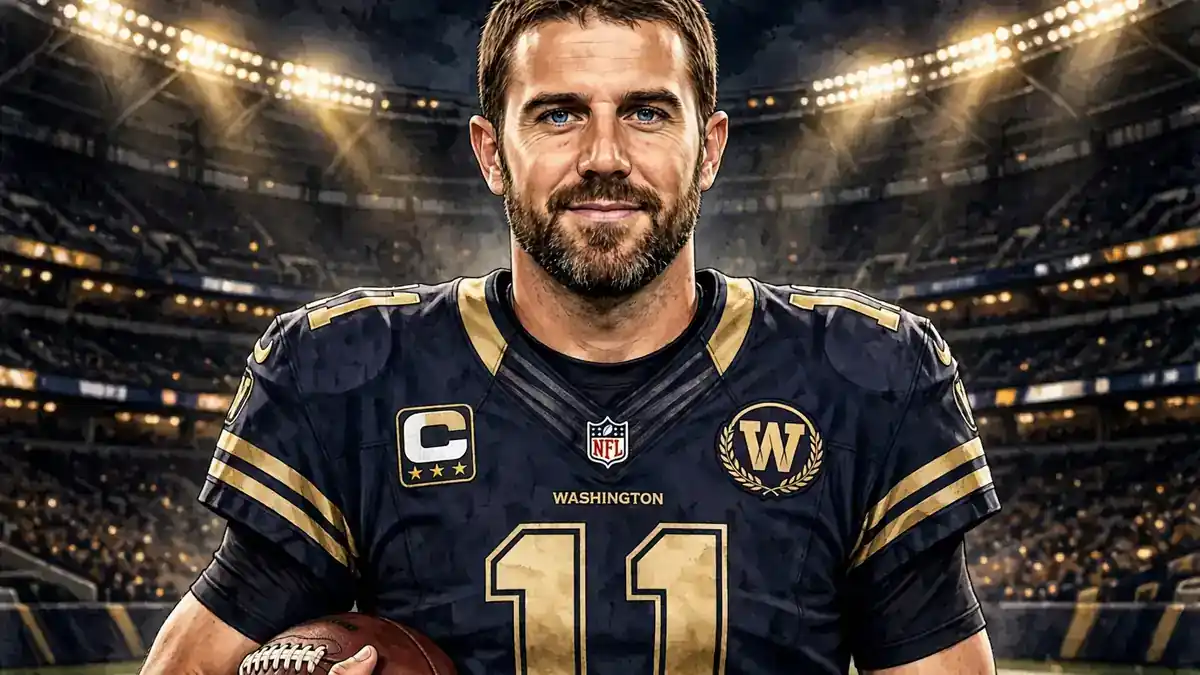
Alex Smith‘s net worth is estimated at $55 million–$95 million as of November 2026. The former NFL quarterback banked $210 million in career salary across 16 seasons with the San Francisco 49ers, Kansas City Chiefs and Washington, survived 17 operations on a shattered right leg, and then did what doctors said was impossible — he played in the NFL again, went 5-1 as a starter, and won Comeback Player of the Year before retiring in April 2021 and joining ESPN as a studio analyst.
Alex Smith: Quick Facts
| Estimated net worth | $55 million–$95 million (range: $55 million–$95 million) |
|---|---|
| Profession | Former NFL quarterback; ESPN studio analyst |
| Nationality | American |
| Born | May 7, 1984 (age 42) |
| Height | 6 ft 4 in (1.93 m) |
| Primary income sources | NFL contracts, endorsements, ESPN analyst role, speaking and investments |
| Active years | 2005–2020 (NFL); 2021–present (broadcasting) |
| Last reviewed | November 2026 |
- Quick Facts
- Early Life and Background
- Education
- Career Journey
- Rise to Fame
- Main Sources of Income
- Salary and Earnings
- Businesses and Investments
- Brand Deals and Sponsorships
- Houses, Cars and Other Assets
- Awards and Achievements
- Net Worth Growth Over the Years
- Social Media Presence
- Personal Life
- Sources & Reporting
- Frequently Asked Questions
Early Life and Background
Alexander Douglas Smith was born on May 7, 1984, in Bremerton, Washington, where his father Douglas worked as a football coach at Olympic High School. The family moved to La Mesa, California, in 1987, when Douglas took a job as executive director at Helix High School — the same school Alex would later attend and star for. That detail matters to the money story that follows: Smith grew up inside a school, not around wealth, and the discipline that later kept him in the league for 16 seasons was drilled in early.
At Helix, Smith started at quarterback in his junior and senior years and led the Highlanders to a 25–1 record and two San Diego CIF section championships. He set a school record by throwing six touchdowns in a single game and finished with the second-highest completion percentage in San Diego CIF history. He was named conference offensive player of the year twice and team MVP twice.
One footnote from those Helix years still stands out. Smith and his high-school teammate Reggie Bush were both finalists for the 2004 Heisman Trophy — the first time one high school had produced two finalists at the same ceremony. Bush went on to win the award at USC; Smith finished fourth in the voting. The two teenagers from the same La Mesa locker room would both become first-round NFL draft picks within 18 months of each other, and both would sign contracts worth tens of millions of dollars before turning 22.
Smith’s younger brother and two sisters kept the household busy, and the family stayed rooted in the San Diego area through his college years. Nothing in his background pointed to a $210 million career. He was a coach’s son with good grades and a quick release, not a can’t-miss physical specimen, and the scouts who watched him at Helix saw a smart, accurate passer rather than a future No. 1 pick.
Education
Smith enrolled at the University of Utah in 2002 and played for the Utah Utes, wearing No. 11. He arrived with enough advanced-placement credits from Helix to finish a bachelor’s degree in economics in just two years, graduating with a 3.71 GPA. That economics degree is easy to treat as a footnote, but it is one of the more useful facts in this profile: Smith understood contracts, compounding and risk before he ever signed an NFL deal, and the way he structured his career — three long deals, no holdouts, no public contract fights — reads like the work of a player who did the math himself.
On the field, his first season under head coach Ron McBride was quiet, and he briefly considered transferring. Everything changed when Urban Meyer arrived as head coach and installed a spread-option offence built around Smith’s accuracy and mobility. Smith posted a 21–1 record as a starter in college, threw for 5,203 yards with 47 touchdowns and eight interceptions, and added 1,072 rushing yards and 15 rushing touchdowns across 25 games.
The 2004 season made him. Utah went 12–0, the first undefeated season in school history, and Smith threw for 2,952 yards with 32 touchdowns and four interceptions while adding 631 rushing yards and 10 rushing scores. Utah then beat Pittsburgh 35–7 in the 2005 Fiesta Bowl, with Smith named offensive MVP after throwing for 328 yards and four touchdowns — a Utah bowl record. Utah became the first team from outside a BCS conference to play in, and win, a BCS bowl game.
Smith finished fourth in Heisman voting, was named Mountain West Conference Offensive Player of the Year, earned first-team All-American honors, and led Utah to wins in the 2003 Liberty Bowl and the 2005 Fiesta Bowl. He declared for the 2005 NFL Draft after his junior season, skipping his final year of eligibility, and entered the draft as the consensus top quarterback available.
Career Journey
The San Francisco 49ers selected Alex Smith with the first overall pick in the 2005 NFL Draft, ahead of Aaron Rodgers, who slid to 24th overall and waited in the green room for hours. The pick came with a six-year, $49.5 million rookie contract carrying about $24 million guaranteed — the first of four major deals that would eventually total more than $280 million in contract value across his career.
Smith’s early years in San Francisco were rough in a way that makes his later earnings almost hard to believe. He played for six offensive coordinators in his first six seasons, threw more interceptions than touchdowns in his first three years, and missed the entire 2008 season after shoulder surgery. The 49ers benched him, brought him back, benched him again, and by 2010 plenty of San Francisco fans had written him off as a bust. His record as a starter through 2010 was 19–31, and the $49.5 million rookie deal looked like dead money.
Jim Harbaugh’s arrival as head coach in 2011 changed the arc. Smith went 13–3 as a starter, threw 17 touchdowns against five interceptions, and led the 49ers to the NFC Championship Game, where they lost in overtime to the New York Giants. He followed that with a strong start to 2012 — a 104.1 passer rating through nine games — before a concussion in Week 10 opened the door for Colin Kaepernick, whose running ability fit Harbaugh’s evolving offence. Kaepernick kept the job, took San Francisco to the Super Bowl, and Smith spent the rest of the season holding a clipboard.
That benching, which could have ended his career as a starter, instead became the hinge of his fortune. In March 2013 the 49ers traded Smith to the Kansas City Chiefs for two draft picks, and Kansas City handed him the starting job under new head coach Andy Reid. Smith went 11–5 in his first season in Kansas City, made the first Pro Bowl of his career, and in September 2014 signed a four-year, $68 million extension that paid him like a franchise quarterback for the first time in his career.
Kansas City became the most stable and most lucrative stretch of Smith’s playing life. He made the Pro Bowl again in 2016, then delivered the finest season of his career in 2017 at age 33: 4,042 passing yards, 26 touchdowns, five interceptions and a league-leading 104.7 passer rating, plus a third Pro Bowl selection. The Chiefs won the AFC West, and Smith set career highs in completions, passing yards and passing touchdowns. The catch was that Kansas City had drafted Patrick Mahomes tenth overall that spring, and Mahomes spent 2017 learning behind Smith. When the season ended, the Chiefs traded Smith to Washington on January 30, 2018, and Mahomes took over — and went on to win league MVP in his first season as a starter.
Washington signed Smith to a four-year, $94 million contract extension with $71 million guaranteed and a $27 million signing bonus, the richest deal of his life at age 34. He started the first ten games of 2018 and had Washington at 6–3 and leading the NFC East when the season, and nearly his life, changed on November 18, 2018.
Against the Houston Texans that afternoon, Smith was sacked by Kareem Jackson and J.J. Watt and suffered a compound spiral fracture of his right tibia and fibula. The break itself was severe; what followed was worse. He developed necrotizing fasciitis — a flesh-eating bacterial infection — in the leg, underwent 17 operations, spent almost a month in hospital, and at one point doctors discussed amputation. He has said since that he wondered whether he would be able to walk with his wife or play with his children in the yard, let alone play football again.
Smith spent the next year and a half rehabbing, much of it in a bulky external fixator frame bolted to his leg, and was cleared to return to football in July 2020. Washington cleared him to play on August 16, 2020, and he took his first game snaps in almost two years on October 11, 2020, against the Los Angeles Rams. His first start came on November 15 against Detroit, and he went 5–1 as a starter down the stretch, including a Week 17 road win over Philadelphia on a strained right calf that clinched the NFC East title for Washington.
Washington released Smith in March 2021. On April 19, 2021, a few weeks short of his 37th birthday, he announced his retirement from the NFL on Instagram, saying he was ready to leave the game but believed he could still play quarterback. He finished with 35,650 passing yards, 199 touchdowns, 109 interceptions, a 62.6 percent completion rate and a 99–67–1 record as a starter across 16 seasons — numbers that put him firmly in the top tier of his generation’s quarterbacks, even if he never reached a Super Bowl.
Rise to Fame
Smith’s fame arrived in two waves, and the second was bigger than the first. The first wave was the draft: a No. 1 overall pick out of Utah, a 12–0 college season, a Fiesta Bowl MVP trophy. The second wave was the comeback, and it turned a respected veteran into a national story.
ESPN documented his recovery in Project 11, an E:60 special named for his jersey number, which showed the surgeries, the fixator and the rehab in unflinching detail. The footage of Smith learning to walk again, then learning to run again, then taking hits in an NFL game at 36 with a titanium rod in his leg, travelled far beyond football audiences. When he returned to the field on October 11, 2020, the ovation crossed team lines, and when the Associated Press named him Comeback Player of the Year for 2020, the award felt less like a football honour and more like a public verdict on the whole ordeal.
The comeback also reshaped his earning power after football. A quarterback who retires quietly at 34 after a solid career gets a regional radio gig; a quarterback who survives a near-amputation and starts six games two years later gets a national studio chair. ESPN hired Smith as a studio analyst in 2021, and his post-playing profile — speaking engagements, the Vertex Pharmaceuticals Pain Game Plan campaign, and regular appearances on ESPN’s NFL coverage — is built directly on the story of the injury and the return.
His peak on-field season, 2017, still deserves its own line in this section because it is the season that locked in his final contract. A 104.7 passer rating led the entire NFL that year, ahead of Tom Brady and Drew Brees, and it came at 33, an age when most quarterbacks are declining. That season is why Washington was willing to guarantee $71 million to a 34-year-old: Smith had just posted the best football of his life, and Washington was buying the player who had done it, not the one who had struggled in San Francisco a decade earlier.
Main Sources of Income
Smith’s money came from four places, and the split is unusually clean for a modern athlete: NFL salary did almost all of the work, endorsements added a steady seven-figure layer, broadcasting pays the bills now, and investments and speaking round out the picture.
NFL salary — about $210 million. OverTheCap, the contract database that tracks every dollar of NFL pay, credits Smith with $210 million in career earnings from 2005 to 2020, split $71.5 million from San Francisco, $67.5 million from Kansas City and $71 million from Washington. That total makes him the 17th-highest earner in NFL history and one of the ten highest-earning quarterbacks ever. Adjusted for the growth of the salary cap since 2005, OverTheCap’s cap-inflated figure is $442.4 million — a reminder that Smith earned his money in an era when the cap was roughly half of today’s $301.2 million.
Endorsements — roughly $1 million a year at his peak. Sportskeeda, drawing on Smith’s own reporting, puts his endorsement income at around $1 million a year from Nike and AdvoCare, plus paid appearances. That is modest next to the $20 million-plus endorsement hauls of the league’s biggest stars, and it fits Smith’s public profile: a respected, low-drama veteran who sold reliability rather than flash.
Broadcasting — ESPN studio analyst since 2021. Smith joined ESPN as a studio analyst shortly after retiring, appearing across the network’s NFL coverage. ESPN does not publish analyst salaries, and no reliable figure for Smith’s deal is public, so we do not guess at one here. What can be said is that a national studio role for a former starting quarterback with Smith’s story is a multi-year, six-figure-plus position, and it is now his steadiest income stream.
Speaking, partnerships and investments. Smith works with Vertex Pharmaceuticals on its Pain Game Plan campaign, speaking about pain management and preparation for surgery — a natural fit for a man whose injury story is public record. He has also been reported to hold shares in multiple companies, though the names and sizes of those holdings are not public. His clothing brand, Just Live, donates all proceeds to the facility where he rehabbed his leg. None of these streams approaches his NFL salary in scale, but together they explain why his net worth kept growing after his last paycheque in 2020.
Salary and Earnings
The contract-by-contract record is the strongest part of this profile, because every deal is documented in league filings and contract databases. Here is the full picture.
| Contract | Team | Value | Guaranteed |
|---|---|---|---|
| Rookie deal (2005) | San Francisco 49ers | 6 years, $49.5 million | ~$24 million |
| Extension (2012) | San Francisco 49ers | 3 years, $24 million | ~$9.5 million |
| Extension (2014) | Kansas City Chiefs | 4 years, $68 million | ~$45 million |
| Extension (2018) | Washington | 4 years, $94 million | $71 million |
Two numbers in that table deserve a second look. First, the Washington deal: $94 million over four years, with $71 million guaranteed, a $27 million signing bonus and $55 million guaranteed at signing. It was the biggest contract of Smith’s career, signed at 34, and it is the deal that pushed his career earnings past $200 million. Second, the Kansas City extension: the four-year, $68 million deal he signed in August 2014, which paid him an average of $17 million a year and arrived only after he had proved himself as a starter again in Reid’s offence.
The single richest 12 months of Smith’s career came between June 2017 and June 2018, when Celebrity Net Worth records him earning $41 million from salary and endorsements — a window that covered the final year of his Chiefs deal and the signing bonus on the Washington contract, and one that briefly placed him among the highest-paid athletes in the world. By September 2018, his NFL salary earnings alone had reached $106.5 million, according to the same source.
Here is where the record needs a correction that most rival profiles skip. A widely repeated figure puts Smith’s career earnings at $189.7 million. That number comes from Spotrac’s older tally, which stopped short of the full Washington deal, and several profiles still quote it as current. OverTheCap’s $210 million figure counts the money actually paid across all three teams, including the Washington years, and Celebrity Net Worth’s own ranking of the 25 highest-paid players in NFL history now lists Smith at $210 million. The $189.7 million figure is stale, not wrong — it was accurate before the Washington contract ran its course — but any profile quoting it in 2026 is under-counting his earnings by about $20 million.
Annual cash earnings, as tracked by SurpriseSports from contract data, show the same shape: a slow start (about $1.2 million in his rookie year of 2005), steady mid-career pay in Kansas City, and a peak of $21 million a year in 2019 and 2020 under the Washington deal. His final active year paid him $14 million in base salary terms, and his salary ranged from about $1 million to $21 million a year depending on the team and the contract year.
For scale, Smith’s $210 million sits behind the quarterbacks who defined his era — Aaron Rodgers, his fellow member of the 2005 draft class, has earned far more — and ahead of most of the starters he played against. The comparison that stings a little is the one inside his own trade history: the Chiefs moved on from Smith to Mahomes, who signed a ten-year, $450 million extension in 2020. Smith’s entire 16-year career earned less than half of Mahomes’s single deal. That is less a comment on Smith than on how fast quarterback pay rose between 2005 and 2020.
Businesses and Investments
Smith has never been a headline entrepreneur, and that is itself a useful fact. Unlike quarterbacks who launched venture funds or restaurant chains, Smith’s business footprint is small, deliberate and mostly charitable — which makes the figures that do exist more credible, because they are documented rather than rumoured.
The Alex Smith Foundation and Guardian Scholars Program. Smith founded the Alex Smith Foundation in 2007, in his third NFL season, and launched the Guardian Scholars Program to help teenagers leaving foster care pay for college. He seeded the programme with $500,000 of his own money and has personally funded the majority of it since. The Boston Globe singled the foundation out as a model charity, noting that 91 percent of the funds it raised between 2008 and 2010 went directly to scholarships and grants. The foundation is a cost centre, not a profit centre — but it is the most consistent use of Smith’s money outside his own household, and it has run for nearly two decades.
Just Live. After his injury, Smith started a clothing brand called Just Live, with all proceeds from sales going to the facility where he rehabilitated his leg. The brand is small and the proceeds are donated rather than banked, so it adds nothing to his net worth — but it is the one commercial venture he built himself, and it is tied directly to the comeback story that defines his public image.
Reported company holdings. DailyWikiBio and other profiles report that Smith holds shares in multiple companies. No filing, interview or company announcement we could verify names those companies or the size of the stakes, so we record the claim as reported and unverified rather than treating it as a fact. The same caution applies to the real-estate claims that circulate about Smith: no property record for a headline purchase has been published by a reliable outlet, and we do not repeat the figures that appear on low-quality net-worth aggregators.
What the record does show is a player who managed his money conservatively. Three long contracts, no holdouts, no public disputes over pay, a foundation funded from his own pocket, and a post-career move into broadcasting rather than a risky business launch. The economics degree from Utah shows up in the shape of the career: Smith maximised guaranteed money at every step — $24 million guaranteed as a rookie, $71 million guaranteed at 34 — and that preference for guarantees over headline totals is a big part of why $210 million in earnings turned into a net worth in the tens of millions rather than a cautionary tale.
Brand Deals and Sponsorships
Smith’s endorsement career was solid rather than spectacular, and the numbers reflect that. Sportskeeda reports he earned around $1 million a year from Nike and AdvoCare sponsorships and appearances at his peak. Nike supplied his on-field footwear and apparel through his playing career, the standard arrangement for a starting NFL quarterback, while AdvoCare, the sports-nutrition company, used him in campaigns built around training and recovery.
That $1 million-a-year figure is worth pausing on, because it explains the gap between Smith’s $210 million in salary and his $55 million–$95 million net worth estimate. A quarterback with $210 million in career pay and only modest endorsement income, paying federal and state tax in California, Missouri and Virginia, plus agent fees of around 3 percent, keeps far less than the headline number. The $41 million he earned between June 2017 and June 2018, for instance, was mostly salary and signing bonus, not endorsement money — and after tax, agent fees and living costs, the amount that stayed in his accounts was a fraction of the gross.
Since retiring, Smith’s commercial work has shifted toward health and recovery. His partnership with Vertex Pharmaceuticals on the Pain Game Plan campaign, discussed on a 2026 podcast appearance, has him speaking publicly about pain management and preparing for surgery — subjects he can discuss from direct experience in a way few spokespeople can. It is a smaller, more targeted kind of endorsement than a shoe deal, and it fits the post-playing brand he has built: the quarterback who came back.
One more comparison helps here. Patrick Mahomes, the quarterback who replaced Smith in Kansas City, earns tens of millions a year from endorsements alone. Smith never had that kind of commercial pull, because he never had a Super Bowl run or a signature highlight-reel style. His endorsements paid for a comfortable life on top of his salary; they did not transform his fortune. Any profile that credits Smith with a large endorsement empire is inventing one.
Houses, Cars and Other Assets
This is the section where most net-worth profiles about Smith go wrong, so we will be direct about what is and is not on the record. No reliable outlet has published a property record for a headline home purchase by Alex Smith, and no verified report lists a car collection or a luxury asset portfolio. Several low-quality aggregators attach a mansion and a fleet of cars to his name; none of them cites a deed, a listing or a named source, and we do not repeat those claims.
What is documented is quieter. Smith and his wife Elizabeth raised their three children in the San Francisco Bay Area during his 49ers years, then in Kansas City and the Washington area as his career moved — the normal pattern for a player whose team changed three times in 16 seasons. He has never been the subject of a celebrity real-estate story, a foreclosure, a lavish purchase profile or a bankruptcy filing, which is itself notable for a player who earned $210 million. The absence of a flashy asset trail is consistent with everything else in his record: a coach’s son with an economics degree who treated his salary as a long-term fund rather than a spending spree.
His most visible asset is not a house or a car but the foundation he funds. The Alex Smith Foundation, seeded with $500,000 in 2007 and personally funded in large part since, has spent the overwhelming majority of its money on scholarships and grants for foster youth going to college. That is a matter of public record through the foundation’s own reporting and the Boston Globe’s coverage of it.
One asset is worth naming precisely because it is not financial: the story itself. The comeback from the 2018 leg injury, documented by ESPN’s Project 11 and retold in every profile since, is the asset that earns Smith his broadcasting salary, his speaking fees and his Pain Game Plan partnership. It cannot be valued in dollars, but it is the reason his income did not stop when his playing career did.
Awards and Achievements
| Honour | Year(s) | Note |
|---|---|---|
| NFL Comeback Player of the Year (AP) | 2020 | Returned from 17 surgeries to go 5–1 as a starter |
| Pro Bowl | 2013, 2016, 2017 | Three selections, all after leaving San Francisco |
| NFL passer rating leader | 2017 | 104.7 rating, best in the league at age 33 |
| Fiesta Bowl Offensive MVP | 2005 | 328 yards, 4 touchdowns vs Pittsburgh |
| Mountain West Offensive Player of the Year | 2004 | Undefeated 12–0 season at Utah |
| First-team All-American | 2004 | Finished 4th in Heisman Trophy voting |
| NFC East champion (Washington) | 2020 | Clinched with Week 17 win at Philadelphia |
| AFC West champion (Kansas City) | 2016, 2017 | Back-to-back division titles |
Two of those honors carry more weight than the rest. The 2017 passer-rating title is the statistical peak of Smith’s career and the direct reason Washington guaranteed him $71 million the following January. The 2020 Comeback Player of the Year award is the one that will define him in the long run — it is the award that turned a good career into a story people will still be telling in twenty years, and it is the award that underwrites his broadcasting career today.
His career numbers back up the honors: 35,650 passing yards, 199 passing touchdowns, a 62.6 percent completion rate and a 99–67–1 record as a starter. He never won a Super Bowl and never made an All-Pro team, which is why he sits outside the Hall of Fame conversation. But he is one of only a handful of quarterbacks to start for three franchises, make the Pro Bowl with two of them, and finish with a winning record at all three stops.
For context on the 2005 draft class he headlined: Smith went first overall, and Aaron Rodgers, taken 24th by Green Bay, became the defining quarterback of the class. The two have been linked ever since — the 49ers chose Smith over Rodgers, a decision San Francisco fans debated for a decade. Smith’s career earnings of $210 million are a fraction of Rodgers’s total, but Smith’s comeback story is one Rodgers has never had to write, and in the long run that story may be the more durable of the two legacies.
Net Worth Growth Over the Years
Because Smith’s earnings are documented contract by contract, his wealth curve can be drawn with more confidence than most athletes’ — though the figures below are still estimates, built from career earnings minus the taxes, fees and living costs that apply to every player.
| Year | Estimated net worth | What drove it |
|---|---|---|
| 2008 | ~$5 million | Rookie deal paying out; missed 2008 season injured |
| 2011 | ~$12 million | Breakout season under Harbaugh; new 3-year deal |
| 2014 | ~$25 million | Chiefs extension: 4 years, $68 million |
| 2017 | ~$40 million | Career-best season; $41M earned June 2017–June 2018 |
| 2019 | ~$50 million | Washington deal paying $21M a year; injury year |
| 2021 | ~$55 million | Retirement; older estimates freeze here |
| 2026 | $55 million–$95 million | ESPN role + investments; Celebrity Net Worth revises to $95M |
The shape of that curve is the point. Smith’s wealth did not spike early and fade; it grew steadily for fifteen years, with the steepest climb coming late — the Chiefs extension at 30, the Washington deal at 34, and the $41 million twelve-month window that straddled them. Players who earn their money early and spend it early peak young. Smith peaked late, which is why his net worth was still rising in his mid-thirties, when most of his draft class had already retired.
The $55 million–$95 million range for 2026 reflects a genuine disagreement in the sources, not hedging on our part. Celebrity Net Worth’s October 2025 update puts Smith at $95 million. Sportskeeda, PlayersBio and a string of aggregators still carry the $55 million figure, which dates to his retirement in 2021 and has not been revised since. TheMost10’s 2025 profile splits the difference with a projected $65 million for 2026. With $210 million in documented career earnings, five years of post-retirement income from ESPN and speaking, and no public record of major losses or lavish spending, the upper half of the range is the more defensible reading — but the honest answer is the range itself, and any profile that prints a single number without naming its source is pretending to a precision the record does not support.
Social Media Presence
Smith keeps a smaller public footprint than most quarterbacks of his generation, and that is a deliberate choice rather than an accident. He announced his retirement on Instagram on April 19, 2021, with a post that drew tributes from across the league — the platform served as his press conference, which is how modern retirements work, but he has never used it as a daily content channel.
His verified social accounts are used mainly for foundation work, ESPN appearances and the occasional family or recovery post, rather than for brand deals or sponsored content. There is no verified follower count we can responsibly quote here, because the numbers move and the aggregators that publish them disagree by wide margins. What can be said with confidence is that Smith’s audience is modest next to the league’s social-media stars — he has never chased the influencer economy, and his post-playing income comes from a television studio and a speaking stage, not from a feed.
That restraint is consistent with the rest of his record. The quarterback who spent 16 seasons avoiding turnovers and contract disputes also avoided the social-media controversies that have cost other players endorsements and money. In a wealth profile, the absence of a social-media scandal is a financial fact: Smith never lost a deal, a job or a season to something he posted.
Personal Life
Smith married Elizabeth Barry in 2009. Barry was a cheerleader for the Oakland Raiders when they met in 2007, and the two have three children together: sons Hudson, born in 2011, and Hayes, born in 2013, and daughter Sloane, born in 2016. Smith has said that the thought of walking with his wife and playing with his children in the yard was what he focused on during the worst weeks of his leg injury in 2018 — before he ever thought about playing football again.
Family is also the reason the foundation exists in the form it does. The Guardian Scholars Program helps teenagers leaving foster care pay for college, and Smith has funded the majority of it personally since seeding it with $500,000 in 2007. The Boston Globe’s praise for the foundation’s efficiency — 91 percent of funds raised between 2008 and 2010 went to scholarships and grants — is the kind of detail that does not appear in most net-worth profiles, but it is the most concrete evidence of what Smith does with his money.
Smith is a practising Christian, and the question of whether he is a member of the Church of Jesus Christ of Latter-day Saints comes up often enough to answer directly: SportsJone’s 2025 profile investigated the claim and found no evidence to support it, concluding that Smith is Christian but not publicly identified with the LDS Church. He played his college football at Utah, which sits in the heart of Mormon country, and the confusion seems to trace to that geography rather than to anything Smith has said or done.
Since retiring, Smith has settled into the broadcaster’s life: studio work for ESPN, speaking engagements, the Pain Game Plan campaign with Vertex Pharmaceuticals, and time with his family. He has not coached, has not taken a front-office job, and has not launched a business — the three most common second acts for retired quarterbacks. The studio chair suits the player he was: prepared, accurate and calm under pressure.
Sources & Reporting
Celebrity Net Worth — the $95 million net-worth figure (October 2025 update), the $41 million earned between June 2017 and June 2018, the $106.5 million in salary earned through September 2018, and the $210 million career-earnings total in its ranking of the 25 highest-paid NFL players of all time. Reporting window: 2018–2025.
OverTheCap — the $210 million career-earnings total, the $71.5 million / $67.5 million / $71 million split by team, the $442.4 million cap-inflated figure, and the 17th-place all-time ranking. Reporting window: 2005–2020 contracts, current database.
Sportskeeda — the $55 million net-worth figure, the four-contract history, the $94 million Washington deal with $71 million guaranteed, and the roughly $1 million a year in Nike and AdvoCare endorsements. Reporting window: 2021–2025.
ESPN — Smith’s hiring as a studio analyst in 2021 and the Project 11 E:60 documentary on his injury and recovery. Reporting window: 2020–2021.
Associated Press — Smith’s retirement announcement on April 19, 2021, the 17 operations, the month-long hospital stay, the 5–1 record as a starter in 2020 and the NFC East title. Reporting window: 2018–2021.
Wikipedia — biographical record: birth, Helix High School, Utah career, 21–1 college record, Fiesta Bowl MVP, foundation founding and family details, cross-checked against the outlets above. Last reviewed November 2026.
Pro Football History — the Helix High School record, the Reggie Bush Heisman connection, the Just Live clothing brand and the foundation’s history. Reporting window: career retrospective.
SportsJone — the $55 million–$95 million range framing, the OverTheCap $210 million figure, and the investigation of the Mormon-affiliation question. Published November 2025.
SurpriseSports — the $95 million figure in its October 2026 update and the year-by-year salary shape, including the $21 million peak years. Updated October 13, 2026.
Figures in this article are estimates built from public reporting, not audited financial statements. Where sources disagree — most notably the $55 million versus $95 million net-worth figures — we publish the range and name who says what, rather than picking the number that looks best.
Frequently Asked Questions
What is Alex Smith’s net worth in 2026?
Alex Smith’s net worth is estimated at $55 million–$95 million as of November 2026. Celebrity Net Worth puts him at $95 million in its October 2025 update, while older estimates from Sportskeeda and PlayersBio still carry the $55 million figure from his retirement in 2021. The range reflects that disagreement; the hard number behind it is $210 million in documented NFL career earnings.
How much did Alex Smith earn in his NFL career?
Alex Smith earned $210 million in NFL salary over 16 seasons, according to OverTheCap — $71.5 million from the San Francisco 49ers, $67.5 million from the Kansas City Chiefs and $71 million from Washington. That makes him the 17th-highest earner in NFL history. His richest 12 months came between June 2017 and June 2018, when he earned $41 million from salary and endorsements.
What happened to Alex Smith’s leg?
On November 18, 2018, playing for Washington against the Houston Texans, Smith suffered a compound spiral fracture of his right tibia and fibula. He then developed necrotizing fasciitis, a flesh-eating infection, underwent 17 operations, spent almost a month in hospital, and doctors at one point discussed amputating the leg. He returned to the NFL on October 11, 2020, went 5–1 as a starter, and won Comeback Player of the Year.
When did Alex Smith retire from the NFL?
Alex Smith announced his retirement on April 19, 2021, on Instagram, a few weeks short of his 37th birthday, after 16 seasons in the NFL. Washington had released him the previous month. He said he was ready to leave the game but believed he could still play quarterback. He finished with 35,650 passing yards, 199 touchdowns and a 99–67–1 record as a starter.
What does Alex Smith do now?
Alex Smith works as a studio analyst for ESPN, a role he took up shortly after retiring in 2021. He also speaks publicly about pain management through Vertex Pharmaceuticals’ Pain Game Plan campaign and makes regular appearances across ESPN’s NFL coverage. He has not coached or taken a front-office job.
Who is Alex Smith’s wife?
Alex Smith married Elizabeth Barry in 2009. Barry was a cheerleader for the Oakland Raiders when they met in 2007. The couple have three children: sons Hudson (born 2011) and Hayes (born 2013), and daughter Sloane (born 2016). Smith has said that walking with his wife and playing with his children was what he focused on during the worst weeks of his 2018 injury.
Was Alex Smith the first overall pick in the NFL Draft?
Yes. The San Francisco 49ers selected Alex Smith first overall in the 2005 NFL Draft, ahead of Aaron Rodgers, who fell to 24th overall and was picked by the Green Bay Packers. Smith signed a six-year, $49.5 million rookie contract with about $24 million guaranteed. He had just led Utah to a 12–0 season and a Fiesta Bowl win, finishing fourth in Heisman Trophy voting.
How many Pro Bowls did Alex Smith make?
Alex Smith made three Pro Bowls — in 2013, 2016 and 2017 — all of them after leaving San Francisco for Kansas City. His best season was 2017, when he led the entire NFL with a 104.7 passer rating at age 33, throwing for 4,042 yards and 26 touchdowns. He also won the Associated Press Comeback Player of the Year award in 2020.
Final Thoughts
Alex Smith’s fortune is the product of patience more than flash. A No. 1 pick who looked like a bust, a benching that could have ended him, a second act in Kansas City that paid him like a franchise quarterback, a third act in Washington that guaranteed him $71 million at 34 — and then an injury that nearly took his leg and his life, followed by a comeback that no spreadsheet could have predicted. The $210 million in career salary is the foundation; the $55 million–$95 million net worth is what remains after tax, fees, a foundation funded from his own pocket, and a life lived without the spending sprees that have undone richer players. The number that matters most is not the net worth at all. It is 17 — the operations it took to save his leg — and 5–1, the record he posted when he came back. Money bought Alex Smith security. The comeback bought him something rarer: a second career, a national audience, and a story that will outlast every contract he ever signed.
Published on 2026-11-19. Last reviewed November 2026. Found an error? See our corrections policy.