
Joe Montana‘s net worth is estimated at $100 million to $150 million as of November 2026. Celebrity Net Worth puts the figure at the top of that range, $150 million, while a 2026 Fortune-cited analysis published by Sophisticated Investor lands on the same $100 million to $150 million band. The four-time Super Bowl champion earned only $25.5 million in NFL salary across 16 seasons, so most of the fortune was built after he left the field: decades of endorsement income that Celebrity Net Worth says out-earned his playing salary, and a second career in venture capital that turned a $100,000 cheque into a stake worth $63 million at GitLab’s public debut.
Joe Montana: Quick Facts
| Estimated net worth | $150 million (range: $100 million to $150 million) |
|---|---|
| Profession | Former NFL quarterback, venture capitalist |
| Nationality | American |
| Born | June 11, 1956 (age 70) |
| Height | 6 feet 2 inches (1.88 m) |
| Primary income sources | NFL salary, endorsements, venture capital (Liquid 2 Ventures), real estate |
| Active years | 1979–1994 (NFL); 1998–present (investing) |
| Last reviewed | November 2026 |
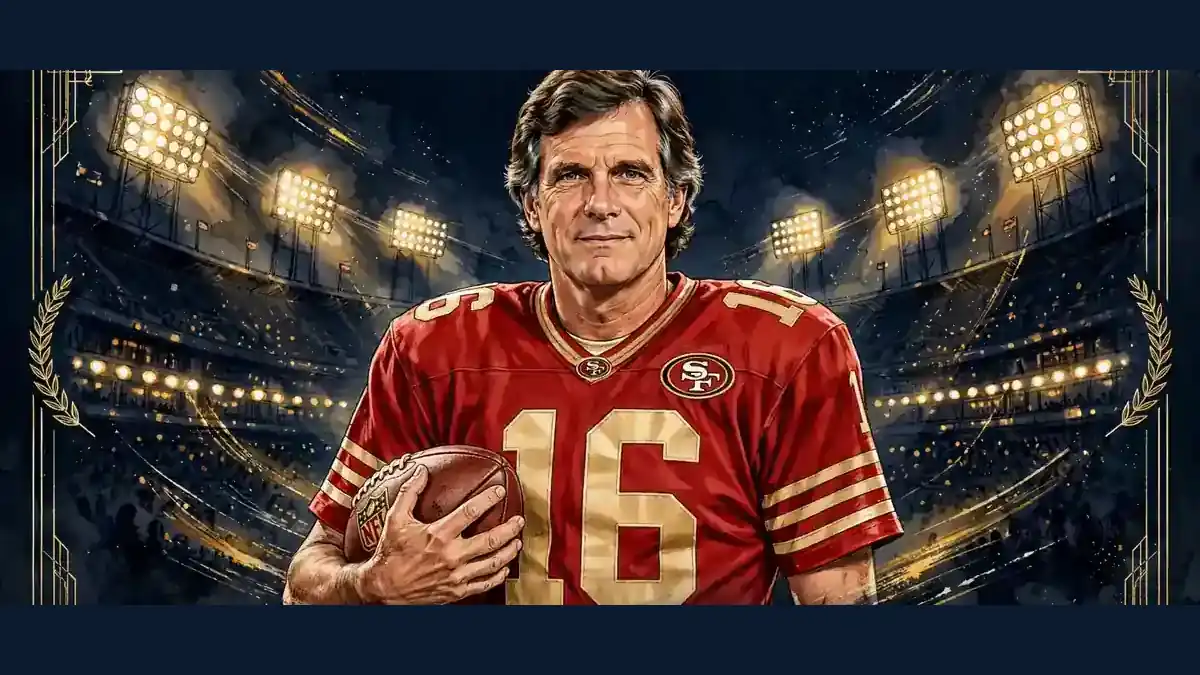
Early Life and Background
Joseph Clifford Montana Jr. was born on June 11, 1956, in New Eagle, Pennsylvania, a small borough in Washington County, and grew up in nearby Monongahela, a coal-mining town about 25 miles south of Pittsburgh. His father, Joe Sr., managed a finance company; his mother, Theresa, worked as its secretary. The household gave the future quarterback an early, unglamorous education in money: a father who ran a lending business and a mother who kept its books.
Joe Sr. introduced his son to football, and Montana began playing organised youth football at eight. The nickname that would follow him for life — “Joe Cool” — came later, but the trait behind it showed up early. Teammates and coaches at every level noticed the same thing: Montana’s pulse seemed to slow down when the game got tight, while everyone else’s sped up.
At Ringgold High School in Monongahela, Montana played football, basketball and baseball, and the basketball court nearly changed his life. North Carolina State offered him a basketball scholarship, a serious alternative to football that says plenty about his athletic range. He chose football instead, became Ringgold’s starting quarterback as a junior, and earned Parade All-American honours as a senior. He also sang in the school choir and served as senior class vice president — an early sign of the polish that would later make him one of the most marketable athletes in America. Ringgold honoured its most famous graduate by naming its football stadium after him in 2006.
The Monongahela years matter to the money story for a second reason. Montana did not grow up wealthy. His first NFL contract paid $85,000 a year, and the $50,000 signing bonus that came with it was real money to a 23-year-old from a Pennsylvania mill town. The contrast between that starting point and a nine-figure fortune built largely after retirement is the spine of this profile: Montana’s wealth is a second-act story, not a signing-bonus story.
Education
Montana arrived at the University of Notre Dame in 1974, during Ara Parseghian’s final season as head coach. His early college career was uneven. Playing time was limited, and a separated shoulder cost him the entire 1976 season. Under Parseghian’s successor, Dan Devine, he gradually established himself through performances that previewed his professional reputation for late comebacks.
The 1977 season made him. Montana helped the Fighting Irish recover from an early-season loss to finish 11–1, then beat top-ranked Texas 38–10 in the Cotton Bowl to win the national championship. The same season included a win over Southern California in which Montana threw two passing touchdowns and ran for two more.
His final college game became the stuff of Notre Dame legend. Facing Houston in the Cotton Bowl on January 1, 1979, Montana struggled with hypothermia in freezing conditions and spent part of the game in the locker room warming up and drinking chicken soup. He returned to help Notre Dame erase a 22-point fourth-quarter deficit and win 35–34, throwing the tying touchdown pass as time expired before the deciding extra point. It was the “Comeback Kid” in full before the NFL ever saw him.
Montana graduated in 1979 with a business degree — a detail that reads differently now that he runs a venture capital firm. The degree was not a footnote; the finance-company household, the business major and the later investing career form a straight line. Despite his college record, NFL teams were unconvinced. He lasted until the third round of the 1979 NFL Draft, where San Francisco selected him with the 82nd overall pick. Thirty years later, that draft slide would be remembered as one of the great talent-evaluation misses in league history: 81 players went before the quarterback who would win four Super Bowls.
Career Journey
Montana joined a rebuilding San Francisco team under head coach Bill Walsh, whose passing offence emphasised timing, accuracy and quick decisions. He began as the backup to Steve DeBerg, started taking over during the 1980 season, and became the full-time starter in 1981. That year San Francisco went 13–3 and reached the NFC Championship Game against Dallas.
Late in that game, Montana rolled right and threw a high touchdown pass to Dwight Clark in the back of the end zone. The play, remembered simply as “The Catch”, sent the 49ers to their first Super Bowl. San Francisco then beat Cincinnati 26–21 in Super Bowl XVI, with Montana earning the game’s MVP award. A second championship followed the 1984 season: the 49ers went 15–1 and beat Miami 38–16 in Super Bowl XIX, with Montana again named MVP.
Injuries tested him through the middle of the decade. In 1986 he underwent back surgery to remove a ruptured disc and widen his spinal canal, then returned to play 55 days later — a comeback that doctors at the time considered startling. The arrival of Steve Young created competition at quarterback, but Montana held the job through the dynasty’s peak.
The 1988 season ended with perhaps his most famous drive. Trailing Cincinnati late in Super Bowl XXIII, he moved San Francisco 92 yards and threw the winning touchdown to John Taylor with 34 seconds remaining. The 20–16 victory gave him his third championship and provided the clearest example of the composure behind the “Joe Cool” nickname. San Francisco repeated the following season under George Seifert, who had succeeded Walsh as head coach. Montana threw five touchdown passes in a 55–10 win over Denver in Super Bowl XXIV and collected his third Super Bowl MVP award — the first player ever to win the award three times. He also won the NFL’s regular-season MVP award in 1989 and 1990.
An elbow injury then kept Montana out of the entire 1991 season and all but one game in 1992. Young developed into an MVP quarterback during his absence, making a permanent return to the starting job increasingly unlikely. Montana moved to Kansas City in an April 1993 trade and continued his career with the Chiefs. In his first season he helped Kansas City win its first division title in 22 years and reach the AFC Championship Game. He returned for the 1994 season before announcing his retirement on April 18, 1995. San Francisco retired his No. 16 jersey in December 1997.
The career numbers hold up across eras: 40,551 passing yards, 273 touchdown passes, 139 interceptions and a 92.3 career passer rating. His postseason record was 16–7, and his four Super Bowl appearances produced 11 touchdown passes without a single interception. He was selected for the NFL’s 1980s All-Decade Team and its 75th and 100th Anniversary All-Time Teams, and entered the Pro Football Hall of Fame in 2000, his first year of eligibility. Many of his postseason records were eventually passed, above all by Tom Brady, but four championship wins without a Super Bowl loss remains the core of his case in every greatest-quarterback debate.
Rise to Fame
Montana’s rise was not instant stardom; it was a slow build that exploded in January 1982. Before “The Catch”, he was a third-round pick fighting for a starting job on a losing franchise. After it, he was the quarterback of America’s most glamorous team, playing in the city that sat at the centre of the 1980s boom. The 49ers became the NFL’s team of the decade, and Montana — calm, handsome, precise — became its face.
What set him apart commercially was temperament. Advertisers could sell composure. While other stars sold power or flash, Montana sold steadiness under pressure, and that translated directly into the endorsement career that would eventually out-earn his football salary. The “Joe Cool” persona was not a marketing invention; it was visible on film, in the 92-yard drive in Super Bowl XXIII, in the hypothermia comeback at Notre Dame, in the 55-day return from back surgery.
Fame also arrived before the money did, and the gap between the two is striking. When Montana won his first Super Bowl MVP in January 1982, he was still playing on a contract that paid him a fraction of what a backup quarterback earns today. His peak annual NFL salary of $4 million came in 1993 and 1994 — his final two seasons. By the time quarterback pay exploded in the 2000s and 2010s, Montana had been retired for a decade. The fame he built in the 1980s became the asset that paid in the 1990s, 2000s and beyond, through commercials, appearances and, eventually, the Rolodex that opened doors in Silicon Valley.
Main Sources of Income
Montana’s fortune comes from four streams, and their order matters: the NFL salary was the smallest of the four in lifetime terms, even though it made him famous. The streams are playing salary, endorsement income, venture capital returns, and real estate. A fifth, smaller stream — appearances, licensing and his wine label — adds colour but not the bulk of the total.
NFL salary ($25.5 million over 16 seasons) is the fully documented base. Spotrac’s contract record and Celebrity Net Worth agree on the career total, and the individual deals are a matter of public record. It was excellent money for the 1980s and modest money by modern quarterback standards — a tension this profile returns to in the salary section.
Endorsements are the second stream and, by Celebrity Net Worth’s account, the larger one: Montana’s post-retirement advertising income exceeded his total NFL salary. His commercial partners have included Guinness, Schick, Papa John’s, Mastercard and AT&T, and the work continued for decades after his final game. A 2024 snapshot of his Instagram account by NFL Draft Scout found his recent posts were largely ads — for Pfizer, Guinness, and his own whiskey label — showing that the endorsement engine was still running 30 years after retirement.
Venture capital is the third stream and the one that moved the estimate from tens of millions into nine figures. Liquid 2 Ventures, the seed-stage firm he co-founded in 2015, backed GitLab, Anduril, Rappi, Pipe, Rippling and Retool early, and its first fund produced more than 20 billion-dollar companies. The GitLab return alone — a $100,000 cheque growing into a holding valued at $63 million at the 2021 IPO, per Celebrity Net Worth — is worth more than twice his entire NFL salary.
Real estate is the fourth stream: a 500-acre wine-country estate bought as land and developed over years, San Francisco apartments bought and sold through the 2010s, and a Malibu oceanfront home bought in 2021. The estate’s sale price fell far short of its original asking price, so property was a mixed financial result — but the portfolio’s scale still matters to the total.
Salary and Earnings
Montana earned $25.5 million in salary during his NFL career, according to Celebrity Net Worth and Spotrac. His pay rose from five-figure annual salaries as a rookie to $4 million in both 1993 and 1994 with Kansas City. Those were substantial paydays for his era, although the entire career total is less than the $55 million annual average of the contract extension Joe Burrow signed in 2023.
His first contract with San Francisco was a three-year, $255,000 agreement averaging $85,000 a year, with a $50,000 signing bonus. Yardbarker, citing Spotrac, notes that $85,000 a year in 1979 would be worth around $396,000 a year in 2025 dollars — comfortable, but a reminder of how different the league’s economics were. In 1984, after establishing himself as a championship quarterback, he signed a six-year deal worth $6.3 million, raising his average annual pay to just over $1 million. A four-year, $13 million extension in 1990 increased the annual average to $3.25 million and included a $500,000 signing bonus; that deal made him the highest-paid quarterback in the league and the first NFL player to reach a $4 million annual salary. His final NFL contract was a three-year, $10 million agreement with the Chiefs in 1993; he played two seasons and collected about $8 million of it before retiring.
| Contract | Value | Notes |
|---|---|---|
| Rookie deal, 49ers (1979) | $255,000 over 3 years | $85,000 a year plus $50,000 signing bonus |
| Extension (1984) | $6.3 million over 6 years | About $1.05 million a year after first Super Bowl wins |
| Extension (1990) | $13 million over 4 years | $3.25 million a year; first $4 million annual salary in NFL history |
| Chiefs deal (1993) | $10 million over 3 years | Played two seasons; about $8 million collected |
| Career NFL salary total | $25.5 million | 16 seasons, per Celebrity Net Worth / Spotrac |
The pay-era comparison is the sharpest illustration of how much the league changed. Brock Purdy’s 2025 extension — $265 million over five years, with $181 million guaranteed — secured roughly twice Montana’s entire career earnings in its first season alone, per Yardbarker. Purdy plays the same position, for the same franchise, in the same stadium city. Montana’s $4 million peak season in 1993 would be worth roughly $7.5 million in today’s money, per Sportskeeda’s inflation comparison — still less than a seventh of Burrow’s $55 million annual average. None of this diminishes Montana’s career; it explains why his fortune had to be built after football, and why the venture capital chapter matters more to his net worth than any contract he signed as a player.
One stale figure deserves a correction. Several older net-worth pages still list Montana at $80 million, including CelebsMoney (last updated January 2024) and MoneyInc (published 2020). Those figures predate the current reporting cycle and sit well below every 2025–2026 estimate. Celebrity Net Worth’s current figure is $150 million, and the Fortune-cited range published by Sophisticated Investor in 2026 is $100 million to $150 million. This profile uses the range, anchored at $150 million, and treats the $80 million figure as outdated.
Businesses and Investments
Montana’s investment career began well before Liquid 2. In 1998 he co-founded HRJ Capital, a private-equity fund-of-funds, remaining an active partner until 2004, when the firm managed more than $900 million. HRJ later collapsed in 2009, a failure Montana has spoken about openly — and one that shaped the more disciplined, early-stage approach he took next. He also co-founded Modern Bank in 2005 and served on its board until 2010.
Working with experienced technology investors, including Ron Conway, Montana began making early personal investments in startups. His personal and fund investments have included Pinterest, Airbnb, Robinhood and GitLab. These activities gave him a second professional network in the Bay Area, beyond the athletes and sponsors he knew through football — and, just as importantly, they taught him the seed-stage game before he raised outside money for it.
In 2015 Montana launched Liquid 2 Ventures with partners including Michael Ma and Michael Miller. His son Nate joined the firm in 2016 and also became a partner. The firm specialises in investing early in a company’s development, when a relatively small cheque can buy a meaningful ownership position but the risk of failure is high. Montana has described his own role plainly: his partners handle the technical work while he focuses on making contacts and opening doors.
GitLab became the firm’s most visible success. Liquid 2 initially invested $100,000 in 2015, when the company was valued at $12 million. Montana met GitLab chief executive Sid Sijbrandij at a Y Combinator event that year — Conway had invited him — and committed on the night of the demo day, joining a $1.5 million seed round alongside investors including Ashton Kutcher and Khosla Ventures. When GitLab went public on October 14, 2021, its first-day closing valuation reached $15 billion, putting Liquid 2’s holding at $63 million, per Celebrity Net Worth. CNBC’s estimate at the time was somewhat lower — roughly $42 million at a $69 share price, counting the initial cheque plus follow-on funding. Either way, the return on a $100,000 starting position was extraordinary: a single seed cheque that grew into a sum larger than Montana’s entire NFL salary. Axios reported the IPO valued GitLab at about $11 billion and raised about $800 million.
The GitLab win was not a one-off. In a 2024 interview, Montana said Liquid 2’s first $28 million fund had reached a total value of eight to ten times its original capital, while cash distributions at that point amounted to 0.8 times invested capital — a useful distinction between valuable shares still held and money already returned to investors. Worth reported in February 2026 that the first fund had produced more than 20 unicorns, and that eight or nine of them belonged to deals sourced by Nate. The firm’s own materials now list more than 40 companies it backed at the seed stage that subsequently reached billion-dollar valuations, and RocketReach counts 35 unicorns across a portfolio of more than 800 technology companies, including Anduril, Rappi, Pipe, Rippling, Retool, Applied Intuition, Remote, FanDuel and WhatNot.
The fundraising continued into 2026. An August 2026 SEC filing for Liquid 2 Ventures Fund V disclosed $84.3 million raised from 72 investors toward a $90 million offering, with Montana identified as a managing member of the general partner and Nate signing the filing on the partnership’s behalf. That filing is the freshest public evidence that the firm is still raising and deploying capital eleven years after its first fund — and it is a data point none of the older net-worth pages carry.
Two cautions belong here. First, fund returns are not personal cash. The $63 million GitLab holding was the firm’s position, shared economically with its investors and partners, not a $63 million personal payment to Montana. Second, venture returns are lumpy and illiquid: a fund can show an eight-to-ten-times total value while having distributed less than its invested capital in cash. This profile’s $100 million to $150 million range reflects those realities rather than treating paper valuations as money in the bank.
Beyond venture capital, Montana developed the Montagia wine label with winemaker Ed Sbragia, a project tied to the family’s wine-country estate, and he has owned several horses, including a favourite named That Cool Cat. The wine label is a small business rather than a fortune-maker, but it fits the pattern of his post-football life: California, agriculture, and long-dated projects rather than quick endorsements.
Brand Deals and Sponsorships
Montana has earned tens of millions of dollars through endorsements, with his post-retirement advertising income exceeding his total NFL salary, per Celebrity Net Worth. His commercial partners have included Guinness, Schick, Papa John’s, Mastercard and AT&T, and the work continued long after his final game — helped by his recognisable name, four championships and reputation for staying calm in difficult situations.
One early advertising assignment changed his personal life: he met his future wife, Jennifer Wallace, while filming a Schick commercial. His later campaigns often drew on his status as a football legend, allowing him to remain a familiar television presence without taking a full-time coaching or broadcasting job. SportsPlayerTV’s 2026 profile puts his endorsement earnings at roughly $10 million to $12 million from Skechers, Guinness, Schick and other campaigns — a partial tally, since most endorsement fees are never disclosed, but a useful floor for the category.
The Guinness work deserves a mention because it ran for years and paired him with a younger generation of quarterbacks, including Joe Burrow — a pairing that doubled as a passing-of-the-torch image and kept Montana in front of audiences who never saw him play. His Instagram account, followed by NFL Draft Scout in 2024, showed the same pattern in miniature: recent posts included ads for Pfizer, a promotion for his 16-year-old whiskey release under the Joe Montana Collection label, and the Guinness video with Burrow. The account also revealed a telling detail about how he uses fame commercially: he follows just 38 accounts, and the largest category among them is endorsement partners — AT&T, Cameo, Excel Sports Management and others.
Montana never took the conventional post-career broadcasting path. Unlike many Hall of Fame quarterbacks who moved into the booth, he built his second act from commercials, investing and business — a choice that paid better than a television salary would have, and one that left his schedule his own.

Houses, Cars and Other Assets
Montana’s best-known property was Villa Montana, a 500-acre estate near Calistoga, California, in wine country about 75 miles north of San Francisco. The nearly 10,000-square-foot main house contained three bedrooms and three and a half bathrooms, and the grounds included an olive grove, bocce and basketball courts, a spa, a skeet-shooting range, horse stables, a guesthouse, a swimming pool, a private pond and housing for a caretaker. Equestrian facilities were a notable feature of the estate, matching Montana’s interest in horses.
The sale history is a lesson in how even trophy property can disappoint. He first listed the Calistoga estate for $49 million in 2009. The asking price fell to $35 million in January 2012, $28.9 million in July 2019, and $24.5 million in June 2021. The property ultimately sold for $20 million in April 2022, per Celebrity Net Worth’s property reporting — less than half the original ask, after thirteen years on and off the market. Realtor.com reported in 2019 that the family had delayed selling because their four grown children asked them to keep the family home a few more years, a human detail behind the price cuts. The final $20 million figure rests on secondary property reporting rather than an official release, so this profile presents it as reported rather than confirmed.
Montana also owned a separate 87-acre Calistoga ranch, which he purchased for $1.8 million in 1998 and listed for $3.1 million in 2019. The ranch was distinct from the much larger Villa Montana estate. In San Francisco, he owned two different apartments in Millennium Tower: a larger unit bought for $2.7 million in 2013, and a separate one-bedroom apartment sold to Giants outfielder Hunter Pence for $1.65 million in 2014. In 2015 he bought a Marina District flat for $2.275 million.
The larger Millennium Tower apartment became the subject of litigation after the building’s sinking and tilting problems became public. In 2017 Montana sued the developers, seeking repayment of the $2.7 million purchase price plus $1 million in consequential damages. Those amounts were claims in the lawsuit, not an announced recovery, and no public record confirms what he ultimately received.
In August 2021, Joe and Jennifer paid $7.4 million for an oceanfront home in Malibu, per property reporting summarised by Celebrity Net Worth. The house was reported at only about 1,400 square feet — a beach cottage near the Malibu Pier, bought from the family of actress Barbara Billingsley — with no pool, stables or acreage. The price was for the sand, not the size. No street address is published here, and no current primary residence is confirmed in reliable public reporting, so this profile does not guess at one.
On cars, the public record is thin: no verified inventory of a car collection exists for Montana, and this profile does not invent one. His documented assets are property, fund interests, the wine label and his endorsement contracts — not a garage of exotic cars. That absence is itself informative: unlike many modern athletes who convert fame into visible luxury, Montana’s wealth sits mostly in illiquid fund stakes and California land.
Awards and Achievements
Montana’s trophy record is the foundation of everything else in this profile — the endorsements, the introductions in Silicon Valley, and the lasting marketability all trace back to it. The headline achievements:
- 4× Super Bowl champion — Super Bowls XVI, XIX, XXIII and XXIV, all with the San Francisco 49ers, without a single Super Bowl loss.
- 3× Super Bowl MVP — XVI, XIX and XXIV; the first player in NFL history to win the award three times.
- 2× NFL Most Valuable Player — 1989 and 1990, the peak seasons of the dynasty’s second wave.
- 8× Pro Bowl selection — 1981, 1983, 1984, 1985, 1987, 1989, 1990 and 1993.
- 3× first-team All-Pro — 1987, 1989 and 1990; NFL Offensive Player of the Year in 1989.
- Sports Illustrated Sportsman of the Year — 1990, shared with the profile of a quarterback at the height of his powers.
- Pro Football Hall of Fame — inducted in 2000, his first year of eligibility; No. 16 jersey retired by the 49ers in December 1997.
- NFL 1980s All-Decade Team, and the league’s 75th and 100th Anniversary All-Time Teams.
- College Football Hall of Fame — inducted in 1996 for his Notre Dame career, including the 1977 national championship and the 1979 Cotton Bowl comeback.
The statistical markers matter too: 40,551 passing yards, 273 touchdown passes, a 16–7 postseason record, and 11 touchdown passes with no interceptions in four Super Bowls. The last of those is the record that best captures why sponsors and investors trusted him — in the highest-pressure games of his life, he did not make the mistake that loses them.
Net Worth Growth Over the Years
The table below is a NetWorthCraft reconstruction built from Montana’s reported contracts, Celebrity Net Worth’s current $150 million figure, and the dated milestones in his investing career. The early years are anchored in hard contract data; the later years are estimates, and the range widens where the record thins. Figures are not audited statements.
| Year | Estimated net worth | What moved it |
|---|---|---|
| 1979 | About $0.1 million | Rookie deal: $255,000 over three years plus $50,000 bonus |
| 1984 | About $2 million | Six-year, $6.3 million deal; two Super Bowl wins |
| 1990 | About $8 million | Four-year, $13 million extension; second league MVP |
| 1995 | About $20 million | Retirement after $25.5 million career salary; endorsements building |
| 2000 | About $30 million | Hall of Fame induction; endorsement income outpacing playing salary |
| 2010 | About $50 million | HRJ and Modern Bank years; Villa Montana listed at $49 million |
| 2015 | About $70 million | Liquid 2 Ventures founded; early stakes in Pinterest, Airbnb, Robinhood |
| 2021 | About $120 million | GitLab IPO; Liquid 2 holding valued at $63 million |
| 2026 | $100 million to $150 million | Fund V filing ($84.3 million raised); first fund at 8–10× total value |
Two features of that curve stand out. First, the fortune roughly doubled in the six years after the GitLab IPO — the venture chapter, not the football chapter, is where the growth happened. Second, the curve bends but does not break around the Villa Montana sale: thirteen years of price cuts ending in a $20 million sale, against a $49 million ask, cost the portfolio tens of millions in hoped-for value. The range we publish for 2026 — $100 million to $150 million — is wide precisely because fund stakes and property values are estimates, not bank balances.
Social Media Presence
Montana keeps a modest social media footprint for a figure of his stature. He is on Instagram as @joemontana and on X (Twitter) as @JoeMontana, with a Facebook page under his name. PlayersBio reports about 204,000 Instagram followers and about 238,500 on X; NFL Draft Scout counted 219,000 Instagram followers in January 2024. Follower counts drift with each reporting window, so treat these as approximate — the point is the scale: a Hall of Fame quarterback with a following closer to a regional celebrity than a modern superstar, because his fame predates social media by two decades.
What he posts is revealing. The account mixes family photos, career throwbacks and, increasingly, paid partnerships: ads for Pfizer, a Guinness video with Joe Burrow, and promotion for his 16-year-old whiskey release under the Joe Montana Collection label. He follows only 38 accounts, and the largest category among them is endorsement partners — AT&T, Cameo and Excel Sports Management among them — which tells you the account functions as a business channel as much as a personal one. He follows his children Nick and Elizabeth, his wife Jennifer’s former jewellery account, and just five former 49ers: Aldon Smith, Patrick Willis, Vernon Davis, Colin Kaepernick and Jerry Rice.
For a net-worth profile, the social numbers matter less than what they confirm: Montana monetises attention sparingly and selectively, and the endorsement income that Celebrity Net Worth says out-earned his playing salary still flows through channels like these thirty years after retirement.
Personal Life
Montana has been married three times. His first marriage, to his high school sweetheart Kim Moses, lasted from 1974 to 1977; his second, to Cass Castillo, from 1981 to 1984. Neither produced children. In 2008 he sued Moses and an auction house for $75,000 over the sale of letters and memorabilia from his Notre Dame years, a dispute that showed how jealously he guards the artefacts of his early career.
He married Jennifer Wallace in 1985, after meeting her on a Schick commercial shoot. They have four children: Alexandra (born October 10, 1985), Elizabeth (born December 20, 1986), Nathaniel — known as Nate — (born October 3, 1989) and Nicholas (born April 28, 1992). Both sons played college football, and Nate later joined his father as a partner at Liquid 2 Ventures, where Worth reported in 2026 that he sourced eight or nine of the first fund’s 20-plus unicorns. The marriage has lasted more than forty years — the longest-running relationship in a life that has had three distinct careers.
Jennifer has her own business and philanthropic profile. Her company, Jennifer Montana Design, employs artisans from Harbor House, a nonprofit community centre in Oakland, and donates about 80 percent of its net profits to charity. The couple co-founded the Four Rings Montana Family Foundation, which focuses on children and family causes across the Bay Area. Jennifer was born July 7, 1958, in New Eagle, Pennsylvania — the same small town as her husband.
In September 2020 the family made national news for a frightening reason: an intruder entered their Malibu home and took their nine-month-old granddaughter from a playpen. Jennifer physically intervened and stopped the attempted kidnapping. It is a jarring episode to include in a wealth profile, but it belongs here because it is the most reported event of Montana’s recent private life — and because it happened at the $7.4 million Malibu home that anchors the property section above.
Outside football and investing, Montana has pursued interests in wine and horses, developing the Montagia label with winemaker Ed Sbragia and owning several horses including a favourite named That Cool Cat. He lives a quieter life in California with Jennifer, focused on family, the venture firm and philanthropy — a long way from the $85,000-a-year rookie who arrived in San Francisco in 1979 with a $50,000 signing bonus and a third-round draft slot.
Sources & Reporting
Celebrity Net Worth — current $150 million net-worth figure; $25.5 million career salary; full contract history; GitLab holding valued at $63 million; Villa Montana sale history and prices; Millennium Tower lawsuit; Malibu purchase. Page updated November 2026; figures checked November 9, 2026.
CNBC — GitLab $100,000 seed investment in 2015; holding worth roughly $42 million at a $69 share price at IPO; Ron Conway introduction and Y Combinator meeting; 12–13 further unicorns in the portfolio; HRJ Capital collapse in 2009. Reporting via 2021 coverage and the October 2026 syndicated retelling.
Fortune (via Sophisticated Investor) — $100 million to $150 million net-worth range cited in 2026 coverage; Liquid 2 Ventures’ first fund producing 21 unicorns.
Axios — GitLab IPO valued at about $11 billion, raising about $800 million; first-half 2021 revenue of $108.1 million. October 2021 reporting.
Worth — February 2026 profile of Montana’s venture career: 20-plus unicorns in the first fund, eight or nine sourced by Nate Montana; more than 800 companies backed; first fund started small and grew to rival SV Angel in scale.
Spotrac (via Yardbarker) — contract-by-contract salary record: $255,000 rookie deal, $6.3 million 1984 extension, $13 million 1990 extension, $10 million Chiefs deal; Brock Purdy comparison ($265 million over five years, $181 million guaranteed).
Realtor.com — Villa Montana relisting at $28.9 million in July 2019; family statement that the children asked to keep the estate; move to San Francisco to run Liquid 2 Ventures.
Pro Football Hall of Fame — career statistics (40,551 yards, 273 touchdowns), Hall of Fame induction in 2000, All-Decade and All-Time Team honours.
PlayersBio — family details, marriage history, social media follower counts (about 204,000 on Instagram, about 238,500 on X), updated November 2026.
NextBiography — Jennifer Montana profile: Four Rings Montana Family Foundation, Jennifer Montana Design charity model, September 2020 Malibu incident, children’s birth dates. Updated September 2026.
Reporting window: October–November 2026. Where sources conflict — above all on the headline figure — this article publishes the range and names the outlet behind each number. SEC filing data for Liquid 2 Ventures Fund V (August 2026, $84.3 million raised from 72 investors toward a $90 million offering) is public filing information.
Frequently Asked Questions
What is Joe Montana’s net worth in 2026?
Joe Montana’s net worth is estimated at $100 million to $150 million as of November 2026. Celebrity Net Worth puts the figure at $150 million, while a Fortune-cited analysis published by Sophisticated Investor in 2026 lands on the same $100 million to $150 million range. Older pages listing $80 million are outdated; they predate the current reporting cycle.
How much did Joe Montana earn in the NFL?
Montana earned $25.5 million in NFL salary across 16 seasons, per Celebrity Net Worth and Spotrac. His rookie deal in 1979 paid $85,000 a year; his peak annual salary was $4 million with the Kansas City Chiefs in 1993 and 1994. His entire career earnings are less than the $55 million annual average of Joe Burrow’s 2023 extension.
How did Joe Montana make his money after football?
Two ways above all: endorsements and venture capital. Celebrity Net Worth reports his post-retirement advertising income exceeded his total NFL salary, with partners including Guinness, Schick, Papa John’s, Mastercard and AT&T. He then co-founded the seed-stage venture firm Liquid 2 Ventures in 2015, whose early GitLab investment turned $100,000 into a holding valued at $63 million at the 2021 IPO.
What is Liquid 2 Ventures?
Liquid 2 Ventures is the seed and pre-seed venture capital firm Montana co-founded in 2015 with Michael Ma and Michael Miller; his son Nate joined as a partner in 2016. It has backed more than 800 startups, including GitLab, Anduril, Rappi, Rippling and Retool, and its first fund produced more than 20 billion-dollar companies. An August 2026 SEC filing showed its fifth fund had raised $84.3 million from 72 investors toward a $90 million target.
How many Super Bowls did Joe Montana win?
Four — Super Bowls XVI, XIX, XXIII and XXIV, all with the San Francisco 49ers — and he never lost one. He was named Super Bowl MVP three times (XVI, XIX and XXIV), the first player ever to win the award three times, and threw 11 touchdown passes with no interceptions across his four Super Bowl appearances.
Who is Joe Montana’s wife?
Joe Montana has been married to Jennifer Wallace since February 24, 1985. They met while filming a Schick commercial. The couple has four children — Alexandra, Elizabeth, Nate and Nick — and co-founded the Four Rings Montana Family Foundation. Montana was married twice before, to Kim Moses (1974–1977) and Cass Castillo (1981–1984).
How old is Joe Montana and is he still alive?
Yes, Joe Montana is alive. He was born on June 11, 1956, in New Eagle, Pennsylvania, which makes him 70 years old as of November 2026. He lives in California with his wife Jennifer and remains active as a managing partner of Liquid 2 Ventures.
Where does Joe Montana live now?
The most recent reported purchase is an oceanfront home in Malibu, bought for $7.4 million in August 2021. He previously owned a 500-acre estate near Calistoga, California — Villa Montana — which sold for a reported $20 million in April 2022 after thirteen years on the market, and a flat in San Francisco’s Marina District bought in 2015. No current primary residence is confirmed in reliable public reporting.
Final Thoughts
Joe Montana’s fortune is a story about what happens after the cheering stops. The football paid $25.5 million — real money in the 1980s, a rounding error against modern quarterback deals. The endorsements kept paying because Montana’s calm under pressure was a product advertisers could sell for thirty years. And the venture capital paid the most, because a quarterback who had spent his career reading defences turned out to be good at reading founders too — or, more honestly, good at knowing which rooms to be in and letting partners like Michael Ma and Michael Miller do the technical work.
The honest range is $100 million to $150 million, and the honest caveat is that much of it sits in fund stakes and property rather than cash. The GitLab cheque is the emblem of the whole second act: $100,000 placed on a ten-person startup in 2015, worth $63 million at the firm’s holding level six years later. It took patience, a failed first fund, and a Rolodex built over decades. Montana’s first career made him famous. His second made him rich.
Published on November 9, 2026. Last reviewed November 2026. Found an error? See our corrections policy.