
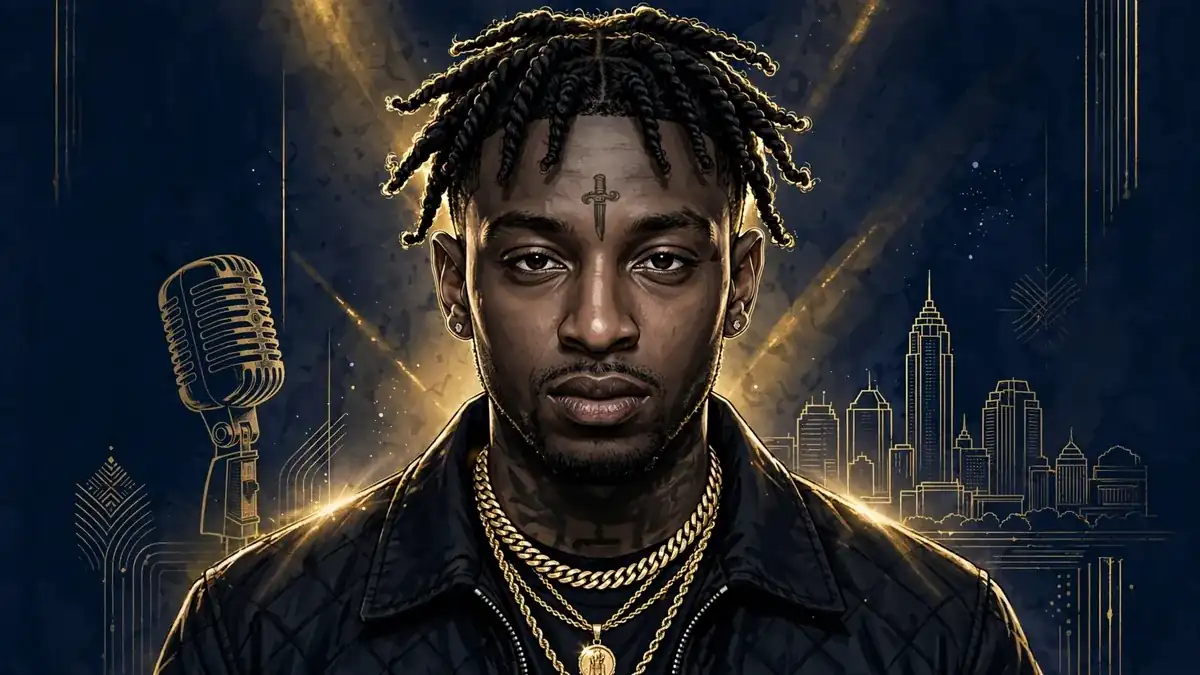
21 Savage‘s net worth is estimated at $25 million to $30 million as of October 2026. The London-born, Atlanta-raised rapper built that fortune on one of the most consistent catalogs in modern hip-hop: four consecutive albums that debuted at number one on the Billboard 200, a co-writing credit on Post Malone’s Diamond-certified “Rockstar,” ownership of his master recordings, and a touring business that took him from a $1 million private Bar Mitzvah gig to co-headlining stadiums with Drake. In December 2025 he added a fifth studio album, What Happened to the Streets?, which opened at number three and pulled more than 8 million Spotify streams a day at launch — proof that, a decade after Savage Mode, his earning power has not slowed.
21 Savage: Quick Facts
| Estimated net worth | About $30 million (range: $25–$30 million) |
|---|---|
| Profession | Rapper, songwriter, record producer |
| Nationality | British-born, U.S. permanent resident (Atlanta-raised) |
| Born | October 22, 1992 (age 33) |
| Height | 6 ft 0 in (183 cm) |
| Primary income sources | Music streaming and royalties, touring, songwriting, Slaughter Gang label |
| Active years | 2013–present |
| Last reviewed | October 2026 |
- Early Life and Background
- Education
- Career Journey
- Rise to Fame
- Main Sources of Income
- Salary and Earnings
- Businesses and Investments
- Brand Deals and Sponsorships
- Houses, Cars and Other Assets
- Awards and Achievements
- Net Worth Growth Over the Years
- Social Media Presence
- Personal Life
- Sources & Reporting
- Frequently Asked Questions
- Final Thoughts
Early Life and Background
Shéyaa Bin Abraham-Joseph was born on October 22, 1992, in Plaistow, in the London borough of Newham, England — a fact the public did not learn until his 2019 immigration arrest, when a birth certificate surfaced and rewrote a backstory the rapper had let Atlanta claim. At seven, he moved to Atlanta, Georgia, with his siblings and his mother, Heather Carmillia Joseph, and the city’s East Side became the bedrock of his identity. Until the ICE detainment, most of the world — including Interview magazine, which once described Atlanta as his birthplace — believed he was a native son of Georgia.
The Atlanta years were violent in ways that later financed his songwriting. In 2011, when he was 19, his close friend and “right-hand man” Larry was killed in a shootout. Two years later, on his 21st birthday, an attempted robbery left Abraham-Joseph shot six times while his best friend, Johnny, was killed beside him. He has said the trauma pushed him toward the microphone: with money for studio time supplied by his late friend’s uncle, he recorded his debut single, “I Can’t Get Enough,” released March 1, 2013. The name came first — he has said “Savage” started as a handle he needed for an Instagram page — and the career followed.
Loss kept finding him. His brother Quantivayus Joseph, known as Tayman, died in a shooting after an attempted drug deal. In November 2020, his half-brother Terrell Davis — who rapped as TM1Way — was stabbed to death in Lambeth, London. The rapper’s Instagram bio memorializes the dead: “The Ghost of JB Larry CJ Tayman Terrell.” Those names recur across his lyrics, and they explain why his catalog reads less like a discography than a casualty report he monetized.
Education
Formal schooling ended early and badly. In seventh grade, Abraham-Joseph was banned from the DeKalb County School District after bringing a gun to school — he told The FADER he carried it because another student had threatened him. The Ringer, profiling him in 2016, confirmed the expulsion, and a later PAPER magazine cover story filled in the rest: youth detention, an alternative program to finish eighth grade, and a single semester of high school before he dropped out as a freshman, worn down by repeated exclusions.
The thin paper trail became a legal problem years later. When he was detained by ICE in 2019, reporting noted he was ineligible for DACA protections partly because he never obtained a GED after dropping out. What school failed to teach him, the streets and then the studio did: by his own account on The Breakfast Club, he knew early that a conventional job was not in his future, and he treated rap as the only trade that would have him.
Career Journey
The apprenticeship years ran from 2013 to 2015. After the debut single, Abraham-Joseph released his first mixtape, The Slaughter Tape, on May 25, 2015 — fourteen tracks of plain-spoken street narrative that earned him Interview magazine’s label “underground hero in Atlanta.” A tribute EP to his idol Gucci Mane, Free Guwop with Sonny Digital, arrived that July; Slaughter King followed in December. Atlanta producers Zaytoven, TM88, and Sonny Digital gave him beats and co-signs, and a 2016 XXL Freshman cover put his deadpan delivery in front of a national audience.
The partnership that changed his economics was with producer Metro Boomin. Their 2016 joint EP Savage Mode — nine tracks recorded in a burst of mutual confidence — produced “No Heart” and “X,” both of which went platinum, and established the formula that still defines him: sparse, menacing production under a flat, affectless flow. In 2017 he signed with Epic Records and released his debut studio album, Issa Album, on July 7. It peaked at number two on the Billboard 200, and its single “Bank Account” — which he produced himself — went platinum and reached number 12 on the Hot 100, becoming the first song the mainstream could not ignore.
That October he joined Offset and Metro Boomin for Without Warning, a Halloween-night surprise that debuted at number four on the Billboard 200; its standout, “Ric Flair Drip,” gave Offset a top-15 solo hit and gave 21 Savage a reputation as a collaborator who elevates everyone in the room. The pattern — solo statement, then a prestige collaboration — would repeat for the rest of his career.
Rise to Fame
The second album made him a chart fixture. I Am > I Was, released December 21, 2018, debuted at number one on the Billboard 200, his first chart-topper. Its centerpiece, “a lot” featuring J. Cole, won the Grammy for Best Rap Song in 2020 and has since passed 1.3 billion Spotify streams — a slow-burning hit that still earns every week. By then his feature résumé read like a hit parade: he co-wrote Post Malone’s “Rockstar,” which spent eight weeks at number one in 2017 and has since crossed 3.4 billion Spotify streams, sitting among the 40 most-streamed songs in the platform’s history.
Savage Mode II, the 2020 reunion with Metro Boomin, arrived with an unlikely prestige touch — narration by Morgan Freeman — and became his second straight number-one album, powered by “Runnin” and “Mr. Right Now” with Drake. Then came the Drake full-length: Her Loss, released November 4, 2022, moved 404,000 album-equivalent units in its first week, debuted at number one, and produced “Rich Flex,” which topped the Hot 100 for seven non-consecutive weeks. Four projects, four number ones — a run of commercial consistency almost no peer from the 2016 freshman class has matched.
American Dream, released January 12, 2024, extended the streak to four consecutive number-one debuts and held the top spot for two weeks, according to Live Nation’s tour announcement. Its single “redrum” became a streaming hit, and the album’s documentary and film rollout leaned into the story his immigration case had made public: a British-born kid who became an American rap star without ever quite being American on paper. In February 2024 he made his Saturday Night Live debut, and that December he closed the loop on a decade of work with a fifth album — detailed below — that opened at number three.
Main Sources of Income
Streaming is the engine. 21 Savage holds roughly 41 million monthly listeners on Spotify with 26.7 million followers on the platform, according to Music Metrics Vault — numbers that put him in the top tier of working rappers. A write-up on Capitalism.com, cited by AfroTech, estimated he pulls in more than $1.39 million per year from streaming royalties alone. His 2023 Spotify Wrapped told the bigger story: 6 billion streams in a single year, from 170 million listeners in 184 countries, totaling more than 312 million hours of listening, as reported by HotNewHipHop — and he managed it without releasing a solo project that year.
The catalog behind those numbers is unusually deep. “Rockstar” (3.4 billion), “Creepin'” with Metro Boomin and The Weeknd (1.8 billion), “Jimmy Cooks” with Drake (1.4 billion), “Bank Account” (1.3 billion), “a lot” (1.3 billion), “Rich Flex” (1.0 billion), “Runnin” (947 million) and “ball w/o you” (926 million) give him eight songs approaching or past a billion streams each. Because he is among the select few artists who own their master recordings, per AfroTech, a larger share of every stream lands in his pocket instead of a label’s — the single most important structural fact about his wealth.
Touring is the second pillar and, in peak years, the larger one. AfroTech’s analysis concluded his live performances likely contribute more to his net worth than his catalog. The evidence: in 2017, TMZ reported he was paid $1 million to perform at a single private Bar Mitzvah — a fee that, as AfroTech noted, has probably doubled or tripled since. Industry estimates cited by newer outlets put his standard per-show range at $150,000 to $300,000. He has headlined repeatedly, co-headlined Drake’s It’s All A Blur tour across North America in 2023, closed the year with a Homecoming Tour through Europe and the UK, and in 2024 mounted his first solo headlining tour in five years: the 30-city American Dream Tour, produced by Live Nation, with JID, Nardo Wick, and 21 Lil Harold in support, wrapping June 15 at Atlanta’s Lakewood Amphitheatre.
Songwriting and features form the third stream. The “Rockstar” co-write — a Diamond-certified, eight-week number-one — pays publishing royalties that will outlive every tour bus. High-profile verses for Drake (“Jimmy Cooks,” “Knife Talk”), J. Cole (“a lot”), Post Malone, DJ Khaled, and Travis Scott command feature fees at the top of the market and keep his name on the charts between albums. In December 2025, What Happened to the Streets? added fourteen new tracks to the earning catalog, with “Mr. Recoup” pushed to U.S. rhythmic radio in January 2026 — fourteen fresh royalty assets from a single release.

Salary and Earnings
No rapper publishes a pay stub, so 21 Savage’s annual income has to be reconstructed from the pieces that surface publicly. The clearest anchor comes from Celebrity Net Worth, which reports he earned an estimated $6 million in a single twelve-month stretch between 2017 and 2018 — the Issa Album / Without Warning era, when “Bank Account” was peaking and the private-gig market was discovering what he cost.
Streaming throws off a steadier, compounding base. The $1.39 million-a-year figure from the Capitalism.com analysis covers recorded-music royalties, and it predates the Her Loss and American Dream eras; with 6 billion Spotify streams banked in 2023 alone and his owned-masters position, his actual annual streaming income in recent years is plausibly higher — though no outlet has published an updated audit, and this site will not invent one. What can be said: eight near-billion-stream songs, four number-one albums, and full ownership of the masters is a royalty machine that pays monthly with no tour bus required.
Live performance is where the spikes live. At the reported $150,000–$300,000 per-show range, a 20-date festival and arena run grosses $3–6 million before costs — and his 2024 American Dream Tour ran 30 cities. Co-headlining Drake’s It’s All A Blur run in 2023, one of the highest-grossing hip-hop tours of its era, put him in front of stadium crowds nightly with a fraction of the overhead a solo headliner carries. Add feature fees, publishing, and the label imprint’s artist revenue, and a $4–6 million annual earning band in active years — the range several 2026 estimators converge on — is consistent with the public record rather than a guess stacked on a guess.
The 2025 album reset the clock again. What Happened to the Streets? — fourteen tracks, features from Drake, Latto, GloRilla, G Herbo, Young Nudy, Lil Baby, Metro Boomin, and Jawan Harris, production from Metro Boomin, Wheezy, Southside, Zaytoven, FnZ, Oz, and D.A. Got That Dope — debuted at number three on the Billboard 200, per AllMusic, and led Spotify’s daily rap chart with 8 million streams a day at launch, according to Ratings Game Music. Its cover, designed by London-based Nigerian artist Slawn, reworked Kerry James Marshall’s 1980 painting A Portrait of the Artist as a Shadow of His Former Self with a graffiti clown face and a knife sketched into the forehead — a nod to the dagger tattoo between the rapper’s eyes. The rollout even reached Art Basel Miami, where Slawn and 21 Savage unveiled a massive inflatable sculpture of the artwork. A catalog that keeps refreshing itself is the difference between a fortune that peaks and one that compounds.
Businesses and Investments
The most consequential business decision of his career was structural: he owns his master recordings, placing him in a small club of artists — Taylor Swift’s re-recording saga made the economics famous — who collect the lion’s share of their streaming revenue instead of renting it back from a label. He records through his own imprint, Slaughter Gang Entertainment, in partnership with Epic Records, which means his releases and the artists he develops generate label-side revenue on top of his artist income. The imprint’s name comes straight from his early mixtape era, and its roster and releases turn his brand into an asset that appreciates rather than a fee he collects once.
His investing philosophy went public in 2018, and it was unusually blunt for a rapper. He told interviewers he had stopped buying expensive jewelry — the double-sided diamond chain bearing his own face opposite Jason Voorhees would be among his last such purchases — because he was “getting way richer” putting money into stocks, land, and art instead. He credited Jay-Z, who had been preaching art investment since 2017, with changing his thinking. AfroTech’s 2024 analysis framed the shift as the hinge of his financial maturity: the moment a street rapper started behaving like a portfolio manager.
The portfolio has a tech edge. He was an early investor in Sound.xyz, the NFT platform that lets artists sell music directly to fans — a bet that aligns exactly with his masters-ownership worldview. He has discussed cryptocurrency positions in interviews and on social media, and he has described ongoing investment in Atlanta real estate, the market he knows block by block. None of these positions are publicly audited, so this site values them conservatively: they are real, directional bets by a man who has said out loud that rap income is volatile and that the artists who stay wealthy build structures around their earnings.
Then there is the philanthropy that doubles as brand equity. In 2018 he launched the Bank Account Campaign, a financial-literacy program named for his breakout single, announcing it on The Ellen DeGeneres Show with partners Get Schooled and the nonprofit Juma. When COVID-19 shut schools, his Leading By Example Foundation expanded it into “Bank Account At Home” — a free online K-12 curriculum built with mobile bank Chime, education platform EverFi, and Juma Ventures, plus a partnership with Atlanta Mayor Keisha Lance Bottoms to put free Wi-Fi and tablets in underserved students’ hands. He seeded the pandemic effort with a $25,000 donation to the city’s #ATLStrong relief fund, as reported by the Associated Press via iHeart. Teaching kids about credit scores and compound interest does not show up on a balance sheet, but it is the kind of reputation asset that keeps brand partners calling.
Brand Deals and Sponsorships
Endorsement income is the smallest of his major streams but the most visible. AfroTech’s reporting ties him to partnerships with Adidas and Avion Tequila — he appeared in promotional materials for both and name-checked brands in his music — and his Chime partnership around the Bank Account campaign blended philanthropy with a commercial banking relationship. With 20.2 million Instagram followers (per StarNgage) and an engagement rate near 1.5%, his sponsored-post economics are formidable: third-party auditors estimate he can command roughly $14,000 for an image post and up to $29,000 for a video post, though he posts sponsored content sparingly compared with peers who treat their feeds as billboards.
What he has not done is the celebrity product-line gold rush — no headphone brand, no fashion label with his name stitched on it, no liquor brand of his own despite the Avion relationship. That restraint looks deliberate next to his 2018 anti-jewelry pivot: fewer, larger partnerships, each consistent with the disciplined-investor persona. The money he leaves on the endorsement table, he appears to make up in equity — in his masters, his label, and his investments.
Houses, Cars and Other Assets
For a man worth tens of millions, 21 Savage keeps a remarkably quiet property footprint — there are no televised mansion tours and no breathless Architectural Digest spreads. What is documented: after his breakthrough he rented in the Hollywood Hills, with one property report putting the monthly rent near $45,000, before returning to Atlanta, the city he calls home. Property-press outlets have reported that he owned a 2,200-square-foot Atlanta high-rise penthouse — two bedrooms, panoramic downtown views — that was listed for sale around $800,000. Treat the specifics cautiously: celebrity property reporting runs on thin sourcing, and the rapper himself has never confirmed a portfolio. What he has confirmed is the direction of travel — money into land and real estate rather than depreciating toys.
The car collection follows the same low-key pattern. His lyrics name-check the expected hardware, and reports have attached a Ferrari 488 (about $250,000), a Bentley Bentayga (about $230,000), and a Mercedes-Maybach S600 (about $192,000, bought, one outlet claims, right after that $1 million Bar Mitzvah check cleared) to his garage. None of it is extravagant by rap-star standards, which is the point: since 2018 he has publicly framed cars and jewelry as the old game and equity as the new one. The most valuable asset he undisputedly holds is not parked anywhere — it is the master recordings, which generate income while he sleeps.
Awards and Achievements
The trophy case is anchored by the 2020 Grammy Award for Best Rap Song for “a lot” featuring J. Cole — the industry’s formal acknowledgment that the deadpan stylist could write a song of the year. The nominations around it tell the breadth story: his work has been recognized across rap and mainstream categories, and his albums have been fixtures on year-end critics’ lists since Savage Mode.
The commercial achievements stack higher than the awards. Four consecutive studio projects debuted at number one on the Billboard 200 — I Am > I Was (2018), Savage Mode II (2020), Her Loss with Drake (2022), and American Dream (2024) — with the 2025 follow-up What Happened to the Streets? opening at number three. “Rockstar,” which he co-wrote, spent eight weeks atop the Hot 100 and is RIAA-certified Diamond; “Rich Flex” added seven non-consecutive weeks at number one. His 2016 XXL Freshman cover, his 2024 Saturday Night Live debut, and a headlining tour history stretching from clubs to Drake’s stadiums complete a résumé that most artists would trade catalogs for.
Net Worth Growth Over the Years
No auditor has ever opened 21 Savage’s books, so the year-by-year figures below are our modeled estimates, built from the dated money events in the public record — the Epic signing, the $1 million private gig, the $6 million twelve-month run Celebrity Net Worth documented for 2017–18, the four number-one albums, and the current published estimates. The shape of the curve matters more than any single cell: steady, compounding growth with no lost years.
| Year | Estimated net worth | What drove it |
|---|---|---|
| 2016 | $2M | Savage Mode breakthrough; “No Heart” and “X” go platinum |
| 2017 | $5M | Epic Records signing; Issa Album hits No. 2; “Bank Account” peaks; $1M Bar Mitzvah gig (TMZ) |
| 2018 | $9M | I Am > I Was debuts at No. 1; $6M earned in twelve months (Celebrity Net Worth) |
| 2020 | $13M | Savage Mode II hits No. 1; Grammy win for “a lot”; Bank Account campaign expands |
| 2022 | $18M | Her Loss with Drake: No. 1, 404K first week; “Rich Flex” tops Hot 100 |
| 2024 | $24M | American Dream hits No. 1; 30-city headlining tour; SNL debut |
| 2026 | $25–30M | What Happened to the Streets? opens at No. 3; catalog streams compound; current published estimates |
How does that stack up against his peers? Gigwise’s 2026 comparison puts Lil Baby at $20–25 million and Metro Boomin at $18–20 million — both a notch below 21 Savage’s range — while Drake, his most frequent collaborator, sits above $250 million in a different financial universe. The honest read: 21 Savage is not the richest rapper of his generation, but he may be the most efficiently built — four number-one albums, owned masters, and a discipline about spending that his own interviews document.
Social Media Presence
21 Savage’s audience is an asset class of its own. He holds about 41.1 million monthly Spotify listeners and 26.7 million Spotify followers (Music Metrics Vault), roughly 20.2 million Instagram followers (StarNgage, adding about 4,300 a day), and a YouTube channel with millions of subscribers whose videos have piled up billions of views. His Instagram bio — “The Ghost Of JB Larry CJ Tayman Terrell” — is a memorial wall for the friends and brothers he has lost, and his feed mixes tour announcements with the occasional flashes of the dry humor that made his interviews cult viewing.
The social footprint converts directly to money: streaming discovery, tour ticket sales, and sponsored-content rates all scale with it. But the more telling metric is durability — 6 billion Spotify streams in 2023, a year he released no solo album, means the audience is listening to the catalog, not just the campaign. That is the behavior of an annuity, not a moment.
Personal Life
He guards his private life the way he guards his masters. What is confirmed: he is the father of three children, whom he keeps almost entirely out of the public eye — a PAPER magazine profile described him as a father of three working toward a pilot’s license, a holdover from a childhood dream of joining the Air Force. He dated model Amber Rose from mid-2017 to early 2018, a relationship that played out in tabloids he otherwise avoids. Since September 2024, rapper Latto has publicly hinted at a relationship with him, calling him her “husband” during a TMZ interview in New York — neither has confirmed more than the hint, and this site treats it as rumor, not fact.
The defining off-stage saga remains the immigration case. On February 3, 2019 — two days after the “a lot” video dropped — ICE agents detained him in Atlanta, revealing that the “Atlanta native” was a British national whose visa had expired in 2006, when he was 13. He spent ten days in a detention center in southern Georgia before release; his attorney, Charles Kuck, told the Associated Press the rapper had been trying to renew his status since 2017 and had applied for a U visa as a crime victim assisting law enforcement. For four years he could not leave the country — he missed the Canadian dates of tours and watched the case crawl. In October 2023, Kuck announced the proceedings were terminated and his client was a lawful permanent resident free to travel internationally. Days later he joined Drake on stage in Toronto, then announced a London homecoming show — his first performance in his birth country since childhood. He told Good Morning America during the fight: “I’ve been here 19 years, this is all I know.”
He practices Ifá, the traditional West African religion, alongside his mother. He has described a diet light on meat — salmon and shrimp, lots of water — and, in one of his most-quoted pivots, a lifestyle that swapped jewelry shopping for stock portfolios. The through-line of the personal life is the same as the business life: a man who survived the unsurvivable twice over, and now manages both with unusual care.
Sources & Reporting
Celebrity Net Worth — the current $30 million net worth estimate and the reported $6 million earned in a single twelve-month period (2017–18); reporting window 2025–26.
AfroTech — masters ownership, the $1.39M/year streaming estimate (via Capitalism.com), the $1M Bar Mitzvah fee (via TMZ), Adidas and Avion Tequila partnerships, the Sound.xyz investment, and the 2018 shift from jewelry to stocks, land, and art; reporting window 2024.
PAPER Magazine — birth in Plaistow, London, the move to Atlanta at age seven, the seventh-grade DeKalb County expulsion (via his FADER interview), three children, and the pilot’s-license ambition; 2019 cover story.
The Ringer — the 2016 Savage Mode-era profile: the 2013 shooting on his 21st birthday, the dagger tattoo, and the Metro Boomin partnership’s origins.
NME — the October 2023 lawful-permanent-resident announcement and the end of the four-year immigration case.
HotNewHipHop — What Happened to the Streets? tracklist, features, and Slawn cover art; the 6-billion-stream 2023 Spotify Wrapped figures.
AllMusic — What Happened to the Streets? review and its number-three Billboard 200 debut.
iHeart / The Breakfast Club — the “Bank Account At Home” program details (Associated Press reporting): Chime, EverFi, Juma Ventures, the Mayor Bottoms partnership, and the $25,000 #ATLStrong donation; July 2020.
Exclaim! — the February 2024 American Dream Tour announcement: 30 cities, Live Nation production, JID/Nardo Wick/21 Lil Harold support.
313 Presents — Live Nation tour press release details: American Dream‘s two weeks at number one, the 2023 It’s All A Blur and Homecoming tours.
Music Metrics Vault — current Spotify figures: 41.1M monthly listeners, 26.7M followers, per-track stream counts.
Wikipedia — What Happened to the Streets? release data: December 12, 2025, Slaughter Gang/Epic, fourteen tracks, “Mr. Recoup” single date.
Frequently Asked Questions
What is 21 Savage’s net worth in 2026?
21 Savage’s net worth is estimated at $25 million to $30 million as of October 2026. Celebrity Net Worth’s current published estimate is $30 million, while other 2026 estimators land between $16 million and $25 million — the range reflects different assumptions about his touring income, label equity, and real estate. All published figures are estimates built from public reporting, not audited statements.
What is 21 Savage’s real name?
His real name is Shéyaa Bin Abraham-Joseph. He was born on October 22, 1992, in Plaistow, London, England, and moved to Atlanta, Georgia, at age seven. His British birth was not widely known until his 2019 immigration arrest.
How old is 21 Savage?
21 Savage is 33 years old in 2026. He was born on October 22, 1992. He took the “21” in his stage name from his street name growing up in Atlanta, and has said the “Savage” started as a handle he needed for an Instagram page.
Is 21 Savage British? Is he a U.S. citizen?
He was born in London, England, and is British by birth. After a four-year immigration case that began with his February 2019 ICE detention, he was granted lawful permanent resident status (a green card) in October 2023, which lets him live and work in the U.S. and travel internationally. His attorney confirmed the immigration proceedings were terminated.
Is 21 Savage married? Who is his wife?
He is not publicly married. He dated model Amber Rose from 2017 to 2018. Since September 2024, rapper Latto has hinted at a relationship with him — calling him her “husband” in a TMZ interview — but neither has confirmed the status, so it remains rumor rather than fact.
How many kids does 21 Savage have?
He has three children, whom he keeps almost entirely out of the public eye. A 2019 PAPER magazine profile described him as a father of three; he rarely discusses them in interviews and does not post them on social media.
How tall is 21 Savage?
21 Savage is 6 feet 0 inches tall (183 cm).
What record label is 21 Savage signed to?
He releases music through his own imprint, Slaughter Gang Entertainment, in partnership with Epic Records, which he signed with in 2017. Crucially, he owns his master recordings — a rarity among major-label rappers that lets him keep the largest share of his streaming royalties.
Final Thoughts
21 Savage’s estimated $25–30 million fortune is the product of an unusually disciplined version of the rap career: four straight number-one albums, a Diamond-certified co-write, ownership of his masters, and a touring operation that scaled from a $1 million private gig to Drake’s stadiums. The 2018 decision to stop buying jewelry and start buying stocks, land, and art — credited to Jay-Z’s influence — may end up mattering as much as any album. With What Happened to the Streets? refreshing the catalog in late 2025 and his immigration case resolved, the constraints that once boxed him in are gone. The estimate carries a range because the record is incomplete; the trajectory does not need one.
Published on October 9, 2026. Last reviewed October 2026. Found an error? See our corrections policy.