
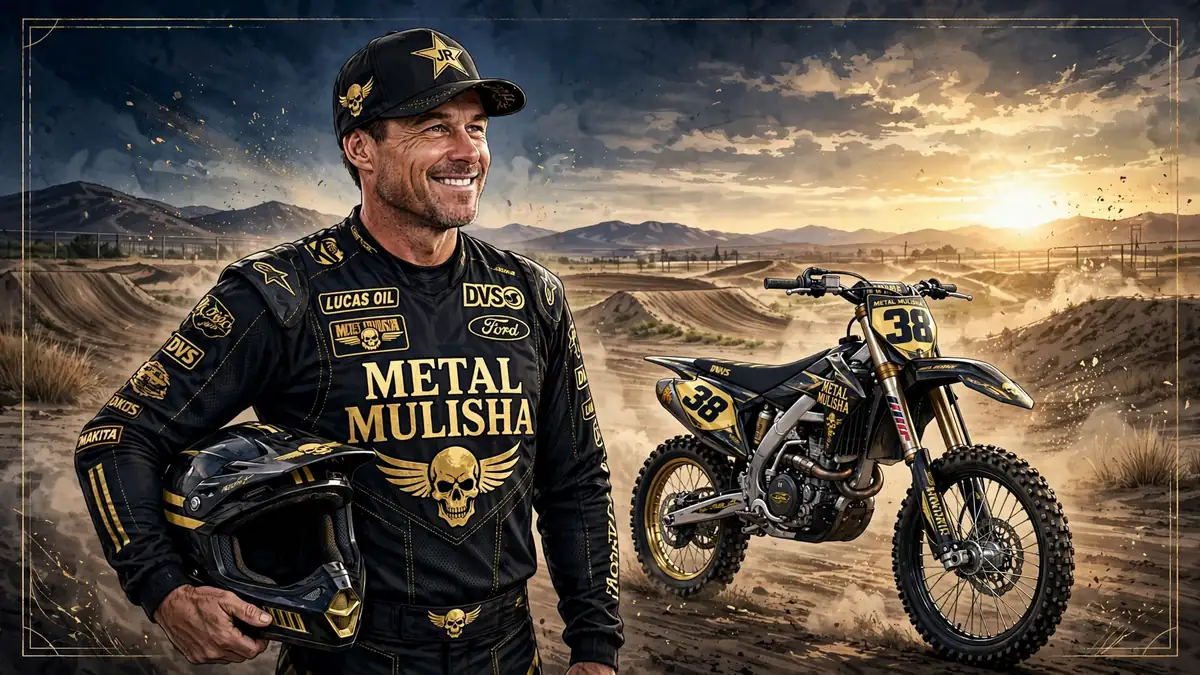
Brian Deegan‘s net worth is estimated at $10 million as of November 2026. The freestyle motocross pioneer turned a 1997 ghost ride across the Los Angeles Coliseum finish line into a career that spans 16 X Games medals, six Lucas Oil off-road championships, a RallyCross gold medal, and the Metal Mulisha brand — a clothing and lifestyle business that was generating a reported $30 million a year in revenue at its peak. No audited fortune exists, and Deegan has never disclosed his finances, so the $10 million figure from Celebrity Net Worth is a public estimate, not a confirmed balance sheet.
Brian Deegan: Quick Facts
| Estimated net worth | $10 million (range: $8 million – $10 million) |
|---|---|
| Profession | Freestyle motocross rider, off-road and rallycross driver, entrepreneur |
| Nationality | American |
| Born | May 9, 1974 (age 52) |
| Height | 5 ft 9 in (175 cm, as reported) |
| Primary income sources | Metal Mulisha, race prize money, sponsorships, Deegan Motorsports, media and family content |
| Active years | 1991–present |
| Last reviewed | November 2026 |
- Early Life and Background
- Education
- Career Journey
- Rise to Fame
- Main Sources of Income
- Salary and Earnings
- Businesses and Investments
- Brand Deals and Sponsorships
- Houses, Cars and Other Assets
- Awards and Achievements
- Net Worth Growth Over the Years
- Social Media Presence
- Personal Life
- Sources & Reporting
- Frequently Asked Questions
- Final Thoughts
Early Life and Background
Brian Deegan was born on May 9, 1974, in Omaha, Nebraska. That date comes from Wikipedia and from his sponsor profile on Monster Energy’s own site, which lists his date of birth as 1974-05-09. A handful of biography sites print 1975 instead — Encyclopedia.com heads its Deegan entry “1975–” and PlayersWiki gives May 9, 1975 — but the two strongest sources agree on 1974, and this article uses it. The one-year split is a small thing, and it is worth naming because so many net-worth pages copy each other without checking: once a wrong year enters the biography-site loop, it circulates for years.
Deegan grew up in Omaha and found motocross at eight years old, introduced to the sport by a neighbour who had moved in from Europe, according to HotCars. Soccer was his first sport as a kid; dirt bikes took over fast. Omaha in the 1980s was a long way from the Southern California motocross scene, and that distance shaped the rest of his story: at 17, with a credit card, a dirt bike, and an old truck, he left Nebraska for Southern California to chase a professional career, as Monster Energy tells it. He had no factory backing and no safety net. The move itself became part of his public identity — the privateer from Omaha who arrived with almost nothing and refused to ride the way the establishment wanted him to ride.
His father supported the racing, and Deegan turned professional in supercross with Team Moto XXX at 17. The early years were lean. In a 2006 Racer X interview he said he had once dreamed of a factory ride paying $80,000 a year and never got one — a revealing detail, because it shows how modest the money was at the start. He finished in the top five at a national one year as a privateer, racing against factory riders on factory bikes, and the frustration of that gap pushed him toward something else entirely: a style of riding that was never going to win a traditional championship, but would invent a sport.
The nickname came later and stuck for good. Inside the sport he is “The General” — the leader of the Metal Mulisha crew, the rider other riders followed into tricks nobody had tried in competition. The name fits the way his career actually worked: Deegan rarely had the best equipment or the biggest contract, and he led by doing the thing first and letting everyone else catch up.
Education
There is no public record of Deegan attending college, and no credible source lists a school, a degree, or any formal education beyond his Nebraska upbringing and his move to California at 17. That is not a gap in this article; it is the fact. He went professional as a teenager, and his education, in any sense that mattered to his career, happened on tracks, in pits, and in negotiations with sponsors.
What he learned early was commercial. A rider without a factory contract has to sell himself: to parts suppliers, to energy-drink brands, to magazines, to event promoters. Deegan’s later success as a businessman — co-founding a clothing brand, running a dealership, building a family media operation — traces back to those years of hustling for support as a privateer. He understood, before most riders did, that the riding was the advertisement and the brand was the business.
It is worth saying plainly because net-worth articles often invent schooling details to fill a section. Deegan’s record contains none, and inventing one would be worse than leaving the section short. His formal education ended where his professional career began, at 17, on the road from Omaha to Southern California.
Career Journey
Deegan’s career breaks into four clear acts, and the money follows the same shape: small purses and no factory deal in act one, invention and fame in act two, brand money in act three, and a four-wheel second career plus a family racing business in act four.
Act one: supercross privateer, 1991–1997. Deegan turned pro with Team Moto XXX at 17 and raced supercross as a privateer. He won amateur titles, rode a 125 SX, and in 1997 won the AMA 125cc West Region main event at the Los Angeles Coliseum — a genuine upset over factory riders David Vuillemin, Robbie Reynard, and Kevin Windham, as HotCars recounts. The Coliseum win is remembered for what happened at the finish: Deegan ghost-rode his bike across the line, jumping off and letting the machine carry itself past the flag while he ran alongside it. The crowd of nearly 50,000 went wild, and the moment became the founding image of freestyle motocross. He had, in effect, invented a new sport on live television while winning a traditional race.
Act two: inventing freestyle motocross, 1997–2005. Deegan walked away from traditional racing in 1999, frustrated by the lack of support, and helped build freestyle motocross as a discipline. With Tommy Clowers and Mike Jones he formed the Metal Mulisha freestyle team — a deliberate act of defiance against the motocross establishment, in HotCars’ telling — and the crew began inventing tricks: the Mandatory Suicide, the Superman Seat Grab, the Coffin Sterilizer. Deegan was the first rider to land a 360 in a freestyle motocross competition. He competed in the X Games every year from 1999 to 2015, a 17-year run, and collected 16 X Games medals in total: 12 in motocross and 4 in rally car racing, per Wikipedia’s medal record. He also won Gravity Games gold in freestyle in 2000 and silver in 1999.
The middle of this period nearly ended him. In 2005, while filming for the television show Viva La Bam, Deegan attempted a backflip, crashed hard, and suffered injuries that cost him a kidney and badly damaged his spleen. He has described the crash as a turning point in his life, and he became a born-again Christian afterwards. He returned to riding — the crash slowed him, it did not stop him — and in 2006 he released the film Disposable Hero with Berkela Films, a documentary about the costs of the freestyle life.
Act three: four wheels, 2009–2015. In 2009, with no history in car racing, Deegan switched to short-course off-road trucks in the Lucas Oil Off Road Racing Series — and won the Unlimited Lites championship in his first attempt. He went on to win six Lucas Oil championships in total: Pro Lite Unlimited in 2009, 2011, and 2013, and Pro 2 Unlimited in 2011, 2012, and 2014. In 2011 he also won the World Championship race in the Pro Light class at Crandon International Off-Road Raceway in the TORC Series, and represented the United States with teammate Travis Pastrana at the Race of Champions in Düsseldorf, Germany. In 2012 he debuted the Metal Mulisha Monster truck, driving it at Chase Field in Phoenix.
Rallycross ran alongside the trucks. Deegan raced an OlsbergsMSE Ford Fiesta in the Global RallyCross Championship, finishing runner-up in 2012, fourth in 2013, and 12th in 2014, and won RallyCross gold at X Games XVII in Los Angeles in 2011. In 2015, Chip Ganassi Racing hired him to contest seven Global Rallycross races in an M-Sport Fiesta alongside former motocross rider Jeff Ward. For a rider who had started the decade on two wheels with no factory deal, the Ganassi seat was a measure of how far the second career had travelled.
Act four: the family business, 2016–present. Deegan never fully retired. He entered Nitrocross — the series formerly known as Nitro Rallycross — with an appearance at Phoenix, as NBC Sports reported, and returned to Crandon in 2025, according to 131offroad.com. But the centre of gravity shifted to his children: daughter Hailie in stock cars, son Haiden in supercross and motocross. In November 2026, RACER reported that Hailie had returned to stock car racing full-time in the ARCA Menards West Series with Bill McAnally Racing, winning races at Madera Speedway and Kern Raceway, while Haiden — a two-time 250SX West Supercross champion and two-time AMA Motocross 250cc champion — was preparing to move up to the premier 450 class full-time in 2027 after re-signing a multi-year deal with Monster Energy Yamaha Star Racing. Brian, RACER wrote, is “front and center in everything his motor racing son and daughter do.” The racer became the patriarch of a racing family, and the family is now the business.
Rise to Fame
Deegan’s fame did not arrive as a single breakthrough; it arrived as a sequence of firsts that made him impossible to ignore. The 1997 Coliseum ghost ride was the first: a privateer winning a 125 main and celebrating with a stunt no crowd had seen before. The first 360 in freestyle competition was the second. The Winter X Games gold in Big Air in 2002 — won with the Mandatory Suicide, a jump in which he leapt from the seat mid-air, twisted his body through the air, and landed seated sideways over a 100-foot snow-covered jump — was the third. Encyclopedia.com notes that he kept the trick secret until he performed it, and the judges awarded gold on the spot.
Television spread the name beyond motocross. Deegan doubled for Vin Diesel as a stunt biker in the 2002 film XXX, appeared on MTV’s Scarred to detail his injuries, and was featured in FHM and on the covers of Transworld MX and Racer X magazines. He is a playable character in the video games Freekstyle and Supercross (2000). The 2018 documentary Blood Line: The Life and Times of Brian Deegan told his story at feature length, and his family’s YouTube channel, The Deegans, carries the story into the present.
The Metal Mulisha brand did as much for his fame as any medal. What began as a crew of defiant riders became a skull-and-crossbones logo recognised far beyond motocross — on clothing, energy drinks, video games, and a Monster Jam truck. Deegan’s face and the brand’s skull travelled together, and each made the other more valuable. By the mid-2000s he had become the public face of a lifestyle brand that sold the attitude he had invented, on top of the medals.
One correction matters here, because several net-worth sites get it wrong. Early Magazine and PlayersBio both credit Deegan with 10 X Games gold medals. The documented record says otherwise: Wikipedia’s medal table lists 4 X Games golds — Moto X Big Air at Los Angeles in 2003, RallyCross at Los Angeles in 2011, Moto X Big Air at Aspen in 2002, and Moto X Best Trick at Aspen in 2005 — alongside 3 silvers and 9 bronzes, for 16 medals in total. Four golds across two disciplines is still a remarkable record, and it is the correct one. The “10 golds” figure appears to be a confusion with his total medal count, repeated from site to site without checking. This article uses the medal record.
Main Sources of Income
Deegan’s money comes from five streams, and their balance changed over time. Prize money dominated the early years, sponsorships and the clothing brand took over in the 2000s, and the family racing operation and media now carry the later years. No single stream explains the $10 million estimate; the total is the sum of a long career in which each stream overlapped the next.
1. Competition prize money. X Games purses in Deegan’s era were modest by mainstream-sport standards. Early Magazine estimates his X Games prize money at roughly $400,000 across his career, with individual wins paying between $10,000 and $50,000 depending on the event. TheRichest’s earnings table gives harder numbers for his truck-racing years: $20,000 for each Lucas Oil championship title (Pro Lite 2009, 2011, 2013; Pro 2 2011, 2012, 2014), $30,000 for the 2018 Challenge Cup at Chandler, Arizona, and $30,000 for the 2005 Winter X Games Best Trick gold. Six Lucas Oil titles at $20,000 apiece is $120,000 in championship bonuses alone, before race-by-race purses. These are real numbers, and they are small next to the brand money — which is the point. Prize money made Deegan famous; it did not make him rich.
2. Metal Mulisha. The brand is the largest single contributor to his wealth, and the hardest to measure precisely. TheRichest lists Metal Mulisha’s annual revenue at $30 million in 2011 — brand revenue, not Deegan’s personal income, a distinction some net-worth pages blur. Early Magazine estimates Deegan’s direct earnings from the brand at $3–5 million through salary, profit sharing, and a partial sale, with annual brand revenues of $20–30 million at the mid-2000s peak. His exact ownership stake has never been disclosed publicly, and the brand went through partnerships and restructuring over the years, so any personal figure is an estimate. What is documented is the scale: a global apparel and lifestyle business, a Rockstar energy-drink joint venture, a video game, and a Monster Jam truck, all carrying the logo Deegan helped create in 1997.
3. Sponsorships and endorsements. Deegan’s sponsor roster across his career reads like a catalogue of action-sports and automotive brands: Rockstar Energy, Ford, Lucas Oil, Makita, Monster Energy, DVS, Mickey Thompson, FRAM Filtration, ODYSSEY Battery, and dozens of parts and equipment suppliers. Sponsorship in action sports pays in cash, free equipment, and win bonuses, and Deegan’s value to sponsors was his visibility across three disciplines at once — freestyle, off-road trucks, and rallycross. No sponsor contract value has ever been published, so this article does not invent one. The breadth and duration of the roster — marquee brands stayed with him for years, not seasons — is itself the evidence of its value.
4. Deegan Motorsports. The family motorcycle dealership in Temecula, California, co-owned by Brian and Marissa Deegan, sells bikes and parts and serves as the base for the family’s racing operation. It is a real operating business with inventory, staff, and a storefront, not a licensing play. Its revenues are private, and this article does not guess at them. Its importance to the net-worth picture is structural: it gives the family a business that earns whether or not anyone is racing that weekend.
5. Media, appearances, and family content. Deegan has earned from film and television work (the XXX stunt doubling, Disposable Hero, Blood Line), appearance fees for demos and exhibitions (Early Magazine puts these at $5,000–$20,000 per event), a Heavy Hitters toy line sold through retailers including Walmart, and the family’s YouTube channel The Deegans and podcast, launched in 2019. None of these streams is individually large. Together they form the long tail of a 30-year public career — the kind of income that keeps arriving after the competitive peak has passed.
A note on a number you will see elsewhere: PlayersWiki and PlayersBio both report that Deegan earned $18 million in 2013 and pockets more than $2 million a year. That $18 million figure is not supported by any primary reporting this article could find, and it sits oddly beside a $10 million net worth — a rider cannot bank $18 million in a single year and hold a $10 million lifetime net worth without extraordinary spending or losses that nobody has documented. Treat the $18 million as an unverified claim from two biography sites, not as a fact. This article does not repeat it as true.
Salary and Earnings
Deegan has never had a published salary, and anyone who prints one as fact is guessing. Action-sports athletes do not earn like stick-and-ball professionals: there is no league minimum, no standard contract, and no public salary database. What exists is a patchwork of purses, bonuses, sponsor payments, and business income, and the honest way to present it is as a patchwork.
The documented purse figures, from TheRichest’s earnings table, are: $30,000 for the 2005 Winter X Games Best Trick gold; $20,000 for each of his six Lucas Oil championship titles (2009, 2011, 2012, 2013, 2014 — two titles in 2011); and $30,000 for the 2018 Challenge Cup win at Chandler, Arizona. Early Magazine’s estimate of roughly $400,000 in total X Games prize money and $500,000 from rally-racing wins is plausible in scale but is that site’s estimate, not a documented total. Appearance fees of $5,000–$20,000 per demo or exhibition, also from Early Magazine, fit what the action-sports market paid headliners in the 2000s and 2010s.
The 2006 Racer X interview gives the best sense of his early economics. Deegan said he had once wanted a factory ride paying $80,000 a year and never got one — and then said, of the freestyle path he chose instead, “I’ve made a killer living.” The comparison is the story: the traditional route would have paid a solid middle-class wage, and the route he invented paid far more, but through ownership and sponsorship rather than a salary line.
Annual income in his peak years is best described as a range, not a number. Between Metal Mulisha distributions, sponsor retainers, race purses, and appearance fees, his peak-year gross income plausibly ran into seven figures — but the split between business revenue and personal income is unknowable from public sources, and this article will not dress a guess as a salary. PlayersBio’s claim of “more than $2 million annually” is that site’s assertion, unsupported by named reporting, and is noted here only so readers who have seen it elsewhere know it has been checked and not confirmed.
What can be said with confidence is the shape: low five figures a year as a teenage privateer; a steep rise through the Metal Mulisha years as the brand scaled; a second peak in the Lucas Oil and rallycross years when three income streams ran at once; and a durable later income from the dealership, the family media operation, and his children’s racing careers, in which he now works as mentor, manager, and patriarch rather than as the headline earner.
Businesses and Investments
Metal Mulisha (co-founder, 1997). Deegan co-founded Metal Mulisha with fellow riders — HotCars names Tommy Clowers and Mike Jones as the other founders of the freestyle team, and the brand was later structured as an LLC with Larry Linkogle. What started as a crew identity became a clothing line, then a lifestyle brand spanning apparel, accessories, energy drinks (through a joint venture with Rockstar), and a video game. At its mid-2000s peak the brand generated an estimated $20–30 million a year in revenue, per Early Magazine, with TheRichest putting the 2011 figure at $30 million. Deegan’s ownership stake varied as the brand took on partners and restructured, and no public filing states his share. The brand also fielded the Metal Mulisha Monster Jam truck, which debuted in January 2012 at Reliant Stadium in Houston, with Todd LeDuc driving and Deegan driving it at Chase Field in Phoenix. Metal Mulisha remains the single most important business fact in Deegan’s financial story: it converted fame into equity, and equity into durable wealth.
Deegan Motorsports (co-owner). The Temecula, California, motorcycle dealership is co-owned by Brian and Marissa Deegan and doubles as the family’s racing headquarters. It sells motorcycles and parts, services bikes, and anchors the family’s commercial presence in the sport. Multiple family profiles describe Marissa as running the shop alongside Brian. It is the kind of business that rarely appears in net-worth roundups because it is unglamorous — a dealership, not a fashion label — but it is also the kind that pays steadily for decades.
The Compound (former owner). Deegan owned the Compound, a freestyle motocross training park, and later sold it to rider Nate Adams, according to Wikipedia. The sale price was never reported. The Compound matters less for the money than for what it shows: Deegan repeatedly bought the infrastructure of his sport — the park where riders trained — and then exited at a profit or at least at a sensible time.
Heavy Hitters and Battlez FMX. Deegan has a toy line, Heavy Hitters, distributed through retail locations including Walmart, and teamed with Illektron to create Battlez FMX, a collectible card and dice game featuring himself, Todd Potter, and Jeremy Lusk. These are small ventures, and their revenues are not public, but they show a pattern: Deegan licenses his name into products that sell to the same audience that watches him ride, and he has done it across toys, games, film, and apparel.
Property and other investments. Some net-worth sites credit Deegan with real-estate investments in San Diego and Lake Tahoe and early-stage tech stakes. This article could not verify those claims against any named reporting, so they are not presented as facts here. What is documented is the family home in Temecula, California, featured on MTV Cribs, and reported additional properties whose details are not public. Readers should treat any site that lists specific Deegan property portfolios with values attached as guessing: no property records with his name and a price have surfaced in the reporting this article reviewed.
One more confusion to clear up: a recent low-quality article from Sterling Press describes Brian Deegan as a “skateboard legend” who built his fortune “beyond the halfpipe” and compares him with Tony Hawk as a fellow skateboarder. That is a different sport and, in substance, a different person — Deegan is a motocross and off-road racer, not a skateboarder. Tony Hawk is the skateboarder, and the comparison in that article is built on a mistaken identity. It is a useful warning about the net-worth genre: when sites scrape each other, errors compound, and the reader is the one who pays.
Brand Deals and Sponsorships
Deegan’s sponsor history is unusually long and unusually broad, because he stayed commercially relevant across three disciplines for more than two decades. The core relationships, documented in sponsor announcements and race coverage, were:
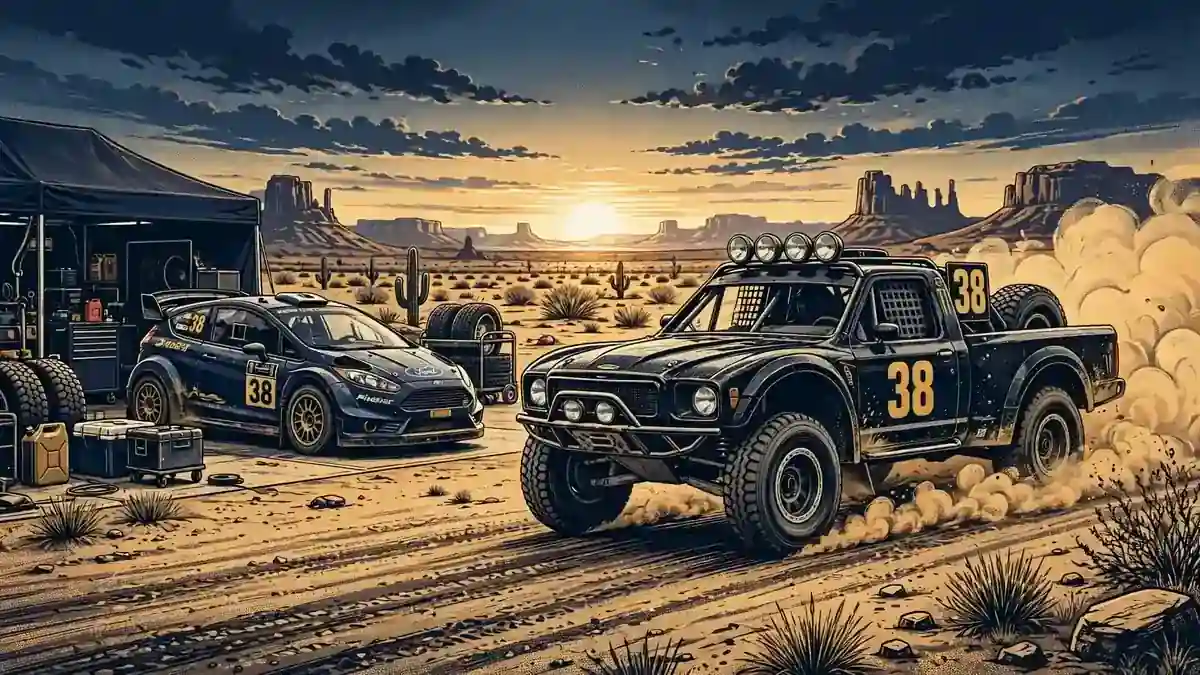
Rockstar Energy Drink. Deegan’s long-term energy-drink partner and the co-brand behind Metal Mulisha energy drinks. Rockstar backed his freestyle, truck, and rallycross programs, and the black-and-gold Rockstar/Metal Mulisha livery — on his No. 38 trucks and his Ford Fiesta rally car — became one of the most recognisable liveries in American motorsport. Energy-drink sponsorship is the financial backbone of action sports, and Rockstar’s multi-year, multi-discipline commitment to Deegan was the single most valuable endorsement relationship of his career.
Ford. Deegan raced Ford machinery across disciplines: the Ford Fiesta in Global RallyCross with OlsbergsMSE, and Ford trucks in the Lucas Oil series. The Ford relationship gave him factory-level equipment in series where privateers usually make do, and it put him on manufacturer-backed programs in both rallycross and off-road racing.
Monster Energy. His current sponsor family — Monster Energy backs his son Haiden’s Yamaha Star Racing program and sponsors Deegan himself, with a dedicated athlete profile on Monster Energy’s site. The relationship spans generations now: the brand that sponsors the father also sponsors the son, which is a rare thing in motorsport and a measure of the family’s commercial value.
Lucas Oil, Makita, and the parts catalogue. A 2012 FRAM Filtration partnership announcement listed Deegan’s official partners for the 2013 season as Rockstar Energy, Ford, DVS, Lucas Oil, and Makita, with FRAM joining them. A 2013 Mickey Thompson sponsorship announcement listed a far longer roster: Rockstar Energy Drink, Ford, Metal Mulisha, FRAM, DVS Shoe Co., Lucas Oil, Makita, Mickey Thompson, MSR, Gibson Exhaust, 4-Wheel Parts, Motegi Wheels, Ronin-Syndicate, Atomik R/C, Pro Taper, MYPLASH Prepaid MasterCard, Fathead, Brembo, Fortin, PPG, VP Racing Fuels, Fox Shocks, Impact by Mastercraft Safety, MSD Ignitions, FK Rod Ends, California Torque Products, Eibach Springs, McKenzies, Fiberwerx, JE Pistons, QTM, Roush Yates Engines, G2, Dailey Engineering, Brown & Miller Racing Solutions, ARP, and AZ Driveshafts. Most of those were parts and equipment deals rather than cash retainers — a truck team runs on parts — but the list shows how completely Deegan’s programs were underwritten by the industry.
ODYSSEY Battery, FRAM, Mickey Thompson. EnerSys announced in March 2013 that its ODYSSEY battery was the official battery of Deegan’s Pro 2 and Pro Lite trucks and his rally car. FRAM partnered with him for the 2013 season. Mickey Thompson signed as his official tyre sponsor in February 2013. These were formal, announced, multi-race deals with press releases — the documented end of the sponsor spectrum, as opposed to the logo-on-a-jersey arrangements that rarely get announced at all.
The honest summary: no contract values are public, and this article does not estimate them. What the record supports is that Deegan held marquee, multi-year deals with the biggest brands in his sport for more than a decade, across freestyle, trucks, and rallycross simultaneously — a sponsor footprint few action-sports athletes have ever matched.
Houses, Cars and Other Assets
Deegan’s most documented asset is his home in Temecula, California, the city in Riverside County where the family has lived for years. The house was featured on MTV Cribs, and PlayersWiki reports that he owns additional properties beyond the Temecula home — but no addresses, purchase prices, or values are documented in credible reporting, and this article does not repeat the “mansions” language some biography sites use without evidence. Temecula is the family’s base: the dealership is there, the children grew up racing there, and the family’s public life is rooted there.
His vehicles are, fittingly, working assets as much as possessions. The No. 38 trucks — the Pro Lite and Pro 2 short-course trucks, the Metal Mulisha Monster Jam truck — were race equipment, owned or leased through the team, and their value sat in the program rather than in a garage collection. His rallycross Ford Fiesta, run with OlsbergsMSE and later with Chip Ganassi Racing, was likewise team equipment. Deegan’s personal collection of bikes and trucks has never been catalogued publicly, and no credible source attaches a dollar value to it.
That restraint matters for the net-worth estimate. A $10 million figure built on a clothing brand, a dealership, and three decades of sponsorship is a different kind of fortune from one built on property portfolios and car collections. Deegan’s wealth is mostly operating wealth — businesses and brand equity — rather than a showcase of houses and cars. Sites that pad his profile with luxury-car lists and mansion counts are filling space, not reporting. The Temecula home, the dealership, the Metal Mulisha equity, and the racing programs are the assets the record supports, and they are enough.
Awards and Achievements
Deegan’s competitive record is long enough to need a table, and the table is where the “10 golds” error becomes visible. Here is the documented record, drawn from Wikipedia’s medal tables and championship lists, with NBC Sports and 131offroad.com confirming the Lucas Oil titles:
| Year | Achievement |
|---|---|
| 1997 | Won AMA 125cc West Region Supercross main event, Los Angeles Coliseum — the ghost ride |
| 1999 | X Games bronze, Moto X Freestyle; Gravity Games silver, Moto X Freestyle; named No. 1 rider by the World Freeride Association |
| 2000 | X Games bronze, Moto X Step Up; X Games bronze, Moto X Freestyle; Gravity Games gold, Moto X Freestyle |
| 2001 | X Games bronze, Moto X Big Air |
| 2002 | Winter X Games gold, Moto X Big Air (the Mandatory Suicide); X Games bronze, Moto X Big Air; X Games bronze, Moto X Step Up |
| 2003 | X Games gold, Moto X Big Air; X Games bronze, Moto X Freestyle |
| 2005 | Winter X Games gold, Moto X Best Trick |
| 2006 | X Games silver, Moto X Step Up |
| 2009 | Lucas Oil Off Road Racing Series Pro Lite Unlimited champion |
| 2010 | X Games silver, Rally Car Racing; X Games silver, Rally Car Super Rally |
| 2011 | X Games gold, RallyCross; Lucas Oil Pro Lite and Pro 2 champion; TORC World Championship race winner, Pro Light; Race of Champions representative for the USA |
| 2012 | Lucas Oil Pro 2 champion; X Games bronze, Rally Car Racing; X Games bronze, Moto X Step Up; Global RallyCross runner-up |
| 2013 | Lucas Oil Pro Lite champion; Dirt Sports Driver of the Year |
| 2014 | Lucas Oil Pro 2 champion; Lucas Oil Driver of the Year (2011, per Monster Energy) |
| 2015 | Chip Ganassi Racing Global Rallycross seat, seven races |
The headline numbers: 16 X Games medals in total — 4 gold, 3 silver, 9 bronze — across motocross and rally car racing, making him one of the most decorated athletes in X Games history. Six Lucas Oil Off Road Racing Series championships. A Global RallyCross runner-up finish in 2012. An ESPY nomination for Best Male Action Sports Athlete. He competed in the X Games every year from 1999 to 2015.
For scale, here is how Deegan’s reported fortune compares with fellow action-sports figures whose estimates come from the same source, Celebrity Net Worth. These are that outlet’s estimates, not audited figures, and they are shown for context, not as verified fact:
| Rider / driver | Reported net worth (Celebrity Net Worth) | What built it |
|---|---|---|
| Brian Deegan | $10 million | Metal Mulisha, FMX and off-road titles, sponsorships |
| Travis Pastrana | $25 million | FMX, rally, Nitro Circus, television |
| Tony Hawk | $140 million | Skateboarding, Birdhouse, video games, licensing |
| Ken Block | $100 million | DC Shoes co-founder, Gymkhana, rally |
The comparison is instructive. Deegan sits well below Hawk and Block, who both co-founded companies that scaled far beyond their sports, and below Pastrana, whose Nitro Circus became a touring and television business. Deegan’s $10 million is the fortune of a rider who built one strong brand and a durable family business — substantial, and honestly smaller than the empires of the sport’s great company-builders. The rallycross link is worth noting too: Ken Block was a contemporary in the rallycross world Deegan raced in during the 2010s, and the two men’s careers ran on parallel tracks — riders and drivers who turned driving into brands.
Net Worth Growth Over the Years
No year-by-year balance sheet exists for Deegan, and the table below is an illustrative reconstruction, not a filing. It is built from the dated facts in this article — the Coliseum win, the X Games medals, the Metal Mulisha revenue peak, the Lucas Oil titles — and from the $10 million anchor published by Celebrity Net Worth. Read it as a shape, not as audited history:
| Year | Estimated net worth | What changed |
|---|---|---|
| 1997 | Under $1 million | Coliseum win and the invention of freestyle motocross; Metal Mulisha founded; no factory deal |
| 2002 | $1 million – $2 million | Winter X Games Big Air gold; XXX stunt work; brand gaining national distribution |
| 2005 | $2 million – $3 million | Winter X Games Best Trick gold; near-fatal crash; Disposable Hero released |
| 2011 | $5 million – $7 million | Metal Mulisha revenue reported at $30 million; Lucas Oil double championship; RallyCross X Games gold |
| 2014 | $7 million – $9 million | Sixth Lucas Oil title; Global RallyCross career; sponsor roster at its widest |
| 2018 | $9 million – $10 million | Blood Line documentary; family media operation growing; Hailie rising in stock cars |
| 2026 | $10 million | Celebrity Net Worth estimate; Haiden a multi-time champion; Hailie back in ARCA West |
Two things stand out in that shape. First, the wealth arrived late relative to the fame: Deegan was famous in 1997 and rich — by action-sports standards — only in the 2010s, when the brand and the truck titles compounded. Second, the curve flattens after 2014. That is not decline; it is the profile of an athlete whose fortune is tied to businesses that matured rather than to a salary that kept rising. The family’s second generation — Haiden’s championships and Hailie’s stock-car career — is now the growth story, and it accrues to the family operation as much as to Brian personally.
Social Media Presence
Deegan’s public presence runs through the handles his sponsors have published for years: Instagram as BrianDeegan38, X (formerly Twitter) as @MMGeneral, and Facebook as Brian Deegan / Metal Mulisha Deegan. The family’s YouTube channel, The Deegans, documents the family’s racing life, and the family launched a weekly podcast in 2019 covering health, sponsorship deals, business, and racing.
This article does not print follower counts. They change daily, they are trivially inflated by aggregator sites, and no count this article reviewed came from a verifiable snapshot. What matters commercially is not a number but the structure: Deegan’s audience follows the family, not just the rider. Hailie’s NASCAR and ARCA career, Haiden’s supercross titles, and Hudson’s youth racing give the family’s channels a constant supply of new storylines, and Brian’s role has shifted from performer to narrator — the veteran explaining the sport his children are now winning. That is a durable media position, and it is monetisable in the same way the riding once was: through sponsors who want access to the audience.
The contrast with his early career is sharp. In 1997, Deegan’s fame depended on magazines, VHS tapes, and a live crowd of 50,000 at the Coliseum. In 2026, the family publishes directly to its audience every week. The distribution changed; the product — a family that races for a living — did not.
Personal Life
Deegan has been married to Marissa Deegan since 2003. They met when Marissa was still in high school, dated for about eight years, and married in a small ceremony attended by around 20 friends and family, according to TheLegit. Marissa, born August 29, 1977, in Corona, California, co-owns Deegan Motorsports with Brian and runs the family side of the operation — the dealership, the household, and the logistics of three racing children. She is also a blogger and social-media personality in her own right.
The couple have three children, all racers. Hailie Deegan, born July 18, 2001, in Temecula, is a professional stock-car driver: she raced in the NASCAR Craftsman Truck Series with David Gilliland Racing, won the series’ Most Popular Driver award in 2021, and in 2026 returned to full-time stock car racing in the ARCA Menards West Series with Bill McAnally Racing, winning at Madera Speedway and Kern Raceway. Haiden Deegan, born January 10, 2006, is a professional supercross and motocross rider with Monster Energy Yamaha Star Racing: 2023 SuperMotocross 250cc champion, 2024 AMA Motocross 250cc champion and SuperMotocross 250cc champion, 2025 AMA Motocross 250cc champion and 250SX West Supercross champion, and 2026 250SX West champion, moving up to the 450 class full-time in 2027. Hudson Deegan, born March 16, 2011, races youth motocross and off-road competition and is known as “DangerBoy Deegan” in the family’s shop branding.
The family lives in California, and faith is a public part of Deegan’s life: he became a born-again Christian after the near-fatal 2005 crash that cost him a kidney and injured his spleen, and he has spoken about that turn in interviews since. He has also done charity work, including support for Sandals Church in Riverside, California, according to PlayersWiki.
There is a temptation in net-worth writing to treat a family like this as a footnote to one man’s fortune. With the Deegans it is the other way around: the fortune now depends on the family. Brian’s competitive peak is behind him; his children’s peaks are arriving now, and the businesses — the dealership, the media channels, the sponsor relationships — serve all five of them. The $10 million estimate is best read as a family-enterprise figure with Brian’s name on it, not as a bank balance in one man’s name.
Sources & Reporting
Celebrity Net Worth — the $10 million net-worth estimate that anchors this article, and the $10 million figures used for the peer comparison table. Reporting window: figure current as of the 2026 review; Deegan has never disclosed his finances, so this remains a public estimate.
TheRichest — the $10 million estimate, corroborated, and the earnings table used for prize money: $30,000 for the 2018 Challenge Cup, $20,000 per Lucas Oil championship title, $30,000 for the 2005 Winter X Games gold, and Metal Mulisha’s $30 million annual revenue in 2011.
Wikipedia — birth date (May 9, 1974, Omaha), the full X Games medal record (16 medals: 4 gold, 3 silver, 9 bronze), the six Lucas Oil championships, the 2005 crash and kidney loss, the Compound sale, and the film and television appearances.
Monster Energy — Deegan’s athlete profile confirming his date of birth (1974-05-09), the move to California at 17, the 2011 Lucas Oil Driver of the Year award, and his current sponsor relationship.
NBC Sports — Deegan’s Nitrocross entry at Phoenix and confirmation of his Pro 2 titles (2011, 2012, 2014) and Pro Lite titles (2009, 2011, 2013).
Racer X — the 2006 “5 Minutes with Brian Deegan” interview (the $80,000 factory-ride remark, the return to nationals) and Haiden Deegan’s championship record.
RACER — the November 14, 2026 report on the Deegan children: Hailie’s 2026 ARCA West season with Bill McAnally Racing and Haiden’s move to the 450 class in 2027.
HotCars — the Coliseum ghost ride in 1997, the Metal Mulisha founders, the X Games run from 1999 to 2015, and Deegan’s early life in Omaha.
PlayersBio — the $10 million estimate, the Temecula home, and the $18 million 2013-earnings claim, which this article flags as unverified rather than repeating as fact.
RockCrawler — the 2013 Mickey Thompson and ODYSSEY Battery sponsorship announcements, including the full sponsor roster.
AftermarketNews — the 2012 FRAM Filtration partnership announcement listing Deegan’s official partners for 2013.
Encyclopedia.com — the 2002 Winter X Games Big Air gold and the Mandatory Suicide, and the conflicting 1975 birth year, noted and set aside in favour of 1974.
Reporting window: sources reviewed November 2026. Where sources conflicted — birth year, gold-medal count, the $18 million earnings claim — this article names the conflict and follows the documented record.
Frequently Asked Questions
What is Brian Deegan’s net worth in 2026?
Brian Deegan’s net worth is estimated at $10 million as of November 2026, according to Celebrity Net Worth, with TheRichest and PlayersBio publishing the same figure. It is a public estimate, not an audited number — Deegan has never disclosed his finances. This article uses a working range of $8 million to $10 million to reflect the uncertainty in the brand and business valuations behind the headline figure.
How did Brian Deegan make his money?
Mostly through the Metal Mulisha brand he co-founded in 1997, which generated a reported $30 million a year in revenue at its 2011 peak. The rest comes from race prize money across freestyle motocross, off-road trucks, and rallycross; long-term sponsorships with Rockstar Energy, Ford, Lucas Oil, and Monster Energy; the Deegan Motorsports dealership in Temecula, California; and media work including films, a toy line, and the family’s YouTube channel and podcast.
How many X Games medals does Brian Deegan have?
Sixteen X Games medals in total: 4 gold, 3 silver, and 9 bronze, across motocross (12 medals) and rally car racing (4 medals), according to Wikipedia’s medal record. His golds came in Moto X Big Air at Aspen in 2002 and Los Angeles in 2003, Moto X Best Trick at Aspen in 2005, and RallyCross at Los Angeles in 2011. Several net-worth sites wrongly credit him with 10 gold medals — that figure confuses his total medal count with his gold count.
Is Brian Deegan still racing?
Yes, selectively. He entered Nitrocross at Phoenix and returned to Crandon in 2025, and he remains active in off-road and exhibition racing. His main racing focus now is his children: daughter Hailie races stock cars full-time in the ARCA Menards West Series, and son Haiden, a multi-time 250cc champion, moves up to the premier 450 class full-time in 2027.
Who is Brian Deegan’s wife?
Marissa Deegan, whom he married in 2003 after about eight years together. Born August 29, 1977, in Corona, California, Marissa co-owns Deegan Motorsports in Temecula with Brian and manages the family side of the racing operation. The couple have three children: Hailie, Haiden, and Hudson.
How many kids does Brian Deegan have?
Three: daughter Hailie Deegan (born July 18, 2001), a professional stock-car driver; son Haiden Deegan (born January 10, 2006), a professional supercross and motocross rider with Monster Energy Yamaha Star Racing; and son Hudson Deegan (born March 16, 2011), a youth motocross and off-road racer. All three race, and the family runs its racing and media operation together.
What is Metal Mulisha worth?
There is no public valuation of Metal Mulisha, and Deegan’s ownership stake has never been disclosed. What is documented is revenue: TheRichest lists the brand’s annual revenue at $30 million in 2011, and Early Magazine estimates $20–30 million a year at the mid-2000s peak. Brand revenue is not personal income — Deegan’s personal earnings from the brand are estimated at $3–5 million by Early Magazine, through salary, profit sharing, and a partial sale.
How tall is Brian Deegan?
He is reported to be 5 feet 9 inches tall (175 cm). The figure comes from biography-site profiles rather than an official measurement, so it should be read as reported rather than verified. He was born on May 9, 1974, in Omaha, Nebraska, making him 52 years old as of November 2026.
Final Thoughts
Brian Deegan’s $10 million estimated net worth is the fortune of an inventor as much as a winner. The medals are real — 16 of them, four gold — and the six Lucas Oil championships are real, and the RallyCross gold is real. But the money came from what he built around the riding: a brand, Metal Mulisha, that turned a crew of defiant riders into a business doing a reported $30 million a year at its peak; a dealership that pays whether or not anyone is racing; and a family operation that now fields two professional racers in the next generation.
The honest caveats belong in the same paragraph as the headline. No audited figure exists. The birth year, the gold-medal count, and the $18 million single-year earnings claim all show how easily errors circulate in this niche, and this article has corrected the ones it could check. What survives checking is a 30-year career that began with a privateer from Omaha, a credit card, and a dirt bike, and became a family business that is still winning races in 2026 — Hailie in ARCA West, Haiden heading for the 450 class. That is the durable part of the fortune, and it is the part most likely to grow.
Published on November 21, 2026. Last reviewed November 2026. Found an error? See our corrections policy.