
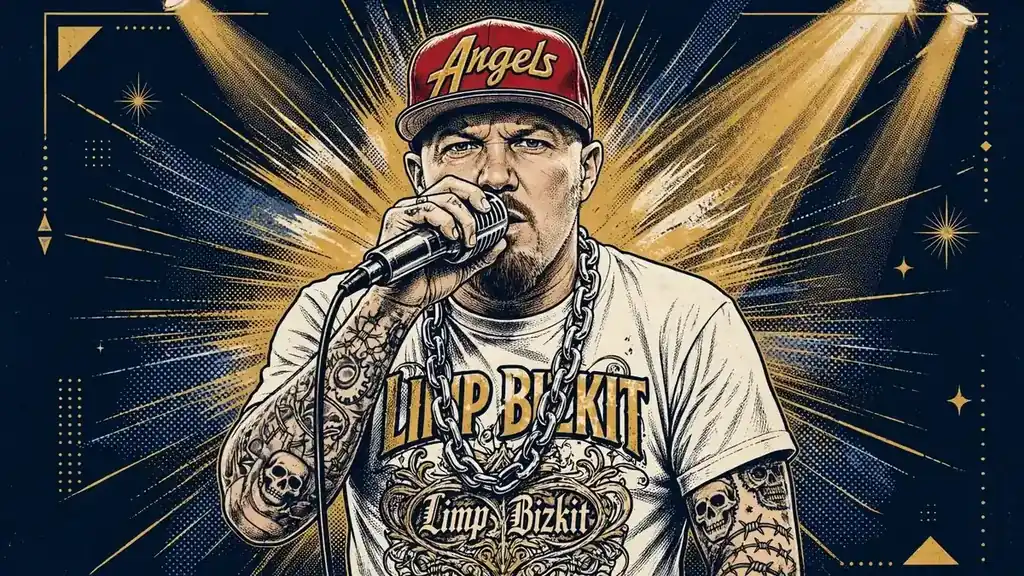
Fred Durst‘s net worth is estimated at $20–$25 million as of November 2026. The Limp Bizkit frontman built that fortune from more than 40 million records sold worldwide, two diamond-era albums that topped the Billboard 200, a decade of arena touring that never really stopped, a second career as a film director, and a short run as one of Interscope’s most powerful A&R executives. The number is a range because the two most-cited estimates disagree: Celebrity Net Worth puts him at $20 million, while older 2023 reporting put him at $25 million — and a $200 million royalty lawsuit against Universal Music Group, still working its way through the courts, could move the figure in either direction.
Fred Durst: Quick Facts
| Estimated net worth | $20 million (range: $20–$25 million) |
|---|---|
| Profession | Rapper, singer, songwriter, film director, actor, former record executive |
| Nationality | American |
| Born | August 20, 1970 (age 56) |
| Height | About 5 ft 8 in (1.73 m) — published listings vary between 5 ft 7 in and 5 ft 9 in |
| Primary income sources | Limp Bizkit record sales and royalties, touring, merchandise, film directing, A&R work |
| Active years | 1990–present |
| Last reviewed | November 2026 |
- Early Life and Background
- Education
- Career Journey
- Rise to Fame
- Main Sources of Income
- Salary and Earnings
- Businesses and Investments
- Brand Deals and Sponsorships
- Houses, Cars and Other Assets
- Awards and Achievements
- Net Worth Growth Over the Years
- Social Media Presence
- Personal Life
- Sources & Reporting
- Frequently Asked Questions
Early Life and Background
William Frederick Durst was born Frederick Allen Mayne III on August 20, 1970, in Jacksonville, Florida. His mother, Anita, renamed him William Frederick Durst after remarrying Bill Durst, a local police officer. The family moved first to Orlando, then to a farm in Cherryville, North Carolina, when Fred was about a year old. A half-brother, Cory Durst, was born to Anita and Bill. In fifth grade the family moved again, to Gastonia, North Carolina, where Fred would finish school.
Childhood in North Carolina was not easy. Durst has said he was bullied as a boy, and the experience stayed with him — he later cited it as one reason Limp Bizkit eventually stepped back from the spotlight, uncomfortable with the idea that his songs were being used to torment other kids. The farm years and the small-town moves gave him two obsessions that would shape his whole career: at 12 he fell for hip-hop — breakdancing, rapping, beatboxing, DJing and skateboarding — and at the same time he fell for heavy metal and punk rock. Most teenagers pick one tribe. Durst spent the next decade figuring out how to weld the two together.
After high school he joined the US Navy and served two years, stationed in Oakland, California, where he married his first wife, Rachel Tergesen, in 1990. When he left the service he moved back to Jacksonville to live with his father and took the kind of jobs that keep a young musician alive: landscaping by day, tattooing by night. The tattoo work mattered more than it sounds. Jacksonville’s underground scene ran through tattoo shops and skate parks, and Durst was building a network of musicians, artists and promoters while he worked. He was also sketching the idea that became Limp Bizkit — a band that rapped like a hip-hop act and hit like a metal band, fronted by a character in a red cap who was louder, ruder and funnier than the shy kid from Gastonia.
That character deserves a note, because Durst has spent years explaining it. “I always knew the guy in the red cap was not me,” he said in an interview quoted by Wikipedia. “I’m Dr Frankenstein, and that’s my creature.” The distinction matters when judging his career: the on-stage Durst picked fights, baited crowds and courted controversy, while the off-stage Durst was quietly building a second career behind the camera and inside a record label. Both versions earned money. Only one of them made the headlines.
Education
Durst graduated from Hunter Huss High School in Gastonia, North Carolina. No college record exists for him, and no credible profile lists a university degree — his formal education ended with high school, followed by two years in the Navy. That is worth stating plainly, because his later career included a senior executive job at one of the world’s biggest record labels. He did not get there through credentials. He got there because the band he built sold millions of records and because he had an ear for other bands that could do the same.
The Navy years doubled as his first real education in the music business. Stationed in Oakland, he was close to the Bay Area’s hip-hop scene at a moment when rap and rock were starting to cross over. He married young, had a daughter in 1990, and came home to Jacksonville with a family to support and no obvious path. Landscaping and tattooing paid the rent while he jammed with local musicians. The lesson of those years — that a working musician needs more than one income stream — shows up again and again in his later career: records, touring, merch, directing, A&R, producing. Durst never depended on a single paycheck for long.
Career Journey
Limp Bizkit came together in Jacksonville in 1994. Durst teamed up with bassist Sam Rivers and Rivers’s high-school friend John Otto on drums; guitarist Wes Borland joined soon after. The name was deliberate provocation — Durst has said he picked a name that would repel casual listeners. Early covers of George Michael’s “Faith” and Paula Abdul’s “Straight Up” pulled curious crowds in the Jacksonville underground, and the band built a local following the slow way, one sweaty club show at a time.
The break came through Korn. When Korn played Jacksonville as the opening act for Sick of It All, Durst invited the band to his house and played them demos of “Pollution,” “Counterfeit” and “Stalemate.” Bassist Reginald Arvizu listened, and Korn put the then-unsigned Limp Bizkit on two tours. That is the kind of break money cannot buy: a bigger band lending its audience to a smaller one. DJ Lethal, formerly of House of Pain, joined as turntablist, and in 1997 the band signed with Flip Records, an Interscope subsidiary, releasing the debut album Three Dollar Bill, Y’all on July 1, 1997. It peaked at No. 22 on the Billboard 200 and was eventually certified 2× Platinum by the RIAA — a solid debut, not a phenomenon.
What happened next is the part most profiles rush past, and it is central to Durst’s money story. In June 1999 he was appointed Senior Vice President of A&R at Interscope Records. He was 28, his band had one modest album out, and he was suddenly deciding which new bands got record deals at a major label. He used the job well. He signed Staind after hearing them play — he had first tried to throw them off a concert bill over a cover-art dispute, then apologised after hearing the set and signed them to Flip/Elektra, co-producing their next album Dysfunction. He signed Cold, Puddle of Mudd and She Wants Revenge, helped attract 30 Seconds to Mars (a band he ultimately passed on signing) and Taproot, who turned down his offer and drew a minor feud for it. He also appeared on other people’s records: Korn’s Follow the Leader (“All in the Family,” a trade-off insult battle with Jonathan Davis) and Soulfly’s debut (“Bleed,” at Max Cavalera’s invitation). A&R salaries at that level are private, but a senior VP at Interscope in 1999 was a six-figure job with real power — and Durst held it while his own band was becoming the biggest rock act on the planet.
By 2002 the music side had slowed enough for Durst to chase the film career he had wanted since his skate-video days. He was tapped to write songs for Britney Spears and later said they had been in a relationship; Spears denied his claims, and Durst later called the association taboo at the time. A sex tape featuring Durst surfaced online in February 2005, and he filed a $70 million lawsuit against ten websites that posted it — a figure that says more about the era’s panic over leaked celebrity footage than about any money actually recovered, since no settlement figure was ever made public. In May 2005 the band released The Unquestionable Truth (Part 1) as an underground record with no advertising or promotion at Durst’s insistence; it still sold more than 2 million copies worldwide and peaked at No. 24 on the Billboard 200. A Greatest Hitz compilation followed, and then the band went quiet.
The quiet years were not idle. Durst acted in Population 436 (2006), directed his first feature, The Education of Charlie Banks (2007), starring Jesse Eisenberg, and followed it with The Longshots (2008), starring Ice Cube and Keke Palmer. He played a bartender in two episodes of House, M.D. in 2008. The original Limp Bizkit lineup reunited in 2009, released Gold Cobra on June 28, 2011 — it peaked at No. 16 on the Billboard 200 — and in February 2012 Lil Wayne announced the band had signed to his Cash Money Records label, which Durst confirmed. Durst appeared with Lil Wayne and Birdman on Kevin Rudolf’s “Champions,” which reached the iTunes top 10. The band’s sixth album, Still Sucks, arrived on October 31, 2021, peaking at No. 22 on the Billboard 200, and the reunion era turned into something nobody had predicted in 2005: a permanent, profitable touring act.
Rise to Fame
The rise took about 18 months and it was violent, loud and enormously profitable. Significant Other, released June 22, 1999, debuted at No. 1 on the Billboard 200 and stayed there for four weeks. It sold 7,237,123 copies in the United States and more than 16 million worldwide, earning a 7× Platinum certification from the RIAA. Its singles — “Nookie,” “Break Stuff,” “Re-Arranged” and “N2 Gether Now” with Method Man — were inescapable on MTV’s Total Request Live and on rock radio, and the band became the face of nu-metal alongside Korn and Slipknot.
Chocolate Starfish and the Hot Dog Flavored Water, released October 17, 2000, was bigger. It debuted at No. 1 in the United States, Australia, Canada, Austria, Germany, the Netherlands, New Zealand and the UK, selling 1,054,511 copies in its first week in the US alone — a record for a rock album, with 400,000 of those sales on the first day, breaking a seven-year record held by Pearl Jam’s Vs. It went on to sell more than 8 million copies in the US and was certified 6× Platinum by the RIAA, with platinum certifications in 13 countries. “Rollin’ (Air Raid Vehicle)” became the band’s highest-charting US single, peaking at No. 65 on the Billboard Hot 100 and spending 17 weeks on the chart; “My Way,” “Take a Look Around” (from the Mission: Impossible 2 soundtrack) and “Boiler” kept the album on the charts deep into 2001.
Fame at that scale came with a cost that still shadows Durst’s reputation. At Woodstock ’99, Limp Bizkit played to roughly 200,000 people, and the set — “Break Stuff” in particular — became the symbol of a festival that slid into violence, with fans tearing plywood from walls and several sexual assaults reported in the aftermath. Durst told the crowd to pick people up if they fell and to let out the positive energy, then said afterward that from a stage twenty feet in the air he could not see what was happening in the crowd. In January 2001, at the Big Day Out festival in Sydney, teenager Jessica Michalik died of asphyxiation in a mosh-pit crush during the band’s set. Durst testified at the inquest that he had warned organisers about the minimal security; the coroner found the crowd density dangerous and said Durst should have acted more responsibly once the problem was apparent. Durst has said he was emotionally scarred by the teenager’s death. These were not publicity stunts. They were tragedies that attached themselves to the band’s name, and they help explain why Durst has spent much of his later career keeping a lower profile than his 1999 self would have imagined.
The other side of the rise was the Napster summer. In June 2000 Limp Bizkit’s tour was sponsored by the file-sharing service Napster, and Durst became its most visible artist advocate, arguing that file sharing helped bands reach fans. At the 2000 MTV Video Music Awards he performed “Livin’ It Up” as a duet with Christina Aguilera, a pairing that drew boos from parts of the rock crowd and a public scolding from Filter frontman Richard Patrick. Durst’s answer — asking why a rock singer was not allowed to like pop music — was typical of him: he refused to stay inside the genre box his own band had built. The same refusal runs through his whole career, from the Staind signing to the film directing to the Vote Durst video of November 2026.
Main Sources of Income
Durst’s money comes from five streams, and their balance has shifted over time. In 1999–2001 the engine was record sales. In the 2010s and 2020s it has been touring, with royalties and streaming as a steady floor underneath. Film directing and A&R work added real money in the middle years. None of the streams is huge on its own in any single year now — the fortune is the sum of 30 years of them running together.
Record sales and royalties. Limp Bizkit has sold an estimated 40 million records worldwide across six studio albums, according to Wikipedia’s band page and the RIAA certification record. The two peak albums did the heavy lifting: Significant Other (7× Platinum, 7.2 million US sales, 16 million-plus worldwide) and Chocolate Starfish (6× Platinum, 8 million US sales). The debut went 2× Platinum, Results May Vary (2003) went Platinum, and The Unquestionable Truth (Part 1) sold more than 2 million copies worldwide with no promotion at all. As the band’s frontman, lyricist and primary songwriter, Durst takes the largest share of the band’s publishing and performance income. The exact split between the five members is private, and the 2024 lawsuit against Universal shows why gross sales figures cannot simply be divided by five: the band claims it received no royalties at all for years while the label said the band was still unrecouped.
Touring. This is the stream that kept the fortune growing after record sales collapsed industry-wide. Limp Bizkit never stopped being a live draw. The 2024 North American Loserville tour wrapped in August 2024; the Welcome to Loserville run crossed Europe and the UK in March 2025, playing arenas like the OVO Hydro in Glasgow, the AO Arena in Manchester and the OVO Arena Wembley in London; the band opened for Metallica’s M72 tour in Nashville in May 2025; and the Loserville Gringo Papi tour ran through Latin America in late 2025, with stadium dates in Mexico City, Bogotá, Lima, Santiago, Buenos Aires and São Paulo. Festival bookings for 2026 include Download in the UK, Graspop in Belgium and Tons of Rock in Norway, plus December 2026 dates in Australia, Malaysia and South Africa reported by Loudwire. Arena and stadium headlining fees for a legacy act with this catalogue run into six figures per night before costs, and Durst, as frontman and the band’s public face, takes the largest cut. Touring is also the most honest explanation for why his net worth has held at $20 million-plus rather than shrinking: the band can still fill rooms 25 years after its peak.
Streaming and licensing. The catalogue earns every day now. “Rollin’,” “Break Stuff,” “Nookie” and “My Way” are permanent fixtures on rock and nostalgia playlists, and the band’s songs have been licensed to films (Mission: Impossible 2), video games and advertising for two decades. Streaming pays fractions of a cent per play, so this stream is a floor rather than a windfall — but across 40 million records’ worth of catalogue and billions of cumulative streams, the floor is solid. The UMG lawsuit is, at its core, a fight about this stream: who gets paid what from streaming, and whether the label’s accounting hid the answer.
Film directing and acting. Durst directed three features — The Education of Charlie Banks (2007), The Longshots (2008) and The Fanatic (2019) — plus music videos for Limp Bizkit and commercials for eHarmony in 2014. The films were modest commercial performers: Charlie Banks scored 48% on Rotten Tomatoes, The Longshots 41%, and The Fanatic, starring John Travolta, was a critical and commercial flop. Directors of independent films at this budget level earn fees rather than fortunes, and the films likely contributed low-six-figure fees each rather than backend profits. Acting roles — Population 436, two episodes of House, M.D., a cameo in Zoolander — paid scale-plus fees. Film was never Durst’s biggest income stream, but it was a real one, and it kept him earning during the years the band was on hiatus.
A&R and producing. The Interscope senior VP job (June 1999 onward) paid an executive salary at a moment when Durst’s band income was also peaking — the rare overlap of two high incomes at once. He also co-produced Staind’s Dysfunction and ran his own label, Flawless Records, which released Limp Bizkit’s later work and is a co-plaintiff in the UMG lawsuit. Label ownership is the quiet part of the story: Flawless’s $2.3 million in back profit participation released by UMG in August 2024 went to the label, not to Durst personally, but it shows the label had real money moving through it.

Salary and Earnings
There is no published annual salary for Fred Durst, and any site that prints one as fact is guessing. What the record does support is a clear shape: a huge peak, a long plateau, and a touring-led second act.
The peak years were 1999–2001. Chocolate Starfish sold more than a million copies in its first week in the US, and the band toured arenas and festivals worldwide on the back of two No. 1 albums. Royalty math from that era is opaque — the UMG lawsuit alleges the band was told it had spent $43 million in advances and was still unrecouped, which is exactly why Durst says he saw no royalties for years — but the gross economics were enormous: two albums that sold 15 million-plus copies in the US alone, plus merchandising, sponsorship (Napster) and festival fees. Older profiles that put Durst’s annual income at around $2 million a year in the early 2020s, such as the 2023 CA Knowledge profile, are unsourced estimates; we repeat them only as what they are, a rival site’s guess, not a verified figure.
The plateau years, roughly 2006–2019, mixed smaller income streams: reunion touring after 2009, the Gold Cobra cycle, film fees, the Cash Money signing in 2012, and the slow build of streaming. None of these matched the 2000 peak, and the band’s own numbers show it: Gold Cobra peaked at No. 16 on the Billboard 200, Still Sucks at No. 22. But the costs of that era were lower too — no stadium production, no label advances to recoup — and the catalogue kept paying.
The second act, 2021 to now, is touring-led. The Loserville brand — Durst’s own touring concept, mixing Limp Bizkit with younger acts like Bones, Ecca Vandal, N8NOFACE and Riff Raff — turned the band into a festival-headliner package again. Headline fees for arena shows, festival slots at Download and Graspop, stadium dates in Latin America and a Metallica support slot all pay far more than club tours, and the band’s costs are shared five ways plus crew. If Durst’s personal take from a good touring year reaches seven figures, that would be consistent with the band’s billing level; we cannot verify a precise number, and we will not invent one.
The lawsuit is the wild card in the earnings picture. Filed October 8, 2024, in Los Angeles federal court by Durst, the band and Flawless Records, it seeks more than $200 million in damages and the return of the band’s master-recording copyrights, alleging Universal designed its royalty systems to keep the band’s accounts showing as unrecouped. The complaint says the band found more than $1 million in unpaid royalties in UMG’s portal, that UMG blamed a software error, and that no royalty statements were issued between 1997 and 2004. UMG’s response, filed November 22, 2024, called the suit “based on a fallacy” and said the band had been paid $43 million in recoupable advances; it also said it had released $1.03 million to the band and $2.3 million to Flawless Records in August 2024. On March 17, 2025, Judge Percy Anderson dismissed 14 of the claims — including breach of contract and fraudulent concealment — ruling they belonged in California and New York state courts, while allowing the federal copyright infringement claim to continue. No final judgment or settlement has been reported as of November 2026. Until the case resolves, the $200 million is a claim, not income, and our estimate counts none of it.
Businesses and Investments
Durst’s business life has three pillars: the band as a business, the label, and the film work. None of them looks like a conventional investment portfolio, and no public record shows him holding the kind of property empire or startup stakes that pad other celebrity net worth pages. That absence is itself informative — the $20–$25 million is a working musician’s fortune, built from catalogue and touring, not from flipping companies.
Flawless Records. Durst’s own label, which released Limp Bizkit’s later albums and is named as a plaintiff alongside him in the UMG suit. The August 2024 release of $2.3 million in back profit participation to Flawless is the only public dollar figure attached to the label, and it shows the label had meaningful money tied up in the same royalty dispute as the band. Flawless also gives Durst something most artists of his era never had: a corporate vehicle that owns a stake in the recordings, rather than a pure artist royalty.
Limp Bizkit as a touring business. The Loserville tours are Durst’s most visible business project of the 2020s. Rather than touring as a nostalgia act on someone else’s bill, he built a branded package — Loserville — with a rotating cast of younger support acts, and took it to North America in 2024, Europe and the UK in spring 2025, and Latin America in late 2025. The model is smart business: the brand draws the older crowd, the support acts draw younger fans, and the package can headline arenas and stadiums that a single legacy band might struggle to fill alone. Merchandise is part of the same machine; Limp Bizkit’s red-cap and break-stuff iconography has sold steadily for 25 years, and the band’s online store and tour merch tables are a real revenue line.
Film production. Durst was attached to direct Pawn Shop Chronicles, starring Paul Walker, before Wayne Kramer took over the director’s chair — a reminder that directing fees for him came project by project, not from a studio deal. He shot three eHarmony commercials in 2014, a tidy commercial-directing payday. None of this amounts to a production empire, and no reporting suggests Durst holds equity in a studio or production company.
What we could not verify. Several low-quality profiles credit Durst with restaurants, clothing lines or property portfolios. We found no primary reporting, filing or reputable outlet supporting any of those claims, so we have left them out. If Durst holds stocks, funds or private investments, they are private; the estimate does not assume them. The honest summary is that his wealth sits in music catalogue, touring income, his label, and Los Angeles real estate — not in a diversified business empire.
Brand Deals and Sponsorships
Durst’s endorsement history is thin compared with pop stars of his era, and that is a deliberate part of his story. He was a rock frontman who built his image on being unmanageable, which is not the profile brands usually chase. The deals that do exist are specific and telling.
The biggest was Napster. In June 2000, at the height of the file-sharing wars, Napster sponsored Limp Bizkit’s tour, and Durst became the service’s most prominent artist defender. The sponsorship was worth far more than its fee: it put Durst at the centre of the biggest music-business fight of the decade, on the side of fans and against the labels. That stance looks prophetic now, and it also looks like the seed of the 2024 lawsuit — Durst has been arguing with record labels about who gets paid for music since 2000.
The eHarmony commercials of 2014 were the other notable commercial job — three spots directed by Durst, not an endorsement of the product by him as a celebrity face. The distinction matters: he was hired for his directing skill, not his fame. Fashion and lifestyle endorsements are absent from the record; the red cap was never a paid placement, it was a personal trademark that the band later turned into merchandise. Festival sponsorships and the Metallica support slot in 2025 are touring business, not endorsements. In short, brand deals are a small line in Durst’s income statement, and the article does not inflate them into something they are not.
Houses, Cars and Other Assets
Durst’s property record is public in outline and modest by celebrity standards — two California homes, one of them lost to fire, and no verified car collection or trophy asset.
The documented purchases are these. In 2014 he bought a Hollywood Hills property for about $1.5 million; in 2015 he put it on the market for $1.645 million. The house, built in the 1920s, had more than 3,000 square feet of living space and a wine cellar. The $145,000 markup over roughly a year is the kind of small, sensible flip that working musicians do, not a property empire. In 2018 he announced on social media that another California house of his had burned down in the wildfires, and that he had lost most of his possessions and valuable sound recording equipment — a genuine financial hit, and a reminder that a musician’s home studio is also a workplace. Then in July 2021 he paid $3 million for a home in West Hollywood, California. That purchase is the largest single asset in the public record, and it is consistent with a net worth in the $20 million range: a $3 million home is a serious asset, not a stretch.
Cars are where the record goes quiet. Durst has never been photographed with a supercar collection, and no reputable outlet has catalogued his vehicles. Low-quality profiles list luxury cars without sources; we do not repeat them. What is known is that his public image — red cap, baggy clothes, skate culture — never leaned on visible luxury, and his spending profile in the record looks like a musician who lives well in Los Angeles rather than a collector. The assets that matter to his net worth are the house in West Hollywood, the catalogue, and the touring business. A car collection, if one exists, is not documented well enough to count.
Awards and Achievements
Durst’s trophy shelf is thinner than his sales figures, and the gap is part of the nu-metal story: the genre sold tens of millions of records while the industry’s awards bodies kept it at arm’s length. The record, as verified by Wikipedia and Rock on the Net, is still substantial.
Limp Bizkit was nominated for three Grammy Awards and won none: Best Rock Album for Significant Other and Best Hard Rock Performance for “Nookie” at the 2000 ceremony, then Best Hard Rock Performance for “Take a Look Around” at the 2001 ceremony. The MTV Video Music Awards were kinder. “Break Stuff” won Best Rock Video at the 2000 VMAs, and “Rollin’ (Air Raid Vehicle)” won Best Rock Video at the 2001 VMAs — the video was shot partly on top of the World Trade Center, and the Port Authority sent the band a letter and a fruit basket congratulating them on the win on September 10, 2001, one day before the towers fell. The band also won an American Music Award for Favorite Alternative Artist in 2001, a Billboard Music Video Award for Best Clip of the Year (Hard Rock) for “Break Stuff,” and a Blockbuster Award for Favorite Group (Modern Rock). Bassist Sam Rivers won an Orville H. Gibson Award for Best Bassist.
The chart achievements outshine the trophies. Two No. 1 albums on the Billboard 200 (Significant Other for four weeks, Chocolate Starfish for two), a record-setting first week of 1,054,511 copies for a rock album, 40 million records sold worldwide, and a catalogue that has stayed in the cultural bloodstream for 25 years — “Rollin'” still closes sports broadcasts and wrestling entrances, “Break Stuff” still soundtracks gym playlists, and the band’s 2024–2026 festival bookings put them on the same bills as Metallica, Linkin Park and Guns N’ Roses at Download 2026. Durst’s achievement as an executive is separate and real: signing Staind, Cold and Puddle of Mudd to major-label deals from inside Interscope, and building the Loserville touring brand a quarter-century after his band’s peak.
Net Worth Growth Over the Years
Year-by-year net worth tables for musicians are estimates stacked on estimates, so read this one as a shape, not an audit. The figures below are our synthesis of the published estimates: Celebrity Net Worth’s $20 million anchor, the 2023 reporting of $25 million, and the career timeline that explains how the number moved.
| Year | Estimated net worth | What moved it |
|---|---|---|
| 1997 | Under $1 million | Debut album out; touring clubs; A&R career not yet started |
| 1999 | $3–$5 million | Significant Other goes 7× Platinum; Interscope SVP job begins |
| 2000 | $8–$12 million | Chocolate Starfish sells 8 million in the US; Napster tour; VMA wins |
| 2003 | $12–$15 million | Results May Vary goes Platinum; catalogue and touring continue |
| 2008 | $15–$18 million | Film directing fees; reunion touring begins 2009 |
| 2015 | $18–$20 million | Gold Cobra cycle; Hollywood Hills sale; streaming builds |
| 2021 | $20 million | West Hollywood home bought for $3 million; Still Sucks released |
| 2023 | $20–$25 million | Older profiles print $25 million; Celebrity Net Worth holds $20 million |
| 2025 | $20–$25 million | Loserville tours; UMG lawsuit filed; Sam Rivers dies in October |
| 2026 | $20–$25 million | Loserville continues; Download/Graspop festival bookings; Vote Durst video |
Two things stand out in that shape. First, the fortune was made early — the 1999–2001 peak did most of the work — and has been defended since, not doubled. That is normal for a rock frontman whose biggest records are 25 years old. Second, the range has stayed flat since about 2021, which is what you would expect when the main income is touring and catalogue: steady, not explosive. The lawsuit is the only event on the horizon that could break the pattern. A win or a settlement in the tens of millions would lift the estimate sharply; a loss would leave it where it is, with legal costs as the only change. For now the honest number is the range, and the range is $20–$25 million.
Peer comparison puts the figure in context. Among the nu-metal and rap-rock generation, Durst sits in the middle of the pack: above the band members who never had a second career, below the genre’s biggest crossover earners. Dave Grohl, who crossed from Nirvana to Foo Fighters and built a far larger touring and publishing machine, is estimated well above Durst, while Ozzy Osbourne — whose Ozzfest bills Limp Bizkit played in the late 1990s — built a fortune across five decades that dwarfs any single nu-metal act. The comparison that flatters Durst most is durability: very few frontmen from 1999 are still headlining arenas in 2026, and fewer still are doing it with their original band, on their own touring brand, while suing their label for $200 million.
Social Media Presence
Durst’s social media presence is large, erratic and entirely on brand: long silences, then a post that makes music news. His main Instagram account, @freddurst, had about 1.7 million followers as of November 2026, according to Wiki of Celebs’ public Instagram data via the Meta API. His X (Twitter) account, also @freddurst, had more than 1.2 million followers in older reporting, though he posts there rarely now. Limp Bizkit’s own accounts carry the tour announcements; Durst’s personal feed carries the surprises.
The biggest surprise of 2026 came on November 7, four days after the 2026 US elections, when Durst launched a second Instagram account, @votedurst, and posted a video saying, “It’s time to vote Durst. I wanna get to the bottom of all this bullshit. I’m runnin’.” The account’s bio reads, “My name is Fred Durst and I want to make our world a better place… so, I’m running.” As of this writing he has not named an office, an election or a year, and no paperwork seeking public office has been reported — Loudwire, Blunt Magazine and Wikipedia all note the same gap. Fans have speculated about a 2028 presidential run; nothing in the record supports that as a plan rather than a joke. We report it because it is the freshest Durst story of 2026, and because it fits the pattern of his career: a provocation first, details later, if ever.
Social media is a minor income stream for Durst, not a major one. He does not run a visible influencer business, sell courses or push sponsored posts, and his following — 1.7 million on Instagram — is modest next to pop stars of his era. Its value to him is different: it is the direct line to the Limp Bizkit audience, the place tour dates are announced, and the stage for the next provocation. The Vote Durst video proved the point: one short clip, posted jointly from both accounts, and every rock outlet in the world covered it within a day.
Personal Life
Durst has been married four times and has two children, and he has kept the details of his family life far more private than his stage persona would suggest. His first wife was Rachel Tergesen, married in 1990 while he was in the Navy; they divorced in 1993 and share a daughter, Adriana Durst, born June 3, 1990. He has a son, Dallas Durst, born August 30, 2001, with ex-girlfriend Jennifer Thayer. His second marriage, to Esther Nazarov, lasted about three months in 2009 after a wedding on July 13 of that year. His third wife was Kseniya Beryazina, married in 2012, with divorce proceedings filed in 2018 and finalised in 2019. In August 2022 he married Arles Durst, who goes by “Mrs. D” on her private Instagram; the relationship had been kept largely out of public view before the wedding was reported.
Family runs through his early story in ways that explain the man. His mother Anita renamed him after remarrying a police officer; his half-brother Cory grew up alongside him in North Carolina; the bullying he endured as a boy became a theme in his lyrics and, later, a stated reason for the band’s hiatus. He has said he disliked seeing his music used to torment other people, and that the character in the red cap was a creation he sometimes had to force himself to inhabit. The private Durst — the one who directs films, signs bands, and keeps his wife off social media — is the one who has managed the money for 30 years. The public Durst is the one who made it.
Controversies have followed him, and a fair profile does not skip them. The Russia episode: in 2015 he began the process of obtaining a Russian passport and spoke warmly about Vladimir Putin, which led to him being barred from entering Ukraine and to Limp Bizkit’s music and merchandise being banned there. A planned Limp Bizkit concert in Tallinn, Estonia, set for May 2026, was cancelled in November 2025 over Durst’s Russia comments, according to Wikipedia. The feuds: he insulted Slipknot’s fans in 1999 and drew a sharp reply from Corey Taylor; he feuded with Placebo, once encouraging crowds to chant against them; he criticised Eminem after Eminem’s feud with Everlast, and Eminem answered with the 2001 diss track “Girls.” In 2018 a member of Insane Clown Posse tried to dropkick him on stage; Durst called him a clout chaser. None of these episodes changed his net worth in a measurable way, but they shaped his public image — and image, for a touring frontman, is inventory.
Sources & Reporting
How this article was reported. Every money figure above traces to a named outlet or a primary record. Where outlets disagreed, we published the range and named both sides. Where a figure comes from a single weak source, we labelled it as such or left it out. Reporting window: October 2024 – November 2026, with the estimate anchored to Celebrity Net Worth’s October 20, 2025 update.
Celebrity Net Worth — the $20 million estimate, the October 2024 UMG lawsuit summary, the Hollywood Hills listing ($1.645 million, bought for $1.5 million), the West Hollywood purchase ($3 million, July 2021), and the 2018 wildfire loss. Last updated October 20, 2025.
Billboard — original reporting on the UMG lawsuit filing (October 8, 2024), UMG’s motion to dismiss (November 22, 2024), the $43 million in advances, and the $1.03 million / $2.3 million releases; also the chart history behind the album peaks cited here.
NME — the $200 million lawsuit filing, the $1 million in the band’s royalty account, and the band’s return to the stage after Sam Rivers’ death (November 29, 2025, Mexico City).
TheWrap — the 60-page complaint, the “easily surpass $200 million” allegation, and the $43 million advances claim.
Loudwire — UMG’s “based on a fallacy” response, the label’s motion to dismiss, the Vote Durst launch (November 2026), and the December 2026 Australia/Malaysia/South Africa dates.
Music Business Worldwide — the UMG motion to dismiss in full, including the Paul Ta / Level Four Business Management communications and the August 2024 payment dates.
Wikipedia — Fred Durst and Limp Bizkit pages: birth name and date, Navy service, band formation, the Korn demo story, the Interscope A&R appointment and signings, Woodstock ’99 and Big Day Out accounts, filmography, marriages and children, the March 17, 2025 court ruling, Sam Rivers’ death, and the Vote Durst account (November 7, 2026). Used as a secondary source and cross-checked against the outlets above wherever a dollar figure was involved.
RIAA — certification record via the Limp Bizkit discography: Significant Other 7× Platinum, Chocolate Starfish 6× Platinum, Three Dollar Bill, Y’all 2× Platinum, Results May Vary Platinum; US sales of 7,237,123 and 8,000,000 for the two peak albums.
NPR — Sam Rivers’ death at 48, confirmed by the band on October 18, 2025 (reported October 19, 2025).
Blabbermouth — the first concert after Rivers’ death and the TMZ report of cardiac arrest at his Florida home.
Far Out Magazine — the $20 million estimate, height listing (5 ft 8 in), partner Arles Durst, and the 40-million-records career total.
Rock on the Net — Grammy nominations (three), VMA wins for “Break Stuff” (2000) and “Rollin'” (2001), the American Music Award for Favorite Alternative Artist, and Billboard chart peaks.
Older profiles that printed a $25 million figure — notably CA Knowledge’s 2023 profile — were treated as stale rather than wrong: they predate the latest Celebrity Net Worth update and the lawsuit, and their $2-million-a-year salary claim is unsourced. The range in this article reflects that disagreement honestly instead of picking the bigger number for effect.
Frequently Asked Questions
What is Fred Durst’s net worth in 2026?
Fred Durst’s net worth is estimated at $20–$25 million as of November 2026. Celebrity Net Worth, the most-cited source, puts him at $20 million (last updated October 20, 2025), while older 2023 reporting put him at $25 million. We publish the range because the sources disagree, and because his $200 million royalty lawsuit against Universal Music Group is unresolved — a win there could lift the figure, while a loss would leave it where it is.
How did Fred Durst make his money?
Mostly from Limp Bizkit. The band sold an estimated 40 million records worldwide, including two No. 1 albums — Significant Other (7× Platinum) and Chocolate Starfish and the Hot Dog Flavored Water (6× Platinum, with a record 1.05 million first-week US sales). Since record sales faded, touring has been the main income: the Loserville tours filled arenas across North America, Europe and Latin America in 2024–2025. He also earned money as Interscope’s Senior Vice President of A&R from 1999, as a film director (The Education of Charlie Banks, The Longshots, The Fanatic), and through his label Flawless Records.
Is Fred Durst still alive and still touring with Limp Bizkit?
Yes. Durst is alive, aged 56, and still fronting Limp Bizkit. The band toured North America, Europe and Latin America in 2024–2025, played its first show after bassist Sam Rivers’ death in Mexico City on November 29, 2025, and has festival dates booked for 2026, including Download in the UK, Graspop in Belgium and Tons of Rock in Norway, plus December 2026 shows in Australia, Malaysia and South Africa.
Who is Fred Durst married to now?
Durst is married to Arles Durst, his fourth wife; they married in August 2022 in Los Angeles County. His previous marriages were to Rachel Tergesen (1990–1993), Esther Nazarov (2009, about three months) and Kseniya Beryazina (2012–2019). He has two children: daughter Adriana, born June 3, 1990, with Rachel Tergesen, and son Dallas, born August 30, 2001, with ex-girlfriend Jennifer Thayer.
How tall is Fred Durst?
Published listings disagree: most put him at about 5 ft 8 in (1.73 m), with other profiles listing 5 ft 7 in and 5 ft 9 in. There is no officially verified measurement, so the honest answer is roughly 5 ft 8 in, with the listings varying by an inch in either direction.
What happened to Limp Bizkit’s bassist Sam Rivers?
Sam Rivers, the band’s founding bassist, died on October 18, 2025, at the age of 48. The band announced his death the same day, calling him “our heartbeat” and “the pulse beneath every song.” TMZ later reported he had suffered a cardiac arrest at his home in Florida. The band returned to the stage without him on November 29, 2025, in Mexico City, with a tribute to Rivers on screen.
Why is Fred Durst suing Universal Music Group?
On October 8, 2024, Durst, Limp Bizkit and his label Flawless Records sued Universal Music Group in Los Angeles federal court, alleging the label designed its royalty accounting to keep the band’s accounts showing as unrecouped, issued no royalty statements between 1997 and 2004, and owed more than $200 million. UMG says the band was paid $43 million in advances and calls the suit “based on a fallacy.” In March 2025 a federal judge dismissed 14 claims, ruling they belonged in state courts, while the copyright infringement claim continues. No final judgment has been reported.
What movies did Fred Durst direct?
Durst directed three feature films: The Education of Charlie Banks (2007), starring Jesse Eisenberg; The Longshots (2008), starring Ice Cube and Keke Palmer; and The Fanatic (2019), starring John Travolta. He also directed Limp Bizkit music videos and three eHarmony commercials in 2014, and acted in Population 436 (2006) and two episodes of House, M.D. (2008).
Final Thoughts
Fred Durst’s $20–$25 million is a working musician’s fortune, and that is the most interesting thing about it. He did not inherit it, marry into it or flip it out of a startup. He built it from a band he formed in Jacksonville in 1994, two albums that sold 15 million copies in America alone, a sharp eye for other bands’ talent that got him a senior job at Interscope, and a touring machine that still fills arenas 25 years after his peak. The range reflects honest disagreement between sources, not uncertainty about the story: every outlet agrees he is worth around $20 million, and the $25 million figure comes from older, thinner reporting.
The lawsuit is the chapter still being written. If Durst wins — or settles — the royalty fight with Universal, the number moves. If he loses, the number stays and the legal bills are the only change. Either way, the deeper fact is already settled: the red-cap frontman who was supposed to be a late-1990s footnote is still headlining festivals in 2026, still running his own touring brand, and still arguing with his record label about who gets paid. That is not a nostalgia act. That is a career.
Published on 2026-11-21. Last reviewed November 2026. Found an error? See our corrections policy.