
Alice Cooper‘s net worth is estimated at $50–$70 million as of November 2026. The figure sits at the center of a 57-year career built on relentless touring, a catalog of more than 50 million albums sold, and a stage act that turned horror theater into a business model — and at 78, Cooper is still adding to it, with a 2025 reunion album from his original band and a packed 2026 festival schedule.
Alice Cooper: Quick Facts
| Estimated net worth | $50 million (range: $50–$70 million) |
|---|---|
| Profession | Rock singer, songwriter, actor, radio host |
| Nationality | American |
| Born | February 4, 1948 (age 78) |
| Height | 5 ft 9 in (1.75 m) |
| Primary income sources | Touring and live shows, album royalties and streaming, licensing, radio hosting, merchandise |
| Active years | 1968–present |
| Last reviewed | November 2026 |
- Early Life and Background
- Education
- Career Journey
- Rise to Fame
- Main Sources of Income
- Salary and Earnings
- Businesses and Investments
- Brand Deals and Sponsorships
- Houses, Cars and Other Assets
- Awards and Achievements
- Net Worth Growth Over the Years
- Social Media Presence
- Personal Life
- Sources & Reporting
- Frequently Asked Questions
Early Life and Background
Alice Cooper was born Vincent Damon Furnier on February 4, 1948, in Detroit, Michigan. His father, Ether Furnier, was a preacher, and the household ran on church, discipline, and music in equal measure. The family moved to Phoenix, Arizona, when Vincent was 12, trading Michigan winters for desert heat — a move that shaped everything that followed, from the band he formed in high school to the Paradise Valley home he still lives in more than 60 years later.
Phoenix in the early 1960s was not a rock-and-roll capital. It was a sprawling desert city with a small live-music circuit, and that worked in Furnier’s favor: a teenager with ambition could get on a stage fast. He and a group of friends from Cortez High School — Glen Buxton, Dennis Dunaway, Neal Smith, and Michael Bruce — started playing together in 1964, first as the Earwigs, a band formed partly as a joke for a school talent show. The joke turned serious quickly. The Earwigs became the Spiders, a garage band that gigged around Phoenix and built a local following, and by 1968 the group had settled on a new name: Alice Cooper.
The name itself became one of rock’s best pieces of branding. Furnier has told the story different ways over the years — a 17th-century witch named Alice Cooper who spoke through a Ouija board is the version he leans into on stage — but the practical effect was the same: a band with a woman’s name, a frontman in eye makeup, and a show built around mock executions, snakes, and gallows humor. In an era when rock bands mostly stood still and played, that was a product nobody else was selling.
Money was thin in those early years. The band lived on gig fees, drove battered vans, and chased a record deal for the better part of four years. The break came through Frank Zappa, who signed the group to his Straight Records label and released its first two albums, Pretties for You (1969) and Easy Action (1970). Both sold poorly. Zappa’s endorsement gave the band credibility in the industry, but it did not pay the rent — the group was still a long way from the $50 million fortune it would eventually build.
One detail from this period matters for understanding Cooper’s later finances: he learned early that the stage show was the business. Records in 1969 and 1970 were a loss-making calling card; the live act was what promoters would pay for. That lesson — touring as the engine, records as the advertisement — stayed with him for the next five decades, and it explains why his wealth today still runs mostly on ticket sales rather than on a catalog sale or a brand empire.
Education
Furnier attended Cortez High School in Phoenix, where he met the musicians who became the original Alice Cooper band. He was a track athlete in school — a detail that surprises people who only know the stage character — and he has said the discipline of running stuck with him. After high school he enrolled at Glendale Community College in Arizona, studying art, but the band pulled him away before any degree. By the late 1960s the group was playing full time, and formal education ended where the road began.
The art-school background shows up in the work anyway. Cooper designed the visual language of his act — the makeup, the costumes, the stage sets — with an artist’s eye, and he has painted and drawn throughout his life. The education that mattered financially was the one he got on the road: how to negotiate with promoters, how to keep a band together through lean years, and how to turn a reputation for chaos into a repeatable, bookable show.
Career Journey
The Alice Cooper band’s commercial breakthrough arrived with its third album, Love It to Death (1971), produced by Bob Ezrin. The single “I’m Eighteen” gave the band its first hit and its first real money — a song about teenage frustration that became an anthem and still anchors Cooper’s setlists. The follow-up, Killer (1971), kept the momentum going, and then came the two records that made the band rich: School’s Out (1972), whose title track reached the Top 10, and Billion Dollar Babies (1973), which hit number one on the US album chart and spun off the hit “No More Mr. Nice Guy.”
Those three years — 1971 to 1973 — transformed five broke Phoenix musicians into one of the biggest touring acts in the world. The band played arenas, headlined festivals, and built a stage show that cost serious money to mount: guillotines, electric chairs, a boa constrictor, and a frontman who got “executed” nightly. The show was expensive, and that was the point. Fans paid to see a spectacle they could not get from any other band, and promoters paid a premium to book it.
The original band split in 1974, and Furnier made the sharpest business move of his career: he legally adopted the name Alice Cooper for himself and went solo. The other members owned a share of the band’s name, and the split was not friendly, but Furnier kept the brand that audiences recognized. His first solo album, Welcome to My Nightmare (1975), again produced by Ezrin, was a hit, and its single “Only Women Bleed” showed he could write a serious ballad as well as a horror anthem.
The late 1970s were harder. Alcohol took hold — Cooper has spoken openly about drinking heavily through this period — and albums like Lace and Whiskey (1977) and From the Inside (1978) sold less. He checked into a sanitarium in 1977, an experience he turned into the From the Inside album, and he got sober in 1983 after his wife Sheryl filed for divorce, a wake-up call he credits with saving his life and his marriage.
The early 1980s were the commercial low point. Four albums — Flush the Fashion (1980), Special Forces (1981), Zipper Catches Skin (1982), and DaDa (1983) — sold modestly, and Cooper stepped back from recording for three years. He filled the gap with film cameos and television, including a memorable turn in John Carpenter’s Prince of Darkness (1987), and rebuilt his touring base from theaters upward.
The comeback was Constrictor (1986) and Raise Your Fist and Yell (1987), but the real return to the top came with Trash (1989). Its lead single “Poison” reached number seven on the Billboard Hot 100, the album went platinum, and Cooper was a headliner again at 41. Hey Stoopid (1991) followed, and a cameo in the hit film Wayne’s World (1992) introduced him to a new generation — the scene where Wayne and Garth bow before him, chanting “we’re not worthy,” is one of the most-quoted moments in comedy film, and it cost Cooper nothing but a day on set.
From the 1990s onward, Cooper settled into the pattern that sustains him now: a new album every two or three years, a tour every year, and a stage show that keeps its core — the makeup, the snake, the guillotine — while the songs rotate. Albums like The Last Temptation (1994), Brutal Planet (2000), Dragontown (2001), Dirty Diamonds (2005), Welcome 2 My Nightmare (2011), Paranormal (2017), Detroit Stories (2021), and Road (2023) kept the catalog growing without ever chasing a trend. In 2011 the original Alice Cooper band was inducted into the Rock and Roll Hall of Fame, a formal stamp on a career that had already outlasted nearly every band it started alongside.
Then came the surprise of 2025. On April 19, 2025, Cooper announced that the surviving members of the original band — Michael Bruce, Dennis Dunaway, and Neal Smith — had reunited with him and producer Bob Ezrin to record The Revenge of Alice Cooper, their first full studio album together since Muscle of Love in 1973. Released on July 25, 2025, through earMusic, the record even featured a posthumous appearance by original guitarist Glen Buxton, who died in 1997, through an unreleased guitar recording on “What Happened to You.” The lead single “Black Mamba” featured Doors guitarist Robby Krieger. The same day the album dropped, the original members reunited on stage at London’s O2 Arena before 12,000 fans to close Cooper’s set with “School’s Out.” A reunion 52 years in the making became a new revenue line: album sales, vinyl editions, streaming, and a wave of press that no marketing budget could buy.
Rise to Fame
Cooper’s rise was not a single moment but a three-year climb from 1971 to 1973, and its engine was the live show. The band toured the Love It to Death and Killer albums into larger rooms, and by the School’s Out tour it was playing arenas. The title track’s success in the summer of 1972 — a song released to coincide with the end of the school year, with a sleeve designed to look like a wooden school desk — gave the band its first Top 10 single and its first gold record. Billion Dollar Babies going to number one in 1973 confirmed that the act was not a novelty: it was the biggest rock band in America for a season.
What set Cooper apart from his peers was that the fame and the money arrived together and fed each other. The horror-theater show was expensive to stage, which meant the band needed big guarantees; big guarantees required big crowds; big crowds came because the show was famous. Ozzy Osbourne built a comparable fortune on a similar model — a wild stage persona plus relentless touring — but Cooper got there first, and his act predated Osbourne’s solo career by nearly a decade. The two men later became friends and occasional tour mates, and the comparison is instructive: Osbourne’s fortune, estimated at around $220 million by Celebrity Net Worth, grew far larger, partly through the reality-TV success of The Osbournes and a catalog that included Black Sabbath’s publishing. Cooper never had a television windfall of that scale, and the gap between the two fortunes starts there.
The second wave of fame came in 1989, when “Poison” put a 41-year-old Cooper back in the Top 10. Most rock acts of his generation were playing oldies circuits by then; Cooper was selling platinum records to teenagers who had not been born when School’s Out came out. The Wayne’s World cameo in 1992 sealed it — a generation that had never bought an Alice Cooper record knew his name, his makeup, and the words “we’re not worthy.”
The third wave is the one running now. The Rock and Roll Hall of Fame induction in 2011, the steady festival-headliner status through the 2010s and 2020s, the 2025 original-band reunion, and a 2026 tour that runs from American theaters to European festivals have kept Cooper in front of audiences for six decades. Few performers of any kind can say the same. Mick Jagger, whose fortune sits near $500 million, is one of the few who can — and Jagger’s wealth shows what Cooper’s might have looked like with the Rolling Stones’ songwriting royalties and stadium economics behind it.
Main Sources of Income
Cooper’s money comes from five streams, and their order has barely changed in 30 years. Touring is first by a wide margin. Industry estimates put live performance at 60–70 percent of his annual income, and the logic is simple: he plays 80 to 100 shows in a busy year, in theaters and arenas that hold 2,000 to 15,000 people, and he has done it almost every year since the 1970s. Festival slots pay the most — a headline set at Hellfest, Graspop, or Welcome to Rockville carries a fee several times a theater date — and his 2026 calendar is heavy with them, including Welcome to Rockville in Florida, Hellfest in France, Graspop in Belgium, Tons of Rock in Norway, Copenhell in Denmark, and Louder Than Life in Kentucky, plus a Las Vegas run co-headlining “Welcome to Our Nightmare” dates with illusionist Criss Angel.
Second is the catalog: royalties from more than 50 million albums sold worldwide, plus streaming and publishing income. The hits — “School’s Out,” “I’m Eighteen,” “No More Mr. Nice Guy,” “Poison,” “Only Women Bleed” — earn every time they stream, air on radio, or land in a film, advertisement, or video game. “School’s Out” alone spikes every June, a seasonal royalty bump tied to the school calendar. The 2025 reunion album added a fresh catalog entry and a round of vinyl and deluxe-edition sales aimed at collectors, a market that pays far more per unit than streaming ever will.
Third is merchandise. Cooper’s image — the eye makeup, the snake, the guillotine — is one of the most merchandisable in rock, and it has been licensed onto T-shirts, posters, vinyl box sets, and signed memorabilia for decades. Tour merchandise is the high-margin part: a fan who paid for a ticket is the easiest customer in the building, and Cooper’s shows have sold shirts at volume since the 1970s.
Fourth is radio. Nights with Alice Cooper, his syndicated classic-rock show, has aired since January 26, 2004, on nearly 100 stations across the United States and Canada, and it pays through syndication fees and sponsorship. In January 2024 he launched a revamped version, Alice’s Attic with Alice Cooper, syndicated by Superadio Networks on more than 70 stations. Two decades of radio hosting is unusual for a rock star, and it is also steady money that does not depend on ticket sales — a hedge against the years when touring slows.
Fifth is acting, voice work, and appearances: film roles, television guest spots, video-game voices, and paid appearances at conventions and corporate events. None of these is a fortune on its own, but together they add a six-figure line that most of his peers do not have. A cameo in Wayne’s World paid little at the time and has paid in recognition ever since.
What Cooper does not have is also worth noting. He has never sold his publishing catalog for a nine-figure lump sum, the way Bob Dylan did when he sold his song catalog to Universal in a deal reported at more than $300 million. He has no tequila brand, no fashion line, no crypto venture. The fortune is built the old way: play, record, license, repeat — for 57 years.
Salary and Earnings
Cooper has never disclosed a per-show fee, and no filing or contract for his touring pay is public, so any salary figure for him is an estimate — and this section says so plainly. The best available picture comes from industry reporting: entertainment-finance outlets that track legacy rock acts estimate Cooper’s annual income at roughly $1.5–$2.5 million across all streams in a normal touring year, with touring contributing the largest share. That is an estimate, not a pay stub, and it moves with the calendar: a year with a European festival run and a Las Vegas residency pays more than a year with a short theater tour.
To put that in context, the money in a Cooper tour is gross revenue, not take-home pay. A theater show grossing several hundred thousand dollars splits among the promoter, the venue, the band, the crew, transport, and the staging — the guillotine and the snake do not travel free. Cooper’s long-running band, including guitarist Ryan Roxie and drummer Glen Sobel in recent years, is a professional touring unit with salaries, per diems, and hotels. What reaches Cooper personally is the headliner’s share after those costs, plus merchandise, which is where the margins are widest.
Festival pay is the exception to the thin-margin rule. A headline festival slot typically pays a flat fee with fewer costs attached, and Cooper’s 2026 festival run — six major European and American festivals in one summer — is likely his most lucrative stretch of the year. His Las Vegas dates with Criss Angel work the same way: a residency-style run in one city, with the production already built and the audience coming to him.
Radio adds a steadier, smaller line. Syndicated radio hosts of Cooper’s standing earn through a mix of salary from the syndicator and a share of advertising, and two decades on the air suggests the show pays well enough to keep doing. The 2024 relaunch as Alice’s Attic on Superadio, on more than 70 stations, indicates the format still sells to stations and advertisers.
Royalties are the quiet earner. Nobody publishes Cooper’s streaming numbers, but a catalog with two songs that are cultural fixtures — “School’s Out” and “Poison” — generates publishing and master royalties every month, in every country where a streaming service operates. The amounts are modest next to touring, and they are the reason his income never falls to zero in a year without a tour.
One number that deserves a correction: some low-quality sites claim Cooper’s fortune is $200 million. That figure has no named source, no filing, and no reporting behind it — it appears only on content-farm pages that repeat each other. The $80 million figure that circulates on a few similar sites is equally unsourced. The credible record is narrower: Celebrity Net Worth at $50 million, several 2025–2026 estimates at $50–$70 million, and one outlier at $20 million from a site that lists its own figures as “$20M to $40M” in the same article. The honest range is $50–$70 million, anchored at $50 million.
Businesses and Investments
Cooper’s business record is quieter than his stage act, and that is part of the story. He has never built a consumer brand empire, and he has said in interviews that he is not a businessman by instinct — he is a performer who hired good people and stayed out of trouble. The ventures he did pursue were mostly extensions of things he already loved: golf, Phoenix, and music.
The best-known was Alice Cooper’stown, a sports bar and restaurant in downtown Phoenix that operated for years as a shrine to the singer — memorabilia on the walls, live music, and a menu built for the ballpark crowd. It was a real business, not a licensing deal: Cooper’s name was on the door and his money was in it. It eventually closed, as most celebrity restaurants do, and it is a reminder that a famous name fills a room on opening night but does not guarantee a second decade.
Golf is the venture that stuck. Cooper is a serious golfer — a low single-digit handicap who plays almost daily — and he turned that obsession into his 2007 memoir Alice Cooper, Golf Monster and into a fundraising machine. His annual celebrity golf tournament in Phoenix, the Alice Cooper Rock & Roll Golf Classic, draws sponsors and celebrity players and raises money for his Solid Rock Foundation, which runs free teen centers in Phoenix and Mesa. The foundation itself is a nonprofit, not a profit center, but the golf events around it — including the Christmas Pudding concert and the newer Christmas Putting tournament at Mountain Shadows Resort in Scottsdale — move serious sponsor money through the Phoenix charity circuit, with title sponsorships listed at $50,000.
His investments, as far as public reporting shows, are conservative: Arizona real estate bought decades ago and held, a classic-car collection, and the catalog itself. He has not been linked to venture capital, startups, or speculative bets, and no report ties him to a failed investment. In an industry where fortunes are often lost as fast as they are made, that restraint is itself a financial strategy — and it is a large part of why a man who was famous in 1973 is still solvent in 2026.
The catalog is the investment that matters most. Unlike peers who sold their publishing for a lump sum, Cooper kept his. That choice trades a one-time windfall for a permanent income line, and at 78, with touring still viable, it looks like the right call: the songs earn every year, and the 2025 reunion album proved the catalog can still grow.
Brand Deals and Sponsorships
Cooper has never been a prolific endorser, and the deals he has done tend to be one-offs tied to his image rather than long-term ambassador contracts. The most-cited is a Jack Daniel’s whiskey promotion that one outlet reports paid him $1 million — a figure that comes from a single low-quality source and should be treated as unconfirmed, though the partnership itself is plausible: Cooper’s stage persona and a whiskey brand are a natural fit, and he has appeared in spirits advertising.
More solid are the brand relationships that run through his tours and events. Guitar and equipment makers have supplied his band for decades, festival sponsors put their names on his stages, and the golf tournaments he hosts carry sponsor rosters that include local and national brands. These are working relationships rather than headline deals, and they pay in equipment, fees, and sponsorship rather than in the multi-million-dollar contracts that athletes and pop stars sign.
Merchandise licensing is the brand business that actually moves money for him. The Cooper image — makeup, snake, top hat, guillotine — is licensed across apparel, posters, collectibles, and vinyl editions, and the 2025 reunion album brought a new round of deluxe vinyl and box-set editions aimed at collectors. A signed, numbered box set sells for several times the price of a standard record, and Cooper’s fan base skews toward collectors who buy them.
The contrast with his peers is sharp. Rob Zombie, whose fortune is also estimated near $50 million, built a parallel career as a film director, turning his horror aesthetic into movies like House of 1000 Corpses and The Devil’s Rejects — a second business Cooper never pursued. Cooper’s horror stayed on stage, and his brand deals stayed small. The money he did not make in endorsements he made up for in touring longevity: he is still headlining festivals at 78, an age when most of his endorsement-hungry peers stopped touring years ago.
Houses, Cars and Other Assets
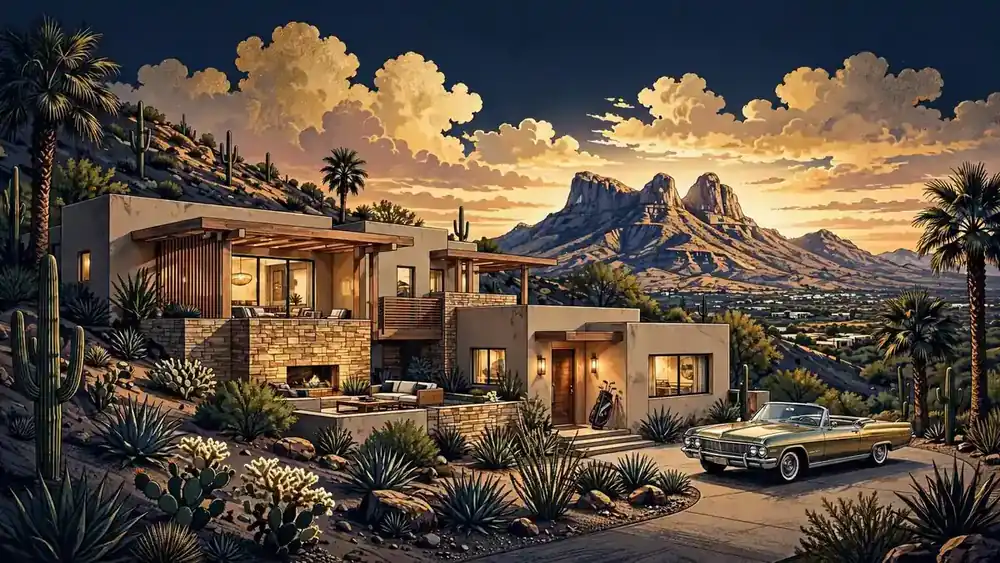
The single best investment Cooper ever made was a house. In the early 1970s, on his manager’s advice, he put about $90,000 into a hillside property in Paradise Valley, Arizona — the affluent desert suburb of Phoenix — instead of spending his first big paycheck on sports cars. His manager’s argument, as Cooper has retold it, was blunt: buy four Ferraris and they will be worth nothing in a decade; buy the house and it will pay you back. The house, in the Goldwater Estates neighborhood with views of Camelback Mountain, has grown from around 2,000 square feet to roughly 6,000 square feet across more than 2 acres, and property reporting now values it at about $5 million. That is a gain of more than fifty times the purchase price, and it happened while he lived in it.
The family moved into the house permanently in 1985, after years of splitting time between Phoenix and Los Angeles, and Cooper and his wife Sheryl have lived there ever since. It is the anchor asset of the fortune: a primary residence in one of Arizona’s most expensive zip codes, bought at 1970s prices, improved over decades, and never sold. The property’s six bathrooms, Southwest contemporary design, and hillside position are the details property sites list; the financial point is simpler — it is a multi-million-dollar asset with a five-figure cost basis.
Cooper has owned other property. He had a Los Angeles home during the height of his 1970s success, which property reporting says was later listed for $1.3 million. Beyond that, his holdings are not publicly documented in detail, and this article does not invent a portfolio for him: no reliable record ties him to additional homes, and the honest statement is that Arizona is the base and Los Angeles was the past.
Cars are the collection he did allow himself. Cooper is known as a classic-car collector, and the cars appear in interviews and photo spreads rather than in any public inventory — no credible source lists models or values, so this article does not guess at them. What is documented is the trade he made in 1972: the house instead of the Ferraris. The cars came later, once the house was paid for, and they are a hobby funded by a fortune rather than the fortune itself.
The catalog remains the largest intangible asset. With more than 50 million albums sold, the publishing and master rights to songs like “School’s Out” and “Poison” are worth millions on their own — the reason higher estimates push the total to $70 million. Unlike a house, a catalog cannot be photographed, but it is the asset that earns while he sleeps, and it is the one asset that will keep earning after he stops touring.
Awards and Achievements
Cooper’s trophy shelf is thinner than his influence, and that gap is part of his story: shock rock was never Grammy bait. He has been nominated for Grammy Awards — including a nomination for Best Hard Rock Performance — but he has not won one, and the industry’s formal honors came late. The big one arrived in 2011, when the original Alice Cooper band was inducted into the Rock and Roll Hall of Fame, 37 years after the band split. The induction put him alongside the acts he had influenced for decades, from Marilyn Manson, who built a career on Cooper’s shock-rock blueprint, to the generations of metal and industrial bands that borrowed his stagecraft.
The commercial achievements are easier to count. More than 50 million albums sold worldwide. A number-one album in Billion Dollar Babies (1973). A platinum comeback album in Trash (1989). A Top 10 single in two different decades — “School’s Out” in 1972 and “Poison” in 1989. A Hollywood Walk of Fame star. A radio show that has run for more than 20 years. And in 2025, a reunion album with his original band, 52 years after their last record together, that charted on Billboard’s Independent Albums and Top Rock & Alternative Albums charts.
The less formal honors may matter more. Cooper’s stagecraft — the makeup, the guillotine, the snake, the mock execution — became the template for theatrical rock, and the list of artists who cite him runs from Kiss to Guns N’ Roses to Rob Zombie. He is one of the few performers whose persona is recognizable in silhouette: the eye makeup alone does it. In Phoenix, his charity work earned him a role as grand marshal of the Fiesta Bowl Parade in 2021, an honor that says as much about the city he stayed in as the career he built.
There is also the longevity record, which no award captures. Cooper has headlined tours in six different decades, from the 1960s to the 2020s, and he is touring in 2026 at 78. The number of rock performers who can claim that is small enough to count on one hand.
Net Worth Growth Over the Years
Cooper’s fortune grew slowly, then held. The pattern is the opposite of the pop-star arc — a fast peak, a crash, and a nostalgia circuit. His wealth rose in the early 1970s, dipped in the early 1980s when the records stopped selling, and rebuilt from the late 1980s onward on touring, which never really stopped. The table below is an estimate built from the reported figures in the sources named in this article; it is not a balance sheet, and the early years in particular are reconstructed from career history rather than from published numbers.
| Year | Estimated net worth | What moved it |
|---|---|---|
| 1973 | ~$1–2 million | Billion Dollar Babies hits number one; arena touring at its peak |
| 1975 | ~$3–5 million | Solo breakthrough with Welcome to My Nightmare |
| 1983 | ~$5 million | Commercial low point; sobriety and rebuilding begin |
| 1989 | ~$10 million | Trash goes platinum; “Poison” returns him to the Top 10 |
| 2000 | ~$20 million | Steady touring, catalog royalties, radio show begins in 2004 |
| 2011 | ~$30 million | Rock and Roll Hall of Fame induction; festival-headliner status |
| 2019 | ~$45 million | Peak touring years; Arizona property appreciation |
| 2024 | ~$50 million | Consensus figure across wealth trackers |
| 2026 | $50–$70 million | Reunion album, 2026 festival run, Las Vegas dates, catalog value |
The shape of that curve is the point: no sudden windfall, no crash, just a fortune that compounded through five decades of work. The 2025 reunion album and the 2026 tour are the latest additions, not a rescue — the fortune was already there.
Social Media Presence
Cooper’s social media is run the way his career is run: steady, professional, and focused on the work. His official accounts announce tour dates, new releases, and charity events, and they carry the same visual identity — black, gold, and horror — that the stage show has used for decades. He is not a daily poster, and he does not do the influencer circuit: no brand-partnership reels, no viral dance, no oversharing. The accounts exist to sell tickets and records, and they do that job.
The audience skews older than a pop star’s, and that is a strength rather than a weakness for his business: his followers buy vinyl, buy box sets, and buy tickets — the high-value actions — rather than just streaming a single. The 2025 reunion announcement traveled fast across his channels and the rock press, and the London O2 reunion show in July 2025 generated the kind of fan-shot footage that does more for ticket sales than any advertisement.
For a performer of his generation, the notable fact is that he is on social media at all, and that he uses it without embarrassment. Many of his peers outsourced their accounts to labels or abandoned them; Cooper’s remain active, current, and tied to a touring schedule that gives fans a reason to follow.
Personal Life
Cooper has been married to Sheryl Goddard since 1976 — fifty years, in a business where five is a long marriage. Sheryl was a dancer and choreographer who worked on his stage show; they met when she was part of the production, and she has been part of the operation ever since, co-founding the Solid Rock Foundation with him in 1995. They have three children: Calico, Dash, and Sonora. The family has stayed largely out of the tabloids, and Cooper credits Sheryl with keeping the household steady through the years when his drinking threatened to end both the marriage and the career.
The turning point came in 1983. Sheryl filed for divorce, telling him she would not watch him drink himself to death, and Cooper got sober — he has been sober since, more than 40 years. He replaced alcohol with golf, playing almost daily and holding a low single-digit handicap, and with work: the radio show, the charity, the touring. He has said the stage character is a job he puts on with the makeup and takes off afterward, and the discipline of that separation is what kept him alive long enough to enjoy the fortune.
Faith is part of the picture, too. Cooper is a Christian — his father was a preacher — and the Solid Rock Foundation is explicitly faith-based, running free music, art, and dance programs for teenagers in Phoenix and Mesa. The first Rock Teen Center opened in Phoenix in May 2012, a 22,000-square-foot building where teens aged 12 to 20 take free lessons in guitar, drums, vocals, and dance; a second center opened in Mesa in 2021. The annual Christmas Pudding concert, running since 2001, raises around $100,000 a year for the centers. The man who made his name pretending to be executed on stage spends his Decembers raising money for teenagers, and he has done it for a quarter of a century.
He lives in the Paradise Valley house he bought in the 1970s, plays golf most mornings when he is home, and hosts a radio show from a studio rather than a tour bus. It is a quiet life for a man whose job is to be the loudest person in the room, and that contrast is the reason the fortune survived: the chaos stayed on stage, and the money stayed in the bank.
Sources & Reporting
Celebrity Net Worth — the $50 million consensus figure, the most-cited estimate for Cooper’s fortune, and the anchor for this article’s range.
alicecooper.org — 2026 reporting placing the estimate at $50–$70 million, with detail on the 2026 tour schedule, festival dates, and the Las Vegas run with Criss Angel.
Wikipedia — the July 25, 2025 release of The Revenge of Alice Cooper, the original-band reunion, Bob Ezrin’s production, Glen Buxton’s posthumous appearance, the Nights with Alice Cooper radio history, and the Solid Rock Foundation timeline.
Far Out Magazine — reporting that Cooper’s fortune is estimated at $50 million and that he has sold more than 50 million records.
Alice Cooper’s Solid Rock — the foundation’s own event material, including the Christmas Putting golf tournament and sponsorship levels for its fundraisers.
Classic Rock History — the original band’s reunion on stage at London’s O2 Arena on July 25, 2025, and the history of the band from the Earwigs through the 2025 album.
This Older House — property reporting on the Paradise Valley home: the roughly $90,000 purchase in the early 1970s, the 6,002-square-foot size, the two-plus acres, and the current estimate near $5 million.
SickthingsUK — the Solid Rock Foundation’s history, the May 2012 opening of the Phoenix Rock Teen Center, the Mesa center in 2021, and the Christmas Pudding fundraiser.
Reporting window: November 2026. Figures are estimates drawn from public reporting; no audited financial statements for Cooper exist, and where sources disagreed this article publishes the range and names the disagreement rather than picking a single number.
Frequently Asked Questions
What is Alice Cooper’s net worth in 2026?
Alice Cooper’s net worth is estimated at $50–$70 million as of November 2026. Celebrity Net Worth puts the figure at $50 million, the most-cited estimate, while several 2025–2026 reports stretch the range to $70 million once his Arizona real estate and catalog value are counted. No audited figure exists, so the honest answer is a range anchored at $50 million.
How old is Alice Cooper?
Alice Cooper was born Vincent Damon Furnier on February 4, 1948, in Detroit, Michigan, which makes him 78 years old in 2026. He has been performing professionally since 1968, when the Alice Cooper band formed in Phoenix, Arizona.
Is Alice Cooper still touring in 2026?
Yes. Cooper’s 2026 schedule includes US theater and arena dates, a Las Vegas run co-headlining “Welcome to Our Nightmare” dates with illusionist Criss Angel, and major festival appearances including Welcome to Rockville, Hellfest, Graspop, Tons of Rock, Copenhell, and Louder Than Life. He released a reunion album with his original band, The Revenge of Alice Cooper, in July 2025.
What is Alice Cooper’s real name?
His real name is Vincent Damon Furnier. He adopted Alice Cooper as his legal name in the 1970s after the original band split — the name had started as the band’s name, and he kept the brand audiences knew. He was born in Detroit and raised in Phoenix, Arizona.
Who is Alice Cooper’s wife?
Alice Cooper has been married to Sheryl Goddard since 1976. She was a dancer and choreographer who worked on his stage show, and the two co-founded the Solid Rock Foundation in 1995. They have three children — Calico, Dash, and Sonora — and live in Paradise Valley, Arizona.
How much does Alice Cooper make per show?
Cooper has never disclosed a per-show fee, and no contract is public, so there is no verified number. Industry estimates put his total annual income at roughly $1.5–$2.5 million across touring, royalties, radio, and merchandise in a normal touring year, with festival headline slots paying the most. Touring is estimated at 60–70 percent of his income.
Where does Alice Cooper live?
Cooper lives in Paradise Valley, Arizona, a suburb of Phoenix, in a hillside home he bought in the early 1970s for about $90,000. The house, in the Goldwater Estates neighborhood with views of Camelback Mountain, is now roughly 6,000 square feet on more than two acres and is estimated to be worth around $5 million. He and his wife Sheryl moved in permanently in 1985.
Is Alice Cooper sober?
Yes. Cooper has been sober since 1983, more than 40 years. He has spoken openly about his alcoholism in the late 1970s and credits his wife Sheryl — who filed for divorce that year as a wake-up call — with pushing him to quit. He replaced drinking with golf, playing almost daily with a low single-digit handicap, and wrote about it in his 2007 memoir Alice Cooper, Golf Monster.
Final Thoughts
Alice Cooper’s $50–$70 million fortune is not the biggest in rock, and that is exactly what makes it interesting. He never sold his catalog for a nine-figure windfall, never built a brand empire, and never had a reality-TV payday. He made his money the slow way: playing 80 to 100 shows a year for five decades, keeping the songs, buying a house in the desert when Phoenix was cheap, and staying sober long enough to enjoy the result. The 2025 reunion album with his original band and the packed 2026 festival calendar prove the model still works at 78 — the snake, the guillotine, and the makeup are still filling rooms, and the fortune they built is still growing.
Published on November 21, 2026. Last reviewed November 2026. Found an error? See our corrections policy.