
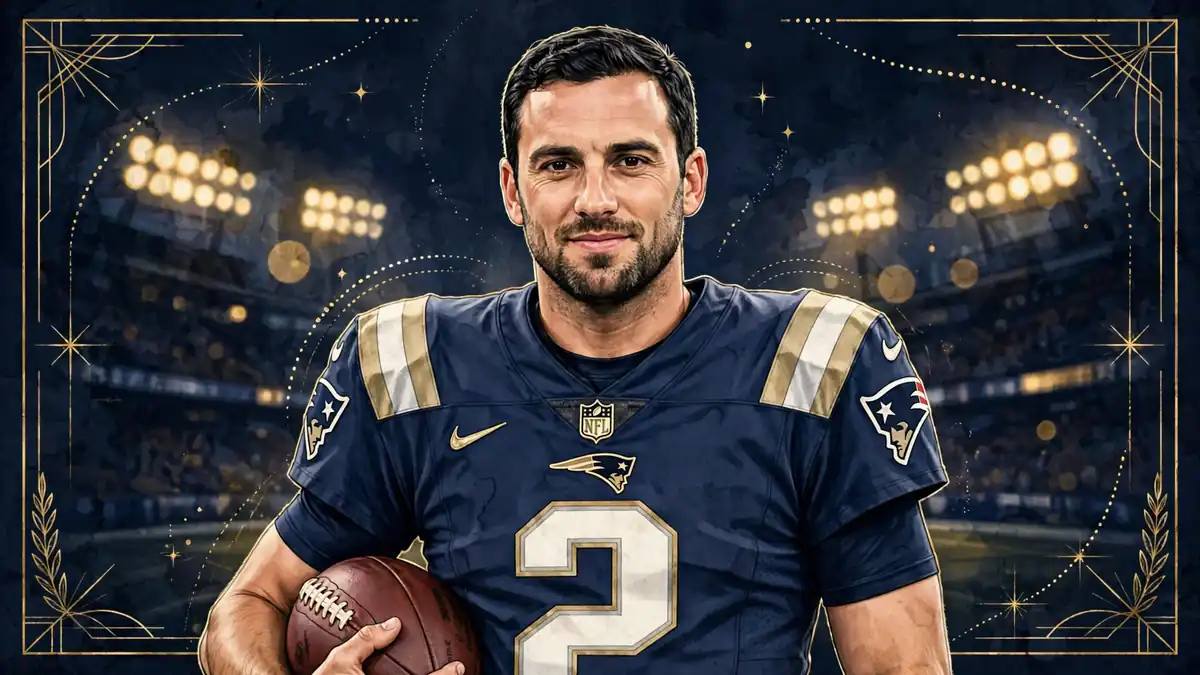
Brian Hoyer‘s net worth is estimated at $12 million–$17 million as of November 2026. The former NFL quarterback never signed a franchise-quarterback mega-deal, yet he banked $38,797,590 in career earnings across 15 seasons, according to Over The Cap, started games for eight different teams, won a Super Bowl ring as a New England Patriot, and now earns a second income as a broadcaster and podcast host in Boston.
Brian Hoyer: Quick Facts
| Estimated net worth | $15 million (range: $12 million–$17 million) |
|---|---|
| Profession | Former NFL quarterback; broadcaster and podcast host |
| Nationality | American |
| Born | October 13, 1985 (age 41) |
| Height | 6 ft 2 in (1.88 m) |
| Primary income sources | NFL salaries and signing bonuses, broadcasting, podcasting |
| Active years | 2009–2023 (NFL); 2024–present (media) |
| Last reviewed | November 2026 |
- Quick Facts
- Early Life and Background
- Education
- Career Journey
- Rise to Fame
- Main Sources of Income
- Salary and Earnings
- Businesses and Investments
- Brand Deals and Sponsorships
- Houses, Cars and Other Assets
- Awards and Achievements
- Net Worth Growth Over the Years
- Social Media Presence
- Personal Life
- Sources & Reporting
- Frequently Asked Questions
- Final Thoughts
Early Life and Background
Axel Edward Brian Hoyer was born on October 13, 1985, in Lakewood, Ohio, and raised in nearby North Olmsted, a Cleveland suburb where football runs deep in the local culture. His parents, Axel and Julie Hoyer, raised four children — Brian, his sister Lauren, and his brothers Brett and Matt — in a household where sport was a normal part of daily life. Matt Hoyer later played quarterback himself, serving as a backup on a St. Ignatius state championship team in 2012, a small detail that says something about how thoroughly the game shaped the family.
Hoyer attended Saint Ignatius High School in Cleveland, one of the most storied high school football programmes in Ohio, where he played football and baseball for the Wildcats under head coach Chuck Kyle. As a two-year starter at quarterback he compiled a 16–7 record. His junior season in 2002 was steady rather than spectacular: 131 completions from 263 attempts for 2,130 yards, 18 touchdowns and 12 interceptions. His senior season in 2003 was the breakout. Hoyer completed 258 of 412 passes for 5,570 yards, 45 touchdowns and 15 interceptions while leading St. Ignatius to a 9–3 record, earning Associated Press Division I all-state honours and a USA Today Prep Player of the Week selection along the way.
Those numbers look gaudy even by modern high school standards, and they explain why a major college programme came calling. Yet the senior-year explosion also set a pattern that would repeat through his whole career: Hoyer could produce at a high level when given the job, but he would spend much of his professional life waiting for the job to be given. At St. Ignatius he was the starter. At Michigan State he would wait behind Drew Stanton. In the NFL he would wait behind Tom Brady, then spend a decade proving he could step in cold for team after team and keep the offence functioning.
North Olmsted and Cleveland stayed central to Hoyer’s identity long after he left. He married his high school girlfriend, returned to Ohio in the off-season through his career, and built his family life in the Cleveland area. That rootedness matters to the money story too: unlike quarterbacks who chased the biggest market or the flashiest lifestyle, Hoyer built his wealth the slow way, one short contract at a time, in a career where the average NFL player lasts about three seasons and he lasted fifteen.
The other early detail worth recording is the name. Hoyer is of German descent through his father, and he holds dual German and American citizenship, a fact noted in several biographical profiles. It never became a commercial angle — no German endorsement deals, no overseas ventures — but it is part of why some European football databases list him as German-American. For a net-worth profile, the point is simpler: there is no hidden overseas income stream in Hoyer’s story. His money came from American football, in American dollars, on contracts filed in the NFL’s public record.
Education
Hoyer committed to Michigan State University, redshirting in 2004 and playing for the Spartans from 2005 to 2008. The redshirt year is easy to skip over, but it shaped the next four seasons: he arrived as a developmental prospect, earned Scout Team Offensive Player of the Week honours twice, and learned the offence from the sideline before he ever threw a pass that counted.
His college numbers, season by season, tell the story of a quarterback who improved, peaked as a junior, and then struggled as a senior on a team in transition. In 2005 he appeared in five games, completing 15 of 23 passes for 167 yards and two touchdowns, including a game against Illinois in which he combined with Drew Stanton to throw seven touchdown passes, tying a Big Ten single-game record. In 2006 he played eight games, completing 82 of 144 passes for 863 yards, four touchdowns and three interceptions.
The 2007 season was his best in East Lansing. As a full-time starter in 13 games, Hoyer completed 223 of 376 throws for 2,725 yards, 20 touchdowns and 11 interceptions, with six 200-yard passing games, and earned honourable mention All-Big Ten selection. That season put him on the NFL radar as a possible late-round pick: a 6-foot-2, 215-pound quarterback with a live arm, three years in a pro-style system, and the poise to run a huddle.
His senior year in 2008 went the other way. Hoyer completed 180 of 353 passes for 2,404 yards, nine touchdowns and nine interceptions in 13 games, a 51.0 percent completion rate that was the weakest of his college career. He had entered the season listed among 26 preseason candidates for the Johnny Unitas Golden Arm Award, given to the nation’s top senior quarterback, but the numbers never matched the billing. Across his Michigan State career he finished with 500 completions from 896 attempts for 6,159 yards, 35 touchdowns and 23 interceptions.
The senior-year dip cost him draft stock. When the 2009 NFL Draft came and went without his name being called, Hoyer became an undrafted free agent — a label that, financially, is the worst starting position in professional football. Drafted quarterbacks in 2009 received signing bonuses in the hundreds of thousands or millions; Hoyer signed with New England for a $12,500 signing bonus, according to Over The Cap’s contract record, on a three-year deal worth $1,197,500 in total. The education section of this story ends, then, with a hard financial truth: his degree from Michigan State and his college tape were worth almost nothing on draft weekend, and everything he earned afterwards had to be earned twice — first the roster spot, then the paycheck.
Career Journey
Hoyer entered the NFL in 2009 as an undrafted free agent with the New England Patriots, the team that would define his career. He spent three seasons in Foxborough as Tom Brady’s backup, appearing in 13 games and learning the Patriots system from the inside — the playbook, the preparation routine, the way Bill Belichick’s staff graded every practice rep. That education turned out to be the most valuable asset of his career. Patriots system knowledge became his calling card: teams kept hiring him because he could walk into a new building, learn the offence quickly, and run it without weeks of ramp-up.
After the Patriots released him in August 2012, Hoyer spent the 2012 season as a true journeyman. He signed with the Pittsburgh Steelers, then moved to the Arizona Cardinals, where he made his first NFL start in Week 17 against the San Francisco 49ers. One start, two teams, no security — the 2012 season paid him a fraction of what a starter earned, and it showed how thin the margin is for a backup quarterback. A player in Hoyer’s position can be cut on a Tuesday and signed on a Wednesday, and the money stops the moment the phone stops ringing.
Cleveland changed the picture. Hoyer signed with the Browns in 2013 and won the starting job, going 3–0 before tearing his anterior cruciate ligament against the Buffalo Bills in October 2013, an injury that ended his season and, for a time, looked like it might end his run as a starter. He returned in 2014 and led the Browns to a 7–4 start, including the largest comeback in franchise history — erasing a 28–3 deficit against the Tennessee Titans to win 29–28 — before being benched for rookie Johnny Manziel as Cleveland slid to a 7–9 finish. The Browns years paid Hoyer $4,015,000 on a two-year deal originally worth $1,965,000, according to Over The Cap, because incentives and a second season pushed the actual cash well past the paper value. It was the first time in his career that performance moved the money in his favour.
Houston was the peak as a starter. In March 2015 Hoyer signed a two-year, $10.5 million contract with the Texans, with $4.75 million guaranteed, and won the starting job. He threw for 2,606 yards and 19 touchdowns in 11 games, led Houston to the AFC South title, and started the playoff game against the Kansas City Chiefs — a 30–0 loss in which he threw four interceptions, the worst game of his career on the biggest stage he had reached. The Texans released him after one season, but the year paid him $5,093,750 in cash, the largest single-season cash payment of his career to that point, and it proved he could be a functional NFL starter for a full season.
Chicago came next. In 2016 Hoyer signed with the Bears and, after Jay Cutler was injured, started five games and played in six, completing 67.0 percent of his passes for 1,445 yards, six touchdowns and no interceptions. He became the first Bears quarterback to throw for over 300 yards in each of his first four starts with the franchise, and his career-high 397 passing yards came against the Indianapolis Colts that season. A broken arm against the Green Bay Packers in October ended his run. The Bears stint lasted one season, but it added another line to the resume every general manager in the league could read: put him in, and the offence does not fall apart.
San Francisco offered the biggest contract of his life. In March 2017 Hoyer signed a two-year, $12 million deal with the 49ers, with $9.85 million fully guaranteed at signing, including a $4 million signing bonus and a fully guaranteed $2.95 million base salary for 2017. NBC Sports reported at the time that incentives could have pushed the deal higher, with up to $1.5 million in 2017 incentives and up to $5 million in 2018 incentives tied to playing time, passing yards, touchdowns and Pro Bowl selection. He started six games, went 0–6, and was released in October after the 49ers acquired Jimmy Garoppolo from New England. The deal still paid him $7,275,000 in cash in 2017, his best single season for earnings, because the guarantee, not the win-loss record, is what a contract pays.
From there the career settled into the pattern that would carry him to 2023: valued backup, trusted mentor, emergency starter. He returned to New England in late 2017 in the Garoppolo trade, backed up Brady through the 2018 season, and earned a Super Bowl LIII ring when the Patriots beat the Los Angeles Rams 13–3 in February 2019. He spent 2019 with the Indianapolis Colts, then returned to New England for a third stint from 2020 to 2022, signing a two-year, $4 million extension in March 2022 with $3.08 million guaranteed and a $480,000 signing bonus. His final season came with the Las Vegas Raiders in 2023: a two-year, $4.5 million deal with $4.205 million guaranteed, three games played, one start, 231 passing yards, and a release on March 8, 2024, first reported by ESPN’s Adam Schefter. The Raiders paid him $2,165,000 in cash in 2024 under the dead-money terms of that deal, according to Over The Cap, money for a season in which he did not play a snap.
Across 15 seasons Hoyer played in 79 games and started 41, completing 925 of 1,560 passes for 10,899 yards, 53 touchdowns and 37 interceptions, with a passer rating of 82.0 and a 16–25 record as a regular-season starter. He started games for eight different teams, the second-most in league history. That last number is the career in miniature: no single franchise built around him, and yet almost a third of the league trusted him to start a game at some point.
Rise to Fame
Hoyer never had a single breakout moment of the kind that makes a quarterback famous. His rise was slower and stranger: he became known precisely because he kept surviving. Each time a team moved on, another team called. Each time a starter went down, Hoyer was the name on the shortlist. By 2015, when he led Houston to a division title, the football press had a label for him — the league’s most reliable journeyman backup — and the label stuck because it was accurate.
The Cleveland comeback against Tennessee in October 2014 was the closest thing to a signature game. Down 28–3, Hoyer led the Browns back to a 29–28 win, the largest comeback in franchise history, and for a few weeks Cleveland talked about him as a genuine starting quarterback rather than a stopgap. The 2014 season also gave him his career-high single-season yardage, 3,339 yards in 14 games, with 12 touchdowns and 13 interceptions. The interceptions and the late-season benching for Manziel kept the story from becoming a fairytale, but the comeback game still appears in every retrospective of his career, and it is the game Browns fans remember when his name comes up.
The 2015 Houston season was the high-water mark for visibility. A starting quarterback on a playoff team gets talked about every week, and Hoyer was talked about — for the division title, for the 19 touchdowns, and then, brutally, for the four interceptions in the 30–0 wild-card loss to Kansas City. That game is the other side of the journeyman story: a backup asked to be a starter in January gets judged like a starter in January, and one bad afternoon can define a season. Houston released him that spring, and the playoff loss followed him in every profile written afterwards.
What actually made Hoyer famous inside the league, rather than among fans, was the Patriots connection. Coaches and executives who had worked in New England knew what his preparation looked like, and they hired him to bring that standard into their quarterback rooms. Josh McDaniels, his offensive coordinator in New England, brought him to Las Vegas in 2023 for exactly that reason — Hoyer knew McDaniels’ system, could mentor rookie Aidan O’Connell, and could step in behind Jimmy Garoppolo without a learning curve. When Garoppolo was hurt in Week 6 against New England, Hoyer came off the bench and finished a 21–17 Raiders win over his old team, a neat piece of symmetry in a career full of them.
The Super Bowl ring cemented his place in the record. Hoyer did not play in Super Bowl LIII, but he was on the roster, in the room, and part of the preparation that held the Rams to three points, and the ring counts the same in the history books whether a player threw a pass or not. For a player who entered the league undrafted, a championship ring, 15 seasons, and nearly $39 million in career earnings is a rise that no draft analyst in 2009 would have predicted — and it is why his net worth, modest by superstar quarterback standards, looks remarkable when measured against where he started.
Main Sources of Income
NFL playing contracts account for almost all of Hoyer’s wealth. Over The Cap lists $38,797,590 in career earnings and Salary Sport lists $38,565,661, a difference of $231,929 that neither site reconciles in its published methodology. Both figures describe gross cash paid under NFL contracts — base salaries, signing bonuses, roster bonuses and per-game bonuses — before taxes, agent fees, union dues and living costs. No other income stream in Hoyer’s public record comes close to that scale.
The shape of the earnings matters as much as the total. Hoyer earned $322,500 in cash in 2009, his rookie season. He did not pass $1 million in cash in a single season until 2014, his sixth year in the league. His three biggest cash years came late: $5,093,750 in Houston in 2015, $7,275,000 in San Francisco in 2017, and the Colts season in 2019, when Salary Sport’s year-by-year table records about $6.7 million in cash. That back-loaded pattern is unusual — most players earn the most early, on a rookie deal or a second contract, and fade — and it reflects the way Hoyer’s value grew with experience. Teams paid more for the 30-year-old who knew six systems than for the 24-year-old who knew one.
Broadcasting and podcasting now provide his post-playing income. In August 2024 Hoyer became an analyst for Patriots preseason games, and in 2025 he and former Patriots centre David Andrews partnered with NBC Sports Boston on The Quick Snap, a weekly football podcast that debuted in September and now airs as a television show on Wednesday evenings as well as on podcast platforms. NBC Sports Boston announced the partnership in September 2025, describing the show as a weekly breakdown of the Patriots season from two players who lived inside the locker room. No salary figure for either role has been published, and this article does not invent one; the honest description is that media work is now his second career, paying a working broadcaster’s income rather than a quarterback’s, and that it keeps his name in front of the New England audience that knows him best.
Endorsements, by contrast, were never a material income source. Hoyer had no national shoe deal, no car campaign, no beverage sponsorship of the kind that adds millions to a star quarterback’s net worth. Backup quarterbacks do not get those deals, and journeyman backups get fewer still. Local appearances and regional work may have added small sums over the years, but nothing in the public record suggests endorsement income ever reached six figures in a single year. Any profile that credits him with major brand money is guessing.
That leaves the core picture clean and, for a net-worth estimate, unusually honest: roughly $38.7 million gross from football, a modest and undisclosed media income since 2024, no verified business empire, and no endorsement fortune. The wealth question is therefore a retention question — how much of $38.7 million gross survives tax, fees and fifteen years of living — and the next sections work through that arithmetic in the open.

Salary and Earnings
The contract record, taken from Over The Cap’s player page and cross-checked against Salary Sport, is the most solid ground in this whole profile. Every figure below is a published contract figure, not an estimate, and the two trackers agree on the shape of the career even where they differ by a few hundred thousand dollars on the lifetime total.
Hoyer started on almost nothing. His undrafted free-agent deal with New England in 2009 was worth $1,197,500 over three years with a $12,500 signing bonus, and he actually collected $1,242,500 across the life of that deal. His rookie cash of $322,500 — a $310,000 base salary plus the prorated bonus — was the kind of money that sounds large to a 23-year-old and small to anyone who has seen an NFL pay scale. The Patriots tendered him as a restricted free agent in 2012 at $1,927,000, but he earned nothing on that tender after his release.
The Cleveland deal is the first one where the money moved in his favour. A two-year, $1,965,000 contract signed in 2013 carried only $250,000 guaranteed, yet Hoyer collected $4,015,000 across the two seasons as incentives and playing time pushed the cash past the paper value. It is a useful reminder that a contract’s headline number and the cash a player actually receives are different things, and that for Hoyer the difference was usually in his favour once he was actually playing.
Houston in 2015 was the first genuinely large deal: two years, $10.5 million, $4.75 million guaranteed, a $3.75 million roster bonus paid in the first month, and $5,093,750 in cash for the season. The Texans’ cap number for him that year was $5,218,750. The deal was terminated after one season, so the second year never paid out, but the guarantee meant the one season alone was worth more than his first six seasons combined.
San Francisco in 2017 was the biggest paper deal of his life: two years, $12 million, $6 million average annual value, $9.85 million fully guaranteed, a $4 million signing bonus and a fully guaranteed $2.95 million base salary in the first year. NBC Sports’ Mike Florio reported the incentive structure in detail at the time — up to $1.5 million in 2017 and up to $5 million in 2018 tied to playing time, passing yards, touchdowns and Pro Bowl selection, plus $800,000 in per-game roster bonuses at $25,000 per game on the active roster. Hoyer was released after six starts, so the incentives never materialised, but the guarantee did: $7,275,000 in cash in 2017, the best earning year of his career, for a 0–6 record as a starter. That sentence is the whole economics of the NFL backup market in one line — guarantees pay, wins do not.
The later contracts were smaller and steadier. New England paid him $1,694,118 across the two-year, $4 million extension signed in March 2022, which carried $3.08 million guaranteed, a $480,000 signing bonus and a $1.12 million base salary in 2022. The Las Vegas deal in April 2023 was two years, $4.5 million, with $4.205 million guaranteed and an $875,000 signing bonus; he collected $2,092,500 in cash in 2023 and a further $2,165,000 in 2024 as dead money after his release, with a $2.6 million cap hit for the Raiders that season, as reported by the Las Vegas Review-Journal’s Vincent Bonsignore.
Over The Cap’s career totals put the scale in one place: $38,797,590 in career earnings, a career average annual value of $2,586,506, total guarantees of $31,427,500, and a largest cap number of $5,218,750 in 2015. Salary Sport’s $38,565,661 is $231,929 lower, a gap of about 0.6 percent that likely reflects different treatment of a bonus or a dead-money payment. Either total supports the same conclusion: Hoyer earned roughly $38.6–$38.8 million gross from football.
What he kept is a different calculation, and this article will not pretend it can be done precisely. A player earning in Massachusetts, Ohio, Texas, Illinois, California, Indiana and Nevada over 15 seasons paid federal tax, state tax in several of those states, agent fees that typically run about 3 percent, and NFLPA dues, while living, travelling and supporting a family for a decade and a half. Apply a rough 40 percent combined tax-and-fees haircut to $38.8 million and the retained figure lands near $23 million before living costs; apply a more conservative lifestyle over 15 years and the $12–$17 million net-worth range used here is the honest landing zone. The $19 million figure published by Sportscasting in 2020, when his career earnings stood near $29 million, sits just above the top of this range and reflects the optimism of that moment; the $1–$3 million figure published by one low-quality contract site is not credible against $38.8 million in gross earnings and is set aside in this estimate.
| Contract | Paper value | Guaranteed | Cash actually collected |
|---|---|---|---|
| Patriots, undrafted free agent, 2009 | $1,197,500 (3 yrs) | $12,500 | $1,242,500 |
| Browns, 2013 | $1,965,000 (2 yrs) | $250,000 | $4,015,000 |
| Texans, 2015 | $10,500,000 (2 yrs) | $4,750,000 | $5,093,750 (2015 only) |
| 49ers, 2017 | $12,000,000 (2 yrs) | $9,850,000 | $7,275,000 (2017 cash) |
| Patriots extension, 2022 | $4,000,000 (2 yrs) | $3,080,000 | $1,694,118 |
| Raiders, 2023 | $4,500,000 (2 yrs) | $4,205,000 | $2,092,500 (2023) + $2,165,000 (2024 dead money) |
Two peer comparisons put the earnings in context. Russell Wilson’s net worth was built on contracts worth hundreds of millions, a different financial universe from Hoyer’s $38.8 million gross. Kirk Cousins’ net worth also sits far above Hoyer’s, thanks to fully guaranteed deals that Hoyer never received. The fair comparison is with other long-serving backups, and on that measure Hoyer is near the top of his class: fifteen seasons of pay cheques is itself the achievement, and the $38.8 million total is the receipt.
Businesses and Investments
Here the honest answer is short: there is no public record of Brian Hoyer running a business, founding a company, or holding a disclosed investment portfolio. No filing, interview or reputable profile credits him with a restaurant group, a real estate fund, a tech stake or a media company of his own. The Quick Snap podcast, co-hosted with David Andrews under NBC Sports Boston and the Shadow Lion production studio, is a media job, not a business he owns — the production company and the network own the show, and Hoyer is the talent.
That absence is itself useful information, because it separates Hoyer from the quarterbacks whose net worth is driven by business. Joe Burrow’s net worth and Lamar Jackson’s net worth both include endorsement and business income on top of playing contracts; Hoyer’s does not, and this profile does not invent business income to make the numbers look bigger. If Hoyer holds private investments — a brokerage account, a retirement fund, a stake in a local venture — they are private, and no source in this research named one.
What can be said with confidence is that the standard NFL financial architecture applied to him. Players of his era were enrolled in the league’s pension and 401(k) arrangements, and a 15-year veteran qualifies for the maximum pension tier, a modest but real post-career income stream that begins at retirement age. The league also paid him $2,165,000 in 2024 dead money from the Raiders deal, which is, in effect, deferred compensation for work already done. Beyond that, any claim about his investments would be speculation, and this article labels it as such rather than printing it.
The post-playing media career is the closest thing to a business development in his story. Broadcasting and podcasting convert his scarcest asset — fifteen seasons of inside knowledge about how NFL teams actually operate — into a durable income. The Quick Snap’s move to NBC Sports Boston in September 2025, with a weekly television slot on Wednesday evenings, suggests the network sees the show as a keeper rather than a one-season experiment, and a second season was already being promoted by Hoyer himself in the network’s announcement. If the show runs for several years, it becomes a meaningful second act; in 2026 it is still early, and no published figure attaches a dollar value to it.
Brand Deals and Sponsorships
Hoyer never carried a national endorsement portfolio. A search of his career turns up no shoe deal, no national car or beverage campaign, and no apparel line. That is normal for his role: brands pay starting quarterbacks and stars, and a backup’s face does not sell sneakers. The few commercial associations that exist in his record are local and small — appearances, charity events, and regional work in New England and Ohio — and none of them carried a published fee.
The contrast with his peers is sharp and worth stating plainly. Matthew Stafford’s net worth includes endorsement income built on a decade as a franchise starter and a Super Bowl win as the face of a team; Hoyer’s Super Bowl ring came as a backup, and the market priced the two roles very differently. Even Andrew Luck’s net worth, built on a short career cut short by injury, includes endorsement money Hoyer never had access to, because Luck was a first overall pick and the face of a franchise from day one.
His media work may change that picture slightly. A weekly host on NBC Sports Boston is a more marketable figure than a third-string quarterback, and local New England brands do pay former Patriots for appearances and campaigns. Nothing in the record as of November 2026 shows a signed deal of that kind, so this section records the position accurately: endorsements contributed little or nothing to the $12–$17 million estimate, and any future brand income would be upside to it, not part of it.

Houses, Cars and Other Assets
Property is the weakest-documented part of Hoyer’s profile, and this section says so rather than dressing up thin sources as fact. Two conflicting reports circulate, and neither is backed by a property record cited in the reporting.
Urban Splatter, in a March 2026 house profile, describes a Dover, Massachusetts mansion — five bedrooms, eight bathrooms, 8,144 square feet, built in 2020, on 4.47 acres — and lists a price of $4,423,500. The same site puts Hoyer’s net worth at $17 million. The profile reads like a real estate listing dressed as a celebrity home story, and it offers no deed, purchase date or mortgage record tying Hoyer to the address. It is reported here as a claim from that outlet, not as a verified purchase.
A second, lower-quality syndicated profile claims Hoyer lives with his family in Berea, Ohio, and owns $1.6 million in real estate there. That figure has been copied across a string of content-farm pages, none of which cites a county record. The two claims cannot both describe the same primary home, and neither is strong enough to anchor a valuation. The honest statement is that Hoyer is reported to own a family home in the Boston area from his Patriots years and to retain ties to the Cleveland area, that the Dover property is the only one described in any detail, and that no verified property portfolio can be priced from the public record.
Cars are even less documented. No reputable profile lists Hoyer’s vehicles, and no car collection story attaches to his name. The absence is consistent with the rest of the profile: a player who earned his money as a backup, lived in team cities for a season at a time, and never cultivated a public lifestyle brand is unlikely to hold a showpiece garage, and this article will not invent one. If a car collection exists, it is private.
What is documented is the pension and the deferred money. The Raiders’ $2,165,000 dead-money payment in 2024, the NFL pension for a 15-year veteran, and whatever retirement savings accumulated across his career are real assets, even if their values are not public. They sit on the conservative side of the ledger: steady, modest, and invisible to the celebrity-home websites that prefer a mansion photograph to a pension statement.
Awards and Achievements
Hoyer’s trophy case is thin by superstar standards and remarkable by undrafted-free-agent standards. The headline item is the Super Bowl LIII championship, won with the New England Patriots in February 2019 when they beat the Los Angeles Rams 13–3. Hoyer did not throw a pass in the game, but he was on the active roster, took the practice reps, and earned the ring that every player in the league chases. For a player who entered the league with a $12,500 signing bonus, a Super Bowl ring is the single most valuable line on the resume, even if it has no dollar value to add to a net-worth total.
His college honours were modest: honourable mention All-Big Ten in 2007, and a place among the 26 preseason candidates for the Johnny Unitas Golden Arm Award in 2008. He never made a Pro Bowl, never made an All-Pro team, and never won a Comeback Player of the Year award, though the 2014 Cleveland comeback season might have earned consideration in a different year. The record books remember him differently: second-most teams started for by a quarterback in league history, with eight, and a 15-season career that outlasted almost every quarterback drafted in his class.
The individual game records are more interesting than the award list. The 397-yard game against Indianapolis in 2016 was a career high and one of the best single-game passing performances in Bears history. The four consecutive 300-yard games to start his Bears tenure tied him with Jay Cutler, Billy Wade and Mitchell Trubisky for the most 300-yard games by a Chicago quarterback in a single season. The 28–3 comeback against Tennessee in 2014 remains the largest comeback in Cleveland Browns history. None of those performances won him an award, and all of them helped him get the next contract, which is the currency that mattered.
His post-playing recognition is still forming. The Quick Snap’s move to a weekly television slot on NBC Sports Boston in 2025 is a professional achievement of a different kind — a former backup quarterback becoming a broadcaster the network builds programming around — and it suggests the second act may produce the kind of public profile his playing career never quite did.
Net Worth Growth Over the Years
Hoyer’s wealth grew in steps, not in a straight line, and the steps map directly onto his contracts. The table below uses published cash earnings by era and the published net-worth estimates that circulated at the time, with the estimate column labelled as reported rather than verified — because no outlet that published those numbers showed its working.
| Period | What happened | Cash earned in the period | Published net-worth estimate at the time |
|---|---|---|---|
| 2009–2012 | Undrafted rookie in New England, then Steelers and Cardinals | About $1.6 million | Not published; under $1 million |
| 2013–2014 | Cleveland starter, ACL tear, then the Titans comeback season | About $4.0 million | Not published; low single millions |
| 2015–2016 | Houston division title, then the Bears’ 300-yard run | About $7.1 million | Not published; mid single millions |
| 2017–2019 | 49ers’ $12 million deal, Super Bowl LIII ring, Colts season | About $15 million | $15 million (PlayersWiki, 2019) |
| 2020–2022 | Third Patriots stint, $4 million extension in 2022 | About $4.8 million | $19 million (Sportscasting, 2020); $12 million (several sites) |
| 2023–2024 | Raiders season, release, $2.17 million dead-money payment | About $4.3 million | $16–$17 million (TheMost10, Urban Splatter, 2026) |
| 2025–2026 | Broadcasting and The Quick Snap podcast | Undisclosed media income | $12 million–$17 million (this estimate, Nov 2026) |
Three things stand out in that timeline. First, the 2017–2019 window did most of the work: roughly $15 million in cash in three seasons, more than the first eight seasons combined. Second, the published estimates did not move in step with the earnings — Sportscasting’s $19 million in 2020 came before the 2022 extension and the Raiders deal had even been signed, which suggests the number was a rough gross-earnings guess rather than a balance-sheet estimate. Third, the low outlier of $1–$3 million, published by one contract site, would require Hoyer to have kept less than a tenth of his gross earnings, a retention rate no tax regime produces, and it is discarded here for that reason.
The growth story since retirement is quieter. With no playing salary since the 2024 dead-money payment, Hoyer’s net worth in 2025 and 2026 depends on media income, investment returns and spending, none of which is public. The range is therefore held flat at $12–$17 million rather than projected upward on hope. A broadcaster’s salary does not move a multi-million-dollar net worth quickly, and this estimate does not pretend otherwise.
One more comparison helps the scale land. Patrick Mahomes’ net worth is built on a half-billion-dollar contract, and Josh Allen’s net worth on a deal worth more than $250 million; Hoyer earned about $39 million gross in total, which is less than a single season of a modern franchise quarterback’s pay. The point of this profile is not that Hoyer is rich by quarterback standards — he is not — but that he is rich by any normal standard, and that he got there without ever being the star.
Social Media Presence
Hoyer keeps a low profile online, and the public record reflects that. His X account, @bhoyer6, is the social handle listed in player databases, and he posts about football, the Patriots and The Quick Snap rather than about lifestyle or wealth. No verified follower count is published in a reliable source as of November 2026, and this article does not quote one, because follower counts on fan-run databases change daily and are frequently wrong.
The Quick Snap is his main social presence now. The show’s accounts on Instagram, X and TikTok — @quicksnappod — carry clips of Hoyer and David Andrews breaking down Patriots games, and NBC Sports Boston promotes the show across its own channels. That distribution matters more than Hoyer’s personal follower count: a weekly show on a regional sports network reaches the audience that already knows him, and it does so every week of the season rather than in a single viral moment.
There is no verified Instagram account for Hoyer himself in the sources reviewed, and no TikTok presence under his own name. That absence fits the pattern of the whole career — a player who was never the face of a franchise has little reason to build a personal brand, and Hoyer appears to have chosen not to. For readers looking for him online, the podcast accounts and the NBC Sports Boston pages are the reliable places to find him.
Personal Life
Hoyer married his high school girlfriend, Lauren Scrivens, on July 2, 2010, at the Glidden House in Cleveland, with a reception at a boutique hotel in the same area. Lauren attended Magnificat High School, the all-girls Catholic school in the Cleveland suburbs, while Hoyer attended the all-boys St. Ignatius nearby, and the two met as teenagers. The couple have two children, a son, Garrett, and a daughter, Cameron, who was born in October 2013. The family has lived in the Cleveland area and, during his Patriots years, in Massachusetts, and Hoyer has spoken in interviews about the difficulty of moving a young family between eight different team cities over fifteen seasons.
His parents, Axel and Julie Hoyer, still live in the Cleveland area, and his brother Matt’s own quarterback career at St. Ignatius kept the family tied to the school long after Brian left. The Hoyer family story is, in the end, a Cleveland story: born in Lakewood, raised in North Olmsted, schooled at St. Ignatius, married in Cleveland, and still rooted there after fifteen seasons away.
Off the field, Hoyer has kept his private life private. There are no public controversies, no legal issues, and no tabloid episodes in his record — a clean sheet that is rare enough in a fifteen-year NFL career to be worth noting. His charitable work has been local and low-key, centred on team foundations and Cleveland-area causes rather than a foundation bearing his name. The post-playing move into coaching — he has been reported as the offensive coordinator for the freshman team at Xaverian Brothers High School in Massachusetts — fits the same pattern: staying close to the game, at a level where the work is about teaching rather than fame.
Sources & Reporting
Over The Cap — contract history, career earnings of $38,797,590, total guarantees of $31,427,500, career average annual value of $2,586,506, and year-by-year cash and cap figures; the primary source for every contract number in this article. Reporting window: contracts 2009–2024, accessed November 2026.
Salary Sport — career earnings of $38,565,661, year-by-year cash totals including $7,275,000 in 2017, and the explicit statement that the site publishes career earnings rather than net worth. Reporting window: accessed November 2026.
Wikipedia — biography, career history across eight teams, college statistics, career NFL statistics (79 games, 10,899 yards, 53 touchdowns), Super Bowl LIII, post-career broadcasting and podcast work, and family details. Reporting window: page updated November 2026, accessed November 2026.
NBC Sports — Mike Florio’s March 2017 report on the 49ers contract, including the $9.85 million guarantee, the $4 million signing bonus and the incentive structure. Reporting window: March 2017.
NBC Sports Boston — the September 2025 announcement of The Quick Snap partnership with Shadow Lion, the show’s weekly format, and Hoyer’s role as co-host with David Andrews. Reporting window: September 2025.
Sportscasting — the 2020 profile putting Hoyer’s net worth at $19 million with career earnings then above $29 million; used here as a dated published estimate, not as a current figure. Reporting window: 2020.
The Finance Base — October 2026 analysis concluding that no reliable public net-worth figure for Hoyer is established by the sources reviewed, and setting out the Over The Cap and Salary Sport earnings totals. Reporting window: October 2026.
Las Vegas Raiders — the team’s March 2024 announcement of Hoyer’s release, confirming one season with the club and 79 career games. Reporting window: March 2024.
ESPN — Adam Schefter’s March 2024 report of the Raiders release, as cited in contemporaneous coverage. Reporting window: March 2024.
PlayersWiki — 2019 profile putting Hoyer’s net worth above $15 million and recording career earnings then of $22,881,470, plus the July 2, 2010 wedding date and family details. Reporting window: 2019.
Urban Splatter — March 2026 house profile describing the Dover, Massachusetts property and putting Hoyer’s net worth at $17 million; treated here as a single-outlet claim, not a verified record. Reporting window: March 2026.
The Most 10 — net-worth profile listing a 2026 estimate of $16 million. Reporting window: accessed November 2026.
Frequently Asked Questions
What is Brian Hoyer’s net worth in 2026?
Brian Hoyer’s net worth is estimated at $12 million to $17 million as of November 2026, with $15 million as the central figure. No verified net-worth total exists in public records, so the range is built from his $38,797,590 in career earnings reported by Over The Cap and the cluster of published estimates between $12 million and $17 million.
How much did Brian Hoyer earn in his NFL career?
Over The Cap lists $38,797,590 in career earnings, while Salary Sport lists $38,565,661 — a difference of $231,929. Both totals cover gross cash from NFL contracts between 2009 and 2024, before taxes, agent fees and living costs. His best single season was 2017 with the San Francisco 49ers, when he collected $7,275,000 in cash.
What was Brian Hoyer’s biggest contract?
His biggest contract was the two-year, $12 million deal he signed with the San Francisco 49ers in March 2017, with $9.85 million fully guaranteed at signing, including a $4 million signing bonus. He was released after six starts, so the incentives in the deal never paid out, but the guarantee made 2017 his highest-earning year.
Which teams did Brian Hoyer play for?
Hoyer played for eight NFL franchises across 15 seasons: the New England Patriots (three stints, 2009–2011, 2017–2018 and 2020–2022), Pittsburgh Steelers (2012), Arizona Cardinals (2012), Cleveland Browns (2013–2014), Houston Texans (2015), Chicago Bears (2016), San Francisco 49ers (2017), Indianapolis Colts (2019) and Las Vegas Raiders (2023). He started games for eight different teams, the second-most in league history.
Did Brian Hoyer win a Super Bowl?
Yes. Hoyer won Super Bowl LIII with the New England Patriots in February 2019, when they beat the Los Angeles Rams 13–3. He was on the active roster as Tom Brady’s backup and did not throw a pass in the game, but he earned the championship ring.
Is Brian Hoyer retired, and what does he do now?
Yes, his playing career ended after the Las Vegas Raiders released him in March 2024. He became an analyst for Patriots preseason games in August 2024, and in 2025 he and former Patriots centre David Andrews partnered with NBC Sports Boston on The Quick Snap, a weekly football podcast and television show. He has also been reported as coaching high school football in Massachusetts.
Who is Brian Hoyer’s wife?
Hoyer is married to Lauren Scrivens, his high school girlfriend. They married on July 2, 2010, at the Glidden House in Cleveland, and have two children, a son, Garrett, and a daughter, Cameron, who was born in October 2013.
How old is Brian Hoyer, and how tall is he?
Brian Hoyer was born on October 13, 1985, in Lakewood, Ohio, which makes him 41 years old as of November 2026. He is listed at 6 feet 2 inches (1.88 m) and 215 pounds, and he played quarterback at Michigan State University from 2004 to 2008 before entering the NFL as an undrafted free agent in 2009.
Final Thoughts
Brian Hoyer’s $12–$17 million net worth is not a superstar fortune, and that is exactly what makes it interesting. He entered the NFL undrafted, with a $12,500 signing bonus, and left fifteen seasons later with $38.8 million in gross career earnings, a Super Bowl ring, and a second career in broadcasting already under way. The money came the slow way — one short contract at a time, with the guarantees doing the heavy lifting — and the range in this estimate is honest about what cannot be known: no public record shows his taxes, his spending, or his investments, and no reputable outlet has ever published a verified net-worth figure for him.
What the record does show is a career that beat the odds at every step. The average NFL career lasts about three seasons; Hoyer lasted fifteen. The average undrafted quarterback never plays a snap; Hoyer started 41 games for eight teams. The lesson for readers is not that backup quarterbacks get rich — most do not — but that durability, preparation and a reputation for reliability can compound into real wealth over a long enough run. His next chapter, on NBC Sports Boston with David Andrews, will not pay quarterback money, but it does not need to: the football money is already banked, and the broadcasting work keeps him in the game he spent fifteen years learning from the inside.
Published on November 22, 2026. Last reviewed November 2026. Found an error? See our corrections policy.