
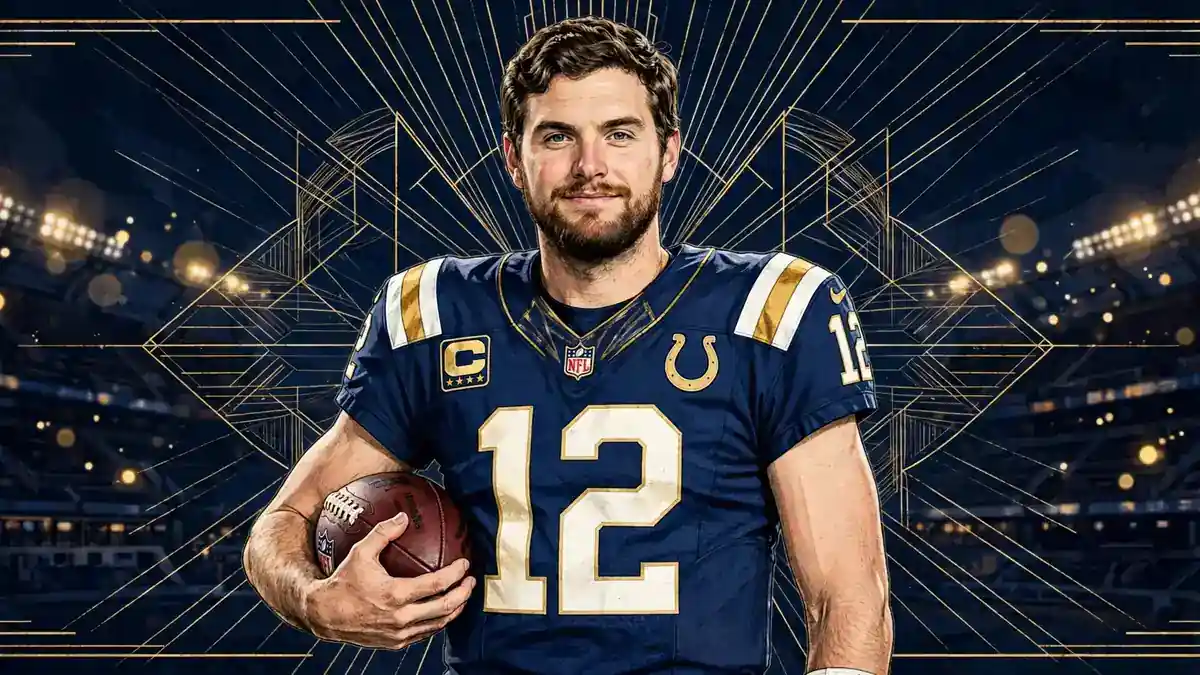
Andrew Luck‘s net worth is estimated at $40 million to $45 million as of November 2026. He banked more than $109 million in seven seasons with the Indianapolis Colts, walked away from another $58 million at 29, and now runs football at Stanford — a second act that pays far less but keeps his name in the game.
Andrew Luck: Quick Facts
| Estimated net worth | $40 million (range: $40 million to $45 million) |
|---|---|
| Profession | Former NFL quarterback; Stanford football general manager |
| Nationality | American |
| Born | September 12, 1989 (age 37) |
| Height | 6 ft 4 in (1.93 m) |
| Primary income sources | NFL salary and signing bonuses; endorsements; Stanford executive role |
| Active years | 2012–2018 (NFL); 2024–present (Stanford general manager) |
| Last reviewed | November 2026 |
- Early Life and Background
- Education
- Career Journey
- Rise to Fame
- Main Sources of Income
- Salary and Earnings
- Businesses and Investments
- Brand Deals and Sponsorships
- Houses, Cars and Other Assets
- Awards and Achievements
- Net Worth Growth Over the Years
- Social Media Presence
- Personal Life
- Sources & Reporting
- Frequently Asked Questions
Early Life and Background
Andrew Austen Luck was born on September 12, 1989, in Washington, D.C., into a household where football was a profession, not a pastime. His father, Oliver Luck, played quarterback in the NFL for the Houston Oilers and later ran the Frankfurt Galaxy and the Rhein Fire in NFL Europe before moving into senior roles at the NCAA and, much later, as commissioner of the XFL. His mother, Kathy, held the family together through moves that took Andrew’s childhood across the Atlantic. He spent part of his youth in London and Frankfurt, attending school in Germany while his father worked in European football, an upbringing that left him fluent in the rhythms of locker rooms on two continents before he ever took a college snap.
The family eventually settled in Houston, Texas, where Andrew attended Stratford High School. He was not the loudest player on the field, and that was the point. Coaches who watched him at Stratford remember a quarterback who treated preparation like homework: film study, footwork drills, and a habit of arriving early that teammates copied. He threw for 7,139 yards and 53 touchdowns in high school, numbers that put him on every major recruiting board, yet the recruiting story that mattered most was the one he turned down. Programs across the country wanted him. He picked Stanford, a school that offered an architectural design degree and a head coach, Jim Harbaugh, who had built his own reputation on quarterbacks. The choice said a lot about the way Luck would handle money for the rest of his career: he weighed the long-term value of the decision, not the loudest offer.
Money was never abstract in the Luck household. Oliver Luck’s post-playing career gave Andrew a front-row seat to the business side of the sport — television contracts, league offices, the way a front office values a player. That education shows up in every financial decision Luck made later, from the structure of his rookie deal to the way he walked away from guaranteed money in 2019 without a public fight. He grew up watching his father negotiate the sport from the other side of the table, and it left him with a rare quality for a franchise quarterback: he understood what his contract was worth to the team as well as to himself.
His sisters — Mary Ellen, Emily, and Addison — were part of the same peripatetic childhood, and Luck has spoken in interviews about how the constant moves taught him to make friends fast and read rooms quickly. Those are soft skills, but they translate directly to a quarterback’s job and, later, to a general manager’s job. The boy who changed schools in two countries became the executive who, in his first months at Stanford, had to fire a head coach and hire another within a week. The through-line is the same: Luck makes a decision, explains it plainly, and moves on.
Education
Luck enrolled at Stanford University in 2008 and redshirted his first season, a year he used to learn the playbook and adjust to college speed without burning eligibility. He majored in architectural design, a choice that surprised people who expected a business or communications major from a future first-round pick. The degree was not a fallback. He has said he liked building things and liked the discipline of a design curriculum, where a project either works or it does not. That same binary thinking — does the play work, does the number add up — runs through his financial life.
He took over as Stanford’s starting quarterback in 2009 and held the job for three seasons, 2009 through 2011. The numbers still hold up: 9,430 passing yards and 82 touchdown passes in his college career, with a completion rate that hovered near 70 percent in his final two seasons. Stanford went 12–1 in 2010, beat Virginia Tech in the Orange Bowl, and finished ranked in the top five. In 2011, the Cardinal went 11–2 and reached the Fiesta Bowl, losing a shootout to Oklahoma State. Luck finished as the Heisman Trophy runner-up in both 2010 and 2011, losing to Cam Newton and then to Robert Griffin III, and he won the Maxwell Award, the Walter Camp Player of the Year award, and the Johnny Unitas Golden Arm Award in 2011. He was also named Pac-12 Offensive Player of the Year.
The academic side of Stanford mattered as much as the football. Luck returned to the university after retirement to study for a master’s degree in education at the Stanford Graduate School of Education, a move that puzzled fans who expected him to go into broadcasting or coaching. The degree was not a hobby. It was the first step in a second career that would, in November 2024, put him in charge of the football program itself. Few former players go back to school for a graduate degree in education; fewer still turn that degree into the general manager’s office. Luck did both, and the salary that comes with the Stanford job — which the university has not publicly disclosed — is now a modest but real line in his post-playing income.
His wife, Nicole Pechanec, followed a parallel path at Stanford. She was a gymnast for the Cardinal, studied architectural design in the same program, and later earned an MBA from Indiana University’s Kelley School of Business. The two met as student-athletes, and the shared academic background shaped the household’s approach to money: two people with design and business training, both allergic to flash, both inclined to treat a fortune as something to manage rather than something to display.
Career Journey
The Indianapolis Colts selected Andrew Luck with the first overall pick in the 2012 NFL Draft, and the assignment could not have been heavier. The Colts had just released Peyton Manning, a franchise icon, after a 2–14 season, and Luck was being asked to replace him. He signed a four-year rookie contract worth $22.1 million, fully guaranteed, with a $14.518 million signing bonus — the largest signing bonus in his draft class and, at the time, a record for a rookie quarterback under the new collective bargaining agreement. The deal was simple and clean: four years, every dollar guaranteed, no games to play with void years or incentives.
His rookie season answered the only question that mattered. Luck threw for 4,374 yards in 2012, then an NFL rookie record, with 23 touchdown passes, and led the Colts to an 11–5 record and a playoff berth one year after the franchise had won two games. He did it while head coach Chuck Pagano missed most of the season undergoing treatment for leukemia, a circumstance that turned a rebuilding year into one of the most emotional seasons in franchise history. Luck made the Pro Bowl as a rookie, and the Colts had their quarterback for the next decade — or so it seemed.
The middle years were a mix of brilliance and punishment. In 2013, Luck led Indianapolis to the playoffs again and engineered a 28-point comeback against Kansas City in the wild-card round, the second-largest comeback in NFL playoff history at the time. In 2014, he led the league with 40 touchdown passes, threw for 4,761 yards, and took the Colts to the AFC Championship Game, where they lost to the New England Patriots. He made the Pro Bowl in each of his first three seasons. The Colts were winning, Luck was the face of the franchise, and the front office was about to pay him like it.
The injuries started in 2015. Luck hurt his shoulder early in the season, played through a lacerated kidney and a partially torn abdominal muscle, and missed nine games. He had surgery on his torn labrum in January 2017 and missed the entire 2017 season — all 16 games — while his shoulder healed and then healed again more slowly than anyone expected. He returned in 2018 under new head coach Frank Reich, threw for 4,593 yards and 39 touchdowns, won the NFL Comeback Player of the Year award, made his fourth Pro Bowl, and led the Colts to a wild-card win over Houston before a divisional-round loss to Kansas City. It was a full return to form, and it made what happened eight months later so hard to believe.
On August 24, 2019, Luck announced his retirement at 29, two weeks before the regular season. He cited a cycle of injuries and rehabilitation that had worn him down mentally and physically, and a calf strain that had kept him out of training camp that summer. The announcement leaked during a preseason game against Chicago, and some fans in Lucas Oil Stadium booed as the news spread — a moment that still defines the conversation about his retirement. Luck never wavered. He said he was mentally worn down by the injury cycle and wanted a life beyond football. He has never attempted a comeback, and he has never publicly second-guessed the call.
His final career line reads like a player who left at the top: 86 games, a 53–33 record as a starter, 23,671 passing yards, 171 touchdown passes, 83 interceptions, and a passer rating of 89.5. He also ran for 1,063 yards and 14 touchdowns. The Colts have spent the years since cycling through quarterbacks — Jacoby Brissett, Philip Rivers, Carson Wentz, Matt Ryan, Anthony Richardson — and none of them has matched what Luck delivered in seven seasons. The franchise is still, in a real sense, looking for his replacement.
Rise to Fame
Luck’s rise was unusual because it was so thoroughly telegraphed. He was the consensus first overall pick for two full years before the draft, a prospect so obvious that the Colts’ 2–14 season in 2011 spawned the “Suck for Luck” slogan among fans of struggling teams. The nickname was a joke, but the evaluation behind it was serious: scouts rated him the best quarterback prospect since Manning, with size at 6 ft 4 in, arm strength, mobility, and a reputation for processing defenses faster than his peers. The fame arrived before the money did, and Luck handled it the way he handled everything else — by deflecting it. He gave interviews in which he talked about books, not brands. He carried a flip phone deep into his NFL career, a detail that became a running joke in the Colts locker room and a shorthand for his indifference to the trappings of stardom.
The 2012 season made him a star in the conventional sense. The rookie passing record, the playoff berth, the Pagano story, and the Manning shadow all combined into a national profile. By 2014, when he led the league in touchdown passes and reached the AFC Championship Game, he was a fixture in national advertising and the unquestioned face of the Colts. His peak salary year, 2017, saw him earn roughly $24 million in combined salary and bonuses even while he did not play a snap — a quirk of the guaranteed money in his extension that tells you how much bargaining power a franchise quarterback holds once the contract is signed.
What made Luck different from other young stars was what he did not do. He did not build a large endorsement portfolio. He did not launch a clothing line or a media company. He did not move into a mansion and fill it with cars. The Andrew Luck Book Club, an Instagram account where he recommended books to followers, was the most public thing he did outside football, and it was free. The fame was real, but the lifestyle that usually follows it never arrived. That restraint is the single biggest reason his net worth held up after retirement: there was no expensive life to unwind when the paychecks stopped.
Main Sources of Income
Luck’s money came from three places, and the proportions tell the story of his career. NFL salary and bonuses dominate: Spotrac puts his total career earnings at $109,107,988, while Celebrity Net Worth counts just over $97 million in salary alone. The gap between those two numbers is the difference between cash earned — salary plus signing bonuses plus roster and workout bonuses — and base salary. Both sources agree on the shape of it: roughly $22 million from the rookie deal and roughly $87 million from the extension years he actually played, plus bonuses. Endorsements added a smaller but real second stream, and his Stanford general manager role now adds a third, much smaller stream.
The rookie contract was the foundation. Four years, $22.1 million, fully guaranteed, with a $14.518 million signing bonus paid up front. Under the 2011 collective bargaining agreement, rookie deals were slotted, so there was little to negotiate; the money was set by draft position. Luck’s bargaining power came later. In June 2016, he signed the extension that made him the highest-paid player in the NFL: six years and $140 million in total value, with $87 million guaranteed and a $32 million signing bonus. The deal is often described as a five-year, $123 million extension because it added five new years to the one remaining year on his rookie contract. Both descriptions are correct; the $140 million figure is the total value of the six-year contract, and the $123 million figure is the value of the new money. The distinction matters because it explains the forfeiture math in 2019: Luck had already collected most of the guaranteed $87 million by the time he retired, which is why his net worth survived a decision that cost him $58.125 million in future pay.
Endorsements were the second stream, and Luck kept it deliberately small. Nike signed him in March 2012, before he had played a professional game. He later became a partner and investor in BodyArmor SuperDrink in September 2013, and he worked with Panini America on trading cards and collectibles. Celebrity Net Worth reports that Luck earned $50 million from salary and endorsements combined across 2016 and 2017, a figure that suggests endorsement income in the low single-digit millions per year at his peak — substantial, but a fraction of what a quarterback with his profile could have commanded if he had chased every deal. He turned down far more than he accepted, and the deals he did take were with brands he actually used.
The third stream is his current job. Stanford announced on November 30, 2024, that Luck would become general manager of the football program, reporting directly to university president Jon Levin. The university has not publicly disclosed his salary, and college general manager pay varies widely, but the role is an executive position, not a coaching one — closer in spirit to an NFL front-office job than to a sideline job. It is the only earned income Luck has reported since retirement, and while it does not move his net worth the way an NFL contract did, it gives him a salary, a purpose, and a platform that keeps his name current in the sport.

Salary and Earnings
The cleanest way to understand Luck’s money is to follow it contract by contract, because the two deals tell different stories. The rookie deal, signed in July 2012, paid $22.1 million over four seasons, all of it guaranteed. The signing bonus alone, $14.518 million, was more than most NFL players earn in a career. By the end of that deal, Luck had been to three Pro Bowls, won two playoff games, and established himself as a top-five quarterback. The Colts responded with the richest contract in league history at the time.
The 2016 extension paid Luck $32 million the moment he signed it, then layered base salaries that rose steeply: roughly $12 million in 2016, $13 million in 2017, and a scheduled $24 million in 2018 that reflected the back-loaded structure of the deal. He collected about $50 million in salary and endorsements across 2016 and 2017 alone, according to Celebrity Net Worth — the two richest years of his life, and two years in which he played only 15 games. The 2018 season, his comeback year, paid him at the top of the quarterback market. Then the music stopped.
Retirement is where the numbers get interesting, because the forfeiture was itemised in public reporting at the time. By walking away in August 2019, Luck gave up a $9 million salary for the 2019 season, a $6 million roster bonus that was due within a month of his announcement, $22 million in salary and roster bonuses for 2020, and $21 million for 2021 — a total of $58.125 million. That is the hard number, the money that was in his contract and that he chose not to collect. Colts owner Jim Irsay later suggested Luck had given up $400 million to $500 million, a figure that counts future contracts he might have signed after 2021, endorsement income he might have earned, and a longer career he might have had. Irsay’s number is a guess about a career that never happened. The $58.125 million is the number that was actually on paper, and it is the one that matters for his net worth.
There is a second, quieter number that helped Luck more than most people realise. When a player retires with years left on a deal, the team can demand repayment of a portion of the signing bonus. The Colts could have asked Luck for $24.8 million back. ESPN’s Adam Schefter reported at the time that Indianapolis decided not to recoup it. That decision, which cost the franchise real money, is rarely mentioned in net worth coverage, but it is worth roughly a quarter of Luck’s entire fortune. Had the Colts clawed the bonus back, the $40 million estimate would look very different. The franchise’s generosity — or, if you prefer, its gratitude — is part of the reason Luck’s post-retirement finances stayed intact.
Taxes and fees did the rest of the trimming. A player who earns $109.1 million in gross cash over seven years does not keep $109.1 million. Federal and Indiana state taxes, agent fees of around 3 percent, and the cost of living through seven years of a professional career take a large share. That is why the net worth figure sits at $40 million to $45 million rather than anywhere near the career-earnings total. The $97 million salary-only figure from Celebrity Net Worth and the $109.1 million all-in figure from Spotrac describe the same career from two angles, and both point to the same conclusion: after taxes, fees, and seven years of living, roughly $40 million remained. The range we publish — $40 million to $45 million — reflects the spread between outlets: Celebrity Net Worth says $40 million, Pro Football Network puts the range at $40 million to $45 million, and some 2025 reporting lands at $43 million. An older $50 million estimate from 2022 still circulates, but it predates several years of post-retirement spending and the more careful 2025–26 reporting, so we treat it as stale.
Peer context sharpens the picture. Aaron Rodgers and Patrick Mahomes played — or are playing — twice as many seasons as Luck did, and their career earnings run into the hundreds of millions. Josh Allen and Joe Burrow, the quarterbacks who followed Luck into the league’s top tier, signed deals worth more than $250 million each. Luck’s $109.1 million in career earnings looks modest beside those numbers, and that is exactly the point of his story: he earned a fortune by any normal standard, then left a second fortune on the table at 29. The gap between what he earned and what he could have earned is the most expensive decision in modern NFL history.
Businesses and Investments
Luck never built a business empire, and that is a deliberate choice worth stating plainly. Some athletes leave the game with a portfolio of restaurants, media companies, and venture stakes. Luck left with a bank account, a BodyArmor investment, and a graduate degree. The BodyArmor stake, taken in September 2013 when the sports-drink company was still a challenger brand, is the one investment with a clear public record. Coca-Cola later bought a controlling interest in BodyArmor and then acquired the company outright in 2021 for $5.6 billion, a deal that would have made early investors a serious return. Luck’s exact stake was never disclosed, so no honest article can put a dollar figure on it, but the direction of travel is clear: a small early bet in a company that became a multi-billion-dollar acquisition. It is the closest thing Luck has to a venture-capital win, and it came from the same instinct that shaped his contract decisions — get in early, pick the right partner, and let time do the work.
Beyond BodyArmor, there is no public record of Luck running a company, sitting on a board, or launching a fund. He has not announced real estate developments, restaurant groups, or a production company. What he has done is invest in himself: the master’s degree in education, the volunteer coaching he did around Palo Alto after retirement, and the Stanford general manager job. Those are not businesses in the usual sense, but they are the investments that now define his working life. The GM role, in particular, is a bet that his value lies in judgment — evaluating players, hiring coaches, rebuilding a program — rather than in a brand.
That restraint cuts both ways for his net worth. On one side, he never risked his fortune on a startup that failed or a restaurant chain that went under, the two most common ways athletes lose money. On the other side, he never multiplied his money the way athletes who became serious investors did. His wealth grew the slow way: salary, a signing bonus, a drink-company stake, and seven years of living well below his means. It is a boring portfolio, and it is the reason the $40 million figure has held steady for years instead of swinging wildly.
Brand Deals and Sponsorships
Luck’s endorsement career was short, selective, and worth less than his talent suggested — by design. Nike signed him in March 2012, weeks after the draft, and the deal put him on the company’s roster of NFL athletes at a time when Nike had just taken over the league’s uniform contract. He wore Nike cleats and appeared in Nike campaigns, but he never became the kind of pitchman who shows up in every commercial break. The Panini America deal covered trading cards and collectibles, a natural fit for a first overall pick whose rookie cards were among the most valuable of his draft class. BodyArmor, as noted above, was both an endorsement and an investment, which made it the most interesting deal of the three: Luck was lending his face to a product and owned a piece of it at the same time.
What Luck turned down matters as much as what he signed. He was offered the usual quarterback menu — car dealerships, fast food, insurance, local television spots — and he took almost none of it. The result is that endorsement income, which can run to $10 million a year for a star quarterback who wants it, stayed in the low single-digit millions for Luck at his peak. Celebrity Net Worth’s figure of $50 million in combined salary and endorsements across 2016 and 2017 implies endorsement earnings of a few million dollars a year in those seasons, not tens of millions. After retirement, the deals stopped. There are no current major endorsements on his record as of November 2026, and that is consistent with a man who has chosen privacy over promotion. The Stanford job pays him to build a football program, not to sell shoes.
The contrast with his peers is stark. Russell Wilson built a business portfolio around his playing career, and Matthew Stafford has been a steady presence in national advertising for a decade. Luck’s name appears in almost no current advertising. That is a financial choice with a real cost — tens of millions in forgone endorsement income over a career that could have run to 2030 — and it is also the choice that let him walk away from football without a sponsor’s calendar to keep. His net worth is smaller for it, and his life is quieter for it. He seems to have decided the trade was worth making.

Houses, Cars and Other Assets
Luck’s asset story is defined by what is not on the record. There is no documented collection of supercars, no portfolio of rental properties with public price tags, and no mansion tour in a glossy magazine. He owned a home in Indianapolis during his playing career, as most franchise quarterbacks do, and reporting in 2026 places his family in the Palo Alto area, where he works at Stanford and where his children are growing up near the university. We do not publish a price for either home, because no reliable public record supports one — and a guessed property value would be fabrication, not reporting. What can be said is that his housing choices track his career: Indianapolis while he played, California after he returned to school and then to the Stanford front office.
The car story is similar. Luck was famous in the Colts locker room for driving a modest car and carrying a flip phone, and teammates teased him about both. There is no verified record of a luxury collection, and the absence is itself the point: a quarterback who earned $109.1 million and drove an ordinary car is a quarterback whose money stayed in the bank. His most visible asset after retirement has been time — time with his daughters, time in a classroom, time rebuilding a college football program. That is not a line on a balance sheet, but it explains why the balance sheet looks the way it does.
What remains of his wealth is best understood as a mix of savings, investments, and the BodyArmor stake, plus whatever equity he holds in the family home. There is no evidence of debt, no bankruptcy filing, no lawsuit over money, and no public financial trouble of any kind. For a player who retired at 29 with tens of millions in the bank, the absence of drama is the asset story. The money is still there because he never gave it a reason to leave.
Awards and Achievements
Luck’s trophy case is smaller than his talent suggested, and that is a function of a seven-season career, not a lack of ability. At Stanford, he won the Maxwell Award and the Walter Camp Player of the Year award in 2011, along with the Johnny Unitas Golden Arm Award, and he finished as the Heisman Trophy runner-up in 2010 and 2011. He was the Pac-12 Offensive Player of the Year and a two-time All-American, and he led Stanford to a 12–1 season and an Orange Bowl victory in 2010.
In the NFL, he made the Pro Bowl four times — 2012, 2013, 2014, and 2018 — and won the NFL Comeback Player of the Year award in 2018 after missing a full season with a shoulder injury. He led the league with 40 touchdown passes in 2014, set the rookie record with 4,374 passing yards in 2012, and took the Colts to the AFC Championship Game in the 2014 season. He was named to the PFWA All-Rookie Team in 2012 and won the AFC Offensive Player of the Week award multiple times. He never won a Most Valuable Player award and never played in a Super Bowl, two gaps that define the “what if” of his career. Had he played ten more seasons, the awards would almost certainly have followed. He chose not to find out, and the trophy case froze in 2018.
The post-playing honours are different in kind. His appointment as Stanford’s general manager in November 2024 was itself a form of recognition: a university handing its football program to a 35-year-old former player with a master’s degree and no front-office experience is a bet on judgment, not on a résumé. The Taylor firing and the Reich hiring in the spring of 2025 were his first executive decisions, and they were covered nationally precisely because they were made by Andrew Luck. The achievement that matters now is not a trophy but a program: if Stanford returns to winning football under his management, that will be the second act that defines him.
Net Worth Growth Over the Years
Luck’s net worth grew in steps, not in a straight line, because his income arrived in two large lumps — the rookie signing bonus and the extension — with long flat stretches in between. The table below is a NetWorthCraft estimate built from the reported earnings above, after allowing for taxes, agent fees, and living costs. The figures are labelled as estimates because no public filing shows Luck’s bank balance, and any outlet that prints a year-by-year net worth as fact is guessing. The direction of travel, though, is solid: fast growth while he played, a plateau after retirement, and a slow drift as living costs outpaced his much smaller Stanford income.
| Year | Estimated net worth | What moved it |
|---|---|---|
| 2012 | $8 million | Rookie deal signed; $14.5 million signing bonus arrives |
| 2014 | $18 million | Three Pro Bowl seasons; league-leading 40 touchdown passes |
| 2016 | $30 million | $32 million signing bonus from the extension lands |
| 2018 | $38 million | Comeback season; extension salaries at their peak |
| 2019 | $40 million | Retirement; $58.1 million forfeited; Colts keep the $24.8 million bonus |
| 2022 | $40 million | Plateau; no playing income; BodyArmor acquisition completes |
| 2024 | $41 million | Stanford general manager role begins; modest salary resumes |
| 2026 | $40 million to $45 million | Current range; outlets split between $40 million and $43 million |
The plateau is the most honest part of the table. A player who retires at 29 with $40 million and lives quietly does not get richer quickly, and Luck has not tried to. His money is not working the way a venture capitalist’s money works, because he has not put it to work that way. It is sitting, growing slowly, and funding a life built around family, school, and a university job. The $43 million figure that appears in some 2025 reporting may reflect investment growth since retirement; the $40 million figure from Celebrity Net Worth, updated in February 2025, is the more conservative anchor. We publish the range and let the reader see the spread, because the spread is the truth: nobody outside Luck’s household knows the exact number.
Lamar Jackson‘s career offers a useful contrast. Jackson, drafted in 2018, signed a five-year, $260 million extension in 2023 and is still adding to his fortune every season. Luck’s fortune stopped growing the day he retired, and the table shows it. That is the cost of his decision, stated in numbers rather than in sentiment, and it is the reason his story still gets told: he is the rare athlete who looked at the biggest contract of his life and decided his health was worth more than the money.
Social Media Presence
Luck has no verified personal social media accounts that he uses publicly as of November 2026. He does not post on X, he does not run a public Instagram account in his own name, and he does not appear on TikTok. The most public social presence he ever had was the Andrew Luck Book Club, an Instagram account where he posted book recommendations and encouraged followers to read along. The account’s bio described its mission as sharing his joy of reading and building a team of readers through social media, and it fit him perfectly: a quarterback who would rather talk about a novel than about himself. The book club account has been quiet in recent years, and Luck’s public communication now runs through Stanford’s official channels — press conferences, university announcements, and the occasional interview about the football program.
The absence is a choice, and it has a financial dimension. A former NFL star with Luck’s profile could earn significant money from sponsored posts, and many of his peers do. He has chosen not to, which means social media contributes nothing to his current income. It also means there is no feed of sponsored content for fans to follow, no podcast, no YouTube channel, and no newsletter. For readers looking for Luck online, the reliable sources are Stanford’s athletics site, the Colts’ official channels, and the established sports press. Any account claiming to be Luck personally should be treated with care unless it carries a platform verification badge, and as of this writing there is no active verified personal account to point to.
Personal Life
Luck married Nicole Pechanec in March 2019 in Prague, in a private ceremony that reflected both of their families — Pechanec’s parents are Czech, and the couple had dated for more than a decade after meeting as student-athletes at Stanford. Pechanec was a gymnast for the Cardinal, studied architectural design alongside Luck, and later earned an MBA from Indiana University’s Kelley School of Business. She worked as a field producer for NBC Sports and ESPN, a job that kept her close to the sport without putting her in front of the camera. The couple’s first daughter, Lucy, was born on November 12, 2019, at Peyton Manning Children’s Hospital in Indianapolis, three months after Luck’s retirement. Reporting in 2026 says the couple have two daughters, Lucy and Penelope, and that the family has kept the children largely out of public view.
The family stayed in Indianapolis for a time after retirement, then relocated to the Palo Alto area as Luck returned to Stanford for his master’s degree and, later, for the general manager job. The move completed a circle: the boy who left for Stanford at 18 came back at 35 to run the program. Friends and former teammates describe Luck as a devoted father who does school drop-offs and coaches youth sports, a picture that matches the public record of a man who has always preferred routine to spectacle. He has spoken in interviews about reading to his daughters and about the book club, and those small details tell you more about his post-football life than any contract figure does.
His father, Oliver Luck, remains a presence in the sport, and the two have been linked in coverage of the XFL and college football administration. Luck’s sisters have stayed out of the public eye. The family is, by the standards of professional sports, remarkably private — no reality television, no tell-all book, no public disputes. That privacy is part of why the net worth estimate has stayed stable: there are no divorces, lawsuits, or business failures to move the number, and no public spending sprees to explain away.
Sources & Reporting
Celebrity Net Worth — the $40 million net worth figure, the $97 million-plus salary total, the $14.518 million rookie signing bonus, the 2016–17 combined salary-and-endorsement figure of $50 million, and the itemised $58.125 million forfeiture breakdown. Reporting window: profile updated February 2025.
Spotrac — total career earnings of $109,107,988, as cited in Pro Football Network’s reporting on Luck’s contracts. Reporting window: career earnings through retirement, 2019.
Pro Football Network — the Spotrac career-earnings total, the $24.8 million signing-bonus sum the Colts chose not to recoup per ESPN’s Adam Schefter, and the $40 million to $45 million net worth range. Reporting window: 2023.
ESPN — Adam Schefter’s reporting that Indianapolis would not seek repayment of the $24.8 million in signing bonus, and Pete Thamel’s reporting on the Frank Reich interim hiring at Stanford. Reporting window: August 2019 and March 2025.
Sports Illustrated — Stanford’s 2025 season context, the Troy Taylor firing, and Frank Reich’s appointment as interim head coach under general manager Andrew Luck. Reporting window: 2025.
247Sports — the Taylor firing on March 25, 2025, the Reich hiring a week later, and Luck’s introductory press conference comments. Reporting window: March–April 2025.
Yardbarker — Taylor’s statement that he was fired without cause, Stanford’s back-to-back 3–9 seasons, and Luck’s pitch to rebuild the program. Reporting window: April–August 2025.
On3 — Luck’s account of calling Reich while Reich was shopping at Costco, and the one-season interim arrangement. Reporting window: July 2025.
PlayersBio — biographical details on Nicole Pechanec, including her Stanford gymnastics career, architectural design degree, and work as a field producer for NBC Sports and ESPN. Reporting window: updated November 2026.
Gazette Direct — the March 2019 Prague wedding, daughter Lucy’s birth on November 12, 2019, and the couple’s two daughters. Reporting window: updated March 2026.
FanBuzz — Jim Irsay’s suggestion that Luck left $400 million to $500 million on the table, and the six-year, $122.9 million framing of the 2016 deal. Reporting window: January 2022.
OfficialROMs — the $40 million to $45 million net worth range in 2026 reporting. Reporting window: September 2026.
SportsJone — the November 2024 Stanford general manager appointment, the $43 million figure in some 2025 reporting, and the March 2025 Taylor firing. Reporting window: 2025–26.
Estimates in this article are NetWorthCraft’s own, built from the sources above and labelled where they appear. Where sources disagree — most visibly on the $97 million salary-only total versus the $109.1 million all-in total, and on the $140 million versus $123 million framings of the 2016 deal — this article explains the difference rather than picking one number and hiding the other.
Frequently Asked Questions
What is Andrew Luck’s net worth in 2026?
Andrew Luck’s net worth is estimated at $40 million to $45 million as of November 2026. Celebrity Net Worth puts the figure at $40 million, while Pro Football Network gives a $40 million to $45 million range and some 2025 reporting lands at $43 million. The range reflects taxes, agent fees, and seven years of living since his last NFL paycheck.
How much money did Andrew Luck make in the NFL?
Spotrac puts Luck’s total career earnings at $109,107,988, while Celebrity Net Worth counts just over $97 million in salary alone. The difference is bonuses: Spotrac includes signing bonuses, roster bonuses, and incentives on top of base salary. Either way, the total comes from two contracts — a four-year, $22.1 million rookie deal and a 2016 extension worth $140 million in total value, of which he collected most of the $87 million guaranteed before retiring.
Why did Andrew Luck retire at 29?
Luck announced his retirement on August 24, 2019, citing a cycle of injuries and rehabilitation that had worn him down mentally and physically. He had undergone shoulder surgery in January 2017, missed the entire 2017 season, and was dealing with a calf strain and ankle pain in the summer of 2019. He said he wanted a life beyond football and has never attempted a comeback.
How much money did Andrew Luck leave on the table by retiring?
The hard number is $58.125 million: a $9 million salary for 2019, a $6 million roster bonus, $22 million for 2020, and $21 million for 2021. Colts owner Jim Irsay suggested the total could reach $400 million to $500 million once future contracts and endorsements are counted, but that is a speculative figure about a career that never happened. The $58.125 million was actually in his contract.
What is Andrew Luck doing now?
Since November 30, 2024, Luck has been general manager of the Stanford football program, reporting directly to university president Jon Levin. In March 2025 he fired head coach Troy Taylor and hired his former Colts coach Frank Reich as interim head coach for one season. Before that he studied for a master’s degree in education at Stanford and spent time as a stay-at-home father.
Is Andrew Luck the general manager of Stanford football?
Yes. Stanford announced the appointment on November 30, 2024. Luck runs the football program as general manager, a role that covers roster building, staffing, and the program’s direction. His first major moves were firing head coach Troy Taylor on March 25, 2025, after two internal investigations into Taylor’s treatment of staff, and hiring Frank Reich as interim head coach on March 31, 2025.
Who is Andrew Luck’s wife?
Andrew Luck is married to Nicole Pechanec, a former Stanford gymnast he met as a student-athlete. They married in March 2019 in Prague. Pechanec studied architectural design at Stanford, earned an MBA from Indiana University’s Kelley School of Business, and worked as a field producer for NBC Sports and ESPN. The couple have two daughters, Lucy and Penelope.
How old is Andrew Luck and how tall is he?
Andrew Luck was born on September 12, 1989, in Washington, D.C., which makes him 37 years old as of November 2026. He is 6 ft 4 in (1.93 m) tall and played his entire NFL career at around 240 pounds.
Final Thoughts
Andrew Luck’s net worth is $40 million to $45 million, and the number is less interesting than how it stopped growing. He earned $109.1 million in seven seasons, gave up $58.1 million more at 29, and kept the $24.8 million signing bonus the Colts could have taken back. He turned down endorsement money most quarterbacks would have grabbed, never built a business empire, and never bought the lifestyle that usually eats a fortune. What he bought instead was time: time with his daughters, time in a classroom, and now time rebuilding the Stanford football program he once played for. The $400 million to $500 million that Jim Irsay says he left behind is a guess about a career that never happened. The $40 million is real, it is his, and it is enough — which, for a man who walked away from the biggest contract of his life because his body and mind told him to, was always the point.
Published on November 19, 2026. Last reviewed November 2026. Found an error? See our corrections policy.