
Guy Adami‘s net worth is estimated at $4 million to $30 million as of November 2026. The spread is wide because the two best-known published estimates disagree sharply: Celebrity Net Worth currently lists him at $4 million, while several biographical outlets still carry the older $30 million figure the same site published for years. Between those two numbers sits a 40-year Wall Street career — head gold trader at Drexel Burnham Lambert and Goldman Sachs, executive director at CIBC World Markets, managing director at optionMONSTER — and nearly two decades as one of the original panelists on CNBC’s Fast Money, a media company he co-founded in 2021, and a speaking career that pays $20,000 to $30,000 per engagement.
Guy Adami: Quick Facts
| Estimated net worth | $4 million–$30 million (range: $4 million–$30 million) |
|---|---|
| Profession | Trader, television personality, investor, media co-founder |
| Nationality | American |
| Born | December 18, 1963 (age 62) |
| Height | 6 feet 3 inches (reported by biographical sites; not confirmed by a primary source) |
| Primary income sources | CNBC television, institutional trading career, RiskReversal Media, speaking engagements, advisory roles |
| Active years | 1986–present |
| Last reviewed | November 2026 |
- Early Life and Background
- Education
- Career Journey
- Rise to Fame
- Main Sources of Income
- Salary and Earnings
- Businesses and Investments
- Brand Deals and Sponsorships
- Houses, Cars and Other Assets
- Awards and Achievements
- Net Worth Growth Over the Years
- Social Media Presence
- Personal Life
- Sources & Reporting
- Frequently Asked Questions
- Final Thoughts
Early Life and Background
Guy Christopher Adami was born on December 18, 1963, in North Tarrytown, New York, a Hudson River village that has since been renamed Sleepy Hollow. He is the eldest of five children born to Nancy C. Adami and Guy M. Adami, a couple who met and married while both were students at Fordham Law School. His father went on to serve as Village Justice in Croton-on-Hudson for more than two decades, a civic post that put the Adami name on the local map long before television did. Growing up in nearby Croton-on-Hudson, Adami was the oldest sibling in a household of five, a position that friends and profiles have linked to the competitive streak that later showed up on the trading floor and on the football field.
That competitive streak had a measurable outlet at Croton-Harmon High School, where Adami captained both the varsity football and basketball teams and earned All-League honors in both sports. The detail that still circulates in his biographies is a 104-yard interception return against Hastings High School, one of the longest recorded in high-school football. The school itself kept the memory alive: in November 2010, Adami was inducted into the Croton-Harmon High School Hall of Distinguished Graduates, an honor that recognized the trading career and the television career together rather than either one alone. He graduated from Croton-Harmon in 1982, the same year he left the Hudson Valley for Washington, D.C.
Nothing in Adami’s early life points to inherited wealth. His father was a small-town judge, his mother a law-school graduate, and the family story is one of professional-class stability rather than money. That matters for the net worth question, because it means the fortune — whatever its true size inside the $4 million to $30 million range — was built from salary, trading profits, and media work across four decades, not from a family trust. It also explains the chip on his shoulder that colleagues have described: Adami has often said he entered Wall Street as an outsider who had to earn his seat, and the gold-trading pit was not a place that handed out seats for free.
The Hudson Valley roots stayed with him. Even after two decades on national television, Adami settled his own family in Morristown, New Jersey, a commuter town rather than a Manhattan penthouse, and he has kept returning to schools in the region to speak — including Delbarton School in Morristown, where his son studied. The pattern is consistent with a man whose wealth, by the standards of the television finance world, is comfortable rather than spectacular: a working trader who became a television fixture, not a billionaire who dabbled in television.
Education
Adami graduated from Georgetown University in 1986 with a Bachelor of Science in Business, a degree from the McDonough School of Business that placed him in the first generation of Georgetown business graduates to walk straight onto a Wall Street trading floor. Georgetown’s own Psaros Center for Financial Markets and Policy still lists him among its notable alumni, describing his path from the New York Mercantile Exchange floor to the CNBC studio as a single continuous career in markets. On April 16, 2009, the university featured him in its “Witness to History” series, an interview program that treats alumni as primary sources on the events they lived through — in Adami’s case, the 1987 crash, the 1990s bull market, the dot-com bust, and the 2008 financial crisis.
The Georgetown connection runs deeper than a degree. Adami has returned to campus repeatedly as a speaker, and his name appears on the university’s financial-policy pages alongside his current titles at Private Advisor Group and RiskReversal Media. Quinnipiac University later awarded him an honorary Doctorate of Humane Letters, according to Biography Points, and he has spoken at Quinnipiac, Adelphi University, the University of Richmond, Fordham University, the University of Virginia, the University of North Carolina, and the University of North Carolina Wilmington. The speaking circuit matters twice over in this article: it is part of his public profile, and — at $20,000 to $30,000 per engagement through Keppler Speakers, the agency he joined in 2012 — it is a real income stream, not a vanity line on a biography page.
What Adami did not do is also worth noting. He holds no MBA, no CFA designation that appears in any public profile, and no record of graduate study. His credential was the trading floor itself: four years at Drexel Burnham Lambert, seven at Goldman Sachs, and a front-row seat to the gold market at a time when gold was still traded by shouting men in jackets rather than algorithms. For a net worth estimate, that distinction is practical rather than academic — his earning power always came from positions and performance, not from a credential premium, and his later media value came from being able to explain markets in plain language to a television audience.
Career Journey
Adami began his career in June 1986 at Drexel Burnham Lambert, working on the floor of the New York Mercantile Exchange. Drexel was then the most aggressive firm on Wall Street, the home of Michael Milken’s junk-bond machine, and its precious-metals desk was a hard place to learn the business. Adami learned it fast enough to be promoted to vice president and head gold trader at the firm, a rise that Georgetown’s profile notes with the kind of brevity that hides how unusual it was: a 22-year-old college graduate running a gold book within a few years of graduation. The gold pit taught him the two skills that defined everything after — reading heavy-volume reversals, and holding a position when the crowd was running the other way.
In 1996, Goldman Sachs hired him into J. Aron, its fabled commodity and currency group, as head gold trader and a proprietary trader inside the Fixed Income, Currency and Commodities division. The move itself is one of the better-sourced stories in Adami’s career: according to a 2018 account of his speech at the New Orleans Investment Conference, Goldman chief Lloyd Blankfein personally asked him to join J. Aron, and Adami asked for time to think it over before accepting. He spent the spring of 2000 moving into Goldman’s U.S. Equities division, where he ran the Industrial and Basic Materials group — a shift from commodities to equities that broadened his market knowledge and, later, his television range. By any measure, the Goldman years were the peak of his institutional earning power: a proprietary trader at the world’s most profitable investment bank in the late 1990s does not publish his bonus, but the compensation culture of that era put senior proprietary traders well into seven figures in good years.
Adami left Goldman Sachs in 2003 to become an executive director at CIBC World Markets, where he headed the Industrial and Basic Materials sector in the U.S. Equities division. The CIBC years are the least documented stretch of his career, but they set up the decision that changed his life. In 2006, CNBC offered him a seat on a new show, Fast Money, and his employer pressed him to choose between the day job and an unproven television gig. Adami was in his early forties, with three children and a mortgage, and he quit. “I think you’re making a mistake, but if you’re asking me to choose, I choose CNBC — I quit,” he later recalled saying. It was, as he has described it since, his biggest trade ever: he traded careers.
The post-CNBC trading career did not stop. In 2008 he joined optionMONSTER, the options-trading platform built by Pete and Jon Najarian, as a managing director, and that August he joined the Najarians’ Drakon Capital division. He has served as Chief Market Strategist at OptionsANIMAL since 2012, and as Director of Advisor Advocacy at Private Advisor Group in Morristown, New Jersey — a network of nearly 600 advisors with assets approaching $17 billion, according to Georgetown’s profile of him. Each of those roles added a separate income line to the trading career that television had supposedly replaced, which is why any net worth estimate that counts only the CNBC salary misses a large part of the picture.
Rise to Fame
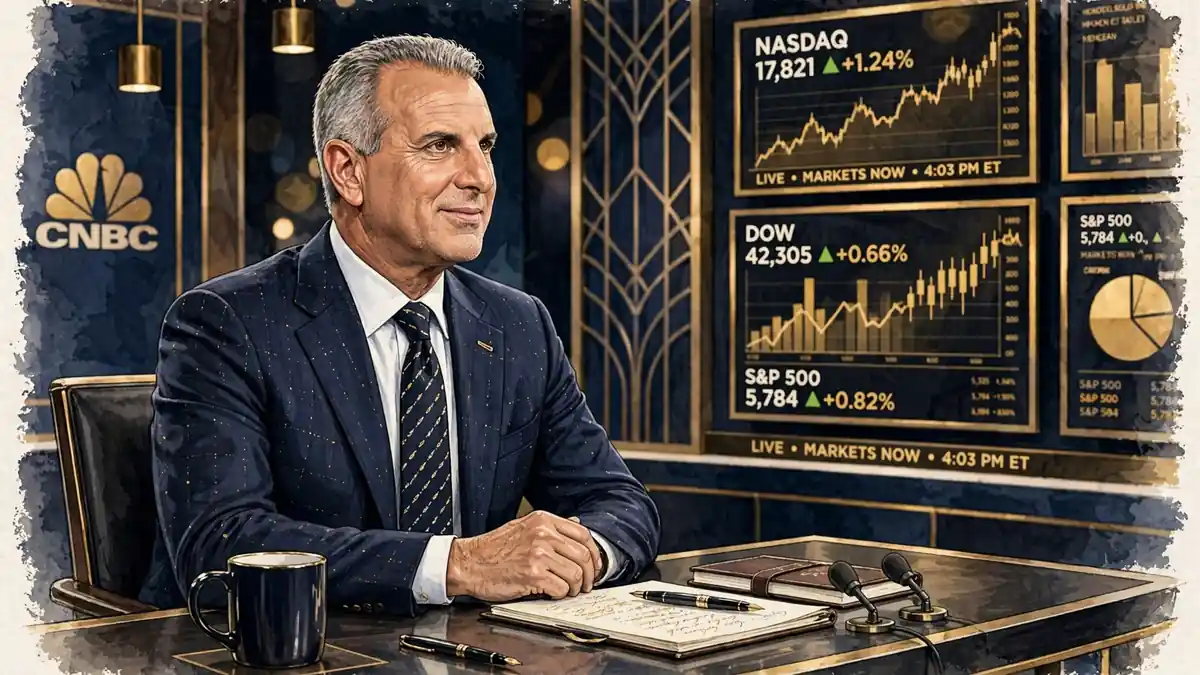
Fast Money debuted on CNBC on June 21, 2006, and Guy Adami was there from the first episode as one of the original “Fast Money Five.” The show was a gamble: a trader-centric program, shot from CNBC’s Englewood Cliffs headquarters with host Dylan Ratigan and a panel of working traders, at a time when financial television was dominated by anchors reading scripts. Adami’s on-screen identity became “The Negotiator,” a nickname that stuck because his style on air matched his style on the floor — patient, volume-driven, willing to wait for a reversal and then commit. Nearly twenty years later, he is still on the panel, now hosted by Melissa Lee alongside Pete Najarian, Tim Seymour, and Karen Finerman, broadcasting from the Nasdaq MarketSite in New York.
The show’s format is the reason Adami became famous rather than merely successful. Fast Money covers options, commodities, and exchange-traded funds through live argument among traders who have actually risked their own capital, and Adami’s commodity background gave him a lane nobody else on the panel owned. CNBC’s own viewer guides note that he appears to be a buy-and-hold or long-term investor by disclosure, yet recommends trades most often on heavy-volume reversals with tight stops — a combination that reads as discipline on television and that viewers remember. He almost never recommends gold on air, a quirk the show’s fans have noted for years: the man who once ran Goldman’s gold book now shies away from the metal in public.
Fame, for Adami, arrived without a single breakout moment. There was no viral clip, no bestselling book, no fund launch with a famous name attached. Instead there were thousands of appearances — weeknights at 5 p.m. Eastern, plus hits across CNBC’s daytime lineup — accumulating into a face that regular viewers recognize the way they recognize a local news anchor. The 2018 New Orleans Investment Conference account captures the scale: a trader and TV personality speaking to a packed room about five fast lessons, introduced as a man who had traded the biggest decision of his life for a television chair. By 2021, that chair had become a platform large enough to build a company on, which is where RiskReversal Media enters the story.
The durability is the point competitors miss when they reduce Adami to a single net worth number. Television finance is a churn business — panels turn over, shows get cancelled, contributors fade — and Adami has survived every cut for almost two decades, outlasting hosts, co-panelists, and two full market cycles. That longevity is itself an asset: it is what makes the speaking fees, the advisory role, and the media company possible, and it is why the $30 million high-end estimate, even if optimistic, is not absurd on its face. A man who has been paid by Wall Street and by television, continuously, since 1986 has had forty years to accumulate.
Main Sources of Income
Guy Adami’s money comes from five distinct streams, and the mix has shifted across his career from pure trading to a blend of media, advisory work, and business ownership. The first stream is the institutional trading career itself: salary and bonuses at Drexel Burnham Lambert, Goldman Sachs, and CIBC World Markets between 1986 and 2006, plus proprietary trading profits. None of those figures are public, and this article does not invent them, but the shape is clear from the roles — a head gold trader and later a proprietary trader at Goldman Sachs in the late 1990s earned multiples of what a television contributor earns today, and those were the years when the bulk of his personal capital was most likely accumulated.
The second stream is CNBC. Adami has been paid by the network, in one form or another, since 2006, and his compensation is the most-asked-about number in his financial life — addressed in detail in the salary section below. The third stream is his advisory and advocacy work at Private Advisor Group, where he serves as Director of Advisor Advocacy for a network of nearly 600 advisors overseeing close to $17 billion in client assets. That role sits at the intersection of his two careers: he is valuable to the firm precisely because advisors and their clients have watched him on television for years, and valuable to CNBC because he still works inside the advisory business every day.
The fourth stream is RiskReversal Media, the digital-first financial media company he co-founded with Dan Nathan in 2021. The company produces the RiskReversal Pod, the “On The Tape” podcast with Danny Moses and Liz Young of SoFi, and a daily stream of market analysis across YouTube, Instagram, and X. Media companies of this size are rarely valued in public, and RiskReversal has disclosed no revenue, so this article treats the stake as a real but unquantified asset — valuable as a business, not as a number on a balance sheet. The fifth stream is speaking: $20,000 to $30,000 per engagement through Keppler Speakers, a rate Market Realist reported from his speaking bio, with appearances at universities, investment conferences, and corporate events adding up across a year.
What the income mix does not include is equally telling. Adami has no bestselling book, no fund with his name on the door, no product line, and no record of major endorsement deals with consumer brands. His wealth, if the high-end estimates are right, was built the slow way: forty years of professional pay, compounded. That is why the low-end $4 million figure from Celebrity Net Worth is also plausible on its own terms — a trader who spent his peak earning years before the era of eight-figure media contracts, who lives in a New Jersey suburb rather than a Manhattan penthouse, and whose business is a podcast network rather than a hedge fund, could reasonably hold a single-digit-million fortune. The honest answer is that the public record supports the range, not a point estimate, and the rest of this article works inside that range.
For readers weighing Adami against the television investors they know best, the contrast with Mark Cuban’s net worth is instructive: Cuban built a multi-billion-dollar fortune by selling companies, while Adami built his by selling his time and judgment, year after year. The Daymond John net worth story sits closer to Adami’s scale — a television investor whose brand and business holdings compound over decades — and the peer comparison table later in this article puts the three side by side with their sources named.
Salary and Earnings
Guy Adami’s CNBC salary has never been publicly disclosed, and neither Adami nor the network has ever confirmed a number. Third-party estimates place his annual CNBC compensation between $500,000 and $1,000,000, a figure Biography Points reports with an explicit warning that it is unverified. That range is consistent with what senior CNBC contributors are believed to earn — well above a staff reporter’s pay, well below the multi-million-dollar contracts of the network’s star anchors — and it is the only salary number in circulation that survives even a light check. Any article that states a precise CNBC salary for Adami as fact is guessing.
The trading-era earnings are harder to pin down and, in total, probably larger. A vice president and head gold trader at Drexel Burnham Lambert in the late 1980s and early 1990s, a proprietary trader in Goldman Sachs’ J. Aron group in the late 1990s, and an executive director at CIBC World Markets in the 2000s would have earned a base salary plus a bonus tied to the profitability of his book. In strong years at Goldman Sachs, senior proprietary traders took home seven-figure bonuses; in weak years, far less. Over the twenty years from 1986 to 2006, a reasonable reading is that Adami’s cumulative trading compensation ran into the low eight figures before tax, spending, and investment returns — enough to explain the high end of the net worth range, and enough to make the low end look cautious rather than wrong.
Speaking fees add a concrete, sourced line. Market Realist, citing his Keppler Speakers bio, reports that Adami charges between $20,000 and $30,000 per speaking engagement. He joined Keppler Speakers in 2012, and his calendar has included universities from Quinnipiac to the University of North Carolina, investment conferences such as the New Orleans Investment Conference, and corporate events. Even a modest schedule of ten to fifteen paid appearances a year would add $200,000 to $450,000 in gross speaking income — before the agency’s cut and taxes, but real money all the same, and money that most net worth roundups never count.
The advisory role at Private Advisor Group and the Chief Market Strategist post at OptionsANIMAL, held since 2012, add further pay that no public source quantifies. This article does not assign numbers to them. What can be said is that a Director of Advisor Advocacy at a firm with nearly 600 advisors and close to $17 billion in assets is a senior, salaried position, not an honorary title — and that Adami has held it alongside his television work for years, stacking two professional incomes in the same week. The earnings picture that emerges is a man who has been paid, continuously and from several directions at once, for forty years. That is the strongest argument for the upper half of the published range.
| Career phase | Years | Main pay source | What is known |
|---|---|---|---|
| Drexel Burnham Lambert | 1986–1996 | Trading salary + bonus | VP and head gold trader; figures not public |
| Goldman Sachs, J. Aron | 1996–2003 | Proprietary trading pay | Head gold trader, then U.S. Equities; peak institutional earning years |
| CIBC World Markets | 2003–2006 | Executive director pay | Head of Industrial/Basic Materials equities |
| CNBC Fast Money | 2006–present | Television contributor pay | Estimated $500,000–$1,000,000 a year (unverified) |
| Speaking circuit | 2012–present | Paid engagements | $20,000–$30,000 per event, via Keppler Speakers |
| RiskReversal Media | 2021–present | Co-founder equity | Value undisclosed; podcasts + digital media |
Businesses and Investments
RiskReversal Media is the business that matters most in Adami’s portfolio, and it is also the hardest to value. Founded in 2021 by Adami and Dan Nathan — a fellow CNBC Fast Money panelist since 2011 and the founder of RiskReversal.com — the company describes itself as a digital-first financial media business built by long-time market participants. Its flagship products are the RiskReversal Pod, a daily market podcast, and “On The Tape,” a weekly show in which Adami and Nathan are joined by former hedge fund manager Danny Moses and SoFi’s head of investment strategy, Liz Young. The SiriusXM press release announcing Adami and Nathan’s live show in June 2023 calls RiskReversal “a digital-first financial media company founded by long-time market participants and CNBC’s Fast Money panelists Guy Adami and Dan Nathan,” and the company now distributes across YouTube, Instagram, X, and LinkedIn as well as audio platforms.
No revenue, valuation, or ownership split has ever been disclosed for RiskReversal Media, and this article will not guess at one. What can be observed is the trajectory: a podcast that began in December 2020 had passed 900 episodes by early 2026, with daily drops, sponsors, and a roster of guests that includes Morgan Stanley’s Mike Wilson and Robinhood’s chief investment officer. A media business with that cadence and that guest list earns real advertising and sponsorship revenue, and a co-founder’s equity in it is a genuine asset even if its dollar value is unknowable from the outside. The honest treatment is to count it as upside to the net worth range rather than as a fixed number inside it.
Adami’s earlier business venture, Drakon Capital, tells a similar story at a smaller scale. Launched in August 2008 under the optionMONSTER umbrella with Pete and Jon Najarian, Drakon specialized in the kind of options and volatility trading the Najarian brothers had built their reputation on. Adami’s role as a managing director at optionMONSTER placed him inside the options-education and trading business at the moment retail options trading was beginning its long expansion — a decade before it became a mainstream retail phenomenon. The venture did not make him famous, and no public record values his stake, but it added a second entrepreneurial line to a career that already had one.
His personal investments are the least visible part of the picture. CNBC’s own viewer guide describes Adami, based on the show’s disclosures, as a buy-and-hold or long-term investor who recommends trades most often on heavy-volume reversals with tight stops. He has spoken publicly about macro-driven swing trading — combining technical chart patterns with interest-rate moves, earnings, and sector rotation — but he has never published a portfolio, a track record, or a list of holdings. This article therefore treats his personal investments as unknown: they could add meaningfully to the high end of the range, or they could be modest. The $100 million-plus figures that circulate on low-quality content farms, claiming offshore entities and private-equity stakes, are unsourced inventions and are not repeated here except to warn readers away from them. No credible outlet supports them, and they contradict everything known about a career spent in salaried trading and television.
The Daymond John story offers the nearest parallel among television business figures: a brand built on air, converted into equity in a real operating business. Adami’s version is smaller and quieter — a podcast network rather than a fashion empire — but the mechanics are the same, and the same logic applies to the valuation: the business is worth what its cash flow and audience are worth, and neither number is public yet.
Brand Deals and Sponsorships
Guy Adami has no consumer brand endorsements of the kind that fill celebrity net worth articles — no watch deal, no car campaign, no clothing line. His commercial relationships are all inside the financial world, and they read as professional partnerships rather than sponsorships. The clearest is OptionsANIMAL, where he has served as Chief Market Strategist since 2012, contributing market commentary and education to the options-training platform. The second is his long association with the Najarian brothers’ optionMONSTER and Drakon Capital ventures, which were business partnerships built on shared trading expertise rather than paid endorsements.
Speaking representation is the closest thing Adami has to a commercial deal structure. Keppler Speakers, which he joined in 2012, markets him to universities, conferences, and corporate clients at $20,000 to $30,000 per engagement. That is a fee-for-service arrangement, not a sponsorship, but it functions the same way in the income statement: a third party monetizes his name and reputation, takes a cut, and passes the rest to him. The same logic applies to the SiriusXM live show he began hosting with Dan Nathan in June 2023 — a paid media engagement that trades on the RiskReversal brand the two men built together.
Podcast sponsorship is the newest line. The RiskReversal Pod carries sponsors, as its listings note, and sponsor revenue flows to RiskReversal Media rather than to Adami personally. The distinction matters for the net worth estimate: sponsor dollars are company revenue, and Adami benefits as a co-owner, not as a paid endorser. Readers who see a brand name on a RiskReversal episode should not add that money to Adami’s personal fortune directly.
The absence of consumer deals is itself informative. Television finance personalities who chase endorsements tend to accumulate them visibly — books, courses, branded funds — and Adami has accumulated almost none of those. His commercial footprint is narrow, professional, and tied to his actual expertise, which is consistent with a net worth built from salaries and equity rather than from licensing his face. It is also why the $4 million low-end estimate cannot be dismissed: a man with no book, no fund, and no endorsement portfolio has fewer windfalls to point to than the celebrity roundups usually assume.

Houses, Cars and Other Assets
Guy Adami lives in Morristown, New Jersey, where he and his wife Linda raised their three children. Morristown is a prosperous Morris County town with a median home value well above the national average, and it is the base for both his family life and his role at Private Advisor Group, which is headquartered there. No public property record, listing, or profile has ever disclosed the address, purchase price, or current value of the Adami home, and this article does not publish an address or a guessed value. What can be said is that the family has lived in the same town for decades, that one son attended Delbarton School in Morristown — an independent preparatory school whose tuition runs to tens of thousands of dollars a year — and that the household pattern is one of settled, upper-middle-class stability rather than display.
The same restraint applies to cars and other visible assets. No profile, interview, or social media post documents a car collection, a boat, a second home, or a watch collection for Adami, and the absence is notable in a genre where such details are usually the first thing a roundup invents. He is not a collector in public, and he does not post lifestyle content. The most expensive object associated with him in any public record is not a car but a feat of endurance: the New York City Ironman triathlon he completed on August 11, 2012, in 16 hours, 19 minutes, and 52 seconds — a race that requires a bicycle, a wetsuit, and months of training, but not a fortune.
For the net worth estimate, the property picture cuts both ways. A long-held home in Morristown, bought decades ago, would have appreciated substantially and could represent a seven-figure asset on its own. At the same time, the absence of any second property, luxury vehicle, or art collection in the public record suggests that real estate is not a major driver of his wealth. The honest accounting is that the family home is likely his largest single tangible asset after any investment accounts, and that its value is unknowable from public sources. Readers should treat any article that prices Adami’s house to the dollar as fiction.
The broader point is that Adami’s asset profile looks like a working professional’s, not a celebrity’s. His wealth, whatever its size, is held in the ordinary places — a home, retirement and brokerage accounts built over forty years of earnings, and equity in a private media company — rather than in the trophy assets that dominate other net worth stories. That profile fits the $4 million to $30 million range better than it fits the $100 million-plus fantasies on content farms, and it is one more reason this article publishes the range and shows its work.
Awards and Achievements
Adami’s honors are the kind that accumulate over a long career rather than arriving in a single ceremony. In November 2010, his high school inducted him into the Croton-Harmon High School Hall of Distinguished Graduates, recognizing the trading career and the television career together. In November 2022, he was inducted into the Tri County Scholarship Fund Hall of Fame, an honor tied to his fundraising and mentorship work in New Jersey rather than to his television fame. Quinnipiac University awarded him an honorary Doctorate of Humane Letters, according to Biography Points, in recognition of his speaking and service to the university.
The athletic achievement is the most vividly documented: on August 11, 2012, Adami completed the New York City Ironman in 16:19:52. Market Realist’s profile of him frames the race as the endpoint of a Fast Money interview that started his Ironman journey, and the detail has stuck to his biography ever since — partly because it is so out of character for a television trader, and partly because it is verifiable to the second. He was 48 years old, working full-time on television, and he finished a 140.6-mile race. It is the single most concrete achievement in his public record, and it says more about his discipline than any award could.
His civic record is long and specific. Adami served on the board of the New Jersey chapter of the Leukemia & Lymphoma Society for a decade, including five years as co-chairman, and served as vice chairman of the chapter according to his CNBC profile. He has served on the national board of Invest in Others and on the board of Big Brothers Big Sisters of America, and he currently serves on the board of I Have The Right To, according to CNBC Events. He has helped raise funds for Delbarton School and for the Children’s Aid Society, and his “Ironteam” fundraising group raised $681,730 for charity, surpassing its original $500,000 goal, as announced at a board meeting on December 11, 2012. None of these roles pays a salary, and all of them cost time; together they describe a man who treats his public profile as a civic asset, not only a commercial one.
Professionally, the achievement that matters most is the simplest: he is still on Fast Money after nearly twenty years. The show has cycled through hosts and panelists, moved studios, and survived the 2008 crisis, the pandemic, and the streaming era, and Adami has been on the panel through all of it. Longevity on live television is its own award — it is voted on every night by viewers who can change the channel — and it is the foundation under everything else in this article.
Net Worth Growth Over the Years
No year-by-year record of Guy Adami’s wealth exists, and the table below is an illustrative reconstruction, not a filing. It is built from the career milestones that are documented — the Drexel promotion, the Goldman Sachs move, the Fast Money debut, the RiskReversal founding — and from the two published estimates that anchor the range. The figures are labeled as estimates at every step, and the wide bands are deliberate: they show how little is actually known, and how much of the growth story is a story of steady accumulation rather than sudden windfalls.
| Year | Milestone | Estimated net worth |
|---|---|---|
| 1986 | Joins Drexel Burnham Lambert, NYMEX floor | Under $100,000 |
| 1990 | VP and head gold trader at Drexel | $250,000–$750,000 |
| 1996 | Joins Goldman Sachs, J. Aron | $1 million–$3 million |
| 2000 | Moves to Goldman U.S. Equities | $2 million–$5 million |
| 2003 | Executive director, CIBC World Markets | $3 million–$7 million |
| 2006 | Debuts on CNBC Fast Money; quits CIBC | $3 million–$8 million |
| 2012 | OptionsANIMAL strategist; Ironman; Keppler Speakers | $4 million–$12 million |
| 2018 | Twelve years on Fast Money; New Orleans keynote | $4 million–$20 million |
| 2021 | Co-founds RiskReversal Media | $4 million–$25 million |
| 2023 | SiriusXM live show with Dan Nathan | $4 million–$28 million |
| 2026 | Still on Fast Money; RiskReversal past 900 episodes | $4 million–$30 million |
The shape of the table is the argument. Adami’s wealth, on any reading, grew fastest during the institutional years — the late 1980s at Drexel and the late 1990s at Goldman Sachs — when bonuses were large and living costs were comparatively low. The television years added steady, high, but not spectacular income, and the media-company years added equity whose value is still unproven. The low end of the range has barely moved since 2012, which is what you would expect if Celebrity Net Worth’s $4 million figure reflects a conservative reading of disclosed income only. The high end has crept upward with each new venture, which is what you would expect if the $30 million figure counts the full value of a forty-year career plus the media business. Both readings are defensible, and the truth most likely sits between them.
Put beside his peers, the range looks modest, and that modesty is itself a finding. The peer table below uses only figures with a named source, and it shows Adami as a successful working trader who became a television fixture — not as a mogul. Mark Cuban’s fortune, built by selling companies, is measured in billions; Adami’s, built by selling his time and judgment, is measured in millions. That is not a criticism. It is the difference between an owner and an employee, and Adami has been, for most of his career, the most richly rewarded kind of employee Wall Street and television have to offer.
| Person | Known for | Reported net worth | Source |
|---|---|---|---|
| Guy Adami | CNBC Fast Money; ex-Goldman gold trader | $4 million–$30 million | Celebrity Net Worth; Market Realist; Biography Points |
| Mark Cuban | Shark Tank; sold Broadcast.com | About $5.7 billion | Forbes |
| Daymond John | Shark Tank; FUBU founder | About $350 million | Celebrity Net Worth |
| Jim Cramer | CNBC Mad Money host | About $150 million | Celebrity Net Worth |
The Cramer comparison is the most useful of the three, because Cramer is the closest analogue: a former hedge fund manager turned CNBC host, with a book and a subscription business on top of the television salary. Cramer’s reported $150 million is roughly five times Adami’s high-end estimate, and the gap is explained by the extras — Cramer’s books, his Action Alerts Plus service, and his earlier fund — that Adami never built. The comparison also shows why the $30 million figure, even at the top of Adami’s range, is not a stretch: a man with a similar television seat and a longer trading career could plausibly hold a fifth of Cramer’s reported wealth.
Social Media Presence
Guy Adami is a light social media user by the standards of modern television personalities, and his presence is professional rather than personal. His most active platform is X, where he posts as @GuyAdami, sharing market commentary, Fast Money clips, and RiskReversal Media episodes. The account functions as an extension of the television show: charts, trade ideas, and reactions to earnings, rather than lifestyle content or family photos. RiskReversal Media maintains its own accounts — @RiskReversal on X, @riskreversalmedia on Instagram and YouTube — and Adami appears across them as a host and co-founder, which means his social reach is best measured through the company as well as through his personal handle.
He does not run a personal Instagram feed of the kind that drives endorsement income, and he has no TikTok presence of note. That restraint is consistent with everything else in his profile: a 62-year-old trader who came to television from the trading floor, not from the influencer economy, and who treats social media as a distribution channel for market views rather than as a business in itself. For the net worth question, the consequence is straightforward — social media contributes to Adami’s wealth indirectly, through RiskReversal’s audience and sponsors, rather than directly through paid posts or brand deals.
The RiskReversal Pod’s distribution tells the growth story better than any follower count. The show publishes daily, has passed 900 episodes, and brings on guests from the top of the finance world — Morgan Stanley strategists, Robinhood executives, hedge fund managers — which is the kind of booking power that only comes with a real audience. The company’s YouTube channel, @RiskReversalMedia, carries the video versions of the same shows. None of these numbers is published as a valuation, and this article does not convert followers into dollars, but the audience is the asset that makes the media company worth something, and Adami owns a founder’s share of it.
Personal Life
Guy Adami has been married to Linda Snow Adami since August 2, 1997. The couple have three children — one daughter and two sons — and the family lives in Morristown, New Jersey, where they have been based for decades. Wikipedia lists his spouse as Linda Adami and his children as three; Biography Points gives the wedding date and the children’s breakdown, and the Morristown residence is confirmed across multiple profiles. The children’s names have not been made public in reliable sources, and this article does not publish them: the family has kept that detail private, and there is no reporting value in repeating names scraped from low-quality biography sites.
The marriage has lasted through the whole of Adami’s television career — he was 33 when he married, 42 when he quit CIBC for CNBC, and 62 as this article is published — and the stability shows in the choices the family has made. They stayed in New Jersey rather than moving to Manhattan. Their son attended Delbarton School in Morristown, where Adami himself has given talks. The family pattern is one of deep local roots: the same town, the same school community, the same charitable boards, year after year. It is the opposite of the peripatetic celebrity life, and it is one more piece of evidence for the modest end of the net worth range.
Outside work, Adami’s best-documented pursuit is endurance sport. The 2012 New York City Ironman — 2.4 miles of swimming, 112 miles of cycling, and a full marathon, finished in 16:19:52 — remains the headline, but the training behind it was the real commitment, months of early mornings fitted around a television schedule. He has also been inducted into the Tri County Scholarship Fund Hall of Fame, in November 2022, for work that blends philanthropy with mentorship in the New Jersey community. His board service — a decade with the Leukemia & Lymphoma Society’s New Jersey chapter, five years as its co-chairman, plus seats with Invest in Others, Big Brothers Big Sisters of America, and I Have The Right To — fills the space in his biography that other television figures fill with hobbies and holidays.
Adami keeps his private life private in a way that is increasingly rare for a television personality. He does not discuss his children on air, does not post family photographs, and does not use his platform for personal revelation. The restraint is worth respecting in a net worth article: the numbers that matter are the professional ones, and the family details that are public — a 1997 wedding, three children, a Morristown home — are enough to complete the picture without prying further.
Sources & Reporting
Wikipedia — birth date and place, family background, Croton-Harmon High School career and 2010 hall-of-fame induction, Drexel/Goldman Sachs/CIBC career timeline, marriage and three children. Reporting window: page as reviewed November 2026.
Georgetown University, Psaros Center for Financial Markets and Policy — 1986 B.S. in Business, Drexel promotion to VP and head gold trader, Goldman Sachs J. Aron role and 2000 move to U.S. Equities, CIBC executive director role, Private Advisor Group title with nearly 600 advisors and close to $17 billion in assets. Reporting window: profile as reviewed November 2026.
CNBC — Fast Money original membership, “The Negotiator” nickname, current panel role, and Adami’s contributor profile; CNBC Events pages confirm the RiskReversal Media founding, the Leukemia & Lymphoma Society board service, and the I Have The Right To board seat. Reporting window: November 2026.
Celebrity Net Worth — current $4 million net worth figure, the low end of this article’s range, plus career summary and Private Advisor Group role. Reporting window: page as reviewed November 2026.
Market Realist — the older $30 million figure (attributed to Celebrity Net Worth at the time), the $20,000–$30,000 speaking fee via Keppler Speakers, the Ironman backstory, and the Leukemia & Lymphoma Society vice-chairmanship. Reporting window: article as reviewed November 2026.
Biography Points — $30 million estimate, $500,000–$1,000,000 CNBC salary estimate (flagged unverified), marriage date of August 2, 1997, three children, Morristown residence, Quinnipiac honorary doctorate, and the $681,730 Ironteam fundraising total. Reporting window: page updated about 46 days before this article, reviewed November 2026.
MN2S — career milestones timeline, 2021 RiskReversal Media founding, OptionsANIMAL role since 2012, Ironman time of 16:19:52, and Tri County Scholarship Fund Hall of Fame induction in November 2022. Reporting window: page as reviewed November 2026.
SiriusXM (press release, June 8, 2023) — Adami and Dan Nathan’s live SiriusXM show, RiskReversal Media described as a digital-first financial media company founded by the two Fast Money panelists. Reporting window: June 2023.
Where sources disagree — above all on the net worth figure itself — this article publishes the range and names the outlet behind each end of it. Figures from content farms claiming $100 million or more, offshore entities, or private-equity stakes were checked and excluded: no credible outlet supports them.
Frequently Asked Questions
What is Guy Adami’s net worth?
Guy Adami’s net worth is estimated at $4 million to $30 million as of November 2026. Celebrity Net Worth currently lists him at $4 million, while Market Realist, Biography Points, and LuxLux report $30 million. No official disclosure exists, so this article publishes the full range and names the source behind each end of it.
How much does Guy Adami make on CNBC?
His CNBC salary has never been publicly disclosed. Third-party estimates place his annual CNBC pay between $500,000 and $1,000,000, but that figure is unverified and neither Adami nor CNBC has confirmed it. His speaking engagements, at $20,000 to $30,000 each through Keppler Speakers, are a separately documented income line.
Is Guy Adami still on Fast Money?
Yes. Guy Adami is an original member of CNBC’s Fast Money, on the panel since the show debuted on June 21, 2006. He remains a regular panelist nearly twenty years later, alongside Pete Najarian, Tim Seymour, and Karen Finerman, under host Melissa Lee.
Who is Guy Adami’s wife?
Guy Adami’s wife is Linda Snow Adami. They married on August 2, 1997, and have three children — one daughter and two sons. The family lives in Morristown, New Jersey. The children’s names have not been made public in reliable sources.
How old is Guy Adami?
Guy Adami was born on December 18, 1963, in North Tarrytown, New York (now Sleepy Hollow). He is 62 years old as of November 2026 and turns 63 on December 18, 2026.
What did Guy Adami do before CNBC?
He spent twenty years as an institutional trader: Drexel Burnham Lambert from 1986, where he became vice president and head gold trader; Goldman Sachs from 1996, as head gold trader in the J. Aron commodities group and later in U.S. Equities; and CIBC World Markets from 2003 as an executive director. He quit CIBC in 2006 to join Fast Money.
What is RiskReversal Media?
RiskReversal Media is the digital-first financial media company Guy Adami co-founded with fellow Fast Money panelist Dan Nathan in 2021. It produces the daily RiskReversal Pod and the weekly “On The Tape” show with Danny Moses and Liz Young, and Adami and Nathan began hosting a live show for SiriusXM in June 2023. No revenue or valuation has been disclosed.
Where does Guy Adami live?
Guy Adami lives in Morristown, New Jersey, with his wife Linda and their family. Morristown is also where Private Advisor Group is based, where he serves as Director of Advisor Advocacy, and where his son attended Delbarton School.
Final Thoughts
Guy Adami’s net worth is estimated at $4 million to $30 million, and the honest thing is to leave the number there. The range is not a failure of research; it is the research. One of the best-known celebrity wealth sites says $4 million today, several others still say $30 million, and nothing in the public record — no filing, no rich-list entry, no disclosure — settles the argument. What the record does settle is the career behind the number: forty years of paid work in markets, from the Drexel gold pit to the Goldman Sachs proprietary desk, from a quit-your-job gamble on a new CNBC show to a media company built with a fellow panelist in his late fifties.
The career is the real story, and it is worth more than the argument over the number. Adami traded the biggest decision of his life at 42, with three children and a mortgage, and the trade paid off for nearly twenty years. He finished an Ironman at 48, raised $681,730 for charity with his Ironteam, spent a decade on the Leukemia & Lymphoma Society’s New Jersey board, and built a second career in media after the first one had already made him. Readers who want a single number will find plenty of sites willing to invent one. Readers who want the truth will take the range, the sources behind each end of it, and the career that earned it — and that is what this article set out to give them.
Published on November 22, 2026. Last reviewed November 2026. Found an error? See our corrections policy.