
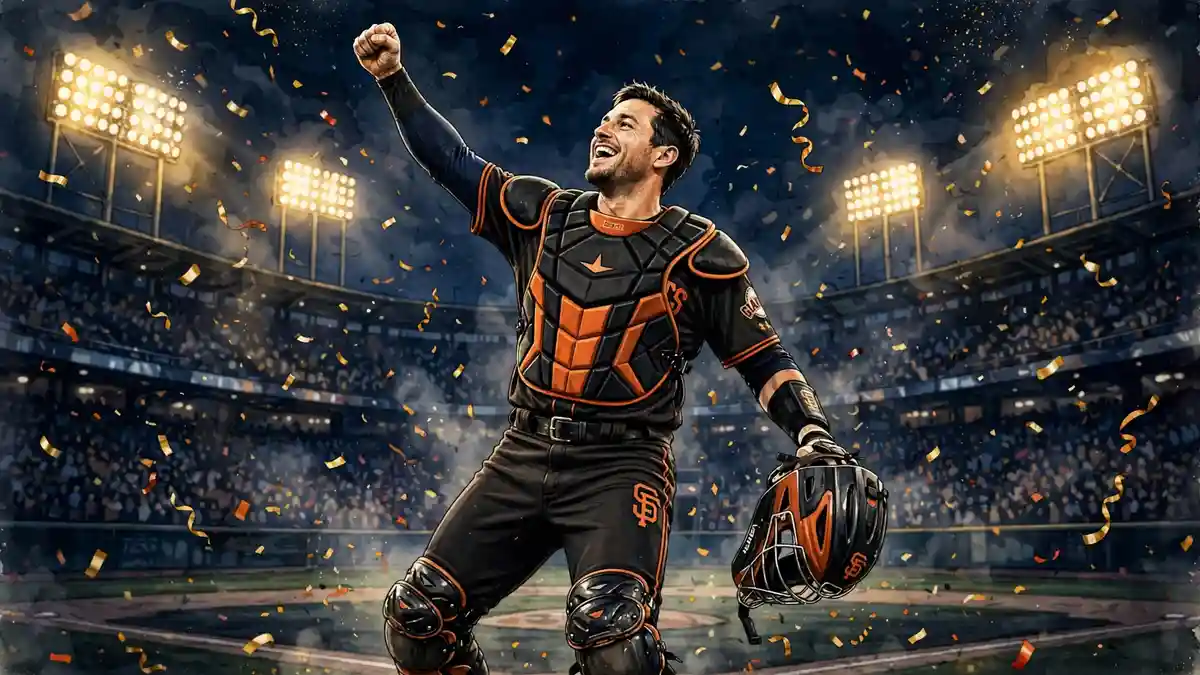
Buster Posey‘s net worth is estimated at $150 million to $180 million as of November 2026. The former San Francisco Giants catcher banked $153.8 million in recorded playing salary, then did something almost no retired star does: he bought into the team he played for, joining the Giants’ ownership group in September 2022, and two years later he took charge of the whole baseball operation as president of baseball operations. In November 2026 he headlined the 2027 Baseball Hall of Fame ballot, a first-ballot case built on three World Series rings, a 2012 National League MVP award and a .302 career batting average.
Buster Posey: Quick Facts
| Estimated net worth | $150 million – $180 million (range: $150 million to $180 million) |
|---|---|
| Profession | Former MLB catcher; President of Baseball Operations, San Francisco Giants |
| Nationality | American |
| Born | March 27, 1987 (age 39) |
| Height | 6 ft 1 in (1.85 m) |
| Primary income sources | MLB salary ($153.8 million career), endorsements, Giants ownership stake, executive salary |
| Active years | 2009–2021 (playing); 2022–present (ownership and executive) |
| Last reviewed | November 2026 |
- Early Life and Background
- Education
- Career Journey
- Rise to Fame
- Main Sources of Income
- Salary and Earnings
- Businesses and Investments
- Brand Deals and Sponsorships
- Houses, Cars and Other Assets
- Awards and Achievements
- Net Worth Growth Over the Years
- Social Media Presence
- Personal Life
- Sources & Reporting
- Frequently Asked Questions
Early Life and Background
Gerald Dempsey Posey III was born on March 27, 1987, in Leesburg, Georgia, to Gerald Dempsey “Demp” Posey II and Traci Posey. He was the oldest of four children. The nickname “Buster” stuck early — it came from his father, who had been called Buster himself — and by the time the younger Posey reached the major leagues, almost nobody in baseball used his given name.
Leesburg is a small city in southwest Georgia, and Posey grew up as a four-sport athlete at Lee County High School, playing baseball, football, basketball and soccer. Baseball was where his talent separated him from everyone else: he could hit for power and average, and he could also pitch. In his senior season he was named Georgia’s Gatorade Player of the Year and the Louisville Slugger State Player of the Year. The Los Angeles Angels drafted him in the 50th round of the 2005 MLB Draft, but Posey turned the offer down and went to college instead — a decision that would pay off in a way few draft picks ever see.
Money was not the family business. Posey’s father worked in agriculture-related jobs, and the family lived a middle-class life in south Georgia. Nothing in his upbringing pointed toward a nine-figure fortune. What pointed toward it was the bat: by his final high school season, scouts were already grading him as a future first-round pick if he developed at the college level.
Education
Posey attended Florida State University, where he played for the Seminoles under longtime head coach Mike Martin. His freshman season in 2006 was spent at shortstop, where he started all 65 games and was named a Louisville Slugger Freshman All-American. He also spent that summer with the Yarmouth-Dennis Red Sox in the Cape Cod Baseball League, winning a league championship.
The move that made his career came as a sophomore, when the Seminoles shifted him behind the plate. Catchers who can hit are the scarcest commodity in baseball, and Posey could do both at an elite level. He finished as runner-up for the Johnny Bench Award, given to college baseball’s best catcher, in his sophomore year, then won it outright as a junior.
His 2008 junior season is one of the great college campaigns in the sport’s history: a .463 batting average with 26 home runs and 93 RBI. He swept the major college awards that spring — the Golden Spikes Award, the Dick Howser Trophy, the Johnny Bench Award and the Brooks Wallace Award — and was named ACC Baseball Player of the Year and Collegiate Baseball Player of the Year. He even pitched for the Seminoles, recording six saves with a 1.17 ERA. When the 2008 MLB Draft arrived, the San Francisco Giants took him with the fifth overall pick and signed him to a $6.2 million bonus, then the largest ever given to a catcher in the draft at that point.
Career Journey
Posey’s professional career began in the minor leagues in late 2008, and he reached the majors on September 11, 2009, appearing in seven games for the Giants that September. He started 2010 in Triple-A Fresno, but by late May the Giants had called him up for good. He never went back down.
The 2010 season made him a star overnight. Posey hit .305 with 18 home runs and 67 RBI in 108 games, won National League Rookie of the Year, and caught the final out of the Giants’ first World Series title since the franchise moved to San Francisco in 1958. He was 23 years old and already the face of a championship team.
The next season nearly ended his career. On May 25, 2011, Florida Marlins outfielder Scott Cousins crashed into Posey at home plate, leaving him with a fractured fibula and torn ligaments in his left ankle. Posey played only 45 games that year. The collision had a lasting effect on the sport itself: Major League Baseball adopted Rule 7.13 in 2014, restricting home-plate collisions, a change still widely known as the Buster Posey Rule.
He came back in 2012 with the finest season of his career, then settled into a decade as the Giants’ on-field leader. Posey caught 1,093 games across 12 seasons, all of them in a Giants uniform — a one-franchise career that has become rare in modern baseball. He handled a pitching staff that included Madison Bumgarner, Tim Lincecum and Matt Cain through three championship runs, and by the end he was calling games with the authority of a coach on the field.
There were interruptions. Concussions cost him time, a hip injury slowed him in 2018 and 2019, and his batting average slid to .257 in 2018 and .688 OPS in 2019. Then came 2020: with the season shortened by the pandemic, Posey opted out entirely after he and his wife Kristen adopted twin girls who had been born prematurely and spent time in a newborn intensive care unit. He walked away from a full season’s pay to be with his family.
The year off turned out to be a reset. Posey returned in 2021 and hit .304 with 18 home runs and an .889 OPS, made his seventh All-Star team, and helped the Giants win a franchise-record 107 games and the National League West. Then, at 34, coming off one of his best seasons, he retired. The announcement came on November 4, 2021. He left a $22 million club option for 2022 on the table, taking the $3 million buyout instead, and said he felt at peace — he had emptied the tank, in his own words, and wanted to be present for his four children while his body still let him enjoy retirement.
Rise to Fame
Posey’s rise was unusually fast and unusually complete. Most catchers take years to earn a pitching staff’s trust; Posey had it within months of his debut. The 2010 Rookie of the Year award and World Series ring arrived in the same season, and the 2012 campaign — National League MVP, batting title at .336, Silver Slugger, Comeback Player of the Year, Hank Aaron Award and a second World Series — put him in the conversation as the best catcher in baseball before his 26th birthday.
The 2013 contract extension was the financial turning point. Signed in March 2013, the nine-year, $167 million deal ran through 2021 and was, at the time, the largest contract in Giants history and the longest ever given to a catcher. It included a $7 million signing bonus and a full no-trade clause. Giants chief executive Larry Baer called it “by any measure the largest and boldest commitment we’ve ever made” when it was announced, and general manager Brian Sabean said Posey was the kind of player who “comes around either once every baseball life or not that often.”
The third World Series title came in 2014, when the Giants beat the Kansas City Royals in seven games. Posey caught 36 of the Giants’ 38 postseason games across the three championship runs, and he remains the only player who appeared on all three title-winning rosters. That 2010–2014 stretch — three rings in five seasons — is the foundation of his Hall of Fame case and the reason his name still carries weight in San Francisco a decade later.
Fame for Posey never looked like the celebrity version. He did not chase endorsements or a media profile. His reputation was built on steadiness: the same swing, the same preparation, the same calm in October. That steadiness is also what made the Giants trust him with the franchise itself after he stopped playing.
Main Sources of Income
Posey’s wealth comes from four streams, and the balance between them has shifted sharply since he retired. During his playing days, salary was nearly everything. Since 2022, the ownership stake and the executive job have taken over as the growth engines.
MLB salary. The largest single source by far. Across 12 seasons Posey earned $153.8 million in recorded salary, signing bonuses and other contract compensation, according to Celebrity Net Worth’s contract-by-contract accounting. The 2013 extension alone was worth $167 million over nine years, with a $22 million club option that could have pushed it to $186 million over ten.
Endorsements. Forbes estimated Posey earned about $3.5 million a year from off-field partnerships at the height of his playing career. His brand partners included Nike, Toyota, DirecTV, Rawlings, Topps and Marucci. He was a natural fit for Toyota in particular, appearing in the company’s commercials, and his clean-cut, low-drama image made him one of the more marketable catchers of his era even though catchers rarely lead endorsement rankings.
Team ownership. In September 2022 Posey bought a minority stake in the San Francisco Giants, becoming the 31st principal partner of San Francisco Baseball Associates LLC and a member of the board of directors. He was the first former player in franchise history to join the ownership group, and he bought in with his own money. The size of his stake was never disclosed, and neither was the price — which is why his net worth is honestly stated as a range. What is public is the direction of the asset: Forbes valued the Giants at $3.5 billion when he bought in, and the franchise was valued at $4.05 billion by 2026. Even a small slice of a franchise that gains half a billion dollars in value is a serious holding.
Executive salary. Since September 30, 2024, Posey has been the Giants’ president of baseball operations, overseeing roster construction, scouting, player development and baseball strategy. He signed a three-year executive contract for the role. The salary was not publicly disclosed — front-office pay is rarely published the way player contracts are — so we do not add a figure for it. What matters for his wealth is the position itself: it keeps him inside the franchise whose value his ownership stake rides on, and it gives him control of the baseball decisions that protect that value.
Salary and Earnings
Posey’s career earnings of $153.8 million put him in the upper tier of catchers in baseball history, and the shape of that money tells the story of his career: a modest start, a massive extension in his mid-twenties, and a disciplined finish that left real money on the table.
The early years were lean by star standards. His 2008 signing bonus of $6.2 million was the headline number, but his first big-league salaries were near the league minimum. In 2012 he played on a one-year, $615,000 deal — the same season he won the MVP and the batting title. The Giants fixed that the following spring with the nine-year extension.
Under the extension, Posey’s base salary climbed in steps: $3 million in 2013 after the $7 million signing bonus, $10.5 million in 2014, $16.5 million in 2015, $20 million in 2016, and $21.4 million in each season from 2017 through 2021. The deal also carried performance bonuses — $100,000 for an MVP award, $100,000 for World Series MVP, $75,000 for NL Championship Series MVP, $50,000 for a Gold Glove and $50,000 for an All-Star election — small numbers next to the base pay, but a reminder of how the contract was built around winning.
The arithmetic of his final decision is worth spelling out. The extension included a $22 million club option for 2022 with a $3 million buyout. Had he played that season, his career earnings would have approached $176 million. He chose the buyout and retirement instead, walking away from roughly $19 million in net additional pay at age 34. Few players in any sport have ever retired in that position — coming off an All-Star season, with a $22 million option waiting — and it is the single clearest signal that money was never the only thing driving his decisions.
| Season | Salary / compensation | Note |
|---|---|---|
| 2008 | $6.2 million signing bonus | Drafted 5th overall by San Francisco |
| 2009–2011 | Near league minimum, rising to about $615,000 by 2012 | Rookie of the Year 2010; ankle injury 2011 |
| 2013 | $3 million salary + $7 million signing bonus | Nine-year, $167 million extension signed |
| 2014 | $10.5 million | Third World Series title |
| 2015 | $16.5 million | All-Star, Silver Slugger |
| 2016 | $20 million | Gold Glove, Silver Slugger |
| 2017–2021 | $21.4 million per season | All-Star selections in 2017, 2018 and 2021 |
| 2020 | Opted out — no salary | Family reasons; adopted twins born prematurely |
| 2022 | $3 million buyout | Retired; $22 million club option declined |
| Career total | $153.8 million | Recorded salary and bonuses (Celebrity Net Worth) |
Endorsements added to the salary picture throughout. At his peak, Forbes put his off-field income at about $3.5 million a year — roughly $25 million to $30 million across his career if that peak rate held for most of his prime, though the real number was lower in his early seasons and higher after the 2012 MVP year. Either way, endorsements were a meaningful second stream, worth perhaps a fifth of his playing salary in total.
One more earnings fact that separates Posey from most retired athletes: he has kept earning at a high level after retirement. The executive contract he signed in 2024 pays a front-office salary on top of the ownership stake, so his post-playing income is not the usual slide into broadcasting or appearances. He runs the baseball side of a franchise valued above $4 billion.
Businesses and Investments
Posey’s business life has one centerpiece — the Giants themselves — and a set of smaller commitments around it. He has never been a serial startup investor or a public dealmaker, and there is no record of the kind of venture-capital portfolio some of his peers built. His approach has been narrower and, so far, more effective: own a piece of the franchise you know best, and then go run it.
The ownership purchase was announced on September 21, 2022, less than a year after he retired. Posey became the 31st principal partner in the Giants’ ownership group and joined the board of directors, chaired by Greg Johnson. Giants chairman Greg Johnson said at the time that Posey was “putting his real money in at that high value,” a reference to the Forbes valuation of $3.5 billion, and that the move showed his commitment to the organization. Posey approached his agents with the idea himself after retirement; the board approved it unanimously.
The economics are straightforward even without a disclosed percentage. The Giants were valued at $3.5 billion by Forbes in 2022 and at $4.05 billion in 2026 — a gain of about $550 million, or roughly 16 percent, in four years. A minority stake bought at the 2022 valuation has appreciated with the franchise, and the club’s other holdings add ballast: the Giants own a 33 percent stake in NBC Sports Bay Area and half of Mission Rock, the residential and retail development across McCovey Cove from Oracle Park. Those are the kinds of assets that keep a franchise valuation climbing even in a down year on the field.
Then came the executive appointment. On September 30, 2024, the Giants announced that Posey would replace Farhan Zaidi as president of baseball operations, giving him responsibility for roster construction, scouting, player development and baseball strategy. He signed a three-year deal. The move was a gamble for the club — Posey had no prior front-office experience — and a bet on the same qualities that made him a great catcher: preparation, judgment under pressure and the trust of a clubhouse.
His first major move answered the skeptics quickly. In December 2024 he signed shortstop Willy Adames to a seven-year, $182 million contract — the largest deal in Giants history, bigger than Posey’s own $167 million extension. In June 2025 he pulled off the trade for Rafael Devers, acquiring the Boston Red Sox slugger in a midseason deal that signaled the Giants intended to contend, not rebuild. Both moves were expensive and both were made with an owner’s eye on the long-term value of the franchise, rather than the next season’s standings alone.
Outside baseball, Posey’s main venture is charitable rather than commercial. In 2016 he and Kristen started the BP28 Foundation, which supports pediatric cancer research and helps families of children in treatment. The foundation grew out of the family’s own experience with childhood illness in their circle, and it became more personal still when the Poseys adopted twin girls in 2020 who were born prematurely. Posey won the Roberto Clemente Award in 2016 for his community work, an honor that carries as much weight inside baseball as any of his on-field awards.
Brand Deals and Sponsorships
Posey’s endorsement portfolio was built on reliability. He was never the loudest athlete in a campaign, but brands kept coming back because his image was clean, his performance was consistent, and his appeal crossed from hardcore baseball fans to the family audience that watches October baseball.
Nike supplied his on-field gear and featured him in baseball campaigns through his prime years. Toyota made him a visible ambassador, putting him in television commercials that played on his calm, straight-talking persona. DirecTV used him in baseball-season advertising, and Rawlings, Topps and Marucci rounded out the baseball-specific side — gloves, cards and bats, the equipment of a catcher who was known for doing the small things right.
Forbes estimated the total at about $3.5 million a year at his peak. That put him well behind the game’s biggest endorsement earners — a two-way star like Shohei Ohtani, whose global deals run into tens of millions a year, operates in a different market — but it was strong money for a catcher, a position that rarely leads endorsement lists. The deals also lasted: Posey’s relationships with Nike and Toyota ran across multiple seasons rather than one-off campaigns, which is usually the sign that a brand is happy with the return.
Since retirement, his commercial profile has shifted. He is no longer selling gloves and bats; his public role is the Giants’ front office, and his commercial value now sits inside the franchise. The ownership stake is, in a sense, the biggest brand deal of his life — he bought the brand instead of renting his image to it.
Houses, Cars and Other Assets
Posey’s property history follows the arc of his career: a Bay Area base during his playing days, a return to Georgia after retirement, and then a move back to the Bay Area once the Giants job called.
The best-documented purchase is the Lafayette, California, home he bought in 2013 for $4.6 million, the year he signed the $167 million extension. Lafayette sits in the East Bay, a short drive from San Francisco, and it was the family home through the rest of his playing career. PlayersWiki reported the purchase price at the time, and the house stayed in the family’s hands until after retirement.
After announcing his retirement in November 2021, Posey and Kristen sold the East Bay home and moved back to Georgia to be closer to relatives. The move lasted less than two years — the family had a change of heart and returned to the Bay Area, where Posey’s ownership role and then the front-office job anchored them again. The family also owns property in Georgia, where Posey’s roots remain.
On cars, Posey has been notably low-key. His long association with Toyota put him in the company’s vehicles in commercials, but there is no public record of an exotic car collection or a fleet of luxury vehicles. That fits the broader pattern: unlike some stars who convert salary into visible assets, Posey’s visible spending has stayed modest, and the big money went into the ownership stake rather than a garage.
The asset that matters most is the one without a public price tag. His Giants ownership stake is an illiquid holding — it cannot be sold on a whim, and its value moves with the franchise — but it is also the asset with the clearest growth story in his portfolio, rising with a franchise valuation that went from $3.5 billion to $4.05 billion between his purchase and 2026.
Awards and Achievements
Posey’s trophy case is the reason his Hall of Fame case is serious rather than sentimental. The headline numbers: three World Series championships (2010, 2012, 2014), the 2012 National League MVP award, the 2010 National League Rookie of the Year award, seven All-Star selections, five Silver Slugger Awards, one Gold Glove, a batting title and the 2012 NL Comeback Player of the Year award.
The college honors came first and predicted everything that followed: the 2008 Golden Spikes Award, the Dick Howser Trophy, the Johnny Bench Award and the Brooks Wallace Award, plus ACC Player of the Year. In the majors, the 2012 season stands alone — MVP, batting title at .336, Silver Slugger, Hank Aaron Award and a World Series ring in a single year.
The Hall of Fame question is now live, not theoretical. On November 16, 2026, the Baseball Writers’ Association of America released the 2027 Hall of Fame ballot, and Posey headlined the group of 14 first-time candidates. NBC Sports Bay Area reported he is likely to be inducted on the first ballot, which would put him alongside Joe Mauer — elected in his first year of eligibility in 2024 — as the only catchers in recent memory to go in at the first attempt. Posey is one of only seven catchers with at least 1,000 games played, at least half of them behind the plate, and a .300 lifetime batting average. His 45 career WAR (Baseball Reference) ranks 16th among catchers, and his .831 career OPS and 129 OPS+ sit in the same neighborhood as Mauer’s .827 OPS. The counting stats are the soft spot — 1,500 hits and 158 home runs are light for Cooperstown — but three rings and an MVP carry weight that counting stats do not measure. The results are expected in January 2027, with induction scheduled for July 25, 2027, in Cooperstown.
- World Series champion: 2010, 2012, 2014
- National League MVP: 2012
- National League Rookie of the Year: 2010
- All-Star: 2012, 2013, 2015, 2016, 2017, 2018, 2021
- Silver Slugger Award: 2012, 2014, 2015, 2016, 2017
- Gold Glove Award: 2016
- National League batting champion: 2012 (.336)
- Hank Aaron Award: 2012
- NL Comeback Player of the Year: 2012
- Roberto Clemente Award: 2016
- Golden Spikes Award, Dick Howser Trophy, Johnny Bench Award: 2008 (Florida State)
Net Worth Growth Over the Years
Posey’s net worth grew in three distinct phases: the extension years, when salary piled up; the retirement years, when the money stopped coming in as salary and started working as an asset; and the ownership years, when the franchise valuation did the heavy lifting.
Before the 2013 extension, his wealth was modest by star standards — a $6.2 million signing bonus, a few years of near-minimum salaries, and the 2010 Rookie of the Year season. The extension changed the curve overnight: by 2016, with three years of eight-figure salaries banked, his net worth was already in the tens of millions. By the time he retired in 2021, after nine years of extension money and a decade of endorsements, he was plausibly worth $120 million to $140 million on salary alone, before taxes and spending.
The published estimates tell the same story with a lag. Older pages still list $50 million — a figure that predates the back half of his contract and ignores the ownership stake entirely. BounceMojo’s 2026 ranking puts him at $150 million. Celebrity Net Worth, which updated its Posey page four days before this article was written, puts him at $180 million, citing the $153.8 million in career earnings, the endorsement income and the ownership stake in a franchise now valued at $4.05 billion. The gap between $150 million and $180 million is the ownership stake: nobody outside the Giants’ ownership group knows its size, so any single number would be false precision. Our range of $150 million to $180 million reflects that uncertainty honestly.
| Year | Estimated net worth | What moved it |
|---|---|---|
| 2010 | $5 million – $8 million | Rookie of the Year season; first World Series ring |
| 2013 | $20 million – $30 million | Nine-year, $167 million extension signed |
| 2016 | $60 million – $75 million | Salary at $20 million a year; Gold Glove season |
| 2019 | $100 million – $115 million | Seven years of extension money banked |
| 2021 | $125 million – $140 million | Final season; 107-win Giants; retirement |
| 2024 | $140 million – $160 million | Giants ownership stake; executive appointment |
| 2026 | $150 million – $180 million | Franchise valued at $4.05 billion; Hall of Fame ballot |
How does that compare with his peers? BounceMojo’s 2026 ranking of the richest MLB players lists Alex Rodriguez at $350 million and Shohei Ohtani at $150 million — the same figure it gives Posey. Aaron Judge, whose nine-year, $360 million Yankees deal dwarfs Posey’s extension, sits above him on career earnings, but Judge never owned a piece of his team. The comparison that matters most for Posey’s future is not a salary table but a valuation table: players who own equity in a franchise can see their wealth grow after their last game, while players who only earned salary watch theirs flatten. Posey chose the first path, and the Giants’ valuation has rewarded it so far.
Social Media Presence
Posey keeps a low profile online, in keeping with everything else about his public image. He is active on Instagram as @busterposey, where he posts family moments, Giants content and the occasional look at his front-office work. He does not run the kind of daily content operation that athletes half his age treat as a second career, and he has never used social media to build a personal brand separate from the team.
That restraint is a deliberate choice and, financially, a trade-off. A more active social presence would almost certainly be worth endorsement money — the market pays for reach, and Posey’s name still carries weight with baseball fans. He has chosen the opposite: his influence now runs through the Giants’ front office, where a single signing like the $182 million Willy Adames deal moves more money than a decade of sponsored posts ever would.
Personal Life
Posey married his high school sweetheart, Kristen Powell, on January 10, 2009. They met during their senior year at Lee County High School while taking the SATs, went to the senior prom together, and dated for about four years before marrying. Kristen has been a constant through every phase of his career, from the Florida State years to the front office.
The couple has four children: twins Lee Dempsey and Addison Lynn, born in 2011, and twin girls Livvi and Ada, adopted in 2020. The adoption shaped the most important decision of Posey’s career — opting out of the 2020 season after the girls were born prematurely and spent time in intensive care. He has spoken about that year as the moment his priorities settled for good: baseball was a job he loved, but it was no longer the thing his life was organized around.
The family lived in the East Bay during his playing career, moved to Georgia after retirement to be near relatives, and returned to the Bay Area within two years as Posey’s ownership role deepened. He is a Christian and served as the Giants’ baseball chapel representative during his playing days. His younger sister Samantha played softball at Valdosta State University.
Through the BP28 Foundation, the Poseys support pediatric cancer research and families going through treatment. The foundation’s work is the through-line of his post-playing life alongside the Giants job: one is about the future of a franchise, the other about the future of children facing something far harder than a baseball season.
Sources & Reporting
Celebrity Net Worth — the freshest published estimate ($180 million, updated November 2026) and the contract-by-contract career earnings total of $153.8 million, the nine-year $167 million extension terms, the Forbes endorsement estimate of $3.5 million a year, and the Giants franchise valuation of $4.05 billion in 2026.
Forbes — the Giants’ franchise valuation of $3.5 billion at the time of Posey’s ownership purchase in 2022, and the endorsement income estimate cited by Celebrity Net Worth.
NBC Sports Bay Area — the September 2022 ownership announcement (31st principal partner, board seat, first former player in the group) and the November 2026 Hall of Fame ballot coverage, including the likely first-ballot case and the July 25, 2027 induction date.
NBC Sports — the 2027 BBWAA Hall of Fame ballot announcement naming Posey among the newcomers, and his retirement at 34 after the 2021 season.
Sportsnet — the March 2013 extension reporting: nine years, $167 million, $7 million signing bonus, salary steps and bonus clauses, as announced by the Giants.
MLB Trade Rumors — the September 2022 ownership move, the $3.5 billion Forbes valuation at the time, and Posey’s early career contract details.
The New York Times — Tyler Kepner’s first report of Posey joining the Giants’ ownership group and board of directors in September 2022.
Wikipedia — biographical backbone: birth date and place, Florida State career and awards, marriage and children, the 2011 collision, the 2020 opt-out and the September 2024 executive appointment, cross-checked against the reporting above.
FanGraphs — the retirement analysis: the $22 million club option left on the table, the $3 million buyout, and the family reasons behind the decision, plus the Hall of Fame counting-stats case.
BounceMojo — the 2026 richest MLB players ranking, listing Posey at $150 million alongside Ohtani and Alex Rodriguez at $350 million.
PlayersWiki — the 2013 Lafayette, California, home purchase at $4.6 million, the family details and the endorsement brand list.
Reporting window: contract and career figures cover 2008–2026; the Hall of Fame ballot news is from November 16, 2026; the franchise valuation and net worth estimates are as of November 2026. Where sources disagreed on the net worth figure, we published the range and named who says what rather than picking a single number.
Frequently Asked Questions
What is Buster Posey’s net worth in 2026?
Buster Posey’s net worth is estimated at $150 million to $180 million as of November 2026. Celebrity Net Worth, which updated its Posey page in November 2026, puts him at $180 million, while BounceMojo’s 2026 ranking lists $150 million. The range exists because his Giants ownership stake — bought in September 2022 — was never publicly disclosed in size, so no single figure can be verified.
How much money did Buster Posey make in his baseball career?
Posey earned $153.8 million in recorded salary, signing bonuses and other contract compensation across his 12-season MLB career, according to Celebrity Net Worth. The biggest piece was the nine-year, $167 million contract extension he signed in March 2013, which included a $7 million signing bonus. He also earned about $3.5 million a year from endorsements at his peak, according to Forbes.
What is Buster Posey doing now?
Posey is the San Francisco Giants’ president of baseball operations, a role he took on September 30, 2024, replacing Farhan Zaidi. He oversees roster construction, scouting, player development and baseball strategy on a three-year executive contract. He is also a member of the Giants’ ownership group and board of directors, having bought a minority stake in September 2022.
Is Buster Posey in the Baseball Hall of Fame?
Not yet, but he is on the ballot. Posey was named to the 2027 Baseball Writers’ Association of America Hall of Fame ballot when it was announced on November 16, 2026, headlining the group of 14 first-time candidates. Results are expected in January 2027, and NBC Sports Bay Area reported he is likely to be inducted on the first ballot, with induction scheduled for July 25, 2027, in Cooperstown.
Who is Buster Posey’s wife?
Posey’s wife is Kristen Posey (née Powell), his high school sweetheart. They met during their senior year at Lee County High School in Georgia while taking the SATs and married on January 10, 2009. The couple has four children: twins Lee Dempsey and Addison Lynn, born in 2011, and twin girls Livvi and Ada, adopted in 2020.
How many World Series did Buster Posey win?
Posey won three World Series with the San Francisco Giants, in 2010, 2012 and 2014. He is the only player who appeared on all three championship rosters, and he caught 36 of the Giants’ 38 postseason games across the three title runs.
Why did Buster Posey retire at 34?
Posey announced his retirement on November 4, 2021, after a resurgent final season in which he hit .304, made his seventh All-Star team and helped the Giants win 107 games. He said he felt at peace and had “emptied the tank,” and wanted to spend more time with his family, including the twin girls he and Kristen had adopted in 2020. He walked away from a $22 million club option for 2022, taking the $3 million buyout instead.
What is Buster Posey’s salary as president of baseball operations?
His executive salary has not been publicly disclosed. Front-office contracts are not published the way player contracts are, so no reliable figure exists. What is public is the structure: he signed a three-year executive contract in September 2024, and he retains the ownership stake he bought in 2022, so his compensation combines the executive salary with the value of his equity in a franchise worth $4.05 billion.
Final Thoughts
Buster Posey’s fortune is unusual in a way that has little to do with its size. Plenty of athletes have earned $150 million. Very few have turned the team that paid them into the next chapter of their wealth — buying a piece of it, joining its board, and then taking over its baseball operation. The $167 million contract made him rich. The ownership stake, bought with his own money at a $3.5 billion valuation and now sitting inside a $4.05 billion franchise, is what keeps his wealth growing after his last game.
The honest number is a range, $150 million to $180 million, because the stake was never disclosed. Everything else is documented: $153.8 million in career earnings, about $3.5 million a year in endorsements at his peak, a $4.6 million home in Lafayette, and a front-office job that pays him to protect the value of the asset he owns. If the Hall of Fame ballot goes his way in January 2027, the range will likely move up — Cooperstown tends to raise a player’s commercial value, and Posey would be joining it as an owner and executive, rather than as a former player alone. That is a second act no other catcher of his generation has put together.
Published on November 23, 2026. Last reviewed November 2026. Found an error? See our corrections policy.