
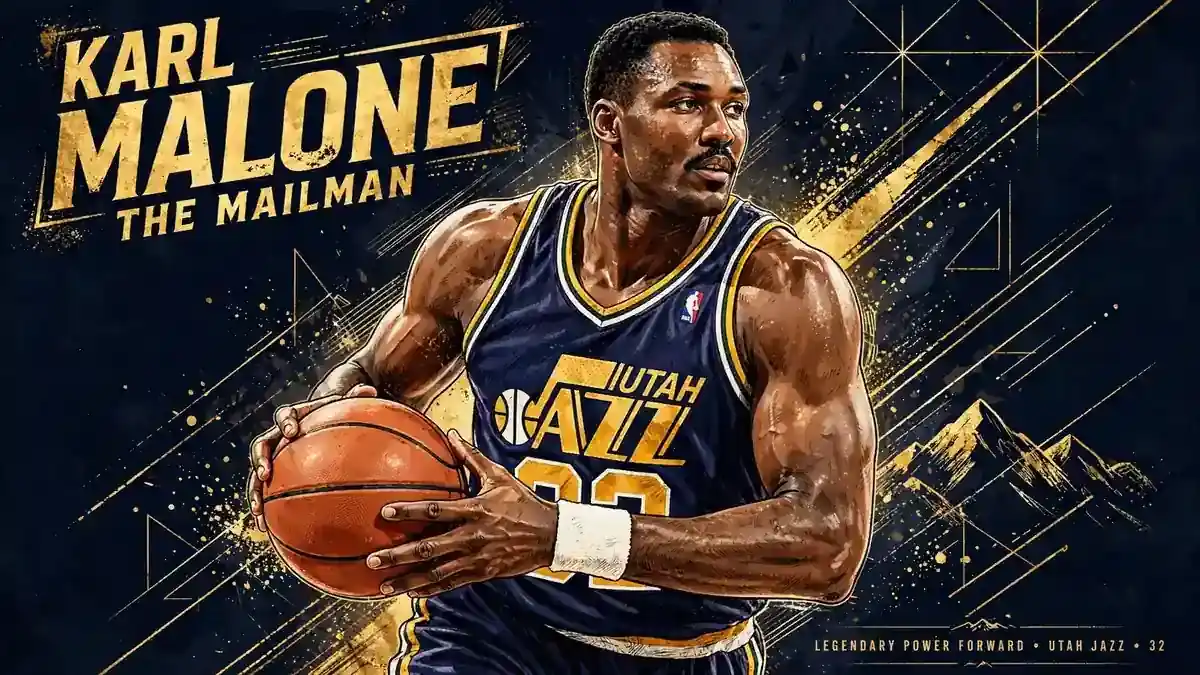
Karl Malone‘s net worth is estimated at $55 million to $85 million as of November 2026. The Mailman collected about $105 million in NBA salary across 19 seasons, then turned a Louisiana car dealership into a multi-state auto group, and the gap between the low and high estimates comes down to how much credit different outlets give those private businesses.
Karl Malone: Quick Facts
| Estimated net worth | $55 million (range: $55 million to $85 million) |
|---|---|
| Profession | Retired professional basketball player, auto dealer group owner |
| Nationality | American |
| Born | July 24, 1963 (age 63) |
| Height | 6 ft 9 in (2.06 m) |
| Primary income sources | NBA salaries, Karl Malone Auto Group dealerships, restaurants and franchises, real estate |
| Active years | 1985–2004 (NBA); business owner since the 1990s |
| Last reviewed | November 2026 |
- Early Life and Background
- Education
- Career Journey
- Rise to Fame
- Main Sources of Income
- Salary and Earnings
- Businesses and Investments
- Brand Deals and Sponsorships
- Houses, Cars and Other Assets
- Awards and Achievements
- Net Worth Growth Over the Years
- Social Media Presence
- Personal Life
- Sources & Reporting
- Frequently Asked Questions
Early Life and Background
Karl Anthony Malone was born on July 24, 1963, in Summerfield, Louisiana, a small town in Claiborne Parish near the Arkansas border. He was the youngest of nine children born to Shirley Malone. His father, Shedrick Hay, left the family home to raise another family, and Malone was raised by his mother on the family farm. When Malone was 14, his father died by suicide, a loss Malone has spoken about rarely and briefly in interviews across his career.
Farm work shaped the player he became. Malone hauled timber, worked in the fields, and built the thick, powerful frame that later made him one of the strongest forwards in league history. Reporters who covered him in Utah loved the contrast: a player who arrived in the NBA from a town of a few hundred people and never lost the work habits of that place. The farm also shaped his money habits. Malone bought land and businesses in Louisiana as soon as his NBA pay allowed it, and he still lives in the Ruston area, close to where he grew up.
At Summerfield High School, Malone led the basketball team to three consecutive state titles. College recruiters noticed the production, but his grades kept major programs cautious. Louisiana Tech, about 40 miles from Summerfield, took him, and the decision defined his life: it gave him a college career, a degree path, and a home base he returned to after basketball.
Malone’s nickname arrived early and stuck for two decades. Teammates and broadcasters called him “The Mailman” because he always delivered — night after night, season after season, the points and rebounds showed up. The nickname also fit his durability. Malone played 1,476 regular-season games and missed remarkably few to injury for a player whose game was built on contact in the paint.
Education
Malone enrolled at Louisiana Tech University in Ruston in 1981. Poor grades in his freshman year kept him off the court for a full season, a setback he later described as the wake-up call of his young life. He got his academics in order, earned playing time as a sophomore, and by his junior year he was the best player in the Southland Conference.
At Louisiana Tech, Malone averaged 18.7 points and 9.3 rebounds per game across his college career, and he led the Bulldogs to the first NCAA tournament appearance in school history in 1984. Louisiana Tech reached the Sweet 16 in 1985, with Malone’s inside scoring carrying the team. He left after his junior year for the NBA draft, one of the few players of his era to jump early from a mid-major program and become a franchise player.
The university stayed part of his life after basketball. In May 2007, Malone returned to Louisiana Tech as director of basketball promotion and assistant strength and conditioning coach, and he donated $350,000 to the athletic department, according to Celebrity Net Worth. The gift and the job were typical of how Malone spends his post-playing years: close to home, inside basketball, and without much ceremony.
Career Journey
The Utah Jazz selected Malone with the 13th overall pick in the 1985 NBA draft. The pick looked modest at the time — he was the third power forward taken — and it became one of the great draft steals in league history. Malone signed a rookie deal worth about $225,000 for the 1985-86 season, per salary records compiled by PlayersBio and BiographyLine, and averaged 14.9 points and 8.9 rebounds as a rookie.
His second season announced him. Between February and April of 1987, Malone was Utah’s leading scorer in 24 of 29 games, and by 1988 he had made his first All-Star team and his first All-NBA team. The Jazz built everything around the pick-and-roll pairing of Malone and point guard John Stockton, a partnership that lasted 18 seasons and became the most durable duo in NBA history. Stockton set Malone up; Malone finished. The two played 1,412 regular-season games together, an NBA record for teammates.
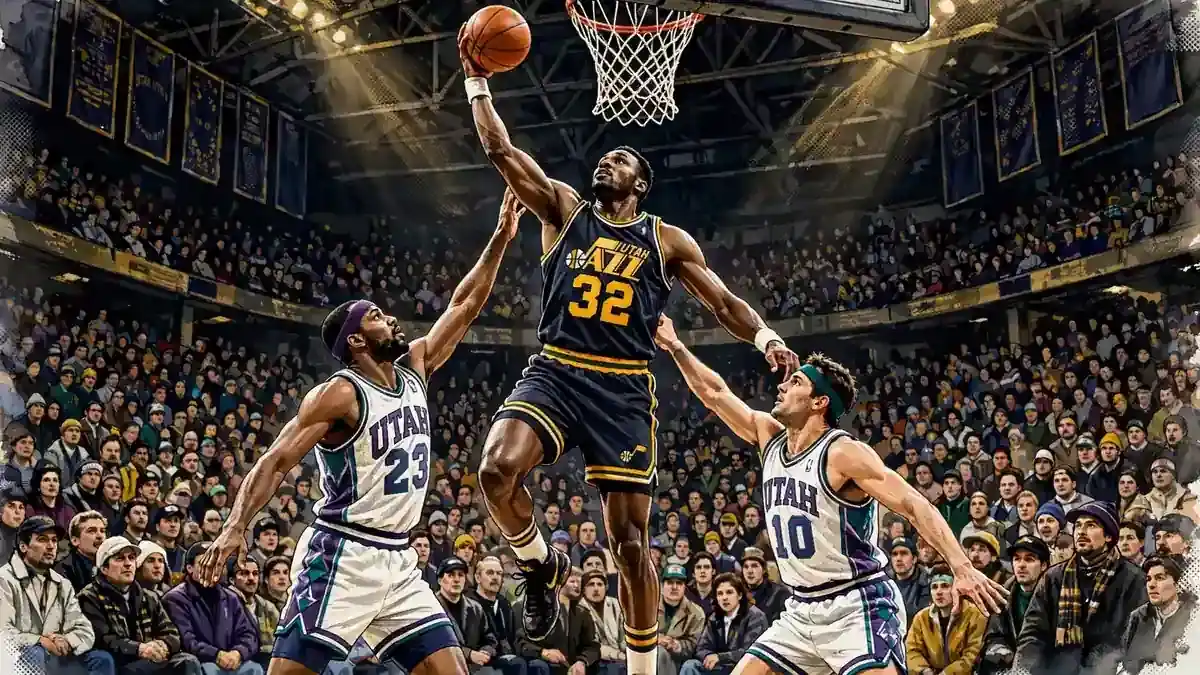
The Jazz reached the Western Conference Finals in 1992 and 1994, then broke through to the NBA Finals in 1997 and 1998. Both times they met Michael Jordan’s Chicago Bulls, and both times they lost — in six games in 1997 and six games in 1998. The 1998 series ended with Jordan’s famous shot over Bryon Russell in Game 6 in Salt Lake City, a moment that still defines Malone’s career for many fans: two MVP seasons, two Finals trips, no ring.
Malone stayed with Utah through the 2002-03 season, his 18th with the franchise. In the summer of 2003, as a free agent at 40, he signed with the Los Angeles Lakers for $1.5 million — a veteran’s minimum deal — to chase the championship that had eluded him. The Lakers reached the 2004 Finals but lost to the Detroit Pistons in five games. Malone played 42 games that season, his knee limiting him, and averaged 13.2 points and 8.7 rebounds. He announced his retirement at a press conference in February 2005.
The Utah Jazz retired his number 32 jersey in March 2006. In 2010, Malone entered the Naismith Memorial Basketball Hall of Fame twice in the same ceremony: once for his individual career and once as a member of the 1992 United States Olympic team, the Dream Team.
Rise to Fame
Malone’s rise was steady rather than sudden, and that steadiness became his brand. He made 14 consecutive All-Star teams from 1988 through 2002, was named to the All-NBA First Team 11 times, and won the league’s Most Valuable Player award in 1997 and again in 1999. The 1997 MVP season was his peak as a public figure: he averaged 27.4 points and 9.9 rebounds, led Utah to a 64-18 record, and carried the Jazz to their first Finals.
The 1999 MVP award told a different story about his longevity. In the lockout-shortened 1998-99 season, at 35, Malone averaged 23.8 points and 9.4 rebounds and won his second MVP while most stars his age were fading. Only a handful of players in league history have won MVP awards in seasons separated by more than a year after age 33, and Malone did it while playing all 49 games of the shortened schedule.
His scoring totals place him among the greatest ever. Malone finished with 36,928 career points, third all-time behind LeBron James and Kareem Abdul-Jabbar, and ahead of every other forward or center who played the game. He also grabbed 14,968 rebounds, seventh all-time, and his 61-point game against the Milwaukee Bucks in 1990 remains one of the great single-game scoring nights by a power forward.
Durability was the quiet engine of those totals. Malone played all 82 games in 10 different seasons, a figure few stars in any era can match, and he played 80 or more games in 17 of his 19 seasons. He was 40 years old when he became the oldest player to record a triple-double and the oldest starter on an NBA Finals team, both marks set during his Lakers season. The Mailman nickname was a joke about reliability; the games-played column is the evidence.
Olympic gold added to his fame on a global stage. Malone won gold with the Dream Team at Barcelona in 1992 and again at Atlanta in 1996, averaging 8.4 points and 4.5 rebounds in the 1996 tournament while shooting 56.9 percent from two-point range, per Celebrity Net Worth’s Olympic recap.
Main Sources of Income
Malone’s money came in two distinct waves. The first wave was NBA salary: about $105 million across 19 seasons, with most of it arriving late. The second wave is business income from the Karl Malone Auto Group and a set of Louisiana restaurants and franchises he has owned for decades. Endorsements were the smallest of the three streams — Malone never chased the shoe and soft-drink money the way Jordan or Michael Jordan‘s contemporaries did — and the public record on his endorsement pay is thin, which is one reason estimates of his wealth spread so wide.
The salary wave is the only part anyone can count precisely. Contract records put his career earnings at about $105 million, or $105.9 million on Basketball Reference’s tally. Adjusted for inflation, Celebrity Net Worth puts that same pay at roughly $200 million in today’s money. The timing matters: Malone earned only $38.6 million in his first 13 seasons combined, then $66.4 million in his final four seasons in Utah, when the four-year, $66.5 million contract he signed in 1999 finally paid him like the superstar he had been for a decade. That backloaded structure is the single most misunderstood fact about Malone’s finances — he was underpaid relative to his production for most of the 1990s, then paid handsomely at the end.
The business wave is harder to value and more important to his current wealth. The Karl Malone Auto Group, founded in 2010, is the centerpiece: a multi-state dealership group that trade publications credit with around 10 rooftops including powersports stores and a body shop. Around it sit the Ruston restaurants — Teriyaki Grill, Eskimoe’s Ice Cream and an Arby’s — plus part-ownership of Burger King franchises in Idaho and Utah and three Jiffy Lube franchises in Utah. None of these businesses publish revenue, so outlets that value them generously land at $75 million to $85 million for Malone, while outlets that count only documented assets land at $55 million.
Salary and Earnings
Malone’s pay history reads like two different careers stitched together. In his first decade, he was one of the league’s best players on a below-market deal. In his last four seasons in Utah, he was one of its best-paid. The table below uses the season-by-season figures compiled by PlayersBio and BiographyLine from contract records; the totals line up with the $105 million career figure that Celebrity Net Worth and Basketball Reference both report.
| Season | Team | Salary (approx.) |
|---|---|---|
| 1985-86 | Utah Jazz | $225,000 |
| 1986-87 | Utah Jazz | $550,000 |
| 1987-88 | Utah Jazz | $835,000 |
| 1988-89 | Utah Jazz | $1.35 million |
| 1990-91 | Utah Jazz | $2.26 million |
| 1992-93 | Utah Jazz | $2.85 million |
| 1994-95 | Utah Jazz | $3.37 million |
| 1996-97 | Utah Jazz | $4.65 million |
| 1998-99 | Utah Jazz | $6.14 million |
| 1999-00 | Utah Jazz | $14 million |
| 2000-01 | Utah Jazz | $15.75 million |
| 2001-02 | Utah Jazz | $17.5 million |
| 2002-03 | Utah Jazz | $19.25 million |
| 2003-04 | Los Angeles Lakers | $1.5 million |
The 1988 contract explains the early years. After his first All-Star season, Malone signed a 10-year deal worth $18 million — a long commitment that looked generous in 1988 and looked like a bargain within five years, as the salary cap and television money pushed star pay upward. Malone never made more than $5.1 million in a season until the 1998-99 campaign, even though he won an MVP award in 1997 while earning $4.65 million. By comparison, Michael Jordan earned $33.1 million in that same 1997-98 season on a one-year deal. The gap is a useful reminder that Malone’s era paid stars far less than today’s game does, and that his $105 million total is more impressive than it looks next to modern contracts.
The 1999 contract fixed the imbalance. Malone signed a four-year deal worth $66.5 million, and his pay jumped to $14 million in 1999-00, then $15.75 million, $17.5 million and $19.25 million in his final three Utah seasons, per the salary databases. One figure in the record deserves a flag: Celebrity Net Worth lists his highest single-season salary as $17 million in 2002-03, while PlayersBio and BiographyLine list $19.25 million for that season. The difference likely comes from how signing bonuses and deferred money were counted. Either way, his peak pay arrived in his final Utah season, at age 39.
One comparison puts his earnings in perspective. Basketball Reference’s salary totals credit Malone with $105.9 million in career salary and Jordan with $93.3 million. Malone, the less famous player and the less marketable star, earned more in NBA salary than the most famous basketball player alive. Jordan made his fortune from endorsements and ownership; Malone made his from paychecks and car dealerships. The two paths explain why their net worth figures sit so far apart today, and why Malone’s story is really a story about saving and owning rather than about a single windfall.
Businesses and Investments
Malone started buying businesses while he was still playing, and he bought the kind of businesses he understood: places in small towns where he knew the customers. In Ruston, Louisiana, he owns Teriyaki Grill, Eskimoe’s Ice Cream and an Arby’s restaurant. He is a part-owner of several Burger King franchises in Idaho and Utah, and he owns three Jiffy Lube franchises in Utah. He has also owned a trucking company and a hunting and fishing lodge in Louisiana, according to Britannica’s profile of his post-playing career.
The auto group is the business that matters most. The Karl Malone Auto Group was established in 2010, in a deal that shows how Malone thinks about assets. He sold his ownership stake in Stockton to Malone Honda — now Stockton 12 Honda — in exchange for the entirety of Karl Malone Toyota in Draper, Utah, according to Gearshifters’ reporting on the group’s history. From that base, the group added stores: Karl Malone Chrysler-Dodge-Jeep-Ram in Heber City, Utah; Karl Malone Toyota of Ruston, Louisiana; and, in late 2021 and early 2022, the Teague dealerships in El Dorado, Arkansas — Teague Toyota, Teague Ford/Lincoln and Teague Chevrolet, rebranded under the Malone name. Trade reporting from that period put the group at 10 dealerships including powersports stores, plus a body and paint shop in Utah, with rooftops across Utah, Arkansas, Louisiana and Idaho.
That growth is the honest reason for the spread in net worth estimates. A dealership group of that size, privately held, can be worth tens of millions or far less depending on debt, inventory financing and real estate ownership — and none of those figures are public. Outlets that give the auto group full credit land at $75 million to $85 million for Malone. Celebrity Net Worth, which updated its Malone page on November 21, 2026, holds at $55 million, a figure that has been stable for years and likely counts the businesses conservatively. Our range, $55 million to $85 million, is the honest way to present that disagreement, and the $55 million anchor is the figure with a named source and a fresh update date.
Malone’s investment style outside the dealerships has been quiet and local: land and property in Louisiana and Utah, plus the lodge and the trucking business. Unlike some of his peers, he has no reported venture-capital portfolio, no media company and no public record of startup investing. A few low-quality blogs have credited him with stakes in technology and cryptocurrency ventures; we found no credible reporting to support those claims, and we do not repeat them as fact. What the record supports is simpler: a former athlete who bought cash-flowing businesses in towns he knew, held them for decades, and expanded slowly.
He also gave back in the places where he made money. The $350,000 donation to Louisiana Tech’s athletic department in 2007 is the largest documented gift, and his coaching roles at Louisiana Tech and with the Jazz — he joined Utah as a big-man coach in 2013 — kept him inside the game without a salary that would move his net worth figure either way.
Brand Deals and Sponsorships
Endorsements were never a major pillar of Malone’s income, and the public record reflects that. He had a long association with Nike during his playing career and later deals reported with brands including Kia, but the values were never disclosed, and no credible outlet has published a total for his endorsement earnings. That silence is itself informative: in the 1990s, endorsement money flowed to guards and high-flyers with national shoe campaigns, and a power forward in Salt Lake City — even a two-time MVP — was not the first call for Madison Avenue.
What Malone did have was a durable personal brand inside basketball. The Mailman nickname, the 14 All-Star selections and the two Olympic gold medals kept him relevant to sponsors long after retirement, and the Karl Malone Auto Group itself trades on his name in four states. The dealerships are, in effect, his biggest endorsement deal: his name on the building, his reputation behind the sale. It is a slower, steadier kind of brand income than a shoe contract, and it fits the rest of his financial story.
Readers should treat any site that quotes an exact endorsement total for Malone with suspicion. We found no filing, interview or trade report that puts a number on it, and we do not publish one. The honest statement is that endorsements added to his wealth in an unquantified way, well behind salary and business income.
Houses, Cars and Other Assets
Malone lives in the Ruston, Louisiana area, close to his hometown of Summerfield and to Louisiana Tech. His primary home there is a large property in a rural setting; the $8 million figure that circulates on some low-quality biography sites for a Ruston house is not supported by any property record we could verify, and we do not repeat it as fact. What is documented is his summer home on the Kenai River in Alaska, where he spends time hunting and fishing — the outdoor life he has talked about since his playing days.
His car holdings are, unsurprisingly, tied to his business. As the owner of a Toyota and multi-brand dealership group, Malone has access to whatever he wants to drive, and the dealerships themselves — their land, buildings and inventory — are likely his most valuable hard assets. A dealership group’s real estate alone can be worth many millions, which is another reason the private-business valuation question matters so much to his net worth estimate.
The hunting and fishing lodge in Louisiana and the trucking company round out a property picture that looks more like a rural business owner than a celebrity collector. There are no reported supercar collections, no art holdings and no headline property purchases in Los Angeles or Miami. Malone’s assets are working assets: stores, restaurants, land and lodges that produce income, not trophies that consume it.
Awards and Achievements
- 2× NBA Most Valuable Player (1997, 1999)
- 14× NBA All-Star (1988–2002, consecutive)
- 11× All-NBA First Team
- 3× NBA All-Defensive First Team
- 2× Olympic gold medalist (Barcelona 1992, Atlanta 1996)
- NBA All-Rookie First Team (1986)
- 36,928 career points — third all-time in NBA history
- 14,968 career rebounds — seventh all-time
- 2× NBA Finals appearances (1997, 1998)
- Utah Jazz number 32 retired (March 2006)
- Naismith Memorial Basketball Hall of Fame, inducted 2010 (individual career and Dream Team)
- Named to the NBA 50th Anniversary All-Time Team (1996) and the NBA 75th Anniversary Team (2021)
- 2× All-Star Game MVP (1989, 1993)
The two MVP awards deserve a closer look, because they frame the money story. Malone won his first MVP in 1997 at 33, beating Jordan in the voting in a season when Utah won 64 games. He won his second in 1999 at 35, in a lockout-shortened season, while playing every game. Players who win MVP awards after 33 are rare; players who win them while earning under $5 million a season, as Malone did in 1997, are rarer still. The awards also explain why his peak pay arrived so late: the Jazz had him locked into the 1988 deal through his prime, and only the 1999 contract reset his pay to match his standing.
Net Worth Growth Over the Years
No audited record of Malone’s wealth exists, so this timeline blends the documented salary record with the published estimates that followed. The salary figures are solid; the net worth figures are the published estimates of their time, and they should be read that way.
| Period | What happened | Estimated net worth |
|---|---|---|
| 1985–1988 | Rookie deal and early seasons; pay under $1 million a year | Under $2 million |
| 1988–1996 | 10-year, $18 million deal; first MVP race years; early Louisiana businesses | $5 million – $10 million |
| 1997–1999 | MVP awards, two Finals runs, Olympic gold; pay still under $5 million a season | $10 million – $20 million |
| 1999–2003 | Four-year, $66.5 million contract; peak pay of about $19 million a season | $25 million – $40 million |
| 2004–2010 | Retirement; Lakers season; Louisiana Tech role; auto group founded 2010 | $40 million – $55 million |
| 2011–2020 | Dealership expansion across four states; restaurant and franchise holdings steady | $55 million – $75 million |
| 2021–2026 | Teague dealerships acquired in El Dorado, Arkansas; group reaches about 10 rooftops | $55 million – $85 million |
The shape of that curve is the point of the article. Malone’s wealth did not spike on a single contract or endorsement; it compounded. The salary wave ended in 2004, and everything since has been business income, property and the slow appreciation of dealerships he bought with playing money. That is also why the range widens in the later years: the more of his wealth sits in private businesses, the more room there is for honest disagreement about what it is worth.
A peer comparison shows how unusual his path was. Scottie Pippen, Malone’s Finals rival in 1997 and 1998, earned about $110 million in salary but is generally estimated at around $20 million today after well-documented financial trouble. Allen Iverson, a generation younger, earned more than $150 million in salary and endorsements and has faced similar reported struggles. Malone earned less than either in endorsements and kept more of it — a quieter story, and a more instructive one. For the full picture on the era’s biggest earner, see our athletes profiles.
Social Media Presence
Malone is not a social media figure, and that is a deliberate choice rather than an absence. He keeps no verified public Instagram, X or TikTok account that posts regularly, and he has given few interviews in recent years. The Karl Malone Auto Group runs active dealership accounts on Facebook and Instagram, and Malone appears in their posts and local advertising, but those are business channels, not personal ones.
That low profile has a side effect readers should know about: dozens of fan pages and low-quality biography sites publish invented details about Malone — inflated house prices, crypto stakes, technology investments — precisely because he does not correct the record online. Where this article could not verify a claim in a named outlet or a public record, it says so rather than repeating the claim. Malone’s own approach to publicity has always been the same as his approach to the game: show up, do the work, and let the record speak.
Personal Life
Malone married Kay Kinsey, the winner of the 1988 Miss Idaho USA pageant, in 1990. They have four children together — three daughters and one son — and the family is based in the Ruston area. Kay has kept a low public profile, and the couple’s life after basketball has centered on Louisiana, the dealerships and the restaurants.
Malone’s family history includes facts he has addressed only briefly and that deserve plain, careful wording. Before his marriage, he fathered twins with Bonita Ford, a woman from his hometown; both were 17 at the time. He also fathered a child with Gloria Bell, who was 13 when she gave birth. The cases were settled on confidential terms, and Celebrity Net Worth reports that Malone was estranged from those children for years before reconciling with them. His twins went on to play basketball at Louisiana Tech, and his son by Gloria Bell played in the NFL. We include this because it is part of the public record about a public figure, not because it bears on his finances; it does not.
Outside basketball and business, Malone is an avid hunter and fisherman, owns the Alaska summer home on the Kenai River mentioned above, and has served on the National Rifle Association’s Board of Directors. He returned to the Jazz as a big-man coach in 2013, working with the team’s young frontcourt players, and he remains a familiar presence at Louisiana Tech events.
Sources & Reporting
Celebrity Net Worth — the $55 million net worth figure (page updated November 21, 2026), the $105 million career salary total, the $17 million peak-season figure, the 10-year $18 million 1988 contract, the 2007 Louisiana Tech donation of $350,000, the dealership and restaurant holdings, and the personal-life record. Reporting window: page published 2021, updated November 2026.
Basketball Reference — career totals of 36,928 points and 14,968 rebounds, 1,476 games played, and the $105.9 million career salary total used in the Jordan comparison. Reporting window: career statistics through 2004, salary records current.
PlayersBio — season-by-season salary table, including the $19.25 million 2002-03 figure and the $1.5 million Lakers season. Reporting window: career contract history, accessed November 2026.
BiographyLine — corroborating season-by-season salary figures and the four-year, $66.5 million 1999 contract. Reporting window: accessed November 2026.
Encyclopaedia Britannica — the trucking company, car dealership, and hunting and fishing ranch holdings, and the $100 million to $120 million upper-range estimate cited by some outlets. Reporting window: accessed November 2026.
Gearshifters — the 2010 founding of the Karl Malone Auto Group through the Stockton to Malone Honda stock swap, and the 2021–2022 Teague dealership acquisitions in El Dorado, Arkansas, bringing the group to about 10 rooftops. Reporting window: accessed November 2026.
Toyota — the Karl Malone Toyota of Ruston dealership listing, confirming the Ruston store’s address and active status. Reporting window: accessed November 2026.
ESPN and NBA.com — career context for the 1997 and 1998 Finals runs, the MVP awards, and the Hall of Fame induction. Reporting window: historical coverage, accessed November 2026.
Where sources conflict — the $17 million versus $19.25 million peak-season salary, and the $55 million versus $75 million to $85 million net worth estimates — this article publishes the range and names who says what, rather than picking the figure that makes the better headline.
Frequently Asked Questions
What is Karl Malone’s net worth in 2026?
Karl Malone’s net worth is estimated at $55 million to $85 million as of November 2026. Celebrity Net Worth, updated November 21, 2026, puts him at $55 million, while other 2026 outlets estimate $75 million to $85 million. The gap reflects his privately held dealership group, which has no public valuation. We anchor on the $55 million figure.
How much money did Karl Malone make in the NBA?
Malone earned about $105 million in NBA salary across 19 seasons, according to Celebrity Net Worth and Basketball Reference, which puts the total at $105.9 million. Adjusted for inflation, that pay is worth roughly $200 million today. Most of it arrived late: he earned $66.4 million in his final four seasons in Utah, against $38.6 million in his first 13 seasons combined.
What businesses does Karl Malone own?
Malone is the majority owner of the Karl Malone Auto Group, founded in 2010, with around 10 dealership rooftops across Utah, Arkansas, Louisiana and Idaho, including Toyota, Ford, Chevrolet and Chrysler-Dodge-Jeep-Ram stores. In Ruston, Louisiana, he owns Teriyaki Grill, Eskimoe’s Ice Cream and an Arby’s, and he part-owns Burger King franchises in Idaho and Utah and three Jiffy Lube franchises in Utah. He has also owned a trucking company and a hunting and fishing lodge.
Did Karl Malone ever win an NBA championship?
No. Malone reached the NBA Finals twice with the Utah Jazz, in 1997 and 1998, losing both times to Michael Jordan’s Chicago Bulls in six games. He joined the Los Angeles Lakers in 2003-04 for one final attempt and reached the Finals again, losing to the Detroit Pistons in five games. He retired in February 2005 without a ring, despite two MVP awards and 14 All-Star selections.
How many points did Karl Malone score in his career?
Malone scored 36,928 points, the third-highest total in NBA history behind LeBron James and Kareem Abdul-Jabbar. He also grabbed 14,968 rebounds, seventh all-time. His career high was 61 points against the Milwaukee Bucks in 1990.
Is Karl Malone in the Hall of Fame?
Yes. Malone was inducted into the Naismith Memorial Basketball Hall of Fame in 2010 — twice in the same ceremony, once for his individual career and once as a member of the 1992 Dream Team. The Utah Jazz retired his number 32 jersey in March 2006.
Where does Karl Malone live now?
Malone lives in the Ruston, Louisiana area, near his hometown of Summerfield and Louisiana Tech University, where he has long-standing business and community ties. He also owns a summer home on the Kenai River in Alaska, where he hunts and fishes.
Who is Karl Malone’s wife?
Malone has been married to Kay Kinsey, the 1988 Miss Idaho USA winner, since 1990. They have four children together — three daughters and one son — and are based in Louisiana.
Final Thoughts
Karl Malone’s money story is the opposite of the modern athlete fortune. There was no nine-figure shoe deal, no media empire, no single contract that made him rich overnight. There was a 10-year deal that underpaid him through his prime, a four-year deal that finally paid him like the superstar he was, and then two decades of buying car dealerships and restaurants in small towns and holding them.
The $55 million to $85 million range is honest about what we know and what we don’t. The salary is documented to the dollar. The businesses are real, named, and still operating — the Ruston Toyota store lists its address and phone number on Toyota’s own site, and the El Dorado stores carry his name today. What no public record shows is what the group is worth after debt, and that is the whole gap between the low estimate and the high one.
What the record does show is the habit that built the fortune: show up every night, for 19 seasons and 1,476 games, and put the money into things that produce income. The Mailman delivered on the court, and then he delivered on the balance sheet — slowly, locally, and without asking anyone to notice.
Published on November 23, 2026. Last reviewed November 2026. Found an error? See our corrections policy.