
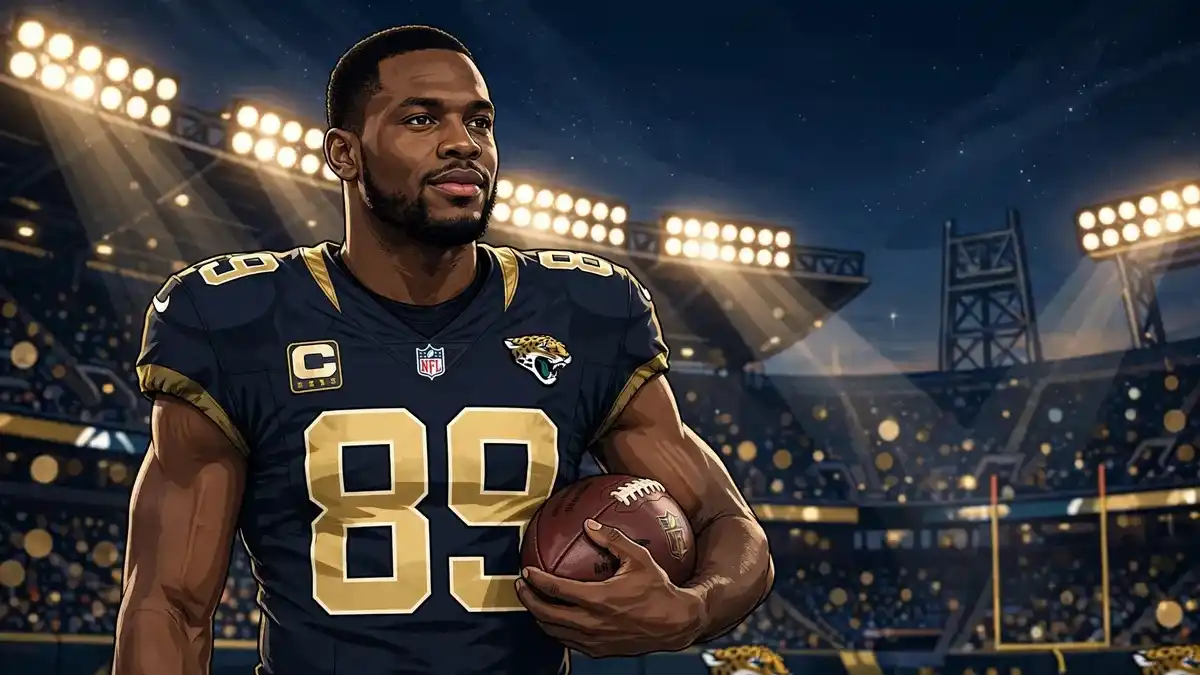
Marcedes Lewis‘s net worth is estimated at $25 million to $30 million as of November 2026. The figure rests on the hardest number in his file: more than $65 million in documented NFL career earnings across 20 seasons, four franchises, and 290 games — the most games ever played by a tight end. He turned a first-round pick in 2006 into the longest tight-end career in league history, and at 41 he was still suiting up for the Denver Broncos in 2025.
Marcedes Lewis: Quick Facts
| Estimated net worth | $25 million (range: $25 million to $30 million) |
|---|---|
| Profession | NFL tight end |
| Nationality | American |
| Born | May 19, 1984 (age 42) |
| Height | 6 ft 6 in (1.98 m) |
| Primary income sources | NFL salaries, signing bonuses, roster and workout bonuses |
| Active years | 2006–2025 (20 NFL seasons) |
| Last reviewed | November 2026 |
- Early Life and Background
- Education
- Career Journey
- Rise to Fame
- Main Sources of Income
- Salary and Earnings
- Businesses and Investments
- Brand Deals and Sponsorships
- Houses, Cars and Other Assets
- Awards and Achievements
- Net Worth Growth Over the Years
- Social Media Presence
- Personal Life
- Sources & Reporting
- Frequently Asked Questions
Early Life and Background
Marcedes Alexis Lewis was born on May 19, 1984, in Los Alamitos, California, and grew up in Long Beach. His mother, Yvonne Snow, was 15 when he was born and raised him as a single mother working three jobs, a stretch of his childhood Lewis has spoken about openly in interviews and on his own website. When he was three, his younger brother Ashley joined the family. In 1993, when Lewis was eight, Yvonne met Michael Withers, who became a father figure and later his stepfather; the family grew again with brother Cody in 1994 and sister Niki in 1996, and relocated to Lakewood, California, when Lewis was 13.
Football entered his life at eight, through Long Beach Poly Pop Warner. The household economics shaped the way he still talks about money: nothing in his early life was guaranteed, and the first real paychecks of his career went toward stability for a family that had lived without much of it. That background also explains the shape of his later giving — the foundation he started with his mother targets kids in the same neighborhoods where he grew up.
At Long Beach Polytechnic High School, Lewis played for the Jackrabbits, one of the most talent-stacked programs in the country. The 2001 Poly team featured a record five Parade magazine All-Americans — Lewis, Darnell Bing, Hershel Dennis, Winston Justice, and Manuel Wright — and played De La Salle of Concord in a nationally televised game that year, a matchup that still gets revisited in California high-school football lore. Poly won the CIF title that season, its third straight, and all five of those Parade All-Americans eventually reached pro football. Lewis finished his senior year as a Parade high school All-American himself, rated a top prospect by every major recruiting service, and chose UCLA over USC — the school his Poly teammates Bing, Justice, Wright, and Dennis had picked.
He also played basketball at Poly, and the two-sport athleticism showed in his game from the start: a 6-foot-6 frame with the hands and body control of a receiver and the willingness to block like a lineman. That combination is what made him a first-round pick, and it is also what kept him employed for two decades after the receiving numbers faded.
Education
Lewis attended the University of California, Los Angeles, and played for the Bruins from 2002 to 2005 under head coaches Bob Toledo and Karl Dorrell. He appeared in 49 games and started 32, finishing as UCLA’s career leader among tight ends with 126 receptions, 1,571 receiving yards, and 21 touchdowns. He still ranks ninth on the school’s overall career receiving list — a striking mark for a tight end in a program that has produced a long line of wide receivers.
His senior season in 2005 was the breakout that set his draft stock. Lewis won the John Mackey Award as the best tight end in college football, earned consensus All-American honors, and was a first-team All-Pac-10 selection. He was UCLA’s only Mackey Award winner, and the honor put him on every NFL scouting board as a first-round talent. UCLA inducted him into its Athletics Hall of Fame as part of the 2022 class, a recognition that arrived while he was still active in the NFL — 17 years after his final college game.
No public record lists a completed degree major or graduation detail for Lewis, and his college value was always measured on the field. The four years at UCLA did two things that mattered financially: they made him a first-round pick, which fixed his rookie contract at the top of the pay scale, and they gave him the blocking technique that would extend his career long past the point when most tight ends lose their roster spots.
Career Journey
The Jacksonville Jaguars selected Lewis 28th overall in the first round of the 2006 NFL Draft, and he signed a five-year rookie contract reported at $7.5 million with $4.9 million guaranteed in July 2006. He played 15 games as a rookie, catching 13 passes for 126 yards and a touchdown, and by his second season he was a full-time starter: 37 receptions for 391 yards and two touchdowns in 2007, then 41 catches for 489 yards in 2008 and 32 for 518 yards in 2009. The numbers were solid rather than spectacular, but the Jaguars valued the other half of his job — run blocking — enough to build their offense around his versatility.
Jacksonville kept him for 12 seasons, from 2006 through 2017, and he played 170 games for the franchise with 33 touchdowns. The peak came in 2010, when he tied the Jaguars’ single-season record with 10 touchdown receptions, caught 58 passes for 700 yards, and earned his only Pro Bowl selection. The Jaguars had placed the franchise tag on him in February 2011 during the NFL lockout, and that August, after a brief training-camp holdout, he signed a five-year deal reported at about $35 million with $17 million guaranteed — the contract that forms the single biggest block of his career earnings.
In March 2016 he re-signed with Jacksonville for three years and $12 million, with $5 million guaranteed per Over The Cap’s ledger. Two years later, in March 2018, the Jaguars released him after 12 seasons. He was 34, an age when most tight ends are already retired, and the release looked like the end of the road. It was not.
The Green Bay Packers signed him in May 2018 to a one-year, $2.1 million contract with a $500,000 signing bonus. Green Bay did not want a receiving star; it wanted the best blocking tight end available, a veteran who could seal edges for Aaron Jones and protect Aaron Rodgers, his former Green Bay teammate, in the passing game. Lewis re-signed on one-year deals in 2019 and 2020, then inked a two-year, $8 million contract in March 2021. He started all 17 games in the 2022 season at age 38, a workload almost unheard of for a player that old at his position, and finished his five Green Bay seasons with 14,450,000 dollars in team salary per Over The Cap’s by-team breakdown.
Chicago came next. The Bears signed him to one-year, $2 million deals in both 2023 and 2024 — $1.6 million in base salary plus a $400,000 signing bonus each year. He appeared in all 17 games in 2023 and caught one pass for two yards in 2024, playing almost entirely as a blocker and locker-room presence. By then his value was measured in things that never show up in a box score: technique, film study, and the example he set for younger players.
His final chapter was the most improbable. In October 2025, at 41, Lewis told reporters he wanted to play one more year, and on October 29 the Denver Broncos signed him to their practice squad after injuries to Nate Adkins and Lucas Krull left them short at tight end. He was elevated for the Week 9 game against the Houston Texans on November 2, 2025, becoming the oldest tight end ever to play in an NFL game and the oldest player in Broncos franchise history — a mark that passed Peyton Manning, who won Super Bowl 50 with Denver at 39. Lewis was elevated three times, signed to the active roster ahead of the Week 14 game against the Las Vegas Raiders in December 2025, and finished the season with five games played for Denver, 66 snaps in his first four appearances, and a career total of 290 games. He was the only player left from the 2006 draft class still on an NFL roster, and the second-oldest active player in the league behind only Aaron Rodgers.
Across the whole run, the career line reads 437 receptions for 5,115 yards and 40 touchdowns in 290 regular-season games. The receiving totals are modest by Hall of Fame standards. The games total is not: no tight end in NFL history has played more.
Rise to Fame
Lewis’s fame arrived in two waves. The first came at UCLA, where the Mackey Award and consensus All-American honors in 2005 made him the best-known tight end in college football and a first-round pick. The second came in Jacksonville in 2010, when the 10-touchdown season and Pro Bowl selection made him a household name among NFL fans — the year his 58 catches for 700 yards turned a reliable blocker into a red-zone weapon.
What kept him famous, though, was longevity rather than a single season. Year after year, as the tight end position tilted toward athletic pass-catchers, Lewis kept winning jobs with blocking, route discipline, and durability. By the time he reached Green Bay, his reputation had flipped: he was the player coaches pointed to when they talked about doing the unglamorous work well. His 2010 Pro Bowl season remained his statistical peak, and he never chased a second one — the second half of his career was built on accepting a smaller role and executing it better than the younger players competing for it.
The Denver comeback in 2025 gave him a third wave of attention, this time as a record-setter. National outlets covered each elevation from the practice squad, and Broncos head coach Sean Payton singled him out in a postgame address after a December 2025 win over Green Bay, presenting the moment as a tribute to a player who had earned respect in every locker room he entered. For a player who spent most of his career away from the spotlight, the final season supplied the storyline his career had always lacked: the oldest tight end ever, still standing, in his 20th season.
Compared with the great receiving tight ends of his era, Lewis’s case is unusual. Rob Gronkowski played 143 games and caught 92 touchdowns in 11 seasons; George Kittle had passed 500 career receptions by his eighth season. Lewis played twice as many games as Gronkowski and caught fewer than half as many touchdowns — and still earned a comparable career total, because availability itself became his market value.
Main Sources of Income
NFL salary is the whole story of Marcedes Lewis’s wealth, with signing bonuses, roster bonuses, workout bonuses, and per-game roster bonuses layered on top. Over The Cap’s ledger breaks his $65,020,554 in career earnings into $39,776,000 in base salary, $14,910,000 in prorated bonus money, $6,295,000 in roster bonuses, $2,450,000 in per-game roster bonuses, $725,000 in workout bonuses, and $800,000 in other bonuses. Base salary supplied roughly six of every ten dollars he earned; the rest came in the lump sums that define NFL pay structure.
Jacksonville supplied the bulk of it: $46,030,000 across 12 seasons, per Over The Cap’s by-team table. Green Bay added $14,450,000 over five seasons, Chicago $4,000,000 over two, and Denver $540,554 in his final season, most of it practice-squad pay and a terminated $1,255,000 contract that paid out $139,444. Spotrac’s competing tally of $65.5 million sits within $500,000 of Over The Cap’s figure, which is a tight spread for two independent contract trackers — and a useful check that the $65 million career-earnings number is solid.
Outside football, Lewis has no publicly documented second income stream of comparable size. There is no record of a national endorsement portfolio, no media contract, and no business venture with disclosed revenue. His foundation work is charitable, not commercial. That concentration is the honest shape of his finances: a player who earned like a star for two decades without ever building a visible business empire alongside the football income, which is exactly why the net-worth estimate lands well below the career-earnings total.
The tax drag on that $65 million was heavy. Lewis played most of his career in Florida, which levies no state income tax, but he still paid federal tax at the top marginal rate on the bulk of his earnings, plus agent fees — typically around 3 percent for NFL agents — and the ordinary costs of a 20-year professional life. A back-of-the-envelope pass through those deductions is what turns $65 million gross into a $25–$30 million net worth, and it lines up with the published estimates rather than contradicting them.
Salary and Earnings
The contract history tells the earnings story better than any single number. Lewis’s rookie deal in 2006 was reported at $7.5 million over five years with $4.9 million guaranteed; Over The Cap’s ledger records the same deal at $7,430,000 in total value with $4,147,500 guaranteed, and the difference comes down to how incentives and escalators were classified. Either way, the first contract paid him $7,655,000 in cash, including a $4.47 million second season in 2007 that reflected a signing-bonus structure weighted toward the early years.
The 2011 deal was the financial centerpiece. After the franchise tag and a short holdout, Lewis signed a five-year contract reported at about $35 million with $17 million guaranteed; Over The Cap lists it at $34 million with $11,650,000 guaranteed and $27,200,000 earned over its life. His single biggest cash year was 2011, when he took home $8,650,000 per Over The Cap — a $7 million signing bonus plus salary and bonuses — while Salary Sport’s season-by-season table puts his best year at $9,450,000 for the same season, counting the signing bonus differently. The two trackers disagree on the label, not the substance: 2011 was the year Lewis got paid like a star.
The 2016 re-signing, three years and $12 million with $5 million guaranteed, paid $8,500,000 before Jacksonville released him in March 2018. Then came the veteran phase: one-year deals of $2.1 million in Green Bay in 2018 and 2019, a two-year, $8 million deal in 2021, and the two $2 million Chicago seasons in 2023 and 2024. Each late-career deal was structured the same way — modest base salary, a signing bonus in the $400,000–$500,000 range, and per-game roster bonuses that paid only if he stayed on the roster. In 2025, the Denver arrangement was smaller still: practice-squad elevations at $315,000 and $331,666 annualized rates, a $396,000 practice-squad deal, and a $1,255,000 active-roster contract that was terminated after paying $139,444.
| Contract | Team | Years | Total value | Guaranteed |
|---|---|---|---|---|
| Rookie deal | Jacksonville Jaguars | 2006–2010 | $7.5 million* | $4.9 million* |
| Second contract | Jacksonville Jaguars | 2011–2015 | About $35 million | $17 million |
| Re-signing | Jacksonville Jaguars | 2016–2018 | $12 million | $5 million |
| First Packers deal | Green Bay Packers | 2018 | $2.1 million | $500,000 signing bonus |
| Two-year deal | Green Bay Packers | 2021–2022 | $8 million | Not fully disclosed |
| Bears deals | Chicago Bears | 2023, 2024 | $2 million per year | $1 million per year |
| Broncos stint | Denver Broncos | 2025 | $1.255 million (terminated) | $139,444 earned |
*Rookie-deal figures as reported at signing; Over The Cap’s ledger records $7,430,000 in total value and $4,147,500 guaranteed for the same contract.
Season-by-season, the cash flow peaked early and tapered late. Salary Sport’s table shows $9,450,000 in 2011, $7.3 million in 2012, $6.8 million in 2014, and $4 million in each of 2016, 2017, 2021, and 2022, before the $2.1 million Green Bay years and the $2 million Chicago years. His 2024 season paid $2 million for a single catch — a tidy illustration of how veteran minimum-plus deals price leadership and blocking rather than receiving production. Career earnings of $65,020,554 place him 199th on Salary Sport’s all-time NFL earnings list among nearly 2,000 players tracked, a ranking that reflects duration more than peak pay: he was never among the highest-paid tight ends in a single season, but he collected a paycheck in 20 of them.
Businesses and Investments
Lewis’s most visible off-field venture is the Marcedes Lewis Foundation, established in 2009 with his mother. The foundation provides academic and athletic scholarships to students in Long Beach and runs a free annual football camp each June that welcomes up to 500 children, combining sports development with academics. Local businesses — including ASK Photography, The Attic, Black Family United, BC Sports, and Hefé Media — have donated to its work, according to the foundation’s own materials. It is a charitable vehicle, not a profit center, and its value to Lewis’s story is reputational: it ties his name to the community that raised him.
Beyond the foundation, no business venture with disclosed revenue is attached to Lewis’s name. He has not launched a public company, a product line, or a media brand, and no investment portfolio has been reported in the business press. His own website lists endorsement, partnership, and appearance inquiries through a contact, Lindsey Waterhouse, which suggests outside opportunities were handled case by case rather than through a standing commercial operation.
What is documented is a long-standing personal investment in his own body. Lewis credits mixed martial arts training — including sessions with UFC Hall of Famer Chuck Liddell — for his longevity, and he has spoken in interviews about the training, diet, and recovery work that kept him on rosters into his forties. That discipline was a financial asset in the most literal sense: every extra season added roughly $2 million in salary, and the five seasons after age 35 were worth about $14 million combined. Few investments in professional sport pay that cleanly.
The absence of a visible business portfolio is itself a data point for the estimate. Players who convert fame into equity — restaurants, apparel, media — often end up with net worths that exceed their career earnings. Lewis’s published $25–$30 million sits below his $65 million gross, which is consistent with a player whose wealth came almost entirely from salary, who paid tax on it, and who did not multiply it through a second career.
Brand Deals and Sponsorships
There is no public record of a major national endorsement deal for Marcedes Lewis — no shoe contract, no beverage campaign, no car commercial with his name on it. That is not unusual for his profile: blocking tight ends, even Pro Bowl ones, rarely attract the endorsement money that flows to quarterbacks and star receivers, and Lewis spent his prime in Jacksonville, a smaller media market, rather than New York or Los Angeles.
Smaller, local arrangements almost certainly existed — appearances, community partnerships tied to the foundation, and the kind of regional deals that never make the trade press — but none are documented with figures, and this article does not invent them. His website’s open invitation for endorsement and appearance inquiries shows the door was open; the absence of reported deals shows how little came through it at national scale.
The honest accounting is that endorsements contributed little to the $25–$30 million estimate. His income was salary, and the brand work that did exist served his foundation and his Long Beach community rather than his bank balance. Readers comparing him with skill-position stars should keep that distinction in mind: a tight end’s commercial value is measured in blocking, and blocking does not sell shoes.
Houses, Cars and Other Assets
Lewis keeps his property holdings private, and no county record or listing has been widely reported in the press. One asset has been described publicly: a condominium at the W Hollywood Residences in Los Angeles, reported by TheRichest’s profile of Lewis at a value of about $1 million, fitted with a smart-home system. The figure comes from a single secondary source and should be read as reported rather than verified, but it fits the pattern of a player who spent his career between California and his NFL cities.
No car collection, boat, or property portfolio has been documented for Lewis, and his public image has never leaned on displays of wealth. Interviews and profiles describe a player who cooks, trains, spends time with family, and works in the music studio — a low-key off-field life for a man who earned $65 million. That restraint is part of why the estimate holds at $25–$30 million rather than drifting toward the higher numbers some outlets publish: there is no visible asset trail to support a larger figure.
What he does own outright is the record book. The marks for most games by a tight end (290) and oldest tight end ever to play are his alone, and they carry no price tag — but they are the reason the Broncos called in October 2025, and the reason his name still draws coverage in his forties. In financial terms, the record was worth the $540,554 Denver paid him; in career terms, it was the payoff for 20 years of showing up.
Awards and Achievements
Lewis’s trophy case is short and specific. The John Mackey Award in 2005 made him the best tight end in college football. Consensus All-American honors and a first-team All-Pac-10 selection came the same year, with a second-team All-Pac-10 nod in 2004. In the NFL, the headline honor is the Pro Bowl selection in 2010, accompanied by second-team All-Pro recognition that season. He also earned a place on the USA Today All-Joe Team in 2008 and a PFF All-Pro mention in 2009, the kind of peer-and-press recognition that rewards unglamorous excellence.
The records matter more than the awards. Most career games by a tight end: 290, a mark that passed the previous holders by a wide margin and is still growing only if he plays again. Oldest tight end ever to play in an NFL game: 41 years old, set on November 2, 2025, against Houston. Oldest player in Denver Broncos franchise history. Only remaining member of the 2006 draft class on an NFL roster in 2025. UCLA’s career tight-end records for receptions (126), yards (1,571), and touchdowns (21) still stand, two decades after he set them.
His career totals — 437 receptions, 5,115 yards, 40 touchdowns — will not put him in the Hall of Fame conversation on receiving numbers alone. The 290 games will keep his name in the record book far longer than most Pro Bowl seasons do, and that durability is the achievement his whole financial story rests on.
Net Worth Growth Over the Years
No public filing tracks Lewis’s net worth year by year, so the table below is an editorial estimate built from his contract cash flow: cumulative earnings, minus typical tax and agent costs, with no assumption of outside business income. It shows the shape of the fortune rather than an audited balance — steep growth through the two big Jacksonville contracts, then a long plateau as late-career deals paid $2 million a year.
| Year | Career stage | Estimated net worth |
|---|---|---|
| 2006 | Rookie season, Jacksonville | $1 million |
| 2011 | Second contract signed ($35M deal) | $8 million |
| 2016 | Third Jacksonville deal ($12M) | $15 million |
| 2018 | First Green Bay season | $17 million |
| 2021 | Two-year, $8M Packers deal | $20 million |
| 2023 | First Chicago season | $23 million |
| 2026 | After Denver comeback season | $25–$30 million |
The pattern is instructive. The first $8 million arrived by 2011, the year of the $35 million contract, and the next $7 million took five more seasons. After 2018, growth slowed to roughly $1–$2 million a year — the pace of a veteran on short deals rather than a star on a long one. That plateau is why the 2026 range is wide at the top: whether Lewis sits at $25 million or $30 million depends on how much of the late-career money he kept, and no public source can settle that question. The $25 million anchor reflects the cluster of published estimates; the $30 million top reflects AboutNetWorth’s higher reading and the possibility of quieter holdings.
One stale figure deserves a correction. CelebsMoney lists Lewis’s net worth at $100,000 to $1 million, a range that predates most of his career earnings and contradicts every contract ledger. It is out of date and should be ignored; the $25–$30 million range is the one supported by the earnings record.
Social Media Presence
Lewis keeps a modest social media presence built around training clips, family moments, and foundation work rather than the daily content machine many athletes run. His posts lean toward the gym and the field — MMA sessions, blocking drills, conditioning work — which fits a player whose brand has always been preparation rather than personality. He does not run a large-scale influencer operation, and no verified follower counts or sponsorship rates are published for his accounts.
That low profile is consistent with everything else in his file. The Denver comeback in 2025 generated more coverage in a month than his social channels had in years, and the attention came from the record, not from content strategy. For readers looking for him online, the reliable sources are the team announcements and the contract trackers, not a feed.
Personal Life
Lewis is unmarried. He was previously in a public relationship with Olivia Pierson, a cast member of the E! reality series WAGS (Wives and Girlfriends of Athletes); the two dated from 2015 and split in 2016. He has also been linked in past reporting to his college sweetheart Es Forbes. Beyond those relationships, he keeps his private life out of the press, and this article does not speculate about his current relationship status.
He is reported to have three children, including a daughter, Londyn Lewis, who is the child most often mentioned in profiles. The mothers’ identities are largely private, and custody details that surfaced in past reporting are not repeated here. What is documented is that family sits at the center of his motivation: he credits his mother Yvonne, who raised him while working three jobs, as the reason he plays, and he started the Marcedes Lewis Foundation with her in 2009.
Off the field, Lewis trains in mixed martial arts, cooks, spends time with family, and works in the music studio. He has trained with UFC Hall of Famer Chuck Liddell and credits MMA for the durability that carried him to 290 games. He remains active in Long Beach, where his foundation’s free June football camps have become a fixture, welcoming up to 500 children a year. The through-line of his personal life is the same as his professional one: a man from a hard start in Long Beach who stayed close to home and measured success by how long he could keep going.
Sources & Reporting
Over The Cap — the contract ledger behind the earnings analysis: career earnings of $65,020,554, the full contract history (rookie deal, 2011 deal, 2016 re-signing, Packers, Bears, and Broncos terms), the by-team earnings breakdown, and the $8,650,000 largest single-year cash payment in 2011. Reporting window: contracts 2006–2025, accessed November 2026.
Wikipedia — biography and career chronology: birth date and place, Long Beach Poly and UCLA career, the 2006 draft (28th overall), the 2011 contract terms, the 2025 Broncos timeline, and career totals of 437 receptions, 5,115 yards, 40 touchdowns, and 290 games. Accessed November 2026.
TheRichest — the $25 million net-worth estimate cited by multiple outlets, and the reported W Hollywood Residences condominium valued at about $1 million. Estimate as published; the property figure is reported, not verified against a public record.
WealthyPeeps — a $25 million net-worth estimate updated November 2026, plus family background (parents, siblings) and foundation details. Used as a corroborating estimate, not a primary source for figures.
Urban Splatter — a $25 million net-worth estimate published November 11, 2026, corroborating the anchor figure.
AboutNetWorth — the higher $30 million net-worth reading that sets the top of our published range, plus the $35 million 2011 contract figure.
Salary Sport — career earnings of $65,501,259, the season-by-season cash table (best year 2011 at $9,450,000), and the all-time earnings ranking (199th of 1,924 players tracked). Used to cross-check Over The Cap.
NBC Sports — the November 2025 report on Lewis’s elevation for the Texans game, confirming he would become the oldest tight end ever to play and the second-oldest active player behind Aaron Rodgers.
Sports Illustrated — the Broncos’ 2026 free-agency overview confirming the 290-game tight-end record and the oldest-tight-end mark, and Lewis’s rotation between the practice squad and active roster in 2025.
Gainesville Sun — Ryan O’Halloran’s December 17, 2025 column on Lewis’s 12 Jacksonville years, the 289-game total at that point, Sean Payton’s postgame tribute, and the 66 snaps across his first four Broncos games.
Heavy — Lewis crediting MMA training for his longevity, the 20-year career span, and his status as the second-oldest player in the league in 2025.
MarcedesLewis.com — Lewis’s own website: family history (mother Yvonne Snow, stepfather Michael Withers, siblings Ashley, Cody, and Niki), the Marcedes Lewis Foundation’s 2009 founding, and the free annual June football camps for up to 500 children in Long Beach.
The 562 — the 25-year look back at the 2001 Long Beach Poly vs. De La Salle game, the five Parade All-Americans on that team, and Lewis’s five games for Denver in 2025 as the oldest tight end ever.
Daily Wiki Bio — corroborating biography: the Olivia Pierson relationship (2015–2016), the reported three children including daughter Londyn, and the foundation’s scholarship work. Used only where it agrees with other reporting.
Figures conflict in two places, and both are flagged in the text: the rookie deal is reported at $7.5 million with $4.9 million guaranteed at signing, while Over The Cap’s ledger records $7,430,000 and $4,147,500; and the 2011 cash year is $8,650,000 per Over The Cap against $9,450,000 per Salary Sport. Net worth is published as a range ($25–$30 million) because the outlets disagree, with $25 million as the anchor. Reporting window for this article: November 2026.
Frequently Asked Questions
What is Marcedes Lewis’s net worth in 2026?
Marcedes Lewis’s net worth is estimated at $25 million to $30 million as of November 2026. Most published estimates land on $25 million, including TheRichest, WealthyPeeps, and Urban Splatter, while AboutNetWorth puts the figure higher at $30 million. The estimate is built on his documented career earnings of more than $65 million across 20 NFL seasons, minus taxes, agent fees, and living costs.
How much did Marcedes Lewis earn in his NFL career?
Over The Cap puts his career earnings at $65,020,554, while Spotrac’s tally is $65.5 million. The money breaks down into $39,776,000 in base salary, $14,910,000 in prorated bonuses, $6,295,000 in roster bonuses, and smaller workout and per-game bonuses. Jacksonville supplied the largest share at $46,030,000 over 12 seasons, followed by Green Bay at $14,450,000.
What was Marcedes Lewis’s biggest contract?
His biggest contract was the five-year deal he signed with the Jacksonville Jaguars in August 2011, reported at about $35 million with $17 million guaranteed. It followed a franchise tag and a brief training-camp holdout, and his largest single cash year came in 2011, when he took home $8,650,000 per Over The Cap, including a $7 million signing bonus.
Is Marcedes Lewis still playing in the NFL?
He played in the 2025 season for the Denver Broncos at age 41, appearing in five games after joining the practice squad on October 29, 2025. He was elevated for the Week 9 game against Houston, becoming the oldest tight end ever to play in the NFL, and was signed to the active roster ahead of Week 14 against Las Vegas. He has not announced a retirement, but no team has signed him for 2026 as of this article’s review date.
How old is Marcedes Lewis?
Marcedes Lewis was born on May 19, 1984, in Los Alamitos, California, which makes him 42 years old as of November 2026. He was 41 when he played for the Denver Broncos in 2025, making him the oldest tight end ever to appear in an NFL game and the second-oldest active player in the league behind only Aaron Rodgers.
How tall is Marcedes Lewis?
Marcedes Lewis is 6 feet 6 inches tall (1.98 m) and listed at 265 pounds (120 kg). His size was central to his game: the frame of a tackle with the hands of a receiver, which is why Jacksonville drafted him 28th overall in 2006 and why teams kept hiring him as a blocking tight end into his forties.
Is Marcedes Lewis married?
No, Marcedes Lewis is unmarried. He was previously in a public relationship with Olivia Pierson, a cast member of the E! reality series WAGS, from 2015 until their split in 2016. He is reported to have three children, including a daughter named Londyn Lewis, and he keeps the details of his family life private.
What records does Marcedes Lewis hold?
Lewis holds the NFL record for most career games by a tight end with 290, and he is the oldest tight end ever to play in a league game, a mark he set at 41 with the Denver Broncos in November 2025. He is also the oldest player in Broncos franchise history and the only member of the 2006 draft class still on an NFL roster in 2025. At UCLA he still holds the tight-end records for receptions (126), receiving yards (1,571), and touchdowns (21).
Final Thoughts
Marcedes Lewis’s $25–$30 million net worth is a durability story, not a stardom story. He never led the league in receiving, never signed a $100 million deal, and never built a business empire — but he collected an NFL paycheck in 20 straight seasons, and the arithmetic of that run is hard to beat: $65 million in career earnings, a $35 million contract at the peak, and $2 million a year still arriving in his late thirties. The 290 games are the asset that explains everything else, including the Broncos calling a 41-year-old off the street in October 2025.
For readers weighing the number, the honest version is the range. The $25 million anchor matches the cluster of published estimates; the $30 million top allows for holdings that never made the public record. Either way, the foundation is documented, the contracts are on the ledger, and the career is in the record book — a fortune built one season at a time, over longer than most NFL careers last twice.
Published on November 23, 2026. Last reviewed November 2026. Found an error? See our corrections policy.