
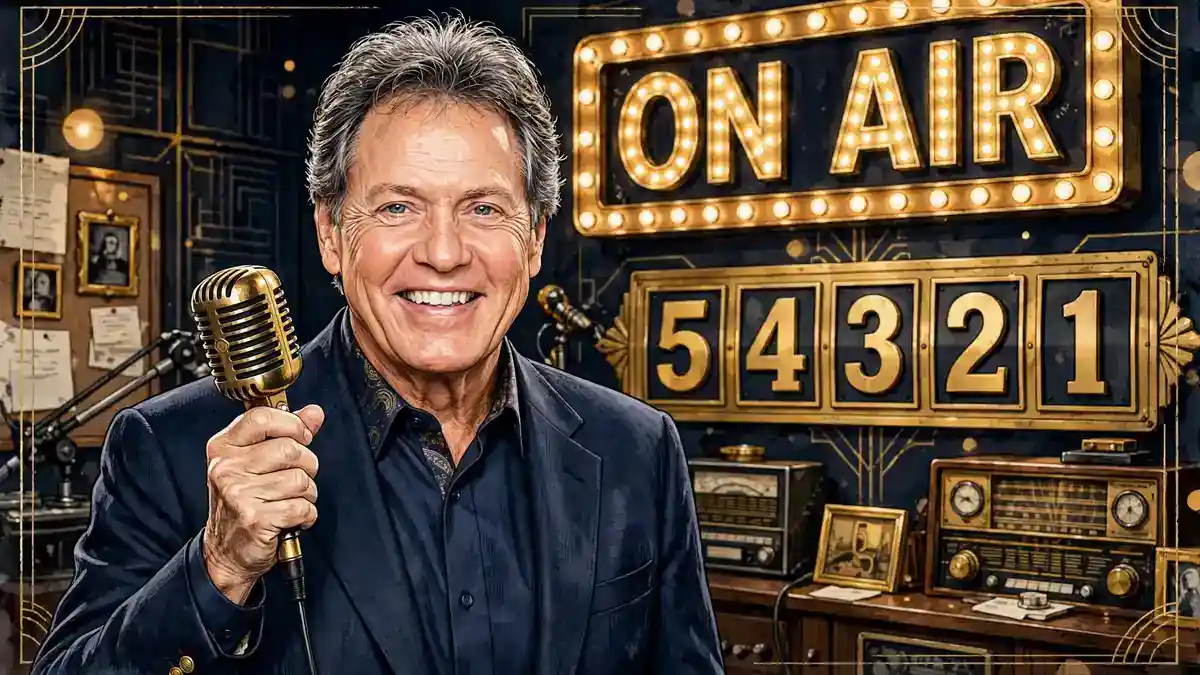
Rick Dees‘s net worth is estimated at $40 million to $50 million as of November 2026. The radio host who turned a joke record into a number-one hit and a Los Angeles morning show into the highest-earning station in America still collects syndication money from the Rick Dees Weekly Top 40, a countdown he launched in 1983 and has never stopped hosting. Celebrity Net Worth, which updated its Dees profile on November 21, 2026, puts the figure at $40 million and his annual pay for the countdown at $10 million; older biographical profiles from 2021 put him at $50 million. The gap between those two numbers is the honest story of a fortune built on radio salaries, one six-million-copy single, and a television network he helped start — and this article works through each piece with the sources named.
Rick Dees: Quick Facts
| Estimated net worth | $40 million – $50 million (range: $40 million – $50 million) |
|---|---|
| Profession | Radio personality, singer, television host, entrepreneur |
| Nationality | American |
| Born | March 14, 1950 (age 76) |
| Height | Not publicly disclosed |
| Primary income sources | Weekly Top 40 syndication, Daily Dees, record royalties, television, network co-founding |
| Active years | 1967 – present |
| Last reviewed | November 2026 |
- Early Life and Background
- Education
- Career Journey
- Rise to Fame
- Main Sources of Income
- Salary and Earnings
- Businesses and Investments
- Brand Deals and Sponsorships
- Houses, Cars and Other Assets
- Awards and Achievements
- Net Worth Growth Over the Years
- Social Media Presence
- Personal Life
- Sources & Reporting
- Frequently Asked Questions
Early Life and Background
Rigdon Osmond Dees III was born on March 14, 1950, in Jacksonville, Florida, and grew up in Greensboro, North Carolina, where his family settled while he was still a boy. Greensboro shaped him in two ways that stayed with him for the rest of his career: it gave him his first radio job while he was still in high school, and it gave him the Boy Scouts. Dees earned the rank of Eagle Scout at 15, and in 2018 the Boy Scouts of America named him a Distinguished Eagle Scout, an honor reserved for Eagles who have spent at least 25 years distinguishing themselves in their careers. He still talks about scouting in interviews, and the discipline of the organization — show up, prepare, perform — reads like a preview of a man who would eventually host a live countdown show every weekend for more than 40 years without missing the beat.
His father, Rigdon Dees Jr., worked in the moving business, and his mother Ann was a schoolteacher. Dees was the youngest of three children, with two older sisters. Nothing about the household suggested show business. What the household did have was a radio, and a teenager who figured out early that the voice coming out of it could be a job. While his classmates at Greensboro’s Grimsley High School were planning college applications, Dees was already working shifts at WGBG, a local Greensboro station, learning the unglamorous side of the trade: cueing records, reading the weather, and filling dead air without panicking. That high-school job is the first line of his professional biography, and it matters to the money story because Dees never had a break-in period as an adult — by the time he graduated from college he already had years of on-air experience, and he moved through bigger markets fast.
Greensboro has not forgotten him. The city and the state have claimed Dees as a native son for decades, and in November 2025 the Library of American Broadcasting Foundation named him a Giant of Broadcasting & Electronic Arts, with the ceremony held at Gotham Hall in New York City on November 14, 2025. The honor put him in the company of that year’s other honorees, including actor Kelsey Grammer and ABC News anchor David Muir, and it arrived 49 years after the novelty record that made him famous — a useful reminder that the fortune under discussion here was built slowly, in weekly increments, rather than in a single lucky year.
Education
Dees graduated from Grimsley High School in Greensboro and went on to the University of North Carolina at Chapel Hill, where he earned a bachelor’s degree in Radio, Television and Motion Pictures in 1972. The degree was not a detour from his career; it ran alongside it. During his college years he worked at WCAR in Chapel Hill — the campus-area station now known as WXYC — adding a second market to a resume that already included Greensboro. UNC’s program gave him formal training in broadcast production at the exact moment he was practicing it nightly, and the combination of a degree and real airtime is one reason station managers kept hiring him into larger markets through the 1970s.
Chapel Hill also left him with a lasting tie to North Carolina broadcasting. He was later inducted into the North Carolina Music Hall of Fame and the North Carolina Broadcast Hall of Fame, honors that recognize a career that began on the state’s small stations and ended up reaching more than 200 countries. The education line on his biography looks modest next to the dollar figures in this article, but it is worth stating plainly: Dees is one of the few radio stars of his generation who actually studied the medium he mastered, and the polish of the Weekly Top 40 — the timing, the production, the scripted comedy bits — comes from that training as much as from talent.
Career Journey
Dees’s route to Los Angeles ran through the Southeast, one station at a time. After WGBG in Greensboro and WCAR in Chapel Hill, he worked at WKIX in Raleigh and WSGN in Birmingham, Alabama, building a reputation as a morning man who could do characters, comedy, and music without losing the audience. In the mid-1970s he landed at WMPS AM 680 in Memphis — “The Great 68” — and that is where the career swerved from steady radio work into pop history.
Memphis in 1976 was deep in the disco craze, and Dees wrote and recorded a satirical novelty song, “Disco Duck,” with his band Rick Dees and His Cast of Idiots. The record’s path to number one is one of the stranger stories in the music business. Station management at WMPS refused to let Dees play his own song on the air, and rival Memphis stations refused to play it for fear of promoting a competitor’s DJ. Dees mentioned on the air that the record was climbing toward number one while his own station would not play it — and management fired him for it. Parade, citing a 2019 Stereogum column, reports he was fired five days before “Disco Duck” reached number one on the Billboard Hot 100. He toured the East Coast with his band while a 45-day non-compete clause ran, then returned to Memphis radio at WHBQ AM 560. The firing turned out to be the best thing that ever happened to him: the song’s success brought an offer from RKO General to host the morning show on KHJ in Los Angeles, and Los Angeles is where the real money started.
KHJ did not last — the station switched to a country format — and in the summer of 1981 Dees moved to KIIS-FM. The move made him the most important morning host in American radio. With Dees in the morning, KIIS-FM became the number-one revenue-generating radio station in America, with an asset value approaching half a billion dollars, according to Wikipedia‘s account of the station’s history. He was named Billboard Radio Personality of the Year ten years in a row, a run no other radio host has matched. He stayed at KIIS-FM for 23 years, leaving in early 2004 after a contract dispute, and was replaced in the morning slot by Ryan Seacrest, whose own radio and television fortune now runs to an estimated $450–$500 million.
Dees did not retire after KIIS. In August 2006 he returned to Los Angeles radio co-hosting the morning show on KMVN, Movin’ 93.9, with Mark Wong and Patti “Long Legs” Lopez, staying until the station changed format and let its personalities go in April 2009. In April 2011 he was hired by KHHT, KIIS’s sister station, after it switched to a gold-based rhythmic AC format, and he hosted there for a year. Through all of it, the Weekly Top 40 never stopped. Dees owns the show through his holding company, Rick Dees Entertainment, and distributes it himself — a structural fact that explains more about his net worth than any single salary figure, because it means the syndication revenue flows to his company rather than to a station that employs him.
Rise to Fame
Fame arrived twice for Dees, and the two arrivals paid very differently. The first was “Disco Duck” in the autumn of 1976. The single reached number one on the Billboard Hot 100 for one week — October 16, 1976 — held the number-two spot for the following four weeks, and stayed in the Top 10 for ten weeks. It also peaked at number 15 on the Billboard Hot Soul Singles chart. Sales figures for the record vary by source, and the honest way to report them is as a range: Dees’s own site and several biographies put sales at more than six million copies, while the Wikipedia entry for the song itself says over four million. The RIAA certified the single Platinum in the United States, which at the time meant two million units shipped. Whatever the exact count, the record won the People’s Choice Award for Favorite New Song and a BMI Award for the year’s record sales, and it earned Dees a Grammy nomination as a performing artist. The song also appears briefly in the 1977 film Saturday Night Fever, whose soundtrack has sold more than 40 million copies worldwide — the second best-selling soundtrack of all time — though Dees’s own earnings from that placement were a small fraction of the soundtrack’s total.
The second arrival was slower and far more lucrative: the Rick Dees Weekly Top 40. Dees launched the countdown on the weekend of October 8–9, 1983, on 18 stations, after KIIS dropped American Top 40 in a dispute over network commercials. The show grew into the longest continuously running pop music countdown in the world, heard each weekend in more than 200 countries and on the Armed Forces Radio Network, with a weekly audience reported at more than 70 million listeners. It was the first English-speaking radio show to air in China. The countdown’s staying power is the core of the Dees fortune: a show that has run for over 40 years, in multiple editions — Hit Radio, Hot Adult, 80s Edition, and 90s Edition — generates syndication fees, advertising revenue, and archive value year after year, and Dees owns it outright.
Television added a third lane. Dees hosted the syndicated music series Solid Gold, hosted the late-night ABC show Into the Night Starring Rick Dees, and appeared on Roseanne, Married… with Children, and Cheers. On film he performed the title song for Ivan Reitman’s Meatballs (1979), played Ted Quillen — the young man who helped launch Ritchie Valens’s career — in La Bamba (1987), and voiced characters in The Flintstones (as Rock Dees) and Jetsons: The Movie (as Rocket Rick). His comedy albums, including the Grammy-nominated Hurt Me Baby — Make Me Write Bad Checks (1984), added another income stream and a second Grammy-adjacent honor, the Grammy Governor’s Award.
Main Sources of Income
Dees’s money comes from five streams, and their relative weight has shifted over the decades. In the 1970s the record was the story; in the 1980s and 1990s the KIIS-FM morning salary dominated; since the 2000s the syndicated countdown and the businesses built around it have carried the fortune. The breakdown below follows the money in the order it mattered.
Syndicated radio. The Weekly Top 40 and the syndicated Daily Dees show are the engine. Because Dees owns the countdown through Rick Dees Entertainment and distributes it to stations and streamers, he collects syndication and licensing income rather than a station salary for this work. The show airs in several editions for different formats, which multiplies the licensing: a contemporary-hit station, a hot adult contemporary station, and an 80s or 90s throwback station can all carry a Dees countdown in the same market. In March 2025 the engine gained a new gear when Rick Dees Entertainment signed a deal with iHeartMedia giving the company access to the Weekly Top 40 archive, which produced two permanent iHeartRadio streams — Rick Dees Weekly Top 40, a 24/7 loop of the current show distributed nationally by Compass Media Networks, and Classic Rick Dees Top 40, featuring complete countdowns from the 1980s through the 2000s, many of which had not been heard in years. Dees promoted the launch by reuniting with his former KIIS-FM co-host Ellen K on her morning show on KOST-FM on March 21, 2025. The financial terms of the iHeartMedia deal were not disclosed, but archive licensing of a 40-year catalog is the kind of asset that pays for decades, and it is a large part of why the 2026 estimates for Dees have held up rather than faded.
Record royalties. “Disco Duck” still earns. The single’s six-million-plus copies, its Platinum certifications in the United States and Canada, and its inclusion in the Saturday Night Fever era catalog mean performance and mechanical royalties continue to arrive, nearly 50 years after release. The amounts are modest next to the radio money — novelty singles do not pay like catalog rock — but they are real, and they arrive without Dees having to do anything. His comedy albums, led by the Grammy-nominated Hurt Me Baby — Make Me Write Bad Checks, add a smaller royalty stream.
Television and film. Hosting Solid Gold and the ABC late-night show, plus acting roles in La Bamba and voice work in The Flintstones and Jetsons: The Movie, paid appearance and performance fees through the 1980s and 1990s. Since August 2021 he has also been the voice announcer for Nexstar Media Group’s Rewind TV network, a steady announcing job that keeps his voice on television daily.
Network co-founding. Dees co-founded the Fine Living Network with the E. W. Scripps Company — the channel that later became the Cooking Channel — and that equity stake is the single most under-reported part of his wealth. Cable network equity, even a minority founder’s stake, can be worth far more than a salary, and the channel’s later life as the Cooking Channel, a fixture of basic cable, gave the stake lasting value. The exact size of his holding and what he ultimately realized from it have never been disclosed, which is one reason the published net worth estimates carry a $10 million spread.
Digital and app ventures. Dees runs the Rick Dees Hit Music app and the Dees Digital Network (DDN), streaming music channels and countdown content directly to listeners. These are smaller revenue lines than the syndicated show, but they matter because they are owned outright: no station, no network, and no middleman takes a cut before Dees Entertainment does.

Salary and Earnings
The best-documented salary figure in Dees’s career is the one Celebrity Net Worth carries: an annual salary of $10 million for the Rick Dees Weekly Top 40. That number should be read carefully. It is not a station salary in the usual sense — Dees has not been a station employee since he left KIIS-FM in 2004 — but the annual value of the countdown business to him, in syndication fees and related income. Treated that way, $10 million a year over a multi-decade run explains the fortune on its own: even a fraction of that figure, sustained for 40 years and invested conservatively, compounds into the $40–$50 million range.
His KIIS-FM years were the peak earning period. Morning drive at the number-one revenue station in America paid a premium in the 1980s and 1990s, when Los Angeles morning hosts were among the highest-paid people in radio. The station itself was worth approaching half a billion dollars at the height of Dees’s tenure, and his contract reflected his role in building that value. No contract figure from the KIIS years has ever been published, so this article does not invent one; what the record supports is that Dees was paid at the very top of the radio market for more than two decades, was named Billboard Radio Personality of the Year ten consecutive times, and left the station in 2004 with the countdown — the asset that mattered — in his own hands.
For scale, the radio fortunes around him show how wide the range runs. Howard Stern, whose satellite-radio contracts redefined what a radio host could earn, built a fortune reported in the hundreds of millions; Sean Hannity, the talk-radio and television host, built a fortune reported at around $300 million. Dees sits below both men, and the reason is structural: Stern and Hannity monetized daily, multi-hour shows inside giant corporate deals, while Dees’s wealth rests on a weekly countdown he owns and a single hit record. Ownership gave him longevity; it did not give him Stern-scale contracts. The $10 million annual figure for the countdown is the number to remember, because it has been there, year after year, long after the KIIS salary ended.
One more earnings detail deserves a place here because it shows how Dees thought about money. In 1991, Cosmo Cappellino, KIIS-FM’s former advertising sales manager, sued Dees and his business manager Wally Clark for $10 million, alleging they had set up secret companies to divert advertising revenue from the syndicated Weekly Top 40. According to a UPI report of the case, the jury found that Dees and Clark had acted with malice and oppression in siphoning $2.5 million in advertising revenue from the show, cheating their partner Cappellino out of profits. The case is a matter of public record and it cuts two ways: it confirms that the countdown was generating millions in advertising revenue by the early 1990s, and it shows that the money around the show was contested. This article reports the jury finding as UPI reported it and draws no further conclusion.
Businesses and Investments
Dees has always behaved like an owner rather than an employee, and the businesses tell that story. Rick Dees Entertainment is the holding company for the countdown, the Daily Dees show, the archive, and the digital channels; his son Kevin Dees serves as president of creative development there, which makes the company a family business as well as a media business. The March 2025 iHeartMedia deal was signed through that holding company, and the structure matters: when iHeartMedia licenses the archive, it licenses it from Dees Entertainment, and the revenue lands in a company Dees controls.
The Fine Living Network is the biggest single business bet of his career. Co-founding a cable network with the E. W. Scripps Company in the 1990s put Dees on the ownership side of television at a moment when cable channels were being built and sold for large sums. The network later became the Cooking Channel, and while the terms of Dees’s exit and the size of his stake were never made public, a founder’s position in a Scripps-backed channel is the kind of asset that can be worth eight figures on its own. It is also the most likely explanation for why some estimates of his wealth run $10 million above the Celebrity Net Worth figure: the network stake is real, it is valuable, and nobody outside the deal knows exactly what it was worth.
The Dees Digital Network and the Rick Dees Hit Music app are the modern versions of the same instinct — own the distribution. The app streams music channels built around the Dees brand, and the digital network carries countdown content to listeners who never turn on a terrestrial radio. Neither venture has disclosed revenue, and this article does not guess at it; their importance is strategic rather than financial, keeping the Dees brand in front of listeners as radio audiences move to phones.
Outside media, Dees’s investments are quiet. He raises cattle and crops on a farm in central Kentucky, according to Bhamwiki, which is both a working agricultural business and a land asset. Farming income is modest next to broadcasting, but farmland holds value, and the Kentucky property adds a second real-estate anchor to a portfolio otherwise centered on Los Angeles. There are no public records of stock portfolios, venture investments, or endorsement equity stakes, and this article does not invent any.
Brand Deals and Sponsorships
Dees’s career predates the modern influencer endorsement economy, and his brand income has always run through radio rather than through product deals. The Weekly Top 40 itself is the sponsorship vehicle: advertisers buy time on a countdown heard by more than 70 million people a week in over 200 countries, and the show’s host reads the spots. That is the oldest form of broadcast sponsorship, and for Dees it has been far more lucrative than any single product endorsement.
The 1991 Cappellino lawsuit is, oddly, the clearest public evidence of how much sponsorship money flowed through the show: the $2.5 million in advertising revenue at issue in that case was a slice of the show’s ad income, not the whole of it. In the decades since, the show’s advertising has moved with the market — terrestrial radio spots, streaming pre-roll on the iHeartRadio channels, and branded segments on the app. Dees has not built a public portfolio of consumer brand endorsements in the style of a modern celebrity, and there is no record of a major sneaker, watch, or beverage deal attached to his name. His brand is the countdown, and the countdown’s sponsors are his brand deals.
The one consumer-facing venture that resembles a brand extension is the food side of his life. Dees describes himself as an amateur pastry chef, and his site carries a collection of recipes and kitchen tips under the name Dees-SERTS & Savories. It is a hobby with a public face rather than a commercial empire, but it fits the pattern of his career: a personal interest turned into content under his own name, distributed through channels he controls.

Houses, Cars and Other Assets
The centerpiece of Dees’s property holdings is the Toluca Lake home in Los Angeles. In 1990, Dees and his wife Julie tore down a recently acquired mansion in the neighborhood and custom-built a 7,000-square-foot house with five bedrooms and six bathrooms in its place. They briefly listed the home for sale in 2006 for around $6 million, then took it off the market and stayed. Celebrity Net Worth, citing comparable sales in the neighborhood, estimates the home could be worth $8–$10 million today. Toluca Lake is one of the San Fernando Valley’s most established celebrity neighborhoods, and a 7,000-square-foot custom build on a large lot there has appreciated steadily for three decades. The house is both a home — Dees and Julie still live there — and the largest single asset in his portfolio after the countdown business itself.
The second property is the farm in central Kentucky, where Dees raises cattle and grows crops. The farm’s size and value have not been publicly reported, and this article does not estimate them; what matters is that it exists, it is worked land rather than a trophy property, and it diversifies a portfolio that would otherwise be a single Los Angeles house plus media assets. Rural Kentucky farmland does not appreciate like Toluca Lake real estate, but it does not fall like it either, and it produces income every year.
On cars, the public record is thin. Dees has never cultivated a car-collector image, and no credible source lists a fleet of exotic vehicles in his name. That absence is itself informative: unlike many celebrities whose wealth shows up in garages, Dees’s money shows up in a business he owns and a house he built. This article will not pad the section with a list of cars he may or may not own. What can be said is that his tangible assets — the Toluca Lake house, the Kentucky farm, and the archive of more than 40 years of countdown broadcasts — are the physical form of the fortune, and the archive may be the most valuable of the three: a complete, owned catalog of the longest-running pop countdown in history, newly licensed to iHeartMedia in 2025.
Awards and Achievements
Dees’s trophy shelf is one of the fullest in radio, and it is worth listing in full because it explains why stations and syndicators kept paying him at the top of the market for so long.
- Billboard Radio Personality of the Year — ten consecutive years, a record for the award.
- Marconi Award — radio’s highest honor, from the National Association of Broadcasters.
- National Radio Hall of Fame — inducted, alongside induction into the National Association of Broadcasters Hall of Fame.
- Hollywood Walk of Fame — star in the Radio category, awarded September 17, 1984, at 1560 North Vine Street.
- Grammy nomination — 1984, for the comedy album Hurt Me Baby — Make Me Write Bad Checks; later honored with the Grammy Governor’s Award.
- People’s Choice Award — Favorite New Song, for “Disco Duck.”
- BMI Award — for the year’s record sales, for “Disco Duck.”
- Tennessee Radio Hall of Fame and North Carolina Music Hall of Fame — honoring the Memphis and Greensboro chapters of his career.
- Giant of Broadcasting & Electronic Arts — Library of American Broadcasting Foundation, November 14, 2025.
- Eagle Scout / Distinguished Eagle Scout — earned the rank at 15; named a Distinguished Eagle Scout in 2018.
The 2025 Giants of Broadcasting honor is the freshest item on the list and the one most other net-worth profiles miss. It arrived 42 years after the Weekly Top 40 began, and it confirms that the industry still treats Dees as a living figure rather than a nostalgia act — a distinction that matters to the value of the archive and the show, because a host who is still being honored is a host whose catalog still has a buyer.
Net Worth Growth Over the Years
No audited year-by-year record of Dees’s wealth exists, and the table below is an estimated trajectory built from the dated facts in this article — the 1976 record, the 1981 KIIS move, the 1983 countdown launch, the 1990s network stake, and the two published estimates — not a set of sourced annual figures. It shows the shape of the fortune rather than its exact balance at any date.
| Year | Estimated net worth | What drove it |
|---|---|---|
| 1976 | ~$1 million | “Disco Duck” reaches number one; six-million-copy single |
| 1985 | ~$10 million | KIIS-FM morning show at America’s top-earning station; countdown in year two |
| 1995 | ~$20 million | Countdown syndication at full scale; Fine Living Network co-founded; television work |
| 2005 | ~$30 million | 23 KIIS years banked; countdown owned outright; Toluca Lake home appreciating |
| 2015 | ~$35 million | Daily Dees and digital channels; Rewind TV announcing to come |
| 2021 | ~$50 million | Biographical profiles’ estimate; Rewind TV voice-announcer role begins |
| 2026 | $40 – $50 million | Celebrity Net Worth $40M (Nov 2026) vs. $50M bio-profile figure; iHeartMedia archive deal |
Two things stand out in that shape. First, the fortune grew steadily rather than in jumps: there was no single windfall after “Disco Duck,” and the biggest gains came from two decades of top-of-market radio pay plus ownership of the countdown. Second, the 2021-to-2026 dip from $50 million to $40 million in the published estimates is a revision of the estimate, not a documented loss. Nothing in the public record shows Dees losing money in that period — the iHeartMedia deal of March 2025, if anything, added a new income line. The $40–$50 million range is the honest statement: the lower figure is the most recent, from Celebrity Net Worth’s November 2026 update, and the higher figure is the one biographical profiles carried in 2021.
Social Media Presence
Dees’s online presence is built around his own properties rather than social platforms. His home base is rick.com, where the countdown, the Daily Dees show, the Rick Dees Hit Music app, and his Dees-SERTS & Savories recipes all live. The Weekly Top 40 has its own social accounts, and the iHeartRadio streams carry the show to listeners who find it through the iHeart app rather than through a radio dial. Dees is active on the major social platforms under his name, but he is not a social-media-first celebrity: his audience reaches him through the countdown and the app, not through viral posts.
That matters to the money story in a specific way. A celebrity whose income depends on social reach lives and dies by the algorithm; a celebrity whose income depends on a syndicated show with 70 million weekly listeners and a 40-year archive has a far more durable asset. Dees’s follower counts are not the point, and this article does not publish them, because no reliable, current count is available and the counts would not change the estimate. The durable numbers are the ones already in this article: 200-plus countries, 40-plus years, two iHeartRadio streams, and a catalog that iHeartMedia paid to license in 2025.
Personal Life
Dees was married to Nancy Carmody from 1970 to 1976. He married voice actress and comedian Julie McWhirter on April 29, 1978 — some biographies list the year as 1977 — and the couple have been together ever since. Julie is a voice actress known for animated series including The Ri¢hie Ri¢h/Scooby-Doo Show, Alvin & the Chipmunks, The Flintstone Kids, and The Smurfs, and she helped Dees compose the sound effects and comedy bits that became a signature of the countdown show. Their son, Kevin Dees, is president of creative development at Rick Dees Entertainment and a radio and television host in his own right, and Dees and Julie are grandparents to Ava and Briar.
The family lives in the Toluca Lake home they built in 1990. Outside broadcasting, Dees is an outdoorsman, a farmer on the Kentucky property, a golfer, and a self-described amateur pastry chef. He remains active in the Boy Scouts, the organization that gave him his Eagle Scout rank at 15, and in Young Life, the Christian youth organization. He is 76 years old as of November 2026 and still hosts the Weekly Top 40 every weekend — the longest continuously running pop countdown in the world, still presented by the man who created it.
One legal episode belongs in the personal record because it has been reported as part of his biography. In 1984, Marvin Fisher, who owned the copyright to the music used in Johnny Mathis’s “When Sunny Gets Blue,” sued Dees after Dees recorded a parody, “When Sonny Sniffs Glue,” using nearly 30 seconds of the song on the album Put It Where the Moon Don’t Shine. The court ruled that the parody was meant to poke fun at Mathis’s singing style and should not be considered infringement. Dees won the case, and the ruling is a small footnote in the history of musical parody law.
Sources & Reporting
Celebrity Net Worth — the $40 million net worth figure and $10 million annual salary for the Weekly Top 40; the Toluca Lake home history and $8–$10 million current estimate; the 1991 Cappellino lawsuit and the 1984 parody lawsuit; the March 2025 iHeartMedia deal summary. Profile updated November 21, 2026.
Wikipedia — Rick Dees biography (birth date, education, station history, KIIS-FM asset value, countdown launch and reach, iHeartMedia deal, honors) and the “Disco Duck” entry (chart run, sales range, RIAA certification). Pages reviewed November 2026.
iHeartMedia — press release of March 20, 2025, announcing the two new iHeartRadio streaming stations in partnership with Rick Dees Entertainment, the Ellen K reunion on KOST-FM, and the archive licensing terms.
RadioInsight — March 20, 2025 report on the iHeartMedia partnership, confirming the two channels and the Compass Media Networks distribution of the current show.
Parade — March 2025 report on Dees turning 76, confirming the “Disco Duck” sales figure and the detail that Dees was fired from WMPS five days before the song reached number one, via a 2019 Stereogum column.
Rick.com — Dees’s official site, for the countdown’s current reach (70 million listeners, 125 countries), the “Disco Duck” sales account, the family details, and the Dees-SERTS & Savories project. Note: parts of the site’s wiki-style pages are AI-assisted, so this article used it only for facts corroborated elsewhere.
Rock & Roll Hall of Fame — the Rick Dees Papers archive guide, confirming the career timeline (UNC graduation 1972, KIIS-FM start July 1981, Grammy nomination 1984, KIIS departure 2004) and the countdown’s audience figures.
Library of American Broadcasting Foundation — Dees biography and the 2025 Giants of Broadcasting & Electronic Arts honor, ceremony November 14, 2025, Gotham Hall, New York.
Bhamwiki — the central Kentucky farm (cattle and crops) and the Marconi Award and Grammy Governor’s Award honors.
Vicksburg Radio — career summary confirming the station sequence, the ten consecutive Billboard Radio Personality of the Year wins, the Fine Living Network co-founding, and the Dees Digital Network.
Reporting window: November 2026. Where sources disagree — the “Disco Duck” sales total (four vs. six million copies), the net worth figure ($40 million vs. $50 million), and the year of Dees’s marriage to Julie McWhirter (1977 vs. 1978) — this article prints the range or both versions and names the source of each.
Frequently Asked Questions
What is Rick Dees’ net worth in 2026?
Rick Dees’ net worth is estimated at $40 million to $50 million as of November 2026. Celebrity Net Worth, which updated its profile on November 21, 2026, puts the figure at $40 million, while biographical profiles from 2021 put it at $50 million. The range reflects that disagreement; the fortune rests on the Weekly Top 40 syndication, the “Disco Duck” royalties, the KIIS-FM years, and his co-founding stake in the Fine Living Network.
How much does Rick Dees make per year?
Celebrity Net Worth reports Rick Dees’ annual salary for the Rick Dees Weekly Top 40 at $10 million. That figure represents the annual value of the countdown business to him — syndication fees and related income through his company, Rick Dees Entertainment — rather than a station salary, since he has not been a station employee since leaving KIIS-FM in 2004.
Is Rick Dees still alive and still hosting the Weekly Top 40?
Yes. Rick Dees is 76 years old as of November 2026 and still hosts the Rick Dees Weekly Top 40 every weekend, along with the syndicated Daily Dees show. The countdown, which he launched on October 8–9, 1983, is the longest continuously running pop music countdown in the world, and in March 2025 he signed a deal with iHeartMedia that added two permanent iHeartRadio streams of the show.
How old is Rick Dees?
Rick Dees was born Rigdon Osmond Dees III on March 14, 1950, in Jacksonville, Florida, which makes him 76 years old as of November 2026. He grew up in Greensboro, North Carolina, graduated from Grimsley High School, and earned his bachelor’s degree from the University of North Carolina at Chapel Hill in 1972.
Who is Rick Dees’ wife?
Rick Dees has been married to voice actress and comedian Julie McWhirter since 1978 (some biographies list 1977). Julie voiced characters on The Smurfs, Alvin & the Chipmunks, The Flintstone Kids, and The Ri¢hie Ri¢h/Scooby-Doo Show, and helped create the sound effects for the Weekly Top 40. They have one son, Kevin Dees, and live in Toluca Lake, Los Angeles. Dees was previously married to Nancy Carmody from 1970 to 1976.
Why did Rick Dees leave KIIS-FM?
Rick Dees left KIIS-FM in early 2004 after 23 years, following a contract dispute. He had hosted the station’s morning show since the summer of 1981 and turned KIIS-FM into the number-one revenue-generating station in America. He was replaced in the morning slot by Ryan Seacrest. Dees kept ownership of the Weekly Top 40, which he continues to host and distribute through his own company.
How many copies did “Disco Duck” sell?
Reports vary: Dees’s own site and several biographies say “Disco Duck” sold more than six million copies, while the Wikipedia entry for the song says over four million. The RIAA certified the single Platinum in the United States. The song reached number one on the Billboard Hot 100 for one week in October 1976, stayed in the Top 10 for ten weeks, and won the People’s Choice Award for Favorite New Song.
Where does Rick Dees live now?
Rick Dees lives in Toluca Lake, Los Angeles, with his wife Julie, in the 7,000-square-foot home they custom-built in 1990 after tearing down the mansion previously on the lot. The home was briefly listed for around $6 million in 2006 and could be worth $8–$10 million today based on comparable sales. He also owns a farm in central Kentucky, where he raises cattle and crops.
Final Thoughts
Rick Dees’s $40–$50 million fortune is a study in what ownership does to a broadcasting career. The hit record made him famous, and the KIIS-FM years made him rich by radio standards, but the decision that built the fortune was keeping the Weekly Top 40 for himself. A countdown he started on 18 stations in 1983 still pays him in 2026 — through syndication, through the iHeartRadio streams that launched in March 2025, and through an archive of 40 years of broadcasts that a major media company paid to license. The Fine Living Network stake added a second kind of ownership, the kind that turns a salary into equity, and the Toluca Lake house added the third, the kind that appreciates while you sleep in it.
The $10 million gap between the two published estimates is not a mystery to solve but a fact to report: the most recent figure, from Celebrity Net Worth’s November 2026 update, is $40 million, and the 2021 figure was $50 million. Nothing in the record shows a loss in between. At 76, Dees is still on the air every weekend, still being honored by the industry — a Giant of Broadcasting in November 2025 — and still collecting on a catalog that grows more valuable the longer it runs. For a man who was fired five days before his song hit number one, that is a reasonable outcome.
Published on November 24, 2026. Last reviewed November 2026. Found an error? See our corrections policy.