
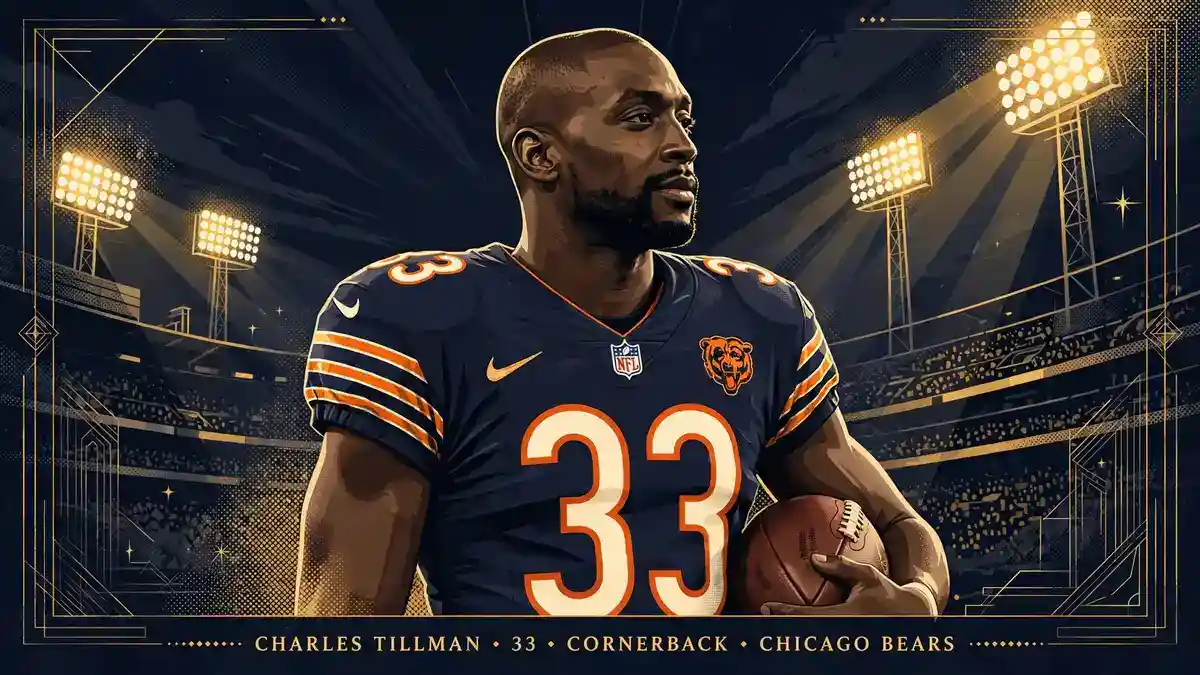
Charles Tillman‘s net worth is estimated at $10 million to $14 million as of November 2026. The former Chicago Bears cornerback banked $49.1 million in NFL salary across 13 seasons, built a second career as an FBI special agent, and then walked away from federal law enforcement in 2025 — a move he said his football money made possible.
Charles Tillman: Quick Facts
| Estimated net worth | $10 million (range: $10 million to $14 million) |
|---|---|
| Profession | Former NFL cornerback; former FBI special agent |
| Nationality | American |
| Born | February 23, 1981 (age 45) |
| Height | 6 ft 2 in (1.88 m) |
| Primary income sources | NFL contracts ($49.1 million career earnings), FBI salary, FOX Sports analyst work, investments |
| Active years | NFL 2003–2015; FBI 2018–2025 |
| Last reviewed | November 2026 |
- Early Life and Background
- Education
- Career Journey
- Rise to Fame
- Main Sources of Income
- Salary and Earnings
- Businesses and Investments
- Brand Deals and Sponsorships
- Houses, Cars and Other Assets
- Awards and Achievements
- Net Worth Growth Over the Years
- Social Media Presence
- Personal Life
- Sources & Reporting
- Frequently Asked Questions
Early Life and Background
Charles Anthony Tillman was born on February 23, 1981, in Chicago, Illinois, and the city shaped him even though he barely grew up there. His father, Donald Tillman Jr., served as a sergeant in the United States Army, and the family’s postings moved constantly — across American states and to Germany. Tillman attended eleven different schools between kindergarten and twelfth grade, a childhood of new classrooms, new teammates, and new zip codes every year or two. That rootlessness became an asset: he learned to read rooms fast, to fit into a locker room fast, and to treat change as routine. Those are the same skills that later let him switch from NFL stardom to federal law enforcement without missing a beat.
The nickname that followed him for life arrived before he could walk. An aunt looked at the newborn and said he was as small as a peanut, and “Peanut” stuck — first as a family joke, then as a stadium chant, then as the brand name for the most famous tackling technique of his generation. He started school at Horace Mann Elementary on Chicago’s South Side before the Army moves carried the family away, and he eventually landed at Copperas Cove High School in central Texas, the eleventh and final school of his youth. At Copperas Cove he played football and basketball, earned two-time All-District 8-5A and all-area honors, and stood out as a 6-foot-2 defensive back with speed that college recruiters somehow undervalued. The big programs passed. The school that wanted him sat just across the Texas–Louisiana border, and that near-miss in recruiting became one of the best bargains in Bears draft history.
The Army childhood also explains the second act that surprises people who only know the football card. Tillman grew up around discipline, chain of command, and service as a daily routine rather than a slogan. His father wore the uniform; his son would later wear a badge. When Tillman talks about his FBI years, he frames them as a continuation of the same household values, not a career change. The money matters here too: a childhood spent moving between Army bases taught him to live without roots in expensive places, and teammates and reporters who covered him in Chicago consistently described a player who spent carefully and planned early — the habits that leave a $49 million career turning into a durable eight-figure fortune instead of a cautionary tale.
Education
Tillman played college football for the Louisiana–Lafayette Ragin’ Cajuns from 1999 to 2002, and he treated the classroom as seriously as the field. He majored in criminal justice — the degree that foreshadowed his FBI career by nearly two decades — and finished it in three and a half years while earning four consecutive letters and starting for three seasons in the defensive backfield. That pace says something about the man: most college athletes stretch a degree across four or five years; Tillman finished early and still made first-team All-Sun Belt in both 2001 and 2002.
The criminal justice degree was no placeholder major picked to stay eligible. Tillman has said he was drawn to the subject by teachers who engaged him during his many school moves, and the interest never faded. When he retired from football at 34, he did not need to discover a new passion — he already had one, documented on a diploma from 2002. The degree also gave him a practical edge in the FBI application process: he arrived at Quantico in 2018 with a formal grounding in the law to go with thirteen years of performing under pressure in front of crowds. Few career pivots in sports history have been telegraphed so far in advance, or executed so cleanly.
His college production translated directly into draft value. At the NFL Combine he ran the 40-yard dash in 4.49 seconds, posted a 40-inch vertical jump, and measured just over 6-foot-1 and 207 pounds — a long, fast cornerback with the frame to tackle like a safety. The Bears took him in the second round, 35th overall, in the 2003 NFL draft, making him the team’s third selection that year. Linebacker Lance Briggs went 68th overall in the same draft, and the two would anchor the Bears defense together for a decade alongside Brian Urlacher, the face of that defense. Tillman returned to Louisiana as a commencement speaker years later, honored as an all-star on and off the field — the university’s words — for a career that began in Lafayette classrooms and ended with a federal badge.
Career Journey
Tillman signed his rookie contract on August 1, 2003 — a five-year, $4.32 million deal with a $2.05 million signing bonus — and opened his first season third on the depth chart. The Bears started 0–3, the coaching staff shuffled the lineup, and by Week 5 the rookie was starting and drawing assignments against Tim Brown and Jerry Rice, two receivers headed for the Hall of Fame. He finished his first season as the Football Digest Defensive Rookie of the Year, and the job never left him. Across 13 seasons he played 194 games with 157 starts, numbers that reflect a durability rare for a cornerback who tackled the way he did.
The defining move of his career was a technique, not a single play. The “Peanut Punch” was Tillman’s habit of punching down at the ball as he wrapped up a ball carrier, knocking it loose instead of simply bringing the man down. Cornerbacks are taught to tackle; Tillman tackled and stripped at the same time, turning routine stops into turnovers. The results piled up into records that still stand: 44 career forced fumbles, the most by a defensive back in NFL history, including 10 in the 2012 season alone — an NFL single-season record — and four forced fumbles in a single game, also a league record. He added 38 interceptions, 140 pass deflections, 11 fumble recoveries, nine defensive touchdowns, 3.0 sacks, and 930 total tackles. The forced-fumble total is the number that defines him: the next-closest defensive backs in history sit well behind it, and the punch has been copied by defensive backs across the league ever since.
The Bears years ran from 2003 to 2014, twelve seasons in navy and orange, and they included the franchise’s run to Super Bowl XLI after the 2006 season. Tillman started at cornerback in that Super Bowl against the Indianapolis Colts, a game the Bears lost 29–17 in a Miami rainstorm. He was still a starter when the Bears rebuilt around him, still the defense’s tone-setter when Lovie Smith’s Tampa-2 scheme gave way to new coordinators, and still productive into his thirties — a rarity at a position where speed fades fast. His peak arrived late: Pro Bowl selections in 2011 and 2012, first-team All-Pro in 2012, and the NFL forced-fumbles crown that same season, at age 31, when most cornerbacks are already declining or retired.
Injuries finally caught up with him in 2013, when a torn triceps ended his season, and again in September 2014, when he tore the same triceps and landed on injured reserve. The Bears re-signed him in March 2014 on a one-year deal worth up to $3.25 million, but the second tear closed his Chicago chapter. On April 9, 2015, he signed a one-year contract with the Carolina Panthers — a deal reported at $2 million with a $350,000 signing bonus — reuniting with head coach Ron Rivera, who had been the Bears’ defensive coordinator from 2004 to 2006. Tillman contributed to a 15–1 Panthers team that reached Super Bowl 50, though he was on injured reserve by the time Carolina played Denver. He announced his retirement on July 18, 2016, in a three-minute YouTube video, then signed a ceremonial one-day contract on July 22 to retire as a Bear. Twelve seasons in Chicago, one in Carolina, two Super Bowls, and a technique that changed how his position is played.
Rise to Fame
Tillman’s fame did not arrive with a single highlight. It accumulated, season by season, as opponents and analysts noticed that the Bears cornerback kept ending plays with the ball on the ground. The 2012 season turned respect into national recognition: ten forced fumbles in sixteen games, three interceptions, first-team All-Pro honors, a second straight Pro Bowl, and the forced-fumbles record. He was 31, playing the best football of his life, and doing it with a skill no one else in the league owned. The following February he won the Walter Payton NFL Man of the Year Award for 2013, the league’s highest honor for community work, presented at Radio City Music Hall in New York. The award citation pointed at the same story the money pages miss: his foundation had already touched more than a million Chicago-area children by then.
The Man of the Year award made him a different kind of famous. Tillman had told his family’s story publicly — his infant daughter’s heart condition, the transplant that saved her, the hospital months that remade his foundation’s mission — and the award put that story on the league’s biggest stage. He told Oprah Winfrey’s audience in 2011 about meeting the mother of the child whose heart had saved his daughter’s life. He delivered the commencement address at his alma mater. He became, in the Bears’ own phrasing, an all-star on and off the field, and the “100 Greatest Bears of All-Time” list later confirmed his place in franchise history. Fame, for Tillman, was never about a shoe deal or a catchphrase. It was about a punch, a foundation, and a second career that nobody saw coming.
The second act made him famous a second time. When news broke in 2018 that the retired cornerback had finished the FBI’s 20-week training program at Quantico and earned his badge, the story traveled far beyond sports pages. A former NFL star joining the Bureau was unusual enough; a two-time Pro Bowler doing it at 37, after earning $49 million on the field, was stranger still. The Daily Mail and NBC Sports both picked up the story, and it followed him for seven years — until September 2025, when he told The Pivot podcast he had resigned, and the story traveled again, this time as a national news item about conscience, immigration enforcement, and a man who could afford to quit. In November 2025, NBC Sports also noted he was among the 128 modern-era nominees for the Pro Football Hall of Fame class of 2026 — a reminder that the football case, alongside the second career, is still being weighed.
Main Sources of Income
NFL salary dominates Tillman’s fortune, and the numbers are unusually clean. Over The Cap puts his career cash earnings at $49,125,000 across thirteen seasons, with $47,237,500 of that coming from twelve Bears seasons and $1,887,500 from his single year in Carolina. Spotrac’s total runs a little higher at $50.97 million — the gap reflects different treatment of incentives and per-game bonuses, not a dispute about the scale. Either way, the playing career produced roughly $49–51 million in gross pay before taxes, agent fees, and living costs. That is the foundation of the $10 million to $14 million net worth estimate, and it is the only income stream in his life with a public paper trail down to the dollar.
The second income stream was federal. Tillman joined the FBI in 2018 and served about eight years, mostly on a safe streets task force, finishing as a firearms and tactical instructor. No public record states his FBI salary or grade, and this article will not guess at one — but the scale is clear from the structure of federal pay: a special agent’s salary sits in the six figures, a small fraction of what he earned per season in the NFL. The FBI years matter to his wealth story in a different way. They gave him a steady income and federal benefits through his late thirties and forties, years when many retired players burn through savings, and they kept him from needing to chase broadcasting or endorsement money to stay afloat. The steady paycheck protected the football fortune rather than adding much to it.
Broadcasting filled the gap between the two careers. After retiring in July 2016, Tillman spent the 2016 season as an NFL analyst for FOX Sports, a common landing spot for recently retired players. Analyst pay for a first-year studio contributor is modest next to a playing salary, and no figure has been reported publicly, so it belongs in the record as a real but minor income stream. Later, the talent agency MN2S listed him as a client and noted his investment in Moment App, a platform built to connect athletes with fans and raise money for their causes — a small, on-brand investment that ties his business interests to his charity work. Endorsements, by contrast, were never a major pillar: no national campaign with a reported value attaches to his name, and the endorsement deals mentioned by net-worth aggregators trace to local Chicago arrangements rather than anything on the scale of a shoe or beverage contract. His wealth is a salary story, a savings story, and a second-career story — not an endorsement story.
Salary and Earnings
The contract record, as compiled by Over The Cap, tells the story in four deals. The rookie contract in 2003 was worth $4,297,500 over four years by the database’s accounting, with $2,055,000 guaranteed; Tillman actually earned $3,739,500 on it. The 2007 extension was the fortune-maker: six years, $37,000,000, with $11,000,000 guaranteed, and he ultimately earned $40,598,000 on that deal as incentives and escalators kicked in — more than the headline value. His largest single cash payment came in 2007, at $12,098,000, the year the extension’s signing bonus and early money landed. The 2014 one-year return to Chicago was worth $3,250,000 with $750,000 guaranteed, of which he earned $2,900,000 before the triceps tear ended his season. The Carolina deal in 2015 was worth $1,750,000 with $350,000 guaranteed, and he earned $1,887,500 on it.
| Contract | Years | Total value | Guaranteed | Amount earned |
|---|---|---|---|---|
| Rookie deal (Bears) | 2003 | $4,297,500 | $2,055,000 | $3,739,500 |
| Extension (Bears) | 2007 | $37,000,000 | $11,000,000 | $40,598,000 |
| One-year deal (Bears) | 2014 | $3,250,000 | $750,000 | $2,900,000 |
| One-year deal (Panthers) | 2015 | $1,750,000 | $350,000 | $1,887,500 |
| Career total | 2003–2015 | — | $14,155,000 | $49,125,000 |
Two points in that table deserve attention because sloppy net-worth pages get them wrong. First, the $37 million extension is routinely described as the deal that made him rich, and it did — but the $40.6 million he actually earned on it exceeded the headline number, which is why the career total lands at $49.1 million rather than the sum of the headline values. Second, some content-farm pages claim Tillman earned $75 million to $85 million in his career, or that his extensions pushed his guaranteed money “into the $50 million range.” Both claims collapse against the databases: total guarantees across his whole career were $14,155,000, and total cash earnings were $49.1 million by Over The Cap and $50.97 million by Spotrac. The $75 million figure appears to confuse contract headline values with cash actually paid, and possibly double-counts the 2007 and 2013 deals. Readers who see an $85 million career-earnings claim for Tillman are looking at a number no contract database supports.
The year-by-year shape of the money matters too. Tillman earned under $1 million a season on his rookie deal — his career average annual pay across thirteen seasons was $3,778,846 — and the big money arrived in a concentrated window from 2007 to 2012, when the extension paid out. That timing is typical of NFL wealth: a few peak years carry the whole fortune, and the player’s job is to make those years last for decades. Tillman’s peak cash year, 2007, delivered $12.1 million in a single season. His final two seasons paid $2.9 million and $1.9 million. The decline was steep, the injuries were real, and the fact that he still holds an eight-figure net worth a decade after his last snap says the peak years were handled with unusual care. For comparison, his longtime teammate Brian Urlacher earned a little over $80 million across his career, per Spotrac — a bigger total built on a first-round pick’s earlier money and a longer peak. Tillman earned about three-fifths of that, from a second-round start, and kept a similar share of it.
Businesses and Investments
Tillman’s business footprint is small, quiet, and consistent with the rest of his public life. The one investment with a public record is Moment App, a platform designed to reinvent how athletes connect with fans and raise money for their causes — the talent agency MN2S notes it in his profile, and it fits the pattern of his post-football choices: small stakes in things connected to charity and athlete-fan relationships rather than splashy startups. No valuation, stake size, or return has ever been reported, so it belongs in the record as a real investment of unknown size, not as a wealth driver. The same honesty applies to the rest of his portfolio: no public record shows a restaurant chain, a clothing line, a real estate fund, or a media company bearing his name. If he holds private investments — and a man with his earnings almost certainly does — they are private, and this article will not invent them.
What is public, and far more important to his finances, is the foundation. The Charles Tillman Cornerstone Foundation is a charity, not a business, but it functions as the most visible institution of his post-football life, and its tax records tell a story that flatters him: according to reporting by Bleacher Report, no one — not even Tillman — draws a salary from the foundation, and no relatives or partners are on its payroll either. Its program spending ran at about 70 percent of revenue in the year Bleacher Report examined, with $246,196 in program-related expenses. The foundation’s own site says it has impacted more than one million Chicago-area children and raised more than $1 million since 2005, and the Chicago Bears’ site repeats those figures. A charity that pays its founder nothing is a cost to his wealth, not a source of it, and that is exactly the point: Tillman’s second career has been about spending football money on other people’s children, not about converting fame into new income.
The investment lesson of Tillman’s file is restraint. He did not launch a tequila brand, buy into a crypto exchange, or open a chain of gyms — the moves that fill the business sections of other players’ net-worth pages. He took a federal salary, kept a small stake in a fan-engagement app, and put his public energy into a foundation that pays him nothing. That restraint is part of why the estimate holds up: there are no failed ventures to subtract, no inflated startup valuations to discount. The $10 million to $14 million range rests on a $49 million career, a decade of living costs, a federal salary, and modest investing — a boring portfolio, in the best sense.
Brand Deals and Sponsorships
Endorsements were never a major income stream for Tillman, and the record is thin enough that honesty requires saying so plainly. Net-worth aggregators credit him with “numerous endorsement deals,” but none of them names a brand, a campaign, or a dollar figure, and no national deal with a reported value attaches to his name in business-press reporting. What exists is local: Chicago-area appearances, foundation-linked partnerships such as Fifth Third Bank’s sponsorship of the Charles’ Locker program, and the kind of community-facing work that pays in relationships rather than contracts. The distinction matters because readers comparing him to skill-position stars will wonder where the shoe money went. The answer is that cornerbacks — even great ones, even in Chicago — rarely command national endorsement portfolios, and Tillman’s prime years came before social media turned every Pro Bowler into a brand. His fame was real, but it was the fame of a defensive player in a team sport, and the endorsement market priced it accordingly.
The sponsorship that does show up in the record is tied to charity, not to his image. Fifth Third Bank sponsored the Charles’ Locker program, which delivers lockers filled with iPads, notebook computers, DVD players, and portable game systems to children’s hospitals. That is a bank supporting a cause, not a brand paying an athlete, and the money went to hospital rooms rather than to Tillman. The same pattern holds across his public life: when a company appears next to his name, it is usually next to the foundation. For a net-worth estimate, the correct treatment is to count endorsements as a minor, largely local income stream during his playing years and essentially zero afterward — a small line item that does not move the $10 million to $14 million range in either direction.

Houses, Cars and Other Assets
No verified public record documents Tillman’s home, property portfolio, or car collection, and this section will not fill the gap with guesses. He has lived in the Chicago area for most of his adult life — he was born there, played twelve seasons there, built his foundation there, and worked his FBI assignment there — and low-quality net-worth pages claim Chicago-area property without citing a deed, an address, or a sale price. Those claims are not repeated here because they cannot be verified. What can be said is structural: a player who earned $49.1 million, kept working on a federal salary for eight more years, and shows no record of lavish spending or financial distress is consistent with a comfortable, unflashy asset base — a family home, retirement accounts, and the kind of holdings that do not generate headlines.
The absence of a car collection in the record is itself informative. Tillman has never been photographed with a fleet of supercars, never promoted a dealership, and never made a vehicle part of his public image. The same holds for watches, jewelry, and the other props that fill the assets sections of other athletes’ pages. His visible spending went to the foundation’s programs — lockers for sick children, holiday celebrations, a 5K run at Soldier Field, luncheons for mothers of ill children — rather than to display assets. For readers who want a property number, the honest answer is that none is public, and any site that prints one for Tillman is printing a guess. The net-worth range already accounts for a normal, comfortable asset base without needing to itemize it.
Awards and Achievements
Tillman’s trophy case pairs on-field honors with the community award that meant more to him. The football list starts with the Walter Payton NFL Man of the Year Award for 2013, presented in February 2014 at Radio City Music Hall, which recognized his foundation work as much as his play. It continues with first-team All-Pro honors in 2012, Pro Bowl selections in 2011 and 2012, the NFL forced-fumbles lead in 2012, and a place among the 100 Greatest Bears of All-Time. His college honors — two first-team All-Sun Belt selections in 2001 and 2002 — and his Football Digest Defensive Rookie of the Year award in 2003 round out the playing honors. The records carry their own weight: most forced fumbles in a season by any NFL player (10, in 2012), most forced fumbles in a single game (4), and 44 career forced fumbles, the most by a defensive back in league history.
The post-football honors are quieter but real. His foundation’s work earned recognition from the Ann & Robert H. Lurie Children’s Hospital of Chicago, which presented Tillman and his wife Jackie with an award at its Champions for Children’s benefit dinner for their commitment to the more than 148,000 patients the hospital treats each year. His alma mater, the University of Louisiana at Lafayette, invited him back as a commencement speaker and celebrated him as an all-star on and off the field. And in November 2025, NBC Sports reported that he was one of 128 modern-era nominees for the Pro Football Hall of Fame class of 2026 — not an induction, and the competition is steep, but a nomination that puts his case in front of voters a decade after his last snap. The Hall of Fame question is the one honor still open, and it will turn on whether voters weigh a revolutionary technique and 44 forced fumbles as heavily as the interceptions and longevity that usually define cornerback inductees.
| Honor | Year |
|---|---|
| Walter Payton NFL Man of the Year | 2013 |
| First-team All-Pro | 2012 |
| Pro Bowl | 2011, 2012 |
| NFL forced fumbles leader (10) | 2012 |
| 100 Greatest Bears of All-Time | — |
| First-team All-Sun Belt | 2001, 2002 |
| Football Digest Defensive Rookie of the Year | 2003 |
| Pro Football Hall of Fame modern-era nominee | 2026 class |
Net Worth Growth Over the Years
Tillman’s wealth followed the classic NFL arc: slow early years, a steep climb when the big extension paid out, a peak at retirement, and a long, gentle plateau afterward as a federal salary replaced football income and living costs drew the balance down. The figures below are estimates built from his contract timeline — cash earned each year, minus taxes, agent fees, and living costs — not audited statements, and they should be read as the shape of the fortune rather than a bank balance at any date. The key insight is the timing: most of the money arrived between 2007 and 2012, and everything since has been management, not accumulation.
| Year | Estimated net worth | What drove it |
|---|---|---|
| 2003 | $1 million | Rookie deal signed; $2.05 million signing bonus |
| 2007 | $5 million | Extension signed; $12.1 million cash year |
| 2010 | $8 million | Extension paying out; Pro Bowl form |
| 2013 | $12 million | Peak earning years; Man of the Year season |
| 2016 | $14 million | Retirement; $49.1 million career total banked |
| 2020 | $12 million | FBI salary years; living costs; no new football income |
| 2026 | $10 million to $14 million | Post-FBI; Celebrity Net Worth at $10 million |
The plateau deserves emphasis because it answers the question every reader of a net-worth page is really asking: did he keep it? A decade after his last NFL paycheck, the estimate has not collapsed, and the reason is visible in his choices. He took a steady federal job instead of chasing paid appearances, he kept his public spending pointed at charity rather than display, and he left the FBI in 2025 by choice — telling The Pivot podcast that he had “made enough money to where I could just walk away.” A man who cannot afford to quit does not quit a federal job on principle. The 2025 resignation is, in its own way, the strongest evidence in the file that the fortune survived: financial independence was the thing that let him act on his conscience.
Why the range, and why do some sites print much bigger numbers? The honest answer is that no one outside Tillman’s household sees his accounts. Celebrity Net Worth, the most-cited estimator, says $10 million in a page updated November 23, 2026. Other estimators print $10 million to $14 million. One outlier page prints $10 million to $29 million, a range so wide it conveys almost no information and rests on no named source. The $10 million to $14 million band used here reflects the agreement of the serious estimators, the $49.1 million career-earnings base, and the decade of post-career costs. Anyone printing $29 million for Tillman needs to explain which assets produce it; no source in this research could.
Social Media Presence
Tillman keeps a low profile online, which fits a man who spent eight years doing quiet federal work after thirteen years in stadiums. The talent agency MN2S lists his Instagram audience at about 140,900 followers — a modest number next to the millions commanded by skill-position stars, and a fair reflection of his public image: respected, recognizable in Chicago, and never chasing the influencer economy. He posts rarely, and his public appearances in recent years have come through Bears media — including an appearance in the team’s schedule-release video — rather than through his own channels. The FBI years required discretion by definition, and the habit seems to have stuck.
That restraint is worth noting for readers who use follower counts as a proxy for wealth. Tillman’s fortune was built before the social media endorsement economy existed in its current form, and his post-football income never depended on it. The 140,900 Instagram followers represent a community, not a revenue line, and no sponsored-post income of any size attaches to his accounts in public reporting. His most-shared moments in recent years were not posts of his own but clips of his Pivot podcast interview about leaving the FBI — other people’s accounts carrying his words further than his own feed ever has.
Personal Life
Tillman and his wife Jackie have four children — Talya, Tiana, Tysen, and Tessa — and the family story is inseparable from the foundation that carries his name. In 2008, when Tiana was three months old, she was diagnosed with dilated cardiomyopathy, a rare heart condition that would be fatal without a transplant. Tillman got the call during a Bears practice: his daughter was going into heart failure. Tiana was placed on the transplant list and received a new heart three months later, after the family spent three months around the clock at Children’s Memorial Hospital in Chicago. She recovered, grew up healthy, and the experience remade the Cornerstone Foundation, which Tillman and Jackie had created in 2005 to help children excel in school. After Tiana’s transplant, the mission changed to improving the lives of critically and chronically ill children.
The foundation’s programs grew directly out of that hospital stay. Charles’ Locker, launched in December 2009 with two lockers at Lurie Children’s Hospital, fills hospital rooms with iPads, notebook computers, DVD players, and portable game systems to help children pass the time during treatment — the idea came from Tillman’s own months at his daughter’s bedside. The Tiana Fund, named for his daughter, has distributed more than $1 million to over 300 economically at-risk families. The TendHER Heart Luncheon honors mothers of ill children. The Field of Dreams and Holiday Celebration programs round out a slate that the foundation says has touched more than one million Chicago-area children and raised more than $1 million since 2005. In 2011, Tillman told his story to Oprah Winfrey on television, appearing with the mother of the child whose donated heart had saved Tiana’s life — a meeting the family had never had before the cameras rolled.
The family thread runs through the FBI resignation too. In January 2025, when the Chicago immigration operation was being organized and agents were told to stand guard and make arrests beyond violent offenders, Tillman chose to spend that day at his 13-year-old daughter Tessa’s basketball game instead of joining the raids. He described the quota-driven arrests as political, said the work “didn’t sit right with my conscience,” and resigned soon after — telling The Pivot podcast he wanted to be “on the right side of history when it’s all said and done.” He left on good terms, he said, with no bitterness toward the colleagues he had served with for eight years. He also noted, plainly, that other agents who felt the same way could not afford to leave — a quiet acknowledgment that his $49 million football career had bought him a freedom most of his coworkers did not have.
Sources & Reporting
Reporting window: November 2026. Figures were checked against the sources below; where they disagree, the article publishes the range and names who says what.
- Celebrity Net Worth — net worth estimate of $10 million, updated November 23, 2026; career-earnings range of $49.1 million to $50.97 million; contract history and FBI resignation details, including The Athletic interview account of his eight Bureau years.
- Over The Cap — contract-by-contract record: $49,125,000 career earnings, $14,155,000 total guarantees, $12,098,000 largest cash payment (2007), and the full earnings-by-team breakdown.
- Spotrac — career-earnings figure of $50.97 million, as cited by Celebrity Net Worth; the $1.8 million gap with Over The Cap reflects incentive and bonus treatment.
- NBC Sports — September 2025 report of the FBI resignation from The Pivot podcast, including Tillman’s quotes on immigration enforcement and his statement that he had “made enough money to where I could just walk away”; also his place among 128 modern-era nominees for the Hall of Fame class of 2026.
- Black Enterprise — account of the resignation tied to the January 2025 ICE deployment to Chicago, the Tom Homan and Dr. Phil briefing, the quota-system quote, and the decision to attend daughter Tessa’s basketball game instead of the operation.
- Wikipedia — career statistics (930 tackles, 44 forced fumbles, 38 interceptions, 140 pass deflections, 9 defensive touchdowns), records (10 forced fumbles in 2012, 4 in one game), draft and contract dates, and biographical details including eleven childhood schools and the Copperas Cove background.
- Pro Football Reference — listed height of 6 ft 2 in and playing weight of 210 lb; career game and start totals.
- Chicago Bears — retirement announcement, foundation impact figures (one million children, $1 million raised), Tiana Fund totals, and the Lurie Children’s Hospital award.
- Charles Tillman Cornerstone Foundation — program details: Charles’ Locker, Tiana Fund, TendHER Heart Luncheon, Field of Dreams, and the 2008 transplant story.
- Bleacher Report — foundation finances, including the finding that no one draws a salary from the foundation, and the Tiana transplant narrative.
- MN2S — Instagram audience of about 140,900 followers and the Moment App investment.
- University of Louisiana at Lafayette — commencement-speaker profile, criminal justice degree completed in three and a half years, and foundation impact figures.
Frequently Asked Questions
What is Charles Tillman’s net worth in 2026?
Charles Tillman’s net worth is estimated at $10 million to $14 million as of November 2026. Celebrity Net Worth puts the figure at $10 million in a page updated November 23, 2026, while other estimators land as high as $14 million. The estimate rests on $49.1 million in career NFL earnings, per Over The Cap, minus taxes, agent fees, and a decade of living costs since his last NFL paycheck.
How much did Charles Tillman make in the NFL?
Over The Cap records $49,125,000 in career cash earnings across 13 seasons, with $47,237,500 from twelve Bears seasons and $1,887,500 from his year in Carolina. Spotrac’s total is slightly higher at $50.97 million. His biggest deal was a six-year, $37 million extension signed in 2007, on which he ultimately earned $40.6 million, and his largest single cash year was 2007 at $12,098,000.
What is Charles Tillman doing now after the FBI?
Tillman resigned from the FBI in 2025 after about eight years as a special agent, most of it on a safe streets task force, finishing as a firearms and tactical instructor. Since leaving, he has kept a low public profile, appearing in Chicago Bears media. In November 2025 he was named one of 128 modern-era nominees for the Pro Football Hall of Fame class of 2026.
Why did Charles Tillman leave the FBI?
Tillman told The Pivot podcast in September 2025 that he resigned because he disagreed with the Trump administration’s immigration enforcement, after agents were told to make arrests beyond violent offenders during the January 2025 Chicago operation. He described quota-driven arrests as political, said the work “didn’t sit right with my conscience,” and noted he could afford to leave because his NFL career had left him financially secure. He said he left on good terms.
What is the Peanut Punch?
The Peanut Punch is Tillman’s signature technique of punching down at the football while tackling a ball carrier, knocking the ball loose instead of just bringing the man down. It produced 44 career forced fumbles — the most by a defensive back in NFL history — including an NFL-record 10 forced fumbles in the 2012 season and a record 4 forced fumbles in a single game.
Is Charles Tillman in the Pro Football Hall of Fame?
Not yet. In November 2025, NBC Sports reported that Tillman was one of 128 modern-era nominees for the Pro Football Hall of Fame class of 2026. His case rests on 44 forced fumbles, two Pro Bowls, first-team All-Pro honors in 2012, and the Walter Payton NFL Man of the Year Award — but he has not been selected as a finalist or inducted.
Who is Charles Tillman’s wife, and how many children does he have?
Tillman is married to Jackie Tillman, and they have four children: Talya, Tiana, Tysen, and Tessa. Their daughter Tiana was diagnosed with dilated cardiomyopathy at three months old in 2008 and received a life-saving heart transplant. The experience reshaped the couple’s Cornerstone Foundation toward helping critically and chronically ill children.
What is the Charles Tillman Cornerstone Foundation?
Tillman and his wife Jackie created the Cornerstone Foundation in 2005. After their daughter Tiana’s heart transplant in 2008, its mission became improving the lives of critically and chronically ill children. Its programs include Charles’ Locker, the Tiana Fund (over $1 million distributed to more than 300 families), the TendHER Heart Luncheon, and Field of Dreams. The foundation says it has impacted more than one million Chicago-area children, and no one — including Tillman — draws a salary from it.
Final Thoughts
Charles Tillman’s fortune is the least flashy $10 million to $14 million in the NFL’s rich-player files, and that is the point. He earned $49.1 million the hard way — twelve seasons in Chicago, one in Carolina, a technique that turned tackles into turnovers — and then did the two things most retired players do not do: he took a steady government job, and he kept his spending pointed at other people’s children. The Peanut Punch made him famous. The foundation made him respected. The FBI years made him unusual. And the 2025 resignation made the whole story cohere: a man who could afford to walk away from a badge because the football money was still there, a decade after his last snap, and who chose his conscience over a paycheck he did not need. The Hall of Fame may or may not come. The fortune, by every check in this article, already did — and it survived because its owner treated it as a tool, not a trophy.
Published on November 24, 2026. Last reviewed November 2026. Found an error? See our corrections policy.