
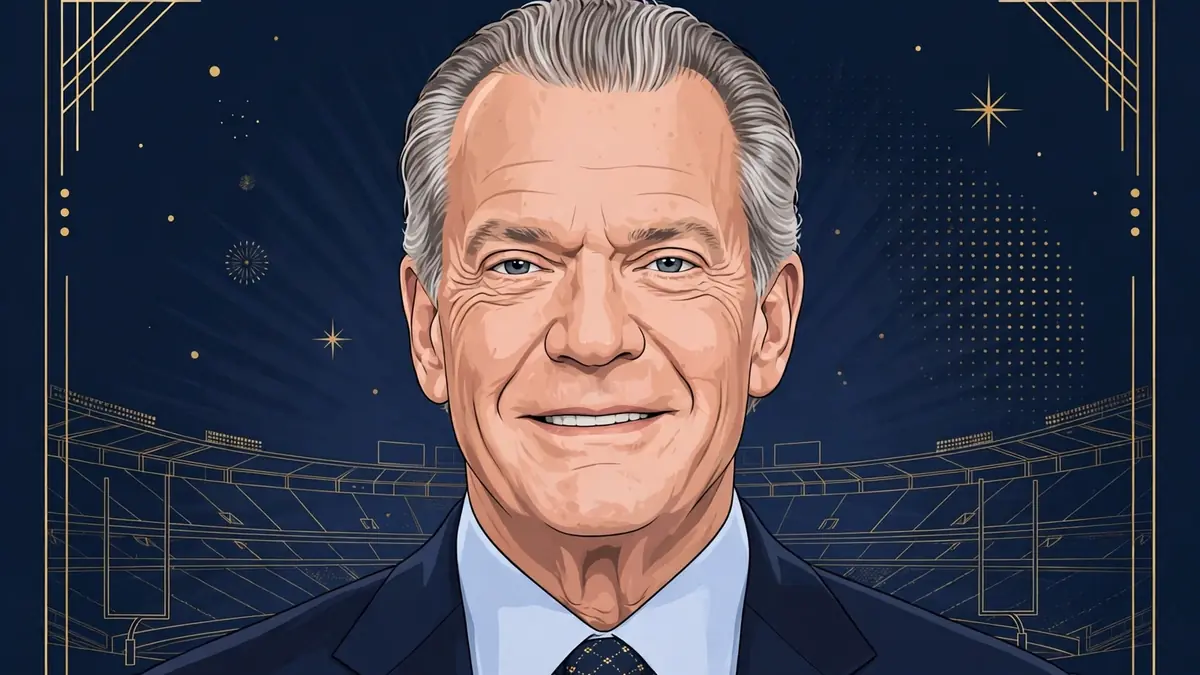
Jim Irsay‘s net worth is estimated at $4.8 billion to $5 billion as of November 2026. The figure is anchored to the day he died — May 21, 2025 — because Forbes put his fortune at $4.8 billion in its final assessment of his wealth, while Celebrity Net Worth settled on $5 billion, and the Indianapolis Colts franchise that made up nearly all of it has only grown more valuable since. Irsay inherited the team from his father in 1997, turned a struggling small-market club into a Super Bowl champion, spent a fortune assembling what Guitar World called the greatest guitar collection on earth, and left the franchise to his three daughters in equal shares.
Jim Irsay: Quick Facts
| Estimated net worth | $4.8 billion to $5 billion (range: $4.8 billion–$5 billion) |
|---|---|
| Profession | NFL team owner, CEO of the Indianapolis Colts, businessman and memorabilia collector |
| Nationality | American |
| Born | June 13, 1959, Lincolnwood, Illinois (died May 21, 2025, age 65) |
| Height | Not publicly documented |
| Primary income sources | Indianapolis Colts franchise ownership, NFL media and league distributions, memorabilia collection |
| Active years | 1972–2025 (Colts staff from 1982; general manager 1984–1996; owner and CEO 1997–2025) |
| Last reviewed | November 2026 |
- Early Life and Background
- Education
- Career Journey
- Rise to Fame
- Main Sources of Income
- Salary and Earnings
- Businesses and Investments
- Brand Deals and Sponsorships
- Houses, Cars and Other Assets
- Awards and Achievements
- Net Worth Growth Over the Years
- Social Media Presence
- Personal Life
- Sources & Reporting
- Frequently Asked Questions
- Final Thoughts
Early Life and Background
James Stephen Irsay was born on June 13, 1959, in Lincolnwood, Illinois, a suburb north of Chicago, to Robert and Harriet Irsay. His father came from a Hungarian Jewish family and had built a fortune in the heating and air conditioning business in Chicago; his mother was the daughter of Polish Catholic immigrants. The family money came from industrial work, not football — the team arrived later, and it arrived by one of the strangest transactions in sports history.
In 1972, when Jim was 12 years old, his father paid $19 million for the Los Angeles Rams and then, in the same year, swapped the entire franchise with Carroll Rosenbloom for the Baltimore Colts — teams, rosters, staff, and all. The boy who had grown up around his father’s factories suddenly grew up around a professional football team. That summer he started working as a ballboy at Colts training camp, fetching footballs and watching practices from the edge of the field. It was the start of a 53-year association with one franchise, and it shaped everything that followed: Irsay never bought his way into football as an adult investor. He was raised inside a locker room.
The Colts of his childhood were a franchise in decline. Baltimore had won Super Bowl V in January 1971, but the team slid through the 1970s, and Robert Irsay’s ownership grew stormy. By the early 1980s the Colts were losing, the city of Baltimore was fighting the team over a new stadium, and the franchise’s future in Maryland looked finished. Jim Irsay, by then a young man out of college, was inside the building for all of it — and what happened next became one of the most famous nights in American sports business.
In March 1984, with stadium talks collapsed, the Colts loaded their equipment into Mayflower moving trucks in the middle of the night and drove to Indianapolis. The midnight move made the Irsay name famous and, in Baltimore, infamous. Jim was 24. Within weeks of the move, his father named him general manager, making him the youngest general manager in NFL history. The job was not a ceremonial title handed to the owner’s son: the Colts were a bad team in a new city that had never hosted an NFL franchise, playing in the Hoosier Dome, and the front office had to build a fan base from zero while also building a roster. Irsay later said the lessons of those years — the lean ones, when the team lost far more than it won — shaped every decision he made as owner.
The Indianapolis years began slowly. Irsay helped lead the team to its first division title and playoff appearance of the Indianapolis era in 1987, a small breakthrough after years of losing seasons. The franchise stayed mediocre through the early 1990s, and by the time his father died, the Colts were still waiting for the quarterback and the coach who would change everything.
Education
Irsay attended high school at Loyola Academy in Wilmette, Illinois, and then at Mercersburg Academy in Pennsylvania, graduating in 1978. He went on to Southern Methodist University in Dallas, where he played linebacker for the SMU Mustangs as a walk-on until an ankle injury ended his playing career. He graduated from SMU in 1982 with a degree in broadcast journalism and was a member of the Sigma Alpha Epsilon fraternity.
The SMU years matter to the Irsay story in two ways. First, the broadcast journalism degree explains a trait that defined his public life as owner: Irsay loved to talk, loved the microphone, and treated the media as a direct line to fans rather than a chore. He gave long, unguarded interviews, posted constantly on social media, and answered questions other owners would have dodged. Second, the walk-on linebacker who lost his playing career to injury never stopped seeing the game from a player’s angle. When he later ran the franchise, he spoke often about the locker room as a place he had belonged to, not a business unit he managed from above. The Colts’ own history page notes that after graduation he worked in virtually every department of the club — ticket sales, public relations, football operations — before the general manager’s job came his way.
He joined the Colts’ professional staff full-time in 1982, straight out of SMU, at the team’s facility in Owings Mills, Maryland. Within two years the franchise had moved cities, and he was running it.
Career Journey
Irsay’s career breaks into three acts: the apprentice years under his father, the general manager years in a new city, and the 28-year ownership that remade the Colts into one of the NFL’s marquee franchises.
As general manager from 1984 to 1996, Irsay ran a team that was usually losing. The Colts made the playoffs in 1987 and again in 1995 — the 1995 run to the AFC Championship Game, behind quarterback Jim Harbaugh, was the high point — but the record over those twelve seasons was mostly forgettable. The work that counted was quieter: building a front office, a scouting operation, and a fan base in Indianapolis, a city that had taken a chance on a team that had arrived in the night. The Colts played in the RCA Dome (originally the Hoosier Dome), one of the league’s smallest stadiums, and the franchise’s revenue lagged behind the big-market clubs. Irsay learned, in those years, that a small-market team lives or dies on the draft.
Robert Irsay died on January 14, 1997. Jim became sole owner and CEO after a legal fight with his stepmother over the estate, a dispute that delayed the transition and put the franchise’s ownership in question for a time. When it was settled, the 37-year-old owner inherited a team with no franchise quarterback, no Super Bowl, and a stadium problem. Within fifteen months he had fixed the first of those.
The 1998 NFL Draft is the hinge of the Irsay fortune. With the first overall pick, the Colts selected Peyton Manning out of Tennessee, passing over Ryan Leaf — a decision that looks obvious now and was anything but obvious then. Manning’s rookie season was rough (the Colts went 3–13), but by 1999 the team was 13–3. Irsay then hired Tony Dungy as head coach in 2002, a decision the Colts’ own history credits as the move that led directly to the Super Bowl. Dungy brought calm, discipline, and a defensive identity to a team built around Manning’s arm.
The results rewrote the franchise’s value. From 2000 to 2009, the Colts won 115 regular-season games, the most in a decade by any NFL club at the time. The team won ten division titles under Irsay, reached the playoffs 18 times, and appeared in two Super Bowls. According to Pro Football Reference, the Colts’ 258 wins under his ownership were the fourth-most in the NFL over that span. The pinnacle came on a rainy night in Miami on February 4, 2007, when the Colts beat the Chicago Bears 29–17 to win Super Bowl XLI — the franchise’s first championship since the Baltimore days, and the image of Irsay hoisting the Lombardi Trophy in the rain became the defining photograph of his ownership.
The Manning era ended the way great eras usually end: with a hard call. Manning missed the entire 2011 season after neck surgery, the Colts collapsed to 2–14, and Irsay released the franchise’s greatest player in March 2012 rather than pay a $28 million roster bonus to a 36-year-old quarterback with a fused neck. He used the first pick in the 2012 draft on Andrew Luck, and the Colts were back in the playoffs by Luck’s second season. Luck’s surprise retirement in August 2019, at 29, started a long quarterback search that was still unresolved at Irsay’s death — a reminder that even the best-run franchises are one injury away from a rebuild.
Off the field, Irsay pushed the Colts into the center of the league’s business. He chaired the NFL’s Legislative Committee and sat on its Finance Committee, where he helped shape league policy. After a 2003 playoff loss to New England in which Manning threw four interceptions, Irsay lobbied the Competition Committee — which included Indianapolis president Bill Polian — for stricter enforcement of pass interference rules, a push that helped open up the passing game across the league. In 2009 he spoke out against a group that included talk-show host Rush Limbaugh buying the St. Louis Rams. And in 2012 he helped bring Super Bowl XLVI to Lucas Oil Stadium, a game still counted among the most successful Super Bowls ever staged, generating hundreds of millions of dollars in economic impact for Indianapolis.
The stadium itself was the other great project of his ownership. The RCA Dome was too small and too old, and Irsay spent years negotiating a replacement. Lucas Oil Stadium opened on August 16, 2008, at a cost of $720 million, with the Colts contributing $100 million and Lucas Oil paying $122 million over 20 years for the naming rights. Irsay told the Associated Press at the time that he had taken on about $230 million in debt — roughly $130 million spent on players and staff since 1997 plus the $100 million stadium contribution — and was counting on the new building to change the franchise’s economics. It did. The stadium’s suites, club seats, and sponsorship inventory turned a small-market team into a far more valuable property, and the valuation curve after 2008 bends sharply upward.
Rise to Fame
Jim Irsay was famous twice over: first as the owner who delivered Indianapolis a Super Bowl, and second as the billionaire with the guitars. The second fame arrived later and spread further, because it had nothing to do with football.
Irsay started collecting in earnest in the 1990s, and by the 2010s his collection was the stuff of music-world legend. He bought Jack Kerouac’s original typescript scroll of On the Road for $2.43 million in 2001. He paid $957,500 for Jerry Garcia’s custom-built “Tiger” guitar in 2002. In 2019 he bought David Gilmour’s “Black Strat” — the black Fender Stratocaster Gilmour played on The Dark Side of the Moon, Wish You Were Here, Animals, and The Wall — for $3.975 million, then a record price for a guitar at auction. In 2022 he bought Kurt Cobain’s 1966 Fender Mustang from the “Smells Like Teen Spirit” video for $4.6 million (some reports put the figure at $4.5 million), and the Cobain family donated a portion of the proceeds to Irsay’s Kicking The Stigma mental health initiative.
He did not keep the collection locked away. Irsay toured it across the United States in free exhibitions — guitars, manuscripts, sports memorabilia, and film artifacts, played live by guest musicians on the very instruments on display. The collection, which Guitar World called “The Greatest Guitar Collection on Earth,” was routinely described as worth more than $100 million, and it made Irsay a different kind of public figure: an owner who could talk for an hour about Pink Floyd recording sessions and mean every word of it.
The collection’s real value was only proved after his death. In March 2026, Christie’s sold The Jim Irsay Collection across four auctions. The headline sale, “The Jim Irsay Collection: Hall of Fame,” took place on March 12, 2026, in New York: 44 lots, every one sold, for a total of $84,091,350 — the largest total ever for a guitar auction, and 373 percent above Christie’s pre-sale low estimates. Across all four sales the collection brought in $94,484,903 and set 28 world records. The Black Strat sold for $14,550,000 after a bidding war of more than 20 minutes, making it the most expensive guitar ever sold at auction. The Kerouac scroll went for $12,135,000, a record for a literary manuscript. Garcia’s “Tiger” fetched $11,560,000, and Cobain’s Mustang sold for $6,907,000. Five of the ten most expensive guitars in history came out of that one room. The man who had paid $3.975 million for the Black Strat in 2019 saw it nearly quadruple in seven years; the scroll he bought for $2.43 million in 2001 returned almost five times his money. As a postscript to a fortune, it was hard to beat: the hobby outperformed the market.
The other side of his fame was messier, and Irsay never hid it. He spoke openly about his addiction, and in March 2014 he was arrested in Carmel, Indiana, on suspicion of driving under the influence and drug possession, with police reporting several bottles of prescription medication and $29,000 in cash in his car. He pleaded guilty to a misdemeanor count of operating a vehicle while intoxicated, was sentenced to a year of probation, and the NFL suspended him for six games and fined him $500,000. He went to rehab; his daughter Carlie ran the team’s day-to-day operations while he was away. He came back to work, and he kept talking about addiction in public — a candor that fed directly into the mental health work that became his legacy project.
Main Sources of Income
Irsay’s fortune had one dominant source and two smaller ones, and the proportions matter: the Colts were the fortune. Everything else was rounding.
The Indianapolis Colts. The franchise was nearly the whole of his wealth. Forbes put both the team and Irsay’s net worth at $4.8 billion in May 2025 — the same number, because the team was the fortune and there was little else of comparable scale. The Colts’ value grew through three engines: the NFL’s shared national media money, which every team splits equally and which has ballooned with each new television deal; local revenue from tickets, suites, sponsorships, and the stadium; and the simple appreciation of a scarce asset — there are only 32 NFL franchises, and none of them ever comes up for sale at a discount. Forbes’ 2025 valuation list, published in August 2025, marked the Colts at $5.9 billion with $593 million in revenue and $109 million in operating income. Sportico’s 2025 list put the team at $5.72 billion. By the 2026 lists the numbers had jumped again — Sportico marked the Colts at $7.77 billion in August 2026, and Forbes at $8.08 billion on $626 million in revenue. Those post-death marks belong to his daughters now, but they show the direction of the asset Irsay held for 28 years: up, steeply, and with no sign of stopping.
NFL league distributions. As an owner, Irsay’s team received an equal share of the league’s national television, sponsorship, and licensing revenue — a pool that now runs to roughly $10 billion a year across the league, or more than $310 million per team — plus the Colts’ own local revenue. The league also distributes money from ventures such as NFL Films and the league’s equity arm. For a small-market owner, the shared pool was the safety net: Indianapolis could never match Dallas or New York in local sponsorship, but it collected the same national check as every other club.
The memorabilia collection. The guitars, manuscripts, and artifacts were a passion purchase that turned into a serious asset. Before the Christie’s sales, the collection was commonly described as worth more than $100 million. The March 2026 auctions proved the number conservative on the top end and precise in spirit: $94.5 million across four sales, with the headline 44-lot sale alone bringing $84.1 million. The collection’s appreciation was real money, not sentiment — the Black Strat’s rise from $3.975 million to $14.55 million in seven years is a return most fund managers would envy.
Real estate. Irsay owned substantial property in Indiana, and the sales that followed his death put hard prices on it. His Carmel estate — about 26,420 square feet on roughly 9.4 acres, built in 1996, with a home theater, a speakeasy, an indoor pool pavilion, a basketball court, a par-3 golf hole, a six-car garage, six bedrooms, twelve bathrooms, and two guest houses — was listed for $12 million in July 2025 and sold for $11.75 million in September 2025. His Lake Maxinkuckee estate in Culver, Indiana — a 35,000-square-foot European-style compound on land he bought in 2000 for $6.235 million — was listed at $19.9 million in September 2025, according to The Wall Street Journal. Real estate was a small slice of a $4.8 billion fortune, but the two listings together represented more than $30 million in asking prices.

Salary and Earnings
Team owners do not earn salaries the way players do, and Irsay’s income worked differently from every athlete profile on this site. There was no contract, no signing bonus, and no per-game check. An NFL owner’s income comes from the team’s profits: distributions of operating income, minus whatever the owner reinvests in the roster, the stadium, and the front office. The Colts’ operating income gives the scale. Forbes put the team’s operating income at $109 million for the season covered by its August 2025 list, and at $81 million for the 2025 season in its September 2026 list, on revenue of $593 million and $626 million respectively. Those are estimates, not audited disclosures — only the Green Bay Packers publish audited accounts — but they frame the annual cash the franchise threw off: roughly $80 million to $110 million a year in recent seasons, before debt service and taxes.
That is the number that explains Irsay’s life. A man whose team generated around $100 million a year in operating profit could afford to spend $3.975 million on a guitar without blinking, commit $31 million to a mental health initiative, and put $100 million into a stadium. It also explains why the wealth was so illiquid: the fortune sat in the franchise, not in a bank account. When Forbes called him a $4.8 billion man, it meant he owned an asset worth $4.8 billion, not that he could spend $4.8 billion. The distinction matters, and it is why the estate’s real question after his death was not how much money there was, but who controlled the team — a question he had answered years earlier by making his daughters vice chairs and co-owners.
The other honest way to read his earnings is through the franchise’s appreciation. His father paid $19 million for the Rams in 1972 and swapped them for the Colts. When Jim took sole ownership in 1997, the Colts were worth a fraction of what they became; by the time he died, the team was valued at $4.8 billion by Forbes. The gain across his 28 years as owner — from a low-hundreds-of-millions franchise to a near-$5 billion one — dwarfs any annual salary figure, and it is the real earnings story of his life. Owners get rich on appreciation, not paychecks.
One more earnings detail belongs here because it shows how he thought about money. In the fall of 2007, after the Super Bowl win, Irsay set aside five Super Bowl rings for fans to win in a charity contest, raising $225,000. It was a small sum next to his fortune, but it was characteristic: he treated the team’s success as something the fans owned a share of, and he spent accordingly.
Businesses and Investments
Irsay’s business life was the Colts, and the Colts were the business. He held no public portfolio of startups, no restaurant chain, no media company. The investments that mattered were the ones inside the franchise: the stadium, the roster, and the collection.
The stadium investment. The $100 million the Colts put into Lucas Oil Stadium was the largest single capital commitment of his ownership, and it came on top of about $130 million he said he had spent out of pocket on players and staff since 1997 — $230 million in debt, by his own estimate to the Associated Press in 2008. The bet was that a modern stadium would close the revenue gap between Indianapolis and the league’s big markets. The valuation history says it paid: the Colts were worth roughly $1 billion in the mid-2000s by contemporary estimates and $4.8 billion at his death, with the stadium’s suites and sponsorships doing much of the lifting.
The roster as investment. Irsay spent aggressively when the team was close. Manning’s contracts set the market: a seven-year, $98 million deal in March 2004 that was then the richest in NFL history, followed by a five-year, $90 million deal in 2011. Those were player costs with a second purpose: they were the spending that produced the 115-win decade, the Super Bowl, and the franchise value that followed. The same logic ran in reverse in 2012, when he released Manning rather than pay the $28 million bonus — a financial decision as much as a football one, and one that freed the cap space to rebuild around Andrew Luck.
The collection as investment. The memorabilia purchases look like a hobby from the outside and like an asset class from the inside. Irsay bought the best objects in their categories — the most famous guitar, the most famous manuscript, the most famous rock artifacts — and held them for decades. The Christie’s results are the audit: $94.5 million in total sales, with the top items returning three to five times their purchase prices. The collection was also the only part of his fortune that could be sold quickly, and the estate did exactly that within ten months of his death.
The family business. The other investment was succession. Irsay made his daughters vice chairs in 2010 and gave them ownership stakes and real operating roles years before his death — Carlie in football operations and league governance, Casey in business operations, Kalen in branding and community work. By the time he died, the transition was a formality: the Colts announced in June 2025 that the three sisters would take control, with Carlie as owner and CEO, Casey as owner and executive vice president, and Kalen as owner and chief brand officer. The NFL requires every team to keep a succession plan on file; the Irsay plan was one of the few that had been rehearsed in public for fifteen years.
Brand Deals and Sponsorships
Irsay did not do brand deals in the athlete sense — no shoe contract, no soft-drink endorsement, no personal sponsorship portfolio. The Colts, as a franchise, did the deals, and the biggest one carried his name in the negotiations: the Lucas Oil naming-rights agreement, worth $122 million over 20 years, signed in 2006 before the stadium opened. Forrest Lucas, the founder of the Indianapolis-based oil company, paid for the right to put his company’s name on the building, and the deal was one of the largest stadium naming agreements of its era. It also anchored the stadium’s financing, which leaned on public money — roughly $620 million of the $720 million cost came from the state, the city, and surrounding counties, a fact that drew criticism at the time and for years after. Irsay’s own contribution was $100 million, and the Colts’ rent for the building was famously small: $250,000 a year.
The other sponsorship story is the one Irsay built himself. Kicking The Stigma, launched with his daughters in late 2020, was not a brand deal but a platform: the Colts’ brand, Irsay’s money, and a cause he had lived with. The initiative partnered with Indiana University, the National Alliance on Mental Illness, and other organizations, and its funding — more than $31 million committed through grants and personal donations by the family, according to the Colts — made it one of the largest mental-health commitments by any sports franchise. The Cobain family’s donation of part of the guitar-sale proceeds to Kicking The Stigma in 2022 tied the collection to the cause in a single transaction: a rock artifact became mental-health funding.
His public persona was its own kind of sponsorship. Irsay was one of the most active owners on social media, posting guitar videos, concert clips, and unfiltered opinions to hundreds of thousands of followers. The account was not managed corporate messaging; it was the owner himself, at 2 a.m., playing a $4 million guitar. That authenticity was the brand, and it is part of why the collection exhibitions drew crowds: people came to see the guitars, and they stayed because the man who owned them plainly loved them.

Houses, Cars and Other Assets
The hard assets of the Irsay fortune were the team, the collection, and two Indiana estates. The cars, by contrast, barely register in the record — Irsay was a guitar man, not a car man, and no verified reporting attaches a notable automobile collection to him. The houses tell the story better.
The Carmel estate. Irsay’s main Indiana residence was a contemporary luxury estate in Carmel, built in 1996: about 26,420 square feet on roughly 9.4 acres, with six bedrooms, twelve bathrooms, two guest houses, a home theater, a speakeasy, an indoor pool pavilion, a basketball court, a par-3 golf hole, and a six-car garage. After his death it was listed for $12 million in July 2025 and sold for $11.75 million in September 2025.
The Lake Maxinkuckee estate. The family’s lakefront compound in Culver, Indiana, was the private retreat: a 35,000-square-foot European-style main residence with an entertainment compound, on land Irsay bought in 2000 for $6.235 million. His daughters described it as the family’s sanctuary away from football. It was listed for $19.9 million in September 2025, according to The Wall Street Journal, and reported by The Richest as the family’s longtime lakefront estate.
The collection. The guitars and manuscripts were the most unusual asset on any NFL owner’s balance sheet. Beyond the headline pieces — the Black Strat, the Kerouac scroll, Garcia’s “Tiger,” Cobain’s Mustang — the collection held hundreds of items spanning music, film, sports, and literature, including John Lennon’s upright piano, which sold for $3,247,000 at Christie’s in March 2026, a record for a Beatles object. Christie’s described it as one of the greatest collections of guitars, instruments, sports, movie, literature, and pop-culture memorabilia ever assembled, and offered it across four auctions in March 2026. The total return, $94,484,903, is now a matter of public record rather than estimate.
What the estate did not include. There was no second team, no casino, no media empire. Irsay’s wealth was concentrated in a single asset to a degree that would make a financial adviser nervous — and that concentration is exactly what made the fortune so large. The Colts were everything, and the Colts kept going up.
Awards and Achievements
Irsay’s honors were the team’s honors, and the list is the record of a 28-year ownership: a Super Bowl championship (XLI, February 2007), a second Super Bowl appearance (XLIV, February 2010), ten division titles, two AFC championships, 18 playoff appearances, and 258 regular-season wins — the fourth-most in the NFL during his tenure, according to Pro Football Reference. From 2000 to 2009 the Colts’ 115 regular-season wins were the most in a decade by any NFL club at the time. He was inducted into the Indianapolis Colts Ring of Honor, and the Colts’ own tribute after his death credited his vision with producing “a Lombardi Trophy, 10 division titles and a host of Pro Football Hall of Famers.”
Two achievements sit outside the win column. The first is Super Bowl XLVI, which Irsay helped bring to Lucas Oil Stadium in February 2012 — the game is still regarded as one of the most successful Super Bowls ever staged, and it cemented Indianapolis as a football town. The second is Kicking The Stigma: more than $31 million committed to mental-health awareness, research, and treatment, including the Irsay Institute at Indiana University, which opened in 2023 after a $3 million family donation in December 2021. The institute and the initiative are the parts of his legacy that will outlast the win totals.
The collection earned its own records after his death. The Christie’s sales set 28 world records, including the most expensive guitar ever sold at auction, the most expensive literary manuscript, and the largest total ever for a guitar auction. Those records belong to the objects, but they were his eye that assembled them.
Net Worth Growth Over the Years
The growth of Jim Irsay’s fortune is the growth of the Colts’ value, and the numbers trace a straight line upward with one long flat stretch in the middle.
| Year | Milestone | Value / estimate |
|---|---|---|
| 1972 | Robert Irsay buys the Los Angeles Rams, swaps them for the Baltimore Colts | $19 million purchase price |
| 1984 | Colts move overnight to Indianapolis; Jim becomes youngest GM in NFL history at 24 | Small-market franchise, RCA Dome era begins |
| 1997 | Jim becomes sole owner and CEO after his father’s death | Franchise worth in the low hundreds of millions |
| 2007 | Colts win Super Bowl XLI; Lucas Oil Stadium under construction | Franchise value climbing past $1 billion |
| 2008 | Lucas Oil Stadium opens ($720 million; Colts contribute $100 million) | Revenue base transformed by suites and sponsorships |
| May 2025 | Forbes’ final assessment at Irsay’s death | $4.8 billion (Celebrity Net Worth: $5 billion) |
| Aug 2025 | Forbes’ NFL valuations: Colts $5.9 billion, revenue $593 million, operating income $109 million | $5.9 billion |
| Aug 2025 | Sportico’s NFL valuations | $5.72 billion |
| Mar 2026 | Christie’s sells The Jim Irsay Collection across four auctions | $94.5 million total |
| Aug–Sep 2026 | Sportico and Forbes 2026 valuations (estate now held by his daughters) | $7.77 billion (Sportico); $8.08 billion (Forbes) |
The shape of the table is the story. The franchise was worth $19 million in 1972, in the low hundreds of millions when Irsay inherited it, and $4.8 billion when he died — a roughly 250-fold increase on the 1972 price, driven by the NFL’s television money, the stadium, and the Manning-era success. The growth did not stop at his death: within sixteen months the Colts were marked at $7.77 billion by Sportico and $8.08 billion by Forbes, as the whole league’s valuations surged on new media deals. The daughters inherited a $4.8 billion asset that the market soon repriced far higher.
One comparison puts the scale in context. Sportico’s 2025 list put the average NFL franchise at $7.13 billion and the Dallas Cowboys — the league’s most valuable team — at $12.8 billion. The Colts, at $5.72 billion on that list, sat 28th of 32 teams: a small-market club in the bottom five by value, owned by a man who was nevertheless one of the richest owners in the league because he owned all of it. Most NFL teams are held by families and partnerships that split the value; Irsay held 100 percent. That is why a 28th-ranked franchise made him a $4.8 billion man, and why his daughters each hold roughly $1.9 billion today — Forbes estimated each sister’s stake at about $1.9 billion, a figure the magazine later put at $1.8 billion for Carlie Irsay-Gordon in January 2026.
Social Media Presence
Irsay was one of the most visible and unfiltered owners on social media, and his accounts were a direct extension of his personality rather than a corporate channel. On X (formerly Twitter), where he posted as @JimIrsay, he shared guitar performances, concert clips, Colts commentary, and long, personal reflections, often late at night. The account had hundreds of thousands of followers, and the posts were unmistakably his — no press-office polish, no approval chain, just the owner talking to fans the way he would talk in a bar.
The social media presence mattered to the fortune in a practical way: it was the marketing engine for the collection exhibitions. When the guitars toured the country in free shows, Irsay announced the dates himself, posted clips of guest musicians playing his instruments, and turned a private collection into a public event. The exhibitions drew thousands of visitors in each city, and the attention they generated fed directly into the Christie’s sale — by March 2026, the collection was famous enough that 44 lots could bring $84.1 million in a single evening.
He also used the platform for the causes he cared about. Kicking The Stigma announcements, mental-health resources, and fundraising appeals went out through his accounts and the Colts’ channels together, and the initiative’s reach owed a great deal to an owner who would talk about his own struggles in public. After his death, the Colts’ accounts became the family’s channel for tributes and for the succession announcement, and the @JimIrsay account stands as a record of a billionaire who treated social media as a conversation, not a billboard.
Personal Life
Irsay married Meg Coyle in 1980. The couple had three daughters — Carlie, Casey, and Kalen — and divorced in 2013. He was a grandfather to ten grandchildren, and his daughters were the center of both his family life and his succession plan: all three were made vice chairs of the Colts in 2010, given ownership stakes, and put to work in real roles inside the franchise years before his death. Carlie Irsay-Gordon, the eldest, is now the team’s owner and CEO; Casey Foyt is owner and executive vice president; Kalen Jackson is owner and chief brand officer. The Colts announced the arrangement in June 2025, a month after his death, and the transition was smooth precisely because it had been rehearsed for a decade and a half.
His personal struggles were public, and he made them public himself. Irsay spoke openly about addiction for years, and the record includes the 2014 arrest, the rehab stay, and his own descriptions of relapses and recovery. In January 2026, eight months after his death, The Washington Post reported that the FBI was investigating his death, citing a federal grand jury subpoena and examining a doctor who had treated him with pain medicine and ketamine. The Colts had announced that he “passed away peacefully” in his sleep on May 21, 2025, at a hotel in Beverly Hills, California, and his death certificate listed cardiac arrest resulting from acute pneumonia, with chronic atrial fibrillation and cardiac arrhythmia as contributing conditions. The investigation, as reported, was examining his history of substance abuse and his ties to the doctor — a story that was still developing at the time of this article’s last review, and one this article reports as reported rather than resolved.
Beyond football and music, Irsay was a philanthropist on a scale that matched his wealth. The Kicking The Stigma initiative, launched with his daughters in late 2020, committed more than $31 million to mental-health awareness, research, and treatment, including the Irsay Institute at Indiana University. He and the family gave widely in Indiana — to addiction treatment, community development, and youth programs — and the Colts’ own tribute after his death described him, in his daughters’ words, as a man whose resilience, personal struggles, and love for family, friends, and community mattered as much as his role as the team’s owner.
Sources & Reporting
Forbes — the $4.8 billion net worth figure at the time of Irsay’s death; the August 2025 NFL valuations (Colts $5.9 billion, $593 million revenue, $109 million operating income); the September 2026 valuations (Colts $8.08 billion, $626 million revenue, $81 million operating income); the daughters’ stakes at about $1.9 billion each. Reporting window: May 2025–January 2026.
Celebrity Net Worth — the $5 billion net worth figure at the time of death, setting the top of our range; biographical details and the May 21, 2025 death date. Page updated May 22, 2025.
Indianapolis Colts (colts.com) — the official tribute and ownership history: born June 13, 1959, in Lincolnwood, Illinois; SMU class of 1982; youngest general manager in NFL history at 24; sole owner from 1997; 115 regular-season wins from 2000–2009; 10 division titles; Super Bowl XLI 29–17 over Chicago; Kicking The Stigma’s $31 million-plus commitment and the Irsay Institute opening in 2023. Published May 2025.
Sportico — 2025 NFL franchise valuations (Colts $5.72 billion, league average $7.13 billion, Cowboys $12.8 billion) and 2026 valuations (Colts $7.77 billion). Published August 2025 and August 2026.
Christie’s — The Jim Irsay Collection sales: the March 12, 2026 Hall of Fame sale ($84,091,350, 44 lots, 23 world records), the four-sale total of $94,484,903 and 28 records, and the individual hammer prices (Black Strat $14,550,000; Kerouac scroll $12,135,000; Garcia “Tiger” $11,560,000; Cobain Mustang $6,907,000; Lennon piano $3,247,000). Announced January–March 2026.
The Washington Post — the January 22, 2026 report that the FBI was investigating Irsay’s death, citing a grand jury subpoena and a doctor who treated him with pain medicine and ketamine; also the death-certificate details (cardiac arrest, acute pneumonia, chronic atrial fibrillation, cardiac arrhythmia). Reported via Forbes and other outlets, January 2026.
ESPN — coverage of the 2014 arrest aftermath and the Colts’ succession, and the report that Irsay was a grandfather of ten. Reporting window: 2014–2025.
Indianapolis Business Journal — the succession reporting: the daughters’ roles since 2010, the estate-tax questions, and the Forbes $4.8 billion figure for both the team and Irsay’s net worth. Published May 2025, updated March 2026.
The Wall Street Journal — the Lake Maxinkuckee estate listing at $19.9 million, via The Richest’s September 2025 reporting; the land purchase price of $6.235 million in 2000.
Wikipedia — biographical cross-checks: Loyola Academy and Mercersburg Academy, SMU walk-on linebacker career ended by ankle injury, the 2003 pass-interference lobbying, the 2009 Limbaugh opposition, 258 wins as fourth-most in the NFL over his tenure, and the Kicking The Stigma $3 million Indiana University donation of December 2021. Accessed November 2026.
Associated Press — the 2008 Lucas Oil Stadium opening ($720 million; Colts’ $100 million contribution; Irsay’s $230 million debt estimate) and the stadium financing details. Reporting window: 2008.
Figures in this article were checked against at least two of the outlets above wherever the record allowed. Where outlets disagree — the net worth range of $4.8 billion to $5 billion, the Cobain guitar’s purchase price of $4.5 million to $4.6 million, the daughters’ individual stakes of $1.8 billion to $1.9 billion — the article publishes the range and names who says what. Franchise valuations are estimates from Forbes and Sportico, not audited disclosures; only the Green Bay Packers publish audited accounts.
Frequently Asked Questions
What was Jim Irsay’s net worth when he died?
Jim Irsay’s net worth was estimated at $4.8 billion to $5 billion at the time of his death on May 21, 2025. Forbes put the figure at $4.8 billion, while Celebrity Net Worth estimated $5 billion. Nearly all of it was the Indianapolis Colts franchise, which Forbes valued at $4.8 billion in the same period.
How did Jim Irsay die?
Jim Irsay died peacefully in his sleep on May 21, 2025, at age 65, at a hotel in Beverly Hills, California, according to the Indianapolis Colts. His death certificate listed cardiac arrest resulting from acute pneumonia, with chronic atrial fibrillation and cardiac arrhythmia as contributing conditions. In January 2026, The Washington Post reported that the FBI was investigating his death, examining a doctor who had treated him with pain medicine and ketamine.
Who inherited Jim Irsay’s fortune?
Jim Irsay’s three daughters — Carlie Irsay-Gordon, Casey Foyt, and Kalen Jackson — inherited the Indianapolis Colts in equal shares, as he had long planned. Forbes estimated each sister’s stake at about $1.9 billion. Carlie became owner and CEO, Casey became owner and executive vice president, and Kalen became owner and chief brand officer.
Who owns the Indianapolis Colts now?
Carlie Irsay-Gordon, Casey Foyt, and Kalen Jackson own the Indianapolis Colts. The team announced the arrangement in June 2025, a month after their father’s death. Carlie serves as owner and CEO, Casey as owner and executive vice president, and Kalen as owner and chief brand officer.
How much did Jim Irsay’s guitar collection sell for?
The Jim Irsay Collection sold for $94,484,903 across four Christie’s auctions in March 2026, setting 28 world records. The headline sale alone brought $84,091,350 for 44 lots. David Gilmour’s “Black Strat” sold for $14,550,000 — the most expensive guitar ever sold at auction — and Jack Kerouac’s “On the Road” scroll sold for $12,135,000.
How did Jim Irsay make his money?
Irsay inherited the Indianapolis Colts from his father, Robert Irsay, in 1997, and the franchise’s appreciation was the source of his fortune. His father had acquired the team in a 1972 swap after paying $19 million for the Los Angeles Rams. Under Jim’s ownership the Colts won Super Bowl XLI, moved into the $720 million Lucas Oil Stadium, and grew from a franchise worth in the low hundreds of millions to one valued at $4.8 billion by Forbes at his death.
How much is the Indianapolis Colts franchise worth?
Forbes valued the Colts at $5.9 billion in August 2025, with $593 million in revenue and $109 million in operating income, and at $8.08 billion in September 2026. Sportico valued the team at $5.72 billion in August 2025 and $7.77 billion in August 2026. The two outlets use different methods, so the figures differ — but both show a franchise that has risen sharply in value since Irsay’s death.
What was Jim Irsay’s Kicking The Stigma initiative?
Kicking The Stigma is a mental-health initiative Irsay launched with his daughters in late 2020 to raise awareness and funding for mental-health disorders and to remove the shame associated with them. Through grants and personal donations, the family committed more than $31 million, including $3 million to Indiana University in December 2021 to create the Irsay Institute, which opened in 2023.
Final Thoughts
Jim Irsay’s $4.8 billion to $5 billion fortune is the simplest kind of billionaire story to explain and one of the hardest to repeat: a man inherited a football team, held it for 28 years, and watched the league’s television money and a Super Bowl turn it into one of the most valuable assets in American sports. The range in the estimate is honest — Forbes said $4.8 billion, Celebrity Net Worth said $5 billion — but the shape of the fortune is not in doubt. The Colts were the fortune, and the Colts kept going up.
What makes the story worth telling is everything around the number. He was the 24-year-old general manager of a team that had arrived in the night, the owner who drafted Peyton Manning and hired Tony Dungy, the man who spent $3.975 million on a guitar and then toured it around the country for free so strangers could see it, and the father who spent fifteen years preparing his daughters to take over. The March 2026 Christie’s sale is the last word on the collection — $94.5 million, 28 world records, a guitar that quadrupled in seven years — and the daughters’ stewardship of the franchise is the last word on the succession. He died at 65, with the team worth $4.8 billion and the collection worth $94.5 million more, and the work he cared about most — the mental-health initiative — is still running. That is a fuller accounting of the fortune than any single number.
Published on November 6, 2026. Last reviewed November 2026. Found an error? See our corrections policy.