
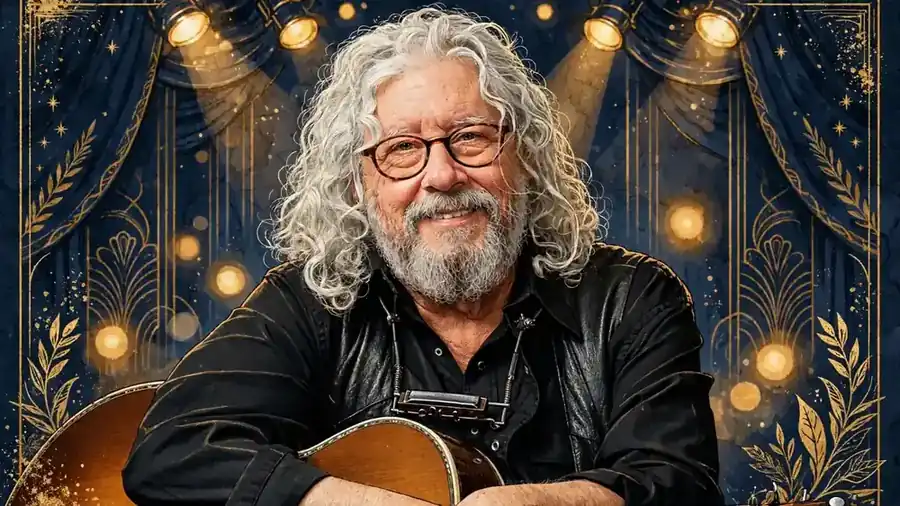
Arlo Guthrie‘s net worth is estimated at $10 million as of November 2026. The folk singer behind the 18-minute Thanksgiving classic “Alice’s Restaurant Massacree” built that fortune across six decades — a platinum debut album, a No. 18 hit with “City of New Orleans,” relentless touring that ran six to nine months a year at its peak, and his own label, Rising Son Records. He stopped touring in 2020 after a series of strokes, yet the catalog keeps paying: every November, radio stations across America play his 1967 talking blues again, and in October 2026 he returned to a Massachusetts stage for a sold-out storytelling evening. Published estimates of his wealth run from $5 million to $15 million, with one outlier claiming far more — this article weighs each one and explains why the middle of that range is the honest answer.
Arlo Guthrie: Quick Facts
| Estimated net worth | $10 million (range: $5 million – $15 million) |
|---|---|
| Profession | Folk singer-songwriter, guitarist |
| Nationality | American |
| Born | July 10, 1947 (age 79) |
| Height | About 6 ft (1.83 m) — widely reported, not officially confirmed |
| Primary income sources | Music royalties, touring, Rising Son Records, film and TV licensing |
| Active years | 1965–2020, with select appearances 2023–2026 |
| Last reviewed | November 2026 |
- Early Life and Background
- Education
- Career Journey
- Rise to Fame
- Main Sources of Income
- Salary and Earnings
- Businesses and Investments
- Brand Deals and Sponsorships
- Houses, Cars and Other Assets
- Awards and Achievements
- Net Worth Growth Over the Years
- Social Media Presence
- Personal Life
- Sources & Reporting
- Frequently Asked Questions
Early Life and Background
Arlo Davy Guthrie was born on July 10, 1947, in the Coney Island section of Brooklyn, New York, the son of Woody Guthrie — author of “This Land Is Your Land” — and Marjorie Mazia Guthrie, a dancer with the Martha Graham company. He grew up inside American folk music itself. The visitors to the family home read like a roll call of the genre: Pete Seeger, Lead Belly, Cisco Houston, Ramblin’ Jack Elliott, Sonny Terry and Brownie McGhee, and the Weavers all passed through, and a young Bob Dylan visited Woody in his hospital room. Arlo has said he did not understand how famous his father was until he switched to a progressive private school in the sixth grade and classmates treated the Guthrie name as something special.
Woody Guthrie’s decline shaped Arlo’s childhood in a direct, practical way. Woody had been diagnosed with Huntington’s disease, an incurable hereditary illness, and was hospitalized permanently in 1954, when Arlo was seven. His mother supervised Woody’s care for the next thirteen years, until Woody’s death in 1967 — the same year Arlo’s career broke open. Marjorie Guthrie went on to found the Committee to Combat Huntington’s Disease, the advocacy group that later became the Huntington’s Disease Society of America, turning a family tragedy into a national cause. That history matters to any honest account of Arlo’s money: he inherited a name that opened doors, and he also inherited a disease that would shadow the family for generations.
Arlo made his first appearance on stage at 13, singing with his father’s old circle, and by his late teens he was playing the coffeehouses of Cambridge, Massachusetts. The folk revival was at full strength, and a Guthrie with a guitar and a storyteller’s timing did not need to audition for attention. What he needed was material of his own, and in the autumn of 1965 a closed town dump in Stockbridge, Massachusetts handed it to him.
Education
Guthrie attended the Stockbridge School, a progressive boarding school in Stockbridge, Massachusetts, graduating in 1965. The school’s informal, arts-friendly atmosphere suited him, and Stockbridge itself became the setting for the story that made him famous: on Thanksgiving Day 1965, he and a friend hauled a load of trash from a friend’s house to the town dump, found it closed for the holiday, and dumped it down a hillside instead. The local police chief arrested them for littering. Guthrie later turned the arrest, the blind judge, and his subsequent visit to the draft board — where the arrest record got him judged unfit for military service — into an 18-minute comic monologue with a guitar riff running through it.
After Stockbridge he enrolled briefly at Rocky Mountain College in Billings, Montana, and left after a short stay. College was never the plan; the road was. He turned professional in February 1966 with a debut at Club 47 in Cambridge, Massachusetts, the folk club that had launched Joan Baez and served as Dylan’s early Boston base. Within eighteen months he would be playing the Newport Folk Festival and holding a major-label recording contract.
Career Journey
Guthrie’s debut at the Newport Folk Festival in the summer of 1967 was the launch. He performed “Alice’s Restaurant Massacree” — the littering-and-draft story, stretched into a talking blues — and the crowd’s reaction made it obvious he had something no other folk singer had: a twenty-minute comedy routine that happened to be a song. Reprise Records signed him, and his debut album Alice’s Restaurant arrived in October 1967. The record entered the Billboard album chart in November, climbed for months, and stayed on the chart for 65 weeks. It went Gold in 1969 and Platinum in 1986 — the kind of slow-burn catalog seller that keeps paying a musician long after the chart moment passes. Over his career he released 32 albums, including 19 studio records and 10 live albums, and spent 15 years signed to a major label, charting 11 LPs before setting up his own imprint.
The second act of the career came fast. In August 1969, days before the film version of “Alice’s Restaurant” reached cinemas, Guthrie played the Woodstock festival, performing “Coming Into Los Angeles” — a song about smuggling marijuana into the city — to a crowd of hundreds of thousands. The performance landed in the Woodstock film and on its multi-platinum soundtrack album, tying him permanently to the defining event of his generation. He was 22. The film Alice’s Restaurant, directed by Arthur Penn with Guthrie playing himself, earned Penn an Academy Award nomination for Best Director and gave the song a second life as cinema.
Through the 1970s Guthrie worked at a pace that looks punishing today: an album a year for much of the decade — Running Down the Road (1969), Washington County (1970), Hobo’s Lullaby (1972), Last of the Brooklyn Cowboys (1973), Amigo (1976) — and a touring schedule that filled most of the calendar. He toured with Pete Seeger, his father’s old friend and his own mentor, and built a reputation as a live act who could hold a room with stories as much as songs. His band Shenandoah, featuring Terry “A La Berry” Hall on drums and Steve and Carol Ide on guitar and vocals, became a fixture of his road show for years.
The 1980s brought the move that changed his economics: he founded Rising Son Records, his own label, and began issuing his records himself — Power of Love (1981), Someday (1986), Son of the Wind (1992), Mystic Journey (1996). Owning the label meant owning the masters and a far larger share of each sale, and it let him record what he wanted, including tributes to his father: Woody’s 20 Grow Big Songs (1991) earned a Grammy nomination, and 32¢ Postage Due (2008), a set of Woody songs recorded with the Dillards, kept the family catalog in front of new listeners. In 2007 he recorded In Times Like These with the University of Kentucky Symphony Orchestra, a late-career swing at scale that showed he was still willing to take a big room seriously.
Anniversary touring carried the later decades. The 50th anniversary of “Alice’s Restaurant” in 2017 brought a Rhino Records vinyl reissue of the debut album and a “Back by Popular Demand” tour with his daughter Sarah Lee Guthrie opening and his son Abe Guthrie in the band — a family business on stage, quite literally. He kept touring into his seventies, and when he announced his retirement from the road in October 2020 it closed a run of more than fifty years. Retirement did not quite hold: in 2023 he returned for “What’s Left of Me,” a reduced run of conversation-and-music evenings with Bob Santelli of the Bruce Springsteen Archives, limited to Northeast venues within driving distance of his Massachusetts home, with shows spaced at least a week apart so he could return home between them. He has said he has no interest in further touring after that run ended, and his public appearances since have been storytelling events and benefits — including “Arlo Guthrie – Unscripted,” a stage conversation at the Mahaiwe Performing Arts Center in Great Barrington in October 2026, staged as a benefit for The Guthrie Center.
Rise to Fame
Three songs explain Arlo Guthrie’s fame, and each one worked differently. “Alice’s Restaurant Massacree” made his name: an 18-minute talking blues built from a real arrest, first performed at Newport in 1967, released as the title track of a debut album that went platinum, adapted into a 1969 film, inducted into the Grammy Hall of Fame in 2002, and selected for preservation in the Library of Congress National Recording Registry in 2017. Radio stations across the United States still play it every Thanksgiving at midday, a ritual that has run for decades and turns one afternoon a year into a national replay of a song recorded when Lyndon Johnson was president. No other folk song of the era has a calendar appointment like it.
“Coming Into Los Angeles” made him a Woodstock figure — the song, the film, the soundtrack, and the association with the festival’s mythology. And “City of New Orleans” made him a chart artist. The song was written by Chicago singer-songwriter Steve Goodman, who, according to the story that has followed the song for decades, approached Guthrie at Chicago’s Quiet Knight club and bought him a beer to get him to listen. Guthrie recorded it for Hobo’s Lullaby, and the single climbed to No. 18 on the Billboard Hot 100 and No. 4 on the Easy Listening chart in the autumn of 1972, spending 16 weeks on the Hot 100. It remains his only Top 40 pop hit — the one moment his career touched the singles chart the way his father’s never did. Goodman later won a posthumous Grammy for the song, and Willie Nelson’s 1984 cover took it to No. 1 on the country chart, which keeps the publishing income flowing through a second famous version.
What is easy to miss about the rise is how little of it depended on hits. Guthrie charted 11 LPs and had exactly one Top 40 single, yet he worked steadily for fifty years. The fame was durable rather than explosive: a reputation built on the road, a signature song with an annual airing, and a name that carried weight with folk audiences on three continents. Fellow travelers of that era included Art Garfunkel, who came out of the same 1960s folk scene, and Linda Ronstadt, whose 1970s touring circuit overlapped with his for years. Both built careers on the same economics — rooms full of loyal listeners, year after year — and both show up in the peer comparison later in this article.
Main Sources of Income
Catalog royalties sit at the center of the money. Guthrie’s recordings span six decades and 32 albums, and the income comes in several streams at once: streaming of the catalog, sales of the platinum debut album, publishing on the songs he wrote, and licensing — “Alice’s Restaurant” in films and television, “City of New Orleans” in covers and commercials, “Coming Into Los Angeles” tied to Woodstock reissues and documentaries. The Thanksgiving spike is real and annual: every November, radio airplay and streaming of “Alice’s Restaurant” surge for a few days, and performance royalties follow. It is a small, reliable seasonal bonus no other folk singer of his generation can claim.
Touring was the second pillar, and for most of his career it was the bigger one. Guthrie himself said, on retiring, that he had “taken back 6–9 months that I used to spend on the road” — a figure that tells you how much of his year the road consumed. A folk act of his size played theaters and festivals rather than arenas, but fifty years of near-constant dates, merchandise sales at the shows, and a loyal audience that returned every year adds up to the bulk of a working musician’s lifetime earnings. The 2023 “What’s Left of Me” dates were smaller and fewer by design, and they paid less — a deliberate trade of income for health.
The third pillar is ownership. Rising Son Records, his own label since the early 1980s, means the later catalog pays him the label’s share as well as the artist’s share, and it issues reissues and archival releases — the 50th-anniversary editions, the Woody Guthrie tribute records — that keep the catalog earning without new recording sessions. Add film and television licensing, the occasional acting appearance, and, in recent years, paid appearances on the celebrity video-message platform Cameo, and the picture is a diversified folk-music income: no single windfall, several steady streams, and costs that fell sharply once touring stopped.
Salary and Earnings
There is no public record of what Arlo Guthrie earned in any single year — no leaked contract, no court filing, no Forbes list. What exists is a mid-decade financial study published in November 2025 that modeled his current income from public materials and standard music-industry economics. Its estimate: gross annual “money in” of roughly $415,000 to $1.345 million, against costs of $245,000 to $1.03 million, leaving a net in the mid six figures in a typical year. The study’s authors were explicit that these were modeled ranges, not audited figures, and the wide spread is the honest part: a single sync placement or documentary license can swing a legacy artist’s year by six figures, while a quiet year leans on the catalog alone. The same study put his net worth at $5–$10 million, the lowest of the published estimates, and its logic is worth noting — with large-scale touring over since 2020, the variable costs of the road (crew, bus, per diems) have largely disappeared, which improves margins even as gross earnings fell.
Older, weaker sources paint a richer picture, and they should be read with care. One net-worth roundup claims touring brought in $3–$5 million a year and royalties another $500,000–$1 million, while another assigns him $1–$2 million a year in passive income from his catalog and the Woody Guthrie estate combined. Those numbers do not survive contact with the facts: Guthrie played theaters, not arenas, and he has been off the road since 2020. A folk singer playing 2,000-seat rooms cannot gross $3–$5 million a year from tickets, and the estate figure confuses the Woody Guthrie legacy — administered by the family and its foundation — with Arlo’s personal income. The $80–$120 million net worth figure pushed by one recent site fails the same test: nothing in Guthrie’s recorded career — no catalog sale, no stadium run, no endorsement empire, no real-estate portfolio on that scale — supports a fortune eight to twelve times the consensus. Celebrity Net Worth, Net Worth List and LuxLux all land at $10 million, ZestVibe at $12 million, and the modeled study at $5–$10 million. The $10 million anchor, inside a $5–$15 million range, is where the credible sources cluster.
For scale, the one hard sales number in the career is the debut album: Platinum certification means one million units shipped in the United States, and the record spent 65 weeks on the Billboard chart. A million-selling album in the late 1960s, at the royalty rates of the era, was worth a low-six-figure sum to the artist after the label’s cut — serious money then, and the reason the record still matters to his wealth today is that it has never stopped selling in small numbers. The “City of New Orleans” single, a 16-week Hot 100 run peaking at No. 18, added a second durable royalty stream, and the song’s second life through Willie Nelson’s No. 1 country cover keeps the publishing side alive. In 2025, Guthrie himself noted that his income included a Social Security pension and appearances on Cameo — a candid glimpse of what a retired folk singer’s cash flow actually looks like: catalog money, small appearance fees, and a pension.
Businesses and Investments
Rising Son Records is the business. Guthrie founded the label in the early 1980s after fifteen years on a major label, and it has been the home of his catalog ever since — new albums, reissues, live recordings, and the Woody Guthrie tribute projects. For a musician, owning the label is the closest thing to owning the factory: the label’s share of every sale and stream stays in the family, and archival releases can be issued whenever the moment is right, as with the 50th-anniversary editions of the debut album. The label also gave him control over the Woody Guthrie material he recorded, including Woody’s 20 Grow Big Songs and the Dillards collaboration 32¢ Postage Due. No revenue figures for Rising Son have ever been published, and a small independent folk label is a modest business, not a fortune — but it is the difference between renting your career from a record company and owning it.
The second venture is newer. In 2022, Guthrie and his wife Marti Ladd launched Gut3 Productions, a small company built to present his post-retirement work — the “In Conversation with Arlo Guthrie” series and the “What’s Left of Me” evenings with Bob Santelli. It is a deliberately small operation: a handful of dates, Northeast venues, conversations rather than full concerts. The economics are modest by design, and the point of the company is control over how a 78-year-old folk singer appears in public, not scale.
The Guthrie Center is the third institution, and it is important to describe it correctly: it is a nonprofit, not a personal asset. Guthrie bought the Old Trinity Church in Great Barrington, Massachusetts in 1991 and turned it into The Guthrie Center, an interfaith community center named for his parents that hosts concerts, classes, and a free Thanksgiving dinner every year — the same holiday his signature song is about. The building’s value does not belong on his personal balance sheet, but the Center is inseparable from his public life: it is where he performs benefits, where the community gathers, and where the “Unscripted” evening of October 2026 raised money. As for investments beyond music, there is nothing on the public record — no disclosed stock portfolio, no startup stakes, no property empire. A folk singer who spent his working life on the road and his later years running a label and a nonprofit is, financially, exactly what he looks like: a man whose wealth is his catalog.
Brand Deals and Sponsorships
There are none to report, and the absence is part of the story. Guthrie never built an endorsement portfolio — no guitar deal announced in the press, no clothing line, no commercial campaign — and that is consistent with a career spent as a counterculture figure whose signature song mocks the military draft. Folk singers of his generation sold records and tickets; the sponsorship economy that later enriched pop stars largely passed them by, and Guthrie showed no interest in chasing it. His recent commercial activity runs in the opposite direction: short, personal video messages on Cameo, where fans pay for a greeting from a folk legend, and the occasional benefit appearance. Both are small, direct, and entirely on his terms. If a reader is looking for a hidden endorsement fortune in this net worth, there is not one — and that is why the estimate stays at $10 million rather than drifting toward the inflated figures some sites publish.
Houses, Cars and Other Assets
Guthrie divides his time between two homes, as he has for years: a house in Sebastian, Florida, on the river he has loved since the 1990s, and a home in Washington, Massachusetts, in the Berkshires, near The Guthrie Center. The Florida house is the one he flew home to after his final Carnegie Hall Thanksgiving show in 2019, and the Massachusetts home is the base for his reduced 2023 appearances — chosen, by his own account, so every date was within driving distance. He was also reported to have owned property in Woodstock, New York, bought in the 1970s, though no recent sale or listing confirms what became of it. No reliable source puts a value on either current home, and this article will not guess at one: two comfortable houses in small-town America are consistent with a $10 million net worth, and they are a long way from a property portfolio.
On cars, there is nothing to report — no public record of a collection, no auction listing, no magazine feature on a garage. A man who spent six to nine months a year on a tour bus does not tend to collect cars, and Guthrie has never made vehicles part of his public image. The assets that matter to his wealth are intangible: the master recordings held through Rising Son, the publishing rights in his own songs, and the share of “Alice’s Restaurant” and “City of New Orleans” that will keep paying for as long as radio stations mark Thanksgiving and train songs get covered. Those are the assets that explain a $10 million figure; a car collection would not.
Awards and Achievements
The formal honors are few and heavyweight. Guthrie was nominated for a Grammy Award in the “Best Folk Performance” category in 1968 for the studio version of “Alice’s Restaurant” on his debut album. The song itself was inducted into the Grammy Hall of Fame in 2002, and in 2017 the Library of Congress selected the recording for preservation in the National Recording Registry, calling it culturally, historically and aesthetically significant — one of only a few hundred American recordings so honored. The film Alice’s Restaurant earned director Arthur Penn an Academy Award nomination for Best Director in 1969, and Guthrie’s later tribute record Woody’s 20 Grow Big Songs was Grammy-nominated in 1991. His debut album’s Gold certification in 1969 and Platinum in 1986 are the commercial honors, and the 65-week run on the Billboard album chart is the chart honor that underlines them.
The achievement that matters most to his wealth, though, is not a trophy: it is the Thanksgiving ritual. A song recorded in 1967, about an arrest in 1965, is played on radio stations across the country every year on the same holiday, and the ritual has now run for more than half a century. That is a royalty stream with a calendar, and it is the reason a folk singer with one Top 40 hit can still be worth an estimated $10 million at 79. Add the Woodstock performance, the No. 18 single, 32 albums, and a six-decade touring career, and the record is complete without needing to inflate it.
Net Worth Growth Over the Years
No year-by-year figures for Guthrie’s wealth have ever been published, so the table below is an editorial reconstruction — bands inferred from the career arc, the album certifications, and the published estimates — not reported numbers. It shows the shape of the fortune rather than its audited size: slow growth in the major-label years, a step up when he took control of his catalog, and a plateau once touring stopped.
| Period | Estimated net worth | What drove it |
|---|---|---|
| 1967–1969 | Under $1 million | Debut album, Newport breakthrough, Gold certification in 1969 |
| 1970–1975 | $1–$2 million | Woodstock film and soundtrack, “City of New Orleans” No. 18 hit, steady touring |
| 1976–1985 | $2–$4 million | Album-a-year output, Rising Son Records founded, debut album goes Platinum in 1986 |
| 1986–2000 | $4–$6 million | Label ownership, catalog reissues, Woody Guthrie tribute records |
| 2001–2016 | $6–$8 million | Anniversary touring, Grammy Hall of Fame induction in 2002, continued road work |
| 2017–2020 | $8–$10 million | National Recording Registry honor, 50th-anniversary tour, then retirement |
| 2021–2026 | $10 million (range $5–$15 million) | Catalog royalties, Gut3 Productions, select appearances, lower costs without touring |
The plateau at the end deserves a word. Retirement cut his gross income — no more months on the road — but it also cut his biggest costs, and the catalog did not retire with him. That is why the published estimates have stayed roughly flat since 2020 instead of falling: a folk catalog with a Thanksgiving appointment and a Woodstock credit is an annuity, not a salary.
Against his peers, Guthrie’s fortune is modest, and the gap tells the story of the folk economy. Bob Dylan, who once visited Woody Guthrie’s hospital room, sold his song catalog to Universal for a reported $300 million-plus in 2020 and sits near $500 million. Stevie Wonder and Carole King both built nine-figure fortunes on hit after hit. Guthrie had one Top 40 single and a catalog of folk records — and still banked an estimated $10 million. The table below uses widely reported estimates; all figures are approximate.
| Artist | Reported estimated net worth | Why the gap |
|---|---|---|
| Bob Dylan | About $500 million | Catalog sale of $300 million-plus; Nobel Prize; decades of arena touring |
| Stevie Wonder | About $200 million | 25 Grammy Awards; a run of 1970s classic albums; global hits |
| Carole King | About $100 million | Her 1971 classic album (25 million-plus sold); a songwriting catalog covered hundreds of times |
| John Fogerty | About $100 million | Creedence Clearwater Revival catalog; regained his publishing rights in 2023 |
| Jackson Browne | About $50 million | Multi-platinum 1970s albums; decades of touring |
| John Mellencamp | About $30 million | 27 million albums sold; heartland rock touring career |
| Arlo Guthrie | About $10 million | One Top 40 hit; a folk catalog; theaters, not arenas |
Social Media Presence
Guthrie’s online presence is modest and personal rather than commercial. His official website, arloguthrie.com, carries his announcements — it was there, and on his Facebook page, that he posted the long “Gone Fishing” retirement note in October 2020, and it remains the first place news of his appearances lands. His Facebook page is his most active social channel, the place fans saw the retirement announcement and where benefit events at The Guthrie Center are promoted. His catalog streams on Spotify, Apple Music and YouTube, where “Alice’s Restaurant” spikes every November and “City of New Orleans” draws a steady audience year-round. He has no TikTok-era reinvention and no influencer operation; in 2025 he was instead recording paid video greetings on Cameo, a platform that suits a 78-year-old storyteller far better than a dance trend. The social footprint is small, and it fits the fortune: the money comes from the recordings, not the feed.
Personal Life
Guthrie married his first wife, Jackie, in 1969; she died of liver cancer in 2012. They had four children, all of whom have worked in music in one way or another: Sarah Lee Guthrie, a singer-songwriter who has toured and recorded in her own right and opened her father’s anniversary shows; Abe Guthrie, a musician who played in his father’s band; and Cathy and Annie Guthrie. In 2021 he married Marti Ladd, a longtime friend, and the two now run The Guthrie Center and Gut3 Productions together, splitting their time between Sebastian, Florida and the Berkshires of Massachusetts.
His health has shaped the last decade of the story. He suffered a mini-stroke on April 1, 2016 — April Fool’s Day — in a hotel parking lot, an episode he did not recognize as a stroke until weeks later, and kept touring for four more years. On Thanksgiving Day 2019, on his way to The Guthrie Center to help with the annual Thanksgiving dinner, he suffered a second, more serious stroke that briefly cost him some ability to walk and left him wondering whether he would play again. He recovered enough to play the final Carnegie Hall Thanksgiving show that year, then announced his retirement from touring in October 2020, writing that “a folksinger’s shelf life may be a lot longer than a dancer’s or an athlete’s, but at some point… it’s time to hang up the ‘Gone Fishing’ sign.” He returned briefly in 2023 for the reduced “What’s Left of Me” run, built around conversation and archival video rather than full concerts, as part of his rehabilitation. In 2025, appearing at a Guthrie Center fundraiser marking the 60th anniversary of “Alice’s Restaurant,” he said he was amazed that contemporaries older than he could still perform and tour, and wished he still had the physical capability to do that. He is 79, living quietly between two homes, and still showing up for the room — on his terms, at his pace.
Sources & Reporting
Celebrity Net Worth — the $10 million anchor figure for Guthrie’s net worth, the most-cited published estimate. Net Worth List — independently lists his net worth at $10 million as of 2025, and notes his age and career details. Wikipedia — biographical spine: birth date and place, retirement announcement of October 23, 2020, the 2016 and 2019 strokes, the 2023 “What’s Left of Me” comeback tour, the October 2026 “Unscripted” appearance, and the 2025 note about his Social Security pension and Cameo appearances. Library of Congress — the 2017 selection of “Alice’s Restaurant Massacree” for the National Recording Registry. Billboard chart data, via chart histories — “City of New Orleans” peaking at No. 18 on the Hot 100 with a 16-week run, and the debut album’s 65-week chart run. Parade — 2026 reporting on his 79th birthday, the Thanksgiving radio tradition, and the enduring popularity of “City of New Orleans.” American Songwriter — the October 2020 retirement announcement and the “Gone Fishing” statement in full. Jambands — the retirement announcement, the 2016 mini-stroke, and the Thanksgiving 2019 stroke in Guthrie’s own words. Remind Magazine — his post-retirement life between Florida and Massachusetts, and his 2021 marriage to Marti Ladd. Monmouth University — career summary: the 1968 Grammy nomination, the debut album’s Gold (1969) and Platinum (1986) certifications, the 32-album catalog, and the Gut3 Productions launch. Reporting window: October–November 2026. Where sources disagreed on the net worth figure, this article publishes the range and names who says what; the $80–$120 million figure from one recent site is documented in the salary section and set aside as unsupported.
Frequently Asked Questions
How much is Arlo Guthrie worth in 2026?
Arlo Guthrie’s net worth is estimated at $10 million as of November 2026, within a published range of $5 million to $15 million. Celebrity Net Worth and Net Worth List both put him at $10 million, ZestVibe reported $12 million in 2024, and a modeled mid-decade study argued for $5–$10 million. He has never disclosed his finances, so every figure is an estimate built from his catalog, touring history, and label ownership.
Is Arlo Guthrie still alive?
Yes. Arlo Guthrie is alive at 79, living between Sebastian, Florida and the Berkshires of Massachusetts with his wife Marti Ladd. He retired from touring in 2020 after a series of strokes, returned briefly for a reduced run of conversation evenings in 2023, and appeared on stage in October 2026 for “Arlo Guthrie – Unscripted,” a benefit evening for The Guthrie Center in Great Barrington.
How old is Arlo Guthrie?
Arlo Guthrie is 79 years old. He was born on July 10, 1947, in Coney Island, Brooklyn, New York, and celebrated his 79th birthday on July 10, 2026.
What is Arlo Guthrie’s most famous song?
“Alice’s Restaurant Massacree” (1967) is his signature song — the 18-minute talking blues about a Thanksgiving littering arrest that became a radio tradition every Thanksgiving, was inducted into the Grammy Hall of Fame in 2002, and entered the Library of Congress National Recording Registry in 2017. His biggest chart hit was different: “City of New Orleans,” which reached No. 18 on the Billboard Hot 100 in 1972 and remains his only Top 40 single.
Did Arlo Guthrie retire?
Yes, from touring. He announced his retirement from live shows and touring on October 23, 2020, citing health issues including a mini-stroke in 2016 and a more serious stroke on Thanksgiving Day 2019. He came back briefly in 2023 for “What’s Left of Me,” a limited run of storytelling evenings in the Northeast, but has said he has no interest in further touring and now appears only at select benefits and conversation events.
Who is Arlo Guthrie’s wife?
Arlo Guthrie is married to Marti Ladd, a longtime friend he married in 2021. They run The Guthrie Center and Gut3 Productions together. His first wife, Jackie Guthrie, whom he married in 1969, died of liver cancer in 2012. He has four children: Sarah Lee, Cathy, Annie, and Abe Guthrie.
Is Arlo Guthrie related to Woody Guthrie?
Yes — Arlo Guthrie is the son of folk legend Woody Guthrie, author of “This Land Is Your Land,” and Marjorie Mazia Guthrie. Woody died in 1967, the same year Arlo’s career broke through, and Arlo has spent much of his career recording and preserving his father’s songs, including the Grammy-nominated “Woody’s 20 Grow Big Songs” in 1991.
How does Arlo Guthrie make money now?
Since retiring from touring in 2020, his income comes mainly from catalog royalties — streaming, sales, and licensing of songs like “Alice’s Restaurant” and “City of New Orleans,” with a spike every Thanksgiving — plus his Rising Son Records label, select paid appearances and benefits, video greetings on Cameo, and a Social Security pension. A modeled mid-decade study estimated his gross annual income at roughly $415,000 to $1.345 million, with costs far lower now that the road is behind him.
Final Thoughts
Arlo Guthrie’s estimated $10 million net worth is the fortune of a musician who never had a blockbuster decade — and never needed one. One 18-minute song, recorded in 1967 about a trash run gone wrong, turned into a Thanksgiving appointment that has paid him for nearly sixty years. One No. 18 single, borrowed from a Chicago songwriter over a beer, gave him a second royalty stream that outlived the chart. Fifteen years on a major label, then forty years owning his own, turned a touring life into a catalog that still earns while he fishes in Florida and tells stories in the Berkshires. The inflated $80–$120 million figures floating around the internet say more about the net-worth content business than about Guthrie; the honest number is smaller, and the career behind it is more impressive for it. He made his money the slow way — a room at a time, a record at a time, a Thanksgiving at a time — and at 79, the song is still playing.
Published on 2026-11-25. Last reviewed November 2026. Found an error? See our corrections policy.