
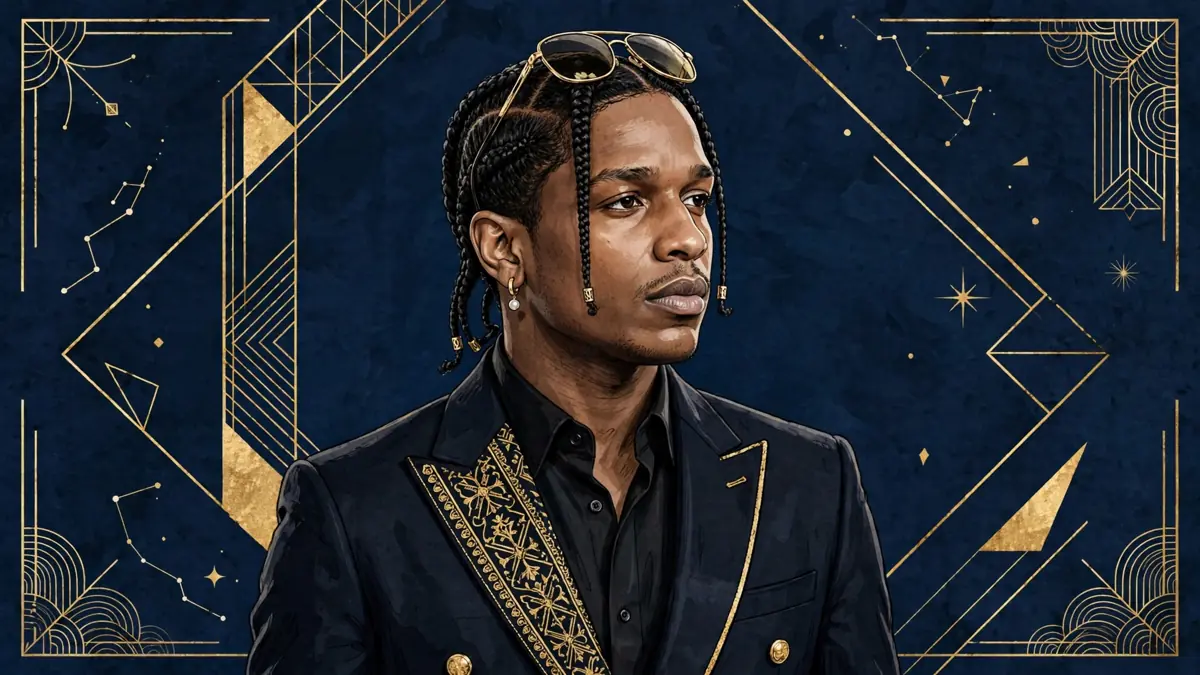
A$AP Rocky‘s net worth is estimated at $30 million to $35 million as of November 2026. The Harlem rapper built that fortune across three careers running in parallel: a chart-topping recording career that returned to number one in January 2026 after an eight-year album gap, a fashion career that now includes creative-director titles at both PUMA and Ray-Ban, and a touring business that sold out 25 dates across the United Kingdom and Europe in 2026 before extending to Australia and New Zealand in December. The headline figure comes with a clear warning, though. Rocky has never published a balance sheet, and the best-known tracker, Celebrity Net Worth, moved its estimate from $30 million to $35 million during 2026 without publishing an audit. This article keeps the two numbers as a range, separates Rocky’s money from his partner Rihanna’s billion-dollar fortune, and names the outlet behind every major figure.
A$AP Rocky: Quick Facts
| Estimated net worth | $35 million (range: $30–$35 million) |
|---|---|
| Profession | Rapper, record producer, actor, fashion designer, creative director |
| Nationality | American |
| Born | October 3, 1988 (age 38) |
| Height | 5 ft 10 in (178 cm) |
| Primary income sources | Music royalties and streaming, touring, fashion creative-director roles, brand partnerships, AWGE |
| Active years | 2011–present |
| Last reviewed | November 2026 |
- Early Life and Background
- Education
- Career Journey
- Rise to Fame
- Main Sources of Income
- Salary and Earnings
- Businesses and Investments
- Brand Deals and Sponsorships
- Houses, Cars and Other Assets
- Awards and Achievements
- Net Worth Growth Over the Years
- Social Media Presence
- Personal Life
- Sources & Reporting
- Frequently Asked Questions
- Final Thoughts
Early Life and Background
Rakim Athelaston Mayers was born on October 3, 1988, in Harlem, Manhattan, and took his first name from Rakim, one half of the pioneering duo Eric B. & Rakim. His father was born in Barbados, and Harlem’s streets, sounds, and style shaped the performer he became. The family history was not comfortable. Rocky has spoken about periods of homelessness during his teenage years, including time in shelters with his mother and sister after his father left the household, and about a father who spent time in prison. Those years gave his early music its specific texture: brand names, block names, and survival details delivered in a relaxed drawl that sounded unbothered even when the subject matter was not.
Music arrived early. Rocky started rapping at eight years old, absorbing Harlem rap group The Diplomats alongside Three 6 Mafia, Mobb Deep, Wu-Tang Clan, UGK, Run-DMC, and Bone Thugs-n-Harmony. The influences explain a style that never fit one regional box: Southern bounce, New York slang, Houston’s slowed-down atmosphere, and a fashion sense borrowed from high-end runways. By his late teens he was part of A$AP Mob, a Harlem collective founded in 2006 whose members took the A$AP prefix as a shared flag. The collective mattered commercially as well as creatively. It gave Rocky a ready-made visual team, a roster of collaborators, and a brand that record labels could market before he had a single studio album.
The hardest early fact to square with the later fashion covers is how close the teenage years came to ending the career before it started. Rocky has described selling drugs as a teenager and being caught in street violence that cost friends their lives. He has also said his older brother, who introduced him to rapping, was killed when Rocky was young. The music that followed did not hide that past, but it refused to stay inside it. From the first mixtape onward, Rocky presented himself as a Harlem kid who wanted luxury goods, art-house film references, and Paris fashion week seats in the same breath — and the industry, which had filed Harlem rappers into narrower lanes, bought the wider version.
Education
Rocky’s formal schooling ran through Harlem schools, including time at the Bayard Rustin Educational Complex in Manhattan, but it did not end with a conventional graduation story. He left school as a teenager to pursue music full time, a decision that later interviews frame as a gamble rather than a plan: the mixtape circuit, not a diploma, became his credential. No college degree sits behind the fashion titles he holds today, and that absence is part of the story. His creative-director appointments came from two decades of visible taste — videos, styling, and collaborations that fashion houses could watch in public — rather than from design-school training.
The education that counted happened in studios, video shoots, and fashion showrooms. Working with directors, stylists, and photographers through A$AP Mob taught Rocky how a visual identity gets built and sold, a skill that later translated directly into paid creative-director work. The same apprenticeship explains AWGE, the creative agency he founded: it formalized a network that had already been making his videos and designing his merchandise for years. Readers who treat the school years as a gap in the résumé miss the point. For Rocky, school ended early and the industry became the classroom, with the tuition paid in mixtapes that initially earned almost nothing.
Career Journey
The breakthrough arrived in 2011 with the mixtape Live. Love. A$AP. Its singles “Peso” and “Purple Swag” circulated online, music videos gave the songs a visual identity, and a bidding war followed. Rocky signed with Polo Grounds Music and RCA Records in a deal widely reported at $3 million, with about $1.7 million of that sum allocated to his solo work and the rest to A$AP Worldwide, the collective’s label arm. The structure mattered. It paid Rocky as an artist and gave his crew a funded label at the same time, a dual arrangement that later made AWGE feel like a natural next step rather than a side project.
His debut studio album, Long. Live. A$AP, arrived in January 2013 and debuted at number one on the Billboard 200. Its lead single, “Fuckin’ Problems,” featuring Drake, 2 Chainz, and Kendrick Lamar, reached the top ten of the Hot 100 and became his calling card on radio. The album also carried “Goldie” and “Wild for the Night” with Skrillex, a pairing that showed how early Rocky wanted electronic and hip-hop audiences in the same room. A second number one followed in May 2015 with At. Long. Last. A$AP, powered by “L$D” and “Everyday” with Rod Stewart, Miguel, and Mark Ronson — a guest list that signaled rock and soul ambitions beyond rap radio.
The third album, Testing, arrived in May 2018 after a three-year gap and debuted at number four on the Billboard 200. It was deliberately stranger than its predecessors: distorted production, guest turns from Frank Ocean, Kid Cudi, and Skepta, and a title that matched its method. “A$AP Forever” became its best-known single, and “Praise the Lord (Da Shine)” with Skepta grew into a long-tail streaming hit that still earns years after release. The album’s commercial dip relative to the first two records marked a shift in Rocky’s income mix. Music alone was no longer the engine; fashion money, acting fees, and his own label’s projects were carrying a larger share of each year’s earnings.
Acting ran alongside the albums rather than after them. Rocky played a supporting part in the 2015 film Dope, appeared in Monster in 2018, and built a film résumé slowly enough that casting directors took him seriously. That patience paid off in 2025, when he co-starred with Denzel Washington in Spike Lee’s Highest 2 Lowest and appeared in Mary Bronstein’s If I Had Legs I’d Kick You. Film fees for a co-starring role in a Spike Lee picture are not published, and this article does not invent one, but the casting itself changed his market value. It put him in rooms where fashion houses and studios negotiate multi-year deals, not single-campaign fees.
Rise to Fame
Fame, for Rocky, came in two waves. The first wave, from 2011 to 2015, made him a rap star with two number-one albums, a Grammy-nominated single, and a reputation as hip-hop’s best-dressed figure. The second wave, from 2019 onward, made him a cultural figure whose name traveled beyond rap coverage: a Stockholm arrest in 2019 that drew a statement from a sitting United States president, a fashion-week front-row fixture, a father alongside Rihanna, and a defendant in a Los Angeles criminal trial that ended in acquittal in February 2025. Each wave raised his price, but the second wave changed what he was being paid for. Brands were no longer buying a rapper’s endorsement; they were buying a creative director’s judgment.
The 2026 album closed an eight-year studio gap and tested whether the audience had waited or moved on. Don’t Be Dumb, released on January 16, 2026, to critical and commercial attention, debuted at number one on the Billboard 200 with 123,000 equivalent album units in its first week, according to Billboard’s chart reporting, giving Rocky his third Billboard 200 number one and his first in more than a decade. Guests included Tyler, the Creator, Doechii, Gorillaz, Brent Faiyaz, Thundercat, and will.i.am, and filmmaker Tim Burton created the cover artwork. Rocky announced a deluxe reissue days later, in January 2026, with production from Metro Boomin and Mike Will Made It teased and a possible feature from Rihanna floated in his own announcements. The rollout treated the album as a multi-month project rather than a one-week release, with videos still arriving in October 2026, including the “SWAT TEAM” video released on October 21, 2026.
Touring turned the album’s chart position into cash flow. The Don’t Be Dumb World Tour began in Chicago on May 27, 2026, ran through North America and Europe, and closed in Athens on October 11, 2026, per tour listings. A sold-out 25-date run across the United Kingdom and Europe covered 19 countries, and Rocky told Billboard in October 2026 that 60 dates had sold out, framing the live show as performance art in a hip-hop formation. A five-date Australia and New Zealand leg followed in December 2026, opening December 5 at Melbourne’s Rod Laver Arena, with Sydney, Auckland, Brisbane, and Perth dates after it — his first visit to the region in eight years. Ticket grosses and Rocky’s settlement share are not published, so this article reports the scale of the tour, not a tour profit figure. Scale still matters for net worth: a 60-date sold-out arena run is the single largest cash event of Rocky’s career since Forbes’ 2016 earnings year.
Main Sources of Income
Rocky’s income falls into five buckets, and their order has changed over time. Music royalties and streaming form the base: three number-one albums, a catalog of platinum singles, and songwriting credits that pay every time a track streams, syncs, or sells. Touring is the spike: quiet in album-gap years, dominant in tour years, and the reason his annual earnings swing so sharply. Fashion work — creative-director salaries or fees, capsule collections, and campaign payments — is the steadiest bucket in the 2020s, because it pays during years when no album exists. Brand partnerships, including whisky and eyewear, sit in a fourth bucket, and AWGE, his creative agency and label, forms a fifth, earning fees for videos, campaigns, and artist projects.
The mix explains why a single-year earnings figure misleads. In a tour year, live fees dominate. In a fashion year, retainers and royalties dominate. In a quiet year, catalog streaming carries the income statement. Competitor pages that assign Rocky one fixed annual salary miss this shape entirely. His own history proves the point: Forbes’ best-documented year, 2016, was a touring year, while 2019 through 2021 were fashion, legal, and family years with far less touring. The 2026 cycle is the first since 2016 in which all five buckets fired at once — a number-one album, a world tour, two creative-director roles, ongoing brand work, and AWGE projects — which is why trackers raised their estimates during 2026 rather than before it.
One bucket deserves a correction that most net-worth pages skip. Rihanna’s fortune is not Rocky’s income. The couple shares a home and three children, and tabloid coverage often blends their balance sheets into a combined figure near $1 billion. That combined number is almost entirely Rihanna’s Fenty Beauty and Savage X Fenty wealth, reported by Forbes at about $1 billion. Rocky’s $30 million to $35 million range stands on his own music, touring, fashion, and business earnings. Treating the couple as one wallet would overstate Rocky’s wealth roughly thirty-fold, and this article keeps the two fortunes separate throughout.

Salary and Earnings
Rocky has no public salary, and no outlet publishes an annual pay figure for him. The most reliable earnings data point remains Forbes’ 2016 estimate: $14.5 million earned over a twelve-month scoring period, after 62 shows, placing him among that year’s highest-paid hip-hop acts. Forbes’ figure was a pre-tax gross estimate for one year, not a net worth and not a recurring salary, and it came before management, legal, touring, and tax costs. Readers who repeat the $14.5 million as Rocky’s current income are quoting a decade-old snapshot.
Booking-fee estimates circulate widely and deserve skepticism. Parade, summarizing unsubstantiated industry estimates, puts Rocky’s per-show fee in the $100,000 to $200,000 range and flags that range as unsubstantiated. At arena scale in 2026, with sold-out dates across Europe and a Live Nation world tour, a headline fee in that band would understate gross ticket revenue by a wide margin — but gross ticket revenue is not artist pay. Promoters, venues, crews, freight, production, taxes, and management all take cuts before the artist’s settlement. Without a published settlement, any claim that Rocky “made” a specific sum from the 2026 tour is guesswork, and this article does not make one.
Career earnings totals need the same caution. Several outlets put Rocky’s estimated pre-tax career income at $60 million to $70 million. That total is plausible as a gross figure across fifteen years of albums, tours, and fashion work, but it is not sourced to a filing or an audit, and it is not net worth. Taxes, touring costs, legal costs — including the Sweden case in 2019 and the Los Angeles trial in 2025 — management commissions, and lifestyle spending all sit between gross career earnings and retained wealth. The gap between a $60 million to $70 million gross career total and a $30 million to $35 million net worth is, in fact, the most believable part of the story: it implies roughly half of gross earnings survived costs and taxes, a ratio consistent with high-earning entertainers who tour heavily and pay large teams.
What changed in 2026 is the direction of travel. Before the album, trackers held Rocky at $30 million. After a number-one debut, a sold-out world tour, and a December arena leg, Celebrity Net Worth moved to $35 million. The $5 million upward revision is modest beside the tour’s scale, which suggests the tracker is crediting only part of the tour cycle so far, with the rest likely to land in later revisions once the Australia and New Zealand leg closes. If the tour’s final settlement beats expectations, a further upward revision in 2027 would not surprise; if fashion retainers lapse, the range could hold flat instead. Either way, the honest 2026 statement is a range with an upward tilt, not a single pinned number.
Businesses and Investments
AWGE is Rocky’s central business. Founded in 2014 as a creative agency and record label, it produces music videos, fashion campaigns, and multimedia projects, supports artists in the A$AP orbit, and designs limited-edition streetwear drops. Its name — a play on the A$AP Mob identity — appears on collaborations with Mercedes-Benz, Needles, Marine Serre, and Under Armour. No public cap table, revenue filing, or audited valuation exists for AWGE, so this article assigns it no dollar value. Its contribution to Rocky’s wealth is real but indirect: it lets him capture creative fees that would otherwise go to outside agencies, and it gives his fashion partners a single vehicle to hire.
Mercer + Prince, the blended Canadian whisky Rocky launched in 2022, is his best-documented consumer product. It debuted on Revolt TV’s Drink Champs during a long interview segment, a launch strategy that traded paid advertising for cultural conversation. Retail pricing and distribution are public; Rocky’s equity stake, royalty rate, and profit share are not. The same disclosure gap applies to most of his business interests: the product exists, the brand association is visible, and the personal economics stay private. Pages that assign Mercer + Prince a multi-million-dollar value to Rocky’s net worth are inventing a valuation from a bottle price, and this article declines to follow them.
Investment activity beyond AWGE and Mercer + Prince is thinly documented. Rocky has spoken about investing in art and design objects, and his fashion work gives him early access to limited products that appreciate on resale markets, but no stock portfolio, startup equity, or fund holding has been reliably reported with a figure attached. The absence of a venture-capital headline is itself informative. Rocky’s wealth is operating income — music, tours, fashion fees — reinvested in his own creative vehicles, not a portfolio of outside bets. That shape makes his net worth more sensitive to touring and fashion cycles than a diversified investor’s fortune would be, and it explains why an eight-year album gap did not collapse his earnings: fashion fees filled the gap that album royalties left.
Brand Deals and Sponsorships
The PUMA appointment is the most substantial fashion deal of Rocky’s career. In October 2023, PUMA named him creative director for its Formula 1 category under a long-term partnership, with a remit covering bespoke capsules, campaign concepts, and the meeting point of motorsport and streetwear. His first campaign explored American car culture, his 2024 work centered on Grand Prix races starting in Miami, and by 2025 the role extended across PUMA x F1 racewear, fanwear, and fashion. PUMA’s chief product officer Maria Valdes and Formula 1’s head of licensing Oliver Boden both framed the hire as a creative appointment, not a standard ambassador deal — a distinction with pay implications, since creative directors typically earn retainers plus collection royalties rather than a flat appearance fee. Neither PUMA nor Rocky has published the fee, so no figure is attached here.
Ray-Ban followed in February 2025, naming Rocky its first creative director. The role covers collections sold under his name, campaign direction, and the brand’s broader cultural positioning. A first-creative-director title at a global eyewear brand is a rare appointment, and it arrived weeks after his criminal acquittal — timing that suggests Ray-Ban had waited for legal clarity before announcing. The deal’s economics are again private, but its strategic value is public: it gives Rocky a second multi-year fashion retainer running alongside PUMA, so a single brand’s budget cycle cannot zero out his fashion income in any given year.
Earlier partnerships built the résumé that made those titles credible. Calvin Klein cast Rocky in major campaigns in 2016, Dior Homme worked with him as a fashion-house collaborator before he turned thirty, Guess and Under Armour ran AWGE-linked projects, and Gucci used him in Guilty fragrance advertising in 2023. Bottega Veneta built a campaign around paparazzi-style candid photographs of him the same year. Each deal paid a fee and, more importantly, added a luxury name to a portfolio that PUMA and Ray-Ban later read as proof he could carry a creative-director title. The through-line is consistent: Rocky rarely signed one-off endorsements for products he did not wear, and the brands that hired him twice — PUMA most clearly — did so after watching the first collaboration sell.

Houses, Cars and Other Assets
Rocky’s clearest documented property transaction is also his most revealing. In 2015 he bought a modern Los Angeles home between Beverly Grove and West Hollywood for $3.05 million. The 4,300-square-foot house, with an Italian kitchen, multiple balconies, and a zero-edge pool and spa, became famous for the wrong reason in April 2022, when Los Angeles police raided it with battering rams during the investigation that led to his 2025 trial. In April 2025, weeks after his acquittal and days before Rihanna revealed her third pregnancy at the Met Gala, Rocky sold the home off-market for $3.95 million, according to Realtor.com’s exclusive reporting and AllHipHop’s coverage. The gross gain was about $900,000 before renovations, commissions, taxes, and a decade of ownership costs — a solid result, not a windfall, and a useful reminder that celebrity property headlines quote gross sale prices, not profit.
The family home is a different asset with a different owner structure. Rocky and Rihanna’s primary residence is a Beverly Hills colonial-style estate of about 7,600 to 7,700 square feet, with five bedrooms, seven bathrooms, a gym, and a cocktail bar, purchased in 2020 for a reported $13.8 million. Reports describe it as the couple’s purchase, and Rihanna’s far larger fortune means it cannot be counted as Rocky’s asset alone. This article lists it as the family residence and excludes its full value from Rocky’s net worth. Rihanna’s separate holdings — including a reported $21 million Century City penthouse acquired in 2023 and a Barbados beachfront property — are hers, not his, and appear here only to prevent the common error of merging the couple’s portfolios.
Cars follow the same pattern as his fashion work: visible, culturally specific, and rarely priced in public. Rocky has been photographed with and referenced classic and luxury vehicles across videos and PUMA’s car-culture campaign, and AWGE’s Mercedes-Benz collaboration put automotive design inside his business portfolio. No verified car collection valuation exists, and this article does not publish one. Jewelry, watches, and art appear constantly in his videos and fashion editorials, but they are working props of a fashion career as much as they are assets, and resale values for custom pieces are speculative. The honest asset picture is therefore narrow: one sold Los Angeles home with a documented $900,000 gross gain, a shared Beverly Hills family home, and a creative business whose value sits in contracts and relationships rather than in titled property.
Awards and Achievements
Rocky’s trophy record is thinner than his influence, and the gap is part of his current story. He is a three-time Grammy nominee without a win to date, a fact the Associated Press noted in its trial coverage in February 2025. The nominations recognize the music; the absence of a win is why his October 2026 Billboard interview matters commercially. Rocky told Billboard he built Don’t Be Dumb with a Grammy in mind, that the album was submitted for the 2027 Grammys including Album of the Year and Best Rap Album, and that winning “would solidify everything” he worked for. A Grammy win would not change his net worth overnight, but it would raise his booking, sync, and fashion negotiating power in the same way a chart-topper does — which is why he is campaigning for it openly.
Beyond the Grammys, his achievements are chart and culture records: three Billboard 200 number-one albums across thirteen years, a debut mixtape that triggered a reported $3 million record deal, a fashion career that produced two global creative-director titles, a Met Gala co-chair role in 2025 alongside LeBron James and Pharrell Williams, and a headlining slot at Rolling Loud in March 2025 weeks after his acquittal. The Met Gala co-chair appointment deserves emphasis because fashion’s biggest night does not hand that title to a rapper as a courtesy. It confirmed, in the industry’s own venue, that Rocky had crossed from musician who dresses well to fashion figure in his own right — the same crossing his PUMA and Ray-Ban contracts pay him for.
The legal record belongs in an achievements section only in the sense that surviving it unlocked everything after it. Acquittal on February 18, 2025, after about three hours of jury deliberation, ended a case in which conviction could have brought up to 24 years in prison. Rocky had turned down a prosecution offer of six months in jail plus probation in exchange for a guilty plea to one count, a gamble his lawyer Joe Tacopina later framed as a bet on innocence. The verdict cleared the way for Rolling Loud, the Met Gala, Highest 2 Lowest, the Ray-Ban announcement, and the 2026 album cycle. A civil lawsuit filed by his former friend Terell Ephron, known as A$AP Relli, remained unresolved after the criminal verdict, and any future settlement or judgment there would be a liability against the net worth estimated here — a risk this article flags rather than prices, since no figure is public.
Net Worth Growth Over the Years
The table below is a milestone timeline, not a year-by-year audited balance sheet. No outlet publishes Rocky’s net worth for every year, and inventing annual figures would mislead readers. Instead, each row pairs a dated, sourced event with what it meant for his wealth, so the growth story stays anchored to evidence.
| Year | Milestone | What it meant for his wealth |
|---|---|---|
| 2011 | Live. Love. A$AP mixtape; reported $3 million RCA/Sony deal | First major capital: solo funding plus a funded A$AP Worldwide label arm |
| 2013 | Long. Live. A$AP debuts at number one; “Fuckin’ Problems” reaches the Hot 100 top ten | Catalog foundation that still earns streaming and sync income |
| 2015 | At. Long. Last. A$AP reaches number one; Los Angeles home bought for $3.05 million | Second chart-topper; first documented property asset |
| 2016 | Forbes estimates $14.5 million in annual earnings after 62 shows | Best-documented earnings year; touring at peak volume |
| 2018 | Testing debuts at number four; “Praise the Lord (Da Shine)” becomes a long-tail hit | Catalog depth grows even as album sales soften industry-wide |
| 2019 | Stockholm arrest and conviction with a suspended sentence | Touring disruption and legal costs in a year with no album |
| 2022 | Mercer + Prince whisky launches; first child with Rihanna born | First owned consumer product; family costs rise with fame |
| 2023 | PUMA names Rocky creative director for its Formula 1 category | Multi-year fashion retainer replaces one-off endorsement income |
| 2025 | Acquitted February 18; Ray-Ban creative-director role; Los Angeles home sold for $3.95 million; Met Gala co-chair | Legal overhang clears; second fashion retainer; $900,000 gross property gain before costs |
| 2026 | Don’t Be Dumb debuts at number one with 123,000 units; world tour sells out 60 dates; estimate rises to $30–$35 million | Largest combined music, touring, and fashion earning year since 2016 |
Peer comparison puts the range in context. Drake’s fortune is commonly estimated near $250 million and Kendrick Lamar’s near $140 million by Celebrity Net Worth, both far ahead of Rocky — a gap explained by larger catalogs, bigger tours, and, in Drake’s case, a far higher release frequency. Tyler, the Creator, a closer peer in fashion-crossover terms, sits near Rocky’s band. The comparison cuts both ways: Rocky earns less from music volume than the top tier, but his two creative-director titles give him a fashion income stream most rappers never secure. His wealth is mid-tier among rap’s biggest names and top-tier among rap’s fashion figures, and both statements are true at once.
Social Media Presence
Rocky’s social presence is concentrated on Instagram, where his handle @asaprocky carries his fashion campaigns, album rollouts, and family announcements to an audience in the tens of millions, and on X and YouTube, where music videos and tour clips do the distribution work that radio once did. He does not run a high-volume posting schedule. Announcements arrive as campaigns — a PUMA capsule, a Ray-Ban collection, an album video — rather than as daily content, which fits a creative-director brand: scarcity protects the price of each appearance.
Social media also served as evidence and announcement channel during the 2025–2026 cycle. Rihanna’s Met Gala pregnancy reveal in May 2025, Rocky’s tour announcements, and the October 2026 video drops all traveled through social posts before traditional coverage caught up. For net worth purposes, the follower count matters less than the conversion: a single Rocky post can launch a limited capsule that sells out, and fashion partners pay creative directors partly for that distribution. No per-post rate is published, and this article does not estimate one, but the mechanism — audience as sales channel — is visible in every PUMA and Ray-Ban launch he has fronted.
Personal Life
Rocky’s personal life is now inseparable from his public image, and the facts are well documented. He and Rihanna, friends and collaborators since the early 2010s, went public as a couple around 2020, and their first son, RZA Athelaston Mayers, was born in May 2022, followed by a second son, Riot Rose Mayers, in August 2023, and a daughter, Rocki Irish Mayers, on September 13, 2025. The children’s names — RZA after the Wu-Tang Clan leader, Riot as a statement name, Rocki as a play on Rocky’s own name — each generated their own news cycle, and the family announcements have become part of his brand calendar, from the Met Gala reveal to tour-stage mentions.
Family life changed his spending and his schedule in ways that show up in the wealth story. A Beverly Hills family home, private security after a 2026 shooting scare outside the mansion that led to an arrest with no casualties reported, and a touring schedule built around arena runs rather than constant club dates all reflect a performer with three young children and a partner whose own schedule is global. The Sweden episode in 2019 and the Los Angeles trial in 2025 also sit in the personal record: the first ended in conviction with a suspended sentence after a Stockholm street fight, the second in full acquittal. Both cost money in legal fees and lost dates, and both are now closed criminal matters, with only the related civil claim still open.
Outside music and fashion, Rocky collects art and design, favors vintage and archival fashion, and has spoken about wanting his children to grow up around creativity rather than around the street economy he left. He keeps his parents’ story largely private, and this article does not speculate about family finances beyond what reporting confirms. The personal bottom line for readers tracking money is simple: his household spending now serves a family of five in Beverly Hills, his touring income must cover a large team and security operation, and his fashion retainers — unlike tour income — pay whether or not he is on stage, which is why they matter more to his long-term wealth than any single album week.
Sources & Reporting
Celebrity Net Worth — current $35 million estimate and earlier $30 million figure; the anchor for the $30 million to $35 million range used throughout this article. Reporting window: profile updated during 2026.
Forbes — $14.5 million earnings estimate for 2016 after 62 shows, from its highest-paid hip-hop acts coverage; also the source for Rihanna’s roughly $1 billion fortune used to separate the couple’s finances.
Billboard — Don’t Be Dumb first-week total of 123,000 equivalent album units and third Billboard 200 number one; October 2026 interview reporting 60 sold-out tour dates and the 2027 Grammy submissions.
Parade — summary of the $30 million estimate before the 2026 revision and the unsubstantiated $100,000 to $200,000 per-show booking-fee range, flagged here as unsubstantiated.
Realtor.com — exclusive reporting of the April 2025 off-market Los Angeles home sale at $3.95 million against a 2015 purchase price of $3.05 million, and the $13.8 million Beverly Hills family home purchased in 2020.
AllHipHop — corroboration of the April 2025 home sale, its timing before the Met Gala pregnancy reveal, and the property’s 4,300-square-foot size and pool details.
Associated Press — February 2025 trial coverage: acquittal after about three hours of deliberation, the rejected six-month plea offer, the potential 24-year sentence, and Rocky’s three Grammy nominations.
HotNewHipHop — October 2026 reporting on the Grammy campaign for Don’t Be Dumb and Rocky’s first major tour in seven years.
PUMA — October 2023 announcement naming Rocky creative director for the PUMA x Formula 1 category under a long-term partnership, including the “In the Lab” incubator approach and the Miami Grand Prix focus in 2024.
Live Nation — Don’t Be Dumb World Tour announcement and routing, including the 42-date arena tour framework and the December 2026 Australia and New Zealand leg.
Where outlets conflict — most visibly the $20 million 2024 figure from Wealthy Gorilla, the $30 million figure held into early 2026, and the current $35 million figure — this article publishes the range and names the outlet, rather than picking the largest number. Figures described as estimates are estimates; figures described as reported are attributed to the outlet that reported them.
Frequently Asked Questions
What is A$AP Rocky’s net worth in 2026?
A$AP Rocky’s net worth is estimated at $30 million to $35 million as of November 2026. Celebrity Net Worth, the most widely cited tracker, moved its estimate from $30 million to $35 million during 2026 after the number-one debut of Don’t Be Dumb and the sold-out world tour. The figure is an estimate, not an audited balance sheet.
How much does A$AP Rocky make per year?
There is no published annual salary for A$AP Rocky, and his income swings sharply by year. The best-documented year is 2016, when Forbes estimated $14.5 million in earnings after 62 shows. Tour years pay far more than album-gap years, while his PUMA and Ray-Ban creative-director roles now add steadier fashion income in between tours.
Is A$AP Rocky richer than Rihanna?
No. Rihanna’s fortune, reported by Forbes at about $1 billion on the strength of Fenty Beauty and Savage X Fenty, is roughly thirty times Rocky’s $30 million to $35 million range. The couple shares a home and three children, but their finances are separate, and combined net-worth figures that blend the two overstate Rocky’s wealth.
What are A$AP Rocky’s biggest sources of income?
Music royalties and streaming from three number-one albums, touring — including the 2026 Don’t Be Dumb World Tour with 60 sold-out dates reported by Rocky — creative-director roles at PUMA x F1 and Ray-Ban, brand partnerships, and AWGE, his creative agency and label. Fashion fees are now his steadiest bucket because they pay during years without an album.
How much did A$AP Rocky sell his Los Angeles house for?
Rocky sold his Los Angeles home off-market in April 2025 for $3.95 million, according to Realtor.com, after buying it in 2015 for $3.05 million. The gross gain was about $900,000 before renovations, commissions, taxes, and ownership costs. The home had been raided by police in April 2022 during the investigation that led to his 2025 trial, in which he was acquitted.
What is AWGE?
AWGE is the creative agency and record label A$AP Rocky founded in 2014. It produces music videos, fashion campaigns, and multimedia projects, supports artists in the A$AP orbit, and designs limited streetwear drops, including collaborations with Mercedes-Benz, Needles, and Marine Serre. No revenue or valuation is published for AWGE, so this article assigns it no dollar value.
What happened in A$AP Rocky’s 2025 trial?
On February 18, 2025, a Los Angeles jury acquitted Rocky of two felony counts of assault with a semiautomatic firearm stemming from a November 2021 Hollywood altercation with former friend Terell Ephron, known as A$AP Relli. The jury deliberated about three hours. Rocky had rejected a plea offer of six months in jail and faced up to 24 years if convicted. A related civil lawsuit remained unresolved after the criminal verdict.
What is A$AP Rocky’s newest album?
Don’t Be Dumb, released on January 16, 2026, is Rocky’s newest album and his first studio album since 2018’s Testing. It debuted at number one on the Billboard 200 with 123,000 equivalent album units in its first week, his third number-one album, with guests including Tyler, the Creator, Doechii, and Gorillaz and cover artwork by Tim Burton. Rocky submitted it for the 2027 Grammy Awards, including Album of the Year.
Final Thoughts
A$AP Rocky’s $30 million to $35 million net worth is best read as a comeback valuation. For most of the 2020s he was a fashion figure with a quiet catalog, living off retainers, old royalties, and a reputation built a decade earlier. The February 2025 acquittal removed the legal ceiling on that career, and the January 2026 album and world tour proved the audience had not left. Sixty sold-out dates, a third number-one album, and a December arena leg in Australia and New Zealand turned a flat $30 million estimate into a rising $35 million one — modest growth beside the tour’s scale, which suggests more revision may follow once the final settlements land.
The durable part of the fortune is not the album week or the tour gross. It is the two creative-director titles. PUMA x F1 and Ray-Ban pay Rocky for judgment, rather than for fame alone, and they pay in years when he releases nothing. That income shape — catalog royalties as the floor, fashion retainers as the walls, touring as the roof — is sturdier than a fortune built on album cycles alone. If Don’t Be Dumb wins a Grammy in 2027, the roof gets higher. If the civil case produces a settlement, the floor takes a hit. Either way, the range published here, with its named sources and its separation from Rihanna’s billion-dollar fortune, is the honest number for November 2026: a Harlem rapper who turned style into a job title, and a job title into a fortune estimated at $30 million to $35 million.
Published on November 2, 2026. Last reviewed November 2026. Found an error? See our corrections policy.