
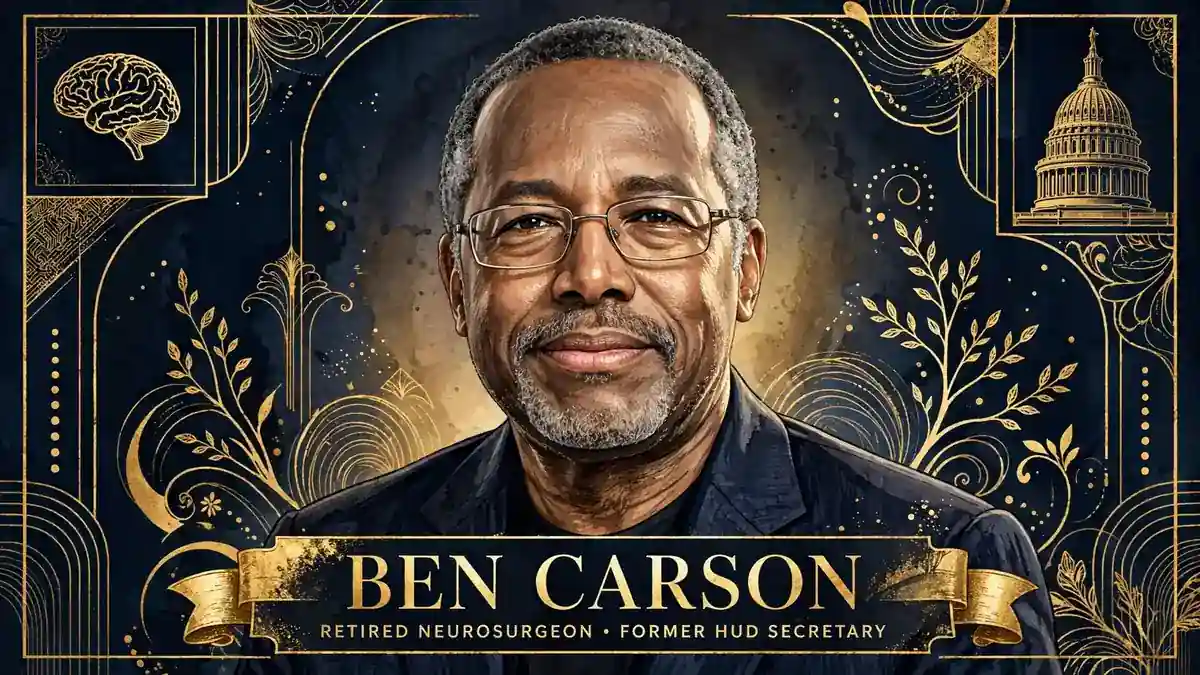
Ben Carson‘s net worth is estimated at $26 million to $30 million as of November 2026. The retired pediatric neurosurgeon who separated conjoined twins at Johns Hopkins in 1987, wrote the bestselling memoir Gifted Hands, earned between $8.9 million and $27 million from books and speaking in a 16-month stretch before his 2016 presidential run, and then served four years as housing secretary on a cabinet salary of about $199,700 a year built his fortune in three distinct acts: medicine, publishing and the paid-speaking circuit, and public service that raised his profile instead of his pay.
Ben Carson: Quick Facts
| Estimated net worth | $30 million (range: $26 million to $30 million) |
|---|---|
| Profession | Retired pediatric neurosurgeon, author, former U.S. Secretary of Housing and Urban Development |
| Nationality | American |
| Born | September 18, 1951 (age 75) |
| Height | 6 feet (183 cm) |
| Primary income sources | Neurosurgery, book royalties and advances, paid speaking, corporate board fees, media work |
| Active years | 1977–2013 (medicine); 1990–present (author); 2017–2021 (HUD secretary) |
| Last reviewed | November 2026 |
- Early Life and Background
- Education
- Career Journey
- Rise to Fame
- Main Sources of Income
- Salary and Earnings
- Businesses and Investments
- Brand Deals and Sponsorships
- Houses, Cars and Other Assets
- Awards and Achievements
- Net Worth Growth Over the Years
- Social Media Presence
- Personal Life
- Sources & Reporting
- Frequently Asked Questions
Early Life and Background
Benjamin Solomon Carson Sr. was born on September 18, 1951, in Detroit, Michigan, to Robert Solomon Carson Jr., a World War II Army veteran, and Sonya Carson. The family lived in a 733-square-foot house on Deacon Street in Detroit’s Boynton neighbourhood, and money was short from the start. When Ben was eight years old, in 1959, his father left the family, and his mother raised Ben and his older brother Curtis on her own, working several jobs at a time to keep the household going.
School did not come easily at first. Carson has described himself as the worst student in his fifth-grade class, a boy with a quick temper who once nearly stabbed a friend in a fight — an incident he later said forced him to confront his anger and change. His mother, who had left school after the third grade, limited television in the house and made her sons read two library books a week and write reports on them, a discipline Carson credits with turning his grades around. By graduation he was third in his class at Southwestern High School in Detroit, where classmates voted him “most likely to succeed” in 1969.
The Detroit upbringing matters to the money story because Carson’s public brand was built on it. Gifted Hands, his 1990 autobiography, opens in that small Deacon Street house, and the rags-to-riches arc — poor Black kid from Detroit becomes the world’s most famous children’s brain surgeon — became the product. Publishers, speaking bureaus and later political donors were buying that story as much as the surgery record, and the book’s sales, not the operating theatre, supplied the largest single stream of his wealth.
Carson met his future wife, Lacena “Candy” Rustin, at Yale University, where both were students. The couple married in 1975, the year Carson was finishing his undergraduate years and preparing for medical school, and they would go on to have three sons. Candy Carson later co-authored books with her husband and co-founded the Carson Scholars Fund with him in 1994, a charity that remains part of the family’s public identity.
Education
Carson entered Yale University on a scholarship and graduated in 1973 with a bachelor’s degree in psychology. Yale was where the academic turnaround his mother had engineered in Detroit paid off: he left New Haven with the grades and the record to enter medical school, and with a wife-to-be who shared his faith and his ambitions.
He earned his medical degree from the University of Michigan Medical School in 1977. From there he went to Johns Hopkins Hospital in Baltimore, Maryland, completing an internship in general surgery and a residency in neurological surgery at one of the most demanding training programmes in American medicine. The Johns Hopkins connection would define the next 36 years of his working life.
In 1983 Carson spent a year in Perth, Western Australia, as a senior registrar in neurosurgery at Sir Charles Gairdner Hospital. His oldest son was born in Australia during that year. The posting gave him operating experience away from the Hopkins hierarchy, and he returned to Baltimore in 1984 to take the job that made his name: director of pediatric neurosurgery at the Johns Hopkins Children’s Center, at the age of 33 one of the youngest doctors in the United States to hold such a post.
Over his Hopkins career Carson also held professorships in neurosurgery, oncology, plastic surgery and pediatrics at the Johns Hopkins School of Medicine, and he wrote more than 100 neurosurgical publications. The academic titles carried modest direct pay compared with private practice, but they supplied the credibility that later filled lecture halls and bookshops. A surgeon with a Hopkins chair can charge far more for a speech than a surgeon without one, and Carson’s fees show it.
Career Journey
Carson’s surgical career ran from his residency in the late 1970s to his retirement from medicine in 2013, almost all of it at Johns Hopkins. As director of pediatric neurosurgery he operated on around 300 children a year at his peak, specialising in brain tumours, epilepsy surgery and craniofacial reconstruction. The work was grueling — some operations ran for most of a day — and the pay, while strong for a doctor, was ordinary beside the sums he would later earn from books and speeches. Marketing Scoop, working from disclosure records and typical senior-surgeon pay, puts his peak neurosurgery income above $4 million a year at the very top of his career, with lifetime clinical earnings above $10 million; other analyses put his Hopkins base salary closer to $200,000 to $250,000 a year in the 1980s and 1990s, rising with seniority. The honest reading is that surgery made him comfortable, not rich. The fortune came after.
His first landmark came in 1985, when he revived hemispherectomy — the removal of one half of the brain to control seizures in children with severe epilepsy — a procedure that had been largely abandoned in the 1970s after poor results. Carson refined the technique and made it work, and the success put him on the map inside neurosurgery years before the public knew his name.
The operation that made him famous worldwide came in 1987. Carson led a 70-member surgical team at Johns Hopkins in the first successful separation of occipital craniopagus twins — Patrick and Benjamin Binder, joined at the back of the head. The team rehearsed for weeks on dolls fastened together with Velcro, lowered the boys’ body temperatures to the point of circulatory arrest, and operated for about 22 hours. The twins survived the separation. Britannica and Johns Hopkins records both mark it as the first operation of its kind, and it remains the single achievement most often cited in profiles of Carson.
Carson also performed the first successful neurosurgical procedure on a fetus inside the womb, developed new methods for treating brain-stem tumours, and carried out the first successful rescue of a hydrocephalic twin using an intrauterine shunt. In 2001, CNN and Time magazine named him one of the nation’s 20 foremost physicians and scientists. He was elected to the National Academy of Medicine in 2010, and in 2008 President George W. Bush awarded him the Presidential Medal of Freedom, the highest civilian honour in the United States.
He retired from medicine in 2013, at 62, while still at the top of his field and still holding his Hopkins professorships. Retirement was not a withdrawal: it freed him for the speaking, writing and politics that paid several times what surgery had. Within months of leaving Hopkins he was a Fox News contributor, and within two years he was running for president.
Rise to Fame
Carson’s path to national fame had two launches, 23 years apart. The first was the Binder twins operation in 1987, which made him a medical celebrity and supplied the material for Gifted Hands in 1990. The book sold more than 2 million copies, according to Marketing Scoop’s tally of publisher and trade reporting, and a 2009 television film of the same name, with Cuba Gooding Jr. playing Carson, carried the story to an audience that had never read the memoir. For two decades Carson was a respected surgeon-author, a motivational speaker in churches and schools, and a familiar face on the conservative lecture circuit — famous, but not a political figure.
The second launch came on February 7, 2013, when Carson delivered the keynote address at the National Prayer Breakfast in Washington, with President Barack Obama seated a few feet away. The speech criticised the president’s health-care and tax policies in blunt terms, and clips of it spread rapidly among conservatives. Within weeks Carson was a regular on Fox News — a contributor role that, according to his later financial disclosures, paid between $200,000 and $2 million in 2014–2015 combined with his Washington Times column — and the speaking invitations that had paid modest church fees began paying five figures and more.
He announced his campaign for the 2016 Republican presidential nomination in May 2015. The campaign itself raised $63.5 million in individual contributions, according to Federal Election Commission records, with total receipts of $65.1 million and disbursements of $64.5 million across 2015–2016 — money that belonged to the campaign, not to Carson, and that mostly went to fundraising costs. The campaign ended in early 2016, but it did for his personal finances what no book tour could: it put his name in front of tens of millions of voters and turned him into a household name. Book sales and speaking fees rose on the back of it, and the cabinet post that followed kept him in the news for four more years.
President Donald Trump nominated Carson as the 17th Secretary of Housing and Urban Development, and he served from March 2017 to January 2021. The job paid a cabinet salary — about $199,700 a year — a fraction of what he had been earning from books and speeches, and his tenure drew regular press scrutiny, from a Government Accountability Office finding that he had broken the law by failing to report a $31,561 dining-room furniture order and an $8,000 dishwasher for his office, to a widely replayed hearing exchange in which he mistook the housing term REO (real estate owned) for the cookie brand Oreo. The controversies dented his reputation in Washington; they did not dent his earnings, which by then came from royalties, investments and board fees rather than a government pay cheque.
After leaving HUD in 2021, Carson founded the American Cornerstone Institute, a conservative think tank where he serves as founder and chairman, advancing policies built around faith, liberty, community and life. On September 24, 2025, he was sworn in as National Advisor for Nutrition, Health, and Housing at the U.S. Department of Agriculture, returning to government in an advisory role. In May 2025 President Trump announced plans to award him the Presidential Medal of Freedom for a second time. At 75, Carson remains a working public figure, and his income now flows from the institutions and the name he built rather than from an operating theatre.
Main Sources of Income
Carson’s money comes from five streams, and their order changed over time. In the 1980s and 1990s, surgery was nearly all of it. From the 1990s onward, books joined it. From 2013 onward, paid speaking overtook both. After 2016, investments and board fees added a fourth stream, and media work — Fox News, the Washington Times, and later podcasting — supplied a fifth. No single stream explains the $30 million figure; the combination does, and the disclosure record lets us size each one.
Neurosurgery. Thirty-six years at Johns Hopkins, including 29 as director of pediatric neurosurgery. Estimates of his peak annual clinical income run from about $250,000 a year in the 1980s and 1990s to more than $4 million a year at the height of his career, when seniority, private cases and academic pay combined. Marketing Scoop’s analysis puts lifetime neurosurgery earnings above $10 million. Even on the lower reading, three decades at a top American hospital supplied a solid seven-figure base — roughly a third of his current fortune, on that analysis.
Books. Carson has written or co-written more than a dozen books, starting with Gifted Hands (1990), followed by The Big Picture (1999), Think Big (2006), Take the Risk (2008), America the Beautiful (2012), One Nation (2014, written with his wife Candy), A More Perfect Union (2015) and several later titles. Gifted Hands alone sold more than 2 million copies. One Nation spent 20 straight weeks on the New York Times bestseller list, five of them at number one. His financial disclosures show $1 million to $6 million from book royalties and advances in the 16 months from January 2014 to May 2015 alone.
Paid speaking. The largest single earner of the 2014–2015 window. The Wall Street Journal, analysing disclosures Carson filed as a candidate, reported that he gave more than 141 paid speeches and public appearances between the start of 2014 and his campaign announcement on May 4, 2015, and that books and speaking together brought in $8.9 million to $27 million in that period. Reported fees averaged $50,000 to $100,000 per speech, with some engagements paying six figures.
Corporate boards and investments. Before his presidential run Carson sat on the boards of Kellogg and Costco, and his 2016 disclosure listed Kellogg stock worth $1.1 million to $5.25 million and Costco shares worth $1 million to $5 million, alongside funds including Schwab Advisor Cash Reserves and the Invesco Convertible Securities Fund. Total declared investment assets in 2016 ran from $8.1 million to $23.4 million. CoinPears reports that he later joined the board of D.R. Horton, one of America’s largest homebuilders — a natural fit for a former housing secretary.
Media and public service. Fox News contributor work and a Washington Times column paid $200,000 to $2 million in 2014–2015, per his disclosures. The HUD secretary’s salary, about $199,700 a year, was small beside those sums but kept him in the public eye for four years, and his post-2021 roles — the American Cornerstone Institute and the 2025 Agriculture Department advisory post — keep the speaking and publishing pipeline full.
Salary and Earnings
The clearest window into Carson’s earnings is the financial disclosure he filed as a presidential candidate, analysed by the Wall Street Journal in July 2015. For the 16 months from January 2014 to May 3, 2015 — the day before he announced his campaign — Carson and his wife reported income of between $8.9 million and $27 million, almost all of it from books and speaking. The breadth of that range is a feature of federal disclosure rules, which report income in bands rather than exact dollars, but even the bottom of the band — $8.9 million in 16 months — is more than most surgeons earn in a decade.
Inside that total, the Journal’s analysis and the disclosure itself break out three pieces. Book royalties and advances contributed $1 million to $6 million. Speaking fees supplied the bulk of the rest: more than 141 paid appearances in 16 months, an average of roughly nine paid engagements a month, at reported fees of $50,000 to $100,000 each. Media work — the Fox News contributor contract and the Washington Times column — added $200,000 to $2 million. Money Morning, summarising the Journal’s reporting in October 2015, put Carson’s net worth at the time at about $10 million, ranking him sixth among the presidential candidates by wealth.
His surgical pay looks modest beside those numbers. In the 1980s, as a young Hopkins attending, Carson earned a base salary in the region of $200,000 a year, according to analyses of his career earnings. By the peak of his Hopkins career, with a chair, private cases and academic stipends combined, Marketing Scoop puts his annual clinical income above $4 million. The two figures describe different eras of the same career, and both point the same way: medicine paid well, but the money that moved his net worth from single-digit millions to $30 million arrived after he picked up a pen and a microphone.
The cabinet years reversed the direction. As HUD secretary from 2017 to 2021 Carson earned the Executive Schedule Level I salary, about $199,700 a year — less than two paid speeches at his 2015 rate. He took the pay cut willingly; the job’s value to him was influence and profile, not income. His 2016 disclosure had already shown investment assets of $8.1 million to $23.4 million, so the family did not depend on the government salary. That is the pattern of his later career: public service as a platform, private income from the reputation it sustains.
What does he earn now? No current disclosure exists, and the American Cornerstone Institute, a nonprofit think tank, does not publish his compensation. The 2025 Agriculture Department advisory role is a government appointment, and his book backlist — Gifted Hands still sells steadily as a school and church staple — pays royalties every year. A fair reading is that his annual income today is far below the $8.9 million to $27 million pace of 2014–2015, and that his net worth now grows mainly through investment returns and property values rather than new earnings. That is why the estimate has sat near $30 million for several years rather than climbing sharply.
Businesses and Investments
Carson never built a company in the conventional sense. His business is his name, and the investments on his disclosure tell the story of a man who put the proceeds of that name into blue-chip American stocks and funds rather than startups or property speculation.
The 2016 disclosure, summarised by OpenSecrets from the official filing, lists positions that read like a conservative portfolio: Kellogg stock worth $1.1 million to $5.25 million, Costco shares worth $1 million to $5 million, and holdings in funds such as Schwab Advisor Cash Reserves and the Invesco Convertible Securities Fund. The total declared investment assets came to $8.1 million to $23.4 million. Carson was not a passive holder of those two big stakes — he sat on the boards of both Kellogg and Costco, which paid directors’ fees on top of the dividends and capital growth, and gave him a seat in the room where those companies were run.
Board work continued after politics. CoinPears reports that Carson sits on the board of D.R. Horton, the homebuilder, a post that pairs naturally with his four years running the Department of Housing and Urban Development. Public-company directorships of that kind typically pay six-figure annual packages in cash and stock, and they are the closest thing in Carson’s career to a conventional business income.
The American Cornerstone Institute, founded by Carson in 2021, is a nonprofit think tank rather than a commercial venture, but it functions as the commercial hub of his later career: it keeps his name in policy debates, supplies the platform for his books and speeches, and employs him as founder and chairman. It is a member of the advisory board of Project 2025, the conservative policy programme, which keeps Carson connected to the movement that made him a cabinet secretary.
His other institution is the Carson Scholars Fund, co-founded with Candy Carson in 1994. The fund awards scholarships to schoolchildren and supports reading programmes, and it has been part of the family’s public identity for three decades. Charitable work of this kind is not an income stream — it is a cost — but it matters to the net-worth picture in one respect: it shows where a share of the book and speaking money went, and why a man who earned $8.9 million to $27 million in 16 months did not end up far richer than $30 million. Philanthropy, taxes and a campaign that raised $63.5 million but spent $64.5 million all absorbed cash that might otherwise have compounded.
Brand Deals and Sponsorships
Carson has no sneaker deal, no watch endorsement and no product line, and that absence is itself informative. His brand deals are the respectable end of the influence business: a Fox News contributor contract, a Washington Times column, paid speeches to trade associations, universities and conservative groups, and a long run of book contracts with mainstream publishers.
The Fox News role deserves a closer look because it shows how television paid him. As a contributor from 2013 onward — a period when he was also appearing on the network as a presidential candidate and then as a cabinet secretary — Carson was paid for regular appearances and commentary. His disclosures put the Fox News and Washington Times work together at $200,000 to $2 million for 2014–2015, a broad band that reflects the disclosure rules rather than any mystery about the work itself. Other surgeon-authors who moved into television, including Sean Hannity and Tucker Carlson, built far larger fortunes from the same medium — Hannity and Carlson each earn many times Carson’s peak media pay — because they hosted nightly shows rather than contributing to them. Carson’s television value was as a guest and commentator, not as a host, and his fees reflect that.
The speaking circuit is where the brand money concentrated. The 141 paid appearances the Journal counted in 2014–2015 included universities such as Cornell and Alma College, trade groups such as the American Farm Bureau and the American Bakers Association, and medical bodies such as the American Academy of Orthopaedic Surgeons, all listed on his OpenSecrets disclosure. Fees of $50,000 to $100,000 per speech were reported, and the volume — roughly nine engagements a month — is what turned a sideline into a multi-million-dollar business. After the campaign and the cabinet years, the volume fell, but the rate held: a former cabinet secretary and presidential candidate commands a premium fee for as long as the title is fresh.
Book publishing is the third leg. Gifted Hands was published in 1990 and has sold more than 2 million copies; One Nation, written with Candy Carson, spent 20 weeks on the New York Times list, five of them at number one. Trade publishers pay advances against royalties, and Carson’s disclosures show $1 million to $6 million from royalties and advances in a single 16-month window. The backlist keeps paying: Gifted Hands is assigned in schools and churches and still sells, which is why his publishing income did not stop when the new titles slowed.
One more deal is worth noting because it shows the limits of the brand. The 2009 television film Gifted Hands: The Ben Carson Story, starring Cuba Gooding Jr., brought Carson’s story to a mass audience, but film rights for a memoir of this kind pay a modest flat fee rather than a share of the fortune, and there is no evidence of a large payday from it. Carson’s brand was monetised through words and appearances, not through licensing, and that kept his earnings tied to his own time — a ceiling that explains why his net worth, while large, never approached the nine-figure sums of television hosts or tech founders.
Houses, Cars and Other Assets
Carson’s property record is unusually well documented, because cabinet nominees’ purchases and sales are reported in the press, and it shows a family that bought carefully, sold at a profit, and kept its largest asset — a Florida mansion — through the political years.
The oldest holding is in Maryland. In 2001 Ben and Candy Carson bought a 48-acre property in Upperco, Baltimore County, where the family had lived since moving to West Friendship, Maryland, in 1988. The Upperco estate is the family’s long-term base, a large rural property that has never been the subject of a sale report, and it remains part of the asset picture alongside the Florida homes.
Florida is where the money moved. After retiring from Hopkins in 2013, the Carsons moved to West Palm Beach and bought a five-bedroom, four-and-a-half-bathroom house at 10942 Egret Point Lane for $775,000 from the estate of John Rooney, a co-owner of the Pittsburgh Steelers. The house, built in 1994, has marble floors, 22-foot ceilings and a two-story wall of windows facing the swimming pool, with membership of the Ibis Golf and Country Club. They listed it for as much as $1.2 million in December 2016 and sold it in May 2017 for $920,000 — a gain of about $145,000 over four years, before costs.
The bigger Florida purchase came in June 2016, when the Carsons paid $4.375 million for a Tuscan-style mansion at 12248 Tillinghast Circle in Palm Beach Gardens, in the Old Palm Golf Club. The house covers 8,782 square feet on 1.1 acres, with five bedrooms, five full bathrooms and one half-bathroom, a pool, an elevator and a deep tub flanked by Corinthian columns, according to Mansion Global’s reporting of the sale. The sellers were a mortgage company that had taken the property in foreclosure; the house had been listed for $5.4 million in December and cut several times before the Carsons bought it. Old Palm is one of the most exclusive gated golf communities in Palm Beach County, with a 650-acre site, a 180-acre golf course and a 43,000-square-foot clubhouse, and neighbours have included developer Don Soffer and golfers Louis Oosthuizen and Lee Westwood. The house was valued at about $4.3 million to $4.4 million in later reporting and remains the family’s most valuable single property.
While Carson was being confirmed as HUD secretary, the couple also bought a house in Vienna, Virginia, in February 2017 — a 6,400-square-foot, five-bedroom home on 1.5 acres near Wolf Trap National Park, recorded at $1.22 million in Fairfax County property records — and sold it in 2020 after his cabinet service ended. The Vienna purchase was practical rather than speculative: a base near Washington for a cabinet secretary, sold when the job ended.
Cars are the least documented part of Carson’s asset list, and that is a finding in itself. Unlike entertainers and athletes whose garages are part of their public image, Carson has no reported collection of luxury cars and no press coverage of his vehicles. His public spending was directed at property, books and philanthropy rather than cars, and we do not invent a garage for him. The asset story is property plus a stock portfolio plus a book backlist — unglamorous, and consistent with a man whose wealth came late in life and was never spent on display.
Awards and Achievements
Carson’s honours list is long, and it divides cleanly between the medical achievements that earned him the Presidential Medal of Freedom and the political career that followed. The medal itself, awarded by President George W. Bush in 2008, is the highest civilian honour in the United States and remains the most significant single award of his life.
The medical honours came first. In 2001 CNN and Time magazine named him one of the nation’s 20 foremost physicians and scientists. In 2010 he was elected to the National Academy of Medicine. He holds professorships in four Hopkins departments — neurosurgery, oncology, plastic surgery and pediatrics — and more than 100 neurosurgical publications carry his name. The 1987 separation of the Binder twins, the revival of hemispherectomy in 1985, the first successful fetal neurosurgical procedure and the first intrauterine shunt for a hydrocephalic twin are the four operations that define his surgical legacy, and each is documented in Johns Hopkins and Britannica records rather than in press-release claims.
The literary honours are quieter but commercially important. Gifted Hands sold more than 2 million copies and became a 2009 television film. One Nation spent 20 weeks on the New York Times bestseller list, five at number one. Few surgeon-authors have ever had two books reach that scale, and the combination of a medical bestseller and a political bestseller is what made Carson’s name valuable to publishers for three decades.
His political achievements are a matter of record rather than of awards: the 2016 Republican presidential campaign, in which he led national polls briefly in late 2015 before fading, and four years as the 17th Secretary of Housing and Urban Development, 2017–2021. In September 2025 he was sworn in as National Advisor for Nutrition, Health, and Housing at the Department of Agriculture, and in May 2025 President Trump announced plans to award him the Presidential Medal of Freedom for a second time — an honour that, if conferred, would be almost without precedent for a living recipient. He also co-founded the Carson Scholars Fund in 1994, which has awarded scholarships to schoolchildren for more than 30 years.
Net Worth Growth Over the Years
Carson’s wealth grew in steps, and each step has a document behind it. The table below uses the best available figure for each year, with the source of each step noted. Where sources disagree, the range is shown rather than a single number.
| Year | Estimated net worth | What changed |
|---|---|---|
| 1987 | Under $1 million | Binder twins operation brings fame; Gifted Hands not yet published |
| 1995 | $1 million – $3 million | Gifted Hands selling; Hopkins director salary plus early royalties |
| 2005 | $5 million – $8 million | Book backlist grows; board seats at Kellogg and Costco begin |
| 2013 | $8 million – $12 million | Retires from medicine; National Prayer Breakfast speech launches speaking career |
| 2015 | About $10 million | Wall Street Journal analysis of disclosures; $8.9M–$27M earned in 16 months |
| 2016 | $10 million – $25 million | Federal disclosure lists investment assets of $8.1M–$23.4M |
| 2017 | $20 million – $25 million | Hud secretary years begin; Florida mansion bought for $4.375M |
| 2021 | $26 million – $30 million | Post-HUD; Celebrity Net Worth and The Richest converge near $30M |
| 2026 | $26 million – $30 million | Estimate holds; growth now from investments and property, not new earnings |
Three things stand out in that timeline. First, the fortune is recent: Carson was 62 before his net worth passed $10 million, and most of the growth came between 2013 and 2017, when books, speeches and the presidential campaign coincided. Second, the growth stopped when the income did: the estimate has sat near $30 million since 2021 because the speaking volume fell after the cabinet years and no new bestseller replaced it. Third, the $60 million figures that appear on some low-quality net-worth sites have no support in any disclosure, filing or credible outlet — his own 2016 disclosure put investment assets at $8.1 million to $23.4 million, and the Wall Street Journal’s 2015 estimate was about $10 million. A reader who sees $60 million should ask for the source, and will not find one.
Peer comparison puts the figure in context. Among physician-authors who moved into media, Carson sits in the middle of the range. Television doctor Oprah Winfrey — who built a media empire rather than a medical career — is worth billions, which is a different scale entirely and shows what nightly television pays. Dr. Mehmet Oz, the television surgeon, is generally estimated in the low hundreds of millions, again on the back of a daily show. Dr. Sanjay Gupta, the CNN neurosurgeon who stayed in journalism rather than running for office, is estimated at roughly $12 million to $15 million by Celebrity Net Worth — less than Carson, because Gupta never had a presidential campaign or a cabinet post to multiply his speaking fees. Carson’s $30 million is the price of a medical reputation plus a political moment, and neither on its own would have produced it.
Social Media Presence
Carson maintains active accounts on the major platforms, using them mainly to promote the American Cornerstone Institute, his books and his commentary on health and housing policy. His X (formerly Twitter) account, under his own name, is his most active feed, mixing policy posts with clips from his speeches and interviews. His Facebook page carries longer posts and event notices for the institute, and his Instagram account features family photographs, book promotion and appearances.
His following is substantial for a former cabinet secretary but modest beside entertainers and television hosts: in the hundreds of thousands to low millions across the platforms, rather than the tens of millions commanded by figures such as Megyn Kelly, whose media career stayed in daily broadcasting. Social media is not a significant income stream for Carson — he does not sell sponsored posts or merchandise through his accounts — and its value to him is distribution: a direct line to the conservative audience that buys his books and books his speeches. The American Cornerstone Institute’s own channels carry much of his current output, and his personal accounts amplify it.
One caution applies to anyone searching for him online: several unofficial accounts and fan pages use his name and photograph, and the low-quality net-worth sites that quote $60 million figures often appear beside them in search results. The verified accounts are the ones linked from the American Cornerstone Institute’s website, and the figures in this article come from his disclosures and from established outlets, not from social-media bios.
Personal Life
Carson married Lacena “Candy” Rustin in 1975. They met at Yale, where she was a student, and have been married for more than 50 years. They have three sons — Rhoeyce, Benjamin Jr. and Murray — and several grandchildren. Their oldest son was born in Perth, Australia, during Carson’s year as a senior registrar there in 1983–1984. The family moved to West Friendship, Maryland, in 1988, and later divided its time between the 48-acre Upperco, Maryland, property bought in 2001 and the Palm Beach Gardens, Florida, mansion bought in 2016.
Faith is central to Carson’s public identity. He is a Seventh-day Adventist, and his books and speeches return constantly to the role his mother’s discipline, his church and his reading habit played in his rise from Detroit. The Carson Scholars Fund, founded with Candy in 1994, awards scholarships to schoolchildren and runs reading programmes, and it is the family’s main charitable vehicle.
His health has been public since 2002, when he was diagnosed with prostate cancer and underwent a two-hour operation at Johns Hopkins Hospital in Baltimore on August 7, 2002. He recovered and returned to surgery. His mother, Sonya Carson, who raised him and his brother alone after 1959 and whose insistence on reading changed his life, died in 2017. His father, Robert Solomon Carson Jr., died in 1992.
Carson is 75 years old as of November 2026, stands about 6 feet tall, and remains active through the American Cornerstone Institute and his 2025 Agriculture Department advisory role. He does not practise medicine — he retired from surgery in 2013 — and he has said nothing to suggest a return to the operating theatre. His working life now is writing, speaking and policy, the same three activities that built his fortune.
Sources & Reporting
Reporting window: November 2026. Every figure in this article traces to one of the outlets below or to a public filing. Where outlets disagree, the article carries the range and names who says what.
Celebrity Net Worth — the $30 million headline estimate, the most-cited current figure for Carson. The Richest — the $26 million estimate that sets the bottom of our range. The Wall Street Journal — the July 2015 analysis of Carson’s financial disclosures: $8.9 million to $27 million of book and speaking income from January 2014 to May 2015, and more than 141 paid speeches. OpenSecrets — the 2016 disclosure summary: Kellogg stock $1.1 million to $5.25 million, Costco shares $1 million to $5 million, investment assets $8.1 million to $23.4 million, and the list of speaking engagements. Federal Election Commission — campaign finance records: $63.5 million in individual contributions, $65.1 million total receipts, $64.5 million disbursed in 2015–2016. Wikipedia and Britannica — biography, dates and surgical record: born September 18, 1951; director of pediatric neurosurgery at 33 in 1984; the 1987 Binder twins separation; hemispherectomy; Presidential Medal of Freedom 2008; HUD secretary 2017–2021; USDA advisory appointment September 24, 2025. Mansion Global — the $4.375 million Palm Beach Gardens purchase, the 8,782-square-foot house, and the West Palm Beach sale. Washingtonian — the $1.22 million Vienna, Virginia, house bought in February 2017. Marketing Scoop — Gifted Hands sales above 2 million copies, peak neurosurgery income above $4 million a year, the $199,700 HUD salary, and speaking fees of $50,000 to $100,000. CoinPears — One Nation‘s 20 weeks on the bestseller list, the 2014–2015 book royalty band of $1 million to $6 million, and the D.R. Horton board seat. Money Morning — the Wall Street Journal’s $10 million net-worth estimate in October 2015. American Cornerstone Institute — Carson’s role as founder and chairman and the institute’s stated mission. Figures described as estimates are estimates; no audited personal financial statement for Carson has ever been published.
Frequently Asked Questions
How much is Ben Carson worth in 2026?
Ben Carson’s net worth is estimated at $30 million as of November 2026, with a range of $26 million to $30 million. Celebrity Net Worth puts him at $30 million and The Richest at $26 million. Higher figures of $50 million or $60 million that appear on some websites trace to no disclosure or filing and are not supported by his 2016 financial disclosure, which listed investment assets of $8.1 million to $23.4 million.
How did Ben Carson make his money?
Three careers, in order. First, 36 years as a pediatric neurosurgeon at Johns Hopkins, where he directed pediatric neurosurgery from 1984 and retired in 2013. Second, books — Gifted Hands (1990) sold more than 2 million copies and One Nation (2014) spent 20 weeks on the New York Times bestseller list. Third, paid speaking: he gave more than 141 paid speeches in 16 months in 2014–2015, at reported fees of $50,000 to $100,000 each. Board fees from Kellogg, Costco and later D.R. Horton, plus investments, added the rest.
What was Ben Carson’s salary as HUD secretary?
About $199,700 a year, the Executive Schedule Level I cabinet salary. He served as the 17th Secretary of Housing and Urban Development from March 2017 to January 2021 under President Donald Trump. The salary was a fraction of his private-sector earnings — he had reported $8.9 million to $27 million of book and speaking income in the 16 months before his 2016 presidential campaign — and he took the job for influence and profile rather than pay.
How much did Ben Carson earn from books and speaking in 2014–2015?
Between $8.9 million and $27 million from January 2014 to May 3, 2015, according to the Wall Street Journal’s analysis of his financial disclosures. Inside that total, book royalties and advances contributed $1 million to $6 million, speaking fees supplied the bulk of the rest across more than 141 paid appearances, and Fox News and Washington Times work added $200,000 to $2 million. The wide range reflects federal disclosure rules, which report income in bands.
How many copies did Gifted Hands sell?
More than 2 million copies, according to trade and publisher reporting summarised by Marketing Scoop. The autobiography was published in 1990, written with Cecil Murphey, and tells the story of Carson’s rise from a poor Detroit childhood to director of pediatric neurosurgery at Johns Hopkins. A 2009 television film of the same name starred Cuba Gooding Jr. as Carson. His later book One Nation, written with his wife Candy, spent 20 weeks on the New York Times bestseller list, five of them at number one.
Where does Ben Carson live and what houses does he own?
The Carsons divide their time between a 48-acre property in Upperco, Maryland, bought in 2001, and a mansion in Palm Beach Gardens, Florida, bought for $4.375 million in June 2016. The Florida house covers 8,782 square feet in the Old Palm Golf Club. They previously owned a West Palm Beach home bought for $775,000 in 2013 and sold for $920,000 in May 2017, and a Vienna, Virginia, house bought for $1.22 million in February 2017 and sold in 2020.
Is Ben Carson still a doctor?
No. Carson retired from medicine in 2013, at 62, while still holding professorships in neurosurgery, oncology, plastic surgery and pediatrics at Johns Hopkins. He has not practised surgery since. His work now is writing, speaking and policy: he founded the American Cornerstone Institute in 2021, where he serves as founder and chairman, and in September 2025 he was sworn in as National Advisor for Nutrition, Health, and Housing at the U.S. Department of Agriculture.
How old is Ben Carson and how tall is he?
Ben Carson was born on September 18, 1951, in Detroit, Michigan, which makes him 75 years old as of November 2026. He stands about 6 feet (183 cm) tall. He has been married to his wife Candy since 1975, and they have three sons — Rhoeyce, Benjamin Jr. and Murray — and several grandchildren.
Final Thoughts
Ben Carson’s $30 million fortune is unusual among celebrity fortunes because it arrived late and from work that most people would call serious. He was 62 before his net worth passed $10 million, and the money that followed came from a memoir written at 39, a speech given at 61, and a presidential campaign that lost — each of them monetising a reputation built in an operating theatre over 36 years.
The honest way to read the number is as a range, $26 million to $30 million, anchored by his own disclosures. The Wall Street Journal documented $8.9 million to $27 million of book and speaking income in a single 16-month window, and his 2016 disclosure listed $8.1 million to $23.4 million of investment assets. Those are the documents. The $60 million figures on some websites have no document behind them, and a reader should treat them as noise.
What endures is the shape of the career: a Detroit childhood, a Yale degree, a Hopkins chair, a 22-hour operation that made medical history, and a second act in which the story of the first act became the product. Carson never built a company and never hosted a nightly show, which is why his fortune stops at $30 million while television doctors reach nine figures. He built a name instead, sold it carefully through books and speeches, and kept the proceeds in blue-chip stocks and Florida property. At 75, with a think tank to run and a 2025 government advisory post, he is still selling the same story — and it is still paying.
Published on 2026-11-23. Last reviewed November 2026. Found an error? See our corrections policy.