
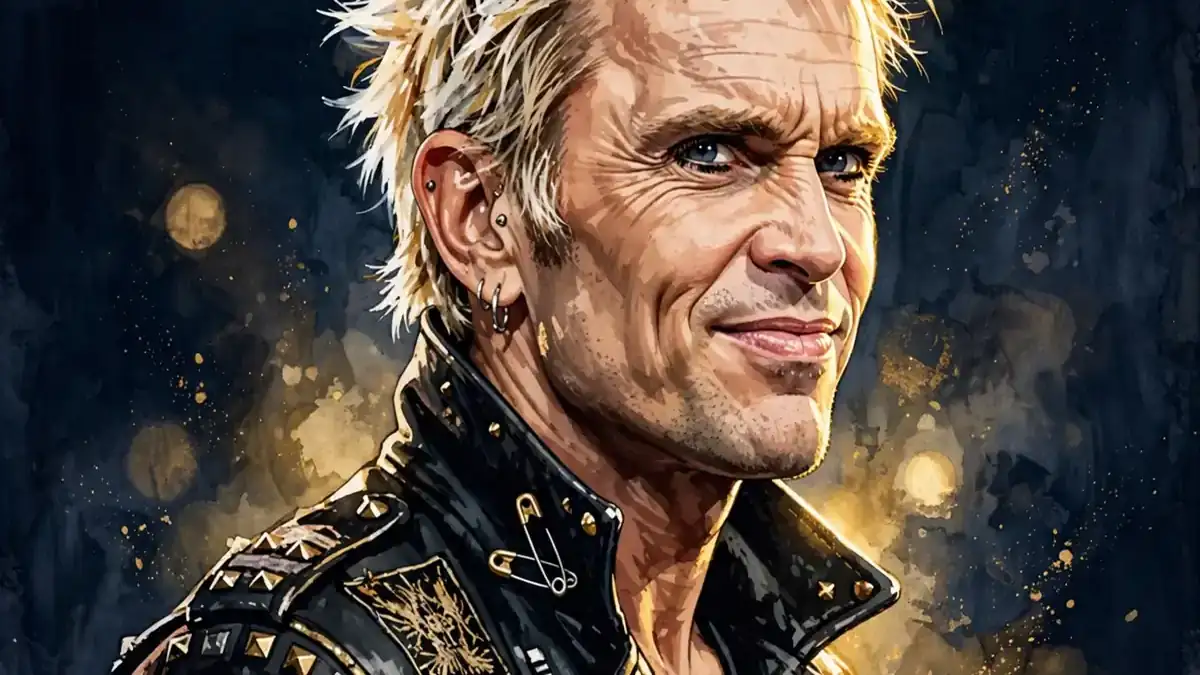
Billy Idol‘s net worth is estimated at $40 million to $60 million as of November 2026. The punk kid from Bromley who sneered his way through MTV in the 1980s still earns from the same four songs — “White Wedding,” “Rebel Yell,” “Eyes Without a Face” and “Mony Mony” — while a new album, a 30-city arena tour, a hit documentary and a Rock & Roll Hall of Fame induction in November 2026 keep the catalog paying.
Billy Idol: Quick Facts
| Estimated net worth | $60 million (range: $40 million to $60 million) |
|---|---|
| Profession | Rock singer, songwriter, actor |
| Nationality | British-American (born in England; U.S. citizen since 2018) |
| Born | 30 November 1955 (age 70) |
| Height | 5 feet 9 inches (1.75 m) |
| Primary income sources | Record and publishing royalties, touring, sync licensing, memoir sales, acting appearances |
| Active years | 1976–present |
| Last reviewed | November 2026 |
- Early Life and Background
- Education
- Career Journey
- Rise to Fame
- Main Sources of Income
- Salary and Earnings
- Businesses and Investments
- Brand Deals and Sponsorships
- Houses, Cars and Other Assets
- Awards and Achievements
- Net Worth Growth Over the Years
- Social Media Presence
- Personal Life
- Sources & Reporting
- Frequently Asked Questions
Early Life and Background
William Michael Albert Broad was born on 30 November 1955 in Stanmore, Middlesex, England. His father worked as a salesman. When Billy was two, the family crossed the Atlantic and settled on Long Island, New York — first in Patchogue, then in Rockville Centre — and stayed four years before returning to England. The boy who came back spoke with an American accent, a detail that later made his transatlantic sneer sound natural on both sides of the ocean.
The family settled in Bromley, south-east London, a suburb that doubled as an incubator for British punk. Billy fell in with the Bromley Contingent, the gang of Sex Pistols devotees who followed the band from gig to gig in 1976. The Contingent was less a fan club than a finishing school: its members learned the look, the attitude and the contacts that built the scene. Billy’s stage name came out of that period. A schoolteacher had once described him as “idle,” and he bent the insult into a brand — Billy Idol, a name that read as a joke and a mission statement at the same time.
His first band job was as guitarist in Chelsea, a punk outfit formed in late 1976. He lasted weeks. The guitar was never his instrument — his voice and his face were — so he left with bassist Tony James to form Generation X, taking the singer’s microphone for himself. The move set the pattern for the rest of his career: Idol has always been better at spotting the opening than at waiting for permission.
Generation X signed to Chrysalis Records and released three albums between 1978 and 1981: Generation X, Valley of the Dolls and Kiss Me Deadly. The band scored British hits with “Your Generation,” “King Rocker” and “Dancing with Myself,” the last of which Idol co-wrote with James and would later re-record as a solo single. The records sold respectably in Britain and almost nothing in America, which was the point of friction that ended the band. Idol wanted the United States. In March 1981 he moved to Greenwich Village in New York, alone, with a record deal to chase and a punk band behind him.
Education
Idol enrolled at the University of Sussex in 1975 to study English literature and left after a year. The dropout line on his biography is often told as a punchline, but the year mattered: Sussex put him in reach of London’s punk explosion at the exact moment it detonated, and the literature degree he never finished left traces in his songwriting — “Eyes Without a Face” takes its title and its mood from the 1960 French horror film Les Yeux sans visage, and his lyrics have always leaned on books and films more than the average punk singer’s did.
His real education was the Bromley Contingent and the London club circuit of 1976 and 1977. He learned stagecraft by watching the Sex Pistols, learned the business by watching managers and labels circle the scene, and learned his own limits by failing as a guitarist in Chelsea and switching to the job he could actually do. No formal qualification follows him. The career that followed was built on that single year of university, three years of punk apprenticeship and a willingness to move to New York with no safety net.
Career Journey
New York in 1981 gave Idol two things London could not: a manager and a guitarist. Bill Aucoin, who had built KISS into an American arena act, took him on. Steve Stevens, a Brooklyn-born guitarist with a taste for flamenco runs and hard-rock flash, became the musical partner who would co-write nearly every Idol hit for the next 45 years. The pair cut the Don’t Stop EP in 1981, then the debut album Billy Idol in July 1982 on Chrysalis. It went gold in the United States, and its singles “White Wedding” and “Hot in the City” turned Idol into one of the first stars made by MTV, a channel then barely a year old.
The breakthrough record was Rebel Yell, released on 10 November 1983 and produced by Keith Forsey. It peaked at No. 6 on the Billboard 200, and the Recording Industry Association of America has certified it double platinum for two million copies shipped in the United States. Music Canada certified it five times platinum. Four of its songs reached the U.S. Hot 100, and “Eyes Without a Face” reached No. 4 — Idol’s first American Top 10 single and still his highest-charting one. The album’s title came from a bottle of Rebel Yell bourbon passed around at a party, a story Idol has told for decades and one that fits the record’s mood exactly.
Whiplash Smile followed in 1986 and went platinum in the United States, powered by “To Be a Lover,” “Sweet Sixteen” and “Don’t Need a Gun.” The remix collection Vital Idol (1985) and the hits set Idol Songs: 11 of the Best (1988) kept the catalog in shops between studio albums. A live version of “Mony Mony” — a song Idol had covered from Tommy James & the Shondells in 1981 — reached No. 1 on the Billboard Hot 100 in 1987, giving him his only American chart-topper six years after he first recorded it.
Charmed Life arrived in 1990 with “Cradle of Love,” written for the film The Adventures of Ford Fairlane. The single reached No. 2 on the Hot 100 and earned Idol his third Grammy nomination. Then the decade turned on him. On 6 February 1990 he ran a stop sign on his motorcycle in Hollywood and was hit by a car, breaking his leg so badly that doctors warned he might lose it. The Charmed Life tour was cut short. The 1993 concept album Cyberpunk — one of the first records promoted over the internet — sold poorly and confused the audience that had bought Rebel Yell by the millions. In 1994 he collapsed outside a Los Angeles nightclub after an overdose of the drug GHB and woke up in hospital, an episode he later described in his memoir as one of several times he woke up in a hospital after passing out in a nightclub.
The comeback was slow and then, in the 2000s, steady. Devil’s Playground came out in 2005 on Sanctuary Records. Kings & Queens of the Underground followed in 2014, the same year his memoir Dancing with Myself became a New York Times bestseller. Two EPs on Dark Horse Records — The Roadside in 2021 and The Cage in 2022 — rebuilt his recording momentum with Stevens still at his side. Then came the late-career surge that frames this estimate: a ninth studio album in 2025, a 30-city arena tour, a documentary and, in November 2026, the Rock & Roll Hall of Fame.
Rise to Fame
Idol’s fame was a two-stage explosion. The first stage was British punk: Generation X put him on Top of the Pops and in the music papers before he was 23. The second stage was MTV, and it was the one that paid. When MTV launched in August 1981, it needed faces as much as songs, and Idol had the best face in the business — platinum spikes, a curled lip, a leather jacket that photographed like a uniform. The videos for “Dancing with Myself” and “White Wedding” ran in heavy rotation, and the channel’s hunger for visual stars turned a punk singer with two gold records into a household name in America within 18 months.
The numbers behind the fame are unusually well documented for a rock act of his era. The Hollywood Walk of Fame, which gave Idol the 2,743rd star in January 2023, credits him with more than 40 million albums sold worldwide, nine Top 40 singles in the United States and ten in the United Kingdom. His discography now runs to nine studio albums, seven compilations and 37 singles, according to the discography record on Wikipedia. “White Wedding,” “Rebel Yell,” “Eyes Without a Face,” “Mony Mony,” “Hot in the City,” “Flesh for Fantasy” and “Cradle of Love” all still turn up on rock radio, in films and in advertising — the kind of rotation that pays songwriters every time it happens.
Acting widened the fame without ever replacing music. He played Cat in Oliver Stone’s The Doors (1991) and himself — the joke being that he was the coolest person at the wedding — in The Wedding Singer (1998), a film that grossed more than $123 million worldwide. He appeared as a guest judge on American Idol in its tenth season. None of these roles made him rich on their own. All of them kept his face in front of audiences between albums, which is exactly what a catalog artist needs.
The 2020s gave him a third act that most 1980s stars never get. He received his Walk of Fame star in January 2023, with artist Shepard Fairey and rocker Henry Rollins speaking at the ceremony at 6201 Hollywood Boulevard. His documentary Billy Idol Should Be Dead premiered at the Tribeca Festival in June 2025 and now streams on Hulu and Sky. In May 2026 he received a Lifetime Achievement Award at the American Music Awards in Las Vegas, performing his hits with Stevens after an introduction by Leon Thomas. And on 14 November 2026 he was inducted into the Rock & Roll Hall of Fame as a member of the Class of 2026, alongside Steve Stevens, inducted by No Doubt’s Gwen Stefani and Tony Kanal and performing “Rebel Yell” before Stefani joined him for “Eyes Without a Face.” Los Angeles declared 13 November 2026 “Billy Idol Day.” A singer who nearly lost a leg in 1990 and nearly lost his life in 1994 was, at 70, collecting the two honors — a Walk of Fame star and a Hall of Fame induction — that the industry reserves for survivors.
Main Sources of Income
Idol’s money comes from five streams, and their order matters. Recording royalties come first: 40 million records sold worldwide, with Rebel Yell alone certified for two million U.S. shipments and five-times platinum in Canada. Second is publishing. Idol co-wrote his hits with Steve Stevens, which means he holds a songwriter’s share of every play, not just a performer’s share — radio, streaming, film and television placements, and cover versions all pay the writers. Third is touring, which has been his largest single-year earner in the 2020s. Fourth is sync licensing, the business of placing old songs in new films, shows and adverts. Fifth is everything else: his memoir, acting cameos, merchandise and catalog reissues.
The catalog is the engine. Four songs do most of the work. “White Wedding” (1982), “Rebel Yell” (1983), “Eyes Without a Face” (1984) and “Mony Mony” (1981, No. 1 in its live version in 1987) have never left rock radio, and streaming gave them a second life. “Eyes Without a Face” has found a young audience on TikTok, where concert reviewers in 2025 noted that teenagers in the crowd knew it as a song from their own feeds. A catalog that earns while its owner sleeps is the difference between a rich rock star and a broke one, and Idol’s has earned for four decades.
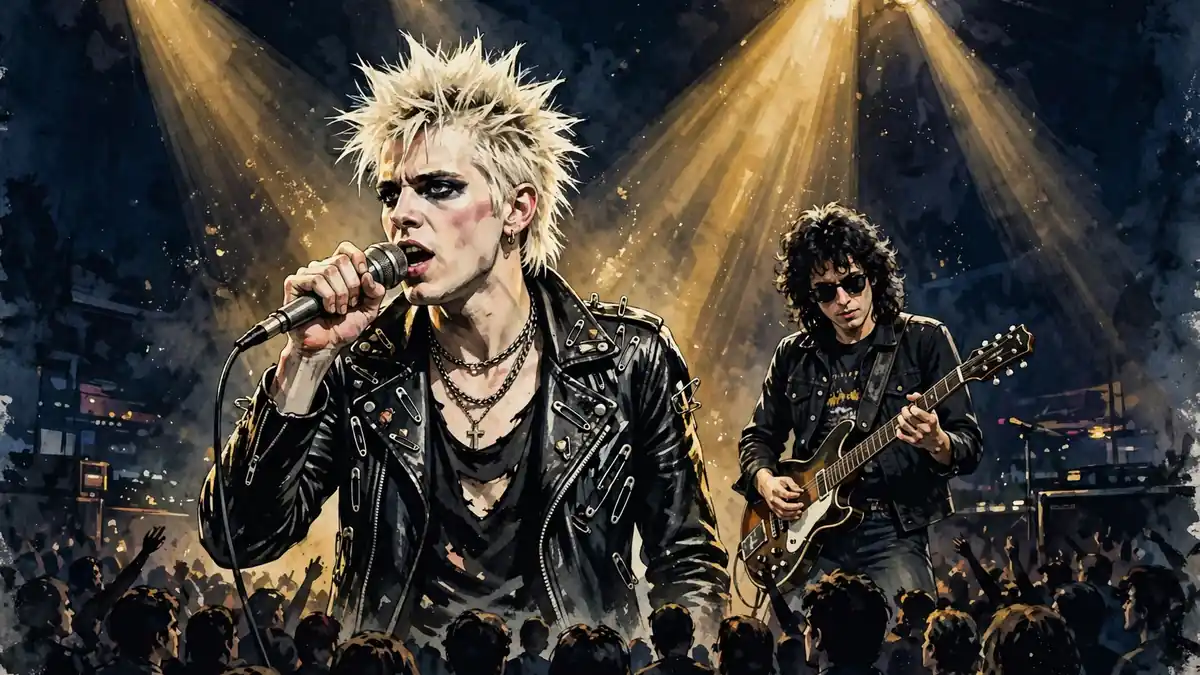
Touring is the loudest stream and the most visible. The 2025 run, It’s a Nice Day to Tour Again!, was produced by Live Nation and opened in Phoenix on 30 April 2025, running through 30 cities in the United States and Canada across two legs, with Joan Jett & the Blackhearts on every date. The routing mixed arenas — Bridgestone Arena in Nashville, the Kia Forum in Inglewood, MGM Grand Garden Arena in Las Vegas — with big amphitheaters such as the Greek Theatre in Berkeley and Saratoga Performing Arts Center. A European leg ran in June and July, and Latin American dates followed in October and November 2025. Pairing two punk-era headliners on one bill widened the audience for both: Jett’s fans bought Idol tickets, Idol’s fans stayed for Jett, and promoters sold a package rather than a nostalgia act.
Sync licensing is the quiet stream, and the 2026 news shows how it works. Pollstar reported in November 2026 that “Rebel Yell” appears in Margo’s Got Money Troubles, a Netflix streaming hit of 2026. One placement in a hit show can pay a songwriter more than a year of streaming, and it introduces the song to viewers who were born after it was recorded. The same logic sits behind the deluxe reissues: a 40th-anniversary edition of Rebel Yell in 2024, and a premium all-analog 180-gram One-Step vinyl edition announced in October 2026 for release on 20 November, limited to 3,000 numbered copies. Small runs of expensive vinyl aimed at collectors are high-margin business, and they keep the album in the news 43 years after release.
The memoir is a smaller but real stream. Dancing with Myself (2014) reached the New York Times bestseller list, and Idol narrated the audiobook himself, which pays a second royalty. Acting paid in cameo fees rather than salaries — the Wedding Singer appearance is a day’s work that has paid in residuals and recognition ever since. Merchandise runs through the tour: T-shirts, posters and vinyl at arena shows, where a 70-year-old rock star can still sell a room full of leather-jacket imagery to people who were not alive when the jacket was new.
What Idol does not have is equally telling. There is no public record of a restaurant chain, a fashion label, a spirits brand or a tech investment portfolio. His wealth is a musician’s wealth: songs, shows and the rights that tie them together. That concentration is a risk — if the catalog ever stops earning, there is no second business to catch him — and it is also the reason the estimate has stayed stable. Catalogs do not crash the way startups do.
Salary and Earnings
No record label, promoter or streaming service has ever published Billy Idol’s salary, and any article that prints a precise annual pay figure for him is guessing. That matters, because the guesswork in this niche is aggressive: one 2025 profile puts his annual income at $5 million to $10 million, another breaks his $60 million into neat slices — $25 million from album sales and streaming, $20 million from touring, $5 million from acting, $6 million from endorsements and $4 million from licensing — with no source for any line. Those tables look authoritative and are not. They are arithmetic dressed as reporting, and we do not repeat them as fact.
What can be said with evidence is how the money arrives and roughly when. The 1980s were the peak earning years in absolute sales: a double-platinum album in 1983, a platinum follow-up in 1986, a No. 1 single in 1987 and a No. 2 single in 1990, all while MTV kept the videos in rotation. Recording contracts of that era paid artists a royalty per album sold after the label recouped recording and promotion costs, so the checks for Rebel Yell would have arrived over years rather than in a single lump — and the publishing checks, as co-writer, would have arrived separately and for longer.
The 1990s and 2000s were leaner. Cyberpunk (1993) sold poorly, and Idol released no studio album between 1993 and 2005. Touring continued, and the hits compilations — Greatest Hits in 2001, certified platinum in the United States in 2005 — kept royalties moving, but the decade was a repair job after the accident and the overdose, not a growth story.
The 2010s stabilized the income. The memoir in 2014 added book royalties. Festival headline slots and package tours paid appearance fees that a solo club tour could not match. The two Dark Horse EPs in 2021 and 2022 were modest sellers, but they put Idol back on release schedules and streaming playlists, which is where catalog money now lives.
The 2020s are his best earning years since the 1980s, and the reason is touring at arena scale. A 30-city Live Nation run in 2025, with arena and amphitheater capacities from 8,500 at the Greek Theatre in Berkeley to more than 17,000 at the Kia Forum, is a different business from the club dates of the 2000s. Ticket prices for legacy rock acts at that scale run far above club prices, and the merchandise table at an arena show can take in a meaningful sum in a single night. No gross figure for the 2025 tour has been published — Billboard’s Boxscore data is not public for this run — so we do not invent one. The shape of the tour is the evidence: Live Nation does not book 30 arenas for an act that cannot fill them.
Streaming pays in small coins that add up. The Cambridge Journal reported in 2025 that Idol’s YouTube channel had passed 1.2 billion views with 1.04 million subscribers, and attached a monthly ad-revenue estimate of about $9,000 to it. Treat that figure as reported by that outlet, not as a verified payment: YouTube revenue depends on geography, ad rates and watch time, and the channel’s own numbers are not public. What the view count does prove is demand. A billion views is a catalog that still finds listeners without new promotion.
The honest summary is this: Idol’s annual income rises and falls with his touring calendar. In a tour year like 2025, with 30 North American arena dates plus Europe and Latin America, his earnings are at their highest in decades. In a quiet year, the catalog still pays — radio, streaming, sync and reissues — but at a fraction of tour-year levels. Any single annual figure quoted without a tour attached to it should be read as a guess.
Businesses and Investments
Search long enough and you will find claims that Billy Idol owns a record label, a property empire and a stake in this or that venture. Almost all of them collapse on inspection. He does not own Dark Horse Records, the label that released his last three records — that label was founded by George Harrison and is run by his son Dhani Harrison. He has no fashion line, no drinks brand and no restaurant group in any credible reporting. The “significant stake in his record label” line that appears in one 2025 net-worth profile is unsourced, and we found no filing, interview or trade-press report to support it.
What he does own, beyond dispute, is a share of his own songs. Idol co-wrote the hits with Steve Stevens, and songwriter ownership is the most durable asset in popular music. The publishing catalog pays on every radio play, every stream, every film placement and every cover version, and it pays for the life of the songwriter plus 70 years under U.S. copyright law. It is also the asset that appreciates when a song lands in a hit show, as “Rebel Yell” did on Netflix in 2026. Catalog valuations for legacy rock acts have risen sharply since 2020, as funds buy up publishing rights — but Idol has never announced a sale of his catalog, and we found no report of one. He still holds the asset rather than cashing it in.
Real estate is the murkiest corner of his finances, and the honest position is to say so. Low-quality net-worth sites claim he bought a Hollywood Hills home for $2.5 million in 2012 and a Bird Streets mansion for $5.5 million in 2015, and one puts his Los Angeles home at $3 million. None of those claims names a deed, a sale record or a reporting outlet, and the figures contradict each other. What is documented is that he has lived in Los Angeles since 1987 — Pollstar noted it in November 2026, when the city declared “Billy Idol Day” — and that he became a U.S. citizen in 2018 while keeping his British citizenship. He owns property in the United States and spends time in Britain, but the addresses, purchase prices and current values are not public, and we will not launder scraper-site guesses into facts.
His investments, to the extent they are visible at all, look like a working musician’s: the catalog, the touring business, the memoir and the reissues. There is no evidence of venture capital, crypto, or a portfolio of startups, and no credible report of debts or bankruptcies either. The 1990s were financially thin — a lost decade of touring income after the accident — but there is no record of the kind of collapse that hit many of his peers. He survived the lean years on the catalog, which is exactly what a catalog is for.
Brand Deals and Sponsorships
Idol has never been a brand ambassador in the modern sense. There is no long-term endorsement contract with a watchmaker, a car company or a clothing label in his record, and no sneaker deal or fragrance launch. The 1980s version of him sold records and concert tickets, not products, and the industry’s endorsement economy was smaller then for rock acts than it was for pop stars.
What he has done, repeatedly, is license his songs. “Rebel Yell,” “White Wedding” and “Dancing with Myself” have appeared in films, television shows, video games and commercials for decades. The 2026 Netflix placement of “Rebel Yell” is the latest example, not an exception. Licensing is a better business for a legacy artist than endorsement: the song does the work, the fee is negotiated per use, and the artist never has to pretend to like a product.
His image has been licensed too, in the looser sense that his look — the sneer, the spikes, the leather — became shorthand for 1980s rock in advertising and pop culture. He has appeared in campaigns and tributes that trade on that image, including his Walk of Fame ceremony, where Shepard Fairey — the artist behind the Obama “Hope” poster — spoke. But a tribute is not a sponsorship, and the distinction matters for the estimate: brand money is a small slice of Idol’s fortune, not a pillar of it. The $6 million endorsement figure that circulates in one 2025 breakdown has no source and should be ignored.
The one commercial relationship that does pay, year after year, is with his label and his promoter. Dark Horse Records releases his new music, and Live Nation produced the 2025 tour. Those are business partnerships, not endorsements, and they are the reason a 70-year-old singer can still play arenas: the machine behind him is the same one that moves the biggest acts in the business.
Houses, Cars and Other Assets
Billy Idol lives in Los Angeles, where he has been based since 1987, and he became an American citizen in 2018. Beyond that, the public record on his homes is thin, and this section says so plainly rather than filling the gap with invented detail. The $2.5 million Hollywood Hills purchase in 2012 and the $5.5 million Bird Streets mansion in 2015 that appear on scraper sites are unverified: no deed, no listing, no reputable outlet. A Los Angeles home “valued at around $3 million” appears in another profile with the same absence of sourcing. We list these claims here only to warn readers away from them. A net-worth estimate that leans on unverified property values is a house built on sand.
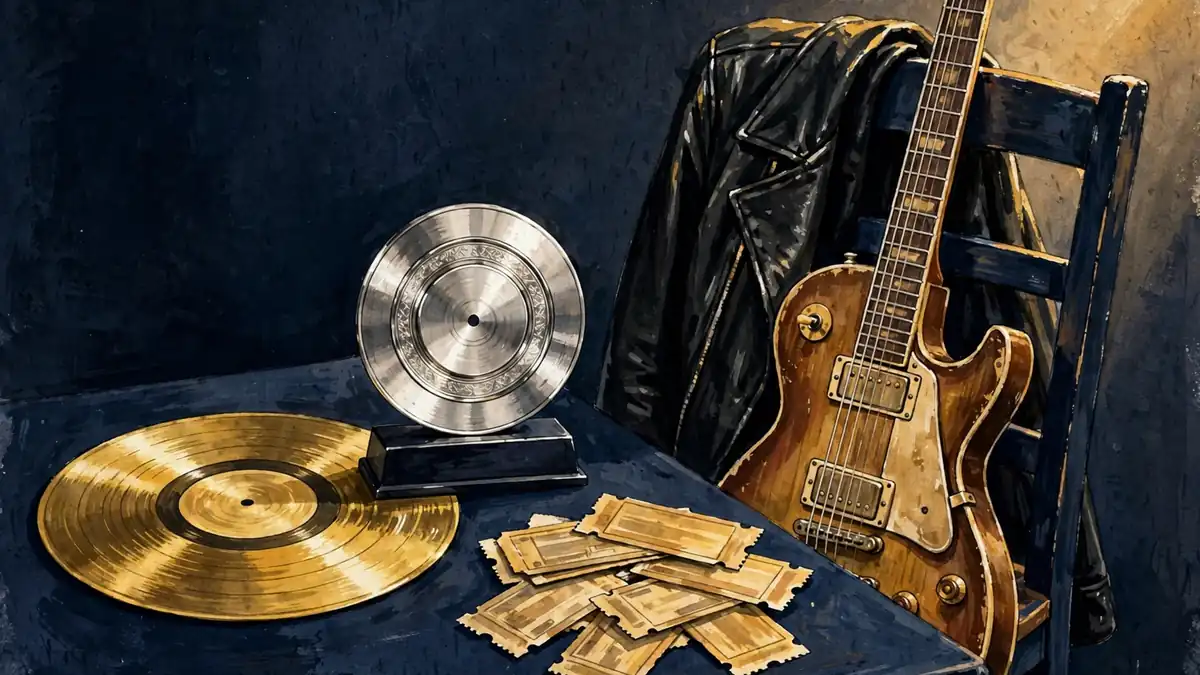
What can be said about his tangible assets is narrower and more interesting. His most valuable physical asset is almost certainly his publishing catalog — the songwriter’s share of “White Wedding,” “Rebel Yell,” “Eyes Without a Face,” “Dancing with Myself,” “Mony Mony,” “Flesh for Fantasy,” “Hot in the City” and “Cradle of Love.” Catalogs for legacy rock writers have sold for multiples of their annual earnings in recent years, but Idol has not sold his, so its value sits inside the estimate rather than beside it.
Motorcycles are the asset he is most publicly attached to. He has ridden for decades, and the 1990 crash that nearly cost him his leg is part of his legend — he ran a stop sign in Hollywood on 6 February 1990 and was hit by a car. Low-quality profiles credit him with a collection of vintage motorcycles and high-end cars, but no inventory, photograph or auction record supports a specific list. He owns guitars, stage equipment and decades of memorabilia, including the leather jackets that are as much a trademark as the hair. None of it is itemized anywhere public, and none of it moves the estimate by itself.
The honest accounting is that Idol’s wealth is mostly intangible: rights, royalties and reputation. The house he lives in and the bikes he rides are private, and the absence of verified detail is not a gap to be filled with guesses. Readers who want a property portfolio should look elsewhere; readers who want to understand how a punk singer stayed rich for 40 years should look at the catalog.
Awards and Achievements
The honors of Idol’s career arrived in two waves: the commercial peak of the 1980s and the legacy recognition of the 2020s. He was nominated for the Grammy Award for Best Male Rock Vocal Performance three times — for “Rebel Yell,” for “To Be a Lover” and for “Cradle of Love” — and never won. The nominations matter more than the losses: they put a punk singer in the same category as the biggest rock vocalists of the decade, and they are the formal record of a peak that the charts already proved.
The 2020s supplied the honors the 1980s never did. On 6 January 2023 he received the 2,743rd star on the Hollywood Walk of Fame, the first star unveiled that year, at 6201 Hollywood Boulevard in front of Amoeba Music. Shepard Fairey and Henry Rollins spoke at the ceremony, and his children Willem Wolfe and Bonnie Blue attended with his partner China Chow. The Walk of Fame’s own citation credits him with 40 million albums sold, nine U.S. Top 40 singles and ten in the U.K.
In May 2026 he received a Lifetime Achievement Award at the American Music Awards in Las Vegas, performing with Steve Stevens more than twenty years after his last appearance at the ceremony. In April 2026 he was announced as a member of the Rock & Roll Hall of Fame Class of 2026 — his second consecutive nomination, after a 2025 nod that did not result in induction — and on 14 November 2026 he was inducted at the Peacock Theater in Los Angeles with Stevens, by Gwen Stefani and Tony Kanal. The class also included Phil Collins, Iron Maiden, Joy Division and New Order, Oasis, Sade, Luther Vandross and Wu-Tang Clan. The ceremony will air on ABC on 8 December 2026 and stream on Disney+ the next day.
The chart record underneath the honors is the achievement that pays. Rebel Yell is double platinum in the United States and five-times platinum in Canada. Whiplash Smile is platinum in the United States. Greatest Hits (2001) is platinum in the United States. Dream Into It (2025) reached No. 7 on the U.S. Top Albums chart, No. 4 on the Current Rock Albums chart, No. 9 on the U.K. Official Albums Sales chart and No. 2 in Germany — a top-ten album 42 years after his debut, with guest appearances from Avril Lavigne, Joan Jett and Alison Mosshart of The Kills. Few artists of his generation can claim a charting album in a sixth decade. That is the achievement the estimate rests on.
Net Worth Growth Over the Years
Published estimates of Billy Idol’s net worth have barely moved in five years, and that stability is itself informative. A fortune built on a catalog does not jump the way a tech founder’s does, and it does not collapse the way a fortune built on borrowed money does. The table below tracks what outlets have published, not what Idol has in the bank — the distinction matters, because no outlet has ever seen his accounts.
| Year | Published estimate | What was behind it |
|---|---|---|
| 2021 | About $50 million | Older profiles, pre-comeback, before the Dark Horse EPs and the 2025 album |
| 2023 | $50 million to $60 million | Walk of Fame year; memoir and touring income steady |
| 2024 | $55 million to $70 million | A wide range from lower-quality profiles; the top end is not well sourced |
| 2025 | $60 million | Celebrity Net Worth and most 2025 profiles converge here |
| 2026 | $40 million to $60 million | Celebrity Net Worth holds $60 million (updated March 2026); a second 2026 profile gives the $40M–$60M range we publish |
Three figures in circulation deserve a warning. A $145 million estimate appears on a satirical “highest-paid singer” site and is not credible. A $20 million to $30 million range appears on content-farm pages that repeat each other without a source. And a $70 million figure from 2025 rests on a single low-quality profile. Our range discards all three. The $60 million anchor is the figure that the most-cited tracker has held through 2025 and into 2026, and the $40 million floor is the low end of the only 2026 profile that gives a range rather than a single number.
The growth story, properly told, is not a rising line but a long plateau with a late lift. The fortune was made between 1982 and 1990, when the albums went platinum and the singles went Top 10. It was defended between 1990 and 2010, when the catalog paid while new sales slowed. It has been extended since 2014 by the memoir, the EPs, the 2025 album and the arena tour — and the Hall of Fame induction in November 2026 is the kind of event that lifts a catalog’s value, because it puts the songs back in front of buyers, programmers and sync supervisors all at once.
Social Media Presence
Idol’s social media presence is that of a legacy act with a working touring business: active, professional and focused on dates, releases and archive material rather than daily life. His YouTube channel is the measurable piece. The Cambridge Journal reported in 2025 that it had passed 1.2 billion views with 1.04 million subscribers, a scale that puts him ahead of most punk-era peers and reflects the way his videos — especially “White Wedding” and “Rebel Yell” — still circulate as MTV-era artifacts. The same outlet attached a monthly ad-revenue estimate of about $9,000 to the channel; treat that as its estimate, not a verified payment.
On Instagram, X and Facebook he posts tour announcements, rehearsal footage, documentary clips and Rock Hall material, much of it built around the 2025 album and the 2026 induction. The accounts are run as a tour-marketing operation, not a personal diary, and the follower counts move with the touring calendar: they rise when a tour is announced and flatten when it ends. TikTok has given him an unexpected second audience. “Eyes Without a Face” circulates there among listeners who were born decades after it charted, and concert reviewers on the 2025 tour noted younger fans in the crowd who knew the song from the app before they knew the album.
Social media does not drive the estimate directly — no brand deal in his record depends on it — but it does drive the touring business that does. A sold-out arena in 2025 starts with a tour announcement post, and a documentary streams better when its subject is trending. The Hall of Fame induction in November 2026, covered live across his accounts, is the latest proof that the machine still works.
Personal Life
Billy Idol has never married. His longest relationship was with Perri Lister, a dancer and singer he met in the early years of his career, who appeared as the bride in the “White Wedding” video. They had two children together: a son, Willem Wolfe Broad, born in 1988, and a daughter, Bonnie Blue Broad, born in 1989. The relationship ended long ago, and reports that describe Lister as his wife are wrong — the pair never married, and the confusion is one of the most repeated errors in low-quality profiles of him.
Since February 2018 his partner has been China Chow, the actress and model, who attended his Walk of Fame ceremony in January 2023. In 2023 Idol revealed he had another son, Brant Broad, after Bonnie took a 23andMe DNA test and learned she had a half-brother. He introduced Brant publicly as his son at the Walk of Fame ceremony that year. He is now a grandfather — he has described himself, with evident delight, as “Grandad Bill” — and the family, including his children’s spouses and children, attended the Walk of Fame ceremony with him.
His private life has been public in the ways that matter to the money story and private in the ways that do not. The 1990 motorcycle accident and the 1994 overdose are on the record because he put them there himself, in interviews and in his memoir, and because they interrupted his earning years. His sobriety and his return to touring are on the record for the same reason. The details of his homes, his cars and his daily spending are not, and this article does not invent them.
He became an American citizen in 2018, holding dual British and American nationality, and has lived in Los Angeles since 1987. He turned 70 on 30 November 2025 and turns 71 on 30 November 2026, two weeks after his Hall of Fame induction. The documentary title says it best: Billy Idol Should Be Dead. The fortune exists because he is not — and because, unlike many of the punk generation, he kept the rights to the songs that made him.
Sources & Reporting
Celebrity Net Worth — the $60 million estimate, updated 6 March 2026; the anchor for our range.
Pollstar — Rock & Roll Hall of Fame induction coverage, 17 November 2026: ceremony date, “Billy Idol Day,” the “Rebel Yell” Netflix placement in Margo’s Got Money Troubles, the next album in progress, and his Los Angeles base since 1987.
BroadwayWorld — induction report, 16 November 2026: Class of 2026, inductors Gwen Stefani and Tony Kanal, Dream Into It chart positions, ABC/Disney+ air dates.
RIAA — Gold & Platinum database: Rebel Yell double platinum, debut album gold, certification dates.
Hollywood Walk of Fame — star ceremony details, January 2023: 2,743rd star, 6201 Hollywood Boulevard, 40 million albums sold, nine U.S. Top 40 singles.
Wikipedia — biography and discography: birth date and place, Generation X history, album certifications and chart peaks, Grammy nominations, U.S. citizenship in 2018, the 2023 revelation of son Brant Broad.
Soap Central — American Music Awards Lifetime Achievement Award, May 2026, and the $60 million figure cited from Celebrity Net Worth.
The FADER — Rebel Yell One-Step vinyl reissue, October 2026: 3,000 numbered copies, release 20 November 2026.
CultureMap Austin — 2025 tour announcement: Live Nation production, 30 cities, Phoenix start on 30 April 2025, Joan Jett & the Blackhearts on all dates.
British News Desk — the $40 million to $60 million 2026 range, the Tribeca documentary, and the April 2026 Hall of Fame announcement.
Reporting window: March 2026 to November 2026, with chart and certification records reaching back to 1982. Where sources disagreed — most notably on the size of the fortune — we published the range and named who said what. Where no reliable source existed — property prices, annual salary, endorsement income — we said so instead of repeating scraper-site figures.
Frequently Asked Questions
What is Billy Idol’s net worth in 2026?
Billy Idol’s net worth is estimated at $40 million to $60 million as of November 2026, anchored on $60 million — the figure Celebrity Net Worth has carried in its March 2026 update. The range reflects the honest disagreement between outlets: most 2025–2026 profiles converge on $60 million, while one 2026 profile gives a $40 million to $60 million range. His fortune comes from 40 million records sold, decades of touring, publishing royalties on songs he co-wrote, sync licensing and his bestselling memoir.
How did Billy Idol make his money?
Mostly from music. He sold more than 40 million records worldwide, with Rebel Yell certified double platinum in the United States and five-times platinum in Canada. As co-writer of his hits with guitarist Steve Stevens, he earns publishing royalties on every radio play, stream and film placement. Touring is his biggest single-year earner — his 2025 arena run with Joan Jett covered 30 North American cities — and sync licensing, memoir sales and acting cameos add smaller streams. He has no major brand empire or business outside music.
How old is Billy Idol?
Billy Idol was born William Michael Albert Broad on 30 November 1955 in Stanmore, Middlesex, England, which makes him 70 years old as of November 2026. He turns 71 on 30 November 2026, two weeks after his Rock & Roll Hall of Fame induction on 14 November 2026.
Is Billy Idol in the Rock & Roll Hall of Fame?
Yes. Billy Idol was inducted into the Rock & Roll Hall of Fame on 14 November 2026 at the Peacock Theater in Los Angeles, as a member of the Class of 2026, alongside his longtime guitarist and co-writer Steve Stevens. They were inducted by No Doubt’s Gwen Stefani and Tony Kanal, and performed “Rebel Yell” before Stefani joined Idol for “Eyes Without a Face.” Los Angeles declared 13 November 2026 “Billy Idol Day.” It was his second nomination, after a 2025 nod that did not result in induction.
What are Billy Idol’s biggest songs?
His defining songs are “White Wedding” (1982), “Rebel Yell” (1983), “Eyes Without a Face” (1984, his highest-charting single at No. 4 on the Billboard Hot 100), “Dancing with Myself,” “Hot in the City,” “Flesh for Fantasy,” “Mony Mony” (No. 1 in its 1987 live version) and “Cradle of Love” (No. 2 in 1990). He has had nine Top 40 singles in the United States and ten in the United Kingdom.
Is Billy Idol married, and who is his partner?
Billy Idol has never married. His former long-term partner Perri Lister, who played the bride in the “White Wedding” video, is the mother of his two eldest children, Willem Wolfe Broad and Bonnie Blue Broad. Since February 2018 his partner has been actress China Chow. In 2023 he revealed a third child, son Brant Broad, after his daughter Bonnie learned through a DNA test that she had a half-brother.
Where does Billy Idol live?
Billy Idol lives in Los Angeles, California, where he has been based since 1987. He was born in England and became a United States citizen in 2018, holding dual British and American nationality. Specific details of his homes, including purchase prices quoted on low-quality net-worth sites, are unverified and are not repeated here as fact.
How many albums has Billy Idol sold?
Billy Idol has sold more than 40 million records worldwide, according to the Hollywood Walk of Fame citation for his January 2023 star. His solo discography runs to nine studio albums, from his 1982 debut through Dream Into It in 2025, plus seven compilations and 37 singles. Rebel Yell (1983) is his best-selling album, certified double platinum in the United States.
Final Thoughts
Billy Idol’s $40 million to $60 million fortune is a catalog fortune, and that is the highest compliment in the music business. The money was made between 1982 and 1990, defended through a lost decade of accidents and excess, and extended in the 2020s by a memoir, two EPs, a top-ten album at 69 and an arena tour at 70. The Rock & Roll Hall of Fame induction on 14 November 2026 is not the end of the story — he told Pollstar he is already finishing another album — but it is the industry’s verdict on a career that survived punk, MTV, a near-fatal crash, an overdose and the collapse of the record business itself.
The lesson for readers is in the structure, not the size. Idol kept his songwriter’s share of the hits, kept touring when the records stopped selling, and never sold the catalog. A fortune built on four songs that never stop playing is worth more than a bigger fortune built on one deal that can fall apart. At 70, with a new album in progress and a Hall of Fame plaque on the wall, the rebel is still yelling — and still getting paid for it.
Published on 2026-11-19. Last reviewed November 2026. Found an error? See our corrections policy.