
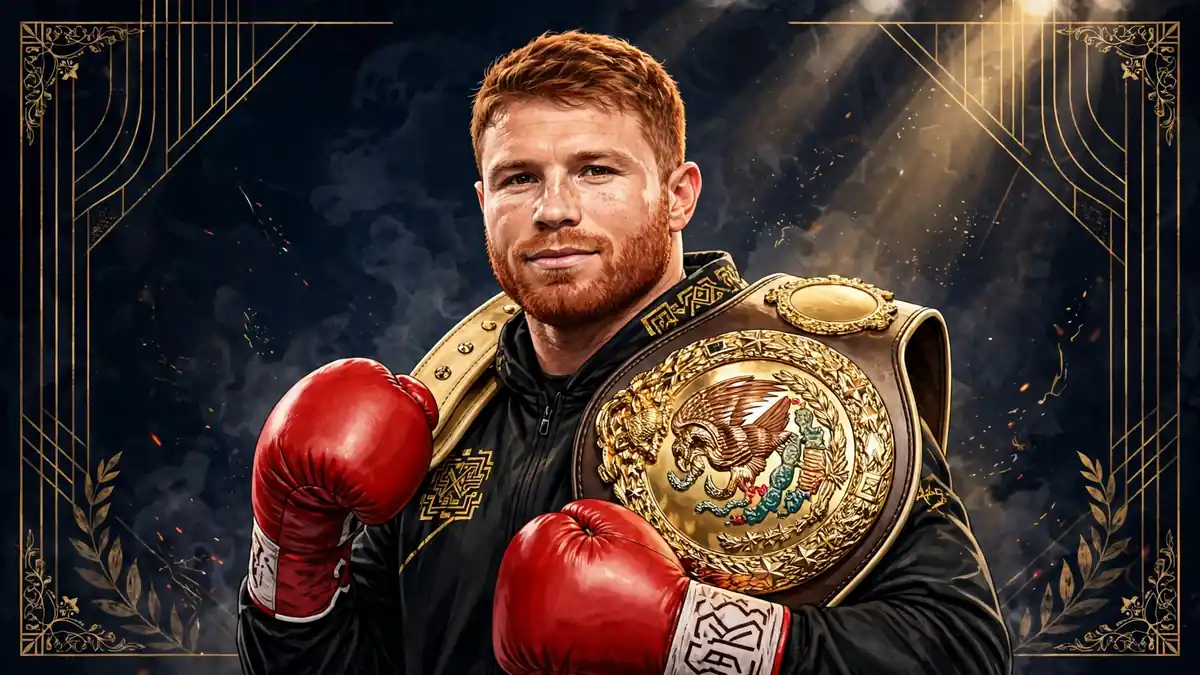
Canelo Álvarez‘s net worth is estimated at $300 million to $350 million as of November 2026. Celebrity Net Worth puts him at $350 million, the top of that range, after a year in which Forbes ranked him the world’s second-highest-paid athlete with $170 million earned in twelve months — and nine days before this article was written, he won back a world title in Riyadh with a reported $47 million purse.
Canelo Álvarez: Quick Facts
| Estimated net worth | $350 million (range: $300 million to $350 million) |
|---|---|
| Profession | Professional boxer, four-division world champion; entrepreneur |
| Nationality | Mexican |
| Born | July 18, 1990 (age 36) |
| Height | 5 ft 7½ in (171 cm) |
| Primary income sources | Fight purses, pay-per-view and streaming revenue, endorsements, gas stations, tequila and drinks brands, real estate |
| Active years | 2005–present |
| Last reviewed | November 2026 |
- Early Life and Background
- Education
- Career Journey
- Rise to Fame
- Main Sources of Income
- Salary and Earnings
- Businesses and Investments
- Brand Deals and Sponsorships
- Houses, Cars and Other Assets
- Awards and Achievements
- Net Worth Growth Over the Years
- Social Media Presence
- Personal Life
- Sources & Reporting
- Frequently Asked Questions
- Final Thoughts
Early Life and Background
Santos Saúl Álvarez Barragán was born on July 18, 1990, in Guadalajara, Jalisco, Mexico, and the family story that follows him everywhere starts with ice pops. His father, Santos Álvarez, sold frozen treats from a small family business, and young Saúl worked alongside him from the age of five. The family had roots in Los Reyes, Michoacán, and moved to Juanacatlán, Jalisco, when Canelo was five, settling on a farm outside Guadalajara where he learned to ride horses — a pastime he still keeps up today.
He is the youngest of eight children, and the household ran on boxing. All seven of his brothers became professional boxers, and the eldest, Rigoberto Álvarez, was the one who pulled him into the sport. Canelo was about 13 when he watched Rigoberto make his professional debut, and he walked into the Guadalajara gym of father-and-son trainers Chepo and Eddy Reynoso soon after. The Reynoso family has trained him ever since, a partnership now more than twenty years old — rare in a sport where fighters change corners as often as they change promoters.
The nickname came from his hair. “Canelo” means cinnamon in Spanish, a reference to the red hair and freckles that made him stand out in every gym in Jalisco. It stuck so firmly that most boxing fans know him by it alone. His amateur career was short and sharp: a silver medal at the Junior Mexican National Championships in 2004, the Junior Mexican National Championship in Tuxtla Gutiérrez in 2005, and a final amateur record of 44 wins against 2 losses, with 12 knockouts.
He turned professional at 15 because there was nobody left to fight as an amateur. The Reynosos could not find suitable junior opponents for him, so on October 29, 2005, he debuted against Abraham González in Tonalá, Guadalajara, and stopped him in the fourth round. He has the date tattooed on his left shoulder in Roman numerals. For the full arc of that rise — from the Guadalajara gyms to the world titles — our sister site’s Canelo Álvarez biography and career timeline covers his life story in detail.
The early money was small and the schedule was relentless. By 16 he was already a champion in the state of Jalisco, fighting grown men while still a teenager, and by 20 he was a world champion. That speed matters to the net worth story: Álvarez has been earning professional purses since 2005, which gives him a twenty-one-year earnings runway that almost no active boxer can match.
Education
Álvarez left school in the eighth grade, a fact biographical profiles consistently report, and the gym became his classroom. There is no college degree or formal business education behind the gas stations and drinks brands discussed later in this article — there is a teenager who turned professional at 15 and learned the fight business by living inside it.
What he did get, unusually early, was a commercial education most fighters never receive. He was headlining cards and negotiating with promoters while still a teenager, and by his early twenties he was dealing directly with the networks and sponsors that shape a boxer’s income. The Reynoso team handled the boxing; Álvarez watched how the money moved around it. When he tells Forbes in 2026 that he only invests in products he uses and understands, that is the voice of someone whose business training came from two decades of contracts, not a classroom.
His daughter Emily Cinnamon was born in 2007, when he was 17 and already a professional. Fatherhood arrived before fame did, and it is one reason his spending habits have always looked different from the typical young champion’s: the car collection gets the headlines, but the property and business portfolio started early and kept growing.
Career Journey
Álvarez won his first world title in March 2011, beating Matthew Hatton for the WBC light middleweight belt at 20 years old — at the time, one of the youngest fighters ever to win that title. He defended it four times, then stepped up to the biggest stage in the sport: a September 2013 fight against Floyd Mayweather Jr. in Las Vegas. Mayweather won a majority decision and handed Álvarez the first loss of his career. The purse, about $12 million according to BoxingScene, was roughly five times his previous career high. Losing to Mayweather turned out to be the most profitable defeat in modern boxing — it made Álvarez a pay-per-view star in his own right.
The middleweight years built the fortune. He beat Miguel Cotto in November 2015 for the WBC middleweight title, then came the trilogy with Gennady Golovkin that defined his prime: a disputed draw in September 2017, a majority-decision win in the September 2018 rematch, and a unanimous-decision win in the September 2022 third fight. The Golovkin fights were the richest rivalry of the decade, with purses reported in the tens of millions per bout, though the exact guarantees were never officially disclosed — Nevada stopped requiring public purse disclosures, so the figures circulating for these fights are media reports rather than commission filings.
In October 2018 he signed the deal that changed boxing economics: an eleven-fight, $365 million agreement with streaming service DAZN, the largest athlete contract in sports history at the time. It lasted three fights. Álvarez sued DAZN and his then-promoter Golden Boy Promotions in 2020, arguing the deal had been breached, and the parties settled privately. The settlement terms were never published, which is why the $365 million figure needs a health warning every time it appears: it was a contract value, not money received. He fought three times under it, then became a free agent — and free agency paid him better than the contract did.
November 2021 gave him the achievement that sits at the top of his record. Knocking out Caleb Plant in Las Vegas made him the first boxer ever to become the undisputed super middleweight champion, holding the WBA, WBC, IBF, WBO and Ring Magazine titles at 168 pounds at the same time. He had already won world titles at light middleweight, middleweight and light heavyweight, the last of those when he stopped Sergey Kovalev in November 2019. Four weight divisions, one fighter, and a résumé that put him in the pound-for-pound conversation for a decade.
The only other defeat of his prime came in May 2022, when Dmitry Bivol outboxed him at light heavyweight. He went back to 168 pounds, defended his undisputed crown four times — against Golovkin, John Ryder, Jermell Charlo and Jaime Munguía — and then, in February 2025, signed a four-fight, $400 million deal with Turki Alalshikh and Riyadh Season. The first fight under it, against William Scull in May 2025, paid him a reported $80 million. The second was the biggest fight of 2025.
Rise to Fame
The Terence Crawford fight on September 13, 2025, was the richest night of Álvarez’s career and one of the richest nights in boxing history. More than 70,000 fans packed Allegiant Stadium in Las Vegas, the bout streamed on Netflix rather than pay-per-view, and it produced the third-highest gate revenue in boxing history, according to TheRichest. Crawford won a unanimous decision, 116-112 and 115-113 twice, taking all four super middleweight titles and becoming the first man to be undisputed champion in three weight divisions.
Álvarez lost the belts and still took home the biggest purse of his life. He was guaranteed at least $100 million, with estimates putting his final take at up to $150 million once backend revenue was counted — Turki Alalshikh corrected a reporter who suggested $100 million was the ceiling, saying “the contract between us and Canelo is more than that,” according to The New York Times via fight-week reporting. Crawford, by contrast, said openly on a podcast before the fight that his guaranteed purse was $10 million. The gap between the two purses — ten to one — tells you who the commercial star of the night was, even in defeat.
One statistic from that week travelled further than any other. Bloody Elbow reported that the two fighters’ combined earnings, close to $200 million, nearly matched the entire UFC roster’s pay for 2025 to that point — a little over $210 million spread across more than 400 fighters. A single boxing match had nearly equalled eight months of MMA payroll. That is the scale of Álvarez’s drawing power, and it is why his net worth kept climbing through a loss.
The comeback came thirteen months later. On October 31, 2026, Álvarez challenged WBC super middleweight champion Christian Mbilli in Riyadh and won a wide unanimous decision, 117-110, 116-111 and 115-112, to take back a world title at 36. Mbilli lost a point in the eighth round for hitting Álvarez behind the head, and Bleacher Report put Álvarez’s purse at a reported $47 million, with Mbilli at around $9 million. His record now stands at 64 wins, 3 losses and 2 draws, with 39 knockouts. He has said he plans to retire around 38, aiming for 2029, which would leave one or two more paydays — including the final fight of the Riyadh Season deal — still to come.
Main Sources of Income
Fight purses are the engine — roughly four-fifths of everything Álvarez has earned, by the split Forbes published for his 2025-26 year. But the reason his net worth keeps rising between fights is the rest of the machine: streaming money, endorsements, and a business portfolio that now produces income every quarter whether he fights or not.
The purse is the headline number, and for Álvarez it has been a nine-figure headline twice in two years. The Crawford fight guaranteed him at least $100 million, the Mbilli fight a reported $47 million, and the Scull fight a reported $80 million. Those three fights alone, inside eighteen months, account for roughly $227 million in reported purses — more than most boxers earn in a lifetime. Behind the purse sits the structure: guaranteed money, a share of gate revenue, and, on the Netflix and DAZN cards, streaming economics that replaced the old pay-per-view model for his biggest nights.
Endorsements and business income are smaller but steadier. Forbes credited him with $10 million from outside the ring in the twelve months to May 2026, and Álvarez himself told Forbes in October 2026 that his investments bring in $4 million to $5 million every three months — about $16 million to $20 million a year on his own accounting, a figure that runs ahead of Forbes’ $10 million and should be read as his claim rather than an audited number. Either way, the direction is clear: the businesses now throw off real cash, not just brand value.
Real estate is the quiet third leg. Álvarez has said his property holdings generate about $1.6 million a month in rental income, a claim he made in an interview with Graham Bensinger at his Guadalajara estate. That works out to roughly the same $4 million to $5 million a quarter he cites for his investments as a whole, which suggests the property portfolio is the core of that income rather than a side note. No public register of his holdings exists, so the figure stays attributed to him, but the San Diego flip early in his career — buy at $5.8 million, sell at $6 million — shows the instinct was there from the start.
Finally, there is the money that does not show up in any purse table: appearance fees, the Canelo Promotions business, media work including his Canelo Media venture, and a film cameo in Creed III (2023) plus an executive producer credit on The Long Game (2024). None of these rivals a single fight purse, but they are the reason his income does not fall to zero in a year without a fight.
Salary and Earnings
Álvarez has never had a salary in the conventional sense. He is paid per fight, and the per-fight numbers tell the story of his career better than any annual figure could. The table below lists the purses and deals that are actually documented in reporting, with the source of each figure named. Where a number is a media report rather than a disclosed guarantee, it says so.
| Fight / deal | Year | Reported figure | What we know |
|---|---|---|---|
| vs Floyd Mayweather Jr. | 2013 | About $12 million | BoxingScene; roughly five times his previous career-high purse |
| DAZN contract (11 fights) | 2018 | $365 million | Contract value, not money received; ended after 3 fights via private settlement |
| Forbes annual earnings | 2022–23 | $110 million | Forbes estimate for the twelve months to May 2023 |
| vs William Scull | May 2025 | $80 million | Reported; first fight of the Riyadh Season deal |
| vs Terence Crawford | Sept 2025 | $100 million guaranteed, up to ~$150 million | Reports and fight-week statements; Crawford’s guarantee was $10 million |
| Forbes annual earnings | 2025–26 | $170 million | Forbes; $160 million in-ring, $10 million off-field; world No. 2 |
| vs Christian Mbilli | Oct 2026 | $47 million | Reported; Mbilli around $9 million |
The Forbes numbers deserve a careful read, because they are the most misquoted figures in this story. Forbes’ May 2026 ranking says Álvarez earned $170 million in the twelve months to May 2026 — that is annual income, not net worth, and $160 million of it came from boxing. Several outlets have repeated the $170 million as though it were his wealth; it is one year’s pay. The same applies to the $110 million Forbes credited him with for 2022–23, when he topped the boxing earners list.
The DAZN contract needs the same care. The $365 million was real as a contract, and it was the largest athlete deal in sports when it was signed in October 2018. But Álvarez fought only three times under it — against Rocky Fielding, Daniel Jacobs and Sergey Kovalev — before the relationship broke down and the parties settled. Nobody outside the settlement knows how much of the $365 million he actually received, and any net worth estimate that treats it as money in the bank is wrong. The honest way to count it is as three purses plus a settlement, not as $365 million.
The Riyadh Season deal is different, because the money is arriving fight by fight and the figures are leaking into reporting as they land. Four fights, $400 million, with Turki Alalshikh: Scull at a reported $80 million, Crawford at $100 million-plus, Mbilli at $47 million. That is roughly $227 million banked from three fights, with one fight left on the deal. If the fourth pays anything like the first three, his career earnings will cross $900 million before he retires.
Career earnings in total: Celebrity Net Worth’s purse table adds up to $730.7 million across the listed bouts, and that table excludes the Mbilli purse and some endorsement income. Its running estimate of his total career earnings passed $800 million after the Crawford fight, and its own headline for the Mbilli build-up said the comeback purse was pushing his career earnings toward $850 million. Gross earnings and net worth are not the same thing — taxes, training costs, management and lifestyle spending all sit between them — which is why a man who has grossed $800 million-plus is worth an estimated $350 million rather than $800 million.
One more number puts his pay in context. The Golovkin trilogy, the Mayweather fight and the Crawford fight all drew the kind of gates and audiences that only a handful of fighters in history have produced. Álvarez has headlined in Las Vegas, New York, San Antonio, Dallas and Riyadh, and his fights have been carried by HBO, Showtime, DAZN and Netflix across three different broadcast eras. Promoters keep paying him nine figures because the audience keeps showing up — the Crawford gate alone was the third-highest in boxing history.
Businesses and Investments
Álvarez started building businesses early, and he built them in Jalisco first. The oldest is Canelo Energy, a chain of gas stations — four locations in Jalisco, according to 2026 reporting — that marked his first move into Mexico’s energy sector. Alongside it came Upper, a convenience-store chain meant to compete with Mexico’s retail giants. Neither is a giant business on its own, and Forbes estimated in 2023 that the combined value of his operating businesses outside boxing was less than $50 million. But they were the start of a pattern: own the business, put his name on it, and keep it in Mexico.
The drinks brands are the most developed part of the portfolio. VMC — short for “Viva México Cabrones,” his signature post-fight cry — is a line of tequila-based canned cocktails built with Spirit of Gallo and Casa Lumbre, the spirits company behind Montelobos Mezcal. It launched in Mexico in 2022 and reached the United States in September 2023, in Margarita, Paloma and Jamaica Hibiscus flavours, with Tamarindo added in April 2025. The cans sell at $10.99 for a four-pack, and the brand made Impact magazine’s 2024 Hot Brands list. VMC is a partnership, not a solo venture — Gallo brings distribution muscle as the second-largest spirits supplier in the US by volume — which is exactly the kind of structure that lets a fighter’s brand scale beyond his own time.
Yaoca came next, launched on April 17, 2023. The name comes from Yaocalli, the Nahuatl word for strength, and the brand sells energy drinks, proteins, creatine and pre-workout supplements, marketed as a 100% Mexican nutrition company. The World Boxing Council covered the launch, and Álvarez has used his own training camps as the marketing — a boxer selling the supplements he claims to train on, which is a more credible pitch than most celebrity product lines.
Around those two sits the rest of the empire: the Canelo Store, selling clothing and accessories; Canelo Promotions, his own promotional company, which keeps him in the fight business as a promoter as well as a fighter; and real estate, which he has described as the steadiest income of the lot. He has also moved into media: in March 2026, Canelo Media signed a strategic partnership with Box to Box Films, the production company behind Formula 1’s Drive to Survive, to make original content for Latino and global audiences.
The newest and most valuable holding arrived in October 2026. Forbes revealed that Álvarez had signed an endorsement and investment agreement with Kalshi, the US prediction-market platform, giving him equity worth more than $10 million. Kalshi’s valuation had climbed from $11 billion in December 2025 to $22 billion in May 2026, with reports in October 2026 putting its latest prospective valuation at $40 billion — so a stake worth $10 million-plus in October could be worth considerably more if that valuation holds. It is his first big move into tech, and it arrived the same month as the Mbilli fight, which is why October 2026 may turn out to be the most important month of his financial life after September 2025.
Two things keep this portfolio honest in the telling. First, the Forbes 2023 assessment — operating businesses worth less than $50 million combined — is the last independent valuation of the whole group, and it predates both the Kalshi stake and the Canelo Media deal. Second, Álvarez’s own income claims run ahead of the independent numbers: he says his investments return $4 million to $5 million a quarter, while Forbes credited him with $10 million of off-field income for the whole year to May 2026. The gap probably reflects different definitions — gross business revenue against net personal income, and a portfolio that grew sharply in late 2026 — but readers should know the two figures come from different mouths.
Brand Deals and Sponsorships
Álvarez has always been picky about endorsements, and he said so himself in October 2026, telling Forbes: “Brands are always asking me to promote their products, but I’m super picky about who I team up with. It has to be true to who I am, so I’ve focused on building my own brands.” The record bears that out. His endorsement portfolio is short, long-running and heavily weighted toward his own companies rather than other people’s logos.
The long-standing deals are the ones boxing fans know by heart. Under Armour has dressed him for years, putting him alongside Stephen Curry as one of the brand’s headline athletes. Hennessy, the cognac house, has been a partner through multiple fight cycles. Everlast supplies his gloves and training gear. Tecate, the Mexican beer brand, has advertised around his fights for a decade, and Coppel, the Mexican department-store chain, has been another domestic partner. These are the deals that put his face on billboards across Mexico and the US Southwest, and they pay in the millions per cycle rather than per post.
The luxury end of the portfolio is newer. EssentiallySports reported deals with Louis Vuitton and the watchmaker Roger Dubuis, the kind of partnerships that arrive once a fighter is selling to an audience beyond boxing. DAZN, meanwhile, was both broadcaster and sponsor through the streaming deal years. And Kalshi, the October 2026 agreement, is the deal that blurs the line between endorsement and investment: ambassador and shareholder at once, with equity worth more than $10 million rather than a flat fee.
What he has not done is also informative. There is no long list of one-off crypto, betting or fast-fashion deals, and no history of the kind of endorsement scandal that has dented other fighters’ commercial value. His sponsors have stayed with him through a failed drugs test in 2018 — he blamed contaminated meat, served a six-month suspension, and the Golovkin rematch was postponed — and through the Crawford defeat. That durability is part of the net worth story: sponsors pay for a reputation that survives a loss, and Álvarez’s has.
Houses, Cars and Other Assets
Álvarez guards his privacy more tightly than almost any athlete at his level, and his current home is the proof: he lives in Guadalajara, in a house and on a ranch whose details have never been published, and he has kept it that way for years. The one property the public record does show is the house he left behind in California.
In 2013 he bought a Spanish-style estate in Rancho Pacifica, a gated community near Del Mar in San Diego County, for $5.8 million. The house covered about 11,970 square feet on more than an acre, with six bedrooms, high ceilings, exposed wooden beams over the living room, a game room with a built-in bar, a library and an ocean view. He sold it in October 2015 for $6 million — a small profit on a two-year hold, and an early sign of the property instinct he later described to Graham Bensinger. The address, 4552 Rancho Del Mar Trail, is a matter of public record; his Guadalajara home is not, and this article will not guess at it.
The car collection is the opposite of private. Lifestyle outlets value it at around £8.3 million, and the list reads like a supercar auction catalogue: a Bugatti Chiron, bought for about $2.3 million and listed for sale in 2022; a Ferrari LaFerrari; a Rolls-Royce Ghost; a Mercedes-Benz G63 AMG 6×6, one of only about 100 ever built; a Lamborghini Aventador SVJ and a Lamborghini Urus; a McLaren P1; a Nissan GT-R he nicknamed Godzilla; a Ferrari Testarossa and a Ferrari 458 Italia; a Mustang 500 Eleanor; and a Porsche 911 GT3. The garage changes constantly — the Chiron listing is the clearest evidence of that — so any valuation is a snapshot, not a balance-sheet entry.
Lifestyle outlets have also credited him with a yacht reported to be worth in the tens of millions and a private jet, but those figures come from single, thinly sourced reports and we have not been able to verify them against a second source, so they are noted here as reports rather than facts. What is documented is the pattern: cars, property and businesses, in that order, with the flashy spending concentrated in the garage and the serious money in the property and drinks companies.

Awards and Achievements
The achievement that defines Álvarez’s career fits in one sentence: he is a four-division world champion who became the first boxer in history to hold every major title at super middleweight at the same time. The detail behind it is worth setting out, because it explains why promoters keep paying him nine-figure purses at 36.
He won his first world title at light middleweight in 2011, added middleweight titles against Cotto in 2015, then moved up to light heavyweight to stop Sergey Kovalev in 2019 — and then came back down to 168 pounds, where he beat Callum Smith in December 2020, Billy Joe Saunders in May 2021 and Caleb Plant in November 2021 to unify the division. The Plant knockout made him undisputed super middleweight champion, holding the WBA, WBC, IBF, WBO and Ring Magazine belts together. He held that undisputed crown until the Crawford fight in September 2025, and he took the WBC belt back from Mbilli in October 2026.
The honours list beyond the belts includes the WBC’s recognition as one of the defining Mexican champions of his era and a place on every serious pound-for-pound list of the past decade. He has been ranked by Forbes among the world’s highest-paid athletes in 2022 (No. 8), 2023 and 2026 (No. 2), and he has headlined the richest fight of 2025. His professional record — 64 wins, 39 by knockout, against 3 losses and 2 draws — has been built over 69 fights and twenty-one years, with only Floyd Mayweather Jr., Dmitry Bivol and Terence Crawford ever beating him.
For a peer comparison, the gap between Álvarez and the rest of boxing’s rich list is wide. The table below uses each outlet’s latest published estimate, and the dates matter — these are different estimates from different years, not a single ranking.
| Boxer | Estimated net worth | Source and date |
|---|---|---|
| Canelo Álvarez | $350 million | Celebrity Net Worth, 2026 |
| Floyd Mayweather Jr. | $300 million | GuideNetWorth profile, 2026 |
| Conor McGregor | ~$200 million | Albat, November 2026 |
| Terence Crawford | $50 million | NetWorthCraft profile, 2026 |
The Mayweather comparison is the interesting one. Mayweather earned more in total — his career gross is generally put above $1 billion — but he has also been retired since 2017 and has spent heavily in public. Álvarez, still fighting and still collecting $47 million purses at 36, has closed much of the gap while his rival’s fortune has been static. The Crawford line is the other end of the scale: the man who beat Álvarez in the ring is worth roughly a seventh of him outside it, because Álvarez has spent twenty-one years building a commercial machine and Crawford spent most of his career on the other side of a promotional dispute.
Net Worth Growth Over the Years
Álvarez’s wealth grew in steps, each one tied to a specific fight or deal, and the steps are uneven — long flat stretches, then a single night that doubles the total. The table below uses published estimates for the years where one exists, and milestones where none does. These are publisher estimates, not audited figures, and the early years are reconstructed from reported purses rather than any rich-list entry.
| Year | Estimate / milestone | What moved it |
|---|---|---|
| 2013 | First eight-figure purse | About $12 million for the Mayweather fight; first pay-per-view stardom |
| 2018 | $365 million DAZN deal signed | Eleven-fight streaming contract; ended after 3 fights via settlement |
| 2020 | $120 million | SportyTell estimate; Golovkin rivalry and DAZN money banked |
| 2023 | At least $275 million | Forbes wealth estimate; businesses valued under $50 million combined |
| 2025 | $300 million | Celebrity Net Worth / Sports Illustrated; Scull and Crawford purses land |
| 2026 | $350 million | Celebrity Net Worth current estimate; $170 million Forbes year; Kalshi stake; Mbilli purse |
The shape of that curve is the story. From 2013 to 2020 his estimated wealth roughly tenfolded, from a single $12 million purse to $120 million. From 2020 to 2023 it more than doubled again, on the back of the Golovkin trilogy and the free-agency purses that followed the DAZN split. And from 2023 to 2026 it rose by another $75 million, driven less by any single fight than by the Saudi deal — $400 million over four fights — and by the re-rating of his business portfolio once Kalshi put a tech valuation on it.
Two risks sit underneath the curve. The first is that most of the wealth is still fight-dependent: one bad injury or one more loss could end the nine-figure purses, and the businesses, on Forbes’ last valuation, were worth less than $50 million. The second is tax and spending: $800 million-plus in gross career earnings has become $350 million in estimated net worth, which implies roughly $450 million has gone to taxes, teams, training costs and lifestyle over twenty-one years. That is normal for a boxer at this level, but it is why the net worth figure is so much smaller than the career earnings figure — and why the business income matters more with every passing year.
Social Media Presence
Álvarez’s social media presence is large, disciplined and — unusually for a fighter — mostly about work. His Instagram account, @canelo, has around 19.1 million followers, where he posts training footage, fight-week build-up, family moments and endorsements, including the VMC and Kalshi launches. His X account has more than 1.5 million followers and his Facebook page more than 3 million, though those counts come from older reporting and the live numbers move constantly.
He uses the accounts the way a promoter would: fight announcements land there first, the VMC flavours get launched there, and the Kalshi partnership was unveiled on his channels in October 2026. His wife, Fernanda Gómez, has more than 1.4 million Instagram followers of her own and runs a nail bar and boutique in Guadalajara, so the household’s combined reach is part of the commercial package sponsors are buying into.
The social following is also a business asset in a literal sense. VMC’s US launch in 2023 was built on his Instagram audience, and the brand’s Hot Brands recognition in 2024 followed the same playbook: announce on his channels, let the fans do the distribution. For a fighter who sells his own products, 19 million followers is not a vanity metric — it is a free distribution channel that a rival drinks brand would pay millions a year to rent.
Personal Life
Álvarez married Fernanda Gómez, a Mexican model, businesswoman and social media personality, on May 15, 2021, at the Guadalajara Cathedral. They had met in 2016, and their daughter María Fernanda was born in December 2017, before the wedding. Gómez runs the Fernanda Gómez Nailbar & Boutique in Guadalajara and has built her own following of more than 1.4 million on Instagram.
He has five children. His eldest, Emily Cinnamon Álvarez, was born in 2007 to his high school girlfriend Karen Beltrán. His second daughter, Mía Ener Álvarez, was born in 2014 to Valeria Quiroz. María Fernanda, his daughter with Gómez, was born in 2017. His only son, Saúl Adiel Álvarez, was born in 2019 to Nadia Sepúlveda. And his youngest, Eva Victoria Álvarez, was born in August 2025 to Gómez — which is why some older profiles still list four children: the fifth arrived after they were written.
Family is the centre of his public image in a way that goes beyond the usual athlete PR. His brothers are all former professional boxers, his sister Ana Elda is a businesswoman, and his parents’ separation when he was 14 is part of the story he tells about his own drive. He has spoken about wanting to retire around 38, in 2029, and his wife has said she hopes he fights on until 40 — a disagreement that will decide how many more nine-figure paydays this story has left in it.
He is also known for philanthropy in Guadalajara, including a reported $1 million donation toward a paediatric cancer treatment facility in his home city. The donation is reported by lifestyle outlets rather than confirmed by a foundation filing, so it is noted here as reported. He still rides horses on the family ranch in Juanacatlán, the same farm he grew up on, and he still trains with Eddy Reynoso, the coach who took him on at 13.
Sources & Reporting
Celebrity Net Worth — current $350 million net worth estimate; $730.7 million selected-purse total; $800 million-plus career earnings; $100 million Crawford guarantee; $47 million Mbilli purse; reporting window August–November 2026.
Forbes — $170 million earned in the twelve months to May 2026 ($160 million in-ring, $10 million off-field), world No. 2 highest-paid athlete; at least $275 million wealth estimate, December 2023; $110 million earnings, 2022–23; operating businesses valued under $50 million, 2023; Kalshi equity worth more than $10 million, October 2026.
Sports Illustrated — $300 million net worth figure, 2026; $400 million four-fight Riyadh Season deal; William Scull as the first fight of the deal.
ESPN — Mbilli fight official result and scorecards, October 31, 2026; record updated to 64-3-2.
Bleacher Report — Mbilli fight live result, scorecards and reported purses ($47 million / $9 million), October 31, 2026.
BoxingScene — Mayweather fight purse of about $12 million; Crawford-fight build-up and the $100 million guarantee context.
TheRichest — Crawford purse of $100 million guaranteed rising toward $150 million; $80 million Scull purse; $800 million career earnings; third-highest gate in boxing history.
Entrepreneur — VMC brand profile: launch in Mexico 2022, US debut September 2023, Spirit of Gallo and Casa Lumbre partnership, flavours and pricing.
Spirit of Gallo — VMC Tamarindo launch, April 2025; brand history and distribution details.
World Boxing Council — Yaoca Brands launch, April 17, 2023; brand background and product lines.
MansionsRadar — San Diego estate purchase ($5.8 million, 2013) and sale ($6 million, October 2015), 11,970 square feet; Guadalajara property ties; car collection overview.
Wikipedia — biographical facts: birth, family, amateur record 44-2, professional debut October 29, 2005, trainers Chepo and Eddy Reynoso, first world title March 2011.
Reporting window: October 31 – November 9, 2026, covering the Mbilli fight result and the Kalshi announcement. Figures that predate 2026 are labelled with their year in the text. Where sources disagree — the $300 million against $350 million net worth estimates, and Álvarez’s own $4–5 million quarterly investment income against Forbes’ $10 million annual off-field figure — the article publishes the range and names who says what. No audited personal balance sheet exists for Álvarez; all net worth figures are publisher estimates.
Frequently Asked Questions
What is Canelo Álvarez’s net worth in 2026?
Canelo Álvarez’s net worth is estimated at $300 million to $350 million as of November 2026. Celebrity Net Worth currently puts him at $350 million, while Sports Illustrated’s 2026 figure is $300 million. Forbes estimated at least $275 million in December 2023, which sets the floor the range has grown from. No audited balance sheet exists, so the honest figure is the range, not a single number.
How much did Canelo make against Terence Crawford?
Canelo was guaranteed at least $100 million for the September 13, 2025 fight against Terence Crawford, with estimates putting his final take at up to $150 million once backend revenue was counted. Turki Alalshikh said during fight week that the contract was worth “more than” $100 million. Crawford, by contrast, said his guaranteed purse was $10 million. Canelo lost the fight by unanimous decision but still took home the biggest purse of his career.
How much did Canelo earn for the Christian Mbilli fight?
Canelo reportedly earned $47 million for beating Christian Mbilli by unanimous decision on October 31, 2026, in Riyadh, winning back the WBC super middleweight title. Mbilli was reported to have earned around $9 million. The purse figures are media reports rather than officially disclosed guarantees, and the fight was the third of Canelo’s four-fight, $400 million deal with Riyadh Season.
How tall is Canelo Álvarez?
Canelo Álvarez is 5 feet 7½ inches tall (171 cm), with a reach of about 70.5 inches (179 cm). He is short for a super middleweight, and he has spent his whole career fighting taller opponents — including the 6-foot-1 Terence Crawford, who moved up two weight divisions to face him in 2025.
Who is Canelo Álvarez’s wife?
Canelo Álvarez is married to Fernanda Gómez, a Mexican model, businesswoman and social media personality. They met in 2016 and married on May 15, 2021, at the Guadalajara Cathedral. Gómez runs a nail bar and boutique in Guadalajara and has more than 1.4 million Instagram followers.
How many children does Canelo have?
Canelo has five children: Emily Cinnamon (born 2007), Mía Ener (born 2014), María Fernanda (born 2017), Saúl Adiel (born 2019) and Eva Victoria (born August 2025). His youngest daughter, Eva Victoria, was born to his wife Fernanda Gómez, which is why some older profiles still list four children.
What businesses does Canelo own?
His business portfolio includes Canelo Energy gas stations and Upper convenience stores in Mexico, the VMC tequila cocktail brand (with Spirit of Gallo and Casa Lumbre), the Yaoca nutrition brand, the Canelo Store, Canelo Promotions and Canelo Media, plus real estate and — since October 2026 — an equity stake worth more than $10 million in the prediction-market platform Kalshi. Forbes estimated in 2023 that his operating businesses outside boxing were worth less than $50 million combined, before the Kalshi stake and the Canelo Media deal.
What is Canelo’s boxing record?
As of November 2026, Canelo Álvarez’s professional record is 64 wins, 3 losses and 2 draws, with 39 wins by knockout. His only defeats came against Floyd Mayweather Jr. in 2013, Dmitry Bivol in 2022 and Terence Crawford in 2025. He is a four-division world champion and was the first boxer to become the undisputed super middleweight champion, in November 2021.
Final Thoughts
Canelo Álvarez’s net worth — $300 million to $350 million, anchored at $350 million by Celebrity Net Worth — is the product of twenty-one years of prizefighting at the highest level, not a single windfall. He has grossed more than $800 million across his career, taken $100 million-plus for a fight he lost, and at 36 he is still collecting $47 million purses. The range matters more than the headline: Forbes’ $275 million floor from 2023 and Sports Illustrated’s $300 million figure are both live, and the gap between them is a reminder that nobody outside his accountants knows the exact number.
What is certain is the direction. The $400 million Riyadh Season deal has already paid roughly $227 million across three fights, with one to go. The Kalshi stake, worth more than $10 million in October 2026, is his first holding with a tech-scale valuation attached to it. And the businesses he built in Jalisco — gas stations, convenience stores, tequila, nutrition — now produce income every quarter, whether he fights or not. If he retires around 38, as he has said he plans to, the next two years will decide whether the final figure lands closer to $350 million or pushes past $400 million. Either way, the boy who sold ice pops with his father in Guadalajara has already built one of the great fortunes in boxing history.
Published on November 9, 2026. Last reviewed November 2026. Found an error? See our corrections policy.