
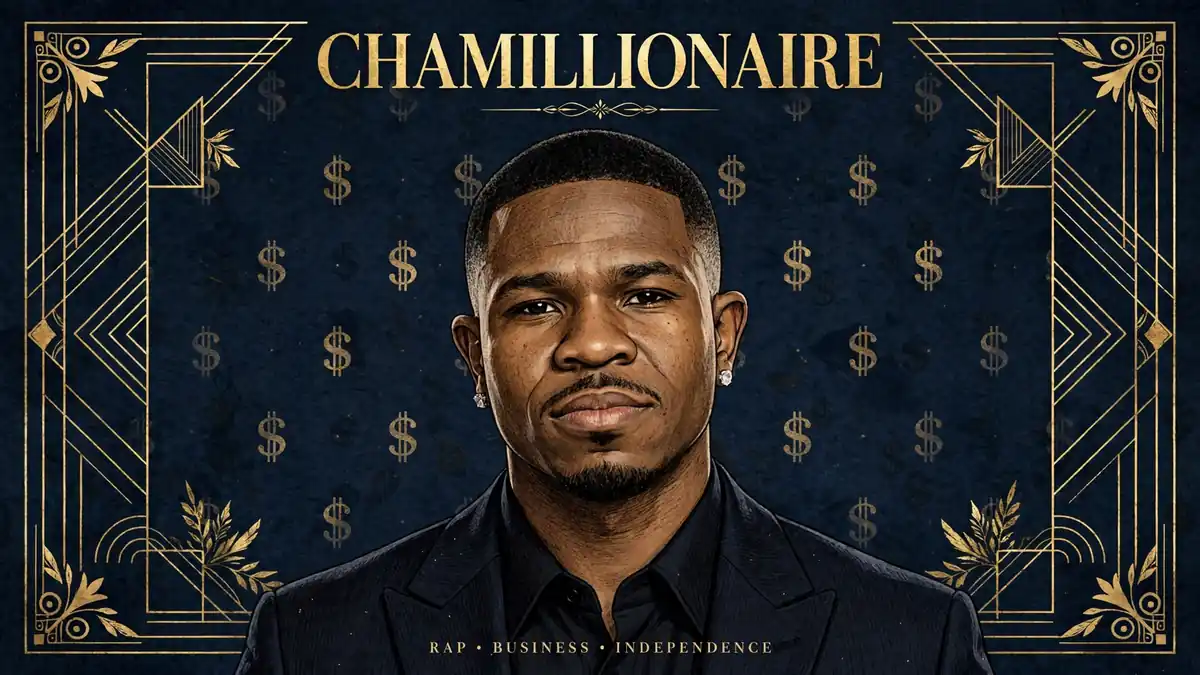
Chamillionaire‘s net worth is estimated at $30 million to $50 million as of November 2026. The Houston rapper who topped the charts with “Ridin'” in 2006 turned a reported $1.5 million early bet on Maker Studios into more than $20 million when Disney bought the company, then built a portfolio of 60-plus startups and became the first rapper named entrepreneur-in-residence at a major venture capital firm.
Chamillionaire: Quick Facts
| Estimated net worth | $50 million (most widely cited) (range: $30 million to $50 million) |
|---|---|
| Profession | Rapper, entrepreneur, angel investor |
| Nationality | American |
| Born | November 28, 1979 (age 46) |
| Height | 5 ft 10 in (1.78 m) |
| Primary income sources | Music royalties and catalog, startup equity and exits, venture advisory, business ventures |
| Active years | 1998–present |
| Last reviewed | November 2026 |
- Quick Facts
- Early Life and Background
- Education
- Career Journey
- Rise to Fame
- Main Sources of Income
- Salary and Earnings
- Businesses and Investments
- Brand Deals and Sponsorships
- Houses, Cars and Other Assets
- Awards and Achievements
- Net Worth Growth Over the Years
- Social Media Presence
- Personal Life
- Sources & Reporting
- Frequently Asked Questions
Early Life and Background
Hakeem Temidayo Seriki was born on November 28, 1979. Celebrity Net Worth lists his birthplace as Washington, D.C., while most biographical coverage describes him as a Houston product through and through — he was raised in Houston, Texas, and the city’s car culture, chopped-and-screwed sound and independent mixtape economy shaped everything he did next. His father was Nigerian, and the Yoruba middle name Temidayo stayed with him long after the stage name took over.
Houston in the late 1990s was a city where rap careers were built out of car trunks, not boardrooms. Seriki grew up around the city’s slow, syrup-thick DJ Screw sound and its obsession with customized cars — candy paint, chrome wheels, trunk-rattling systems. That culture gave him both his subject matter and his first business lessons: he watched local artists press their own CDs, sell them hand to hand, and keep the money instead of waiting for a label advance.
His younger brother Rasaq would later appear on his debut album, a sign of how family-run the operation stayed even after the major-label deal. Seriki has said in interviews that his parents pushed education and discipline at home, and that tension — a straight-laced household, a street-level music scene outside — shows up in his lyrics, which tend to be cleaner and more business-minded than most of his mid-2000s peers.
The stage name itself is a portmanteau he has explained many times: “chameleon” plus “millionaire.” It was a mission statement as much as a nickname. The chameleon part signaled adaptability — the ability to change with the market — and the millionaire part set the target out loud. Twenty years later, the name reads less like bragging and more like a plan he actually followed.
Education
Seriki attended Jersey Village High School in the Houston area. He did not follow a college path into music; his education in the business came from Houston’s independent rap circuit, where he learned promotion, distribution and branding by doing them. That hands-on schooling matters for the net worth story: the same instincts that moved mixtapes in parking lots later moved checks into startups.
By his late teens he was already studying how local stars like DJ Screw and Swishahouse built audiences without national radio. Swishahouse, the Houston label and mixtape collective, became his first professional home. Working inside that system taught him the economics of the mixtape — low production cost, direct fan contact, and a product that doubled as advertising for live shows and merchandise.
Career Journey
Seriki’s first real break came as part of the Color Changin’ Click, the Houston group he co-founded with Paul Wall in 2001. The Click’s mixtapes circulated through the Texas underground and built a regional following before either man had a national deal. Their 2002 collaboration Get Ya Mind Correct, a joint project with Paul Wall, sold well by independent standards and put both names on the map in the South.
The partnership with Paul Wall was productive but short-lived as a duo; both men went solo, and Seriki founded his own label, Chamillitary Entertainment, in 2004. Running his own imprint gave him control over his masters and his release schedule, a decision that paid off later when streaming turned catalog ownership into steady income.
Before the major-label deal, Seriki built his name on the Mixtape Messiah series, a run of free and low-cost tapes that kept him in front of fans between official releases. The series ran to seven volumes between 2004 and 2009 and became a case study in using free product to build a paying audience — the same audience-first logic he later applied to tech products.
In 2005 he signed with Universal Records, which released his major-label debut through a joint arrangement with Chamillitary. The deal gave him national distribution while his own imprint kept a stake. That structure — partner with the big company, keep a piece of your own — became the template for his later investing career.
After his second album, Seriki’s relationship with Universal cooled. He has described the label pushing for a quick follow-up in 2006 and then under-promoting the 2007 record. He left the major-label system in 2011, returning to independent releases: the Reignfall EP and Elevate EP both arrived in 2013, and the long-promised third album Venom (once dated for 2009) never materialized as a commercial release. The shelved album is one of the few clear financial disappointments in his catalog story — years of recording with no album-cycle payday at the end.
Rise to Fame
The Sound of Revenge, released November 22, 2005, debuted at No. 10 on the Billboard 200 and went on to RIAA platinum certification, with U.S. sales past 1.5 million copies according to label-era reporting. Its first single, “Turn It Up” featuring Lil’ Flip, reached the Top 50, but the second single changed his life.
“Ridin’,” featuring Krayzie Bone of Bone Thugs-N-Harmony, was released in late 2005 and hit No. 1 on the Billboard Hot 100 in 2006. The song’s hook about police stops — “they see me rollin’, they hatin'” — turned a complaint about racial profiling into the biggest rap single of the year. It won the Grammy for Best Rap Performance by a Duo or Group in February 2007, and the RIAA later certified it 4× platinum in the United States, with 6× platinum certification in Canada.
“Ridin'” also made Seriki a pioneer of a revenue stream most rappers had ignored: the ringtone. Label-era announcements crowned him the biggest-selling ringtone artist in history at the time, with more than 4 million ringtone sales and a first-of-its-kind multi-platinum Mastertone certification from the RIAA. At a moment when the recorded-music business was collapsing under piracy, ringtones were a high-margin digital product, and Seriki was its first rap star. That early grasp of a new digital format foreshadowed his tech investing — he kept spotting the new distribution channel before his peers did.
The follow-up, Ultimate Victory, arrived September 18, 2007, debuted at No. 8 on the Billboard 200, and took a deliberate creative risk: Seriki recorded it without profanity, a choice that won critical respect but limited radio and retail support. Sales landed just above 200,000 copies, a steep fall from the platinum debut. The lead single “Hip Hop Police” featuring Slick Rick drew attention but never matched “Ridin’.” The commercial drop is the hinge of his career story — it pushed him to treat music as one income stream among several, not the whole business.
Main Sources of Income
Four streams feed the estimate. First, music: royalties from a platinum album, a 4× platinum single, ringtone-era earnings, and a catalog that still streams. Second, startup equity: early checks into more than 60 companies, with headline exits at Maker Studios, Cruise and Ring. Third, venture advisory: his entrepreneur-in-residence role at Upfront Ventures and later advisory work. Fourth, his own companies: Chamillitary Entertainment, the Convoz app, and the Access Club investor platform launched in 2022.
The balance between those streams is the point most coverage misses. Celebrity Net Worth, AfroTech and BounceMojo all agree on the shape of the fortune even when they differ on the total: the music made him famous, but the investing made him rich. AfroTech’s 2024 profile put it plainly, noting that his net worth “continues to grow long after he stopped rapping full-time.”
That shape also explains the disagreement in the headline number. A fortune built on private startup equity cannot be priced the way a salary can. Some of his positions were sold at known exits; others were diluted, written off, or still sit unrealized. Different estimators make different assumptions about the unrealized portion, and that is where the $30 million and $50 million figures part company.

Salary and Earnings
Seriki has never had a salary in the conventional sense, and no filing discloses his annual income, so this section works from the documented paydays rather than a yearly figure.
The music paydays break down like this. The Sound of Revenge moved more than 1.5 million U.S. copies as a platinum album; at mid-2000s wholesale and royalty economics, a platinum rap album with a major-label deal typically generated low seven figures for the artist after recoupment, though Seriki’s exact royalty rate was never disclosed. “Ridin'” at 4× platinum singles certification plus more than 4 million ringtone sales was the bigger earner — ringtones in 2006 sold for around $2–3 each with a much larger artist share than a CD track, which is why the ringtone crown mattered financially in its own right, beyond trivia.
Touring and live shows added a second layer during 2006–2008, when “Ridin'” was inescapable on radio and he played the national festival and club circuit. No grosses were published for his tours, so we do not put a number on them; the honest statement is that touring income peaked with the debut album cycle and faded with the second album’s softer sales.
The catalog has kept earning in the streaming era, and this is a revenue line competitors routinely skip. “Ridin'” remains a staple of 2000s hip-hop playlists, and its 4× platinum certification reflects a long tail of sales and streams rather than a single year’s spike. Catalog income of this kind is lumpy — it rises when a song trends on a platform or lands a sync placement — but for an artist who owns a stake in his own imprint’s releases, it functions like a small annuity. Seriki’s decision to found Chamillitary Entertainment in 2004, before the major-label deal, is what makes that annuity his rather than a label’s alone. The same logic applies to the Mixtape Messiah series: free tapes built the audience that bought the album, and that audience still streams the catalog today.
A second under-covered earnings thread is the mixtape economy itself. In the mid-2000s, Houston mixtapes sold hand to hand at prices far below album retail, but the margin stayed with the artist because there was no label split. Seriki’s Get Ya Mind Correct collaboration with Paul Wall moved significant independent volume in Texas before either man had national distribution. Those early independent sales funded the Chamillitary operation and, by extension, the first startup checks — the seed capital for the investing career came from music fans in Houston parking lots, not from a venture fund.
The investing paydays are better documented because the exits were public. The Maker Studios stake is the anchor: a reported $1.5 million invested around 2009–2010 that returned more than $20 million when Disney acquired the company in 2014 — a return above 13× on that single check. Cruise Automation, which he backed in 2013, sold to General Motors in 2016 for more than $1 billion; his check size and payout there were not disclosed, so we claim no figure for it. Ring, acquired by Amazon in 2018 for more than $1 billion, and Lyft, which went public in 2019, sit in the same undisclosed-payout category: the exits are confirmed, the personal proceeds are not.
What that means for the total: the one fully reported windfall is the Maker Studios payout of $20 million-plus. Everything else in the tech column is directional — a portfolio of 60-plus companies with several billion-dollar exits among them, filtered through dilution, follow-on rounds and taxes. That is precisely why the published range runs from $30 million to $50 million rather than landing on a single audited number.
Businesses and Investments
The Maker Studios bet is the best-documented deal of his life, and the details matter because they show how he got into the room. Seriki invested a reported $1.5 million in the YouTube talent network around 2009–2010, years before most musicians treated creator-economy startups as investments. Disney acquired Maker Studios in March 2014 for $500 million upfront with performance earn-outs that took the total deal value to around $675 million (some coverage cites up to $950 million including all earn-outs). Seriki’s payout was reported at more than $20 million.
The deal also produced his most valuable relationship. Maker Studios founder Mark Suster was a managing partner at Upfront Ventures, the Los Angeles venture firm. Suster later recruited Seriki as entrepreneur-in-residence at Upfront in February 2015 — making him, by Celebrity Net Worth’s account, the first rapper to hold such a role at a major VC firm. Upfront’s own announcement praised his years of “employing successful tech and marketing strategies as both an independent music artist and later a label partner with Universal Records,” and noted he had “quietly been a fixture in the tech world for many years.”
From that base he built a portfolio his own website describes as more than 60 technology companies. The named positions, confirmed across Celebrity Net Worth, AfroTech and his own investment page, include Maker Studios, Cruise Automation (backed 2013, sold to GM 2016 for over $1 billion), Ring (sold to Amazon 2018 for over $1 billion), Lyft, Coinbase and Dropbox. His stated preference, per his own site’s FAQ, is early Seed and Series A rounds, with later-stage targets needing valuations below $50 million — a discipline that keeps his checks small and his upside large.
His own companies tell a mixed story, which is normal for a founder portfolio. Chamillitary Entertainment, founded in 2004, remains his label vehicle. Fly Rydes, the Houston custom-car shop he invested in back in 2003 (some coverage dates the investment to 2009), is now defunct. Masterpiece Mind Frame, a modeling company, never became a major earner. Convoz, the video-based social app he co-created and launched in January 2018 after teasing it at the Upfront Summit, aimed to let influencers talk face-to-face with fans; it is now defunct too, a reminder that founder risk cuts both ways.
The venture that carries his current activity is Access Club, launched in 2022 through his company X Empire Inc. It is a private, invite-only platform connecting high-profile investors with early-stage startups — essentially his deal flow, productized. A 2026 post on his site noted that some membership proceeds would support a community cause, the most recent public trace of the platform’s activity.
Alongside the investing, he has run pitch competitions aimed at founders the venture world overlooks. With E-40 and the investment platform Republic, he awarded $10,000 to a Black-founded startup in 2018, then $25,000 to a minority- or woman-founded startup in 2019, then a $100,000 competition judged with “Shark Tank” investor Daymond John, announced on CNBC’s “Squawk Alley” in November 2019 with pitches submitted through Convoz. The competitions cost him money directly — $100,000 of his own and E-40’s capital in the final round — but they bought him deal flow and credibility with underrepresented founders, the exact audience his Access Club now serves.
One gap in most coverage is what the Upfront role actually paid and what it returned. Entrepreneur-in-residence posts at venture firms are typically structured as a salary plus the chance to co-invest, not as equity in the firm itself, and no figure for Seriki’s compensation was ever published. The return that mattered was access: sitting inside Upfront’s deal flow in 2015–2018 put him in rooms with founders and co-investors he could never have reached from a recording studio. That access is the connective tissue between the Maker Studios check and the 60-company portfolio — the first bet got him the relationship, and the relationship got him the pipeline. It is also why his later Access Club venture makes sense as a business: it sells the same pipeline, packaged for investors who want in on early rounds without a venture firm’s overhead.
The portfolio’s risk profile deserves a plain statement too. Early-stage investing loses money most of the time; a 60-company portfolio implies dozens of write-offs alongside the headline exits. Seriki has never published his hit rate, and none of the outlets covering him claim to know it. The honest way to read the $30–50 million range is as the net result of a high-variance strategy: a few very large wins, a long tail of small losses, and a residue of unrealized positions whose value will only be known when they exit or fold.
Brand Deals and Sponsorships
Seriki’s endorsement history is thin compared with his peers, and that thinness is itself informative. His brand value was never built on sneakers or liquor; it was built on credibility with two audiences — hip-hop fans and tech founders — and the deals that fit were advisory and platform roles rather than product endorsements.
The Upfront Ventures role was the flagship arrangement: a formal, paid advisory position at a real venture firm, not a celebrity endorsement. The Republic partnership worked the same way, attaching his name and his Convoz platform to an SEC-registered investment platform’s pitch competitions. Both deals paid in reputation and deal flow as much as cash, and both are consistent with how he monetizes now — access, not ads.
Earlier in his career he appeared in the usual music-era promotional channels — video appearances, tour sponsorships and the ringtone partnerships that made him the format’s biggest seller — but no major consumer endorsement deal with a disclosed fee is on the public record. We do not invent one. The honest read is that endorsements are a minor line in his income, dwarfed by the Maker Studios exit and the broader portfolio.

Houses, Cars and Other Assets
Real estate is the least documented part of Seriki’s fortune, and the coverage reflects that. A 2026 house-tour piece pegged his net worth at $50 million and walked through his Houston property history, but no deed, purchase price or current listing for a primary residence is on the public record with a verifiable figure attached, so we do not publish a house price here. What is established is that he has stayed rooted in Houston — the city where he built both careers — rather than relocating to Los Angeles during his Upfront years.
Cars are a different story, because cars were his first business. He invested in Fly Rydes, a Houston auto dealer and customizer, in 2003, and the city’s slab culture — candy paint, chrome, elaborate sound systems — runs through his early image and lyrics. No current collection inventory with values is publicly documented, so we treat cars as a lifestyle holding, not a priced asset in the estimate.
The priced assets, to the extent they can be priced, are the financial ones: the realized Maker Studios proceeds, the remaining startup equity, music catalog royalties, and whatever cash and market investments sit behind a private individual who does not file public disclosures. That opacity is the reason the range stays at $30–50 million. Anyone quoting a single precise figure for a private investor is guessing at the unrealized half of the portfolio.
Awards and Achievements
The trophy case is short and heavyweight. The Grammy for Best Rap Performance by a Duo or Group for “Ridin'” in 2007 is the centerpiece — a win that also made him one of the few Houston rappers of his era with a Grammy on the shelf. He won Best Rap Video for “Ridin'” at the 2006 MTV Video Music Awards, beating 50 Cent, Busta Rhymes and T.I. in the category, and took Rookie of the Year and the Viewers’ Choice award at the first BET Hip-Hop Awards.
The commercial achievements carry their own weight: a platinum debut album, a 4× platinum single, the biggest ringtone sales of any artist at the format’s peak, and the first multi-platinum Mastertone certification in RIAA history. On the business side, the Upfront Ventures appointment in 2015 stands as the achievement his peers have not matched — a working role inside a top-tier venture firm, earned on an investing record rather than a famous name.
He was also in line for a Best New Artist Grammy nomination around his debut, but bootleg releases carrying his name in the same eligibility year reportedly disqualified him — a footnote he explained himself on the final track of Mixtape Messiah 7 in 2009. It is a small story that says a lot about how his career was run: even his setbacks came from the independent mixtape economy he helped build.
Net Worth Growth Over the Years
No audited year-by-year figures exist, so the table below reconstructs the trajectory from the dated milestones in the reporting — the figures are estimates, not filings.
| Year | Estimated net worth | What moved it |
|---|---|---|
| 2005 | Under $1 million | Independent mixtape income; major-label deal signed |
| 2006 | $5–10 million | “Ridin'” No. 1, platinum debut, ringtone sales surge |
| 2009 | $8–12 million | Catalog and touring; early startup checks begin |
| 2014 | $25–35 million | Disney buys Maker Studios; payout reported above $20 million |
| 2016 | $30–40 million | GM buys Cruise; Upfront role; portfolio maturing |
| 2019 | $35–45 million | Lyft IPO; Ring exit to Amazon realized |
| 2024 | $50 million | Celebrity Net Worth figure; AfroTech repeats $50 million |
| 2026 | $30–50 million | Range reflects the $30 million 2025 estimate against the $50 million consensus |
The shape is unusual for a rapper: the peak does not come at the height of fame. His music income peaked in 2006–2007, but his wealth peaked a decade later, after the exits. That lag is the whole story — a performer who converted a short fame window into a long investing career.
Social Media Presence
Seriki was early to social media in a way that foreshadowed his tech career. His MySpace page passed 15 million profile views at its peak according to label-era announcements, and he used Twitter takeovers and live broadcasts from Chamillionaire.com while most artists still treated the internet as a poster wall. That audience-first instinct later became Convoz, an app built around face-to-face video conversation between creators and fans.
His current presence is lower-volume and business-weighted: posts about Access Club, investing and the occasional music anniversary, rather than daily content. Follower counts shift too often to print as facts, and we do not anchor any income claim to them. The durable point is the pattern — he has treated every new platform as a distribution channel first and a fame channel second, which is why his social history reads like a product history.
Personal Life
Seriki keeps his private life out of the press to a degree that is rare for a chart-topping rapper. No marriage, divorce or family detail is confirmed on the public record with a reliable source attached, and we do not repeat the unverified claims that circulate on gossip pages. What is documented is the family he works with: younger brother Rasaq, who appeared on the debut album, and the Houston circle — Paul Wall, Slim Thug and the Swishahouse scene — that formed his professional family.
He has spoken about the discipline his parents instilled and about staying close to Houston even as his business moved to Los Angeles boardrooms. The 2019 Associated Press profile that covered his pitch competitions captured the through-line: a man who noticed he was often the only person in the venture room who looked like him, and decided to change the room rather than just profit from it.
Sources & Reporting
Celebrity Net Worth — the $50 million estimate, the Maker Studios $1.5 million investment and $20 million-plus payout, the Upfront Ventures entrepreneur-in-residence appointment, and the 60-plus company portfolio; profile and feature updated May 2026.
AfroTech — the Maker Studios and Cruise timelines, the $50 million figure as of June 2024, and the assessment that his wealth kept growing after he stopped rapping full-time.
BounceMojo — the $50 million 2026 estimate, the Ring/Cruise/Coinbase/Lyft portfolio framing, and the year-by-year table; updated May 2026.
Reality Tea — the dissenting $30 million estimate for 2025, which sets the low end of our published range; published September 2025.
Money Inc — the older $25 million figure, showing how the estimate has risen as exits landed.
Associated Press — the 2019 pitch-competition profile: the $100,000 E-40/Republic competition, Convoz as the submission channel, Daymond John as judge.
Revolt — the $100,000 pitch competition announcement from CNBC’s “Squawk Alley,” November 2019.
Digital Music News — the 2019 competition details and the note that Seriki still held his Lyft investment.
Black Enterprise — the earlier $10,000 and $25,000 competition rounds with E-40 and Republic, 2018–2019.
RIAA — platinum certification for The Sound of Revenge and 4× platinum for “Ridin’,” plus the multi-platinum Mastertone milestone.
Billboard — Hot 100 No. 1 for “Ridin’,” Billboard 200 debuts at No. 10 (debut) and No. 8 (Ultimate Victory).
GRAMMY.com — the 2007 Best Rap Performance by a Duo or Group win for “Ridin’.”
HotNewHipHop — the $50 million 2024 estimate and the Fly Rydes/Upfront background.
Wikipedia — career chronology: Color Changin’ Click (2001–2005), Chamillitary Entertainment (2004), Upfront appointment (February 2015), Convoz launch (January 2018), Access Club (2022).
Reporting window: November 2026 review of coverage from 2005–2026. Where outlets disagree — most visibly on the headline total — this article publishes the range and names each outlet’s figure rather than picking one silently.
Frequently Asked Questions
What is Chamillionaire’s net worth in 2026?
Chamillionaire’s net worth is estimated at $30 million to $50 million in 2026. Celebrity Net Worth and most 2026 coverage put him at $50 million, while Reality Tea estimated $30 million in 2025. The range reflects his private startup equity, which cannot be priced precisely from public records.
How did Chamillionaire make his money?
Music made him famous, but investing made him rich. A reported $1.5 million early investment in Maker Studios returned more than $20 million when Disney bought the company in 2014. He went on to back more than 60 startups, including Cruise, Ring, Lyft, Coinbase and Dropbox, and became entrepreneur-in-residence at Upfront Ventures in 2015.
How much did Chamillionaire make from Maker Studios?
His payout from Disney’s acquisition of Maker Studios was reported at more than $20 million, on an initial investment reported at around $1.5 million. Disney paid $500 million upfront in 2014, with earn-outs taking the total deal value to around $675 million.
What companies did Chamillionaire invest in?
His portfolio of more than 60 companies includes Maker Studios, Cruise Automation (sold to General Motors for over $1 billion), Ring (sold to Amazon for over $1 billion), Lyft, Coinbase and Dropbox. He favors early Seed and Series A rounds, according to his own investment page.
What is Chamillionaire’s real name?
His real name is Hakeem Temidayo Seriki. He was born on November 28, 1979, and raised in Houston, Texas. The stage name combines “chameleon” and “millionaire.”
What was Chamillionaire’s biggest song?
“Ridin'” featuring Krayzie Bone, which reached No. 1 on the Billboard Hot 100 in 2006, won the 2007 Grammy for Best Rap Performance by a Duo or Group, and was certified 4× platinum by the RIAA. It also made him the biggest-selling ringtone artist of its era, with more than 4 million ringtone sales.
Is Chamillionaire still making music?
He left the major-label system in 2011 and has released independent projects since, including the Reignfall and Elevate EPs in 2013. His main focus since 2015 has been venture investing, advisory work and his Access Club investor platform, launched in 2022.
What is Chamillionaire’s role at Upfront Ventures?
In February 2015 he became entrepreneur-in-residence at Upfront Ventures, the Los Angeles venture capital firm — the first rapper to hold such a role at a major VC firm. The appointment came through his relationship with Maker Studios founder Mark Suster, a managing partner at Upfront.
Final Thoughts
Chamillionaire’s fortune is the rare rap-career story where the second act out-earned the first. The platinum album and the No. 1 single built the seed capital; the $20 million-plus Maker Studios payout and a 60-company portfolio built the wealth. At $30–50 million, he sits well below the nine-figure moguls of his era — but his money looks different from theirs. It is diversified across exits, equity and advisory roles instead of resting on one catalog or one brand deal, and it is still compounding through Access Club while his music income fades. The honest number is a range, because a private investor’s portfolio deserves one. The honest story is simpler: he saw the tech wave coming before his peers did, and he bought a ticket early.
Published on November 2, 2026. Last reviewed November 2026. Found an error? See our corrections policy.