
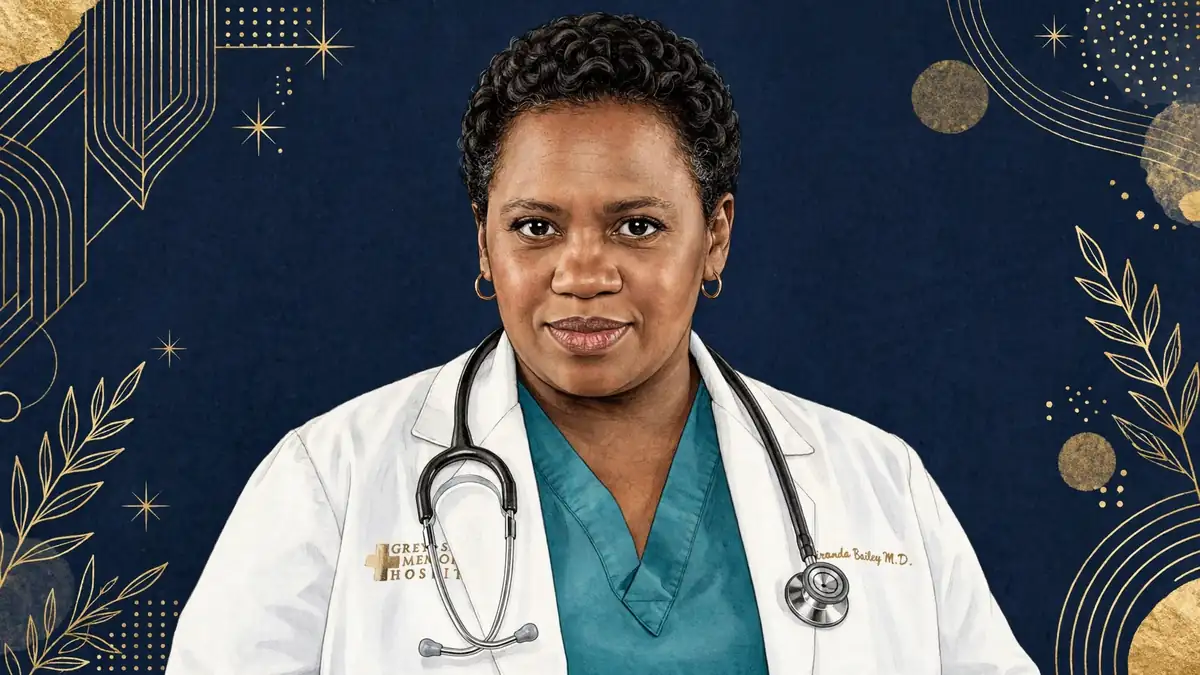
Chandra Wilson‘s net worth is estimated at $10 million to $20 million as of November 2026. The figure rests on 21 years as Dr. Miranda Bailey on Grey’s Anatomy, a per-episode salary that started at a documented $125,000 in 2007 and rose from there, directing fees from 26 episodes of the same show, and a co-executive producer credit that pays long after the cameras stop rolling.
Chandra Wilson: Quick Facts
| Estimated net worth | $10 million – $20 million (range: $10 million to $20 million) |
|---|---|
| Profession | Actress, television director, producer |
| Nationality | American |
| Born | August 27, 1969, Houston, Texas (age 57) |
| Height | 5 ft 1 in (1.55 m) |
| Primary income sources | Grey’s Anatomy acting salary, television directing, producing, residuals, stage work |
| Active years | 1989–present |
| Last reviewed | November 2026 |
- Early Life and Background
- Education
- Career Journey
- Rise to Fame
- Main Sources of Income
- Salary and Earnings
- Businesses and Investments
- Brand Deals and Sponsorships
- Houses, Cars and Other Assets
- Awards and Achievements
- Net Worth Growth Over the Years
- Social Media Presence
- Personal Life
- Sources & Reporting
- Frequently Asked Questions
Early Life and Background
Chandra Danette Wilson was born on August 27, 1969, in Houston, Texas, and grew up there with her mother, Wilma Bradshaw Allen, who worked for the United States Postal Service. Her father has never been part of her public story, and Wilson has kept that side of her family life private for the whole of her career. Houston in the 1970s gave her a stage early: she was cast in her first play at the age of five, and the habit stuck. By her teens she was doing musicals and local theatre, the kind of grounding that later made her one of the few television stars who could walk back onto a Broadway stage without missing a beat.
Money was not abundant in the Wilson household. Her mother held a steady federal job, which meant stability rather than comfort, and Wilson has spoken in interviews about growing up with a clear sense of what a paycheque had to cover. That plain-spoken relationship with money shows up in her career choices. She spent 14 years working stage and small television parts before Grey’s Anatomy arrived, turning down nothing that paid the rent and building a reputation as a reliable working actor rather than a star chasing a breakout. The long apprenticeship is the first reason her fortune looks the way it does: it was built slowly, then compounded by two decades on one show.
Houston also gave her the role model she still cites — her mother, who raised a daughter alone on a postal worker’s wage and still found the money and the time to get her to rehearsals. Wilson has said her mother’s work ethic shaped the way she treats a set: show up early, know the lines, and treat the crew with respect. Directors noticed. The same dependability later made her a natural choice to direct episodes herself, a second income stream that most of her castmates never built.
One detail from her early life matters more than it first looks. Wilson was a singer as well as an actor, and her stage career leaned on musical theatre. That training fed directly into her Broadway work in the late 1990s and early 2000s, and it kept her employable in the years when television parts were thin. A working actor with two marketable skills — straight acting and musical theatre — can survive dry spells that end a single-skill career. Wilson survived them, and the survival is part of the financial story.
Education
Wilson attended Houston’s High School for the Performing and Visual Arts, graduating in 1987. The school, one of the best-known arts magnets in the United States, put her in daily contact with other teenagers who were serious about performance, and it gave her formal training in voice and stagecraft while she was still a minor. From there she went to New York University’s Tisch School of the Arts, earning a Bachelor of Fine Arts in drama in 1991. Tisch is one of the most expensive theatre programmes in the country, and Wilson has never hidden that the degree was an investment her family stretched to make.
After Tisch she spent four years at the Lee Strasberg Theatre & Film Institute in New York, studying method acting while she worked the New York stage. The Strasberg years are often skipped over in short biographies, but they explain a lot about the Bailey performance: the stillness, the way she lets a pause do the work, and the refusal to play a scene bigger than it needs to be. Four years of method training is also four years of not earning much, and it sits in the ledger as the last stretch of her low-income period. Her first paid stage work came in 1991, the same year she finished at Tisch, when she made her New York debut in The Good Times Are Killing Me as Bonna Willis — and won a Theatre World Award for Outstanding Debut Performance for it.
The education line on her résumé matters for the money story in a second way. A BFA from Tisch and a Theatre World Award in the same year gave casting directors a reason to keep calling, even when the parts were small. Between 1991 and 2005 she stacked up New York stage credits — On the Town on Broadway in 1998, Avenue Q in 2003, the Tony-nominated Caroline, or Change in 2004 — plus guest spots on prime-time television. Broadway pay for a supporting player in that era ran to a few thousand dollars a week, solid working money but not wealth. The real return on the education came in 2005, when the training let her win an audition she had no business winning on paper.
Career Journey
Wilson’s television debut came in 1989, as Dina on The Cosby Show, and her film debut followed in 1993 with a small part in Philadelphia, the Tom Hanks legal drama that won two Academy Awards. Neither part made her famous. What followed was a decade and a half of the working actor’s life: guest spots on Law & Order and Law & Order: SVU, a run on the short-lived sitcom Bob Patterson in 2001, and a steady stream of stage work. She played Coretta Scott King in the 2008 film A Single Woman and Yvonne in the television movie Accidental Friendship the same year — the latter earning her a Primetime Emmy nomination for Outstanding Supporting Actress in a Miniseries or Movie, her fifth Emmy nomination in total.
The stage work in this period deserves more attention than it usually gets. On the Town in 1998 put her on Broadway. Avenue Q in 2003 put her in a hit. Caroline, or Change in 2004 put her in a Tony-nominated production, singing in a cast that included some of the best voices in American theatre. Broadway contracts for featured players in those years paid roughly $1,500 to $2,500 a week, and a long run could add up to a respectable annual income — but the work was seasonal, and a show closing meant starting over. Wilson’s career before 2005 was a patchwork of those runs, and her net worth at the point Grey’s Anatomy called was modest, likely under $1 million by any honest measure.
Then came the audition that changed everything. In 2005, Shonda Rhimes was casting Grey’s Anatomy, a mid-season replacement medical drama for ABC. The part of Dr. Miranda Bailey, the tough supervising resident who trains the new interns, had been written for a petite, blonde-haired white woman. Wilson, a full-figured African-American woman, walked in and gave an audition so commanding that the producers rewrote the character around her. It is one of the best-documented casting stories in modern television, and it is also a financial hinge: the role was written small, and Wilson made it indispensable.
Bailey began as a supporting player — the drill-sergeant resident the interns called “the Nazi” in the show’s early seasons — and grew into the moral centre of the series. Across 22 seasons she has risen from resident to attending surgeon to Chief of Surgery and back to attending, a career arc that mirrors the show’s own history. Wilson has appeared in more than 450 episodes, making her one of only a handful of actors to appear in every season since the 2005 premiere. That longevity is the engine of her wealth: a regular salary, renegotiated upward over two decades, on a show that never stopped.
Alongside the acting, Wilson built a second career behind the camera. She made her television directing debut with the Grey’s Anatomy season 6 episode “Give Peace a Chance” in 2009, and has since directed 26 episodes of the series, according to EBSCO’s research profile — roughly two episodes a season. She has also directed episodes of The Fosters (three episodes between 2015 and 2017) and Good Trouble in 2019, and she holds a co-executive producer credit on Grey’s Anatomy itself. Directing pays a separate fee per episode, and a producer credit pays again — two income streams that sit on top of the acting salary and that most long-running television actors never develop.
Her screen work outside Grey’s Anatomy stayed selective. She crossed over as Bailey into the spin-off Station 19, appearing in 24 episodes between 2018 and 2024. She starred in the short film Muted in 2014, winning Best Acting Performance at the Soho International Film Festival in 2015. And in 2009, at the height of her television fame, she took a brief hiatus from the show to play Mama Morton in a Broadway revival of Chicago — a reminder that the stage never stopped being home, and a booking that paid Broadway money on top of a television salary.
Rise to Fame
Grey’s Anatomy premiered on March 27, 2005, as a mid-season replacement with modest expectations, and landed in the Nielsen Top Ten straight away. Wilson’s Bailey was an instant break-out: a five-foot-tall surgeon who could silence a room of interns with a single sentence, and who turned out to have the warmest heart on the show. The first Emmy nomination came in 2006, for Outstanding Supporting Actress in a Drama Series. It came again in 2007, 2008 and 2009 — four consecutive nominations, a run matched by very few supporting players in television history.
The awards followed the nominations. She won the Screen Actors Guild Award for Outstanding Performance by a Female Actor in a Drama Series in 2007, and a SAG ensemble award with the cast the same year. She won four consecutive NAACP Image Awards for Outstanding Supporting Actress in a Drama Series from 2007 to 2010. She won the People’s Choice Award for Favorite Scene-Stealing Star in 2008. Each trophy raised her asking price a little, and each contract round after 2007 reflected it. Fame, for Wilson, arrived as a slow ratchet rather than a single explosion — which is why her finances look steady rather than spiky.
The show’s own growth did the rest. Grey’s Anatomy became the longest-running medical drama in American television history and one of ABC’s most valuable properties, running to a 22nd season in 2025 and a 23rd season in 2026. A regular on a show like that holds rare bargaining power: replacing Bailey would mean rewriting the show’s spine. Wilson has never had to test that power in public the way her co-star Ellen Pompeo did — Pompeo fought openly for higher pay and now earns a reported $575,000 per episode as the show’s lead — but the bargaining power was there in every negotiation, and her pay rose with each renewal even though the exact figures stayed private.
One common error in the online record is worth correcting here. Several low-quality net-worth pages attribute the $575,000-per-episode figure to Wilson. It is Pompeo’s number, reported by Forbes and others, and it has been copied onto Wilson’s name by sites that mix up the cast’s pay. Wilson’s documented figure is $125,000 per episode from 2007, and everything after that is an informed estimate, not a reported fact. The distinction matters: it is the gap between a $10 million fortune and a $20 million one, and it is why this article prints a range.
By the show’s 20th anniversary in March 2025, Wilson was one of only four original cast members still on the series, alongside Pompeo and James Pickens Jr. That fact alone explains her financial position. Twenty years of continuous employment on a hit network drama, with no gaps, no cancellations and no career resets, is the closest thing to a guaranteed income that acting offers. Her co-stars who left — Katherine Heigl, Sandra Oh, Patrick Dempsey — all earned more per episode at their peaks, but they also gave up the compounding power of staying. Wilson stayed, and the staying paid.
Main Sources of Income
Wilson’s income breaks into five streams, and the first dwarfs the other four. The acting salary from Grey’s Anatomy is the foundation: a per-episode fee, paid across 18 to 25 episodes a season for more than 20 seasons, renegotiated upward at each contract round. Even at the documented 2007 rate of $125,000 per episode, a 25-episode season paid $3.1 million. At any higher later rate, the annual figure rises toward $4 million or beyond. No other stream comes close.
Directing is the second stream. A directors’ fee for a network drama episode typically runs into five figures, and Wilson directs about two episodes of Grey’s Anatomy a season — 26 episodes in total by 2025, per EBSCO — plus her outside work on The Fosters and Good Trouble. The fees are smaller than her acting pay, but they arrive on top of it, and they carry a second benefit: a director’s credit on a hit show is a calling card for future work that an acting credit alone does not provide.
Producing is the third. Wilson is a co-executive producer on Grey’s Anatomy, a credit that carries a per-episode producing fee and, more importantly, a share of the show’s backend economics. Producer fees on a long-running network drama are substantial, and they continue as long as the show runs. This is the stream that separates Wilson from a pure actor on the same show: she is paid three ways for the same production.
Residuals are the fourth. Grey’s Anatomy has been sold into syndication and streaming around the world, and its 400-plus episodes generate residual payments to the cast under the SAG-AFTRA agreements. Residuals on a show of this scale are not a footnote; for a series regular with 20 years of episodes in the library, they can run to hundreds of thousands of dollars a year, and they keep arriving after the show ends. The streaming era has changed the exact maths, but the library is so large that the payments remain meaningful.
Stage work, voice work and the occasional film part form the fifth stream. The Broadway revival of Chicago in 2009, the short film Muted, guest appearances and the Station 19 crossovers all paid, but their real value was reputational: they kept Wilson visible as a versatile performer rather than a one-role actor, which protected her negotiating position. She has never been a heavy endorser — there is no long list of brand deals attached to her name — and that absence is itself a data point: her fortune was built from the work, not from selling it.

Salary and Earnings
The one hard number in Wilson’s salary history comes from Reuters, reporting in March 2007 on a round of contract renegotiations at Grey’s Anatomy. After the show’s Golden Globe win for Best TV Drama and the cast’s SAG Award for Best Ensemble, ABC raised the pay of its core players. Ellen Pompeo went to roughly $200,000 per episode. Wilson, along with T.R. Knight, Justin Chambers and James Pickens Jr., went to $125,000 per episode — and the raises were retroactive to the start of the season, which meant a one-off catch-up payment on top of the new rate. TV Guide reported the same figure that summer, and Nicki Swift’s later reporting confirmed it: $125,000 per episode in 2007.
At that rate, the maths is simple. A 17-episode season — the length of season 4 — paid about $2.1 million. A full 25-episode season paid $3.1 million. Those are the documented floors, and they date from 2007, when Wilson had been on the show for only two seasons. Every contract round since then has pushed the number up, because that is how long-running network television works: the cast’s bargaining power grows with each renewal, and the studio pays to keep the show intact. Wilson’s current per-episode figure has never been reported, which is itself informative — she has never fought her pay in public, so the trades have had nothing to print.
What can be said with confidence is the shape of it. The cast’s pay bands are well documented: Pompeo, the lead, now earns a reported $575,000 per episode; Sandra Oh earned a reported $350,000 per episode before she left; and the long-serving supporting players sit below the lead but far above a guest star’s rate. Wilson, as one of the last original cast members and a co-executive producer, sits in the upper band of that supporting group. A conservative working estimate puts her recent per-episode pay in the $200,000 to $350,000 range, which at 18 to 20 episodes a season means $3.6 million to $7 million a year from acting alone. That is an estimate, labelled as one, and it is the main reason the net-worth range in this article is wide: the difference between the low end and the high end of her pay is worth millions a year over two decades.
One more figure circulates and needs handling. A handful of net-worth sites claim Wilson earns $575,000 per episode — the Pompeo number, copied across. Others claim $350,000, the Sandra Oh number. Neither has a source behind it for Wilson, and this article does not repeat them as fact. The honest statement is that her documented pay is $125,000 per episode from 2007, her current pay is undisclosed, and the credible range implied by the show’s economics and her seniority is $200,000 to $350,000 per episode. Readers who see a single precise number for her current salary on another site should ask where it came from. In almost every case, the answer is nowhere.
Directing fees sit on top of the acting money. The Directors Guild of America sets minimums for network drama episodes, and an experienced director on a hit show earns comfortably above the minimum. Two episodes a season, across more than a decade of directing, adds a six-figure annual sum in most years. Her producing fee adds more. Put together, a realistic estimate of Wilson’s annual income in recent seasons is $4 million to $7 million before tax, with the acting salary doing most of the work and directing and producing supplying the rest. After tax, agent commission (typically 10 percent) and manager fees, the amount she keeps is far smaller — which is why a 21-year career at that level produces a fortune in the $10 million to $20 million range rather than something far larger.
The comparison with her castmates puts the number in context. Pompeo’s reported net worth sits near $80 million, built on $575,000 per episode plus a producing deal and a much larger public profile. Dempsey, who left the show and built a film and racing career, is reported near $85 million. Sandra Oh is reported near $25 million. James Pickens Jr., the other long-serving original, is reported near $13 million. Wilson’s $10 million to $20 million sits exactly where the pay bands say it should: below the lead, near her fellow lifers, and far above a short-stay cast member. The peer table in the growth section below lays this out in full.
Businesses and Investments
Wilson has never been a visible entrepreneur in the way some of her peers have. There is no Wilson-branded beauty line, no production company with a press release behind it, and no venture portfolio that she discusses in interviews. What she has built instead is a producing position inside the show that employs her. The co-executive producer credit on Grey’s Anatomy is a business asset in its own right: it pays a fee, it gives her a say in the stories, and it converts her from an employee of the production into a part-owner of its creative direction. Oprah Winfrey’s producing empire shows what that path can become at its largest scale, and Reese Witherspoon’s move from actor to producer is the nearer model — Wilson’s version is smaller and quieter, but it runs on the same logic.
Her directing work functions as a second business. A director with 26 episodes of a hit network drama on her résumé can work anywhere in television, and Wilson has used the credit exactly that way, directing episodes of The Fosters and Good Trouble outside the Shondaland universe. Each outside job pays a fee and widens the network of showrunners who will hire her. It also hedges the obvious risk in her finances: if Grey’s Anatomy ends, the acting salary stops, but the directing career continues. That hedge has real monetary value, even though it never appears on a balance sheet.
On investments, the public record is thin, and this article will not fill the gap with invention. No property records, stock holdings or private equity stakes belonging to Wilson have been published by a reliable outlet, and several of the sites that claim she owns “several rental properties” offer no address, no deed and no source. We treat those claims as unverified and do not repeat them as fact. What is known is that she has lived in Los Angeles with her family for many years, near the show’s production, and that a Los Angeles home bought years ago and held through the city’s long price rise would itself be a meaningful asset. Beyond that, the honest statement is that her wealth is concentrated in her career earnings, not in a public portfolio.
That concentration is worth a note. A fortune built almost entirely from salary is more fragile than one built from businesses or property, because it stops when the work stops. Wilson’s answer has been to convert salary into a producing and directing position that outlasts any single acting job — a slow, unglamorous form of diversification that fits everything else about her career. She has never chased a quick business win, and the fortune reflects it: steady, work-based, and still growing while the show runs.
Brand Deals and Sponsorships
Wilson keeps a notably low profile in the endorsement market. Unlike many television stars, she has no long-running deal with a fashion house, a beauty brand or a consumer product, and she does not run a sponsored-content business on social media. The absence is deliberate — she has spent her career keeping her private life private, and endorsement work is the opposite of private — and it has a direct effect on the net-worth maths. Endorsements are a major income stream for stars of her stature, often worth seven figures a year, and Wilson has largely left that money on the table.
What commercial work she has done has been tied to causes rather than products. She has appeared in public-service work around cyclic vomiting syndrome, the condition her eldest daughter lives with, and she has lent her name to health and arts-education initiatives. That kind of appearance is usually unpaid or modestly paid, and it belongs in the personal-life section of this article as much as in the money section. The point for the estimate is that no endorsement income of any size can be documented, so none is included in the $10 million to $20 million figure. If she has private deals, they are private — and the range already allows for them.
The contrast with her castmates is instructive. Pompeo has fronted major campaigns and built a production company with a first-look deal. Dempsey has a long association with the watch and automotive world. Wilson has chosen the opposite path, and the choice has a cost measured in millions of dollars of forgone endorsement income over 20 years. It also has a benefit: a reputation for seriousness that keeps her employable as a director and producer, where advertisers’ favour counts for far less than a showrunner’s trust. Her fortune is smaller than it could have been, and more durable than a fortune built on ads.

Houses, Cars and Other Assets
Wilson lives in Los Angeles with her partner and children, near the Grey’s Anatomy production. Beyond that, the public record on her property is thin. No home purchase by Wilson has been covered in the real-estate press, no listing has been tied to her name, and no reliable outlet has published an address or a price. That is unusual for a star of her tenure, and it is consistent with everything else about her: she keeps her private life out of the press, and the property press has had nothing to print.
Several net-worth sites claim she owns multiple homes or a real-estate portfolio. None of them names a property, a city or a price, and this article treats those claims as unverified. What can be said is that a Los Angeles home bought during a 21-year career at her income level, and held, would be a substantial asset on its own — Los Angeles prices have roughly tripled since 2005 — and that her net worth would look very different without a home in the city where she works. The estimate in this article assumes a primary residence of meaningful value and does not assume a portfolio beyond it.
On cars, the record is similarly quiet. Wilson has never been photographed with a luxury car collection, has never discussed vehicles in interviews, and has no known association with an automotive brand. That silence is itself a data point: the spending habits that drain a television fortune — fleets of cars, yachts, art collections — do not appear in her public life. Her visible lifestyle is that of a working actor and mother of three, not a spender. That restraint is part of why the fortune has compounded rather than leaked away.
The honest summary of her assets is therefore a short one: a long-running salary, a producing position, a directing career, residuals from one of the largest episode libraries in television, and a Los Angeles home. There is no evidence of the exotic assets — private equity stakes, art, aircraft — that fill out the fortunes of the richest stars, and this article does not invent them. The $10 million to $20 million range is a working actor’s fortune, built the slow way.
Awards and Achievements
Wilson’s awards shelf is one of the strongest of any supporting player in modern television. The headline numbers: four consecutive Primetime Emmy nominations for Outstanding Supporting Actress in a Drama Series, from 2006 to 2009, for Grey’s Anatomy. She did not win any of the four — the category in those years was brutally competitive — but four straight nominations put her in rare company, and the nominations themselves moved her pay upward at every contract round.
She added a fifth Emmy nomination in 2009, for Outstanding Supporting Actress in a Miniseries or Movie for Accidental Friendship, the television film in which she played Yvonne. That nomination is often missed in short biographies, and it matters: it showed the industry that her range went beyond Bailey, and it came in the same year as her fourth drama-series nomination, a double recognition few actors manage.
The wins came elsewhere. She won the Screen Actors Guild Award for Outstanding Performance by a Female Actor in a Drama Series in 2007, and a SAG Award for Outstanding Ensemble in a Drama Series with the Grey’s Anatomy cast the same year. She won four consecutive NAACP Image Awards for Outstanding Supporting Actress in a Drama Series from 2007 to 2010, and collected further Image Award nominations across the following years. She won the People’s Choice Award for Favorite Scene-Stealing Star in 2008 and a Prism Award in 2009 for Accidental Friendship. On stage, her first award was the Theatre World Award for Outstanding Debut Performance in 1991 for The Good Times Are Killing Me, and she later won Best Acting Performance at the Soho International Film Festival in 2015 for the short film Muted. She was also nominated for a Golden Globe in 2007 — nominated, not a winner, despite what some secondary sites claim.
The achievement that dwarfs the trophies is the run itself. Twenty-two seasons and more than 450 episodes on one series, with a 23rd season in 2026, makes Wilson one of the longest-serving actors on a single American television drama. She has directed 26 episodes of the show, served as a co-executive producer, and crossed over into Station 19 for 24 episodes. Zendaya’s Emmy wins show what the top of the television awards ladder looks like for a younger star; Wilson’s record is the opposite shape — not a peak, but a plateau held for two decades. In money terms, the plateau is worth more than the peak.
Net Worth Growth Over the Years
Wilson’s fortune grew in three phases, and the shape of the curve is the story. The first phase, 1989 to 2005, was the lean years: stage work, guest spots and small film parts, with a net worth that likely never passed $1 million. The second phase, 2005 to 2012, was the steep climb: the $125,000-per-episode contract, the Emmy nominations, the SAG win and the first directing credits, taking her from under $1 million to roughly $5 million. The third phase, 2012 to 2026, was compounding: a high salary, renewed again and again, plus directing and producing fees and residuals, carrying her into the $10 million to $20 million range.
| Year | Estimated net worth | What drove it |
|---|---|---|
| 2005 | Under $1 million | Stage and guest work; Grey’s Anatomy begins |
| 2008 | $2 million – $3 million | $125,000 per episode; SAG and Image Awards |
| 2012 | $5 million – $6 million | Contract renewals; directing begins |
| 2016 | $7 million – $9 million | Senior cast pay; producing credit; residuals |
| 2020 | $9 million – $12 million | Peak-era salary; 15 seasons of residuals |
| 2026 | $10 million – $20 million | 22 seasons; directing 26 episodes; co-executive producer |
The figures before 2026 are our modelled estimates, built from the documented salary points and the show’s economics; the 2026 range is the published range, with Celebrity Net Worth at $20 million and the cluster of other outlets at $10 million. The honest reason for the width is the unknown current salary: at $200,000 per episode the career maths lands near $10 million, and at $350,000 it lands near $20 million. A reader who wants a single number should take the midpoint, about $15 million, and remember it is a midpoint of a range, not a fact.
The peer comparison sharpens the picture. Grey’s Anatomy cast members, by the strongest published estimates:
| Cast member | Reported net worth | Why it differs |
|---|---|---|
| Ellen Pompeo | $80 million | Lead pay of $575,000 per episode; producing deal |
| Patrick Dempsey | $85 million | Film career and endorsements after leaving |
| Sandra Oh | $25 million | $350,000 per episode at her peak; Killing Eve after |
| James Pickens Jr. | $13 million | Fellow original; similar long-run pay |
| Chandra Wilson | $10 million – $20 million | Supporting pay; directing and producing on top |
Wilson sits where the pay bands predict. She earned less per episode than the lead and less than the stars who left for film, but she earned for longer than almost anyone, and she added two extra income streams. The growth table is the payoff for patience: a fortune that rises a few million at a time, year after year, without a single windfall.
Social Media Presence
Wilson keeps a modest social media presence, in line with her private approach to fame. She is on Instagram, where she posts about the show, her directing work and the occasional cause, and she has a presence on X. Her following is far smaller than her castmates’ — Jennifer Aniston’s Instagram following runs into the tens of millions, while Wilson’s is a fraction of that — and she does not run a sponsored-content business. That is a choice with a price: an account of her size, used commercially, could earn a five- or six-figure sum a year. She has chosen not to sell it.
The restraint fits the rest of her public life. She rarely posts about her family, she does not share her children’s lives online, and she does not use the platforms to fight public battles. The account functions as a work noticeboard: new episodes, directing credits, the occasional behind-the-scenes photograph. For the net-worth estimate, social media contributes nothing material — no endorsement income, no brand deals, no paid partnerships of any documented size — and the article records that plainly rather than inventing a social-media income line.
Personal Life
Wilson has been with the same partner since 1988 — a relationship that has now lasted 38 years. She has never married. In a 2007 interview with Parade magazine, she confirmed that she and her partner had been together for 19 years at that point, that they had no plans to marry, and that she was happy with the arrangement as it stood. People magazine confirmed the same year that she had a longtime partner whose name she has never made public. Nearly two decades later, nothing has changed: she remains unmarried, and her partner’s name remains private. Several low-quality sites have published names for him; none of them is sourced, and this article does not repeat them.
The couple have three children: two daughters, Sarina, born in 1992, and Joylin, born in 1998, and a son, Michael, born on October 31, 2005. Wilson has spoken about motherhood sparingly, and most often in the context of her eldest daughter’s health. Sarina lives with cyclic vomiting syndrome, a rare condition that causes repeated, severe episodes of nausea and vomiting. Wilson has described the years of searching for a diagnosis, and in 2012 she pitched the show’s producers on an episode about the condition. The result was “Second Opinion,” a Grey’s Anatomy episode she directed herself, which put the syndrome in front of millions of viewers and gave other families a name for what they were living through.
That episode is the clearest window into who Wilson is off screen. She used her position on the show — as an actor, a director and a producer — to tell a story that mattered to her family, and she did it without turning her daughter into a public figure. Sarina has stayed out of the spotlight, as have her siblings. The family lives in Los Angeles, and Wilson has said she keeps her children out of the public eye so they can have a normal life. It is the same privacy that shapes her finances: no property coverage, no car collection, no endorsement circus.
Her mother, Wilma Bradshaw Allen, remains a central figure in her story. Wilson has credited her mother’s steady work at the Postal Service with teaching her the value of showing up and doing the job properly, and she has spoken about her mother’s support for her early theatre work. The family story, taken together, is one of unusual stability: a 38-year relationship, three children raised out of the spotlight, and a career that has lasted 21 years on a single show. Stability of that kind is a personal fact with a financial edge, because it means no divorce settlements, no public scandals and no career interruptions — the three costs that quietly erase the fortunes of many stars.
Sources & Reporting
Celebrity Net Worth — the $20 million net-worth estimate for Wilson, updated October 2025; the top end of the range used in this article.
Reuters — the March 2007 reporting on the Grey’s Anatomy contract renegotiation, recording Wilson’s raise to $125,000 per episode, retroactive to the season premiere; the only hard salary figure in the public record.
TV Guide — the summer 2007 confirmation of the $125,000-per-episode figure, cited in later reporting by Nicki Swift and Looper.
Nicki Swift — detailed 2019 reporting on Wilson’s per-episode pay, the $2.1 million season-4 maths, and the contrast with Ellen Pompeo’s $575,000 per episode.
Looper — 2022 reporting on the cast’s pay bands, including the $125,000 figure for Wilson and James Pickens Jr. and the $350,000 figure for Sandra Oh.
Wikipedia — biographical spine: born August 27, 1969 in Houston; Tisch BFA 1991; Theatre World Award 1991; four Emmy nominations 2006–2009; Chicago hiatus 2009; Station 19 24 episodes.
EBSCO — research profile recording 26 episodes of Grey’s Anatomy directed by Wilson and her work on The Fosters.
Parade — the 2007 interview in which Wilson confirmed her 19-year relationship, her unmarried status and her three children.
People — 2007 confirmation of Wilson’s longtime partner and her family details.
TVOverMind — 2026 cast net-worth rankings giving Wilson a $6 million to $12 million range and peer figures for Pompeo, Dempsey, Oh and Pickens.
Reporting window: sources consulted November 2026, covering reporting from 1991 (Theatre World Award) through the 23rd season of Grey’s Anatomy in 2026. Figures before 2007 are modelled estimates; the 2007 salary is documented; the current salary is undisclosed and estimated from the show’s pay bands.
Frequently Asked Questions
What is Chandra Wilson’s net worth in 2026?
Chandra Wilson’s net worth is estimated at $10 million to $20 million as of November 2026. Celebrity Net Worth puts her at $20 million, while most other outlets land at $10 million. The range reflects her undisclosed current salary: the fortune was built on 21 years as Dr. Miranda Bailey on Grey’s Anatomy, plus directing and producing income.
How much does Chandra Wilson make per episode of Grey’s Anatomy?
Her documented pay is $125,000 per episode, reported by Reuters and TV Guide in 2007 after a contract renegotiation. Her current per-episode figure has never been reported. Based on the show’s pay bands and her seniority as one of the last original cast members, a credible estimate is $200,000 to $350,000 per episode. The $575,000-per-episode figure sometimes attached to her name belongs to her co-star Ellen Pompeo.
Is Chandra Wilson married?
No. Wilson has been with the same partner since 1988 — a relationship of 38 years — but she has never married. She confirmed this in a 2007 Parade interview, saying she and her partner had no plans to marry. Her partner’s name has never been made public.
How old is Chandra Wilson?
Chandra Wilson was born on August 27, 1969, in Houston, Texas, which makes her 57 years old as of November 2026.
How tall is Chandra Wilson?
Chandra Wilson is 5 ft 1 in tall (1.55 m). Some outlets list her at 5 ft 0 in; the difference is a matter of rounding in secondary sources, and 5 ft 1 in is the figure carried by Wikidata.
How many children does Chandra Wilson have?
Chandra Wilson has three children with her longtime partner: daughters Sarina (born 1992) and Joylin (born 1998), and a son, Michael (born October 31, 2005). Her eldest daughter, Sarina, lives with cyclic vomiting syndrome, a condition Wilson brought to television in the Grey’s Anatomy episode “Second Opinion,” which she directed herself.
How many episodes of Grey’s Anatomy has Chandra Wilson directed?
Wilson has directed 26 episodes of Grey’s Anatomy, according to EBSCO’s research profile, starting with the season 6 episode “Give Peace a Chance” in 2009. She directs about two episodes a season, and she has also directed episodes of The Fosters and Good Trouble.
Is Chandra Wilson still on Grey’s Anatomy in 2026?
Yes. Wilson is still playing Dr. Miranda Bailey in the show’s 23rd season in 2026, having appeared in more than 450 episodes since the series premiered in 2005. She is one of only a handful of original cast members still on the show, and she also serves as a co-executive producer.
Final Thoughts
Chandra Wilson’s fortune is the least flashy fortune on this site, and that is the point. There is no windfall in it, no viral moment, no brand empire. There is a $125,000-per-episode contract from 2007, renewed and raised for two decades; 26 directing credits and a producer’s chair on top of the acting; and a private life that kept the money from leaking away. The $10 million to $20 million range is wide because her current salary is private, but the shape of it is certain: a working actor who stayed, directed, produced, and let 21 years of steady pay do the work. In a business that rewards noise, Wilson built her wealth the quiet way — and the quiet way held.
Published on November 15, 2026. Last reviewed November 2026. Found an error? See our corrections policy.