
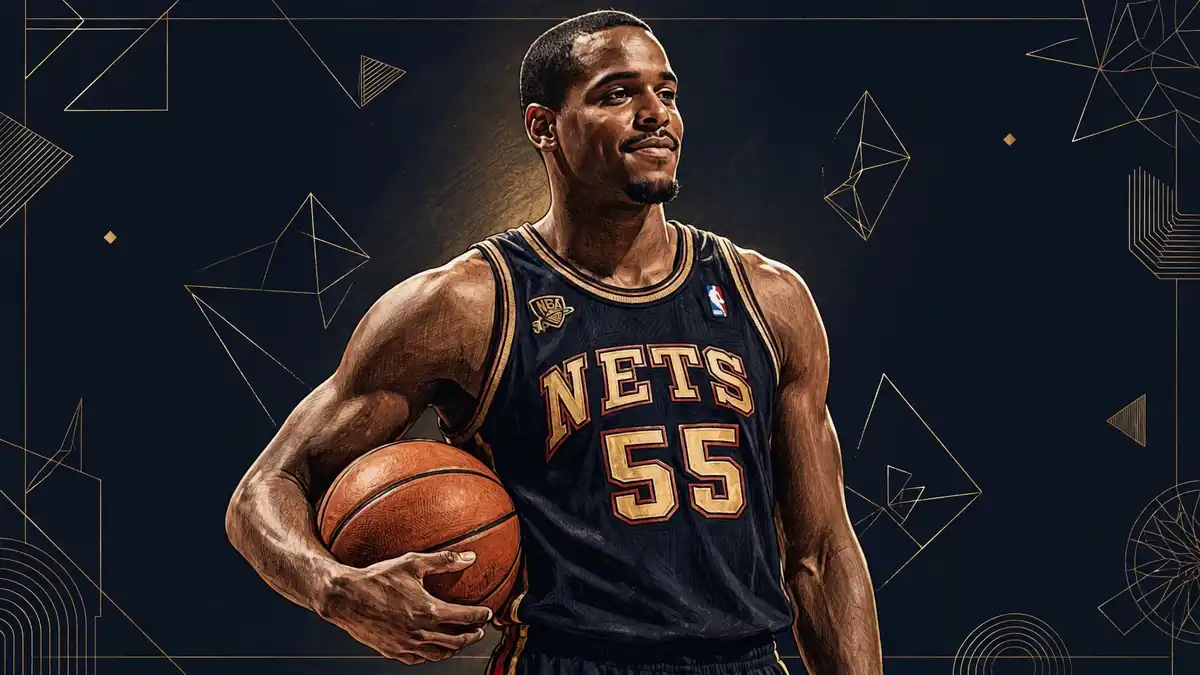
Jayson Williams‘s net worth is estimated at $40 million as of November 2026. The former New Jersey Nets All-Star banked roughly $120 million in NBA salary — most of it from a six-year contract he barely played under — then watched injury, a fatal shooting and 27 months in prison remake his fortune. His story is less a tale of steady wealth than of a fortune built fast, battered hard, and rebuilt around recovery work in the years since his release.
Jayson Williams: Quick Facts
| Estimated net worth | $40 million (range: $40 million–$60 million) |
|---|---|
| Profession | Former professional basketball player, author, recovery-program founder |
| Nationality | American |
| Born | February 22, 1968 (age 58) |
| Height | 6 ft 9 in (2.06 m) |
| Primary income sources | NBA salaries, book sales, recovery programs, speaking |
| Active years | 1990–2000 (NBA); 2005 (brief comeback attempt) |
| Last reviewed | November 2026 |
- Early Life and Background
- Education
- Career Journey
- Rise to Fame
- Main Sources of Income
- Salary and Earnings
- Businesses and Investments
- Brand Deals and Sponsorships
- Houses, Cars and Other Assets
- Awards and Achievements
- Net Worth Growth Over the Years
- Social Media Presence
- Personal Life
- Sources & Reporting
- Frequently Asked Questions
- Final Thoughts
Early Life and Background
Jayson Williams was born on February 22, 1968, in Ritter, South Carolina, to Elijah Joshua “EJ” Williams and Barbara Williams. His background crossed lines that shaped the way he talked about himself for the rest of his life: he is of Polish, Italian and African-American descent, raised Catholic, and his mother worked for years at the Gouverneur skilled nursing facility in lower Manhattan. When Jayson was twelve, the family moved to Brooklyn, and New York City became the place that made him — first on playground courts, then at Christ the King Regional High School in Queens, one of the city’s storied basketball programs.
The New York roots matter to the money story because they explain the player he became. Williams was never a polished scorer. He was a brawler on the glass, a kid who learned the game in gyms where second chances came off the rim rather than off a playbook. Coaches at Christ the King saw a 6-foot-9 teenager who played every possession like a loose ball, and St. John’s University, a short trip away in Queens, kept him home for college. That local-boy path also meant his earliest earning years arrived without the polish or the endorsement machinery that followed smoother prospects — a theme that would repeat through his whole career.
His family history carried losses that later surfaced in his own writing. His father, EJ, died of a stroke at 76 in November 2009, while Williams was still fighting his legal case — a death Williams later said haunted him as much as the shooting itself. He had three sisters: two died from AIDS, one after a blood transfusion that followed a mugging, and the third was killed by her husband in a murder-suicide. Williams wrote about being sexually abused as a boy in his 2012 memoir, a disclosure that reframed his public image from fallen star to a man whose troubles started long before fame. None of that excuses the night in 2002, and Williams has never claimed it does. It does explain why, after prison, he built his second act around people trying to climb out of their own wreckage.
Education
Williams attended Christ the King Regional High School in Queens, where he played on a team that fed players to major college programs year after year. He enrolled at St. John’s University in 1987 and played three seasons for the Redmen, from 1987 to 1990, under a program that expected its big men to defend and rebound first. As a sophomore in 1988–89 he averaged 19.5 points and 7.9 rebounds per game and earned second-team All-Big East honors — the season that put him on NBA draft boards as a possible first-round pick.
His junior year broke the plan. An injury limited him to 13 games in 1989–90, in which he still averaged 14.6 points and 7.8 rebounds, but the missed time cost him draft position. Instead of the top ten, where a healthy junior season might have placed him, he waited until the 21st pick of the 1990 NBA draft to hear his name. The slide cost him real money: a top-ten pick in 1990 signed a far richer rookie deal than the 21st pick, and Williams spent his first two professional seasons making up the gap from the bench. It is the first of several moments in his career where a single injury redrew his finances.
St. John’s kept its ties to him anyway. In 2023 the university inducted him into its athletics Hall of Fame, an honor that arrived more than three decades after he left school and more than a decade after his release from prison — a sign that the institution weighed the whole arc of his life, rather than only the headlines from 2002 to 2012.
Career Journey
The Phoenix Suns selected Williams with the 21st pick of the 1990 NBA draft, then traded his draft rights to the Philadelphia 76ers on October 28, 1990, for a 1993 first-round pick — before he had played a single professional game. Philadelphia was a hard place to start: the 76ers still had Charles Barkley anchoring the frontcourt, plus veterans like Armon Gilliam, Rick Mahorn and Manute Bol, so a 22-year-old rookie with a raw offensive game had almost no path to minutes. He averaged 9.8 minutes, 3.5 points and 2.1 rebounds as a rookie, then 12.9 minutes, 4.1 points and 2.9 rebounds in his second season, shooting just 36.4 percent from the field. The numbers look thin, but the per-minute rebounding already hinted at what he could do with real playing time.
On October 8, 1992, Philadelphia traded him to the New Jersey Nets for conditional draft choices. The first three seasons in New Jersey looked like more of the same — 12 starts in three years, under 13 minutes a night, a bench big man on a team still finding its shape. Then the per-minute numbers forced the coaches’ hands. In 1994–95 he grabbed 5.7 rebounds in just 13.1 minutes a game, a rate that worked out to 15.6 rebounds per 36 minutes — territory owned by Dennis Rodman, the era’s rebounding standard. The Nets started giving him real run in 1995–96, and he answered with 9.0 points and 10.0 rebounds a night across 80 games, finishing as runner-up for the Sixth Man of the Year award.
The 1996–97 season made him a full-time starter at last: 40 starts in 41 games, 34.9 minutes a night, a career-high 13.4 points and 13.5 rebounds per game. A year later he was an All-Star. He played 475 NBA games in all — 102 for Philadelphia, 373 for New Jersey — and finished with career totals of 3,472 points, 3,584 rebounds and 287 assists, averaging 7.3 points and 7.5 rebounds. The totals understate him because so much of his career was spent on the bench; his peak-season numbers, not his career averages, are the honest measure of the player.
His playoff record was thin: nine games, 3.3 points and 5.4 rebounds per game, and he never reached an NBA Finals. The Nets made the playoffs in 1998, his All-Star year, but were swept in the first round. That missing championship run is one reason his name sits a tier below the era’s greats in memory — and one reason his contract, signed the next year, drew so much second-guessing once he could no longer play.
Rise to Fame
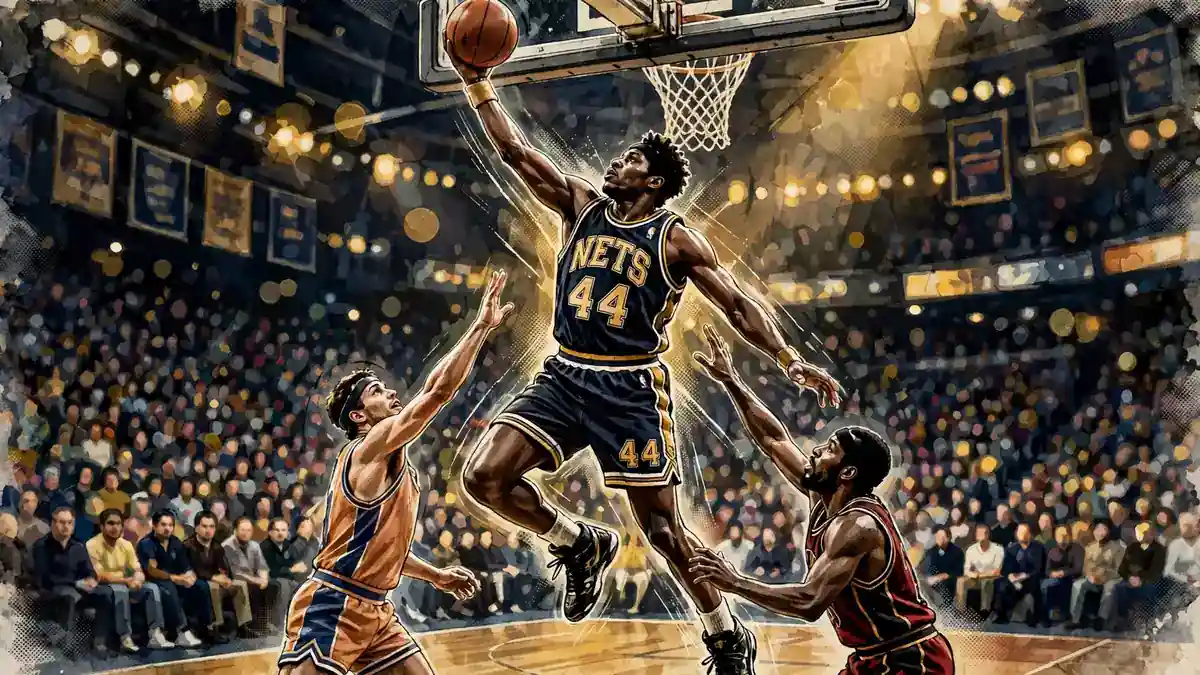
Williams became famous the way rebounders become famous: by doing the game’s least glamorous job better than almost anyone. In the first game of the 1997–98 season he set a Nets franchise record with 17 offensive rebounds, 20 boards in total, against the Indiana Pacers. That season he led the entire league in offensive rebounds and offensive rebound percentage, finished in the top five in total rebounds, rebounds per game and total rebound percentage, and averaged 12.9 points and a career-high 13.6 rebounds. The All-Star selection followed, his only one, and with it the kind of national attention that turns a role player into a name.
The Nets rewarded him in 1999 with a six-year contract that has been reported at two different figures ever since — $86 million according to Celebrity Net Worth, and $90 million according to Wikipedia, Sportscasting and Yardbarker. The gap is a reporting conflict, not a rounding error, and it matters: four million dollars is real money even at this scale. What no outlet disputes is the shape of the deal — it started at roughly $11 million for the 1998–99 season and escalated into the $12 million–$15 million range annually — or that it was one of the richest contracts in Nets history at the time.
He played 30 games under it. On April 1, 1999, in a game against the Atlanta Hawks, Williams collided with teammate Stephon Marbury and broke his right leg. Surgeons inserted a plate and five screws the next day. He missed the entire 1999–2000 season and announced his retirement on June 28, 2000, at 32. The Nets had just made their first playoff appearance since the 1993–94 season, and their breakout star was done. Because NBA contracts are fully guaranteed, Williams still collected virtually the entire value of the deal despite playing only those 30 games, with the Nets covering their share through an insurance policy — a detail that explains why his career earnings stayed so high even as his playing days ended overnight.
Fame, for Williams, also came with a reputation for chaos off the court that predated the shooting. In 1992 he was accused of breaking a beer mug over a patron’s head at a Chicago saloon; in 1994 he was accused of firing a semiautomatic weapon into the parking lot at the Meadowlands sports complex. He was never criminally charged in either case. His own 2001 memoir, Loose Balls, later drew attention for recounting nine separate episodes of reckless behavior with guns — including one in which former NFL player Wayne Chrebet was nearly shot. Readers who picked the book up as a funny locker-room memoir found a warning sign instead.
Main Sources of Income
Williams’s money came overwhelmingly from one place: NBA salary. Celebrity Net Worth’s breakdown puts his career earnings at roughly $120 million before taxes and fees, and that single stream dwarfs everything else he ever made. There is no documented portfolio of major endorsement deals, no signature shoe, no long broadcasting contract and no business empire to rival his playing income. That concentration is itself the story — his fortune was built in nine seasons, then had to survive more than two decades without a playing paycheck.
The secondary streams, in rough order of size, were his three books — Loose Balls (2001), Humbled ~ Letters From Prison (2012) and Crashing: A Memoir (December 2018) — with proceeds from Humbled going to charity, according to the Good Men Project; paid speaking and media appearances after his release, including a long ESPN interview in September 2012 and a Breakfast Club appearance in 2017; and, in recent years, his recovery programs, REBOUND and REBOUND on the Road, which operate as mission-driven ventures rather than profit engines. He also owned a professional sports franchise outright for a time, the New Jersey Storm of the National Lacrosse League, which ran for two seasons before moving to Anaheim and folding before the 2006 season.
What he did not have is just as telling. Unlike Michael Jordan, whose sneaker empire made his playing salary look small, or LeBron James, who turned basketball fame into a media and investment portfolio, Williams never converted stardom into a second fortune. His post-basketball income has been modest, steady work — books, talks, programs — rather than equity. Any honest estimate of his wealth has to start from the salary, subtract two decades of living, legal bills and a prison stretch, and land well below the career-earnings total. That arithmetic is exactly why the $40 million anchor makes sense against $120 million earned.
Salary and Earnings
Celebrity Net Worth’s contract breakdown is the most detailed public account of what Williams earned, and it is worth laying out in full because it explains both the size of his fortune and its fragility. After the trade to New Jersey in 1992, his pay climbed in steps: roughly $800,000 a year at first, then just under $1 million, then into the $2 million range by the mid-1990s. In his All-Star season of 1997–98 he was making about $2.5 million a year. Across his first nine seasons, before the big extension, he had earned an estimated $35 million.
Then came the extension. The six-year deal signed in 1999 began at about $11 million for the 1998–99 season and escalated into the $12 million–$15 million range in the seasons that followed. Because the contract was fully guaranteed, Williams received virtually the entire $86 million–$90 million value despite playing only 30 games after signing it. Add the earlier $35 million and his total NBA salary lands at roughly $120 million — a figure Celebrity Net Worth states plainly and that no other outlet has seriously challenged. One site, ExactNetWorth, lists his “total career earnings” as $3,183,600 in one passage while quoting the $35 million and $86 million figures in the next — an internal contradiction that shows why single-source numbers need checking before they are repeated.
For scale, $120 million earned mostly in the 1990s is worth roughly $230 million in 2026 purchasing power on a consumer-price-index adjustment — the kind of money that should have made Williams wealthy for life. It did not, quite, because of what came after: taxes and agent fees took the usual large cut, the legal case that ran from 2002 to 2010 consumed years of lawyers’ bills, and his earning power collapsed to near zero during the prison years. The guaranteed contract saved him from ruin; it could not save him from the cost of the decade that followed.
How does that salary stack up against his peers? The table below compares approximate career NBA salaries — the money actually paid for playing — for Williams and five contemporaries whose NetWorthCraft profiles track the same era. Salary is not net worth, and the gap between the two columns is the whole point of this article.
| Player | Approx. career NBA salary | All-Star selections |
|---|---|---|
| Jayson Williams | ~$120 million | 1 |
| LeBron James | More than $525 million | 20+ |
| Michael Jordan | ~$94 million | 14 |
| Allen Iverson | ~$155 million | 11 |
| Scottie Pippen | ~$109 million | 7 |
| James Harden | ~$340 million | 10 |
Salary figures are approximate career totals per Spotrac reporting. The contrast with Jordan is the sharpest lesson in the table: Jordan earned less in salary than Williams — about $94 million — yet built a fortune measured in billions through endorsements and equity, while Williams, who out-earned Jordan on the court, kept far less of what he made. Timing helped Jordan and hurt Williams: Jordan’s peak coincided with the sneaker boom, while Williams’s peak coincided with a broken leg and a courtroom.
Businesses and Investments
Williams’s most visible business move was buying into a sport he never played. He became the principal owner of the New Jersey Storm, a franchise in the National Lacrosse League, which operated for two seasons, 2002 and 2003, before moving to Anaheim, California, and becoming the Anaheim Storm. The team went out of business before the 2006 season began. No public record states what Williams paid for the franchise or what he lost on it, and this article will not guess — but a two-season indoor lacrosse team in the early 2000s was not a wealth-building asset, and its collapse belongs in the loss column of his story rather than the win column.
No verifiable record exists of a stock portfolio, real estate empire or startup portfolio for Williams, and the numbers that some content farms attach to him should be treated with open skepticism. One AI-generated page claims a net worth above $400 million built on private equity, a sports investment fund and international real estate — claims supported by no filing, interview or credible outlet, and contradicted by every serious profile of him. Another breaks his wealth into neat slices of $40 million from basketball, $30 million from business ventures and $20 million from real estate, numbers that appear invented to fill a template. We name these claims here so readers who meet them elsewhere know they have no source behind them.
His genuine second-act business is REBOUND, the recovery and reentry program he built in Florida after his release. The idea came from his own failed stint in treatment: the program did not hold his attention, friends challenged him to build one that would, and he designed it around movement — paddleboarding, snorkeling, skydiving, fishing — for adults in recovery and returning from incarceration. An earlier version, the Rebound Institute, ran a 45-day program. The newest arm, REBOUND on the Road, adds a career path: a 90-day program, run with Nassau County and Nassau Community College, that helps participants earn commercial truck-driving licenses and find work. Its first graduation was held on August 11, 2025, at Nassau Community College in Garden City, New York. Worth.com profiled the program in December 2025, updating the piece in February 2026, and a November 2025 podcast episode, Celebrate Your Story, recorded on site at the program’s headquarters, reported that the exposure had driven fresh donations and inquiries.
Williams also tried, briefly, to come back to basketball itself. In January 2005, while awaiting retrial on the manslaughter charge, he joined the Idaho Stampede of the Continental Basketball Association — a comeback attempt that went nowhere and ended the same year. It was his last appearance as a professional player.
Brand Deals and Sponsorships
Here the honest answer is short: no major endorsement deal for Jayson Williams is documented in any credible source we could find. No signature shoe, no national campaign, no long-running sponsor relationship appears in his biographical record, his memoir coverage or the business press. Some low-quality net-worth pages credit him with Nike, Adidas and Reebok deals worth millions a year; those pages also confuse him with Jason Williams, the point guard nicknamed “White Chocolate,” whose career and endorsements were entirely different. The two men share a similar name and an overlapping era, and content farms merge them constantly — which is why this article keeps the distinction visible.
The absence matters for the estimate. In the 1990s, a rebounding specialist on a mid-market team was not a marketer’s first call even at his peak, and his peak lasted about two seasons before the injury. By the time he might have built a public profile off the All-Star selection, he was out of the league. After 2002, no brand would touch him. His income, from start to finish, was salary plus books — and that is why his net worth tracks his contract so closely, and why it sits so far below players with similar career earnings who had endorsement income on top.
What he did earn from visibility came later and smaller: speaking engagements, podcast appearances, a 2017 visit to The Breakfast Club with Charlamagne Tha God and DJ Envy, and the 2025 Celebrate Your Story episode with Jim McCann. None of these is a salary-scale payment, and none is disclosed. We count them as modest, steady income in his post-prison years — enough to live on alongside book royalties, not enough to move the net-worth needle.

Houses, Cars and Other Assets
The one property that defines Williams’s asset history is the house where everything went wrong. His estate in Alexandria Township, New Jersey — a 30,000-square-foot mansion about 30 miles northwest of Trenton — was the scene of the February 14, 2002 shooting. Christofi had been hired to drive Williams’s NBA charity team home from an event in Bethlehem, Pennsylvania; Williams was showing guests around the house, and the 12-gauge shotgun he was handling went off. In 2005, while awaiting retrial, Williams sold the property for $8 million to New Jersey petroleum executive John Lionetti, according to Celebrity Net Worth. The sale is the largest single asset transaction in his public record, and it came at a moment when legal bills were mounting — a sale driven by necessity as much as by choice.
No public record documents a current home for Williams, and this article will not invent one. After his release he has lived largely out of the spotlight in Florida and New York, where his REBOUND work is based, and his public appearances center on the program rather than a lifestyle. There is no verified car collection to report — the only vehicle tied to him in the record is the Mercedes he crashed into a tree in lower Manhattan in the early hours of January 5, 2010, the DWI accident that added a year at Rikers Island to his sentence and a $16,433 fine for damage to the tree.
His durable assets today are intangible: three published books, the REBOUND programs, and a story that still draws media interest a quarter-century after his last NBA game. Those do not show up on a balance sheet the way a house does, but they are what generate his current income. The contrast with his 1999 self — a 31-year-old with a $90 million contract and a 30,000-square-foot house — is the arc of the whole article.
Awards and Achievements
Williams’s trophy case is short and honest. He was an NBA All-Star once, in 1998, the year he led the league in offensive rebounds. He was second-team All-Big East in 1989 at St. John’s. He finished as runner-up for the NBA Sixth Man of the Year award in 1995–96, the season he averaged 10.0 rebounds off the bench. He set a Nets franchise record with 17 offensive rebounds in a single game. He was inducted into the New York City Basketball Hall of Fame in 2016 and into the St. John’s University athletics Hall of Fame in 2023.
What is missing is just as notable: no NBA championship, no All-NBA selection, no Defensive Player of the Year votes of record, no Finals appearance. His nine playoff games produced 30 points in total. For a net-worth profile, that matters because championships and deep playoff runs are what turn good players into marketable ones — the endorsement money, the broadcasting chair, the shoe deal all flow from the biggest stages, and Williams never reached them. His one All-Star season is the peak, and everything in his financial story slopes away from it.
The later honors tell a different story. The Hall of Fame inductions, both of them local — New York City and St. John’s — arrived after prison, and both institutions chose to honor the whole life rather than the playing career alone. The 2025 first graduation of REBOUND on the Road is an achievement of another kind, measured in commercial licenses rather than trophies, and it is the one Williams himself talks about most in recent interviews.
Net Worth Growth Over the Years
No audited record of Williams’s wealth exists, so the table below is an editorial reconstruction — built from his reported salary totals, the known $8 million mansion sale, the timeline of his legal case, and the $40 million anchor from Celebrity Net Worth. Treat each row as an informed estimate, not a filing.
| Year | Estimated net worth | What moved it |
|---|---|---|
| 1990 | Under $1 million | Drafted 21st overall; rookie-scale pay in Philadelphia |
| 1995 | $5 million–$8 million | Salary climbing past $2 million a year; bench role ending |
| 1999 | $25 million–$35 million | Six-year, $86 million–$90 million Nets contract signed |
| 2002 | $35 million–$45 million | Peak: guaranteed contract paying out; mansion held |
| 2005 | $30 million–$40 million | Mansion sold for $8 million; legal bills mounting |
| 2012 | $20 million–$30 million | Released after 27 months in prison; earning power near zero |
| 2018 | $30 million–$40 million | Third memoir published; speaking and media work steady |
| 2026 | $40 million (range $40M–$60M) | Anchor: Celebrity Net Worth; REBOUND work ongoing |
The shape is a rise, a long plateau, a dip and a slow recovery — not the smooth upward curve of a player who stayed healthy and stayed marketable. Two forces explain the dip: the legal case, which ran eight years from the shooting to the sentence and consumed the prime earning window of his thirties, and the simple fact that his income stopped in 2000 while his expenses did not. The recovery since 2012 has been real but modest: books, talks and program work do not pay NBA money, and the $40 million figure has been stable in reporting for years, suggesting a fortune that is now holding rather than growing fast.
One more piece of context: the $120 million he earned was paid mostly in 1990s dollars. Adjusted for inflation, it represents roughly $230 million in 2026 purchasing power. That adjustment cuts both ways — it shows how large the original fortune was, and how much of it has gone.
Social Media Presence
Williams keeps a low public profile online, and this section will not invent handles or follower counts that cannot be verified. He has no widely documented, verified social media presence that functions as a public platform in the way current players’ accounts do; his visibility in the 2020s has come through other people’s channels — podcasts, interviews and program coverage — rather than his own feed. That is consistent with a man whose public life ended before social media existed and whose return to public life has been built around in-person program work.
His most substantial recent appearances are long-form conversations rather than posts: the September 2012 ESPN interview after his release, in which he spoke about the shooting, his father’s death and his time inside; the 2017 Breakfast Club visit, where he discussed the accident, his alcoholism and the Rebound Institute; and the November 2025 Celebrate Your Story episode, filmed at the REBOUND on the Road headquarters, which the Shorty Awards later showcased as a study in second chances. For readers looking for current news about him, the REBOUND programs and their partner institutions — Nassau Community College among them — are the reliable sources, not a personal account.
Personal Life
Williams’s personal life has been public since his playing days, and the record is unusually well documented. In 1996 he proposed during halftime of a nationally televised game to model Cynthia Bailey; the two later parted. He married Kellie Batiste in December 1999; they divorced soon afterward. In 2000 he married Tanya Young, and the couple had two daughters before divorcing in 2011. Young later appeared as a cast member on VH1’s reality show Basketball Wives: LA. His daughters have been kept largely out of the press, and this article follows that lead — no names, no speculation about their lives.
The legal case is the unavoidable center of this section, and the timeline deserves to be stated plainly. On February 14, 2002, 55-year-old limousine driver Costas “Gus” Christofi was shot and killed at Williams’s Alexandria Township estate. Williams was showing guests around the house after a charity basketball event and mishandled a 12-gauge shotgun. He was indicted on May 1, 2002, on charges including aggravated manslaughter. In April 2004 a jury acquitted him of aggravated manslaughter but convicted him on four counts of trying to cover up the shooting, and deadlocked on reckless manslaughter. In April 2006 an appeals court ruled he could be retried on that charge. On January 11, 2010, he pleaded guilty to aggravated assault; on February 23, 2010, he was sentenced to five years in prison with parole possible after 18 months. He was paroled in August 2011 after serving the minimum, then transferred to Rikers Island to serve an additional one-year sentence for the January 2010 DWI, of which he served eight months. He was released on April 13, 2012, having served 27 months in total.
The years around the case included other incidents that filled police blotters: in April 2009, New York police reported finding him suicidal and intoxicated in a Manhattan hotel room, tasered him and took him to hospital; a few weeks later he was charged with simple assault after allegedly punching a man at a bar in Raleigh, North Carolina — charges that were later dropped. At his sentencing, Williams apologized to the Christofi family and said, “There’s not a day I wake up and I don’t feel sorry for what I did to Mr. Christofi.” In the 2012 ESPN interview he went further, saying his father — who died of a stroke in November 2009, at 76, while the case was still open — was a second victim of that night: “Not one person died that night, two people died.”
Prison changed how he spent his days. At Rikers Island he led Bible-study classes, worked as a suicide-prevention assistant on the midnight shift, and earned the nickname “the Moses of Rikers” from fellow inmates, according to the New York Post. He told ESPN after his release that he had never seen a new prisoner go two months without crying every night. That experience is the direct line to REBOUND: the program he built is, in his own telling, the program he wished had existed for him.
Sources & Reporting
Reporting window: November 2026, with sources ranging from 2010 court coverage to February 2026 program updates. Celebrity Net Worth — the $40 million net-worth figure, the $120 million career-salary total, the $86 million contract figure, the $35 million pre-extension earnings, and the $8 million mansion sale to John Lionetti. Wikipedia and Basketball Reference — birth date and place, height and weight, draft position and trades, season-by-season statistics, the $90 million contract figure, the April 1, 1999 injury, the 2005 Idaho Stampede comeback, the New Jersey Storm ownership, the three books, and the personal-life record. Land of Basketball — career totals and season breakdowns cross-checked against Basketball Reference. ESPN — the September 2012 post-release interview, the April 2012 release report, and the 2005 comeback report. NBC Sports and Sportsnet — the February 2010 sentencing, five-year term and 18-month parole eligibility. New York Post — reporting on the shooting, the “Moses of Rikers” account and the 2009 hotel incident, as cited in the sources above. Sportscasting and Yardbarker — the $90 million contract figure and the apology at sentencing. Worth.com — the December 2025 profile of REBOUND and REBOUND on the Road, updated February 2026. Nassau Community College — the August 11, 2025 first graduation of REBOUND on the Road. The Good Men Project — Humbled ~ Letters From Prison and its charity proceeds. Basketball Network — the July 2026 retrospective on the shooting and its aftermath. Spotrac — approximate career NBA salary totals used in the peer comparison table. TheCityCeleb — the weaker $60 million net-worth figure that sets the top of our published range. Figures that appear only on AI-generated content farms — including claims above $400 million — were checked and excluded as unsourced. Where sources conflict, notably the $86 million versus $90 million contract figure, both are published and named.
Frequently Asked Questions
What is Jayson Williams’ net worth in 2026?
Jayson Williams’ net worth is estimated at $40 million as of November 2026, with a published range of $40 million to $60 million. Celebrity Net Worth carries the $40 million figure, which most outlets repeat; a weaker source, TheCityCeleb, puts him at $60 million. Claims above $400 million on AI-generated pages have no source behind them and should be ignored.
How much money did Jayson Williams make in the NBA?
About $120 million in salary before taxes and fees, according to Celebrity Net Worth. That breaks down into roughly $35 million earned before his big extension and $86 million from his six-year contract signed in 1999 — a deal other outlets report as $90 million. Because the contract was fully guaranteed, he collected virtually all of it despite playing only 30 games under it.
Why did Jayson Williams go to prison?
On February 14, 2002, Williams accidentally shot and killed his limousine driver, Costas “Gus” Christofi, with a 12-gauge shotgun at his New Jersey mansion while showing guests around after a charity basketball event. He was acquitted of aggravated manslaughter in 2004 but convicted of four cover-up counts, and in January 2010 he pleaded guilty to aggravated assault to avoid a retrial on reckless manslaughter. He was sentenced to five years in prison.
How long was Jayson Williams in prison?
He served 27 months in total. That covers 18 months in a New Jersey state prison on the shooting case, from which he was paroled in August 2011, plus eight months at Rikers Island on a separate one-year DWI sentence. He was released on April 13, 2012.
What happened to Jayson Williams’ leg and why did he retire?
On April 1, 1999, in the first year of his six-year contract, Williams broke his right leg in a collision with teammate Stephon Marbury during a game against the Atlanta Hawks. Surgeons inserted a plate and five screws the next day. He missed the entire 1999–2000 season and announced his retirement on June 28, 2000, at age 32. He never played in the NBA again.
Where is Jayson Williams now?
He runs REBOUND, a recovery and reentry program in Florida built around outdoor activity for adults in recovery and returning from prison, and its newer arm, REBOUND on the Road, which trains participants for commercial truck-driving licenses in partnership with Nassau County and Nassau Community College. Its first class graduated on August 11, 2025. He also writes and speaks about addiction and accountability.
Did Jayson Williams win an NBA championship?
No. Williams never reached the NBA Finals and never won a championship. He played in only nine playoff games across his career, all in first-round series, and his best team result was the Nets’ 1998 playoff appearance in his All-Star season. His honors were individual: one All-Star selection, a Sixth Man of the Year runner-up finish, and Hall of Fame inductions in New York City (2016) and at St. John’s (2023).
Is Jayson Williams married?
No. Williams is divorced. He married Tanya Young in 2000 and the couple, who had two daughters together, divorced in 2011; Young later appeared on VH1’s Basketball Wives: LA. He was previously married briefly to Kellie Batiste in 1999, and in 1996 he proposed on live television to model Cynthia Bailey, though the two later parted.
Final Thoughts
Jayson Williams’s net worth in 2026 — $40 million, in a $40 million–$60 million range — is a number that only makes sense with the story attached. The $120 million he earned was real, guaranteed money, and it should have made him wealthy for life. Instead, a broken leg at 31 ended the earning, and a shotgun blast at 34 began an eight-year legal case that consumed the decade when he should have been building a second career. What remains is a fortune that survived because the contract was guaranteed, and a life rebuilt around the one thing his playing career never gave him: a purpose that pays in something other than points and rebounds.
The honest way to read his wealth is as a cautionary tale with a working ending. Few players have ever been paid so much for so little basketball, and fewer still have lost so much of what followed to a single night. His REBOUND programs will never return the money to $120 million, and they are not meant to. They return something the contract never could — a reason to be believed when he tells people in recovery that a life can be rebuilt after it falls apart. He has lived that sentence, and the $40 million figure is only the footnote.
Published on November 15, 2026. Last reviewed November 2026. Found an error? See our corrections policy.