
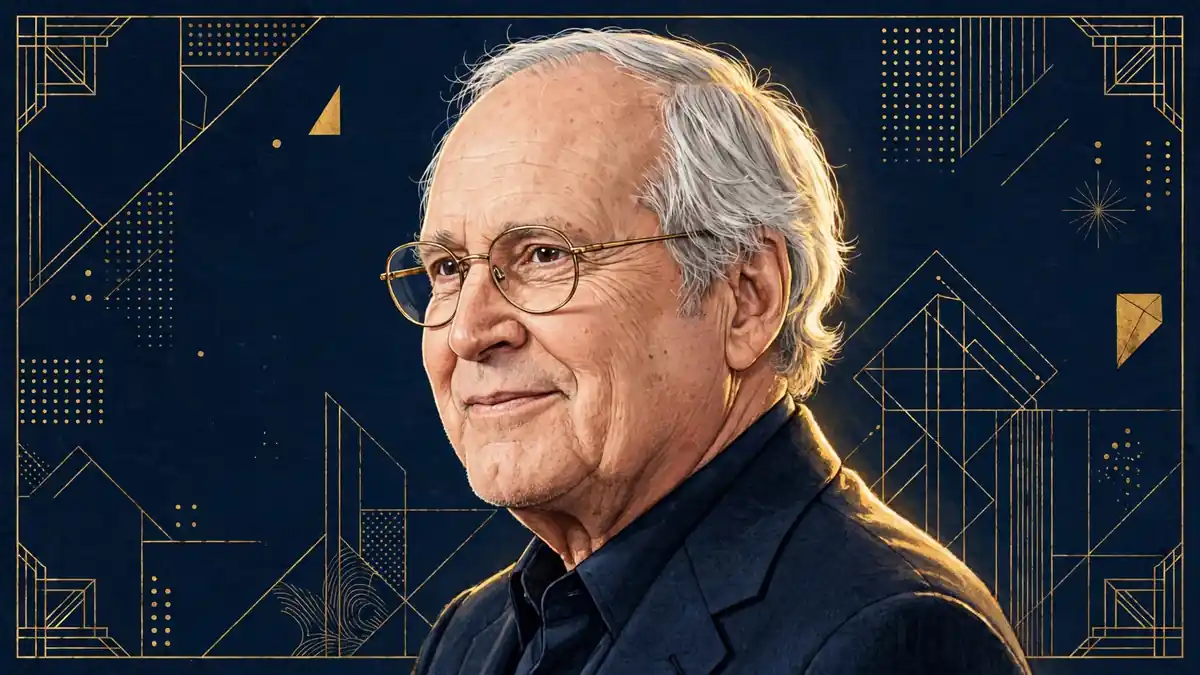
Chevy Chase‘s net worth is estimated at $50 million to $55 million as of November 2026. The anchor figure is $50 million, the number Celebrity Net Worth has carried for years and updated most recently in January 2026, while a handful of smaller outlets stretch the top of the range to $55 million. Chase built that fortune the old-fashioned way: one season of Saturday Night Live that remade American comedy, a run of 1980s film hits that paid him as much as $7 million a picture, and a second act on Community that put him back in front of a new generation. In January 2026, a CNN documentary, I’m Chevy Chase and You’re Not, gave the story its freshest chapter yet, with Chase himself calling his early exit from SNL a mistake.
Chevy Chase: Quick Facts
| Estimated net worth | $50 million (range: $50 million to $55 million) |
|---|---|
| Profession | Actor, comedian, writer |
| Nationality | American |
| Born | October 8, 1943 (age 83) |
| Height | 6 feet 4 inches (1.93 m) |
| Primary income sources | Film salaries, television, residuals and syndication, writing, live appearances |
| Active years | 1967–present |
| Last reviewed | November 2026 |
- Early Life and Background
- Education
- Career Journey
- Rise to Fame
- Main Sources of Income
- Salary and Earnings
- Businesses and Investments
- Brand Deals and Sponsorships
- Houses, Cars and Other Assets
- Awards and Achievements
- Net Worth Growth Over the Years
- Social Media Presence
- Personal Life
- Sources & Reporting
- Frequently Asked Questions
- Final Thoughts
Early Life and Background
Cornelius Crane Chase was born on October 8, 1943, in Lower Manhattan, New York City, to Edward Tinsley “Ned” Chase and Cathalene Parker Browning. His grandmother nicknamed him “Chevy” after the old English ballad “The Ballad of Chevy Chase,” and the nickname stuck so firmly that most of America has never known him by any other name. The family tree around him was thick with artists and money. His mother was a concert pianist and librettist who had been adopted as a child by her stepfather, Cornelius Vanderbilt Crane, heir to a plumbing fortune. His paternal grandfather, Edward Leigh Chase, was an artist and illustrator. His great-uncle Frank Swift Chase was a painter and teacher, and his maternal grandmother sang opera at Carnegie Hall.
That gilded background came with a hard edge. His parents divorced when he was four years old. His mother remarried twice, and his father remarried into the Folgers coffee family. Chase was raised in Woodstock, New York, and in a 2007 biography he disclosed that he had suffered physical and psychological abuse as a child at the hands of his mother and his stepfather, Dr. John Cederquist, a psychoanalyst, saying he “lived in fear all the time, deathly fear.” The disclosure, made when he was already in his sixties, reframed a career built on smug, untouchable characters: the confidence on screen was a performance, and the childhood behind it was anything but comfortable.
The money in the family background is worth stating plainly because it shapes the net-worth question. Chase was born into a family with Vanderbilt-adjacent wealth on his mother’s side, but no reporting ties his $50 million fortune to an inheritance. The fortune on the public record was earned, film by film, in the 1980s, and every figure in this article traces to salaries, box-office results, or property records rather than family money. His mother’s side of the family explains the polish and the prep-school path; it does not explain the bank balance.
Education
Chase graduated from the Stockbridge School in Massachusetts in 1962, then spent one semester at Haverford College before transferring to Bard College, where he graduated in 1967 with a Bachelor of Arts degree in English. Bard gave him two things that mattered more than the degree. The first was a band: he played drums in a college group alongside Walter Becker and Donald Fagen, the two musicians who would go on to form Steely Dan. The second was a writing habit that carried straight into his professional life — he was writing humor pieces for Mad magazine by 1970, including a one-page spoof of Mission: Impossible.
Between graduation and fame, Chase worked a string of jobs that now read like a setup for a comedy routine: cab driver, truck driver, construction worker, waiter, fruit picker, audio engineer, wine salesman, and theater usher. The list matters for the money story in one specific way. When he finally broke through at 32, he had spent a decade broke and hustling, which is why the speed of his rise — writer to breakout star inside a single television season — still surprises people who study his career. He did not arrive with a trust fund cushion; he arrived with a decade of odd jobs behind him.
Career Journey
Chase co-founded the underground comedy ensemble Channel One in 1967, the same year he left Bard. By 1973 he was a writer and performer on the syndicated National Lampoon Radio Hour, a talent incubator whose cast also included John Belushi, Gilda Radner, and Bill Murray. The radio show paid little and taught him a lot: sharp satire, character work, and the dry, self-aware delivery that became his signature. In 1975 he wrote for the Smothers Brothers’ television comeback, a credit that put him in front of Lorne Michaels at exactly the right moment.
Michaels hired him for NBC’s new late-night sketch show in October 1975. Chase signed on as a writer on a one-year contract and became a cast member during rehearsals, just before the premiere. He left the show in late 1976, midway through its second season, becoming the first member of the original cast to walk away for a film career. The film years ran from Tunnel Vision in 1976 through Foul Play in 1978 — his first leading role and the film that earned him two Golden Globe nominations — and into the run that made him rich: Caddyshack in 1980, National Lampoon’s Vacation in 1983, Fletch in 1985, and National Lampoon’s Christmas Vacation in 1989.
The 1990s broke the run. Nothing but Trouble in 1991, Memoirs of an Invisible Man in 1992, and Cops & Robbersons in 1994 flopped in sequence, and the three films together took in only about $34 million at the global box office, according to Celebrity Net Worth. In September 1993 he tried to come back to television as host of The Chevy Chase Show on Fox. The show was heavily promoted, struggled with format problems and low ratings, and was cancelled after five weeks. From there his work thinned to guest spots on Law & Order, Brothers & Sisters, Chuck, and voice work on Family Guy, until NBC’s Community handed him a second act in 2009 as Pierce Hawthorne, the moist-towelette tycoon. He left that show in 2012 after four seasons, returned for a cameo in the season-five premiere, and has worked intermittently since — Hot Tub Time Machine in 2010, The Last Laugh on Netflix in 2019, and the horror-comedy Zombie Town in 2023.
Rise to Fame
The rise took about fourteen months. When Saturday Night Live premiered in October 1975, Chase was its first breakout star, and the vehicle was Weekend Update, the mock newscast he anchored with the introduction “I’m Chevy Chase, and you’re not.” The line became a national catchphrase, the pratfalls that opened each segment became appointment viewing, and Chase became the first cast member the public could name. He won two Primetime Emmy Awards in 1976 — one for individual performance in a variety program and one for outstanding writing — and a third in 1978 for writing The Paul Simon Special.
What the Emmys do not capture is how fast the industry moved to claim him. He hosted the Academy Awards twice, in 1987 and 1988, a job that in that era went only to performers the whole country already knew. In a 2015 Rolling Stone ranking of every SNL cast member to that point, Chase placed tenth and was described as possibly the most underappreciated performer in the show’s history — a fair verdict on a man whose contribution went beyond starring in the first season — he set the tone for what the show’s comedy would sound like, deadpan and self-aware, and every Weekend Update anchor since has worked in a format he built.
The film fame that followed was bigger in dollars and narrower in range. National Lampoon’s Vacation opened in July 1983 on a $15 million budget and took in $61.4 million, Chase’s most successful film to that point. Fletch followed in 1985, grossing more than $50 million from an $8 million budget. Spies Like Us, with fellow SNL graduate Dan Aykroyd, made $60 million the same year, and European Vacation pulled in just under $50 million. Christmas Vacation in 1989 grossed $71.3 million in the United States and Canada and $108 million worldwide, and it never left the culture: it plays every December, which is why a man who has barely made a hit film in thirty years still draws crowds to live screening events in 2026.
Main Sources of Income
Film salaries are the foundation of the fortune. Celebrity Net Worth’s salary record puts at least $36 million in Chase’s hands from just seven films — Fletch and Fletch Lives at $7 million each, Christmas Vacation and Memoirs of an Invisible Man at $6 million each, Cops & Robbersons and Vegas Vacation at $4 million each, and Man of the House at $2 million. That $36 million covers only the films whose paydays leaked or were reported; it leaves out Caddyshack, the Vacation sequels, Spies Like Us, Three Amigos, and a dozen smaller roles, so the true career total from acting fees runs well past that figure. At his peak in the late 1980s he was earning around $7 million per film, which Celebrity Net Worth equates to roughly $20 million per film in today’s dollars.
Television paid in two separate waves. The first was SNL in 1975–76, where his salary was never publicly disclosed — NBC’s first-season cast was paid modestly by later standards, and the real value of that year was the fame that made the film salaries possible. The second was Community from 2009 to 2012, where he appeared in most of the show’s first four seasons as Pierce Hawthorne. His Community salary was never publicly disclosed either, and one net-worth blog’s claim of $8.3 million for the run, at $80,000 to $100,000 per episode, is unverified — it is the kind of number that circulates because it sounds precise, not because a trade paper reported it. We leave it out of the totals and flag it here so readers know why other pages quote it.
Residuals and syndication are the quiet third leg. The Vacation films, Caddyshack, and Fletch have played on cable and streaming for four decades, and Christmas Vacation is a permanent December fixture. Residual checks from that catalog do not match the original salaries, but they have run for years with no new work attached, and they explain how a man with no hit film since the 1990s kept a $50 million net worth intact. Writing added a smaller stream early on — Mad magazine pieces, the National Lampoon Radio Hour, and SNL writing credits — and live appearances have become the visible income of his eighties: screening-and-conversation events built around Christmas Vacation, including a November 29, 2026 date at the Mayo Performing Arts Center in Morristown, New Jersey, with tickets priced from $45 to $280.
Salary and Earnings
The salary table below is the most useful single piece of data in this article, because it is the only part of the fortune that comes with receipts. Celebrity Net Worth publishes the per-film figures, and they add up to $36 million across seven films, before taxes, agents’ commissions, and the lifestyle costs of a peak-era movie star. The table is also the reason the $50 million estimate holds together: a man who banked $36 million from seven films, with a dozen more paydays on top, plus forty years of residuals, lands at $50 million without needing any exotic income stream.
| Film | Year | Reported salary |
|---|---|---|
| Fletch | 1985 | $7 million |
| Fletch Lives | 1989 | $7 million |
| National Lampoon’s Christmas Vacation | 1989 | $6 million |
| Memoirs of an Invisible Man | 1992 | $6 million |
| Cops & Robbersons | 1994 | $4 million |
| Vegas Vacation | 1997 | $4 million |
| Man of the House | 1995 | $2 million |
| Total, seven films | $36 million |
Inflation turns those numbers into something sharper. The $7 million Chase earned for Fletch in the late 1980s is worth roughly $20 million in today’s dollars, and the $6 million for Christmas Vacation equals about $12.5 million today, both conversions per Celebrity Net Worth. That framing matters because it explains the gap between Chase’s peak and the modern comedy pay scale. By 1996, a decade after Fletch, Jim Carrey was commanding $20 million for The Cable Guy — the deal that reset what a comedy star could ask. Chase’s $7 million was the top of his era’s market; Carrey’s $20 million was the top of the next one.
Two salary myths need clearing up. The first is the claim, repeated on thin content-farm pages, that Chase earned $90 million in royalties from Christmas Vacation, or $3 million a year from it. No credible outlet supports either number, and the film’s entire worldwide gross was $108 million, which makes a $90 million royalty payout to one actor arithmetically absurd. The second is the $1 million estimate for his pay on the first Vacation film in 1983, which circulates from a single fan-site estimate and was never confirmed by a trade paper. His exact pay for that film is not publicly known; the honest statement is that he was the highest-paid actor on the picture and that his price rose steeply from there.
Businesses and Investments
Here is where Chase’s money story differs from the modern celebrity template: there is no business empire to describe. No production company with a public slate, no tequila brand, no clothing line, no venture portfolio that trade papers have ever documented. His wealth is a salary fortune, not a business fortune, and the article says so directly because the absence is itself the finding. The peers who passed him financially in the 1990s and 2000s mostly did it by building something outside acting; Chase kept acting, and the acting stopped paying at the top rate after the early-90s flops.
One low-quality roundup claims he co-founded a production company and expanded into a “business empire” — the claim appears on a page that also puts his net worth at $65 million and invents a lawsuit over a failed venture, with no source attached to any of it. No trade paper, filing, or reputable profile supports the production-company claim, so it is excluded from the totals and noted here as an example of how net-worth content degrades when sites copy each other. What is documented on the business side is narrow: writing credits that paid early in his career, a producer stake in his own projects at various points, and the long tail of residuals from films he headlined. His investments, if he holds a portfolio beyond property, have never been disclosed in any public record we could find, and this article does not guess at them.
The comparison that puts this in context is his Three Amigos co-star Martin Short, whose net worth Celebrity Net Worth puts at $30 million — a smaller fortune built the same way, from steady performing work rather than business ventures. The two men shared a film, a comic tradition, and a career shape: long, respected, and paid by the job rather than by equity. Chase simply had a hotter peak, and the $20 million gap between their estimates is the price of those $7 million film paydays.
Brand Deals and Sponsorships
Chase never built an endorsement portfolio of the kind modern stars treat as standard. His peak came in the 1980s, when a film star’s income was the salary and the backend, not a sneaker deal or a social-media rate card, and his public record contains no major brand ambassadorship. That is not a gap in the research; it is a feature of his era. The deals that did exist were small and tied to specific moments, and none of them moved the net-worth needle the way a single Fletch paycheck did.
What replaced endorsements in his later career was the paid-appearance market. The Christmas Vacation screening tour is the clearest example: theaters book the film, Chase and his wife Jayni take the stage afterward, and tickets sell at a premium — $45 to $280 for the November 2026 Morristown date. Fan conventions and nostalgia events work the same way, with autograph and photo fees that, across a year of dates, add a real if modest income line. Voice and cameo work filled the same role in the 2010s, including guest spots on Family Guy and a return as Clark Griswold in the 2015 Vacation reboot, where he and Beverly D’Angelo reprised their roles in a cameo. None of these is a brand deal in the modern sense, and the article does not dress them up as one.

Houses, Cars and Other Assets
The best-documented property in Chase’s life is the Pacific Palisades house he and Jayni owned from 1990 to 2005. It sat on five acres inside a guarded, gated community in Los Angeles, and Chase spent $1.2 million on improvements and renovations there, according to Celebrity Net Worth. They listed it for sale in 1994 at $3 million and did not find a buyer until 2005, when it sold for an undisclosed amount. Two details in that record get misreported constantly, so they are worth fixing here: the $3 million figure was an asking price from 1994, not a sale price, and the 2005 sale price was never disclosed, so any page quoting a sale figure is guessing. The house is also the clearest evidence of how the fortune was managed — a five-acre property in one of Los Angeles’ most expensive neighborhoods, held for fifteen years, renovated with seven figures of his own money.
The couple’s later property record is smaller and quieter. They now live in Bedford, New York, in Westchester County, and no reputable report publishes a purchase price, square footage, or current valuation for that home, so this article publishes none. A separate, verifiable transaction: a Park Slope condo in Brooklyn sold in 2022 for $989,000, according to a 2026 property review. Cars are a similar story of thin documentation. The wood-paneled Wagon Queen Family Truckster from the Vacation films was a studio prop, not his car, and no verified record of a personal car collection exists. Chase’s assets, on the public record, are a house in Bedford, the proceeds of a long-held California property, and the residual stream from a film catalog that has never stopped earning.
Awards and Achievements
Chase has won three Primetime Emmy Awards: two in 1976 for his Saturday Night Live work — individual performance in a variety program and outstanding writing for a variety series — and a third in 1978 for outstanding writing on The Paul Simon Special. He earned two Golden Globe nominations in 1979 for Foul Play, for best actor in a motion picture comedy or musical and for best acting debut. He received a star on the Hollywood Walk of Fame in 1993 at 7021 Hollywood Boulevard, a Golden Palm Star on the Palm Springs Walk of Stars in 1998, was named Hasty Pudding Man of the Year in 1993, and received the Harvard Lampoon Lifetime Achievement Award in 1996.
The honors did not stop with the old ones. In February 2026 he appeared at the 40th Annual Fort Lauderdale International Film Festival, where he received a Lifetime Achievement Award at a screening of the CNN documentary about his life. He was wheeled onto the red carpet and stood inside the event to accept it, at 82, in front of an audience that had come to see the film. Hosting the Academy Awards twice, in 1987 and 1988, belongs on the same list: in that era the Oscars host was chosen from the small group of performers the entire country already knew by first name, and Chase was in that group for exactly the two years his film stardom was at its hottest.
Net Worth Growth Over the Years
The table below is a reconstruction, not a set of audited balances. Nobody publishes a celebrity’s net worth year by year from primary records, and any page that pretends otherwise is inventing numbers. The ranges here are built from the dated evidence in this article — the salary table, the box-office record, and the property timeline — and they show the shape of the fortune: a steep climb in the 1980s, a plateau through the thin 1990s and 2000s, and a flat line at $50 million or so ever since, held up by residuals rather than new paydays.
| Period | Estimated range | What drove it |
|---|---|---|
| 1975–1976 | Under $1 million | SNL breakout; modest NBC pay, fame as the asset |
| 1978–1982 | $1 million – $5 million | Foul Play, Caddyshack, Seems Like Old Times |
| 1983–1989 | $10 million – $35 million | Vacation franchise, Fletch, $6–7 million per film |
| 1990–1997 | $35 million – $45 million | Peak salaries continue; flops slow the climb |
| 1998–2008 | $40 million – $50 million | Thin film years; residuals and property carry it |
| 2009–2019 | $45 million – $50 million | Community comeback; Last Laugh, Hot Tub Time Machine |
| 2020–2026 | $50 million – $55 million | Residuals, live appearances, CNN documentary |
The shape is the story. Most net-worth curves for working actors keep climbing; Chase’s flattened in the 1990s and stayed flat, because the income that built it was front-loaded into a single decade. The $50 million figure has barely moved in years — Celebrity Net Worth’s January 2026 update kept it at $50 million — and the stability is the point. A fortune built on seven-figure salaries and forty years of reruns does not need new hits to survive; it needs the old ones to keep playing, and Christmas Vacation plays every December.
Social Media Presence
Chase keeps a public social presence, and the handles are consistent across sources: Instagram at @chevychase, where his bio reads “Actor, writer, musician, husband, father and tremendous slouch”; TikTok at @officialchevychase, which one biography put at about 1.2 million followers with 5.6 million likes as of August 2025; and X at @ChevyChaseToGo. His official site is officialchevychase.com. Follower counts vary sharply between sources and dates — Instagram figures quoted for the same handle range from roughly 150,000 in 2022 to about 790,000 in an April 2026 directory snapshot — so this article reports the handles as verified and treats the counts as snapshots, not facts.
The social accounts matter to the money story in a narrow way: they are a marketing channel for the live-appearance dates, not an income stream of their own. There is no evidence of paid brand posts or a creator-style business built on the following, and the documentary press tour in January 2026 — including a two-part appearance on The Drew Barrymore Show — ran through television and print, not through his feeds. For a man whose fame predates the internet by decades, the accounts function as a notice board: tour dates, old clips, and the occasional family photo with Jayni.
Personal Life
Chase has been married three times. His first marriage, to Susan Hewitt, ran from February 1973 to February 1976. His second, to Jacqueline Carlin, ran from December 1976 to November 1980. In June 1982 he married Jayni Luke, a production coordinator he met while working on the 1981 film Under the Rainbow. The couple celebrated their 43rd wedding anniversary in June 2025, and they have three daughters together: Cydney Cathalene, born in 1983; Caley Leigh, born in 1985; and Emily Evelyn, born in 1988. Chase also has a son, Bryan Perkins, with an unidentified woman, according to Celebrity Net Worth. He and Jayni live in Bedford, New York.
Two health chapters belong in any honest account of the last decade. Chase was admitted to the Betty Ford Clinic in 1986 for a prescription painkiller addiction, and he received treatment at the Hazelden Clinic for alcoholism in 2016. In 2021 he suffered heart failure, spent five weeks in the hospital, and was placed in a medically induced coma for eight days. The documentary that premiered on CNN on January 1, 2026, I’m Chevy Chase and You’re Not, directed by Marina Zenovich, covers that episode candidly: Chase and Jayni say on camera that his memory is “shot,” with gaps his doctors attribute to the 2021 incident, and that he plays chess and card games to keep his mind sharp. In the same film he says leaving SNL after one season was a mistake — the closest thing to a verdict he has ever offered on the decision that defined his career. He attended the SNL 50th anniversary special in 2025 as an audience member, not a performer, sitting in the building while other alumni took the stage.
The Community exit deserves the same plain treatment. Chase left the show in 2012 after completing most of the fourth season, following reported on-set tensions and creative differences with the show’s direction, and he returned only for a cameo in the season-five premiere. The exit cost him a steady television salary and a role that had reintroduced him to viewers under thirty, and it is the second of the two decisions — with the 1976 SNL exit — that his own 2026 documentary frames as a turning point. Neither decision touched the fortune directly; both shaped the career that produced it.
Sources & Reporting
Celebrity Net Worth — the $50 million estimate (profile updated January 2, 2026), the full per-film salary table totaling $36 million, the Pacific Palisades property record ($1.2 million in renovations, $3 million 1994 asking price, 2005 sale undisclosed), the three early-1990s flops’ combined $34 million gross, and the personal-life record (marriages, children, Betty Ford 1986, Hazelden 2016). Reporting window: profile first published April 2020, updated January 2026.
Wikipedia — biography and filmography (Channel One 1967, National Lampoon Radio Hour 1973, SNL 1975–76, eight hosting returns through 1997, Oscars 1987–88, Community 2009–2012), box-office grosses via Box Office Mojo (Vacation $61.4 million, Caddyshack $39.8 million domestic / $60 million worldwide, Christmas Vacation $71.3 million domestic / $108 million worldwide, Fletch over $50 million), and the 2007 biography abuse disclosure. Reporting window: entries reviewed November 2026.
The Famous People — biography detail (Emmy wins 1976 and 1978, The Chevy Chase Show cancelled after five weeks, Community exit in 2012, daughters’ birth years, Bedford residence). Reporting window: reviewed November 2026.
Far Out Magazine — profile data (born October 8, 1943, height 6 feet 4 inches, estimated net worth $50 million, wife Jayni Chase). Reporting window: profile updated December 2025.
This Old House — property reporting (Bedford home with no published purchase price or valuation, Pacific Palisades five-acre record, Park Slope condo sale of $989,000 in 2022, and the warning that the $3 million figure was an asking price only). Reporting window: updated November 5, 2026.
Rolling Stone — 2015 ranking of all SNL cast members, placing Chase tenth and describing him as possibly the most underappreciated performer in the show’s history.
CNN — the documentary I’m Chevy Chase and You’re Not, premiered January 1, 2026, directed by Marina Zenovich; Chase’s on-camera statement that leaving SNL was a mistake and the account of his 2021 heart failure, eight-day coma, and memory gaps.
Us Weekly — February 2026 report of Chase’s wheelchair appearance and Lifetime Achievement Award at the 40th Annual Fort Lauderdale International Film Festival (via syndicated coverage, February 27, 2026).
Box Office Mojo — theatrical grosses cited through Wikipedia’s film entries, as above.
The Rich Net Worth — cited only to flag an unverified claim: its $8.3 million Community total at $80,000–$100,000 per episode is not corroborated by trade reporting and is excluded from the totals in this article.
Estimates are dated November 2026. Where sources disagree, this article publishes the range and names the outlet behind each figure. No figure in this article comes from an anonymous roundup, and no salary is stated without a named source.
Frequently Asked Questions
What is Chevy Chase’s net worth in 2026?
Chevy Chase’s net worth is estimated at $50 million in 2026, with a published range of $50 million to $55 million. Celebrity Net Worth, which updated his profile in January 2026, carries the $50 million figure; a few smaller outlets stretch it to $55 million. The fortune comes mainly from his 1980s film salaries — at least $36 million from seven films alone — plus decades of residuals from the Vacation franchise, Caddyshack, and Fletch.
Is Chevy Chase still alive?
Yes. Chevy Chase is alive and living in Bedford, New York, with his wife Jayni. He is 83 years old as of November 2026. He survived a serious health scare in 2021, when heart failure put him in a medically induced coma for eight days, and he appeared publicly in February 2026 to accept a Lifetime Achievement Award in Fort Lauderdale. A CNN documentary about his life, I’m Chevy Chase and You’re Not, premiered on January 1, 2026.
How old is Chevy Chase?
Chevy Chase is 83 years old. He was born Cornelius Crane Chase on October 8, 1943, in Lower Manhattan, New York City, which makes him 83 as of November 2026. He was 32 when Saturday Night Live premiered in October 1975, and 46 when National Lampoon’s Christmas Vacation opened in 1989.
How much did Chevy Chase make per movie?
At his peak in the late 1980s, Chevy Chase earned around $7 million per film — $7 million each for Fletch and Fletch Lives, and $6 million each for Christmas Vacation and Memoirs of an Invisible Man. Celebrity Net Worth equates the $7 million figure to roughly $20 million in today’s dollars. Across just seven films with reported salaries, he earned $36 million. His exact pay for the first Vacation film in 1983 was never publicly disclosed.
How much does Chevy Chase make from Christmas Vacation?
He was paid a reported $6 million salary for Christmas Vacation in 1989, worth about $12.5 million in today’s dollars. Claims that he earned $90 million in royalties from the film, or $3 million a year, have no credible source behind them — the film’s entire worldwide gross was $108 million, so a $90 million payout to one actor is not plausible. He does still earn residuals from the film, which airs every December, but no reliable outlet has published the annual amount.
What is Chevy Chase doing now?
Chase is largely retired from regular acting and lives in Bedford, New York. His most recent film role was in Zombie Town in 2023, and his most visible 2026 project is the CNN documentary I’m Chevy Chase and You’re Not, which premiered on January 1, 2026. He still makes paid live appearances built around Christmas Vacation, including a screening and conversation event with his wife Jayni in Morristown, New Jersey, on November 29, 2026, with tickets from $45 to $280.
Who is Chevy Chase’s wife?
Chevy Chase has been married to Jayni Luke Chase since June 1982. They met while working on the 1981 film Under the Rainbow, where she was a production coordinator, and celebrated their 43rd wedding anniversary in June 2025. They have three daughters: Cydney Cathalene (born 1983), Caley Leigh (born 1985), and Emily Evelyn (born 1988). Chase was previously married to Susan Hewitt (1973–1976) and Jacqueline Carlin (1976–1980).
Why did Chevy Chase leave Community?
Chase left NBC’s Community in 2012 after completing most of the fourth season, following reported on-set tensions and creative differences over the show’s direction. He returned for a cameo in the season-five premiere and has not been a regular on the show since. It was his second high-profile early exit, after leaving Saturday Night Live in late 1976 — a decision he called a mistake in the 2026 CNN documentary about his life.
Final Thoughts
Chevy Chase’s $50 million is a fortune with a shape you can trace in a straight line: one season of television that changed comedy, one decade of film paydays at $6 million and $7 million a picture, and forty years of reruns that never stopped paying. He never built a business empire, never cashed in on a brand deal, and never had a second peak to match the first — and the number still held, because the work at the peak was that well paid and the films never left the screen.
The 2026 documentary adds the honest ending the story needed. Chase calls leaving SNL a mistake, talks openly about the coma that nearly killed him in 2021, and admits his memory is not what it was. The fortune survived the flops, the cancelled talk show, and the Community exit; what it could not survive was never the risk, because the money was banked before the fall. Clark Griswold’s road trip is still playing every December, and that is the real pension plan.
Published on November 13, 2026. Last reviewed November 2026. Found an error? See our corrections policy.