
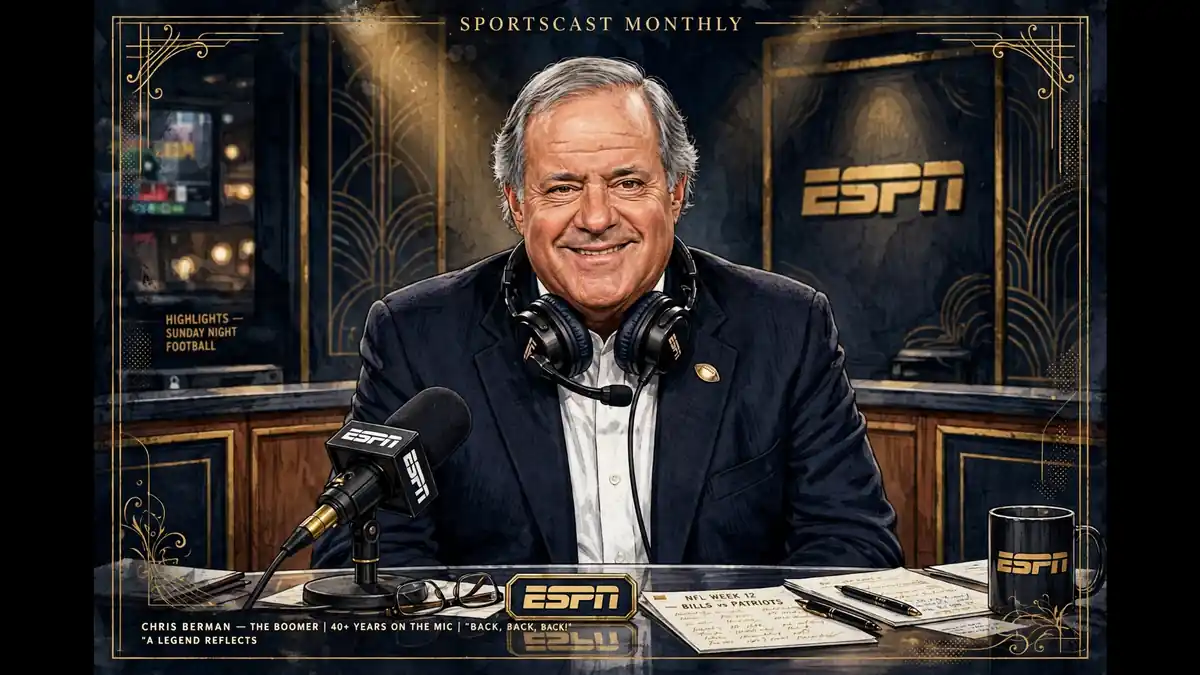
Chris Berman‘s net worth is estimated at $30 million to $40 million as of November 2026. The man ESPN viewers have called “Boomer” since 1979 built that fortune on 47 years at one network, a reported salary of $5 million to $8 million a year, and a May 2025 contract extension that runs through 2029 — the year he plans to retire as the first 50-year employee in ESPN history.
Chris Berman: Quick Facts
| Estimated net worth | $30 million – $40 million (range: $30 million to $40 million) |
|---|---|
| Profession | American sportscaster, television host |
| Nationality | American |
| Born | May 10, 1955, Greenwich, Connecticut (age 71) |
| Height | 6 ft 5 in (1.96 m) |
| Primary income sources | ESPN salary, NFL PrimeTime hosting, SportsCenter, appearances and film cameos |
| Active years | 1977–present |
| Last reviewed | November 2026 |
- Early Life and Background
- Education
- Career Journey
- Rise to Fame
- Main Sources of Income
- Salary and Earnings
- Businesses and Investments
- Brand Deals and Sponsorships
- Houses, Cars and Other Assets
- Awards and Achievements
- Net Worth Growth Over the Years
- Social Media Presence
- Personal Life
- Sources & Reporting
- Frequently Asked Questions
Early Life and Background
Christopher James Berman was born on May 10, 1955, in Greenwich, Connecticut, and grew up in Irvington, New York. His mother, Peggy Shevell, worked as a reporter-researcher for Time magazine; his father, James Keliner Berman, was a corporate executive vice president. The household gave the future broadcaster two things that shaped his career: a reporter’s ear for a story and a front-row seat to how big American institutions are run.
Berman was raised Jewish and spent childhood summers at Camp Winnebago in Fayette, Maine, where he played the team sports he would later spend a lifetime describing. Friends and classmates from those years remember a kid who already narrated games out loud, inventing nicknames for players and calling imaginary highlights. The habit never left him. It became the signature of his broadcasting style: a fast, musical delivery packed with wordplay, rhymes and player nicknames that turned a highlight reel into a piece of theatre.
Greenwich and Irvington placed Berman inside the New York sports orbit from the start. The Yankees, the Giants and the Knicks were the teams on the radio and on the television in his house, and the New York tabloid style — short, loud, funny — seeped into the voice he later took to a national audience. Few sportscasters have ever sounded as much like the city they grew up near as Berman does.
Education
Berman enrolled at the Hackley School in Tarrytown, New York, in 1970. After Hackley he went to Brown University, where he graduated in 1977 with a degree in history. The history degree mattered more to his broadcasting than it might look on paper. Berman’s best work has always been built on memory: a player’s rookie year, a team’s last title, the last time two clubs met in the playoffs. That instinct for context started in seminar rooms at Brown.
At Brown he also ran the sports operation at the campus radio station, WBRU, serving as its sports director. Campus radio was his real training ground. He learned to fill dead air, to call a game with no pictures, and to keep a listener’s attention with words alone — the exact skills that made him the anchor ESPN turned to when it needed someone who could carry a live show for hours. Brown later awarded him an honorary degree in 2007 and inducted him into the university’s Athletic Hall of Fame.
His first job after graduation was at WVIT-TV in Hartford, Connecticut, where he worked as a weekend sports anchor from 1977 to 1979. The Hartford job put him two hours from Bristol, where a brand-new cable sports network was about to launch. When ESPN hired him on October 1, 1979 — less than a month after the network went on air — he was 24 years old and one of the youngest people in the building.
Career Journey
Berman joined ESPN on October 1, 1979, and his first assignment tells you everything about the early network: he anchored the 2:30 a.m. edition of SportsCenter. The overnight slot was the network’s laboratory. There was no audience to impress and no producer hovering, so Berman experimented — nicknames, catchphrases, jokes, a delivery that sped up when a play got exciting and slowed down for the punchline. The experiments worked, and within a few years the overnight voice was the face of the network.
He took over ESPN’s NFL Draft coverage in 1981 and stayed with it for decades, turning a niche offseason event into appointment television. In 1985 he became host of Sunday NFL Countdown, the pregame show he would front for 31 years, through 2016. In 1987 he added NFL PrimeTime, the Sunday-night highlights show that became his signature program, and he hosted Baseball Tonight and anchored SportsCenter through the network’s biggest growth years. His catchphrases entered the language of American sports: “He could… go… all… the… way!” for a long run, and “Back, back, back, back… gone!” for a home run.
By the 1990s Berman was the most recognizable voice in American sports television. He hosted the U.S. Open golf coverage, anchored Monday Night Countdown, and became the master of ceremonies for the Pro Football Hall of Fame enshrinement ceremony in Canton, Ohio — a role he has held since 1999, more than two decades of introducing the game’s new immortals. He also built a second career as a cameo actor, playing himself in films including Necessary Roughness (1991), Little Big League (1994), Kingpin (1996), The Waterboy (1998) and The Longest Yard (2005).
In January 2017 ESPN announced that Berman would step down from several NFL roles, including Sunday NFL Countdown and Monday Night Countdown, while remaining with the company. The announcement read like a retirement, but it wasn’t one. He signed a new multi-year deal in May 2021 to keep hosting NFL PrimeTime, and on May 12, 2025, he signed the extension that defines the final chapter of his career: a deal running through at least 2029, which would make him the first employee in ESPN history to reach 50 years with the company. In February 2026 he told the CNBC Sports podcast that he plans to retire when that contract ends, after the 2029 NFL season — and that he will contribute to ESPN’s first-ever Super Bowl broadcast on February 14, 2027, along the way.
Rise to Fame
Berman’s rise tracks the rise of ESPN itself. When he joined in 1979, the network was a startup broadcasting from Bristol, Connecticut, with a schedule full of Australian rules football and slow-pitch softball because it could not afford the rights to anything else. Berman was its first breakout star. His SportsCenter became the show young sports fans watched before school, and his highlight calls gave the network a personality it could sell to cable operators and advertisers.
The turning point was the NFL. When ESPN won the right to carry Sunday night football highlights, Berman’s NFL PrimeTime became the show every football fan watched after the late games ended. His player nicknames — “Bert ‘Be Home’ Blyleven” in baseball, dozens of rhyming NFL handles — were quoted in schoolyards and offices on Monday mornings. No other anchor of his generation was as imitated, and no other anchor turned imitation into job security the way he did.
Awards followed the fame. ESPN’s own press room lists him as a six-time National Sportscaster of the Year, the first cable sportscaster ever to win the award, and the winner of 10 Sports Emmy Awards and 12 CableACE Awards. His shows won Emmys of their own, and his name became shorthand for the network’s golden era. When ESPN celebrated its 40th anniversary, Berman was the living link to its first month on air — the only on-air figure who had been there from the beginning.
The other half of his rise was durability. Television burns through stars quickly, and sports television faster still. Berman survived four decades of format changes, ownership changes, layoffs and the shift from cable to streaming by doing the one thing nobody else at the network could do as well: hosting a live NFL studio show. That durability is the financial story of this article. A 47-year run at one employer, with salary renegotiated at every peak, is how a broadcaster reaches a $30 million to $40 million net worth without ever owning a team or a company.
Main Sources of Income
Berman’s money comes from one employer above all else: ESPN. His salary has been the engine of his wealth for nearly five decades, and the deals he signed at each career peak stacked on top of one another. Around that salary sit four smaller streams — hosting fees, film and television cameos, speaking engagements, and residuals from decades of syndicated programming.
ESPN salary. The central figure. Celebrity Net Worth reports that Berman was earning $8 million a year before his May 2025 extension, and that the new deal is generally believed to have kept his pay roughly at that level. Older reports put the figure at $5 million a year, which was the number most outlets used through the 2010s. The gap between the two numbers is the gap between his reduced post-2017 role and his current legacy contract — and it is the main reason net worth estimates for Berman run from $30 million to $40 million instead of landing on a single figure.
Hosting and studio work. NFL PrimeTime remains the highest-profile assignment. The show moved to ESPN+ in its current form, with postseason specials on ESPN, and Berman’s role as host and historian of the program carries its own fee inside his overall deal. His long-running job as master of ceremonies for the Pro Football Hall of Fame enshrinement ceremony, held since 1999, is a separate, prestigious paid engagement each summer in Canton.
Film and television cameos. Berman has played himself — or a version of himself — in more than a dozen films, from Necessary Roughness in 1991 to The Waterboy in 1998 and The Longest Yard in 2005. Cameo fees for a famous broadcaster are modest next to an $8 million salary, but the roles kept his name in front of audiences who never watched SportsCenter, and they paid residuals as the films moved through cable, streaming and syndication.
Speaking engagements and appearances. A six-time National Sportscaster of the Year with a Hall of Fame résumé is a natural draw for corporate events, sports conventions and charity dinners. Berman has been a regular on that circuit for decades. Speaking fees are not publicly disclosed, but for a figure of his standing they typically run into five figures per appearance, and they add up over a 40-year career.
What he does not have. There is no public record of Berman owning a sports team, founding a media company, or holding a large equity stake in a business. That matters for understanding his net worth. His fortune is a salary fortune — earned year by year, taxed year by year, and saved over an unusually long career — rather than a windfall from an exit or an investment. That is why the range is narrower and lower than the figures attached to broadcasters who cashed out of companies or signed $20 million-a-year deals in the streaming era. Pat McAfee’s net worth, built on a $85 million-plus FanDuel-era deal and his own media company, shows the contrast: the new generation of sports media stars monetizes ownership, while Berman monetized longevity.

Salary and Earnings
The most reported salary figure for Berman is $8 million a year, published by Celebrity Net Worth with the note that his pay before the May 2025 extension was $8 million and the new deal is believed to have kept it roughly the same. That figure is the top end of the range. The bottom end is $5 million a year, the number used by PlayersBio, Interesticle and several salary roundups that tracked his pay during the 2010s, when his role was smaller than it had been at his peak.
Both numbers can be true at different points in his career. In the 2000s, when Berman hosted Sunday NFL Countdown, Monday Night Countdown, NFL PrimeTime and SportsCenter, his pay was at its peak. After January 2017, when he stepped back from the daily NFL studio shows, his schedule shrank and his reported pay figures with it. The May 2021 extension and the May 2025 extension then reset the number upward again, as ESPN paid a premium to keep its founding voice through the network’s 50th anniversary and its first Super Bowl.
Put the salary in context. Berman’s $5 million to $8 million a year sits below the top of today’s sports media market. Stephen A. Smith’s ESPN deal is reported at around $20 million a year, and Troy Aikman’s net worth reflects an ESPN contract reported at $18 million a year. But Berman’s pay was set in an earlier era, when $5 million made him one of the highest-paid sportscasters in the country, and he has collected a top-of-market salary for far longer than anyone else in the business. Forty-seven years of elite pay, even at a lower annual rate than today’s stars, compounds into a large fortune — especially for a broadcaster whose lifestyle has never been tied to the spending habits of the athletes he covered.
| Period | Role | Reported annual pay |
|---|---|---|
| 1980s–1990s | SportsCenter anchor, Sunday NFL Countdown host | Peak-era salary, rising with ESPN’s growth |
| 2000s–2016 | Countdown, PrimeTime, Monday Night Countdown | Reported around $5 million a year |
| 2017–2021 | Reduced schedule, NFL PrimeTime | Reported around $5 million a year |
| 2021–2025 | NFL PrimeTime on ESPN+, specials | Reported $5 million to $8 million a year |
| 2025–2029 | Legacy extension through 50th anniversary | Reported $8 million a year (Celebrity Net Worth) |
Career earnings are the number that turns a salary into a net worth. Berman has been paid at or near the top of his profession since the mid-1980s. Even a conservative run of the numbers — $3 million a year through the 1990s, $5 million a year through the 2000s and 2010s, $8 million a year under the current deal — puts his cumulative ESPN earnings well above $150 million before tax. After taxes, agent fees and living costs across 47 years, a $30 million to $40 million net worth is the plausible remainder. The math is the reason the range is credible: it does not need a hidden business or a lucky investment to work.
Businesses and Investments
Berman has never been a businessman in the way modern sports media stars are. There is no Berman media company, no Berman podcast network, no Berman-branded anything in the public record. His career predates the era in which broadcasters turned themselves into companies, and his wealth reflects that. He sold his time and his voice to one employer, and he sold them for a very long time.
What is on the record is a set of long, stable institutional ties. He has been associated with Brown University since his student days, returning for an honorary degree in 2007 and entering the university’s Athletic Hall of Fame. He has served as master of ceremonies for the Pro Football Hall of Fame enshrinement since 1999, a relationship that has now lasted more than a quarter of a century. He has been a fixture at ESPN’s own charity and community events in Bristol. None of these is a business, but together they describe a career built on loyalty to institutions rather than on deal-making.
On investments, the public record is thin, and an honest estimate says so. No filings, interviews or profiles tie Berman to a notable startup stake, a real estate portfolio or a private equity position. That absence is itself a data point. Broadcasters of his generation typically held their wealth in a home, retirement accounts and conservative investments, and Berman’s profile fits that pattern. We do not invent a portfolio for him, and any net worth site that lists specific Berman business holdings without a source is guessing.
The contrast with his peers is instructive. Cris Collinsworth’s net worth is lifted by Pro Football Focus, the analytics company he bought into and helped build; Mike Tirico’s net worth reflects a career that moved across networks and into Olympic and prime-time hosting. Berman’s fortune is the purest version of the old model: one network, one voice, 47 years.
Brand Deals and Sponsorships
Berman’s endorsement history is modest by the standards of the athletes he covered, and that is by design. ESPN’s on-air talent has long operated under strict rules about commercial work, and Berman’s value to the network was his credibility as a journalist and host, not his value as a pitchman. There is no long list of Berman endorsement deals in the public record, and no single brand is associated with him the way a shoe or a drink is associated with a star player.
What he did lend his name to was ESPN itself. For three decades he was the network’s most recognizable ambassador, appearing in its promotions, hosting its upfront events and fronting its NFL coverage. That work was inside his employment deal rather than a separate sponsorship, and it paid off in contract renewals rather than in endorsement cheques.
His film cameos functioned as a different kind of brand work. Playing himself in The Waterboy, The Longest Yard and Kingpin put his catchphrases in front of moviegoers and made him a pop-culture figure beyond sports. The fees were small, but the cultural reach was large, and it is the reason people who never watched a football game know his voice.
One more stream deserves a mention: his voice. Berman’s delivery has been licensed and imitated for decades, and his catchphrases have been used in video games, commercials and highlight packages. The individual payments are not public, and we do not assign a dollar figure to them. They belong in the picture as a reminder that a famous voice is an asset that keeps paying long after the show ends.
Houses, Cars and Other Assets
Berman has long been reported to live in Connecticut, near the Bristol headquarters where he has worked since 1979. Public records and profiles place his home in Cheshire, Connecticut, a quiet suburb a short drive from the ESPN campus. The house itself has never been the subject of a glossy real-estate feature, and no sale price or valuation has been reliably reported, so we do not put a number on it. What the location tells you is more useful than a price: Berman built his life around his job, not around a property portfolio. He stayed in Connecticut for 47 years while colleagues moved to New York or Los Angeles.
On cars, the record is similarly quiet. Berman has never been a car collector in the public eye, and no profile of him lists a notable garage. That fits the pattern of his career. His spending has never been part of his public story, and the absence of luxury-car headlines is consistent with a broadcaster who kept a low profile off the air.
The assets that matter to his net worth are financial rather than physical: decades of salary, saved and invested, plus the value of a contract that runs to 2029. At 71, with a retirement date announced, his balance sheet is in its harvest phase. The $8 million a year he is reported to earn under the current deal, collected through the 2029 season, would add roughly $30 million in gross pay before tax across the final four years of the contract — a final lift that supports the top end of the $30 million to $40 million range.
One caveat belongs here. Net worth estimates for broadcasters are always softer than estimates for athletes with public contracts or business owners with filings. Berman’s pay has been reported, not disclosed, and his savings rate is unknown. The $30 million to $40 million range is our honest reading of the reported figures, and the width of the range is the point: anyone who gives you a single exact number for Chris Berman’s net worth is pretending to know more than the record shows.
Awards and Achievements
Berman’s honours list is one of the longest in American sports broadcasting, and it is the reason his name carries weight beyond his salary. ESPN’s press room records the core of it: he was selected National Sportscaster of the Year six times — in 1989, 1990, 1993, 1994, 1996 and 2001 — by the National Sportscasters and Sportswriters Association, now the National Sports Media Association. In 1989 he became the first cable sportscaster ever to win the award, and he ranks second among all sportscasters in total wins.
He and his shows have won 10 Sports Emmy Awards and 12 CableACE Awards, and the American Sportscasters Association named him Sportscaster of the Year in the studio-host category in 1995, 1997 and 1998. In 2010 the Pro Football Hall of Fame gave him the Pete Rozelle Radio-Television Award for long-time exceptional contributions to radio and television in professional football — the honour Berman himself has said he cherishes most. The same year, on May 24, 2010, he received a star on the Hollywood Walk of Fame.
The hall of fame inductions came later and kept coming. He entered the Cable Hall of Fame in 2015 as only the fifth on-air personality so honoured, and in 2016 the Newseum Institute gave him its Al Neuharth Award for Excellence in Media — the first sportscaster ever to receive it. In December 2017 he was inducted into the Sports Broadcasting Hall of Fame, and he is also a member of the National Sports Media Association Hall of Fame and the Brown University Athletic Hall of Fame. In 2024 his list grew again with the Lamar Hunt Award for Professional Football, given to the individual who has helped shape the NFL into the preeminent professional sports league in America. He also won the Maxwell Football Club’s Reds Bagnell Award in 2001 for contributions to the game.
Then there is the honour that is not a trophy: since 1999 he has been the master of ceremonies for the Pro Football Hall of Fame enshrinement ceremony, introducing each new class in Canton. More than two decades of standing on that stage, year after year, is a measure of trust no award committee hands out. It is the football world saying, in public, that Berman is one of its own.
Net Worth Growth Over the Years
Berman’s wealth grew slowly and then steadily, the way a salary fortune grows. There was no single windfall, no IPO, no team sale. The table below is our modeled reading of his career, built from his reported salary history and the contract milestones ESPN has confirmed. The figures are estimates, not audited numbers, and they are presented as a range where the record is thin.
| Era | Career marker | Estimated net worth |
|---|---|---|
| Early 1980s | SportsCenter anchor, first NFL Draft coverage | $1 million – $2 million |
| Early 1990s | Sunday NFL Countdown, first Sportscaster of the Year awards | $5 million – $8 million |
| Early 2000s | Peak studio role, Monday Night Countdown | $10 million – $15 million |
| 2010 | Rozelle Award, Walk of Fame star | $15 million – $20 million |
| 2017 | Steps back from daily NFL roles | $20 million – $25 million |
| 2021 | Multi-year extension, NFL PrimeTime continues | $25 million – $30 million |
| 2026 | 2025 extension through 2029, retirement announced | $30 million – $40 million |
Two things stand out in that arc. First, the curve never falls. Berman’s net worth kept rising even after 2017, when his on-air role shrank, because his pay stayed high and his spending stayed low. Second, the 2025 extension is the single biggest driver of the current figure. A four-year deal at a reported $8 million a year, signed at age 70, is almost unheard of in television, and it is the reason the top of today’s range is $40 million rather than $30 million.
Peer comparison puts the number in perspective. Celebrity Net Worth puts Al Michaels at around $40 million and Joe Buck at around $35 million — Berman sits in the same band as the two men most often named alongside him as the defining NFL voices of their generation. Troy Aikman, who moved from the booth to a reported $18 million-a-year ESPN deal, is reported at around $65 million, and Tony Romo, on a reported $17 million-a-year CBS deal, is reported at around $70 million. The gap between Berman and the younger booth stars is a pay-era gap, not a talent gap: Romo and Aikman signed their big deals in the streaming era, when networks started paying quarterback money to the people who talk about quarterbacks. Berman signed his in the cable era, and then kept collecting it for longer than anyone else.
Social Media Presence
Berman keeps no public personal social media presence. There is no verified Chris Berman account on X, Instagram or Facebook, and he has never used social media to promote his work or share his views. That is a deliberate choice, and it fits a broadcaster who came up in the era when the show was the platform. His audience finds him on ESPN’s channels — SportsCenter, NFL PrimeTime on ESPN+, and the network’s NFL coverage — rather than on a personal feed.
ESPN’s own accounts carry clips of his highlights and his catchphrases, and fan accounts repost his classic calls, but those are not Berman’s accounts and they earn him nothing directly. For a net worth article, the point is simple: social media is not an income stream for him. He has no sponsorship posts, no subscriber revenue and no personal brand funnel. His money comes from the contract, not the feed.
That absence is also a generational marker. The broadcasters who followed him — McAfee, Smith, the podcast generation — built fortunes by owning their audience directly. Berman built his by being the voice of a network that owned the audience. Both models work. His just happens to be the older one, and the $30 million to $40 million range is what the older model pays when it is executed for 47 years without interruption.
Personal Life
Berman married Katherine “Kathy” Alexinski in 1983, and the marriage lasted nearly 34 years. They had two children, a son, Douglas, and a daughter, Meredith. Kathy died in a car crash in Woodbury, Connecticut, in May 2017, the day before Berman’s 62nd birthday. The crash also killed the driver of the other car. Reports later said toxicology tests found Kathy’s blood-alcohol level well above the legal limit. Berman was at a Mets–Giants game in New York with his son Doug when he received the news.
The loss shaped the final decade of his career. He has spoken rarely about it in public, and when he has, it has been briefly and without self-pity. Colleagues from that period describe a man who threw himself back into work, and the 2021 and 2025 contract extensions both came after Kathy’s death — a reminder that his professional life did not stop with his personal one. His children are adults now; Meredith lives in Brooklyn, and Douglas has worked in sports media himself.
Off the air, Berman is known as a loyal friend and a relentless sports fan. He has been a fixture at the Pro Football Hall of Fame’s events for decades, a regular at charity golf tournaments, and a mentor to younger ESPN talent — including Dan Patrick, who worked alongside him in Bristol in the 1990s and has spoken about Berman’s influence on his own career. He is also known for his memory: colleagues say he can recall the details of games from 30 years ago, including the score, the key plays and the nicknames he gave the players involved.
His nickname, “Boomer,” dates to his early years at ESPN and has stuck for four decades. It suits him. He has always been the loudest, most enthusiastic voice in the room, the one who treats a Tuesday night highlight like a championship moment. That enthusiasm is the product, and it is the reason a 71-year-old broadcaster is still under contract to the network he joined at 24.
Sources & Reporting
Celebrity Net Worth — net worth estimate of $40 million and salary of $8 million a year before the May 2025 extension, with the extension believed to have kept pay roughly the same; also the source for the May 12, 2025 extension date and the 50-year milestone. Reporting window: updated through 2025–2026.
ESPN Press Room — Berman’s official biography: six National Sportscaster of the Year awards, 10 Emmy Awards, 12 CableACE Awards, the Pete Rozelle Radio-Television Award, the Lamar Hunt Award in 2024, and the May 2025 extension through 2029; also the source for his October 1, 1979 start date. Reporting window: updated 2025–2026.
Sporting News — February 27, 2026 report of Berman’s plan to retire after the 2029 NFL season, his May 10, 1955 birth date, and the $40 million net worth figure attributed to Celebrity Net Worth. Reporting window: February 2026.
PlayersBio — net worth estimate of $30 million and salary of $8 million a year, plus biographical details on his marriage, his children Douglas and Meredith, and his wife’s death in May 2017. Reporting window: updated November 2026.
Poynter — 2017 retrospective on Berman’s career, confirming the six National Sportscaster of the Year awards and the Pete Rozelle Award, and his role in establishing ESPN’s popularity in the network’s formative years. Reporting window: January 2017, updated 2018.
Wikipedia — birthplace (Greenwich, Connecticut), upbringing in Irvington, New York, Hackley School and Brown University education, WBRU sports director role, and the full honours list including the Hollywood Walk of Fame star and hall of fame inductions. Reporting window: updated November 2026.
Where outlets disagree — most importantly on the net worth figure itself ($40 million at Celebrity Net Worth, $30 million at PlayersBio, $20 million at older outlets) and on the annual salary ($5 million in older reports, $8 million in the newest) — this article publishes the range and names the outlet behind each figure. The growth table in the Net Worth Growth section is our modeled estimate built from the reported salary history and confirmed contract milestones, not an audited figure.
Frequently Asked Questions
What is Chris Berman’s net worth in 2026?
Chris Berman’s net worth is estimated at $30 million to $40 million as of November 2026. Celebrity Net Worth puts the figure at $40 million, while PlayersBio puts it at $30 million. Older outlets still show $20 million, but that figure predates his May 2025 contract extension and is now stale.
How much does Chris Berman make a year?
Chris Berman’s annual ESPN salary is reported at $5 million to $8 million a year. Celebrity Net Worth reports $8 million a year before his May 2025 extension, with the new deal believed to have kept his pay roughly the same. Older reports from the 2010s put the figure at $5 million a year.
Is Chris Berman still at ESPN?
Yes. Chris Berman is still at ESPN under a contract extension signed on May 12, 2025, that runs through at least 2029. He hosts NFL PrimeTime on ESPN+ and contributes to the network’s NFL coverage. In February 2026 he announced that he plans to retire when the contract ends, after the 2029 NFL season.
How old is Chris Berman?
Chris Berman was born on May 10, 1955, in Greenwich, Connecticut, which makes him 71 years old as of November 2026. He will turn 74 during the 2029 season, the year he plans to retire from ESPN.
What happened to Chris Berman’s wife?
Chris Berman’s wife, Katherine “Kathy” Alexinski, died in a car crash in Woodbury, Connecticut, in May 2017, the day before Berman’s 62nd birthday. They had been married since 1983 and had two children, Douglas and Meredith. The crash also killed the driver of the other vehicle.
What shows did Chris Berman host?
Chris Berman hosted SportsCenter from 1979, Sunday NFL Countdown from 1985 to 2016, NFL PrimeTime from 1987 onward, Baseball Tonight, and Monday Night Countdown. He has also covered the NFL Draft since 1981, the U.S. Open golf tournament, and the Home Run Derby, and he has been master of ceremonies for the Pro Football Hall of Fame enshrinement since 1999.
How tall is Chris Berman?
Chris Berman is 6 feet 5 inches tall (1.96 m). His height and his booming voice made him one of the most physically imposing figures in the ESPN studio, and colleagues often joked that he was the biggest presence in the room before he said a word.
When did Chris Berman join ESPN?
Chris Berman joined ESPN on October 1, 1979, less than a month after the network launched. He was 24 years old and one of the network’s first employees. His first assignment was anchoring the 2:30 a.m. edition of SportsCenter. His contract extension through 2029 would make him ESPN’s first-ever 50-year employee.
Final Thoughts
Chris Berman’s $30 million to $40 million net worth is the product of a career that no longer exists in sports media: 47 years at one network, one voice, one job done better than anyone else could do it. He never owned a team, never founded a company, and never signed a $20 million-a-year streaming deal. He showed up in Bristol in 1979, stayed, and got paid at the top of his profession for four decades.
The May 2025 extension is the final proof of that model. At 70, ESPN paid him a reported $8 million a year to stay through 2029 — not because he draws the biggest ratings anymore, but because he is the living history of the network, the man who was there on day one and will be there for the 50th anniversary and the first Super Bowl. When he retires after the 2029 season, the number that matters will not be the net worth. It will be 50 years, one employer, and a voice that defined what sports television sounds like.
Published on 2026-11-14. Last reviewed November 2026. Found an error? See our corrections policy.